Constrictive
Pericarditis
Secrete parlour
Pathology
 Pericardium
 Thickened > 5mm by
CT
 Scarred
 Loss of elasticity
No thickening
28% -CT scan
18% -Histopathology
Ref:Talreja et al,circulation,2003
Effusive-constrictive
pericarditis
Constrictive pericarditis Cardiac tamponade
 JVP remain elevated
despite lowering of the
pericardial pressure to
near zero with peri-
cardiocentesis
 Rapid y descent
appears
 No inspiratory decline
in RAP
 Thickened ,scarred
and consequent loss
of the normal elasticity
of the pericardial sac
 Typically chronic
 Variants
 Subacute
 Transient
 occult constriction
 Acute
 Subacute
 Accumulation of
pericardial fluid under
pressure
 Variants
 Low pressure
(occult)
 Regional
tamponade
What went wrong
Normal pericardium Pericardium in constriction
The normal pericardium can stretch to
accommodate physiologic changes in cardiac
volume
 Keep up with intra thoracic pressure
Inelastic, resulting in minimal ability to adapt
to volume changes
Cardiac filling is impeded by an external
force(constriction)
 Pathophysiologic
 Entry and exit of external volume is
handled by enhanced ventricular
interdependence= exaggerated
coupling
 Pericardial space has no communication
with intra thoracic pressure change
A little more
Normal pericardium Constriction
With a normal pericardium,
intrathoracic pressure decreases
during inspiration, leading to an
increase in venous return to the right
heart and transient increase in right
ventricular chamber size. Because the
normal pericardium accommodates the
increased venous return by expanding,
this increase in venous return does not
impair left ventricular filling or
influences to bare minimum
 Upper limit of cardiac volume is constrained
 Intrathoracic pressure is not transmitted to the heart chambers
 Pericardium does not expand to accommodate increased venous return to
the right heart during inspiration
 PCWP fall but not LVEP in inspiration, leading to a reduction in LV volume
 Ventricular filling thrives on interdependence
 Compression does not occur until the cardiac volume approximates that of
the pericardium, which begins in mid-diastole
 Early diastolic filling is even more rapid than normal
 Ventricular filling occurs in early diastole with little or no filling subsequently
 Stroke volumes are reduced
Tuberculosis is the most common cause in
INDIA
Idiopathic or viral – 42 to 49 percent
Post-cardiac surgery – 11 to 37
percent
Post-radiation therapy – 9 to 31
percent, primarily after Hodgkin
disease or breast cancer
Connective tissue disorder – 3 to 7
percent
Postinfectious (tuberculous or purulent
pericarditis) – 3 to 6 percent
Miscellaneous causes (malignancy,
trauma, drug-induced, asbestosis,
sarcoidosis, uremic pericarditis) – 1 to
10 percent
Idiopathic/viral – 0.76 cases per 1000
person-years
Connective tissue/pericardial injury
syndrome – 4.40 cases per 1000
person-years
Neoplastic pericarditis – 6.33 cases
per 1000 person-years
Tuberculous pericarditis – 31.65 cases
per 1000 person-years
Purulent pericarditis – 52.75 cases per
1000 person-years
Out of Subject
Respiratory variations
You know all of them
The " a " wave corresponds to right Atrial contraction and
ends synchronously with the carotid artery pulse. The peak
of the 'a' wave demarcates the end of atrial systole.
The " c " wave corresponds to right ventricular Contraction
causing the tricuspid valve to bulge towards the right
atrium.
The " x " descent follows the 'a' wave and corresponds to
atrial relaxation and rapid atrial filling due to low pressure.
The " x' " (x prime) descent follows the 'c' wave and occurs
as a result of the right ventricle pulling the tricuspid valve
downward during ventricular systole. (As stroke volume is
ejected, the ventricle takes up less space in
pericardium, allowing relaxed atrium to enlarge). The x' (x
prime) descent can be used as a measure of right ventricle
contractility.
The " v " wave corresponds to Venous filling when the
tricuspid valve is closed and venous pressure increases
from venous return - this occurs during and following the
carotid pulse.
The " y " descent corresponds to the rapid emptying of the
atrium into the ventricle following the opening of the
tricuspid valve.
How does normal pericardium response?
Rapid vs slow accumulation
Transmural pressure gradient
(TPG)
Normal pericardial pressure is -5 to +5 mmHg
RVEDP or LVEDP minus intra-pericardial
pressure=TPG
Normal Transmural pressure gradient is zero
Negative in Tamponade
Positive in CP
Some beautiful features of CP
Features……
Increased right atrial pressure
Prominent x and y descents of venous in atrial pressure tracings
Kussumal's sign
Increased RV end-diastolic pressure, usually to a level one-third or more of RV systolic
pressure
"Square root" signs in the RV and LV diastolic pressure tracings A greater inspiratory fall in
pulmonary capillary wedge pressure compared to left ventricular diastolic pressure
Equalization of LV and RV diastolic plateau pressure tracings, with little separation with
exercise, since filling, and therefore diastolic pressure, in both ventricles is constrained by the
inelastic pericardium
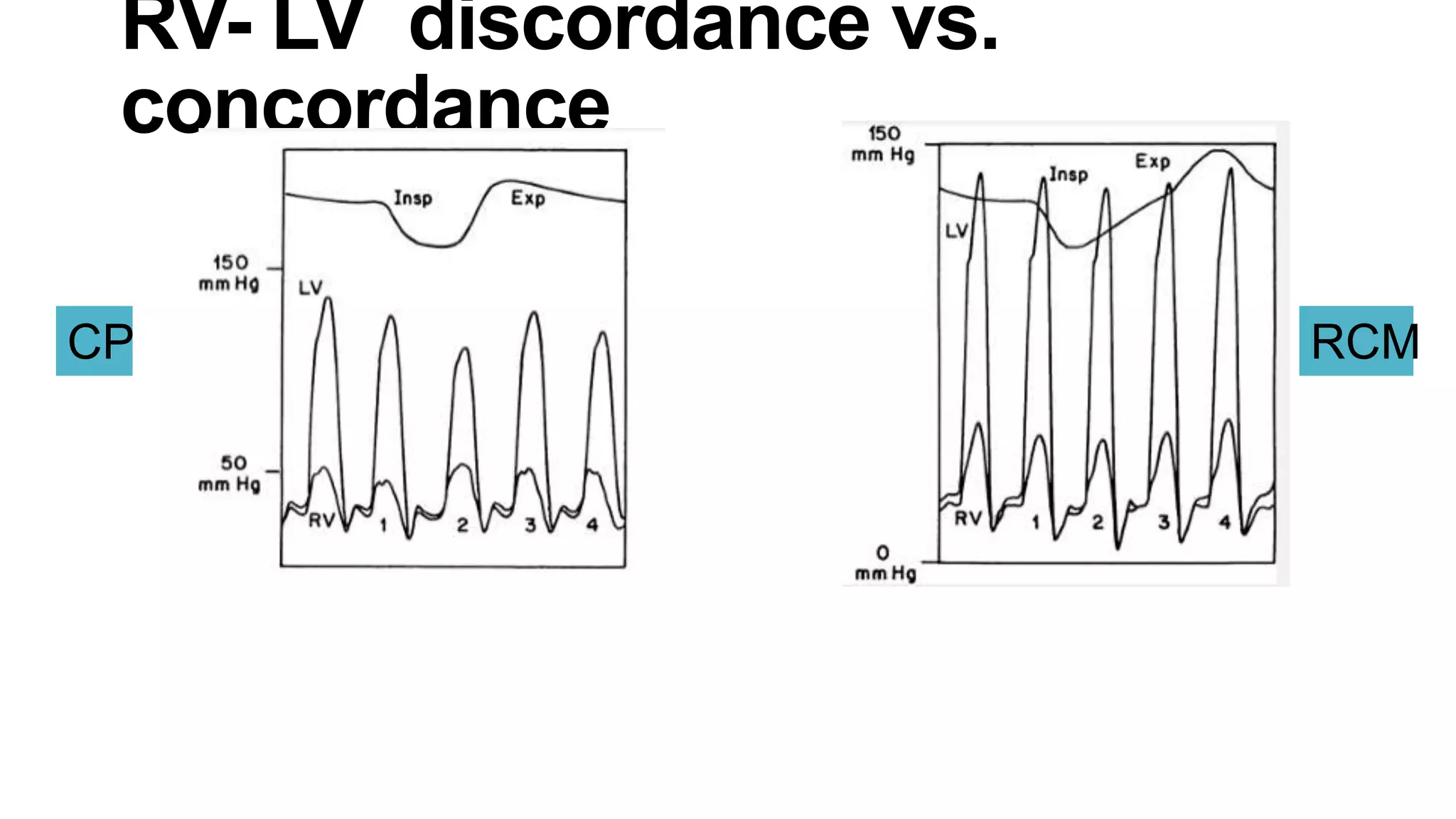
Mirror-image discordance between RV and peak LV systolic pressures during inspiration,
another sign of increased ventricular interdependence
 During peak inspiration, an increase in RV pressure occurs when LV pressure is lowest
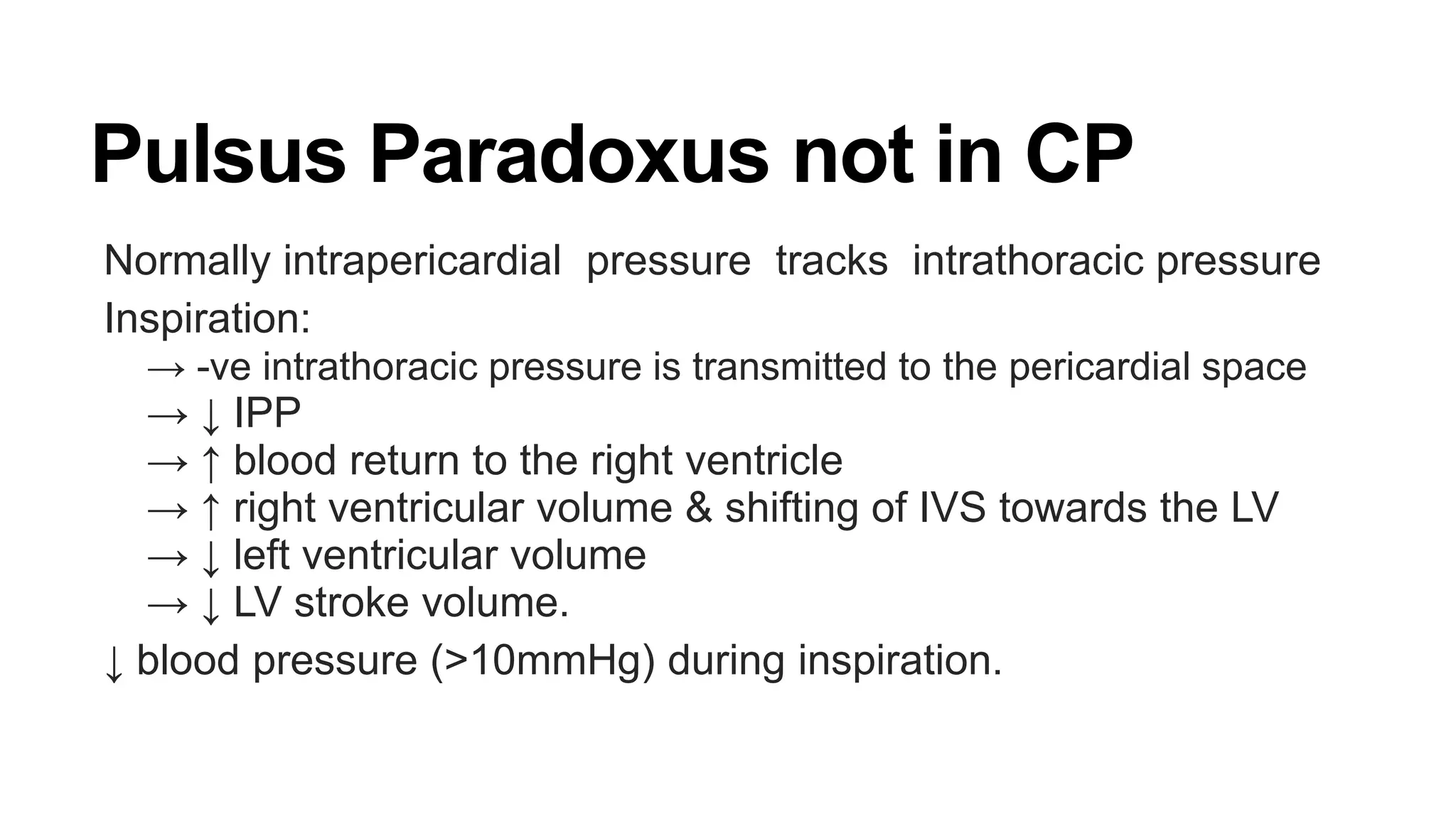
Pulsus Paradoxus not in CP
Normally intrapericardial pressure tracks intrathoracic pressure
Inspiration:
→ -ve intrathoracic pressure is transmitted to the pericardial space
→ ↓ IPP
→ ↑ blood return to the right ventricle
→ ↑ right ventricular volume & shifting of IVS towards the LV
→ ↓ left ventricular volume
→ ↓ LV stroke volume.
↓ blood pressure (>10mmHg) during inspiration.
Kussumal’s sign +ve in CP
Kussumal’s Sign is no reduction of mean
column height JVP in inspiration
RV fills only in early diastole irrespective of
respiratory phase
Because no communication between
pericardial space and intra thoracic pressure
change
CT vs. CP
Clinical
M-Mode: Constriction
Septum-
Abnormal Rapid
movements- notching in
early diastole.
Post LV wall-
Abrupt postr motion in early
diastole and flat in remaining
diastole
IVC and hepatic vein
dilatation
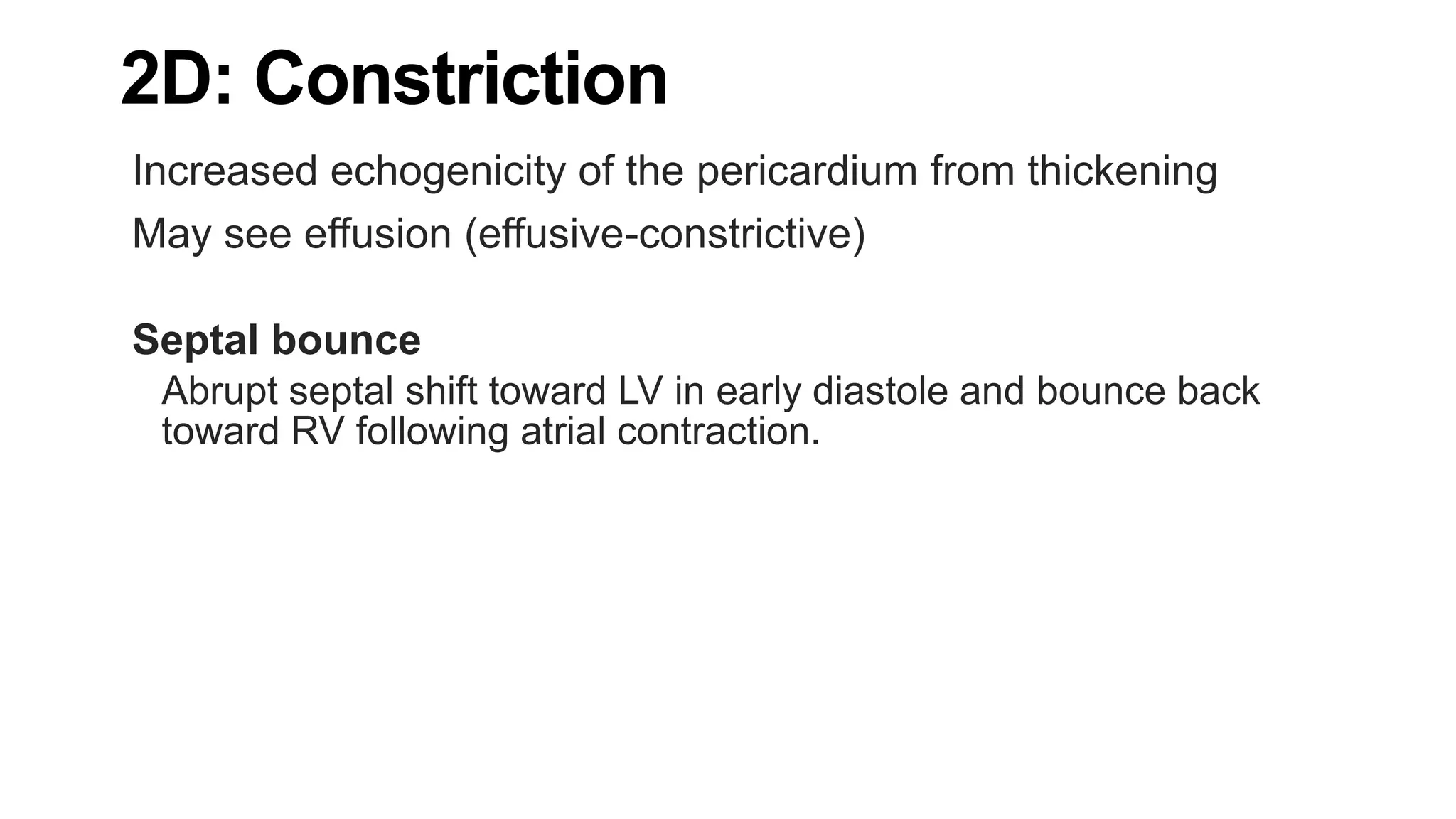
2D: Constriction
Increased echogenicity of the pericardium from thickening
May see effusion (effusive-constrictive)
Septal bounce
Abrupt septal shift toward LV in early diastole and bounce back
toward RV following atrial contraction.
Echo Doppler- mitral inflow:
Constriction
1. RV and LV inflow show
prominent E wave due to
rapid early diastolic filling
2. Short deceleration time of E
wave as filling abruptly stops
3. Small A wave as little filling
occurs in late diastole
following atrial contraction
4. E/A ratio >1.5:1
5. DT<160ms
6. IVRT: <60ms
Echo Doppler- mitral inflow: RCM
Early disease E<A.
Late disease: E>A
Constant IVRT
Respiratory Mitral Inflow velocity
IN CP:
Mitral peak E velocity >25 %
increase in exp.
IN RCM:
velocity varies by <10%.
Tissue Doppler of mitral annulus
Constrictictive pericarditis:
Annular paradox:
E’ increases as severity of CP increase[as increased filing pressure]
Peak E’ ≥ 8 cm/s
89% senstive for constriction
100% specific.
RCM:
E’ decreases as severity ↑
E’< 8 cm/s.
Respiratory Mitral Inflow & TD of mitral
annulus
HV diastolic flow reversal:CP vs
RCM
VS
Pulmonary Venous flow
Right Heart Catheterization
Equalization of pressures
< 5 mm hg difference between
mean RA, RV diastolic, PA
diastolic, PCWP, LV diastolic and
pericardial pressures in CP.
Diagnostic for CP (also seen in
tamponade).
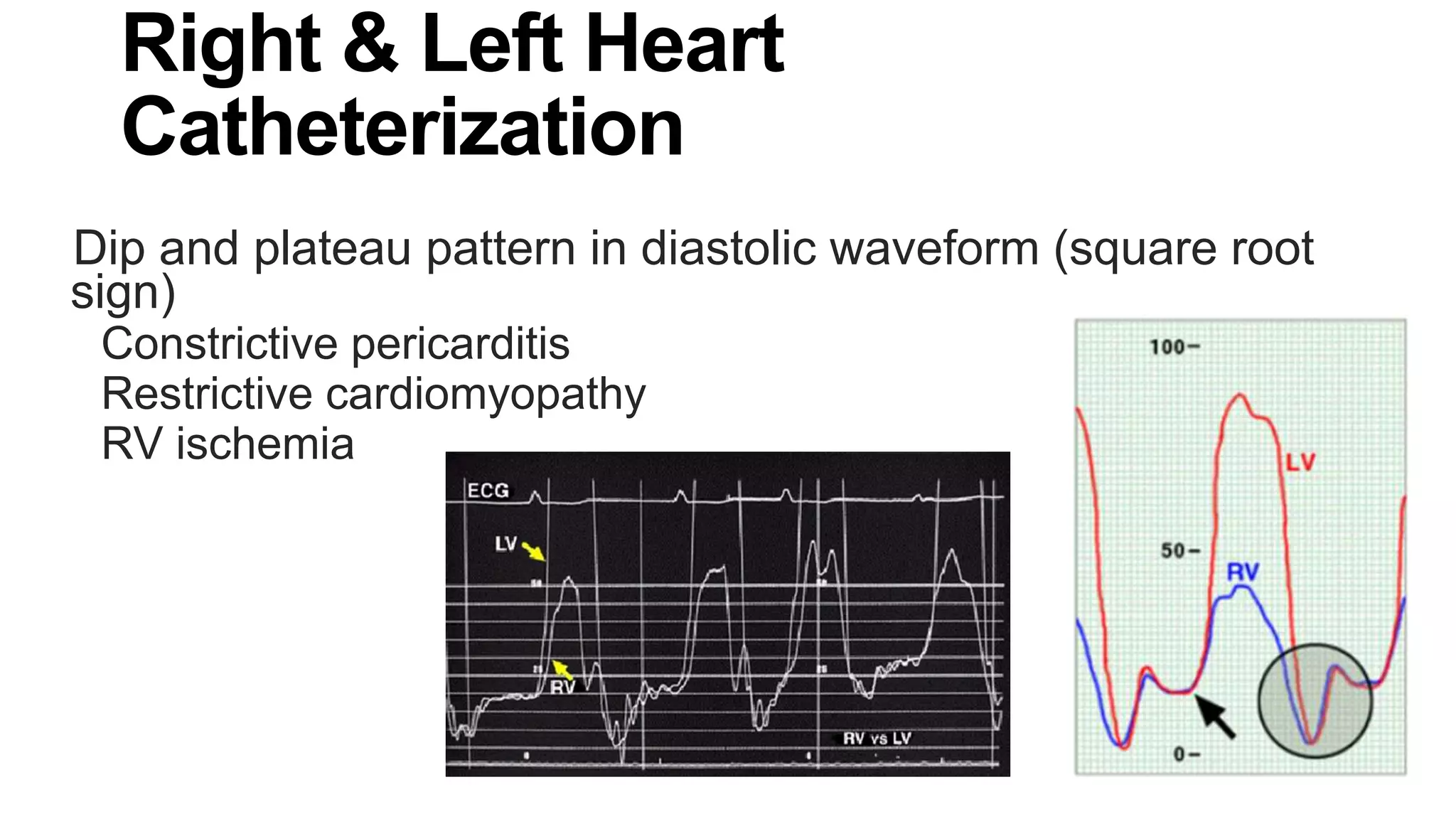
Right & Left Heart
Catheterization
Dip and plateau pattern in diastolic waveform (square root
sign)
Constrictive pericarditis
Restrictive cardiomyopathy
RV ischemia
Right & Left Heart
Catheterization
RVSP < 35-45 mm
Hg
RVEDP / RVSP >
1/3
LVEDP-RVEDP < 5
• PASP = RVSP very high(>55 - 60 mm
Hg)
• RVEDP / RVSP < 1/3
• LVEDP-RVEDP > 3-5 mm Hg
CP RCM
RV- LV discordance vs.
concordance
CP RCM
Conclude with some comparison
Pericardium failed to relax

Constrictive pericarditis

  • 1.
  • 2.
    Pathology  Pericardium  Thickened> 5mm by CT  Scarred  Loss of elasticity
  • 3.
    No thickening 28% -CTscan 18% -Histopathology Ref:Talreja et al,circulation,2003
  • 4.
    Effusive-constrictive pericarditis Constrictive pericarditis Cardiactamponade  JVP remain elevated despite lowering of the pericardial pressure to near zero with peri- cardiocentesis  Rapid y descent appears  No inspiratory decline in RAP  Thickened ,scarred and consequent loss of the normal elasticity of the pericardial sac  Typically chronic  Variants  Subacute  Transient  occult constriction  Acute  Subacute  Accumulation of pericardial fluid under pressure  Variants  Low pressure (occult)  Regional tamponade
  • 5.
    What went wrong Normalpericardium Pericardium in constriction The normal pericardium can stretch to accommodate physiologic changes in cardiac volume  Keep up with intra thoracic pressure Inelastic, resulting in minimal ability to adapt to volume changes Cardiac filling is impeded by an external force(constriction)  Pathophysiologic  Entry and exit of external volume is handled by enhanced ventricular interdependence= exaggerated coupling  Pericardial space has no communication with intra thoracic pressure change
  • 6.
    A little more Normalpericardium Constriction With a normal pericardium, intrathoracic pressure decreases during inspiration, leading to an increase in venous return to the right heart and transient increase in right ventricular chamber size. Because the normal pericardium accommodates the increased venous return by expanding, this increase in venous return does not impair left ventricular filling or influences to bare minimum  Upper limit of cardiac volume is constrained  Intrathoracic pressure is not transmitted to the heart chambers  Pericardium does not expand to accommodate increased venous return to the right heart during inspiration  PCWP fall but not LVEP in inspiration, leading to a reduction in LV volume  Ventricular filling thrives on interdependence  Compression does not occur until the cardiac volume approximates that of the pericardium, which begins in mid-diastole  Early diastolic filling is even more rapid than normal  Ventricular filling occurs in early diastole with little or no filling subsequently  Stroke volumes are reduced
  • 7.
    Tuberculosis is themost common cause in INDIA Idiopathic or viral – 42 to 49 percent Post-cardiac surgery – 11 to 37 percent Post-radiation therapy – 9 to 31 percent, primarily after Hodgkin disease or breast cancer Connective tissue disorder – 3 to 7 percent Postinfectious (tuberculous or purulent pericarditis) – 3 to 6 percent Miscellaneous causes (malignancy, trauma, drug-induced, asbestosis, sarcoidosis, uremic pericarditis) – 1 to 10 percent Idiopathic/viral – 0.76 cases per 1000 person-years Connective tissue/pericardial injury syndrome – 4.40 cases per 1000 person-years Neoplastic pericarditis – 6.33 cases per 1000 person-years Tuberculous pericarditis – 31.65 cases per 1000 person-years Purulent pericarditis – 52.75 cases per 1000 person-years
  • 8.
  • 9.
  • 10.
    You know allof them The " a " wave corresponds to right Atrial contraction and ends synchronously with the carotid artery pulse. The peak of the 'a' wave demarcates the end of atrial systole. The " c " wave corresponds to right ventricular Contraction causing the tricuspid valve to bulge towards the right atrium. The " x " descent follows the 'a' wave and corresponds to atrial relaxation and rapid atrial filling due to low pressure. The " x' " (x prime) descent follows the 'c' wave and occurs as a result of the right ventricle pulling the tricuspid valve downward during ventricular systole. (As stroke volume is ejected, the ventricle takes up less space in pericardium, allowing relaxed atrium to enlarge). The x' (x prime) descent can be used as a measure of right ventricle contractility. The " v " wave corresponds to Venous filling when the tricuspid valve is closed and venous pressure increases from venous return - this occurs during and following the carotid pulse. The " y " descent corresponds to the rapid emptying of the atrium into the ventricle following the opening of the tricuspid valve.
  • 11.
    How does normalpericardium response? Rapid vs slow accumulation
  • 12.
    Transmural pressure gradient (TPG) Normalpericardial pressure is -5 to +5 mmHg RVEDP or LVEDP minus intra-pericardial pressure=TPG Normal Transmural pressure gradient is zero Negative in Tamponade Positive in CP
  • 13.
  • 14.
    Features…… Increased right atrialpressure Prominent x and y descents of venous in atrial pressure tracings Kussumal's sign Increased RV end-diastolic pressure, usually to a level one-third or more of RV systolic pressure "Square root" signs in the RV and LV diastolic pressure tracings A greater inspiratory fall in pulmonary capillary wedge pressure compared to left ventricular diastolic pressure Equalization of LV and RV diastolic plateau pressure tracings, with little separation with exercise, since filling, and therefore diastolic pressure, in both ventricles is constrained by the inelastic pericardium Mirror-image discordance between RV and peak LV systolic pressures during inspiration, another sign of increased ventricular interdependence  During peak inspiration, an increase in RV pressure occurs when LV pressure is lowest
  • 15.
    Pulsus Paradoxus notin CP Normally intrapericardial pressure tracks intrathoracic pressure Inspiration: → -ve intrathoracic pressure is transmitted to the pericardial space → ↓ IPP → ↑ blood return to the right ventricle → ↑ right ventricular volume & shifting of IVS towards the LV → ↓ left ventricular volume → ↓ LV stroke volume. ↓ blood pressure (>10mmHg) during inspiration.
  • 16.
    Kussumal’s sign +vein CP Kussumal’s Sign is no reduction of mean column height JVP in inspiration RV fills only in early diastole irrespective of respiratory phase Because no communication between pericardial space and intra thoracic pressure change
  • 17.
  • 18.
  • 19.
    M-Mode: Constriction Septum- Abnormal Rapid movements-notching in early diastole. Post LV wall- Abrupt postr motion in early diastole and flat in remaining diastole IVC and hepatic vein dilatation
  • 20.
    2D: Constriction Increased echogenicityof the pericardium from thickening May see effusion (effusive-constrictive) Septal bounce Abrupt septal shift toward LV in early diastole and bounce back toward RV following atrial contraction.
  • 21.
    Echo Doppler- mitralinflow: Constriction 1. RV and LV inflow show prominent E wave due to rapid early diastolic filling 2. Short deceleration time of E wave as filling abruptly stops 3. Small A wave as little filling occurs in late diastole following atrial contraction 4. E/A ratio >1.5:1 5. DT<160ms 6. IVRT: <60ms
  • 22.
    Echo Doppler- mitralinflow: RCM Early disease E<A. Late disease: E>A Constant IVRT
  • 23.
    Respiratory Mitral Inflowvelocity IN CP: Mitral peak E velocity >25 % increase in exp. IN RCM: velocity varies by <10%.
  • 24.
    Tissue Doppler ofmitral annulus Constrictictive pericarditis: Annular paradox: E’ increases as severity of CP increase[as increased filing pressure] Peak E’ ≥ 8 cm/s 89% senstive for constriction 100% specific. RCM: E’ decreases as severity ↑ E’< 8 cm/s.
  • 25.
    Respiratory Mitral Inflow& TD of mitral annulus
  • 26.
    HV diastolic flowreversal:CP vs RCM VS
  • 27.
  • 28.
    Right Heart Catheterization Equalizationof pressures < 5 mm hg difference between mean RA, RV diastolic, PA diastolic, PCWP, LV diastolic and pericardial pressures in CP. Diagnostic for CP (also seen in tamponade).
  • 29.
    Right & LeftHeart Catheterization Dip and plateau pattern in diastolic waveform (square root sign) Constrictive pericarditis Restrictive cardiomyopathy RV ischemia
  • 30.
    Right & LeftHeart Catheterization RVSP < 35-45 mm Hg RVEDP / RVSP > 1/3 LVEDP-RVEDP < 5 • PASP = RVSP very high(>55 - 60 mm Hg) • RVEDP / RVSP < 1/3 • LVEDP-RVEDP > 3-5 mm Hg CP RCM
  • 31.
    RV- LV discordancevs. concordance CP RCM
  • 32.
  • 33.

Editor's Notes

  • #16 The second characteristic hemodynamic finding is the paradoxical pulse, an abnormally large decline in systemic arterial pressure during inspiration (usually defined as a drop of &gt;10 mm Hg in systolic pressure).Other causes of pulsusparadoxus include CP, PE and pulmonary disease with large variations in intrathoracic pressure (tension pneumothorax, ac. sev. Asthma). In severe tamponade, the arterial pulse is impalpable during inspiration. The mechanism of the paradoxical pulse is multifactorial, but respiratory changes in systemic venous return are certainly important.In tamponade, in contrast to constriction, the normal inspiratory increase in systemic venous return is retained. Therefore, the normal decline in systemic venous pressure on inspiration is present (and Kussmaul sign is absent). The increase in right-sided heart filling occurs, once again, under conditions in which total heart volume is fixed and left-sided heart volume is markedly reduced to start. The IVS shifts to the left in exaggerated fashion on inspiration, encroaching on the LV such that its stroke volume and pressure generation are further reduced. Although the inspiratory increase in right-sided heart volume (preload) causes an increase in RV stroke volume, this requires several cardiac cycles to increase LV filling and stroke volume and to counteract the septal shift. Other factors that may contribute to the paradoxical pulse include increased afterload caused by transmission of negative intrathoracic pressure to the aorta and traction on the pericardium caused by descent of the diaphragm, which increases pericardial pressure. Associated with these mechanisms are the striking findings that left- and right-sided heart pressure and stroke volume variations are exaggerated and 180 degrees out of phase
  • #22 Otto. Textbook of Clinical Echocardiography, 3rd Edition, 2004.
  • #23 Otto. Textbook of Clinical Echocardiography, 3rd Edition, 2004.
  • #24 Feigenbaum’s-Under normal circumstances,peak velocity of mitral inflow varies by 15% or less with respiration and tricuspid inflow by 25% or less. However, up to 20% of ptwith constriction do not exhibit typical respiratory changes, most likely because of markedly increased LA pressure or possibly a mixed constrictive-restrictive pattern due to myocardial involvement by the constrictive process. In patients without typical respiratory mitral-tricuspid flow findings, examination after maneuvers that decrease preload (head-up tilt, sitting) can unmask characteristic respiratory variation in mitral E velocity. Similar patterns of respiratory variation can be observed in COPD, RVinfarction,pul. embolism, and pleural effusion. Superior vena caval flow velocities are helpful in distinguishing CP from COPD. Patients with pulmonary disease display a marked increase in inspiratory superior vena caval systolic forward flow velocity, which is not seen in constriction. (less than 20 cm/sec respiratory variation in superior vena cava systolic velocity)
  • #25 Feigenbaum’s Echocardiography, 7th ed
  • #27 CP:With insp: minimal increase in HV S &amp; D.With exp: decreased diast. Flow &amp; increased reversal.RCM: blunted S/D ratio, increased insp. Reversal of dias flow.
  • #28 RCM:S/D ratio: &lt;0.5.No resp. variation in D.CP:Decreased S &amp; D wave with insp. Opp with exp.
  • #29 Grossman’s cardiac catheterisation, 7thh ed
  • #30 Grossman’s cardiac catheterisation, 7thh ed
  • #31 Grossman’s cardiac catheterisation, 7thh ed
  • #32 Grossman’s cardiac catheterisation, 7th edRespiratory changes in LV and RV pressures measured with micromanometer catheters in a patient with CP (left) and in a patient with RCM (right).Peak inspiration is indicated in beat 2 in each cardiac cycle.In the pt with CP, there is a discordant change in LV and RV syst.pressures during respiration: LV syst. pressure falls to its minimum value during peak inspiration simultaneously with an increase in RV syst. pressure to its highest value in the cardiac cycle. These findings indicate the presence of ventricular interdependence owing to the constricting pericardium, and suggest that as LV filling and stroke volume decreases, there is a corresponding increase in RV filling and stroke volume. In contrast, in the patient with cardiomyopathy (right), there are concordant changes in LV and RV pressures during respiration.
  • #33 Braunwald’s 9th ed.