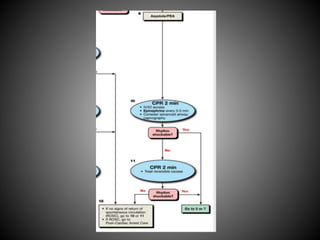
AHA 2010 GUIDELINES
 Defibrillation should take a maximum period of
five seconds, with charging during chest
compressions.
 For tracheal intubation, ten seconds’ hands-off
time for the passage of the tube is the only point
at which compressions are paused.
 Pulse checks are only undertaken where there
are signs suggestive of ROSC.
 In BLS, compression depth has been increased to
between 5 & 6 cm. Studies have shown that a
depth of 4-5 cm, as recommended before, was
inadequate to achieve ROSC.
 The use of feedback technology( separate units
or integrated into defibrillators) promoted, to
assist in the delivery of high-quality
compressions.
 All healthcare providers should be able to provide ventilation with
a bag-mask device during CPR or when the patient
demonstrates cardiorespiratory compromise.
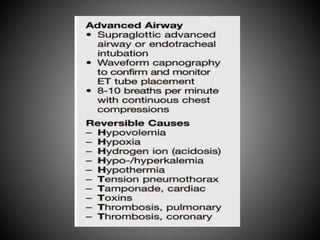
 Airway control with an advanced airway, which may include an
ETT or a supraglottic airway device, is a fundamental ACLS skill.
 Prolonged interruptions in chest compressions should be avoided
during advanced airway placement.
 All providers should be able to confirm and monitor correct
placement of advanced airways.
 Training, frequency of use, and monitoring of success and
complications are more important than the choice of a specific
advanced airway device for use during CPR.
 During CPR, oxygen delivery to the heart and brain is
limited by blood flow rather than by arterial oxygen
content.
 Rescue breaths are less important than chest
compressions during the first few minutes of
resuscitation and could lead to interruption in chest
compressions.
 Increase in intra-thoracic pressure that accompanies
positive pressure ventilation decreases CPR efficacy.
 Advanced airway placement in cardiac arrest should
not delay initial CPR and defibrillation for VF cardiac
arrest
 It is unknown whether 100% inspired oxygen is beneficial
or whether titrated oxygen is better.
 Prolonged exposure to 100% inspired oxygen has potential
toxicity.
 Passive oxygen delivery via mask with an opened airway
during the first 6 minutes of CPR provided by (EMS)
resulted in improved survival.
 In theory, as ventilation requirements are lower during
cardiac arrest, oxygen supplied by passive delivery is likely
to be sufficient for several minutes after onset of cardiac
arrest with a patent upper airway.
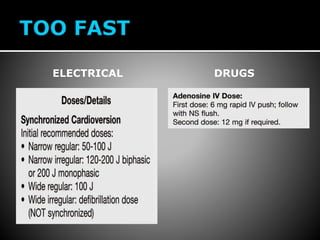
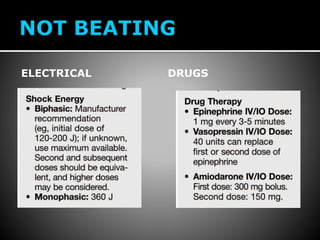
ELECTRICAL DRUGS
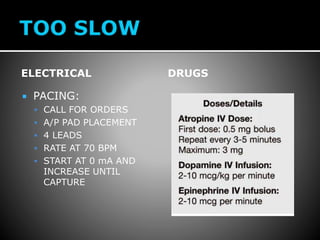
ELECTRICAL
 PACING:
 CALL FOR ORDERS
 A/P PAD PLACEMENT
 4 LEADS
 RATE AT 70 BPM
 START AT 0 mA AND
INCREASE UNTIL
CAPTURE
DRUGS
ELECTRICAL DRUGS
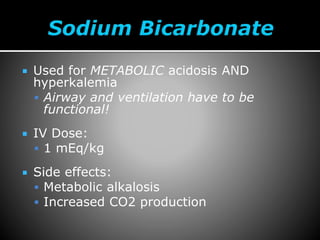
 Used for METABOLIC acidosis AND
hyperkalemia
 Airway and ventilation have to be
functional!
 IV Dose:
 1 mEq/kg
 Side effects:
 Metabolic alkalosis
 Increased CO2 production
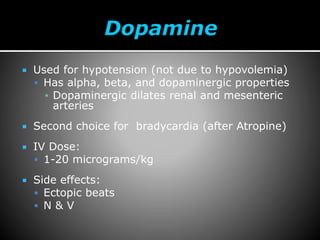
 Used for hypotension (not due to hypovolemia)
 Has alpha, beta, and dopaminergic properties
▪ Dopaminergic dilates renal and mesenteric
arteries
 Second choice for bradycardia (after Atropine)
 IV Dose:
 1-20 micrograms/kg
 Side effects:
 Ectopic beats
 N & V
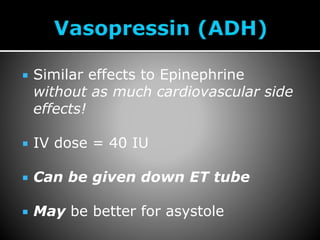
 Similar effects to Epinephrine
without as much cardiovascular side
effects!
 IV dose = 40 IU
 Can be given down ET tube
 May be better for asystole
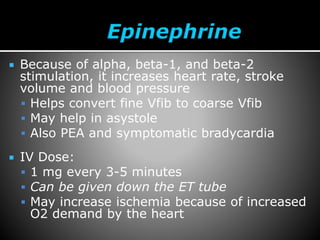
 Because of alpha, beta-1, and beta-2
stimulation, it increases heart rate, stroke
volume and blood pressure
 Helps convert fine Vfib to coarse Vfib
 May help in asystole
 Also PEA and symptomatic bradycardia
 IV Dose:
 1 mg every 3-5 minutes
 Can be given down the ET tube
 May increase ischemia because of increased
O2 demand by the heart
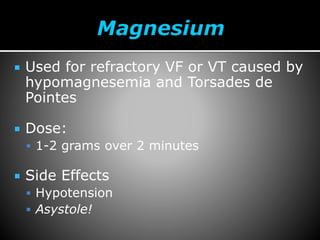
 Used for refractory VF or VT caused by
hypomagnesemia and Torsades de
Pointes
 Dose:
 1-2 grams over 2 minutes
 Side Effects
 Hypotension
 Asystole!
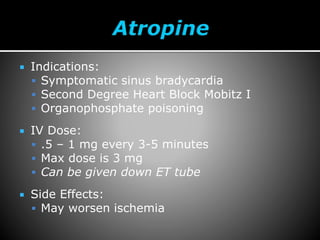
 Indications:
 Symptomatic sinus bradycardia
 Second Degree Heart Block Mobitz I
 Organophosphate poisoning
 IV Dose:
 .5 – 1 mg every 3-5 minutes
 Max dose is 3 mg
 Can be given down ET tube
 Side Effects:
 May worsen ischemia
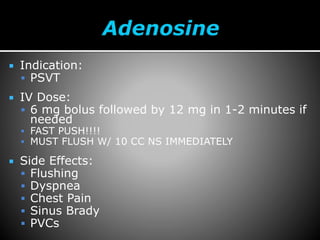
 Indication:
 PSVT
 IV Dose:
 6 mg bolus followed by 12 mg in 1-2 minutes if
needed
 FAST PUSH!!!!
 MUST FLUSH W/ 10 CC NS IMMEDIATELY
 Side Effects:
 Flushing
 Dyspnea
 Chest Pain
 Sinus Brady
 PVCs
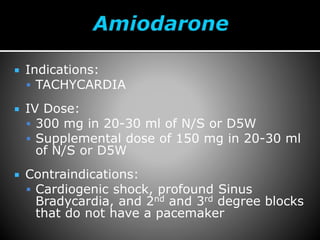
 Indications:
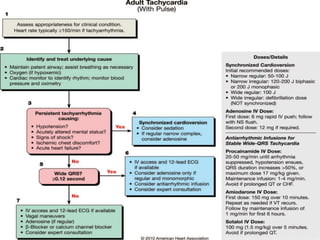
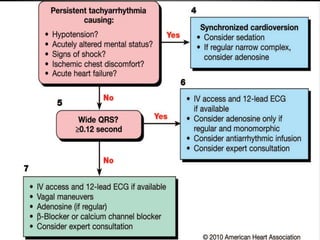
 TACHYCARDIA
 IV Dose:
 300 mg in 20-30 ml of N/S or D5W
 Supplemental dose of 150 mg in 20-30 ml
of N/S or D5W
 Contraindications:
 Cardiogenic shock, profound Sinus
Bradycardia, and 2nd and 3rd degree blocks
that do not have a pacemaker
 Indications:
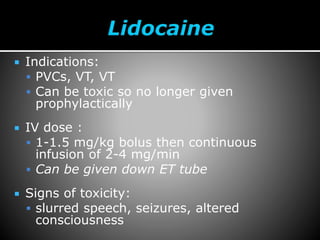
 PVCs, VT, VT
 Can be toxic so no longer given
prophylactically
 IV dose :
 1-1.5 mg/kg bolus then continuous
infusion of 2-4 mg/min
 Can be given down ET tube
 Signs of toxicity:
 slurred speech, seizures, altered
consciousness
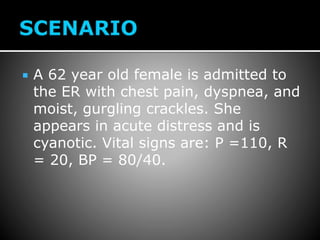
 A 62 year old female is admitted to
the ER with chest pain, dyspnea, and
moist, gurgling crackles. She
appears in acute distress and is
cyanotic. Vital signs are: P =110, R
= 20, BP = 80/40.
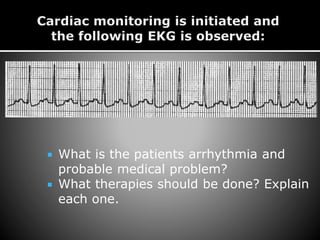
 What is the patients arrhythmia and
probable medical problem?
 What therapies should be done? Explain
each one.
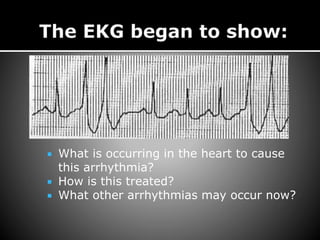
 What is occurring in the heart to cause
this arrhythmia?
 How is this treated?
 What other arrhythmias may occur now?
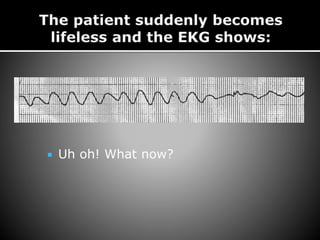
 Uh oh! What now?
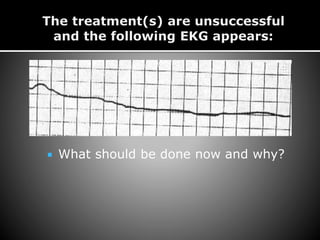
 What should be done now and why?
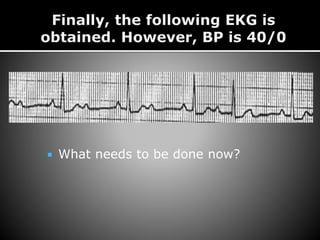
 What needs to be done now?
Acls update class 2015

Acls update class 2015

  • 1.
  • 6.
     Defibrillation shouldtake a maximum period of five seconds, with charging during chest compressions.  For tracheal intubation, ten seconds’ hands-off time for the passage of the tube is the only point at which compressions are paused.  Pulse checks are only undertaken where there are signs suggestive of ROSC.
  • 7.
     In BLS,compression depth has been increased to between 5 & 6 cm. Studies have shown that a depth of 4-5 cm, as recommended before, was inadequate to achieve ROSC.  The use of feedback technology( separate units or integrated into defibrillators) promoted, to assist in the delivery of high-quality compressions.
  • 8.
     All healthcareproviders should be able to provide ventilation with a bag-mask device during CPR or when the patient demonstrates cardiorespiratory compromise.  Airway control with an advanced airway, which may include an ETT or a supraglottic airway device, is a fundamental ACLS skill.  Prolonged interruptions in chest compressions should be avoided during advanced airway placement.  All providers should be able to confirm and monitor correct placement of advanced airways.  Training, frequency of use, and monitoring of success and complications are more important than the choice of a specific advanced airway device for use during CPR.
  • 9.
     During CPR,oxygen delivery to the heart and brain is limited by blood flow rather than by arterial oxygen content.  Rescue breaths are less important than chest compressions during the first few minutes of resuscitation and could lead to interruption in chest compressions.  Increase in intra-thoracic pressure that accompanies positive pressure ventilation decreases CPR efficacy.  Advanced airway placement in cardiac arrest should not delay initial CPR and defibrillation for VF cardiac arrest
  • 10.
     It isunknown whether 100% inspired oxygen is beneficial or whether titrated oxygen is better.  Prolonged exposure to 100% inspired oxygen has potential toxicity.  Passive oxygen delivery via mask with an opened airway during the first 6 minutes of CPR provided by (EMS) resulted in improved survival.  In theory, as ventilation requirements are lower during cardiac arrest, oxygen supplied by passive delivery is likely to be sufficient for several minutes after onset of cardiac arrest with a patent upper airway.
  • 13.
  • 16.
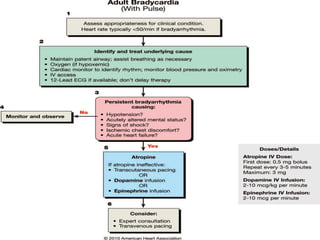
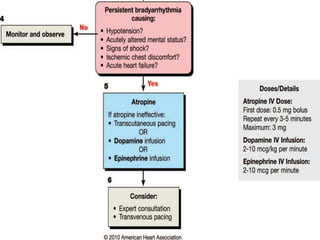
    ELECTRICAL  PACING:  CALLFOR ORDERS  A/P PAD PLACEMENT  4 LEADS  RATE AT 70 BPM  START AT 0 mA AND INCREASE UNTIL CAPTURE DRUGS
  • 19.
  • 26.
     Used forMETABOLIC acidosis AND hyperkalemia  Airway and ventilation have to be functional!  IV Dose:  1 mEq/kg  Side effects:  Metabolic alkalosis  Increased CO2 production
  • 27.
     Used forhypotension (not due to hypovolemia)  Has alpha, beta, and dopaminergic properties ▪ Dopaminergic dilates renal and mesenteric arteries  Second choice for bradycardia (after Atropine)  IV Dose:  1-20 micrograms/kg  Side effects:  Ectopic beats  N & V
  • 28.
     Similar effectsto Epinephrine without as much cardiovascular side effects!  IV dose = 40 IU  Can be given down ET tube  May be better for asystole
  • 29.
     Because ofalpha, beta-1, and beta-2 stimulation, it increases heart rate, stroke volume and blood pressure  Helps convert fine Vfib to coarse Vfib  May help in asystole  Also PEA and symptomatic bradycardia  IV Dose:  1 mg every 3-5 minutes  Can be given down the ET tube  May increase ischemia because of increased O2 demand by the heart
  • 30.
     Used forrefractory VF or VT caused by hypomagnesemia and Torsades de Pointes  Dose:  1-2 grams over 2 minutes  Side Effects  Hypotension  Asystole!
  • 31.
     Indications:  Symptomaticsinus bradycardia  Second Degree Heart Block Mobitz I  Organophosphate poisoning  IV Dose:  .5 – 1 mg every 3-5 minutes  Max dose is 3 mg  Can be given down ET tube  Side Effects:  May worsen ischemia
  • 32.
     Indication:  PSVT IV Dose:  6 mg bolus followed by 12 mg in 1-2 minutes if needed  FAST PUSH!!!!  MUST FLUSH W/ 10 CC NS IMMEDIATELY  Side Effects:  Flushing  Dyspnea  Chest Pain  Sinus Brady  PVCs
  • 33.
     Indications:  TACHYCARDIA IV Dose:  300 mg in 20-30 ml of N/S or D5W  Supplemental dose of 150 mg in 20-30 ml of N/S or D5W  Contraindications:  Cardiogenic shock, profound Sinus Bradycardia, and 2nd and 3rd degree blocks that do not have a pacemaker
  • 34.
     Indications:  PVCs,VT, VT  Can be toxic so no longer given prophylactically  IV dose :  1-1.5 mg/kg bolus then continuous infusion of 2-4 mg/min  Can be given down ET tube  Signs of toxicity:  slurred speech, seizures, altered consciousness
  • 35.
     A 62year old female is admitted to the ER with chest pain, dyspnea, and moist, gurgling crackles. She appears in acute distress and is cyanotic. Vital signs are: P =110, R = 20, BP = 80/40.
  • 36.
     What isthe patients arrhythmia and probable medical problem?  What therapies should be done? Explain each one.
  • 37.
     What isoccurring in the heart to cause this arrhythmia?  How is this treated?  What other arrhythmias may occur now?
  • 38.
     Uh oh!What now?
  • 39.
     What shouldbe done now and why?
  • 40.
     What needsto be done now?