Supraventricular Tachycardia
OUTLINE
• Introduction
• Epidemiology
• Pathophysiology
• Classification
• Clinical Features
• Investigations
• Management
• Specific SVTs
• Conclusion
INTRODUCTION
A tachycardia originating in the following
• Sinus node
• AV node
• Atrial myocardium
• Bundle of His above the bifurcation
Presents with a characteristic narrow QRS complex on ECG with few
exceptions(pre-excitation or aberrant conduction)
• PSVT is characterized by episodes of tachycardia which occur with
abrupt onset & termination
• A subset of SVT
• Includes AVRT, AVNRT & AT(occasionally)
Paroxysmal Supraventricular Tachycardia
EPIDEMIOLOGY
Prevalence of SVT: ~ 2.3 per 1000
Incidence of PSVT: 36 per 100,000 per year
F : M(2:1)
More common in people with underlying structural heart disease,
family history of SVT or Sudden Cardiac death
PATHOPHYSIOLOGY
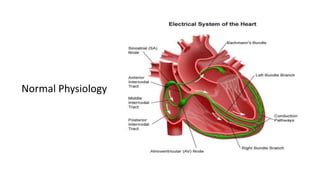
Normal Physiology
Tachyarrhythmias occur as a result of 3 main mechanisms:
 Reentry
 Automaticity
 Enhanced
 Abnormal
 Triggered activity; due to
 Early Afterdepolarizations(EADs)
 Delayed Afterdepolarizations(DADs)
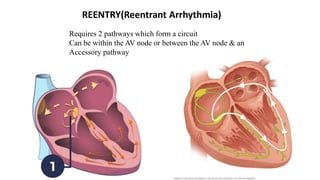
REENTRY(Reentrant Arrhythmia)
Requires 2 pathways which form a circuit
Can be within the AV node or between the AV node & an
Accessory pathway
Automaticity
• Repetitive firing from a single focus, which may either be
ectopic or originate from the SA node
• Enhanced Automaticity: originates in the SAN or other
subsidiary pacemakers
• Abnormal Automaticity; Scar tissue forms foci for ectopic
impulse generation
Triggered Activity
These arrhythmias are produced by early or delayed
afterdepolarizations depending on the timing of the first depolarization
relative to the preceding action potential
EAD - occurs before full repolarization
- Affects patients with Heart failure, prolonged QT syndrome
DAD - Occurs after full repolarization
-Typically in states of high intracellular calcium(digitalis toxicity
Hyperkalemia, Hypercalcemia)
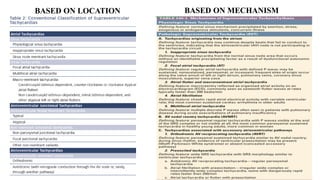
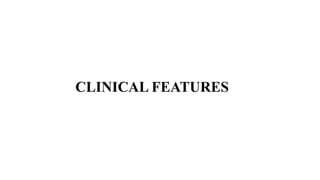
CLASSIFICATION
BASED ON MECHANISM
BASED ON LOCATION
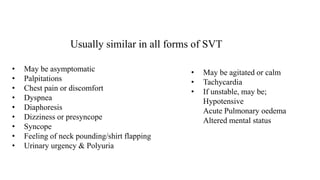
CLINICAL FEATURES
• May be asymptomatic
• Palpitations
• Chest pain or discomfort
• Dyspnea
• Diaphoresis
• Dizziness or presyncope
• Syncope
• Feeling of neck pounding/shirt flapping
• Urinary urgency & Polyuria
• May be agitated or calm
• Tachycardia
• If unstable, may be;
Hypotensive
Acute Pulmonary oedema
Altered mental status
Usually similar in all forms of SVT
INVESTIGATIONS
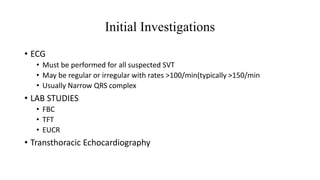
Initial Investigations
• ECG
• Must be performed for all suspected SVT
• May be regular or irregular with rates >100/min(typically >150/min
• Usually Narrow QRS complex
• LAB STUDIES
• FBC
• TFT
• EUCR
• Transthoracic Echocardiography
Additional Investigations
• Prolonged ECG
• 24 hour ambulatory ECG
• Event or Implantable loop recorders
• Electrophysiological study(Gold standard)
• Exercise Tolerance testing; Indicated in pre-excitation
• Cardiac stress testing: Indicated in patients with ASCVD risk factors
MANAGEMENT
PRINCIPLES
1. Stabilize patient & restore sinus rhythm
2. Identify SVT & treat underlying precipitant(if present)
3. Terminate SVT
4. Long term Control
5. Prevention of complications
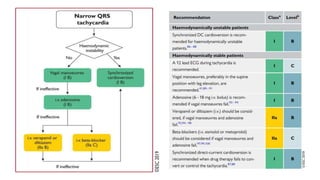
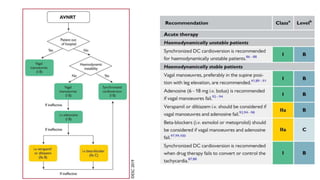
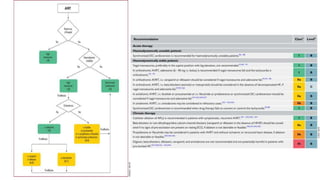
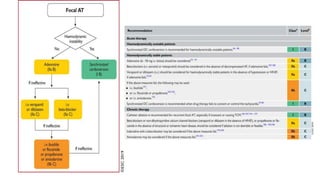
ACUTE MANAGEMENT
Unstable patients
• Synchronized electrical Cardioversion
• May be ineffective for Multifocal AT & Junctional Tachycardia
Stable Patients
• Perform vagal maneuvers
• Reassess Rhythm, then pharmacotherapy
• Irregular(Aflut, AFIB, MAT); Rate or rhythm control
• Regular; Administer IV Adenosine
If still resistant, then administer AV nodal blockers(nDHP CCBs OR BB)
Anti-arrhythmics if still unresponsive
Synchronized Electrical Cardioversion as last resort
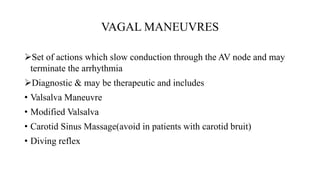
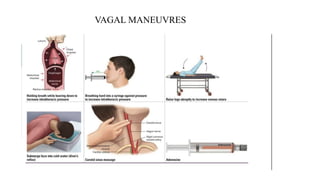
VAGAL MANEUVRES
Set of actions which slow conduction through the AV node and may
terminate the arrhythmia
Diagnostic & may be therapeutic and includes
• Valsalva Maneuvre
• Modified Valsalva
• Carotid Sinus Massage(avoid in patients with carotid bruit)
• Diving reflex
VAGAL MANEUVRES
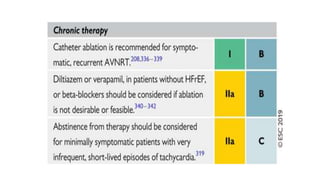
LONG TERM MANAGEMENT
Catheter Ablation(first line)
• Curative in PSVTs
• Symptomatic patients who want to avoid long-term drug therapy(especially
younger patients)
• Asymptomatic patients with special lifestyle considerations(.eg Pilots,
Athletes)
Pharmacotherapy
• Depends on the SVT;
• AV nodal Blocking Agents(nDHP CCBs or BB)
• Antiarrhythmics
Atrioventricular Nodal Reentrant Tachycardia(AVNRT)
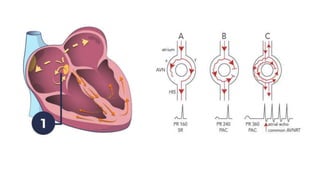
AV node contains 2 pathway, one slow and one fast Impulses circle around the AV
node within both pathways a continuous circuit is formed Tachyarrhythmia
Antegrade conduction across the slow pathway & retrograde conduction across the fast
pathway occurs in over 90% of cases(although the reverse is possible)
ECG findings; May be normal between episodes of tachycardia
• Rate; 150-220/min
• Regular rhythm
• Narrow QRS complex(<120ms)
• P wave typically not visible(buried in QRS complex) or may be seen after QRS complex
as retrograde P waves(pseudo S or R waves)
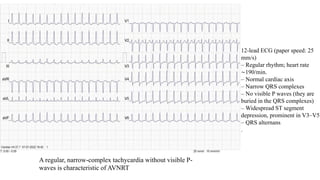
12-lead ECG (paper speed: 25
mm/s)
– Regular rhythm; heart rate
∼190/min.
– Normal cardiac axis
– Narrow QRS complexes
– No visible P waves (they are
buried in the QRS complexes)
– Widespread ST segment
depression, prominent in V3–V5
– QRS alternans
.
A regular, narrow-complex tachycardia without visible P-
waves is characteristic of AVNRT
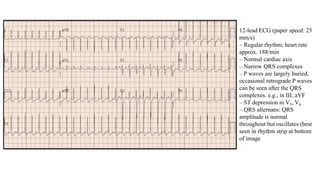
12-lead ECG (paper speed: 25
mm/s)
– Regular rhythm; heart rate
approx. 188/min
– Normal cardiac axis
– Narrow QRS complexes
– P waves are largely buried,
occasional retrograde P waves
can be seen after the QRS
complexes. e.g., in III, aVF
– ST depression in V5, V6
– QRS alternans: QRS
amplitude is normal
throughout but oscillates (best
seen in rhythm strip at bottom
of image
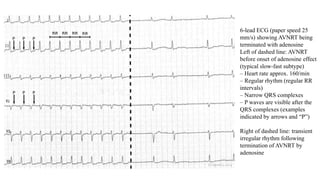
6-lead ECG (paper speed 25
mm/s) showing AVNRT being
terminated with adenosine
Left of dashed line: AVNRT
before onset of adenosine effect
(typical slow-fast subtype)
– Heart rate approx. 160/min
– Regular rhythm (regular RR
intervals)
– Narrow QRS complexes
– P waves are visible after the
QRS complexes (examples
indicated by arrows and “P”)
Right of dashed line: transient
irregular rhythm following
termination of AVNRT by
adenosine
Atrioventricular Reciprocating Tachycardia(AVRT)
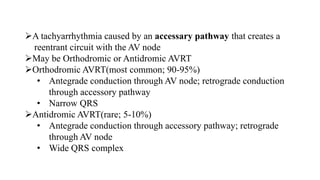
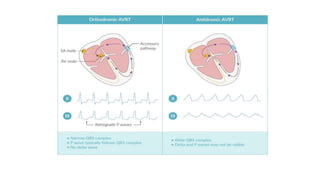
A tachyarrhythmia caused by an accessary pathway that creates a
reentrant circuit with the AV node
May be Orthodromic or Antidromic AVRT
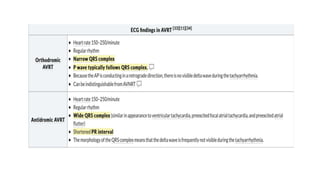
Orthodromic AVRT(most common; 90-95%)
• Antegrade conduction through AV node; retrograde conduction
through accessory pathway
• Narrow QRS
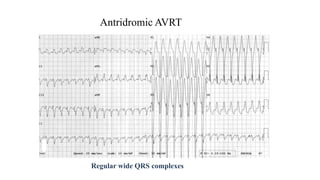
Antidromic AVRT(rare; 5-10%)
• Antegrade conduction through accessory pathway; retrograde
through AV node
• Wide QRS complex
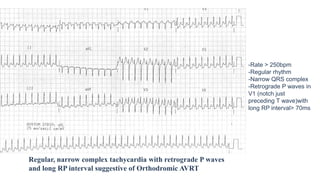
-Rate > 250bpm
-Regular rhythm
-Narrow QRS complex
-Retrograde P waves in
V1 (notch just
preceding T wave)with
long RP interval> 70ms
Regular, narrow complex tachycardia with retrograde P waves
and long RP interval suggestive of Orthodromic AVRT
Antridromic AVRT
Regular wide QRS complexes
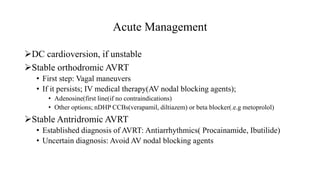
Acute Management
DC cardioversion, if unstable
Stable orthodromic AVRT
• First step: Vagal maneuvers
• If it persists; IV medical therapy(AV nodal blocking agents);
• Adenosine(first line(if no contraindications)
• Other options; nDHP CCBs(verapamil, diltiazem) or beta blocker(.e.g metoprolol)
Stable Antridromic AVRT
• Established diagnosis of AVRT: Antiarrhythmics( Procainamide, Ibutilide)
• Uncertain diagnosis: Avoid AV nodal blocking agents
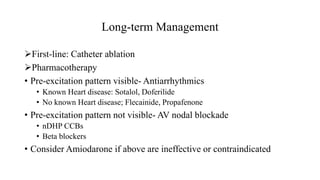
Long-term Management
First-line: Catheter ablation
Pharmacotherapy
• Pre-excitation pattern visible- Antiarrhythmics
• Known Heart disease: Sotalol, Doferilide
• No known Heart disease; Flecainide, Propafenone
• Pre-excitation pattern not visible- AV nodal blockade
• nDHP CCBs
• Beta blockers
• Consider Amiodarone if above are ineffective or contraindicated
Wolff-Parkinson White Syndrome
• A congenital condition characterized by intermittent tachycardias and
signs of ventricular preexcitation on ECG, both of which arise from
an accessory pathway known as the bundle of Kent
• Abnormal connection between atria and ventricles leading
to ventricular preexcitation
• May be associated with structural abnormalities(e.g Ebstein anomaly)
• May be asymptomatic (WPW pattern) or associated
with arrhythmias (WPW syndrome), including:
• AVRT(most common; 80%)
• Atrial fibrillation(15–35%; incidence increases with age)
• Atrial flutter (5%)
• Others (rare): MAT, focal atrial tachycardia, VFIB
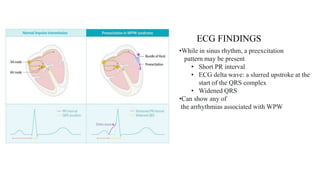
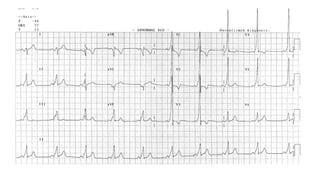
•While in sinus rhythm, a preexcitation
pattern may be present
• Short PR interval
• ECG delta wave: a slurred upstroke at the
start of the QRS complex
• Widened QRS
•Can show any of
the arrhythmias associated with WPW
ECG FINDINGS
 Unstable Patient: DC Cardioversion
 Stable: Assess underlying rhythm.
• Regular NCT (i.e. orthodromic AVRT): vagal maneuvers, Adenosine
• WCT: irregular (e.g., underlying Afib or multifocal AT) OR regular
(underlying Aflut or focal AT)
• Avoid AV nodal blocking agents and vagal maneuvers (may
precipitate Vtach or Vfib)
• Rhythm control measures (i.e., cardioversion or IV procainamide are the safest
treatment option.
Acute Episodes
Long-term Management
Risk stratify based on clinical features, dynamic ECG testing and
Electrophysiologic studies
Catheter ablation(first line)
Pharmacotherapy
• No associated heart disease: Class 1C antiarrhythmic(Flecainide,
Propafenone)
• Known structural heart disease: nDHP CCBs, BBs or Class III
antiarrhythmics(Amiodarone, sotalol)
Focal Atrial Tachycardia
• A supraventricular tachycardia that arises from a localized atrial focus
outside of the SA node
• May be Idiopathic(most common), due to Chronic
conditions(hypertension, cardiomyopathy), Acute conditions(MI,
sepsis) or Drug toxicity(.e.g. Digoxin, Theophylline, Cocaine)
• Different mechanisms including triggered activity, micro-reentry or
enhanced automaticity
• Abrupt in onset and worsened by adrenergic activity
ECG findings
• Heart rate 100–250/minute
• Regular rhythm
• May be 1:1 or 2:1 AV conduction
• P wave
• Typically visible in 2:1 AT
• May be hidden by the QRS complex or T wave in 1:1 AT
• Morphology depends on the site of origin but remains constant.
• An isoelectric baseline is present between P waves
• QRS complex: morphology does not vary
• Narrow complex: most common
• Wide QRS complex may be present in SVT with aberrant conduction
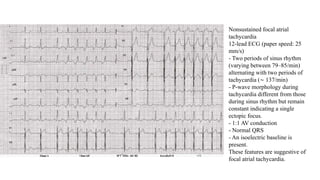
Nonsustained focal atrial
tachycardia
12-lead ECG (paper speed: 25
mm/s)
- Two periods of sinus rhythm
(varying between 79–85/min)
alternating with two periods of
tachycardia (∼ 137/min)
- P-wave morphology during
tachycardia different from those
during sinus rhythm but remain
constant indicating a single
ectopic focus.
- 1:1 AV conduction
- Normal QRS
- An isoelectric baseline is
present.
These features are suggestive of
focal atrial tachycardia.
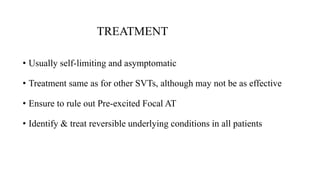
TREATMENT
• Usually self-limiting and asymptomatic
• Treatment same as for other SVTs, although may not be as effective
• Ensure to rule out Pre-excited Focal AT
• Identify & treat reversible underlying conditions in all patients
Multifocal Atrial Tachycardia
An irregular SVT featuring ≥ 3 morphologies of P waves due to
multifocal origins of pacemaker activity
Etiology
• Severe underlying conditions (e.g., heart failure and pulmonary
diseases, such as COPD or pneumonia)
• Drugs (e.g., theophylline, isoproterenol) [52]
• Electrolyte abnormalities (e.g., hypokalemia, hypomagnesemia)
• Others: hypoxia, hypercapnia, acidosis
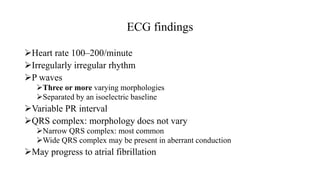
ECG findings
Heart rate 100–200/minute
Irregularly irregular rhythm
P waves
Three or more varying morphologies
Separated by an isoelectric baseline
Variable PR interval
QRS complex: morphology does not vary
Narrow QRS complex: most common
Wide QRS complex may be present in aberrant conduction
May progress to atrial fibrillation
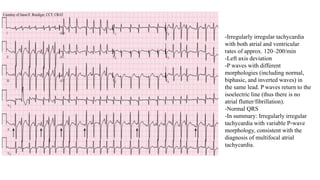
-Irregularly irregular tachycardia
with both atrial and ventricular
rates of approx. 120–200/min
-Left axis deviation
-P waves with different
morphologies (including normal,
biphasic, and inverted waves) in
the same lead. P waves return to the
isoelectric line (thus there is no
atrial flutter/fibrillation).
-Normal QRS
-In summary: Irregularly irregular
tachycardia with variable P-wave
morphology, consistent with the
diagnosis of multifocal atrial
tachycardia.
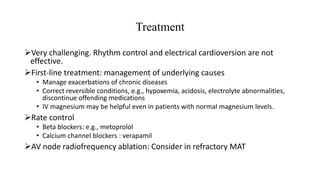
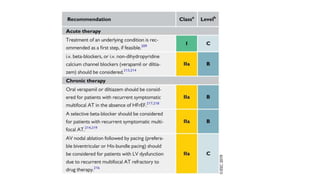
Treatment
Very challenging. Rhythm control and electrical cardioversion are not
effective.
First-line treatment: management of underlying causes
• Manage exacerbations of chronic diseases
• Correct reversible conditions, e.g., hypoxemia, acidosis, electrolyte abnormalities,
discontinue offending medications
• IV magnesium may be helpful even in patients with normal magnesium levels.
Rate control
• Beta blockers: e.g., metoprolol
• Calcium channel blockers : verapamil
AV node radiofrequency ablation: Consider in refractory MAT
Junctional Tachycardia
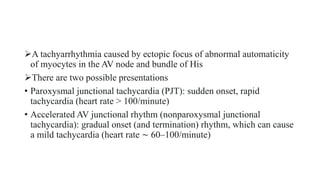
A tachyarrhythmia caused by ectopic focus of abnormal automaticity
of myocytes in the AV node and bundle of His
There are two possible presentations
• Paroxysmal junctional tachycardia (PJT): sudden onset, rapid
tachycardia (heart rate > 100/minute)
• Accelerated AV junctional rhythm (nonparoxysmal junctional
tachycardia): gradual onset (and termination) rhythm, which can cause
a mild tachycardia (heart rate ∼ 60–100/minute)
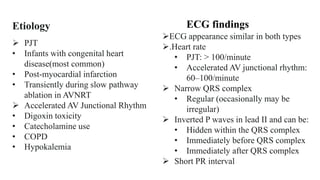
 PJT
• Infants with congenital heart
disease(most common)
• Post-myocardial infarction
• Transiently during slow pathway
ablation in AVNRT
 Accelerated AV Junctional Rhythm
• Digoxin toxicity
• Catecholamine use
• COPD
• Hypokalemia
Etiology
ECG appearance similar in both types
.Heart rate
• PJT: > 100/minute
• Accelerated AV junctional rhythm:
60–100/minute
 Narrow QRS complex
• Regular (occasionally may be
irregular)
 Inverted P waves in lead II and can be:
• Hidden within the QRS complex
• Immediately before QRS complex
• Immediately after QRS complex
 Short PR interval
ECG findings
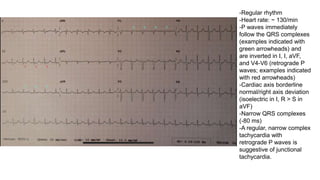
-Regular rhythm
-Heart rate: ~ 130/min
-P waves immediately
follow the QRS complexes
(examples indicated with
green arrowheads) and
are inverted in I, I, aVF,
and V4-V6 (retrograde P
waves; examples indicated
with red arrowheads)
-Cardiac axis borderline
normal/right axis deviation
(isoelectric in I, R > S in
aVF)
-Narrow QRS complexes
(-80 ms)
-A regular, narrow complex
tachycardia with
retrograde P waves is
suggestive of junctional
tachycardia.
Treatment
Acute episodes
• Intravenous pharmacotherapy
• Beta blockers or nDHP CCBs
Long-term management
• Accelerated AV junctional rhythm: Identify and treat the underlying
cause (e.g., digoxin toxicity).
• Paroxysmal junctional tachycardia: medical therapy with AV nodal
blocking agents or Class 1C antiarrhythmics
• Catheter ablation: Consider in selected patients with PJT.
Thank you

SupraventricularTachycardia.pptx

  • 1.
  • 2.
    OUTLINE • Introduction • Epidemiology •Pathophysiology • Classification • Clinical Features • Investigations • Management • Specific SVTs • Conclusion
  • 3.
    INTRODUCTION A tachycardia originatingin the following • Sinus node • AV node • Atrial myocardium • Bundle of His above the bifurcation Presents with a characteristic narrow QRS complex on ECG with few exceptions(pre-excitation or aberrant conduction)
  • 4.
    • PSVT ischaracterized by episodes of tachycardia which occur with abrupt onset & termination • A subset of SVT • Includes AVRT, AVNRT & AT(occasionally) Paroxysmal Supraventricular Tachycardia
  • 5.
    EPIDEMIOLOGY Prevalence of SVT:~ 2.3 per 1000 Incidence of PSVT: 36 per 100,000 per year F : M(2:1) More common in people with underlying structural heart disease, family history of SVT or Sudden Cardiac death
  • 6.
  • 7.
  • 8.
    Tachyarrhythmias occur asa result of 3 main mechanisms:  Reentry  Automaticity  Enhanced  Abnormal  Triggered activity; due to  Early Afterdepolarizations(EADs)  Delayed Afterdepolarizations(DADs)
  • 9.
    REENTRY(Reentrant Arrhythmia) Requires 2pathways which form a circuit Can be within the AV node or between the AV node & an Accessory pathway
  • 10.
    Automaticity • Repetitive firingfrom a single focus, which may either be ectopic or originate from the SA node • Enhanced Automaticity: originates in the SAN or other subsidiary pacemakers • Abnormal Automaticity; Scar tissue forms foci for ectopic impulse generation
  • 11.
    Triggered Activity These arrhythmiasare produced by early or delayed afterdepolarizations depending on the timing of the first depolarization relative to the preceding action potential EAD - occurs before full repolarization - Affects patients with Heart failure, prolonged QT syndrome DAD - Occurs after full repolarization -Typically in states of high intracellular calcium(digitalis toxicity Hyperkalemia, Hypercalcemia)
  • 12.
  • 13.
  • 14.
  • 15.
    • May beasymptomatic • Palpitations • Chest pain or discomfort • Dyspnea • Diaphoresis • Dizziness or presyncope • Syncope • Feeling of neck pounding/shirt flapping • Urinary urgency & Polyuria • May be agitated or calm • Tachycardia • If unstable, may be; Hypotensive Acute Pulmonary oedema Altered mental status Usually similar in all forms of SVT
  • 16.
  • 17.
    Initial Investigations • ECG •Must be performed for all suspected SVT • May be regular or irregular with rates >100/min(typically >150/min • Usually Narrow QRS complex • LAB STUDIES • FBC • TFT • EUCR • Transthoracic Echocardiography
  • 18.
    Additional Investigations • ProlongedECG • 24 hour ambulatory ECG • Event or Implantable loop recorders • Electrophysiological study(Gold standard) • Exercise Tolerance testing; Indicated in pre-excitation • Cardiac stress testing: Indicated in patients with ASCVD risk factors
  • 19.
  • 20.
    PRINCIPLES 1. Stabilize patient& restore sinus rhythm 2. Identify SVT & treat underlying precipitant(if present) 3. Terminate SVT 4. Long term Control 5. Prevention of complications
  • 21.
    ACUTE MANAGEMENT Unstable patients •Synchronized electrical Cardioversion • May be ineffective for Multifocal AT & Junctional Tachycardia Stable Patients • Perform vagal maneuvers • Reassess Rhythm, then pharmacotherapy • Irregular(Aflut, AFIB, MAT); Rate or rhythm control • Regular; Administer IV Adenosine If still resistant, then administer AV nodal blockers(nDHP CCBs OR BB) Anti-arrhythmics if still unresponsive Synchronized Electrical Cardioversion as last resort
  • 22.
    VAGAL MANEUVRES Set ofactions which slow conduction through the AV node and may terminate the arrhythmia Diagnostic & may be therapeutic and includes • Valsalva Maneuvre • Modified Valsalva • Carotid Sinus Massage(avoid in patients with carotid bruit) • Diving reflex
  • 23.
  • 25.
    LONG TERM MANAGEMENT CatheterAblation(first line) • Curative in PSVTs • Symptomatic patients who want to avoid long-term drug therapy(especially younger patients) • Asymptomatic patients with special lifestyle considerations(.eg Pilots, Athletes) Pharmacotherapy • Depends on the SVT; • AV nodal Blocking Agents(nDHP CCBs or BB) • Antiarrhythmics
  • 26.
    Atrioventricular Nodal ReentrantTachycardia(AVNRT) AV node contains 2 pathway, one slow and one fast Impulses circle around the AV node within both pathways a continuous circuit is formed Tachyarrhythmia Antegrade conduction across the slow pathway & retrograde conduction across the fast pathway occurs in over 90% of cases(although the reverse is possible) ECG findings; May be normal between episodes of tachycardia • Rate; 150-220/min • Regular rhythm • Narrow QRS complex(<120ms) • P wave typically not visible(buried in QRS complex) or may be seen after QRS complex as retrograde P waves(pseudo S or R waves)
  • 28.
    12-lead ECG (paperspeed: 25 mm/s) – Regular rhythm; heart rate ∼190/min. – Normal cardiac axis – Narrow QRS complexes – No visible P waves (they are buried in the QRS complexes) – Widespread ST segment depression, prominent in V3–V5 – QRS alternans . A regular, narrow-complex tachycardia without visible P- waves is characteristic of AVNRT
  • 29.
    12-lead ECG (paperspeed: 25 mm/s) – Regular rhythm; heart rate approx. 188/min – Normal cardiac axis – Narrow QRS complexes – P waves are largely buried, occasional retrograde P waves can be seen after the QRS complexes. e.g., in III, aVF – ST depression in V5, V6 – QRS alternans: QRS amplitude is normal throughout but oscillates (best seen in rhythm strip at bottom of image
  • 30.
    6-lead ECG (paperspeed 25 mm/s) showing AVNRT being terminated with adenosine Left of dashed line: AVNRT before onset of adenosine effect (typical slow-fast subtype) – Heart rate approx. 160/min – Regular rhythm (regular RR intervals) – Narrow QRS complexes – P waves are visible after the QRS complexes (examples indicated by arrows and “P”) Right of dashed line: transient irregular rhythm following termination of AVNRT by adenosine
  • 33.
  • 34.
    A tachyarrhythmia causedby an accessary pathway that creates a reentrant circuit with the AV node May be Orthodromic or Antidromic AVRT Orthodromic AVRT(most common; 90-95%) • Antegrade conduction through AV node; retrograde conduction through accessory pathway • Narrow QRS Antidromic AVRT(rare; 5-10%) • Antegrade conduction through accessory pathway; retrograde through AV node • Wide QRS complex
  • 37.
    -Rate > 250bpm -Regularrhythm -Narrow QRS complex -Retrograde P waves in V1 (notch just preceding T wave)with long RP interval> 70ms Regular, narrow complex tachycardia with retrograde P waves and long RP interval suggestive of Orthodromic AVRT
  • 38.
  • 39.
    Acute Management DC cardioversion,if unstable Stable orthodromic AVRT • First step: Vagal maneuvers • If it persists; IV medical therapy(AV nodal blocking agents); • Adenosine(first line(if no contraindications) • Other options; nDHP CCBs(verapamil, diltiazem) or beta blocker(.e.g metoprolol) Stable Antridromic AVRT • Established diagnosis of AVRT: Antiarrhythmics( Procainamide, Ibutilide) • Uncertain diagnosis: Avoid AV nodal blocking agents
  • 40.
    Long-term Management First-line: Catheterablation Pharmacotherapy • Pre-excitation pattern visible- Antiarrhythmics • Known Heart disease: Sotalol, Doferilide • No known Heart disease; Flecainide, Propafenone • Pre-excitation pattern not visible- AV nodal blockade • nDHP CCBs • Beta blockers • Consider Amiodarone if above are ineffective or contraindicated
  • 42.
  • 43.
    • A congenitalcondition characterized by intermittent tachycardias and signs of ventricular preexcitation on ECG, both of which arise from an accessory pathway known as the bundle of Kent • Abnormal connection between atria and ventricles leading to ventricular preexcitation • May be associated with structural abnormalities(e.g Ebstein anomaly) • May be asymptomatic (WPW pattern) or associated with arrhythmias (WPW syndrome), including: • AVRT(most common; 80%) • Atrial fibrillation(15–35%; incidence increases with age) • Atrial flutter (5%) • Others (rare): MAT, focal atrial tachycardia, VFIB
  • 44.
    •While in sinusrhythm, a preexcitation pattern may be present • Short PR interval • ECG delta wave: a slurred upstroke at the start of the QRS complex • Widened QRS •Can show any of the arrhythmias associated with WPW ECG FINDINGS
  • 46.
     Unstable Patient:DC Cardioversion  Stable: Assess underlying rhythm. • Regular NCT (i.e. orthodromic AVRT): vagal maneuvers, Adenosine • WCT: irregular (e.g., underlying Afib or multifocal AT) OR regular (underlying Aflut or focal AT) • Avoid AV nodal blocking agents and vagal maneuvers (may precipitate Vtach or Vfib) • Rhythm control measures (i.e., cardioversion or IV procainamide are the safest treatment option. Acute Episodes
  • 47.
    Long-term Management Risk stratifybased on clinical features, dynamic ECG testing and Electrophysiologic studies Catheter ablation(first line) Pharmacotherapy • No associated heart disease: Class 1C antiarrhythmic(Flecainide, Propafenone) • Known structural heart disease: nDHP CCBs, BBs or Class III antiarrhythmics(Amiodarone, sotalol)
  • 48.
  • 49.
    • A supraventriculartachycardia that arises from a localized atrial focus outside of the SA node • May be Idiopathic(most common), due to Chronic conditions(hypertension, cardiomyopathy), Acute conditions(MI, sepsis) or Drug toxicity(.e.g. Digoxin, Theophylline, Cocaine) • Different mechanisms including triggered activity, micro-reentry or enhanced automaticity • Abrupt in onset and worsened by adrenergic activity
  • 50.
    ECG findings • Heartrate 100–250/minute • Regular rhythm • May be 1:1 or 2:1 AV conduction • P wave • Typically visible in 2:1 AT • May be hidden by the QRS complex or T wave in 1:1 AT • Morphology depends on the site of origin but remains constant. • An isoelectric baseline is present between P waves • QRS complex: morphology does not vary • Narrow complex: most common • Wide QRS complex may be present in SVT with aberrant conduction
  • 51.
    Nonsustained focal atrial tachycardia 12-leadECG (paper speed: 25 mm/s) - Two periods of sinus rhythm (varying between 79–85/min) alternating with two periods of tachycardia (∼ 137/min) - P-wave morphology during tachycardia different from those during sinus rhythm but remain constant indicating a single ectopic focus. - 1:1 AV conduction - Normal QRS - An isoelectric baseline is present. These features are suggestive of focal atrial tachycardia.
  • 52.
    TREATMENT • Usually self-limitingand asymptomatic • Treatment same as for other SVTs, although may not be as effective • Ensure to rule out Pre-excited Focal AT • Identify & treat reversible underlying conditions in all patients
  • 54.
  • 55.
    An irregular SVTfeaturing ≥ 3 morphologies of P waves due to multifocal origins of pacemaker activity Etiology • Severe underlying conditions (e.g., heart failure and pulmonary diseases, such as COPD or pneumonia) • Drugs (e.g., theophylline, isoproterenol) [52] • Electrolyte abnormalities (e.g., hypokalemia, hypomagnesemia) • Others: hypoxia, hypercapnia, acidosis
  • 56.
    ECG findings Heart rate100–200/minute Irregularly irregular rhythm P waves Three or more varying morphologies Separated by an isoelectric baseline Variable PR interval QRS complex: morphology does not vary Narrow QRS complex: most common Wide QRS complex may be present in aberrant conduction May progress to atrial fibrillation
  • 57.
    -Irregularly irregular tachycardia withboth atrial and ventricular rates of approx. 120–200/min -Left axis deviation -P waves with different morphologies (including normal, biphasic, and inverted waves) in the same lead. P waves return to the isoelectric line (thus there is no atrial flutter/fibrillation). -Normal QRS -In summary: Irregularly irregular tachycardia with variable P-wave morphology, consistent with the diagnosis of multifocal atrial tachycardia.
  • 58.
    Treatment Very challenging. Rhythmcontrol and electrical cardioversion are not effective. First-line treatment: management of underlying causes • Manage exacerbations of chronic diseases • Correct reversible conditions, e.g., hypoxemia, acidosis, electrolyte abnormalities, discontinue offending medications • IV magnesium may be helpful even in patients with normal magnesium levels. Rate control • Beta blockers: e.g., metoprolol • Calcium channel blockers : verapamil AV node radiofrequency ablation: Consider in refractory MAT
  • 60.
  • 61.
    A tachyarrhythmia causedby ectopic focus of abnormal automaticity of myocytes in the AV node and bundle of His There are two possible presentations • Paroxysmal junctional tachycardia (PJT): sudden onset, rapid tachycardia (heart rate > 100/minute) • Accelerated AV junctional rhythm (nonparoxysmal junctional tachycardia): gradual onset (and termination) rhythm, which can cause a mild tachycardia (heart rate ∼ 60–100/minute)
  • 62.
     PJT • Infantswith congenital heart disease(most common) • Post-myocardial infarction • Transiently during slow pathway ablation in AVNRT  Accelerated AV Junctional Rhythm • Digoxin toxicity • Catecholamine use • COPD • Hypokalemia Etiology ECG appearance similar in both types .Heart rate • PJT: > 100/minute • Accelerated AV junctional rhythm: 60–100/minute  Narrow QRS complex • Regular (occasionally may be irregular)  Inverted P waves in lead II and can be: • Hidden within the QRS complex • Immediately before QRS complex • Immediately after QRS complex  Short PR interval ECG findings
  • 63.
    -Regular rhythm -Heart rate:~ 130/min -P waves immediately follow the QRS complexes (examples indicated with green arrowheads) and are inverted in I, I, aVF, and V4-V6 (retrograde P waves; examples indicated with red arrowheads) -Cardiac axis borderline normal/right axis deviation (isoelectric in I, R > S in aVF) -Narrow QRS complexes (-80 ms) -A regular, narrow complex tachycardia with retrograde P waves is suggestive of junctional tachycardia.
  • 64.
    Treatment Acute episodes • Intravenouspharmacotherapy • Beta blockers or nDHP CCBs Long-term management • Accelerated AV junctional rhythm: Identify and treat the underlying cause (e.g., digoxin toxicity). • Paroxysmal junctional tachycardia: medical therapy with AV nodal blocking agents or Class 1C antiarrhythmics • Catheter ablation: Consider in selected patients with PJT.
  • 65.