CVS lectures :
Arrhythmia
Professor Ali A. Hadi Al-Saady
University of Al-Ameed / College of Medicine
Department of Medicine
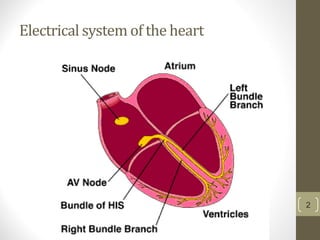
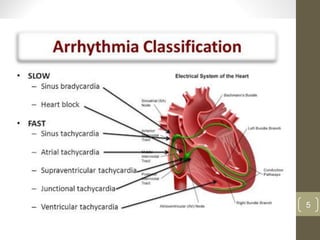
Electrical system of the heart
2
Arrhythmia : abnormal heart rhythm.
• Arrhythmias can cause palpitation, dizziness, syncope,
chest pain or breathlessness, and trigger heart failure
or even sudden death.
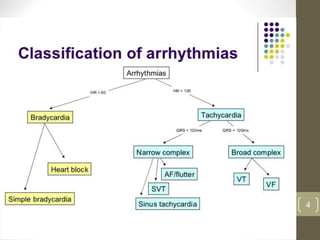
• They are generally classified as either tachycardias
(heart rate > 100/min) or bradycardias (heart rate <
60/min).
● ‘Supraventricular’ (sinus, atrial or junctional)
arrhythmias: usually produce narrow QRS complexes
because the ventricles are depolarised via normal
pathways.
● Ventricular arrhythmias: give rise to broad QRS
complexes because the ventricles are activated in an
abnormal sequence.
3
4
5
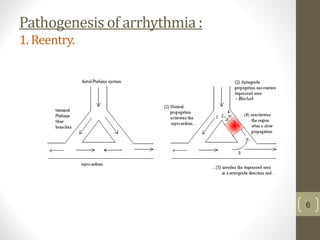
Pathogenesis of arrhythmia :
1. Reentry.
6
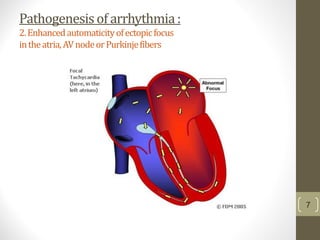
Pathogenesisof arrhythmia:
2.Enhancedautomaticityofectopicfocus
intheatria,AVnodeorPurkinjefibers
7
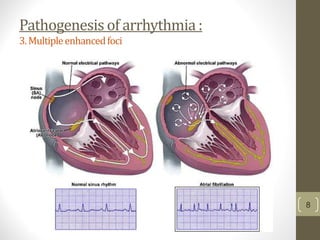
Pathogenesis of arrhythmia :
3.Multipleenhancedfoci
8
Bradyarrhythmias : SA nodal
dysfunction
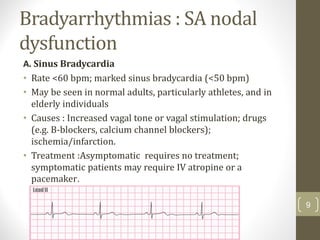
A. Sinus Bradycardia
• Rate <60 bpm; marked sinus bradycardia (<50 bpm)
• May be seen in normal adults, particularly athletes, and in
elderly individuals
• Causes : Increased vagal tone or vagal stimulation; drugs
(e.g. B-blockers, calcium channel blockers);
ischemia/infarction.
• Treatment :Asymptomatic requires no treatment;
symptomatic patients may require IV atropine or a
pacemaker.
9
Sinoatrial disease (sick sinus syndrome)
• Sinoatrial disease results from degeneration of
the sinus node and is common in the elderly.
• It may present with palpitation, dizzy spells or
syncope, due to intermittent tachycardia,
bradycardia, or pauses with no atrial or
ventricular activity (sinus arrest or sinoatrial
block).
• A permanent pacemaker may benefit patients
with symptomatic bradycardias but is not
indicated in asymptomatic patients. 10
AV CONDUCTION BLOCKS
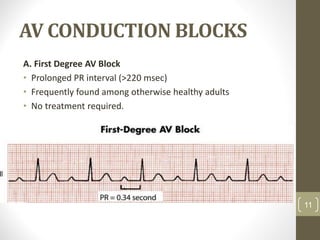
A. First Degree AV Block
• Prolonged PR interval (>220 msec)
• Frequently found among otherwise healthy adults
• No treatment required.
11
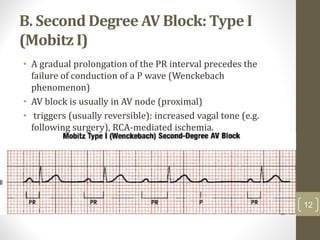
B. Second Degree AV Block: Type I
(Mobitz I)
• A gradual prolongation of the PR interval precedes the
failure of conduction of a P wave (Wenckebach
phenomenon)
• AV block is usually in AV node (proximal)
• triggers (usually reversible): increased vagal tone (e.g.
following surgery), RCA-mediated ischemia.
12
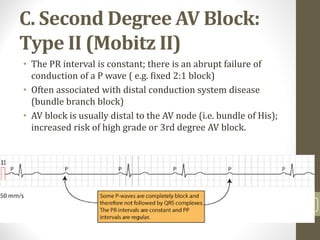
C. Second Degree AV Block:
Type II (Mobitz II)
• The PR interval is constant; there is an abrupt failure of
conduction of a P wave ( e.g. fixed 2:1 block)
• Often associated with distal conduction system disease
(bundle branch block)
• AV block is usually distal to the AV node (i.e. bundle of His);
increased risk of high grade or 3rd degree AV block.
13
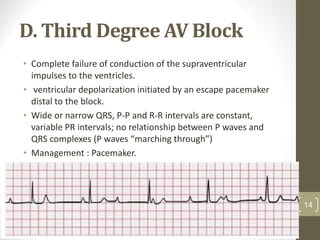
D. Third Degree AV Block
• Complete failure of conduction of the supraventricular
impulses to the ventricles.
• ventricular depolarization initiated by an escape pacemaker
distal to the block.
• Wide or narrow QRS, P-P and R-R intervals are constant,
variable PR intervals; no relationship between P waves and
QRS complexes (P waves “marching through”)
• Management : Pacemaker.
14
Tachyarrhythmias
Presentation for SVT (and Pre-Excitation Syndromes)
• presentation can include: palpitations, dizziness, dyspnea,
chest discomfort, presyncope/syncope
• may precipitate CHF, hypotension, or ischemia ( in patients
with underlying cardiovascular disease) , long term tachycardia
may precipitate cardiomyopathy.
• arrhythmias involving the AV node (AVNRT and AVRT) may
terminate spontaneously, after vagal stimulation, or adenosine
treatment
Supraventricular Tachyarrhythmias
• tachyarrhythmias that originate in the atria or AV junction
• characterized by narrow QRS . 15
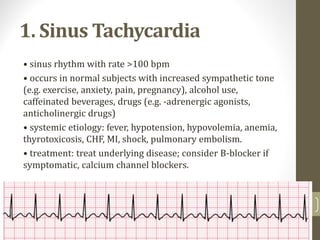
1. Sinus Tachycardia
• sinus rhythm with rate >100 bpm
• occurs in normal subjects with increased sympathetic tone
(e.g. exercise, anxiety, pain, pregnancy), alcohol use,
caffeinated beverages, drugs (e.g. -adrenergic agonists,
anticholinergic drugs)
• systemic etiology: fever, hypotension, hypovolemia, anemia,
thyrotoxicosis, CHF, MI, shock, pulmonary embolism.
• treatment: treat underlying disease; consider B-blocker if
symptomatic, calcium channel blockers.
16
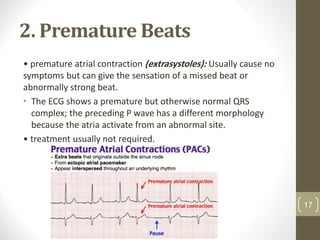
2. Premature Beats
• premature atrial contraction (extrasystoles): Usually cause no
symptoms but can give the sensation of a missed beat or
abnormally strong beat.
• The ECG shows a premature but otherwise normal QRS
complex; the preceding P wave has a different morphology
because the atria activate from an abnormal site.
• treatment usually not required.
17
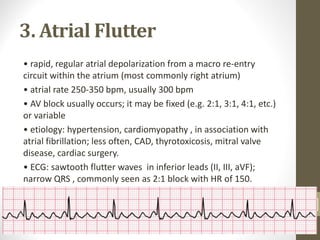
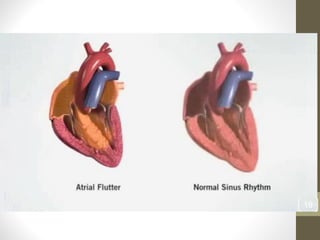
3. Atrial Flutter
• rapid, regular atrial depolarization from a macro re-entry
circuit within the atrium (most commonly right atrium)
• atrial rate 250-350 bpm, usually 300 bpm
• AV block usually occurs; it may be fixed (e.g. 2:1, 3:1, 4:1, etc.)
or variable
• etiology: hypertension, cardiomyopathy , in association with
atrial fibrillation; less often, CAD, thyrotoxicosis, mitral valve
disease, cardiac surgery.
• ECG: sawtooth flutter waves in inferior leads (II, III, aVF);
narrow QRS , commonly seen as 2:1 block with HR of 150.
18
19
Treatment of atrial flutter
Acute :
if unstable (e.g. hypotension, CHF, angina): electrical
cardioversion
if stable:
1. rate control: -blocker, diltiazem, verapamil, or digoxin
2. chemical cardioversion: sotalol, amiodarone, type I
antiarrhythmics, or electrical cardioversion.
- Anticoagulation guidelines same as for patients with AFib
• Treatment of long-term AF : includes antiarrhythmics and
radiofrequency (RF) ablation (success rate dependent on site of
origin of atrial utter)
20
4. Atrial Fibrillation
• Atrial fibrillation (AF) is the most common sustained cardiac
arrhythmia, its prevalence rising with age.
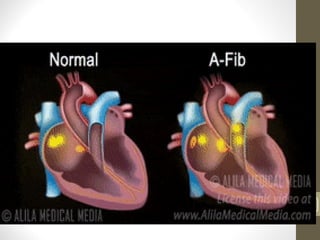
• The atria beat rapidly but in an uncoordinated and ineffective
manner. The ventricles are activated irregularly at a rate
determined by conduction through the AV node, giving rise to
an ‘irregularly irregular’ pulse.
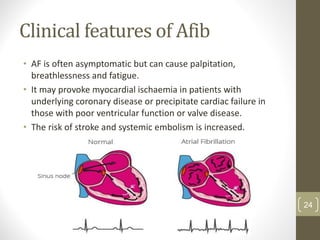
• The ECG shows normal but irregularly spaced QRS complexes
with absent P waves.
• AF can be classified as:
● Paroxysmal (intermittent, self-terminating episodes).
● Persistent (prolonged episodes that can be terminated by
electrical or chemicalcardioversion).
● Permanent.
21
22
Common causes of atrial fibrillation
• Coronary artery disease (including acute MI)
• Valvular heart disease, especially rheumatic mitral valve
disease
• Hypertension
• Sinoatrial disease
• Hyperthyroidism
• Alcohol
• Cardiomyopathy
• Congenital heart disease
• Chest infection
• Pulmonary embolism
• Pericardial disease
• Idiopathic
23
Clinical features of Afib
• AF is often asymptomatic but can cause palpitation,
breathlessness and fatigue.
• It may provoke myocardial ischaemia in patients with
underlying coronary disease or precipitate cardiac failure in
those with poor ventricular function or valve disease.
• The risk of stroke and systemic embolism is increased.
24
Management of A Fib
Primary goal is symptom control
major objectives (RACE): all patients with AFib (paroxysmal,
persistent, or permanent), should be stratified using a predictive
index for stroke risk and for the risk of bleeding, and most
patients should receive either an oral anticoagulant or ASA
1. Rate control: -blockers, diltiazem, verapamil (in patients with
heart failure: digoxin, amiodarone)
2. Anticoagulation: use either warfarin or novel oral
anticoagulant (NOACs) e.g. apixaban, to prevent
thromboembolism
3. Cardioversion (electrical)
4. Etiology : treat underlying cause.
If all fail : Radiofrequency ablation or surgery ( MAZE operation)
25
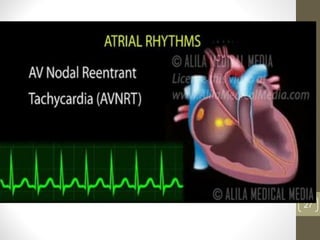
5. AV NODAL RE-ENTRANT
TACHYCARDIA (AVNRT)
• re-entrant circuit using dual pathways (fast conducting -fibers
and slow conducting -fibers) within or near the AV node; often
found in the absence of structural heart disease.
• fast regular rhythm: rate 150-250 bpm
• AVNRT accounts for 60-70% of all paroxysmal SVTs
• retrograde P waves may be seen but are usually lost in the QRS
complex
• treatment
acute: Valsalva maneuver or carotid sinus pressure technique,
adenosine ; if no response, try metoprolol, digoxin, diltiazem,
electricacardioversion if patient hemodynamically unstable
(hypotension, angina, or CHF).
long-term: 1st line – radiofrequency ablation ,B-blocker,
diltiazem, digoxin; 2nd line – Flecainide, propafenone.
26
27
Pre-Excitation Syndromes
• refers to a subset of SVTs mediated by an accessory pathway
which can lead to ventricular pre-excitation.
e.g. Wolff-Parkinson-White Syndrome (WPW)
• congenital defect present in 1.5-2/1000 of the general
population.
• an accessory conduction tract (Bundle of Kent; can be in right
or left atrium) Bypass AV node & abnormally allows early
electrical activation of part of one ventricle.
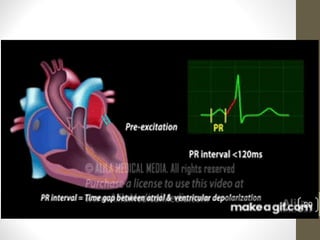
• ECG features of WPW
PR interval <120 msec, delta wave: slurred upstroke of the QRS ,
widening of the QRS complex due to premature activation.
- Tachyarrhythmias may occur – most often AVRT and AFib 28
29
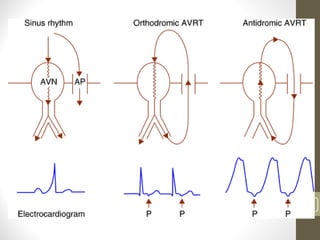
AV Re-Entrant Tachycardia
• re-entrant loop via accessory pathway and normal conduction
system
• orthodromic AVRT: stimulus from a premature complex
travels up the bypass tract (V to A) and down the AV node (A to
V) with narrow QRS complex (no delta wave because stimulus
travels through normal conduction system), e.g. WPW syndrome
• antidromic AVRT: more rarely the stimulus goes up the AV
node (V to A) and down the bypass tract (A to V); wide and
abnormal QRS as ventricular activation is only via the bypass
tract.
• treatment
acute: similar to AVNRT except avoid long-acting AV nodal
blockers (e.g. digoxin and verapamil).
30
31
Ventricular Tachyarrhythmias
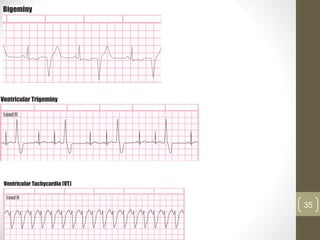
Premature Ventricular Contraction (PVC) or Ventricular
Premature Beat (VPB)
• QRS width >120 msec, no preceding P wave, bizarre QRS
morphology
• origin: LBBB morphology of VT = RV origin; RBBB morphology
of VT = LV origin
• PVCs may be benign but are usually significant in the following
situations:
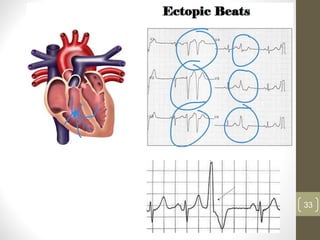
- consecutive (≥ 3 = VT) or multiform (varied origin)
- PVC falling on the T wave of the previous beat (“R on T
phenomenon”): may precipitate ventricular tachycardia or VF
• risk of sustained arrhythmia depends on the clinical situation
(i.e. MI, HF), not the PVCs themselves.
32
33
Ventricular Tachycardia (VT)
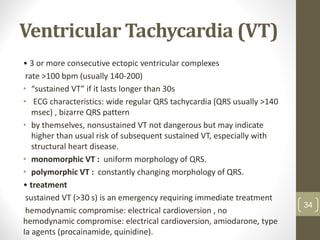
• 3 or more consecutive ectopic ventricular complexes
rate >100 bpm (usually 140-200)
• “sustained VT” if it lasts longer than 30s
• ECG characteristics: wide regular QRS tachycardia (QRS usually >140
msec) , bizarre QRS pattern
• by themselves, nonsustained VT not dangerous but may indicate
higher than usual risk of subsequent sustained VT, especially with
structural heart disease.
• monomorphic VT : uniform morphology of QRS.
• polymorphic VT : constantly changing morphology of QRS.
• treatment
sustained VT (>30 s) is an emergency requiring immediate treatment
hemodynamic compromise: electrical cardioversion , no
hemodynamic compromise: electrical cardioversion, amiodarone, type
Ia agents (procainamide, quinidine).
34
35
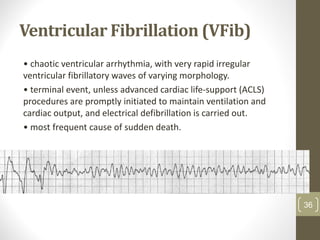
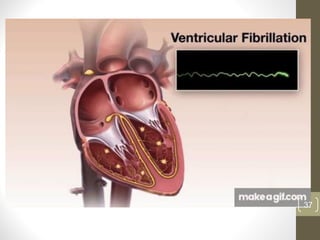
Ventricular Fibrillation (VFib)
• chaotic ventricular arrhythmia, with very rapid irregular
ventricular fibrillatory waves of varying morphology.
• terminal event, unless advanced cardiac life-support (ACLS)
procedures are promptly initiated to maintain ventilation and
cardiac output, and electrical defibrillation is carried out.
• most frequent cause of sudden death.
36
37
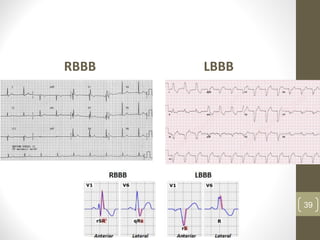
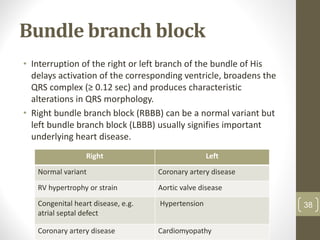
Bundle branch block
• Interruption of the right or left branch of the bundle of His
delays activation of the corresponding ventricle, broadens the
QRS complex (≥ 0.12 sec) and produces characteristic
alterations in QRS morphology.
• Right bundle branch block (RBBB) can be a normal variant but
left bundle branch block (LBBB) usually signifies important
underlying heart disease.
38
Right Left
Normal variant Coronary artery disease
RV hypertrophy or strain Aortic valve disease
Congenital heart disease, e.g.
atrial septal defect
Hypertension
Coronary artery disease Cardiomyopathy
RBBB LBBB
39
Arrhythmia.pdf

Arrhythmia.pdf

  • 1.
    CVS lectures : Arrhythmia ProfessorAli A. Hadi Al-Saady University of Al-Ameed / College of Medicine Department of Medicine
  • 2.
  • 3.
    Arrhythmia : abnormalheart rhythm. • Arrhythmias can cause palpitation, dizziness, syncope, chest pain or breathlessness, and trigger heart failure or even sudden death. • They are generally classified as either tachycardias (heart rate > 100/min) or bradycardias (heart rate < 60/min). ● ‘Supraventricular’ (sinus, atrial or junctional) arrhythmias: usually produce narrow QRS complexes because the ventricles are depolarised via normal pathways. ● Ventricular arrhythmias: give rise to broad QRS complexes because the ventricles are activated in an abnormal sequence. 3
  • 4.
  • 5.
  • 6.
  • 7.
  • 8.
    Pathogenesis of arrhythmia: 3.Multipleenhancedfoci 8
  • 9.
    Bradyarrhythmias : SAnodal dysfunction A. Sinus Bradycardia • Rate <60 bpm; marked sinus bradycardia (<50 bpm) • May be seen in normal adults, particularly athletes, and in elderly individuals • Causes : Increased vagal tone or vagal stimulation; drugs (e.g. B-blockers, calcium channel blockers); ischemia/infarction. • Treatment :Asymptomatic requires no treatment; symptomatic patients may require IV atropine or a pacemaker. 9
  • 10.
    Sinoatrial disease (sicksinus syndrome) • Sinoatrial disease results from degeneration of the sinus node and is common in the elderly. • It may present with palpitation, dizzy spells or syncope, due to intermittent tachycardia, bradycardia, or pauses with no atrial or ventricular activity (sinus arrest or sinoatrial block). • A permanent pacemaker may benefit patients with symptomatic bradycardias but is not indicated in asymptomatic patients. 10
  • 11.
    AV CONDUCTION BLOCKS A.First Degree AV Block • Prolonged PR interval (>220 msec) • Frequently found among otherwise healthy adults • No treatment required. 11
  • 12.
    B. Second DegreeAV Block: Type I (Mobitz I) • A gradual prolongation of the PR interval precedes the failure of conduction of a P wave (Wenckebach phenomenon) • AV block is usually in AV node (proximal) • triggers (usually reversible): increased vagal tone (e.g. following surgery), RCA-mediated ischemia. 12
  • 13.
    C. Second DegreeAV Block: Type II (Mobitz II) • The PR interval is constant; there is an abrupt failure of conduction of a P wave ( e.g. fixed 2:1 block) • Often associated with distal conduction system disease (bundle branch block) • AV block is usually distal to the AV node (i.e. bundle of His); increased risk of high grade or 3rd degree AV block. 13
  • 14.
    D. Third DegreeAV Block • Complete failure of conduction of the supraventricular impulses to the ventricles. • ventricular depolarization initiated by an escape pacemaker distal to the block. • Wide or narrow QRS, P-P and R-R intervals are constant, variable PR intervals; no relationship between P waves and QRS complexes (P waves “marching through”) • Management : Pacemaker. 14
  • 15.
    Tachyarrhythmias Presentation for SVT(and Pre-Excitation Syndromes) • presentation can include: palpitations, dizziness, dyspnea, chest discomfort, presyncope/syncope • may precipitate CHF, hypotension, or ischemia ( in patients with underlying cardiovascular disease) , long term tachycardia may precipitate cardiomyopathy. • arrhythmias involving the AV node (AVNRT and AVRT) may terminate spontaneously, after vagal stimulation, or adenosine treatment Supraventricular Tachyarrhythmias • tachyarrhythmias that originate in the atria or AV junction • characterized by narrow QRS . 15
  • 16.
    1. Sinus Tachycardia •sinus rhythm with rate >100 bpm • occurs in normal subjects with increased sympathetic tone (e.g. exercise, anxiety, pain, pregnancy), alcohol use, caffeinated beverages, drugs (e.g. -adrenergic agonists, anticholinergic drugs) • systemic etiology: fever, hypotension, hypovolemia, anemia, thyrotoxicosis, CHF, MI, shock, pulmonary embolism. • treatment: treat underlying disease; consider B-blocker if symptomatic, calcium channel blockers. 16
  • 17.
    2. Premature Beats •premature atrial contraction (extrasystoles): Usually cause no symptoms but can give the sensation of a missed beat or abnormally strong beat. • The ECG shows a premature but otherwise normal QRS complex; the preceding P wave has a different morphology because the atria activate from an abnormal site. • treatment usually not required. 17
  • 18.
    3. Atrial Flutter •rapid, regular atrial depolarization from a macro re-entry circuit within the atrium (most commonly right atrium) • atrial rate 250-350 bpm, usually 300 bpm • AV block usually occurs; it may be fixed (e.g. 2:1, 3:1, 4:1, etc.) or variable • etiology: hypertension, cardiomyopathy , in association with atrial fibrillation; less often, CAD, thyrotoxicosis, mitral valve disease, cardiac surgery. • ECG: sawtooth flutter waves in inferior leads (II, III, aVF); narrow QRS , commonly seen as 2:1 block with HR of 150. 18
  • 19.
  • 20.
    Treatment of atrialflutter Acute : if unstable (e.g. hypotension, CHF, angina): electrical cardioversion if stable: 1. rate control: -blocker, diltiazem, verapamil, or digoxin 2. chemical cardioversion: sotalol, amiodarone, type I antiarrhythmics, or electrical cardioversion. - Anticoagulation guidelines same as for patients with AFib • Treatment of long-term AF : includes antiarrhythmics and radiofrequency (RF) ablation (success rate dependent on site of origin of atrial utter) 20
  • 21.
    4. Atrial Fibrillation •Atrial fibrillation (AF) is the most common sustained cardiac arrhythmia, its prevalence rising with age. • The atria beat rapidly but in an uncoordinated and ineffective manner. The ventricles are activated irregularly at a rate determined by conduction through the AV node, giving rise to an ‘irregularly irregular’ pulse. • The ECG shows normal but irregularly spaced QRS complexes with absent P waves. • AF can be classified as: ● Paroxysmal (intermittent, self-terminating episodes). ● Persistent (prolonged episodes that can be terminated by electrical or chemicalcardioversion). ● Permanent. 21
  • 22.
  • 23.
    Common causes ofatrial fibrillation • Coronary artery disease (including acute MI) • Valvular heart disease, especially rheumatic mitral valve disease • Hypertension • Sinoatrial disease • Hyperthyroidism • Alcohol • Cardiomyopathy • Congenital heart disease • Chest infection • Pulmonary embolism • Pericardial disease • Idiopathic 23
  • 24.
    Clinical features ofAfib • AF is often asymptomatic but can cause palpitation, breathlessness and fatigue. • It may provoke myocardial ischaemia in patients with underlying coronary disease or precipitate cardiac failure in those with poor ventricular function or valve disease. • The risk of stroke and systemic embolism is increased. 24
  • 25.
    Management of AFib Primary goal is symptom control major objectives (RACE): all patients with AFib (paroxysmal, persistent, or permanent), should be stratified using a predictive index for stroke risk and for the risk of bleeding, and most patients should receive either an oral anticoagulant or ASA 1. Rate control: -blockers, diltiazem, verapamil (in patients with heart failure: digoxin, amiodarone) 2. Anticoagulation: use either warfarin or novel oral anticoagulant (NOACs) e.g. apixaban, to prevent thromboembolism 3. Cardioversion (electrical) 4. Etiology : treat underlying cause. If all fail : Radiofrequency ablation or surgery ( MAZE operation) 25
  • 26.
    5. AV NODALRE-ENTRANT TACHYCARDIA (AVNRT) • re-entrant circuit using dual pathways (fast conducting -fibers and slow conducting -fibers) within or near the AV node; often found in the absence of structural heart disease. • fast regular rhythm: rate 150-250 bpm • AVNRT accounts for 60-70% of all paroxysmal SVTs • retrograde P waves may be seen but are usually lost in the QRS complex • treatment acute: Valsalva maneuver or carotid sinus pressure technique, adenosine ; if no response, try metoprolol, digoxin, diltiazem, electricacardioversion if patient hemodynamically unstable (hypotension, angina, or CHF). long-term: 1st line – radiofrequency ablation ,B-blocker, diltiazem, digoxin; 2nd line – Flecainide, propafenone. 26
  • 27.
  • 28.
    Pre-Excitation Syndromes • refersto a subset of SVTs mediated by an accessory pathway which can lead to ventricular pre-excitation. e.g. Wolff-Parkinson-White Syndrome (WPW) • congenital defect present in 1.5-2/1000 of the general population. • an accessory conduction tract (Bundle of Kent; can be in right or left atrium) Bypass AV node & abnormally allows early electrical activation of part of one ventricle. • ECG features of WPW PR interval <120 msec, delta wave: slurred upstroke of the QRS , widening of the QRS complex due to premature activation. - Tachyarrhythmias may occur – most often AVRT and AFib 28
  • 29.
  • 30.
    AV Re-Entrant Tachycardia •re-entrant loop via accessory pathway and normal conduction system • orthodromic AVRT: stimulus from a premature complex travels up the bypass tract (V to A) and down the AV node (A to V) with narrow QRS complex (no delta wave because stimulus travels through normal conduction system), e.g. WPW syndrome • antidromic AVRT: more rarely the stimulus goes up the AV node (V to A) and down the bypass tract (A to V); wide and abnormal QRS as ventricular activation is only via the bypass tract. • treatment acute: similar to AVNRT except avoid long-acting AV nodal blockers (e.g. digoxin and verapamil). 30
  • 31.
  • 32.
    Ventricular Tachyarrhythmias Premature VentricularContraction (PVC) or Ventricular Premature Beat (VPB) • QRS width >120 msec, no preceding P wave, bizarre QRS morphology • origin: LBBB morphology of VT = RV origin; RBBB morphology of VT = LV origin • PVCs may be benign but are usually significant in the following situations: - consecutive (≥ 3 = VT) or multiform (varied origin) - PVC falling on the T wave of the previous beat (“R on T phenomenon”): may precipitate ventricular tachycardia or VF • risk of sustained arrhythmia depends on the clinical situation (i.e. MI, HF), not the PVCs themselves. 32
  • 33.
  • 34.
    Ventricular Tachycardia (VT) •3 or more consecutive ectopic ventricular complexes rate >100 bpm (usually 140-200) • “sustained VT” if it lasts longer than 30s • ECG characteristics: wide regular QRS tachycardia (QRS usually >140 msec) , bizarre QRS pattern • by themselves, nonsustained VT not dangerous but may indicate higher than usual risk of subsequent sustained VT, especially with structural heart disease. • monomorphic VT : uniform morphology of QRS. • polymorphic VT : constantly changing morphology of QRS. • treatment sustained VT (>30 s) is an emergency requiring immediate treatment hemodynamic compromise: electrical cardioversion , no hemodynamic compromise: electrical cardioversion, amiodarone, type Ia agents (procainamide, quinidine). 34
  • 35.
  • 36.
    Ventricular Fibrillation (VFib) •chaotic ventricular arrhythmia, with very rapid irregular ventricular fibrillatory waves of varying morphology. • terminal event, unless advanced cardiac life-support (ACLS) procedures are promptly initiated to maintain ventilation and cardiac output, and electrical defibrillation is carried out. • most frequent cause of sudden death. 36
  • 37.
  • 38.
    Bundle branch block •Interruption of the right or left branch of the bundle of His delays activation of the corresponding ventricle, broadens the QRS complex (≥ 0.12 sec) and produces characteristic alterations in QRS morphology. • Right bundle branch block (RBBB) can be a normal variant but left bundle branch block (LBBB) usually signifies important underlying heart disease. 38 Right Left Normal variant Coronary artery disease RV hypertrophy or strain Aortic valve disease Congenital heart disease, e.g. atrial septal defect Hypertension Coronary artery disease Cardiomyopathy
  • 39.