Page 1
TACHYARRHYTHMIAS
Dr Kurian
Page 2
Page 3
Cardiac Action potential,
Pacemaker potential
Page 4
Mechanism of Arrhythmia
• Abnormal heart pulse formation
1. Sinus pulse
2. Ectopic pulse
3. Triggered activity
• Abnormal heart pulse conduction
1. Reentry
2. Conduct block
Page 5
REENTRY circuit
• Reentry occurs when a propagating impulse
fails to die after normal activation of the
heart and persists to excite the heart after
expiration of the refractory period.
Page 6
Page 7
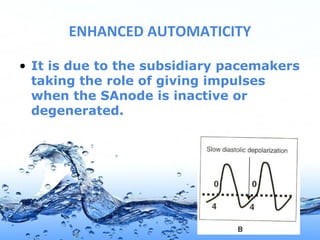
ENHANCED AUTOMATICITY
• It is due to the subsidiary pacemakers
taking the role of giving impulses
when the SAnode is inactive or
degenerated.
Page 8
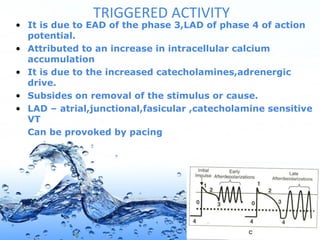
TRIGGERED ACTIVITY
• It is due to EAD of the phase 3,LAD of phase 4 of action
potential.
• Attributed to an increase in intracellular calcium
accumulation
• It is due to the increased catecholamines,adrenergic
drive.
• Subsides on removal of the stimulus or cause.
• LAD – atrial,junctional,fasicular ,catecholamine sensitive
VT
Can be provoked by pacing
Page 9
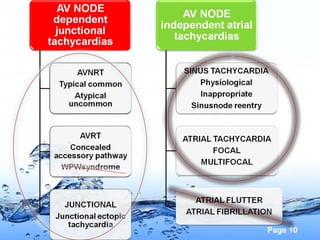
SUPRAVENTRICULAR TACHYCARDIA
• Supraventricular tachycardia is any tachycardia that
originates in the atria or that uses the atrium or AVjunction
and that requires the participation of the tissue above the
bifurcation of the bundle of HIS for propagation as a critical
component of the tachycardia circuit….CRAWFORD
• SVT – include all tachyarrhythmias that either
originate from or incorporate supraventricular tissue
in a reentrant circuit…HURST
Page 10
Page 13
Atrial Tachycardias
Heart's electrical impulse comes from an ectopic
atrial pacemaker rather than from the SA node.
Regular rates ranging from 140–220 bpm.
Automatic
Triggered
Reentrant
Classification
1. Focal – Small area of atrium
2. Macroreentrant - Large reemtrant circuit using
conduction barriers
Page 14
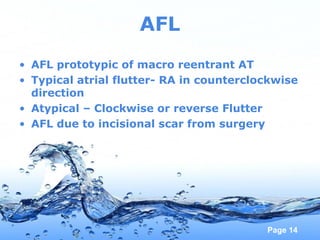
AFL
• AFL prototypic of macro reentrant AT
• Typical atrial flutter- RA in counterclockwise
direction
• Atypical – Clockwise or reverse Flutter
• AFL due to incisional scar from surgery
Page 15
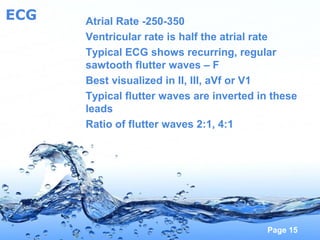
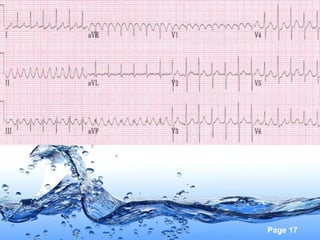
ECG Atrial Rate -250-350
Ventricular rate is half the atrial rate
Typical ECG shows recurring, regular
sawtooth flutter waves – F
Best visualized in II, III, aVf or V1
Typical flutter waves are inverted in these
leads
Ratio of flutter waves 2:1, 4:1
Page 16
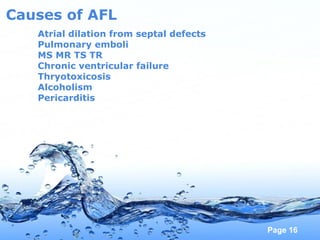
Causes of AFL
Atrial dilation from septal defects
Pulmonary emboli
MS MR TS TR
Chronic ventricular failure
Thryotoxicosis
Alcoholism
Pericarditis
Page 17
Page 18
Management:
Cardioversion – Synchronous DC wt low energies 50j
Ibutilitde IV to convert AFL (sucess rate 60-90%)
To slow ventricular rate
Verapamil bolus 5-10 mg IV then 5mg/min
Diltiazem 0.25 mg/kg
If electrical conversion fails Digitalis can be tried
with CCB or BB
For preventing recurrences
Amiodarone 200mg/day
RF Catherer ablation in refractory
cases – Sucess rate is 90-100%
Risk of Thrombo embolism is
lower than AFs
Page 19
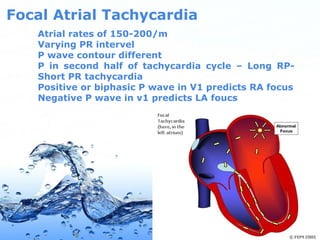
Focal Atrial Tachycardia
Atrial rates of 150-200/m
Varying PR intervel
P wave contour different
P in second half of tachycardia cycle – Long RP-
Short PR tachycardia
Positive or biphasic P wave in V1 predicts RA focus
Negative P wave in v1 predicts LA foucs
Page 20
Focal Atrial Tachycardia
Associated with significant sturctural heart
disease such as CAD, Cor pulmonale
Digitalis toxicity with k depletion
Rx
Digitalis, BB or CCB to slow ventricular rates
If refractory Class 1A, 1C, III drugs can be
added
In digitalis toxicity the drug should be stopped and
digitalis antibodies and potassium be added.
Page 21
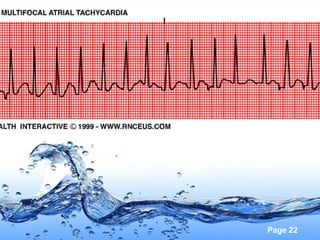
Chaotic Atrial Tachycardia
Aka Multifocal atrial tachycardia(MAT)
At least three different P wave contours noted with
most P waves conducted to ventricles and with
variable PR intervels.
Atrial rate 100-130/m,
Total irrigular PP intervel
Commonly associated with COPD and CCF
Theophylline also implicated
Rx Treat the cause
Verapamil and amiodarone may be
useful
K and Mg may supress tahcycardia
Page 22
Page 23
Page 24
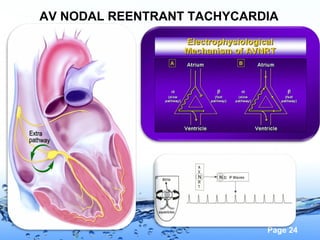
AV NODAL REENTRANT TACHYCARDIA
Page 25
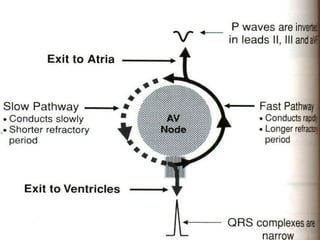
AVNRT
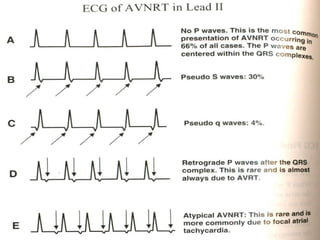
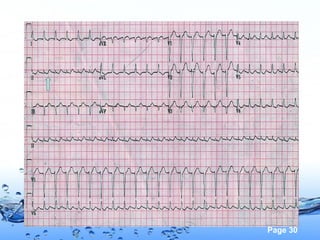
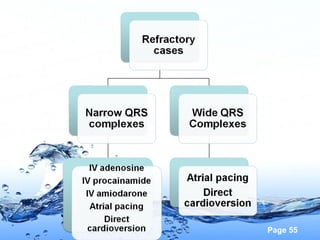
• Presence of a narrow complex tachycardia with
regular R-R intervals and no visible p waves.
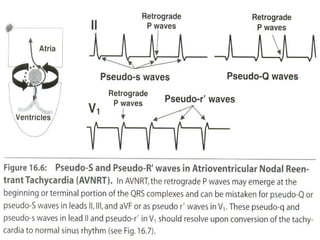
• P waves are retrograde and are inverted in leads
II,III,avf.
• P waves are buried in the QRS complexes –
simultaneous activation of atria and ventricles –
most common presentation of AVNRT –66%.
• If not synchronous –pseudo s wave in inferior
leads ,pseudo r’ wave in lead V1---30% cases .
Page 26
Page 27
Page 28
Page 29
Page 30
Page 31
AVNRT Rx
1st line RX - Vagal maneuvers- Carotid sinus
massage, Valsalva and Muller maneuvers, gagging
and exposure of the face to ice water
Adenosine, Digitalis, CCB and BB depress
conduction in anterogradely conducting slow AVN
pathway
Class 1A and 1C drugs depress retrograde fast
pathway
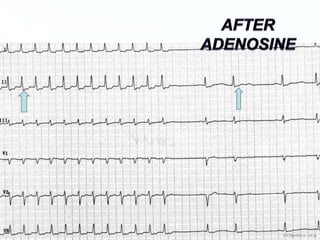
Adenosine 6-12 mg rapid IV 90% sucess rate
Verapamil 5-10 mg iv
Diltiazem .25 -.35mg iv
if DC shocked 10-50 J
RF ablation – 95 % curing long term
Page 32
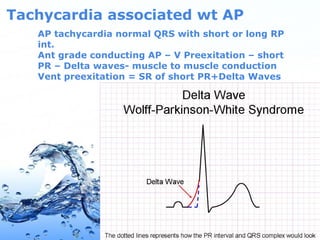
Tachycardia associated wt AP
AP tachycardia normal QRS with short or long RP
int.
Ant grade conducting AP – V Preexitation – short
PR – Delta waves- muscle to muscle conduction
Vent preexitation = SR of short PR+Delta Waves
Page 33
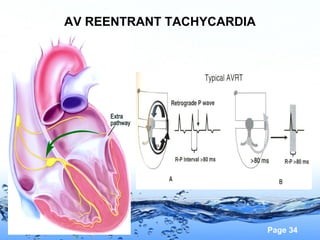
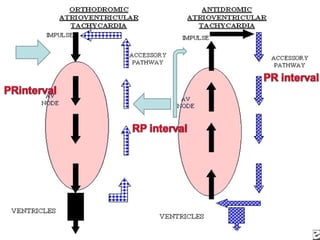
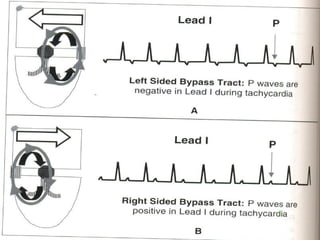
AVRT
• Typical – RP interval < PR interval
• RP interval > 80 milli sec
• Atypical –RP interval > PR interval
• Concealed bypass tract – only retrograde conduction
• Manifest bypass tract– both anterograde and
retrograde.
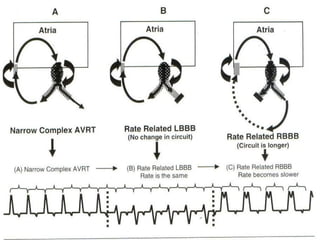
• Electrical alternans –the amplitude of QRS
complexes varies by 5 mm alternatively.
• Rate related BBB occuring and the rate of
tachycardia is decreasing –then the bypass tract is on
the same side of the block.
Page 34
AV REENTRANT TACHYCARDIA
Page 35
Page 36
Page 37
Page 38
Page 39
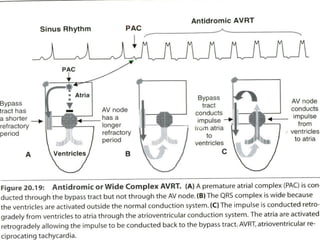
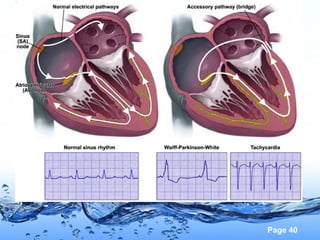
WPW syndrome
• Two types
• Orthodromic
• Antidromic
• Antidromic is wide complex tachycardia
• In NSR detected by delta wave.
• Can ppt into AF and VF on use of AV nodal blockers
• MEMBRANE ACTIVE ANTIARRHTYHMIC DRUGS are
safe.
• CONCEALED WPW syndrome – no delta wave .less
risk of AF
Page 40
Page 41
Page 42
Page 43
Page 44
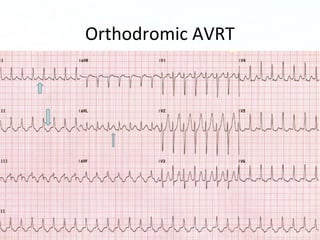
Orthodromic AVRT
Page 45
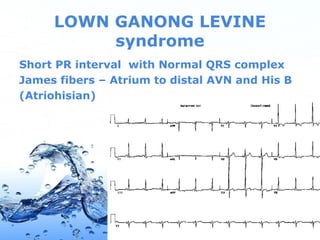
LOWN GANONG LEVINE
syndrome
Short PR interval with Normal QRS complex
James fibers – Atrium to distal AVN and His B
(Atriohisian)
Page 46
AcuteAcute
TreatmeTreatme
ntnt
OfOf
Page 47
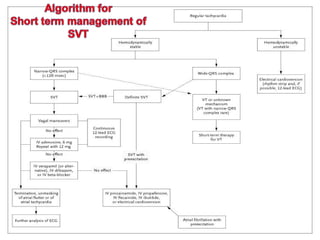
• A 12 lead ECG during tachycardia and NSR.
• No delay in therapy if the mechanism of SVT is not
known.
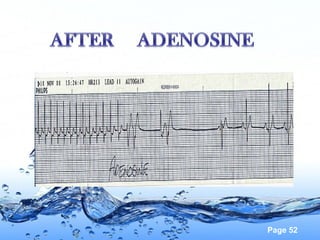
• Perform CAROTID SINUS MASSAGE,or give 6mg
bolus adenosine.
• In case of severe hemodynamic compromise a
synchronised cardioversion to be given.
Page 48
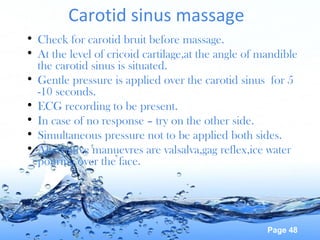
Carotid sinus massage
• Check for carotid bruit before massage.
• At the level of cricoid cartilage,at the angle of mandible
the carotid sinus is situated.
• Gentle pressure is applied over the carotid sinus for 5
-10 seconds.
• ECG recording to be present.
• In case of no response – try on the other side.
• Simultaneous pressure not to be applied both sides.
• Alternative manuevres are valsalva,gag reflex,ice water
pouring over the face.
Page 49
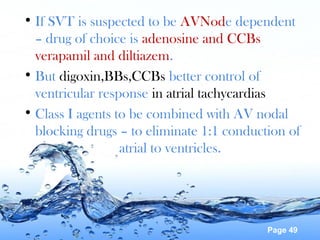
• If SVT is suspected to be AVNode dependent
– drug of choice is adenosine and CCBs
verapamil and diltiazem.
• But digoxin,BBs,CCBs better control of
ventricular response in atrial tachycardias
• Class I agents to be combined with AV nodal
blocking drugs – to eliminate 1:1 conduction of
atrial to ventricles.
Page 50
Page 51
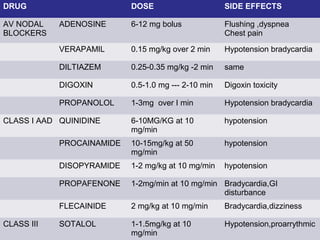
DRUG DOSE SIDE EFFECTS
AV NODAL
BLOCKERS
ADENOSINE 6-12 mg bolus Flushing ,dyspnea
Chest pain
VERAPAMIL 0.15 mg/kg over 2 min Hypotension bradycardia
DILTIAZEM 0.25-0.35 mg/kg -2 min same
DIGOXIN 0.5-1.0 mg --- 2-10 min Digoxin toxicity
PROPANOLOL 1-3mg over I min Hypotension bradycardia
CLASS I AAD QUINIDINE 6-10MG/KG at 10
mg/min
hypotension
PROCAINAMIDE 10-15mg/kg at 50
mg/min
hypotension
DISOPYRAMIDE 1-2 mg/kg at 10 mg/min hypotension
PROPAFENONE 1-2mg/min at 10 mg/min Bradycardia,GI
disturbance
FLECAINIDE 2 mg/kg at 10 mg/min Bradycardia,dizziness
CLASS III SOTALOL 1-1.5mg/kg at 10
mg/min
Hypotension,proarrythmic
Page 52
Page 53
Page 54
Page 55
Page 56
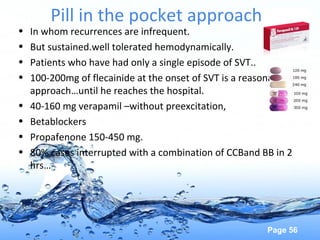
Pill in the pocket approach
• In whom recurrences are infrequent.
• But sustained.well tolerated hemodynamically.
• Patients who have had only a single episode of SVT..
• 100-200mg of flecainide at the onset of SVT is a reasonable
approach…until he reaches the hospital.
• 40-160 mg verapamil –without preexcitation,
• Betablockers
• Propafenone 150-450 mg.
• 80% cases interrupted with a combination of CCBand BB in 2
hrs…
Page 57
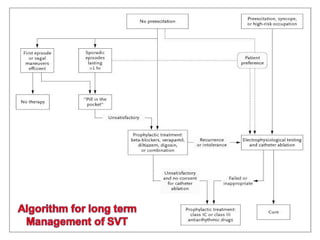
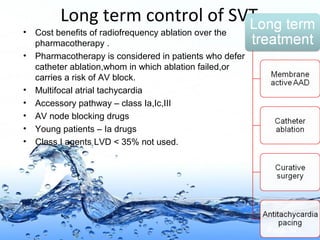
Long term control of SVT
• Cost benefits of radiofrequency ablation over the
pharmacotherapy .
• Pharmacotherapy is considered in patients who defer
catheter ablation,whom in which ablation failed,or
carries a risk of AV block.
• Multifocal atrial tachycardia
• Accessory pathway – class Ia,Ic,III
• AV node blocking drugs
• Young patients – Ia drugs
• Class I agents LVD < 35% not used.
Page 58
Catheter guided Radiofrequency Ablation
• Several multipolar catheters are introduced
• High right atrium ,bundle of his ,RVapex,Coronary
sinus.
• Radiofrequency is delivered at the site of earlier
activation
• Success is defined by elimination of the tachycardia
or loss of pre excitation.
• 90-98% success in AV node dependent
• 60-80% in case of AV node independent.
• Cryoablation more useful…
Page 59
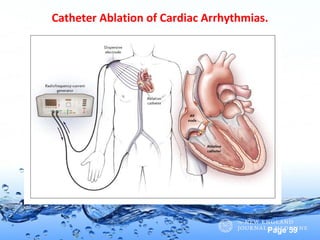
Catheter Ablation of Cardiac Arrhythmias.
Page 60
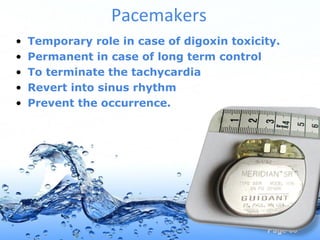
Pacemakers
• Temporary role in case of digoxin toxicity.
• Permanent in case of long term control
• To terminate the tachycardia
• Revert into sinus rhythm
• Prevent the occurrence.
Page 61
VT
Page 62
VT
Most common cause of wide complex tachycardia.(80%)
VT arises distal to bifurcation of His bundle or vent
muscle or both.
Mechanism of impulse formation
1. Triggerd activity
2. Enhanced automaticity
3. Conduction – Reentry
Prognosis depends on any structural heart diseases
ECG- > 3 consecutive PVC
>120 millisec wide QRS
ST-T vector opposite to QRS
AV dissociation/Association if vent
activated retrogradely
Rate 75-250 beats/M
Capture/fusion beats
Page 63
Page 64
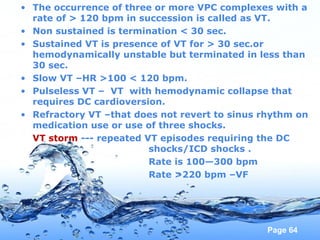
• The occurrence of three or more VPC complexes with a
rate of > 120 bpm in succession is called as VT.
• Non sustained is termination < 30 sec.
• Sustained VT is presence of VT for > 30 sec.or
hemodynamically unstable but terminated in less than
30 sec.
• Slow VT –HR >100 < 120 bpm.
• Pulseless VT – VT with hemodynamic collapse that
requires DC cardioversion.
• Refractory VT –that does not revert to sinus rhythm on
medication use or use of three shocks.
VT storm --- repeated VT episodes requiring the DC
shocks/ICD shocks .
Rate is 100—300 bpm
Rate >220 bpm –VF
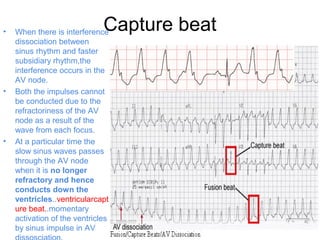
Capture beat• When there is interference
dissociation between
sinus rhythm and faster
subsidiary rhythm,the
interference occurs in the
AV node.
• Both the impulses cannot
be conducted due to the
refractoriness of the AV
node as a result of the
wave from each focus.
• At a particular time the
slow sinus waves passes
through the AV node
when it is no longer
refractory and hence
conducts down the
ventricles..ventricularcapt
ure beat..momentary
activation of the ventricles
by sinus impulse in AV
Page 66
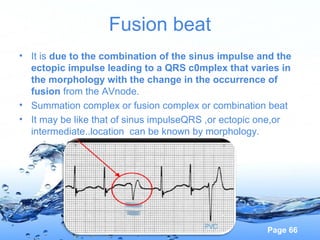
Fusion beat
• It is due to the combination of the sinus impulse and the
ectopic impulse leading to a QRS c0mplex that varies in
the morphology with the change in the occurrence of
fusion from the AVnode.
• Summation complex or fusion complex or combination beat
• It may be like that of sinus impulseQRS ,or ectopic one,or
intermediate..location can be known by morphology.
Page 67
ETIOLOGY
Acute MI
After chronic infarction
Ischaemic heart disease
Dilated cardiomyopathy
Hypertrophic cardiomyopathy
Post CABG
Post TOF surgery
Electrolyte abnormalities
Idiopathic
Specific etiology-- genetic
Page 68
Reversible causes of VT
Hypoxia
Hyperthyroidism
catecholamines
Hypokalemia
Metabolic acidosis
Hypomagenesemia
Hypocalcemia
Drugs
Alcohol
Starvation
Page 69
CLASSIFICATION OF VT
Sustained /non sustained VT
Monomorphic VT/polymorphic VT
Pulseless VT/hemodynamic stable VT
Structural heart disease/idiopathic
Unique VT syndromes
Page 70
Focal
Associated
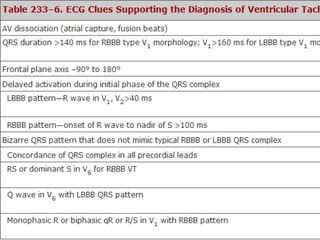
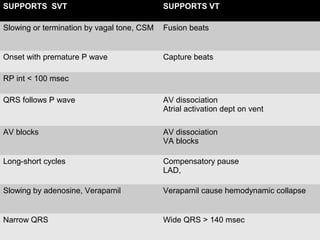
SUPPORTS SVT SUPPORTS VT
Slowing or termination by vagal tone, CSM Fusion beats
Onset with premature P wave Capture beats
RP int < 100 msec
QRS follows P wave AV dissociation
Atrial activation dept on vent
AV blocks AV dissociation
VA blocks
Long-short cycles Compensatory pause
LAD,
Slowing by adenosine, Verapamil Verapamil cause hemodynamic collapse
Narrow QRS Wide QRS > 140 msec
Page 71
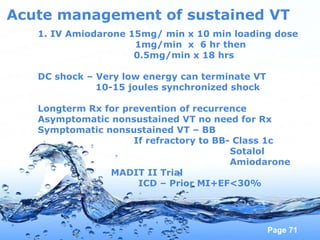
Acute management of sustained VT
1. IV Amiodarone 15mg/ min x 10 min loading dose
1mg/min x 6 hr then
0.5mg/min x 18 hrs
DC shock – Very low energy can terminate VT
10-15 joules synchronized shock
Longterm Rx for prevention of recurrence
Asymptomatic nonsustained VT no need for Rx
Symptomatic nonsustained VT – BB
If refractory to BB- Class 1c
Sotalol
Amiodarone
MADIT II Trial
ICD – Prior MI+EF<30%
Page 72
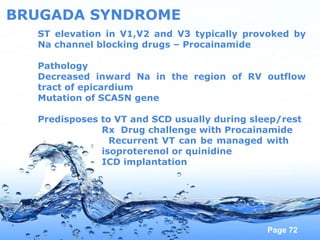
BRUGADA SYNDROME
ST elevation in V1,V2 and V3 typically provoked by
Na channel blocking drugs – Procainamide
Pathology
Decreased inward Na in the region of RV outflow
tract of epicardium
Mutation of SCA5N gene
Predisposes to VT and SCD usually during sleep/rest
Rx Drug challenge with Procainamide
Recurrent VT can be managed with
isoproterenol or quinidine
ICD implantation
Page 73
Torsades de pointes
A type of polymorphic VT characterized by QRS
complex of changing amplitudes that twist around
the isoelectric line @ 200-250 B/M
Characterized by 1. Prolonged vent repolarization
2. QT int> 500msec
3. U wave fused with T wave
Peaks of QRS appear one side then other of
isoelectric line, giving its characteristic twisting
appearance with continuous and progressive
changes in QRS contour and amplitude
Page 74
Torsades De Pointes conti
Commonly Congenital
Associated with 1. Severe bradycardia
2. K depletion
3. Class 1a & III AAD
Rx
IV Magnesium is 1st line of Rx in acquired cause
Followed by temp atrial/Vent pacing
Lidocaine, Mexiletine or phenytoin can be tried
Congenital- BB, Pacing an ICD
Page 75
Long QT syndrome
QTc > 0.46 for men and > 0.47 for Female
Congenital – Inherited channelopathies
Jervell and Lange-Nielsen syn-A.recessive
Romano-ward syn – Auto dominant
Acquired – Quinidine, Procainamide, Sotalol,
Amiodarone, Phenothiazines, TCA, Erythromycin, some
antimalarials
Hypokalemia and hypomagnesmia
Page 76
Long Qt
Valsalva lengths QT
BB in maximum tolerated dose in
1. F/H of early SCD
2. QTC > 500 Msec
3. Asymptomatic pt with Complex VentArrthmia
ICD in pt with syncope wt V Arrthmia
Page 77
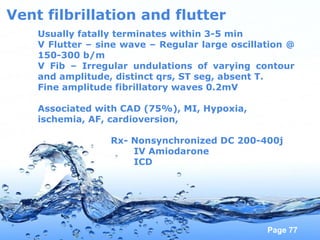
Vent filbrillation and flutter
Usually fatally terminates within 3-5 min
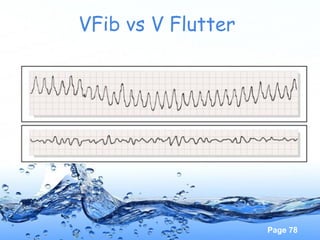
V Flutter – sine wave – Regular large oscillation @
150-300 b/m
V Fib – Irregular undulations of varying contour
and amplitude, distinct qrs, ST seg, absent T.
Fine amplitude fibrillatory waves 0.2mV
Associated with CAD (75%), MI, Hypoxia,
ischemia, AF, cardioversion,
Rx- Nonsynchronized DC 200-400j
IV Amiodarone
ICD
Page 78
VFib vs V Flutter
Page 79
Page 80
THANK YOU
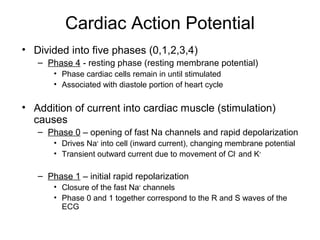
Cardiac Action Potential
• Divided into five phases (0,1,2,3,4)
– Phase 4 - resting phase (resting membrane potential)
• Phase cardiac cells remain in until stimulated
• Associated with diastole portion of heart cycle
• Addition of current into cardiac muscle (stimulation)
causes
– Phase 0 – opening of fast Na channels and rapid depolarization
• Drives Na+
into cell (inward current), changing membrane potential
• Transient outward current due to movement of Cl-
and K+
– Phase 1 – initial rapid repolarization
• Closure of the fast Na+
channels
• Phase 0 and 1 together correspond to the R and S waves of the
ECG
Page 82
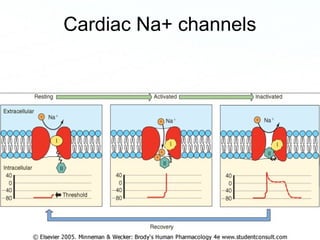
Cardiac Na+ channels
Page 83
Cardiac Action Potential (con’t)
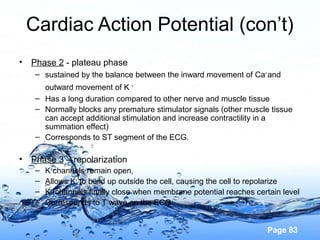
• Phase 2 - plateau phase
– sustained by the balance between the inward movement of Ca+
and
outward movement of K +
– Has a long duration compared to other nerve and muscle tissue
– Normally blocks any premature stimulator signals (other muscle tissue
can accept additional stimulation and increase contractility in a
summation effect)
– Corresponds to ST segment of the ECG.
• Phase 3 – repolarization
– K+
channels remain open,
– Allows K+
to build up outside the cell, causing the cell to repolarize
– K +
channels finally close when membrane potential reaches certain level
– Corresponds to T wave on the ECG
Page 84
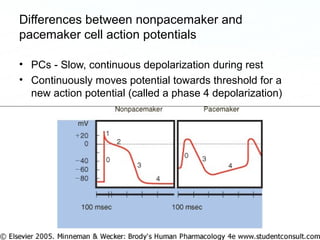
Differences between nonpacemaker and
pacemaker cell action potentials
• PCs - Slow, continuous depolarization during rest
• Continuously moves potential towards threshold for a
new action potential (called a phase 4 depolarization)
Mechanisms of Cardiac Arrhythmias
• Result from disorders of impulse
formation, conduction, or both
• Causes of arrhythmias
– Cardiac ischemia
– Excessive discharge or sensitivity to
autonomic transmitters
– Exposure to toxic substances
– Unknown etiology
Disorders of impulse formation
• No signal from the pacemaker site
• Development of an ectopic pacemaker
– May arise from conduction cells (most are capable of
spontaneous activity)
– Usually under control of SA node  if it slows down too much
conduction cells could become dominant
– Often a result of other injury (ischemia, hypoxia)
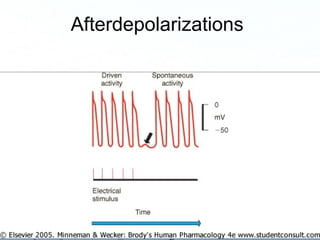
• Development of oscillatory afterdepolariztions
– Can initiate spontaneous activity in nonpacemaker tissue
– May be result of drugs (digitalis, norepinephrine) used to treat
other cardiopathologies
Page 87
Afterdepolarizations
Page 88
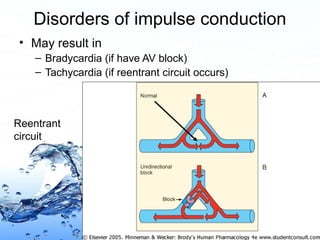
Disorders of impulse conduction
• May result in
– Bradycardia (if have AV block)
– Tachycardia (if reentrant circuit occurs)
Reentrant
circuit
Antiarrhythmic drugs
• Biggest problem – antiarrhythmics can
cause arrhythmia!
– Example: Treatment of a non-life threatening
tachycardia may cause fatal ventricular
arrhythmia
– Must be vigilant in determining dosing, blood
levels, and in follow-up when prescribing
antiarrhythmics
Therapeutic overview
• Na+
channel blockade
• β-adrenergic receptor blockade
• Prolong repolarization
• Ca2+
channel blockade
• Adenosine
• Digitalis glycosides
Classification of antiarrhythmics
(based on mechanisms of action)
• Class I – blocker’s of fast Na+
channels
– Subclass IA
• Cause moderate Phase 0 depression
• Prolong repolarization
• Increased duration of action potential
• Includes
– Quinidine – 1st
antiarrhythmic used, treat both atrial and
ventricular arrhythmias, increases refractory period
– Procainamide - increases refractory period but side
effects
– Disopyramide – extended duration of action, used only
for treating ventricular arrthymias
Classification of antiarrhythmics
(based on mechanisms of action)
– Subclass IB
• Weak Phase 0 depression
• Shortened depolarization
• Decreased action potential duration
• Includes
– Lidocane (also acts as local anesthetic) – blocks Na+
channels mostly in ventricular cells, also good for
digitalis-associated arrhythmias
– Mexiletine - oral lidocaine derivative, similar activity
– Phenytoin – anticonvulsant that also works as
antiarrhythmic similar to lidocane
Classification of antiarrhythmics
(based on mechanisms of action)
– Subclass IC
• Strong Phase 0 depression
• No effect of depolarization
• No effect on action potential duration
• Includes
– Flecainide (initially developed as a local anesthetic)
» Slows conduction in all parts of heart,
» Also inhibits abnormal automaticity
– Propafenone
» Also slows conduction
» Weak β – blocker
» Also some Ca2+
channel blockade
Classification of antiarrhythmics
(based on mechanisms of action)
• Class II – β–adrenergic blockers
– Based on two major actions
1) blockade of myocardial β–adrenergic receptors
2) Direct membrane-stabilizing effects related to Na+
channel blockade
– Includes
• Propranolol
– causes both myocardial β–adrenergic blockade and membrane-
stabilizing effects
– Slows SA node and ectopic pacemaking
– Can block arrhythmias induced by exercise or apprehension
– Other β–adrenergic blockers have similar therapeutic effect
• Metoprolol
• Nadolol
• Atenolol
• Acebutolol
• Pindolol
• Stalol
• Timolol
• Esmolol
Page 95
Classification of antiarrhythmics
(based on mechanisms of action)
• Class III – K+
channel blockers
– Developed because some patients negatively
sensitive to Na channel blockers (they died!)
– Cause delay in repolarization and prolonged
refractory period
– Includes
• Amiodarone – prolongs action potential by delaying K+
efflux
but many other effects characteristic of other classes
• Ibutilide – slows inward movement of Na+
in addition to
delaying K +
influx.
• Bretylium – first developed to treat hypertension but found to
also suppress ventricular fibrillation associated with
myocardial infarction
• Dofetilide - prolongs action potential by delaying K+
efflux with
no other effects
Classification of antiarrhythmics
(based on mechanisms of action)
• Class IV – Ca2+
channel blockers
– slow rate of AV-conduction in patients with
atrial fibrillation
– Includes
• Verapamil – blocks Na+
channels in addition to Ca2+;
also slows SA node in tachycardia
• Diltiazem
Pacemakers
• Surgical implantation of electrical leads attached to a
pulse generator
• Over 175,000 implanted per year
1) Leads are inserted via subclavicle vein and advanced to the
chambers on the vena cava (right) side of the heart
2) Two leads used, one for right atrium, other for right ventricle
3) Pulse generator containing microcircuitry and battery are
attached to leads and placed into a “pocket” under the skin
near the clavicle
4) Pulse generator sends signal down leads in programmed
sequence to contract atria, then ventricles
• Pulse generator can sense electrical activity generated
by the heart and only deliver electrical impulses when
needed.
• Pacemakers can only speed up a heart experiencing
bradycardia, they cannot alter a condition of
tachycardia

Tachyarrhythmias

  • 1.
  • 2.
  • 3.
    Page 3 Cardiac Actionpotential, Pacemaker potential
  • 4.
    Page 4 Mechanism ofArrhythmia • Abnormal heart pulse formation 1. Sinus pulse 2. Ectopic pulse 3. Triggered activity • Abnormal heart pulse conduction 1. Reentry 2. Conduct block
  • 5.
    Page 5 REENTRY circuit •Reentry occurs when a propagating impulse fails to die after normal activation of the heart and persists to excite the heart after expiration of the refractory period.
  • 6.
  • 7.
    Page 7 ENHANCED AUTOMATICITY •It is due to the subsidiary pacemakers taking the role of giving impulses when the SAnode is inactive or degenerated.
  • 8.
    Page 8 TRIGGERED ACTIVITY •It is due to EAD of the phase 3,LAD of phase 4 of action potential. • Attributed to an increase in intracellular calcium accumulation • It is due to the increased catecholamines,adrenergic drive. • Subsides on removal of the stimulus or cause. • LAD – atrial,junctional,fasicular ,catecholamine sensitive VT Can be provoked by pacing
  • 9.
    Page 9 SUPRAVENTRICULAR TACHYCARDIA •Supraventricular tachycardia is any tachycardia that originates in the atria or that uses the atrium or AVjunction and that requires the participation of the tissue above the bifurcation of the bundle of HIS for propagation as a critical component of the tachycardia circuit….CRAWFORD • SVT – include all tachyarrhythmias that either originate from or incorporate supraventricular tissue in a reentrant circuit…HURST
  • 10.
  • 11.
    Page 13 Atrial Tachycardias Heart'selectrical impulse comes from an ectopic atrial pacemaker rather than from the SA node. Regular rates ranging from 140–220 bpm. Automatic Triggered Reentrant Classification 1. Focal – Small area of atrium 2. Macroreentrant - Large reemtrant circuit using conduction barriers
  • 12.
    Page 14 AFL • AFLprototypic of macro reentrant AT • Typical atrial flutter- RA in counterclockwise direction • Atypical – Clockwise or reverse Flutter • AFL due to incisional scar from surgery
  • 13.
    Page 15 ECG AtrialRate -250-350 Ventricular rate is half the atrial rate Typical ECG shows recurring, regular sawtooth flutter waves – F Best visualized in II, III, aVf or V1 Typical flutter waves are inverted in these leads Ratio of flutter waves 2:1, 4:1
  • 14.
    Page 16 Causes ofAFL Atrial dilation from septal defects Pulmonary emboli MS MR TS TR Chronic ventricular failure Thryotoxicosis Alcoholism Pericarditis
  • 15.
  • 16.
    Page 18 Management: Cardioversion –Synchronous DC wt low energies 50j Ibutilitde IV to convert AFL (sucess rate 60-90%) To slow ventricular rate Verapamil bolus 5-10 mg IV then 5mg/min Diltiazem 0.25 mg/kg If electrical conversion fails Digitalis can be tried with CCB or BB For preventing recurrences Amiodarone 200mg/day RF Catherer ablation in refractory cases – Sucess rate is 90-100% Risk of Thrombo embolism is lower than AFs
  • 17.
    Page 19 Focal AtrialTachycardia Atrial rates of 150-200/m Varying PR intervel P wave contour different P in second half of tachycardia cycle – Long RP- Short PR tachycardia Positive or biphasic P wave in V1 predicts RA focus Negative P wave in v1 predicts LA foucs
  • 18.
    Page 20 Focal AtrialTachycardia Associated with significant sturctural heart disease such as CAD, Cor pulmonale Digitalis toxicity with k depletion Rx Digitalis, BB or CCB to slow ventricular rates If refractory Class 1A, 1C, III drugs can be added In digitalis toxicity the drug should be stopped and digitalis antibodies and potassium be added.
  • 19.
    Page 21 Chaotic AtrialTachycardia Aka Multifocal atrial tachycardia(MAT) At least three different P wave contours noted with most P waves conducted to ventricles and with variable PR intervels. Atrial rate 100-130/m, Total irrigular PP intervel Commonly associated with COPD and CCF Theophylline also implicated Rx Treat the cause Verapamil and amiodarone may be useful K and Mg may supress tahcycardia
  • 20.
  • 21.
  • 22.
    Page 24 AV NODALREENTRANT TACHYCARDIA
  • 23.
    Page 25 AVNRT • Presenceof a narrow complex tachycardia with regular R-R intervals and no visible p waves. • P waves are retrograde and are inverted in leads II,III,avf. • P waves are buried in the QRS complexes – simultaneous activation of atria and ventricles – most common presentation of AVNRT –66%. • If not synchronous –pseudo s wave in inferior leads ,pseudo r’ wave in lead V1---30% cases .
  • 24.
  • 25.
  • 26.
  • 27.
  • 28.
  • 29.
    Page 31 AVNRT Rx 1stline RX - Vagal maneuvers- Carotid sinus massage, Valsalva and Muller maneuvers, gagging and exposure of the face to ice water Adenosine, Digitalis, CCB and BB depress conduction in anterogradely conducting slow AVN pathway Class 1A and 1C drugs depress retrograde fast pathway Adenosine 6-12 mg rapid IV 90% sucess rate Verapamil 5-10 mg iv Diltiazem .25 -.35mg iv if DC shocked 10-50 J RF ablation – 95 % curing long term
  • 30.
    Page 32 Tachycardia associatedwt AP AP tachycardia normal QRS with short or long RP int. Ant grade conducting AP – V Preexitation – short PR – Delta waves- muscle to muscle conduction Vent preexitation = SR of short PR+Delta Waves
  • 31.
    Page 33 AVRT • Typical– RP interval < PR interval • RP interval > 80 milli sec • Atypical –RP interval > PR interval • Concealed bypass tract – only retrograde conduction • Manifest bypass tract– both anterograde and retrograde. • Electrical alternans –the amplitude of QRS complexes varies by 5 mm alternatively. • Rate related BBB occuring and the rate of tachycardia is decreasing –then the bypass tract is on the same side of the block.
  • 32.
  • 33.
  • 34.
  • 35.
  • 36.
  • 37.
    Page 39 WPW syndrome •Two types • Orthodromic • Antidromic • Antidromic is wide complex tachycardia • In NSR detected by delta wave. • Can ppt into AF and VF on use of AV nodal blockers • MEMBRANE ACTIVE ANTIARRHTYHMIC DRUGS are safe. • CONCEALED WPW syndrome – no delta wave .less risk of AF
  • 38.
  • 39.
  • 40.
  • 41.
  • 42.
  • 43.
    Page 45 LOWN GANONGLEVINE syndrome Short PR interval with Normal QRS complex James fibers – Atrium to distal AVN and His B (Atriohisian)
  • 44.
  • 45.
    Page 47 • A12 lead ECG during tachycardia and NSR. • No delay in therapy if the mechanism of SVT is not known. • Perform CAROTID SINUS MASSAGE,or give 6mg bolus adenosine. • In case of severe hemodynamic compromise a synchronised cardioversion to be given.
  • 46.
    Page 48 Carotid sinusmassage • Check for carotid bruit before massage. • At the level of cricoid cartilage,at the angle of mandible the carotid sinus is situated. • Gentle pressure is applied over the carotid sinus for 5 -10 seconds. • ECG recording to be present. • In case of no response – try on the other side. • Simultaneous pressure not to be applied both sides. • Alternative manuevres are valsalva,gag reflex,ice water pouring over the face.
  • 47.
    Page 49 • IfSVT is suspected to be AVNode dependent – drug of choice is adenosine and CCBs verapamil and diltiazem. • But digoxin,BBs,CCBs better control of ventricular response in atrial tachycardias • Class I agents to be combined with AV nodal blocking drugs – to eliminate 1:1 conduction of atrial to ventricles.
  • 48.
  • 49.
    Page 51 DRUG DOSESIDE EFFECTS AV NODAL BLOCKERS ADENOSINE 6-12 mg bolus Flushing ,dyspnea Chest pain VERAPAMIL 0.15 mg/kg over 2 min Hypotension bradycardia DILTIAZEM 0.25-0.35 mg/kg -2 min same DIGOXIN 0.5-1.0 mg --- 2-10 min Digoxin toxicity PROPANOLOL 1-3mg over I min Hypotension bradycardia CLASS I AAD QUINIDINE 6-10MG/KG at 10 mg/min hypotension PROCAINAMIDE 10-15mg/kg at 50 mg/min hypotension DISOPYRAMIDE 1-2 mg/kg at 10 mg/min hypotension PROPAFENONE 1-2mg/min at 10 mg/min Bradycardia,GI disturbance FLECAINIDE 2 mg/kg at 10 mg/min Bradycardia,dizziness CLASS III SOTALOL 1-1.5mg/kg at 10 mg/min Hypotension,proarrythmic
  • 50.
  • 51.
  • 52.
  • 53.
  • 54.
    Page 56 Pill inthe pocket approach • In whom recurrences are infrequent. • But sustained.well tolerated hemodynamically. • Patients who have had only a single episode of SVT.. • 100-200mg of flecainide at the onset of SVT is a reasonable approach…until he reaches the hospital. • 40-160 mg verapamil –without preexcitation, • Betablockers • Propafenone 150-450 mg. • 80% cases interrupted with a combination of CCBand BB in 2 hrs…
  • 55.
    Page 57 Long termcontrol of SVT • Cost benefits of radiofrequency ablation over the pharmacotherapy . • Pharmacotherapy is considered in patients who defer catheter ablation,whom in which ablation failed,or carries a risk of AV block. • Multifocal atrial tachycardia • Accessory pathway – class Ia,Ic,III • AV node blocking drugs • Young patients – Ia drugs • Class I agents LVD < 35% not used.
  • 56.
    Page 58 Catheter guidedRadiofrequency Ablation • Several multipolar catheters are introduced • High right atrium ,bundle of his ,RVapex,Coronary sinus. • Radiofrequency is delivered at the site of earlier activation • Success is defined by elimination of the tachycardia or loss of pre excitation. • 90-98% success in AV node dependent • 60-80% in case of AV node independent. • Cryoablation more useful…
  • 57.
    Page 59 Catheter Ablationof Cardiac Arrhythmias.
  • 58.
    Page 60 Pacemakers • Temporaryrole in case of digoxin toxicity. • Permanent in case of long term control • To terminate the tachycardia • Revert into sinus rhythm • Prevent the occurrence.
  • 59.
  • 60.
    Page 62 VT Most commoncause of wide complex tachycardia.(80%) VT arises distal to bifurcation of His bundle or vent muscle or both. Mechanism of impulse formation 1. Triggerd activity 2. Enhanced automaticity 3. Conduction – Reentry Prognosis depends on any structural heart diseases ECG- > 3 consecutive PVC >120 millisec wide QRS ST-T vector opposite to QRS AV dissociation/Association if vent activated retrogradely Rate 75-250 beats/M Capture/fusion beats
  • 61.
  • 62.
    Page 64 • Theoccurrence of three or more VPC complexes with a rate of > 120 bpm in succession is called as VT. • Non sustained is termination < 30 sec. • Sustained VT is presence of VT for > 30 sec.or hemodynamically unstable but terminated in less than 30 sec. • Slow VT –HR >100 < 120 bpm. • Pulseless VT – VT with hemodynamic collapse that requires DC cardioversion. • Refractory VT –that does not revert to sinus rhythm on medication use or use of three shocks. VT storm --- repeated VT episodes requiring the DC shocks/ICD shocks . Rate is 100—300 bpm Rate >220 bpm –VF
  • 63.
    Capture beat• Whenthere is interference dissociation between sinus rhythm and faster subsidiary rhythm,the interference occurs in the AV node. • Both the impulses cannot be conducted due to the refractoriness of the AV node as a result of the wave from each focus. • At a particular time the slow sinus waves passes through the AV node when it is no longer refractory and hence conducts down the ventricles..ventricularcapt ure beat..momentary activation of the ventricles by sinus impulse in AV
  • 64.
    Page 66 Fusion beat •It is due to the combination of the sinus impulse and the ectopic impulse leading to a QRS c0mplex that varies in the morphology with the change in the occurrence of fusion from the AVnode. • Summation complex or fusion complex or combination beat • It may be like that of sinus impulseQRS ,or ectopic one,or intermediate..location can be known by morphology.
  • 65.
    Page 67 ETIOLOGY Acute MI Afterchronic infarction Ischaemic heart disease Dilated cardiomyopathy Hypertrophic cardiomyopathy Post CABG Post TOF surgery Electrolyte abnormalities Idiopathic Specific etiology-- genetic
  • 66.
    Page 68 Reversible causesof VT Hypoxia Hyperthyroidism catecholamines Hypokalemia Metabolic acidosis Hypomagenesemia Hypocalcemia Drugs Alcohol Starvation
  • 67.
    Page 69 CLASSIFICATION OFVT Sustained /non sustained VT Monomorphic VT/polymorphic VT Pulseless VT/hemodynamic stable VT Structural heart disease/idiopathic Unique VT syndromes
  • 68.
    Page 70 Focal Associated SUPPORTS SVTSUPPORTS VT Slowing or termination by vagal tone, CSM Fusion beats Onset with premature P wave Capture beats RP int < 100 msec QRS follows P wave AV dissociation Atrial activation dept on vent AV blocks AV dissociation VA blocks Long-short cycles Compensatory pause LAD, Slowing by adenosine, Verapamil Verapamil cause hemodynamic collapse Narrow QRS Wide QRS > 140 msec
  • 69.
    Page 71 Acute managementof sustained VT 1. IV Amiodarone 15mg/ min x 10 min loading dose 1mg/min x 6 hr then 0.5mg/min x 18 hrs DC shock – Very low energy can terminate VT 10-15 joules synchronized shock Longterm Rx for prevention of recurrence Asymptomatic nonsustained VT no need for Rx Symptomatic nonsustained VT – BB If refractory to BB- Class 1c Sotalol Amiodarone MADIT II Trial ICD – Prior MI+EF<30%
  • 70.
    Page 72 BRUGADA SYNDROME STelevation in V1,V2 and V3 typically provoked by Na channel blocking drugs – Procainamide Pathology Decreased inward Na in the region of RV outflow tract of epicardium Mutation of SCA5N gene Predisposes to VT and SCD usually during sleep/rest Rx Drug challenge with Procainamide Recurrent VT can be managed with isoproterenol or quinidine ICD implantation
  • 71.
    Page 73 Torsades depointes A type of polymorphic VT characterized by QRS complex of changing amplitudes that twist around the isoelectric line @ 200-250 B/M Characterized by 1. Prolonged vent repolarization 2. QT int> 500msec 3. U wave fused with T wave Peaks of QRS appear one side then other of isoelectric line, giving its characteristic twisting appearance with continuous and progressive changes in QRS contour and amplitude
  • 72.
    Page 74 Torsades DePointes conti Commonly Congenital Associated with 1. Severe bradycardia 2. K depletion 3. Class 1a & III AAD Rx IV Magnesium is 1st line of Rx in acquired cause Followed by temp atrial/Vent pacing Lidocaine, Mexiletine or phenytoin can be tried Congenital- BB, Pacing an ICD
  • 73.
    Page 75 Long QTsyndrome QTc > 0.46 for men and > 0.47 for Female Congenital – Inherited channelopathies Jervell and Lange-Nielsen syn-A.recessive Romano-ward syn – Auto dominant Acquired – Quinidine, Procainamide, Sotalol, Amiodarone, Phenothiazines, TCA, Erythromycin, some antimalarials Hypokalemia and hypomagnesmia
  • 74.
    Page 76 Long Qt Valsalvalengths QT BB in maximum tolerated dose in 1. F/H of early SCD 2. QTC > 500 Msec 3. Asymptomatic pt with Complex VentArrthmia ICD in pt with syncope wt V Arrthmia
  • 75.
    Page 77 Vent filbrillationand flutter Usually fatally terminates within 3-5 min V Flutter – sine wave – Regular large oscillation @ 150-300 b/m V Fib – Irregular undulations of varying contour and amplitude, distinct qrs, ST seg, absent T. Fine amplitude fibrillatory waves 0.2mV Associated with CAD (75%), MI, Hypoxia, ischemia, AF, cardioversion, Rx- Nonsynchronized DC 200-400j IV Amiodarone ICD
  • 76.
    Page 78 VFib vsV Flutter
  • 77.
  • 78.
  • 79.
    Cardiac Action Potential •Divided into five phases (0,1,2,3,4) – Phase 4 - resting phase (resting membrane potential) • Phase cardiac cells remain in until stimulated • Associated with diastole portion of heart cycle • Addition of current into cardiac muscle (stimulation) causes – Phase 0 – opening of fast Na channels and rapid depolarization • Drives Na+ into cell (inward current), changing membrane potential • Transient outward current due to movement of Cl- and K+ – Phase 1 – initial rapid repolarization • Closure of the fast Na+ channels • Phase 0 and 1 together correspond to the R and S waves of the ECG
  • 80.
  • 81.
    Page 83 Cardiac ActionPotential (con’t) • Phase 2 - plateau phase – sustained by the balance between the inward movement of Ca+ and outward movement of K + – Has a long duration compared to other nerve and muscle tissue – Normally blocks any premature stimulator signals (other muscle tissue can accept additional stimulation and increase contractility in a summation effect) – Corresponds to ST segment of the ECG. • Phase 3 – repolarization – K+ channels remain open, – Allows K+ to build up outside the cell, causing the cell to repolarize – K + channels finally close when membrane potential reaches certain level – Corresponds to T wave on the ECG
  • 82.
    Page 84 Differences betweennonpacemaker and pacemaker cell action potentials • PCs - Slow, continuous depolarization during rest • Continuously moves potential towards threshold for a new action potential (called a phase 4 depolarization)
  • 83.
    Mechanisms of CardiacArrhythmias • Result from disorders of impulse formation, conduction, or both • Causes of arrhythmias – Cardiac ischemia – Excessive discharge or sensitivity to autonomic transmitters – Exposure to toxic substances – Unknown etiology
  • 84.
    Disorders of impulseformation • No signal from the pacemaker site • Development of an ectopic pacemaker – May arise from conduction cells (most are capable of spontaneous activity) – Usually under control of SA node  if it slows down too much conduction cells could become dominant – Often a result of other injury (ischemia, hypoxia) • Development of oscillatory afterdepolariztions – Can initiate spontaneous activity in nonpacemaker tissue – May be result of drugs (digitalis, norepinephrine) used to treat other cardiopathologies
  • 85.
  • 86.
    Page 88 Disorders ofimpulse conduction • May result in – Bradycardia (if have AV block) – Tachycardia (if reentrant circuit occurs) Reentrant circuit
  • 87.
    Antiarrhythmic drugs • Biggestproblem – antiarrhythmics can cause arrhythmia! – Example: Treatment of a non-life threatening tachycardia may cause fatal ventricular arrhythmia – Must be vigilant in determining dosing, blood levels, and in follow-up when prescribing antiarrhythmics
  • 88.
    Therapeutic overview • Na+ channelblockade • β-adrenergic receptor blockade • Prolong repolarization • Ca2+ channel blockade • Adenosine • Digitalis glycosides
  • 89.
    Classification of antiarrhythmics (basedon mechanisms of action) • Class I – blocker’s of fast Na+ channels – Subclass IA • Cause moderate Phase 0 depression • Prolong repolarization • Increased duration of action potential • Includes – Quinidine – 1st antiarrhythmic used, treat both atrial and ventricular arrhythmias, increases refractory period – Procainamide - increases refractory period but side effects – Disopyramide – extended duration of action, used only for treating ventricular arrthymias
  • 90.
    Classification of antiarrhythmics (basedon mechanisms of action) – Subclass IB • Weak Phase 0 depression • Shortened depolarization • Decreased action potential duration • Includes – Lidocane (also acts as local anesthetic) – blocks Na+ channels mostly in ventricular cells, also good for digitalis-associated arrhythmias – Mexiletine - oral lidocaine derivative, similar activity – Phenytoin – anticonvulsant that also works as antiarrhythmic similar to lidocane
  • 91.
    Classification of antiarrhythmics (basedon mechanisms of action) – Subclass IC • Strong Phase 0 depression • No effect of depolarization • No effect on action potential duration • Includes – Flecainide (initially developed as a local anesthetic) » Slows conduction in all parts of heart, » Also inhibits abnormal automaticity – Propafenone » Also slows conduction » Weak β – blocker » Also some Ca2+ channel blockade
  • 92.
    Classification of antiarrhythmics (basedon mechanisms of action) • Class II – β–adrenergic blockers – Based on two major actions 1) blockade of myocardial β–adrenergic receptors 2) Direct membrane-stabilizing effects related to Na+ channel blockade – Includes • Propranolol – causes both myocardial β–adrenergic blockade and membrane- stabilizing effects – Slows SA node and ectopic pacemaking – Can block arrhythmias induced by exercise or apprehension – Other β–adrenergic blockers have similar therapeutic effect • Metoprolol • Nadolol • Atenolol • Acebutolol • Pindolol • Stalol • Timolol • Esmolol
  • 93.
    Page 95 Classification ofantiarrhythmics (based on mechanisms of action) • Class III – K+ channel blockers – Developed because some patients negatively sensitive to Na channel blockers (they died!) – Cause delay in repolarization and prolonged refractory period – Includes • Amiodarone – prolongs action potential by delaying K+ efflux but many other effects characteristic of other classes • Ibutilide – slows inward movement of Na+ in addition to delaying K + influx. • Bretylium – first developed to treat hypertension but found to also suppress ventricular fibrillation associated with myocardial infarction • Dofetilide - prolongs action potential by delaying K+ efflux with no other effects
  • 94.
    Classification of antiarrhythmics (basedon mechanisms of action) • Class IV – Ca2+ channel blockers – slow rate of AV-conduction in patients with atrial fibrillation – Includes • Verapamil – blocks Na+ channels in addition to Ca2+; also slows SA node in tachycardia • Diltiazem
  • 95.
    Pacemakers • Surgical implantationof electrical leads attached to a pulse generator • Over 175,000 implanted per year 1) Leads are inserted via subclavicle vein and advanced to the chambers on the vena cava (right) side of the heart 2) Two leads used, one for right atrium, other for right ventricle 3) Pulse generator containing microcircuitry and battery are attached to leads and placed into a “pocket” under the skin near the clavicle 4) Pulse generator sends signal down leads in programmed sequence to contract atria, then ventricles • Pulse generator can sense electrical activity generated by the heart and only deliver electrical impulses when needed. • Pacemakers can only speed up a heart experiencing bradycardia, they cannot alter a condition of tachycardia

Editor's Notes

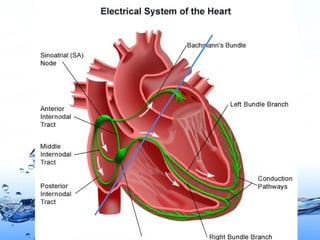
  • #3 Figure 1. Diagram of the heart and the electrical conduction system of the heart. Electrical impulses start in the sino-atrial node and travel via the atria to the AV node. From there, the electrical impulse travels through the His fibers and the Purkinje fibers to the left and right ventricles.
  • #25 Figure 2. Diagram of AV nodal reentrant tachycardia (AVNRT). The electrical impulse travels in a circle using extra fibers in and around the AV node.
  • #35 Figure 3. A diagram of AV reentrant tachycardia (AVRT). The electrical impulse travels down the AV node to the ventricles and back to the atrium via extra fibers that connect the atria and ventricles.
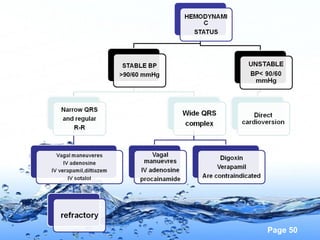
  • #54 Figure 3. Algorithm for the Short-Term Management of Supraventricular Tachycardia (SVT). If the diagnosis of SVT with aberration or SVT with preexcitation is not certain, tachycardia with a wide QRS complex must be considered as an unknown mechanism and treated as such. SVT with preexcitation can be the result of either antidromic atrioventricular reentry or, uncommonly, another type of SVT (e.g., atrial tachycardia) with an accessory pathway that is not critical for the maintenance of the arrhythmia. BBB denotes bundle-branch block, VT ventricular tachycardia, IV intravenous, and ECG electrocardiogram. Adapted from Blomstrom-Lundqvist et al.8
  • #55 Figure 4. Algorithm for the Long-Term Management of Supraventricular Tachycardia. In many circumstances, patient preference is an important consideration in the selection of therapy. Referral to an electrophysiologist should be considered for discussion of the risks and benefits of catheter ablation.
  • #60 Figure 5. Catheter Ablation of Cardiac Arrhythmias. One to four catheter electrodes are introduced into the cavities of the heart through femoral (or, alternatively, internal jugular or subclavian) venous access after local anesthesia is administered. Radiofrequency current — a low-voltage, high-frequency (500 kHz) form of electrical energy used for electrocautery in surgery — is delivered through a catheter electrode to create small lesions through thermal injury in the myocardial tissue, the conduction system, or both, which have been identified as critical for mediating the cardiac arrhythmia. In patients with arrhythmias mediated by an abnormal accessory pathway, the catheter is positioned so that it is in contact with the pathway, and the application of radiofrequency current blocks conduction over the accessory pathway within a few seconds. For left-sided accessory pathways, a retrograde approach through the femoral artery and the aortic valve can be used. Alternatively, a transseptal puncture can be performed to gain access to the left atrium. Cryothermal ablation is an effective approach in patients with atrioventricular (AV) nodal reentrant tachycardia or an accessory pathway close to a His bundle because of the reversibility of the initial effect and the negligible risk of AV block. Most ablation procedures take one to three hours. Catheter ablation of supraventricular tachycardia can be performed as a one-day outpatient procedure, or it may require overnight hospitalization. Treatment with aspirin is often recommended for several weeks after ablation that has been performed in the left side of the heart to reduce the potential risk of emboli. Patients need no special follow-up after the intervention.