Tachy Rhythms 
Candice Hanson
Tacky rhythm quiz…
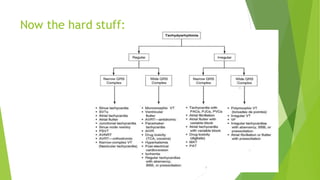
Now the hard stuff:
Regular & Narrow Complex
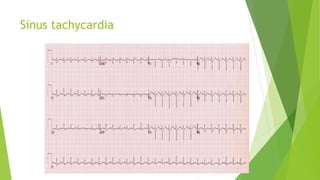
Sinus tachycardia
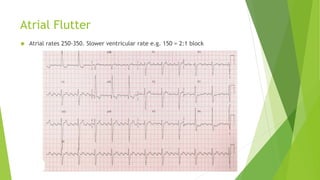
Atrial Flutter 
 Atrial rates 250-350. Slower ventricular rate e.g. 150 = 2:1 block
Supraventicular Tachycardias 
 Generally used to mean any tachyarrythmia with abrupt onset and offset 
involving a re-entrant pathway: 
 Atrioventricular nodal re-entrant tachycardia (AVNRT) 
 Atrioventricular re-entry tachycardia (AVRT) – orthodromic, antidromic 
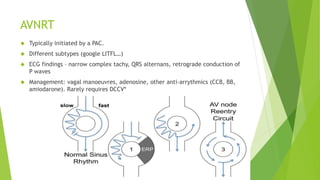
 AVNRT 
 Anatomy of the AV node: fast & slow fibres. Results in a functional re-entrant 
circuit within the AV node. 
 Narrow complex, rates of 140-280. Heart is structurally normal. More common in 
women. Sudden onset / offset. May respond to vagal manoeuvres.
AVNRT 
 Typically initiated by a PAC. 
 Different subtypes (google LITFL…) 
 ECG findings – narrow complex tachy, QRS alternans, retrograde conduction of 
P waves 
 Management: vagal manoeuvres, adenosine, other anti-arrythmics (CCB, BB, 
amiodarone). Rarely requires DCCV*
ECG in AVNRT
AVRT 
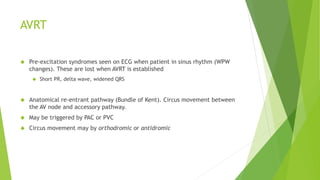
 Pre-excitation syndromes seen on ECG when patient in sinus rhythm (WPW 

changes). These are lost when AVRT is established 
 Short PR, delta wave, widened QRS 
 Anatomical re-entrant pathway (Bundle of Kent). Circus movement between 
the AV node and accessory pathway. 
 May be triggered by PAC or PVC 
 Circus movement may by orthodromic or antidromic
Pre-excitation
Orthodromic vs Antidromic Conduction
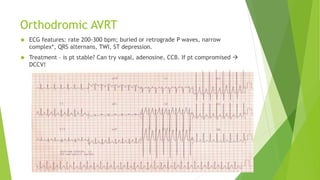
Orthodromic AVRT 
 ECG features: rate 200-300 bpm; buried or retrograde P waves, narrow 
complex*, QRS alternans, TWI, ST depression. 
 Treatment – is pt stable? Can try vagal, adenosine, CCB. If pt compromised  
DCCV!
Antidromic AVRT 
 Antegrade conduction via the accessory pathway, retrograde conduction via 
AV node. 
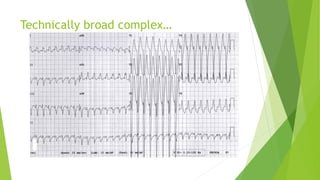
 ECG features: rate 200-300, wide QRS (abnormal depolarisation of ventricles) 
 Likely to be mistaken for VT. Treatment: DCCV
Technically broad complex…
Summing up the SVTs 
 AVNRT – most common 
 Narrow complex*, rate up to 240, regular, responds to adenosine 
 Structurally normal heart – functional re-entrant pathway 
 AVRT – seen in pre-excitation syndromes (WPW) 
 Anatomical re-entrant pathway due to presence of accessory bundle 
 Orthodromic  via AV node and back up (retrograde) via the bundle. Results in 
narrow complex tachy up to 300bpm, regular 
 Antidromic  via accessory pathway and retrograde via the AV node. Results in 
broad complex tachy up to 300bpm, regular.
Tacky rhythm quiz #2
Regular & Broad Complex
Ventricular Tachycardia 
 Ventricular tachycardia, rates up to 300bpm 
 Sustained / non-sustained; monomorphic, polymorphic 
 VT should be regular (sustained irregularity think SVT w BBB e.g. AF) 
 SVT with aberrancy vs VT 
 Pt can be stable or unstable 
 Features more suggestive of VT: 
 Age > 35 
 Pre-existing ischaemic heart disease 
 Previous VT 
 Absence normal BBB morphology 
 Hx structural disease, CCF, cardiomyopathy 
 FHx sudden cardiac death
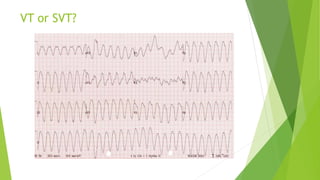
SVT with aberrancy 
 Looks like VT! 
 Broad complex tachycardia originating above Bundle of His. Becomes broad due to 
pre-existing BBB. This will be seen on the baseline ECG! 
 Some clues to distinguish 
 North west axis 
 Concordance of QRS complexes in praecordial leads 
 Left rabbit ear > right in V1 (very specific for VT) 
 Fusion & capture beats; AV dissociation 
 Brugada & Josephson’s signs 
 Q wave in V6 
 Very broad complex 
 http://lifeinthefastlane.com/ecg-library/basics/vt_vs_svt/ for examples of above
VT or SVT?
VT or SVT?
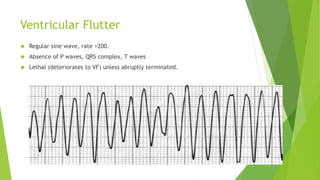
Ventricular Flutter 
 Regular sine wave, rate >200. 
 Absence of P waves, QRS complex, T waves 
 Lethal (deteriorates to VF) unless abruptly terminated.
Tacky rhythm quiz #3 - Australiana
Irregular & Narrow Complex
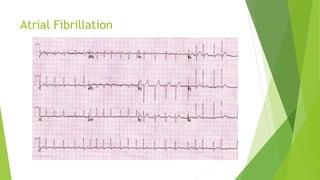
Atrial Fibrillation
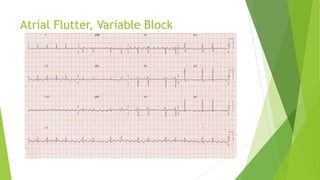
Atrial Flutter, Variable Block
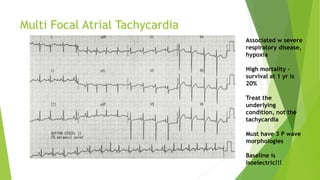
Multi Focal Atrial Tachycardia 
Associated w severe 
respiratory disease, 
hypoxia 
High mortality – 
survival at 1 yr is 
20% 
Treat the 
underlying 
condition, not the 
tachycardia 
Must have 3 P wave 
morphologies 
Baseline is 
isoelectric!!!
Tacky rhythm quiz #4
Irregular & Broad Complex
Polymorphic VT - torsades 
 Requires polymorphic appearance AND QT prolongation 
 PVC causes ‘R on T’ phenomenon 
 May be self terminating, or degrade into VF 
 Treatment – magnesium, overdrive pacing, isoprenaline
Ventricular Fibrillation
AF / flutter in pre-excitation
Other causes of broad complex tachys 
 Don’t forget 
 Metabolic derangements e.g. hyperkalaemia 
 Toxidromes e.g. TCA poisoning 
 Pacemaker related
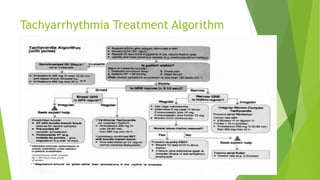
Tachyarrhythmia Treatment Algorithm
Summing it up… 
 Tachyarrhythmias can be regular, irregular, narrow or broad complex 
 May be the result of functional or anatomical re-entrant circuits, or increase 
automaticity 
 Treatment may depend on underlying cause and on whether the patient is 
haemodynamically stable 
 VT and SVT with aberrancy can be difficult to distinguish, when in doubt, 
cardioversion
The ED Doctor’s Most Important ‘Tacky 
Rhythm’…

Tachyarrhythmias

  • 1.
  • 2.
  • 3.
  • 4.
  • 5.
  • 6.
    Atrial Flutter Atrial rates 250-350. Slower ventricular rate e.g. 150 = 2:1 block
  • 7.
    Supraventicular Tachycardias Generally used to mean any tachyarrythmia with abrupt onset and offset involving a re-entrant pathway:  Atrioventricular nodal re-entrant tachycardia (AVNRT)  Atrioventricular re-entry tachycardia (AVRT) – orthodromic, antidromic  AVNRT  Anatomy of the AV node: fast & slow fibres. Results in a functional re-entrant circuit within the AV node.  Narrow complex, rates of 140-280. Heart is structurally normal. More common in women. Sudden onset / offset. May respond to vagal manoeuvres.
  • 8.
    AVNRT  Typicallyinitiated by a PAC.  Different subtypes (google LITFL…)  ECG findings – narrow complex tachy, QRS alternans, retrograde conduction of P waves  Management: vagal manoeuvres, adenosine, other anti-arrythmics (CCB, BB, amiodarone). Rarely requires DCCV*
  • 9.
  • 10.
    AVRT  Pre-excitationsyndromes seen on ECG when patient in sinus rhythm (WPW changes). These are lost when AVRT is established  Short PR, delta wave, widened QRS  Anatomical re-entrant pathway (Bundle of Kent). Circus movement between the AV node and accessory pathway.  May be triggered by PAC or PVC  Circus movement may by orthodromic or antidromic
  • 11.
  • 12.
  • 13.
    Orthodromic AVRT ECG features: rate 200-300 bpm; buried or retrograde P waves, narrow complex*, QRS alternans, TWI, ST depression.  Treatment – is pt stable? Can try vagal, adenosine, CCB. If pt compromised  DCCV!
  • 14.
    Antidromic AVRT Antegrade conduction via the accessory pathway, retrograde conduction via AV node.  ECG features: rate 200-300, wide QRS (abnormal depolarisation of ventricles)  Likely to be mistaken for VT. Treatment: DCCV
  • 15.
  • 16.
    Summing up theSVTs  AVNRT – most common  Narrow complex*, rate up to 240, regular, responds to adenosine  Structurally normal heart – functional re-entrant pathway  AVRT – seen in pre-excitation syndromes (WPW)  Anatomical re-entrant pathway due to presence of accessory bundle  Orthodromic  via AV node and back up (retrograde) via the bundle. Results in narrow complex tachy up to 300bpm, regular  Antidromic  via accessory pathway and retrograde via the AV node. Results in broad complex tachy up to 300bpm, regular.
  • 17.
  • 18.
  • 19.
    Ventricular Tachycardia Ventricular tachycardia, rates up to 300bpm  Sustained / non-sustained; monomorphic, polymorphic  VT should be regular (sustained irregularity think SVT w BBB e.g. AF)  SVT with aberrancy vs VT  Pt can be stable or unstable  Features more suggestive of VT:  Age > 35  Pre-existing ischaemic heart disease  Previous VT  Absence normal BBB morphology  Hx structural disease, CCF, cardiomyopathy  FHx sudden cardiac death
  • 20.
    SVT with aberrancy  Looks like VT!  Broad complex tachycardia originating above Bundle of His. Becomes broad due to pre-existing BBB. This will be seen on the baseline ECG!  Some clues to distinguish  North west axis  Concordance of QRS complexes in praecordial leads  Left rabbit ear > right in V1 (very specific for VT)  Fusion & capture beats; AV dissociation  Brugada & Josephson’s signs  Q wave in V6  Very broad complex  http://lifeinthefastlane.com/ecg-library/basics/vt_vs_svt/ for examples of above
  • 21.
  • 22.
  • 23.
    Ventricular Flutter Regular sine wave, rate >200.  Absence of P waves, QRS complex, T waves  Lethal (deteriorates to VF) unless abruptly terminated.
  • 24.
    Tacky rhythm quiz#3 - Australiana
  • 25.
  • 26.
  • 27.
  • 28.
    Multi Focal AtrialTachycardia Associated w severe respiratory disease, hypoxia High mortality – survival at 1 yr is 20% Treat the underlying condition, not the tachycardia Must have 3 P wave morphologies Baseline is isoelectric!!!
  • 29.
  • 30.
  • 31.
    Polymorphic VT -torsades  Requires polymorphic appearance AND QT prolongation  PVC causes ‘R on T’ phenomenon  May be self terminating, or degrade into VF  Treatment – magnesium, overdrive pacing, isoprenaline
  • 32.
  • 33.
    AF / flutterin pre-excitation
  • 34.
    Other causes ofbroad complex tachys  Don’t forget  Metabolic derangements e.g. hyperkalaemia  Toxidromes e.g. TCA poisoning  Pacemaker related
  • 35.
  • 36.
    Summing it up…  Tachyarrhythmias can be regular, irregular, narrow or broad complex  May be the result of functional or anatomical re-entrant circuits, or increase automaticity  Treatment may depend on underlying cause and on whether the patient is haemodynamically stable  VT and SVT with aberrancy can be difficult to distinguish, when in doubt, cardioversion
  • 37.
    The ED Doctor’sMost Important ‘Tacky Rhythm’…

Editor's Notes

  • #6 Physiological e.g. exercise In response to stressors e.g. catecholamine surg, anxiety, infection, fever Treat the underlying cause. Can have ‘inappropriate sinus tachycardia’ – persistent HR > 100 otherwise NSR at rest. Typically seen in young women.
  • #7 This is 4:1 block, suggests treatment with nodal blocking drug. Clearly demonstrates saw toothed appearance of P waves. Re-entry circuit established in right atrium. Very rapid flutter can resemble other forms of SVT (e.g. AVNRT), but tends not to revert with adenosine of vagal manoeuvres. May slow so flutter waves become more obvious facilitating diagnosis.. Can have fixed or variable block. Should suspect if the ventricular rate is bang on 150.
  • #9 AV node comprised of two bundles of fibres – fast and slow. Fast fibres depolarise rapidly, but have a long refractory period. Slow fibres taking longer to depolarise but have a shorter refractory period. This can set the stage for re-entrant tachy-arrhythmias. Normally, Impulse reaches AV node, travels down both fast and slow fibres. Fast impulse propagated to ventricles, then begins up slow pathway and meets refractory tissue. Impulse is terminated. PAC arrives at AV node when the fast tissue is still refractory (remember, long refractory period – the normal physiology for AV delay), but the slow pathway is no longer refractory, so the impulse travels down slow pathway, meets the fast tissue, which is no longer refractory and impulse travels retrograde to establish a re-entrant circuit. Impulses can also be conducted back up to the atria, which is the basis for retrograde P waves that can either be buried in the QRS or appear after the QRS (esp V1). These P waves will resolve one NSR is restored. *Can required DCCV especially in a pt who has had previous and failed ablation.
  • #10 Narrow complex, normal QRS morphology Regular Rate 145 (ranges between 120 and 250bpm) Retrograde P waves seen in V1 (can be inverted in the inferior leads), just after QRS. Can be buried in QRS because atria and ventricles have simultaneous depolarisation. Can have ST and T wave changes related to rate. These changes resolve with reversion to NSR
  • #11 Short PR as there is no delay via the AV node. Slurring of QRS upstroke as the accessory bundle beings to depolarise the ventricles prior to the normal conduction pathway (pre-excitation of the ventricles), and this causes widening of the QRS. Thought to be other variants e.g ?Levon Gown – not proven to exist.
  • #12 Baseline ECG Short PR interval Delta wave Broad complex QRS
  • #13 AVRT can be established by two types of circus movement: Orthodromic – conduction is anterograde (i.e. toward the ventricle) via the AV node and then travels retrogradely towards the ventricles via the accessory bundle. This establishes a circus loop. Because the bundles are depolarised via the AV node, this results in a narrow complex tachycardia Antidromic – conduction is anterograde (toward the ventricles) via the accessory pathway. The venticles therefore undergo abnormal depolarisation. Impulse travels retrogradely toward ventricles by the AV node causing the loop. This results is a broad complex tachycardia.
  • #14 *any narrow complex rhythm can be broad complex in the presence of aberrancy or pre-existing BBB. Can be extremely difficult to differentiate from AVNRT ?pre-excitation features on baseline ECG
  • #16 Antidromic AVRT Broad complex, regular due to abnormal depolarisation of the ventricles via the accessory bundle.
  • #20 Note: can have narrow complex VT if established high at the Bundle of His. VT can also be slow (e.g. in setting of medications such as anti-arrythmics)
  • #21 VT should be the default diagnosis. Can use Brugada criteria to help establish, but largely a theoretical exercise as these patient should be treated as VT until proven to be SVT. Brugada sign – Distance from onset of QRS to nadir of S wave is >100 msec Josephson sign – notching of the S wave near the nadir
  • #22 Very broad complex Negative concordance North west axis QS complex in V6 Consistent with VT
  • #23 Broad, but relatively narrow QRS Normal axis No AV dissocation Non concordant LBBB pattern Consistent with SVT (AVNRT) with BBB. An old ECG would demonstrate pre-existing LBBB.
  • #27 Rhythm vs rate control
  • #28 May be regular or irregular or regularly irregular or irregularly irregular…. Can have variable block
  • #29 Rare Associated with severe respiratory disease (COPD) and hypoxia Requires at least 3 different P wave morphologies on same rhythm strip (numerous different atrial pacemakers) High mortality – survival at 1 yr after an episode of MAT is 20% Do not treat the rhythm, but the underlying cause of the rhythm e.g. COPD. Must have HR >100 3 distinct P wave morphologies in the same lead (different ectopic foci) Baseline must be isoelectric (to distinguish from AF) Differing P-P, PR and R-R intervals
  • #30 Whitney Houston – I will always love you, the Bodyguard Gloria Estefan – the rhythm will get you Beach Blanket Bingo – theme song from Beach Blanet Bingo The real tacky brady syndrome…
  • #32 Other forms of polymorphic VT e.g. bidirectional VT (rare)
  • #33 Irregular chaotic activity does not produce an output. Shockable rhythm
  • #34 Irregular AF impulses travel down the accessory pathway – abnormal depolarisation of ventricles results in broad complex. No AV nodal delay so can have very rapid rates up to 300bpm. Features of pre-excitation are absent Can occasionally have a capture beat Pt’s are haemodynamically compromised and require DCCV – admit!