Laughter Electricity is the best medicine
Tim Cook
Tachyarrhythmias
Basic stuff
• Haemodynamic stability
• Chest pain / syncope
• Hx of Cardiac Disease
• PPM / ICD
• Signs / symptoms of heart failure
• OLD ECGS!
Step 1
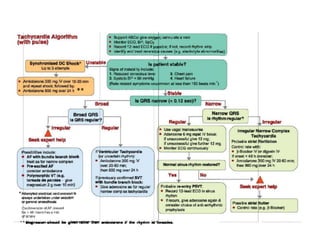
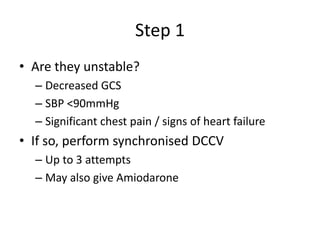
• Are they unstable?
– Decreased GCS
– SBP <90mmHg
– Significant chest pain / signs of heart failure
• If so, perform synchronised DCCV
– Up to 3 attempts
– May also give Amiodarone
Step 2
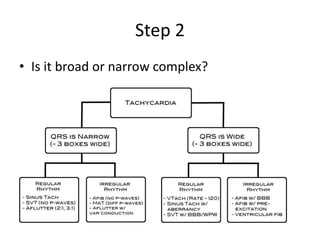
• Is it broad or narrow complex?
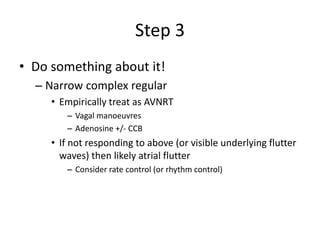
Step 3
• Do something about it!
– Narrow complex regular
• Empirically treat as AVNRT
– Vagal manoeuvres
– Adenosine +/- CCB
• If not responding to above (or visible underlying flutter
waves) then likely atrial flutter
– Consider rate control (or rhythm control)
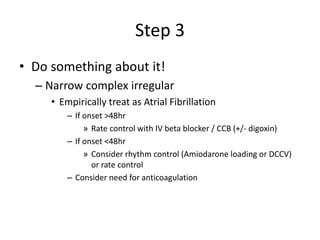
Step 3
• Do something about it!
– Narrow complex irregular
• Empirically treat as Atrial Fibrillation
– If onset >48hr
» Rate control with IV beta blocker / CCB (+/- digoxin)
– If onset <48hr
» Consider rhythm control (Amiodarone loading or DCCV)
or rate control
– Consider need for anticoagulation
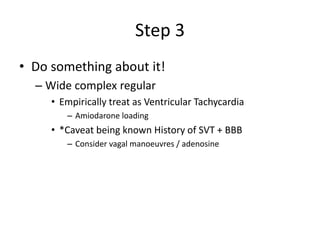
Step 3
• Do something about it!
– Wide complex regular
• Empirically treat as Ventricular Tachycardia
– Amiodarone loading
• *Caveat being known History of SVT + BBB
– Consider vagal manoeuvres / adenosine
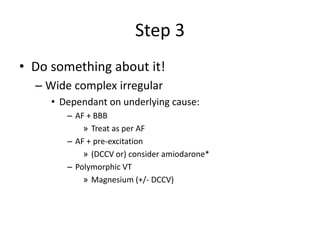
Step 3
• Do something about it!
– Wide complex irregular
• Dependant on underlying cause:
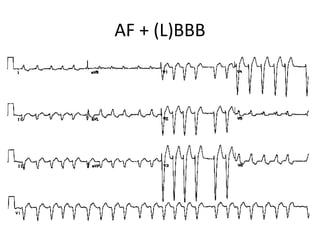
– AF + BBB
» Treat as per AF
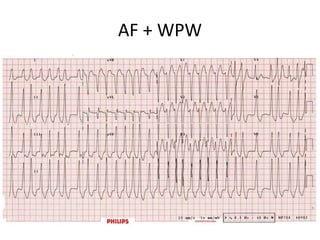
– AF + pre-excitation
» (DCCV or) consider amiodarone*
– Polymorphic VT
» Magnesium (+/- DCCV)
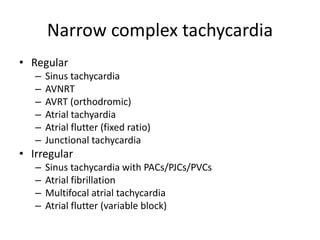
Narrow complex tachycardia
• Regular
– Sinus tachycardia
– AVNRT
– AVRT (orthodromic)
– Atrial tachyardia
– Atrial flutter (fixed ratio)
– Junctional tachycardia
• Irregular
– Sinus tachycardia with PACs/PJCs/PVCs
– Atrial fibrillation
– Multifocal atrial tachycardia
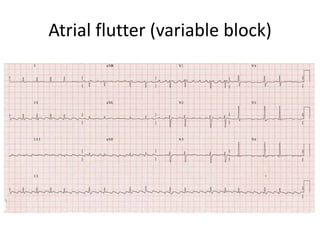
– Atrial flutter (variable block)
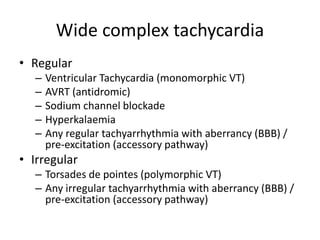
Wide complex tachycardia
• Regular
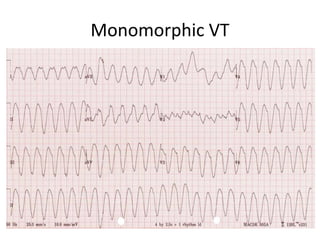
– Ventricular Tachycardia (monomorphic VT)
– AVRT (antidromic)
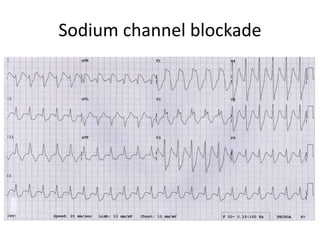
– Sodium channel blockade
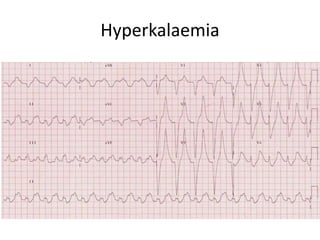
– Hyperkalaemia
– Any regular tachyarrhythmia with aberrancy (BBB) /
pre-excitation (accessory pathway)
• Irregular
– Torsades de pointes (polymorphic VT)
– Any irregular tachyarrhythmia with aberrancy (BBB) /
pre-excitation (accessory pathway)
Narrow complex regular tachycardias
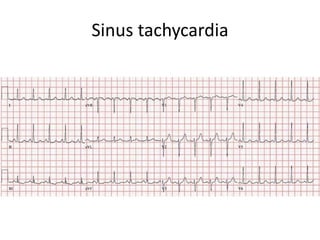
Sinus tachycardia
Sinus tachycardia
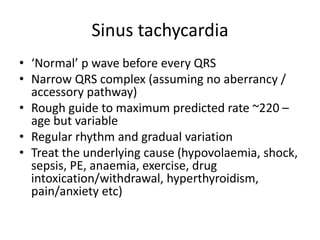
• ‘Normal’ p wave before every QRS
• Narrow QRS complex (assuming no aberrancy /
accessory pathway)
• Rough guide to maximum predicted rate ~220 –
age but variable
• Regular rhythm and gradual variation
• Treat the underlying cause (hypovolaemia, shock,
sepsis, PE, anaemia, exercise, drug
intoxication/withdrawal, hyperthyroidism,
pain/anxiety etc)
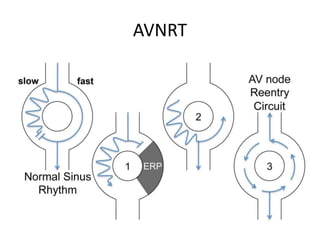
AVNRT
AVNRT
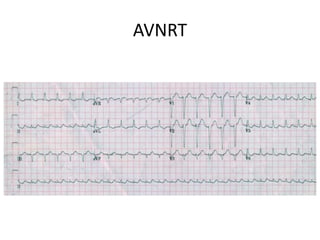
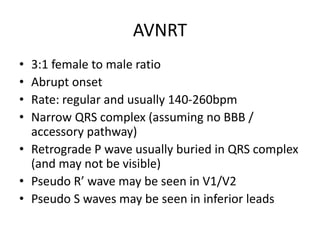
• 3:1 female to male ratio
• Abrupt onset
• Rate: regular and usually 140-260bpm
• Narrow QRS complex (assuming no BBB /
accessory pathway)
• Retrograde P wave usually buried in QRS complex
(and may not be visible)
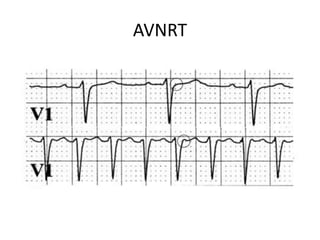
• Pseudo R’ wave may be seen in V1/V2
• Pseudo S waves may be seen in inferior leads
AVNRT
AVNRT
AVNRT
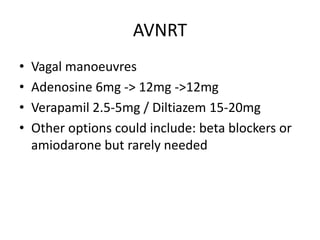
• Vagal manoeuvres
• Adenosine 6mg -> 12mg ->12mg
• Verapamil 2.5-5mg / Diltiazem 15-20mg
• Other options could include: beta blockers or
amiodarone but rarely needed
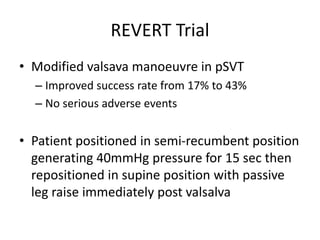
REVERT Trial
• Modified valsava manoeuvre in pSVT
– Improved success rate from 17% to 43%
– No serious adverse events
• Patient positioned in semi-recumbent position
generating 40mmHg pressure for 15 sec then
repositioned in supine position with passive
leg raise immediately post valsalva
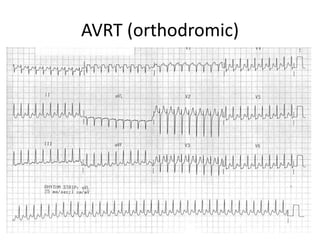
AVRT (orthodromic)
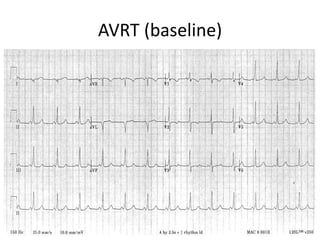
AVRT (baseline)
AVRT
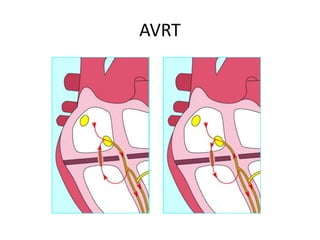
• A re-entry circuit is formed by the normal
conduction system and the accessory pathway
resulting in circus movement.
• During tachyarrythmias the accessory pathway
forms part of the re-entry circuit.
• AVRT often triggered by premature atrial or
premature ventricular beats.
• AVRT are further divided into orthodromic
or antidromic conduction based on direction of
re-entry conduction and ECG morphology.
AVRT
AVRT (orthodromic)
• Rate usually 200 – 300 bpm
• P waves usually retrograde and often buried in
the ST segment
• Narrow QRS complex
AVRT (orthodromic)
• Vagal manoeuvres
• Adenosine or calcium-channel blockers
• Other options could include: beta blockers or
amiodarone
• DCCV if non-responsive to medical therapy
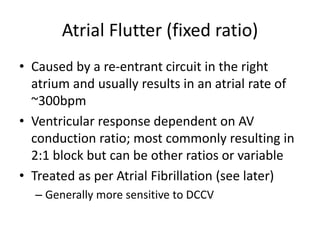
Atrial Flutter (fixed ratio 2:1)
Atrial Flutter (fixed ratio)
• Caused by a re-entrant circuit in the right
atrium and usually results in an atrial rate of
~300bpm
• Ventricular response dependent on AV
conduction ratio; most commonly resulting in
2:1 block but can be other ratios or variable
• Treated as per Atrial Fibrillation (see later)
– Generally more sensitive to DCCV
Atrial Flutter (fixed ratio)
• Narrow complex tachycardia
• Flutter waves (saw-tooth pattern) best seen
in inferior leads
– Flutter waves are often difficult to see when 2:1
block is present, but be suspicious with HR of
~150 and little rate variability
• Flutter waves in V1 may resemble P waves
• Loss of the isoelectric baseline
Narrow complex irregular tachycardias
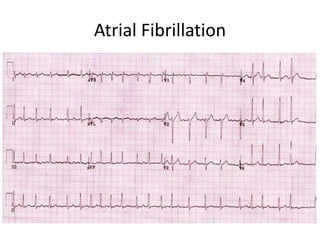
Atrial Fibrillation
Atrial Fibrillation
• Irregular rhythm
• rAF often associated with a ventricular rate
~110 – 170bpm
• No P waves
– Fibrillatory waves may be present
• Absence of an isoelectric baseline
• Narrow QRS complex (assuming no BBB /
accessory pathway)
Atrial Fibrillation
• Look for and treat reversible causes:
– Electrolyte disturbances
– Hyperthyroidism
– Sepsis
– Recreational drug / alcohol binge
– Peri/myocarditis
– ACS / PE
– Digoxin toxicity
Atrial Fibrillation
• If onset >48hr
– Rate control
• Beta blocker / CCB / amiodarone (+/- digoxin)
– Consider TOE guided DCCV
– Consider elective DCCV after 3/53 of
anticoagulation
Atrial Fibrillation
• If onset <48hr
– Rate control if: age >65, untreated reversible
cause (eg sepsis) or recent CVA / TIA
– Consider rhythm control (Amiodarone loading or
DCCV) if age <65, no obvious reversible cause,
WPW, heart failure or unacceptable symptoms
– ‘Wait and see’ approach (if onset <24hr)
• Return in <24hrs for re-review
• 60% will spontaneously revert within 48hrs of onset
Atrial Fibrillation
• Consider need for anticoagulation
– CHA2DS2-VASc >1
• Recommend anticoagulation
– HASBLED >2
• Consult with cardiology before anticoagulating
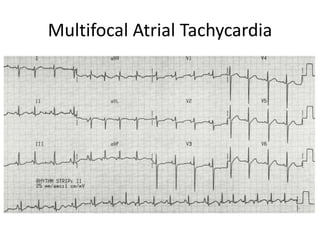
Multifocal Atrial Tachycardia
• A rapid, irregular atrial rhythm arising from
multiple ectopic foci within the atria
• Most commonly seen in elderly, unwell patients
with severe COPD / CCF
• Poor prognostic marker, associated with a 60% in-
hospital mortality & mean survival of just over
one year. Death occurs due to the underlying
illness; not the arrhythmia itself
• Tends to resolve following treatment of the
underlying disorder
Multifocal Atrial Tachycardia
• Heart rate usually 100-150 bpm
– May be as high as 250 bpm
• Irregular rhythm with varying PP, PR and RR intervals.
• At least 3 distinct P-wave morphologies in the same
lead
• Isoelectric baseline between P-waves (i.e. no flutter
waves).
• Absence of a single dominant atrial pacemaker (i.e. not
just sinus rhythm with frequent PACs).
• Some P waves may be non-conducted; others may be
aberrantly conducted to the ventricles.
Atrial flutter (variable block)
Broad complex regular tachycardias
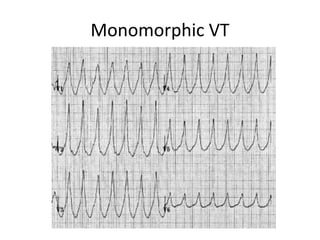
Monomorphic VT
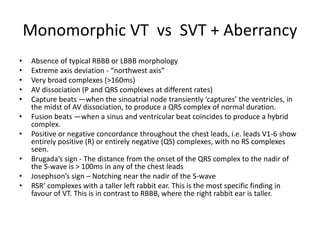
Monomorphic VT vs SVT + Aberrancy
• Absence of typical RBBB or LBBB morphology
• Extreme axis deviation - “northwest axis”
• Very broad complexes (>160ms)
• AV dissociation (P and QRS complexes at different rates)
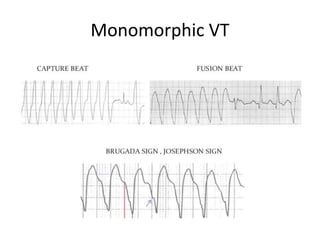
• Capture beats —when the sinoatrial node transiently ‘captures’ the ventricles, in
the midst of AV dissociation, to produce a QRS complex of normal duration.
• Fusion beats —when a sinus and ventricular beat coincides to produce a hybrid
complex.
• Positive or negative concordance throughout the chest leads, i.e. leads V1-6 show
entirely positive (R) or entirely negative (QS) complexes, with no RS complexes
seen.
• Brugada’s sign - The distance from the onset of the QRS complex to the nadir of
the S-wave is > 100ms in any of the chest leads
• Josephson’s sign – Notching near the nadir of the S-wave
• RSR’ complexes with a taller left rabbit ear. This is the most specific finding in
favour of VT. This is in contrast to RBBB, where the right rabbit ear is taller.
Monomorphic VT vs SVT + Aberrancy
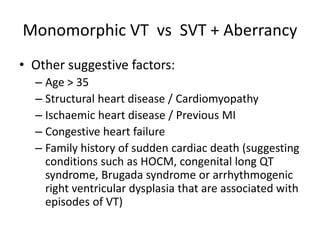
• Other suggestive factors:
– Age > 35
– Structural heart disease / Cardiomyopathy
– Ischaemic heart disease / Previous MI
– Congestive heart failure
– Family history of sudden cardiac death (suggesting
conditions such as HOCM, congenital long QT
syndrome, Brugada syndrome or arrhythmogenic
right ventricular dysplasia that are associated with
episodes of VT)
Monomorphic VT
Monomorphic VT
Monomorphic VT
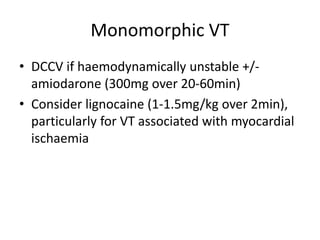
• DCCV if haemodynamically unstable +/-
amiodarone (300mg over 20-60min)
• Consider lignocaine (1-1.5mg/kg over 2min),
particularly for VT associated with myocardial
ischaemia
AVRT (antidromic)
AVRT (antidromic)
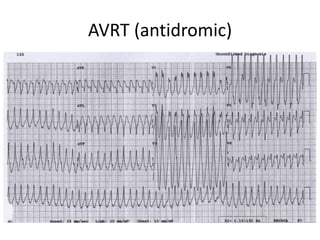
• Much less common than orthodromic AVRT
• Rate usually 200 – 300 bpm
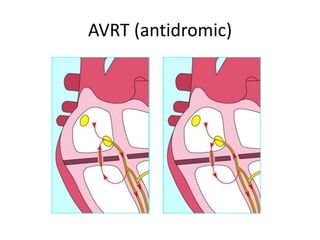
• Wide QRS complexes due to abnormal
ventricular depolarisation via accessory
pathway.
AVRT (antidromic)
AVRT (antidromic)
• If in doubt treat as VT
• Stable patients may respond to drug therapy
including amiodarone or procainamide, but
may require DCCV
Sodium channel blockade
• Tachycardia: this is often a sinus tachycardia
with a grossly prolonged PR interval, such that
the P wave is hidden in the previous T wave or
QRS complex
• Broad QRS complexes.
• Right axis deviation of the terminal QRS
– positive R’ wave in aVR, deep S wave in lead I
• Give bicarb and intubate / hyperventilate
Hyperkalaemia
Hyperkalaemia
• Widening/flattening then loss of p wave
• Peaked T waves
• Development of a sine-wave appearance
• Usually slower rather than fast heart rate
• Give calcium and agents to reduce / shift the
potassium
Other WCT differentials
• Sinus tachycardia + BBB (constant or rate-related)
• Sinus tachycardia + WPW
• Pacemaker mediated tachycardia
• If unsure; treat as VT!
– Overall, VT accounts for:
• 80% of cases of WCT
• >90% of cases of WCT in patients with structural / ischaemic
heart disease
Broad complex irregular tachycardias
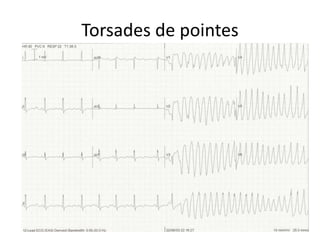
Torsades de pointes
Torsades de pointes
• Ventricular tachyarrhythmia associated with
prolonged QT interval (congenital or acquired)
• Cease QT prolonging agents (inc amiodarone)
and correct electrolyte abnormalities
• Initially Magnesium Sulphate 2g over 10 min
• DCCV if needed
• Consider pacing / isoprenaline to prevent
relapse
AF + (L)BBB
AF + WPW
AF + WPW
• Rate > 200 bpm
• Irregular rhythm
• Wide QRS complexes due to abnormal
ventricular depolarisation via accessory
pathway
• QRS Complexes change in shape and
morphology
• Axis remains stable (unlike TDP)
AF + WPW
• Don’t give AV nodal blocking drugs eg:
– Adenosine / CCB / Beta blockers etc
• DCCV usually preferred
– Some suggest considering procainamide
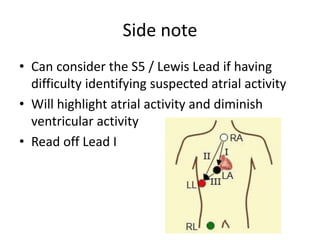
Side note
• Can consider the S5 / Lewis Lead if having
difficulty identifying suspected atrial activity
• Will highlight atrial activity and diminish
ventricular activity
• Read off Lead I
References
• Australian Resuscitation Council Guideline
11.9 – Managing Acute Dysrhyhmias
– https://resus.org.au/guidelines/
• Life In The Fast Lane
• Deranged Physiology
• UpToDate
• REVRT trial
– http://www.thelancet.com/journals/lancet/article
/PIIS0140-6736(15)61485-4/abstract

Tachyarrhythmias

  • 1.
    Laughter Electricity isthe best medicine Tim Cook Tachyarrhythmias
  • 2.
    Basic stuff • Haemodynamicstability • Chest pain / syncope • Hx of Cardiac Disease • PPM / ICD • Signs / symptoms of heart failure • OLD ECGS!
  • 4.
    Step 1 • Arethey unstable? – Decreased GCS – SBP <90mmHg – Significant chest pain / signs of heart failure • If so, perform synchronised DCCV – Up to 3 attempts – May also give Amiodarone
  • 5.
    Step 2 • Isit broad or narrow complex?
  • 6.
    Step 3 • Dosomething about it! – Narrow complex regular • Empirically treat as AVNRT – Vagal manoeuvres – Adenosine +/- CCB • If not responding to above (or visible underlying flutter waves) then likely atrial flutter – Consider rate control (or rhythm control)
  • 7.
    Step 3 • Dosomething about it! – Narrow complex irregular • Empirically treat as Atrial Fibrillation – If onset >48hr » Rate control with IV beta blocker / CCB (+/- digoxin) – If onset <48hr » Consider rhythm control (Amiodarone loading or DCCV) or rate control – Consider need for anticoagulation
  • 8.
    Step 3 • Dosomething about it! – Wide complex regular • Empirically treat as Ventricular Tachycardia – Amiodarone loading • *Caveat being known History of SVT + BBB – Consider vagal manoeuvres / adenosine
  • 9.
    Step 3 • Dosomething about it! – Wide complex irregular • Dependant on underlying cause: – AF + BBB » Treat as per AF – AF + pre-excitation » (DCCV or) consider amiodarone* – Polymorphic VT » Magnesium (+/- DCCV)
  • 10.
    Narrow complex tachycardia •Regular – Sinus tachycardia – AVNRT – AVRT (orthodromic) – Atrial tachyardia – Atrial flutter (fixed ratio) – Junctional tachycardia • Irregular – Sinus tachycardia with PACs/PJCs/PVCs – Atrial fibrillation – Multifocal atrial tachycardia – Atrial flutter (variable block)
  • 11.
    Wide complex tachycardia •Regular – Ventricular Tachycardia (monomorphic VT) – AVRT (antidromic) – Sodium channel blockade – Hyperkalaemia – Any regular tachyarrhythmia with aberrancy (BBB) / pre-excitation (accessory pathway) • Irregular – Torsades de pointes (polymorphic VT) – Any irregular tachyarrhythmia with aberrancy (BBB) / pre-excitation (accessory pathway)
  • 12.
  • 13.
  • 14.
    Sinus tachycardia • ‘Normal’p wave before every QRS • Narrow QRS complex (assuming no aberrancy / accessory pathway) • Rough guide to maximum predicted rate ~220 – age but variable • Regular rhythm and gradual variation • Treat the underlying cause (hypovolaemia, shock, sepsis, PE, anaemia, exercise, drug intoxication/withdrawal, hyperthyroidism, pain/anxiety etc)
  • 15.
  • 16.
    AVNRT • 3:1 femaleto male ratio • Abrupt onset • Rate: regular and usually 140-260bpm • Narrow QRS complex (assuming no BBB / accessory pathway) • Retrograde P wave usually buried in QRS complex (and may not be visible) • Pseudo R’ wave may be seen in V1/V2 • Pseudo S waves may be seen in inferior leads
  • 17.
  • 18.
  • 19.
    AVNRT • Vagal manoeuvres •Adenosine 6mg -> 12mg ->12mg • Verapamil 2.5-5mg / Diltiazem 15-20mg • Other options could include: beta blockers or amiodarone but rarely needed
  • 20.
    REVERT Trial • Modifiedvalsava manoeuvre in pSVT – Improved success rate from 17% to 43% – No serious adverse events • Patient positioned in semi-recumbent position generating 40mmHg pressure for 15 sec then repositioned in supine position with passive leg raise immediately post valsalva
  • 21.
  • 22.
  • 23.
    AVRT • A re-entrycircuit is formed by the normal conduction system and the accessory pathway resulting in circus movement. • During tachyarrythmias the accessory pathway forms part of the re-entry circuit. • AVRT often triggered by premature atrial or premature ventricular beats. • AVRT are further divided into orthodromic or antidromic conduction based on direction of re-entry conduction and ECG morphology.
  • 24.
  • 25.
    AVRT (orthodromic) • Rateusually 200 – 300 bpm • P waves usually retrograde and often buried in the ST segment • Narrow QRS complex
  • 26.
    AVRT (orthodromic) • Vagalmanoeuvres • Adenosine or calcium-channel blockers • Other options could include: beta blockers or amiodarone • DCCV if non-responsive to medical therapy
  • 27.
  • 28.
    Atrial Flutter (fixedratio) • Caused by a re-entrant circuit in the right atrium and usually results in an atrial rate of ~300bpm • Ventricular response dependent on AV conduction ratio; most commonly resulting in 2:1 block but can be other ratios or variable • Treated as per Atrial Fibrillation (see later) – Generally more sensitive to DCCV
  • 29.
    Atrial Flutter (fixedratio) • Narrow complex tachycardia • Flutter waves (saw-tooth pattern) best seen in inferior leads – Flutter waves are often difficult to see when 2:1 block is present, but be suspicious with HR of ~150 and little rate variability • Flutter waves in V1 may resemble P waves • Loss of the isoelectric baseline
  • 30.
  • 31.
  • 32.
    Atrial Fibrillation • Irregularrhythm • rAF often associated with a ventricular rate ~110 – 170bpm • No P waves – Fibrillatory waves may be present • Absence of an isoelectric baseline • Narrow QRS complex (assuming no BBB / accessory pathway)
  • 33.
    Atrial Fibrillation • Lookfor and treat reversible causes: – Electrolyte disturbances – Hyperthyroidism – Sepsis – Recreational drug / alcohol binge – Peri/myocarditis – ACS / PE – Digoxin toxicity
  • 34.
    Atrial Fibrillation • Ifonset >48hr – Rate control • Beta blocker / CCB / amiodarone (+/- digoxin) – Consider TOE guided DCCV – Consider elective DCCV after 3/53 of anticoagulation
  • 35.
    Atrial Fibrillation • Ifonset <48hr – Rate control if: age >65, untreated reversible cause (eg sepsis) or recent CVA / TIA – Consider rhythm control (Amiodarone loading or DCCV) if age <65, no obvious reversible cause, WPW, heart failure or unacceptable symptoms – ‘Wait and see’ approach (if onset <24hr) • Return in <24hrs for re-review • 60% will spontaneously revert within 48hrs of onset
  • 36.
    Atrial Fibrillation • Considerneed for anticoagulation – CHA2DS2-VASc >1 • Recommend anticoagulation – HASBLED >2 • Consult with cardiology before anticoagulating
  • 37.
  • 38.
    Multifocal Atrial Tachycardia •A rapid, irregular atrial rhythm arising from multiple ectopic foci within the atria • Most commonly seen in elderly, unwell patients with severe COPD / CCF • Poor prognostic marker, associated with a 60% in- hospital mortality & mean survival of just over one year. Death occurs due to the underlying illness; not the arrhythmia itself • Tends to resolve following treatment of the underlying disorder
  • 39.
    Multifocal Atrial Tachycardia •Heart rate usually 100-150 bpm – May be as high as 250 bpm • Irregular rhythm with varying PP, PR and RR intervals. • At least 3 distinct P-wave morphologies in the same lead • Isoelectric baseline between P-waves (i.e. no flutter waves). • Absence of a single dominant atrial pacemaker (i.e. not just sinus rhythm with frequent PACs). • Some P waves may be non-conducted; others may be aberrantly conducted to the ventricles.
  • 40.
  • 41.
  • 42.
  • 43.
    Monomorphic VT vsSVT + Aberrancy • Absence of typical RBBB or LBBB morphology • Extreme axis deviation - “northwest axis” • Very broad complexes (>160ms) • AV dissociation (P and QRS complexes at different rates) • Capture beats —when the sinoatrial node transiently ‘captures’ the ventricles, in the midst of AV dissociation, to produce a QRS complex of normal duration. • Fusion beats —when a sinus and ventricular beat coincides to produce a hybrid complex. • Positive or negative concordance throughout the chest leads, i.e. leads V1-6 show entirely positive (R) or entirely negative (QS) complexes, with no RS complexes seen. • Brugada’s sign - The distance from the onset of the QRS complex to the nadir of the S-wave is > 100ms in any of the chest leads • Josephson’s sign – Notching near the nadir of the S-wave • RSR’ complexes with a taller left rabbit ear. This is the most specific finding in favour of VT. This is in contrast to RBBB, where the right rabbit ear is taller.
  • 44.
    Monomorphic VT vsSVT + Aberrancy • Other suggestive factors: – Age > 35 – Structural heart disease / Cardiomyopathy – Ischaemic heart disease / Previous MI – Congestive heart failure – Family history of sudden cardiac death (suggesting conditions such as HOCM, congenital long QT syndrome, Brugada syndrome or arrhythmogenic right ventricular dysplasia that are associated with episodes of VT)
  • 45.
  • 46.
  • 47.
    Monomorphic VT • DCCVif haemodynamically unstable +/- amiodarone (300mg over 20-60min) • Consider lignocaine (1-1.5mg/kg over 2min), particularly for VT associated with myocardial ischaemia
  • 48.
  • 49.
    AVRT (antidromic) • Muchless common than orthodromic AVRT • Rate usually 200 – 300 bpm • Wide QRS complexes due to abnormal ventricular depolarisation via accessory pathway.
  • 50.
  • 51.
    AVRT (antidromic) • Ifin doubt treat as VT • Stable patients may respond to drug therapy including amiodarone or procainamide, but may require DCCV
  • 52.
  • 53.
    Sodium channel blockade •Tachycardia: this is often a sinus tachycardia with a grossly prolonged PR interval, such that the P wave is hidden in the previous T wave or QRS complex • Broad QRS complexes. • Right axis deviation of the terminal QRS – positive R’ wave in aVR, deep S wave in lead I • Give bicarb and intubate / hyperventilate
  • 54.
  • 55.
    Hyperkalaemia • Widening/flattening thenloss of p wave • Peaked T waves • Development of a sine-wave appearance • Usually slower rather than fast heart rate • Give calcium and agents to reduce / shift the potassium
  • 56.
    Other WCT differentials •Sinus tachycardia + BBB (constant or rate-related) • Sinus tachycardia + WPW • Pacemaker mediated tachycardia • If unsure; treat as VT! – Overall, VT accounts for: • 80% of cases of WCT • >90% of cases of WCT in patients with structural / ischaemic heart disease
  • 57.
  • 58.
  • 59.
    Torsades de pointes •Ventricular tachyarrhythmia associated with prolonged QT interval (congenital or acquired) • Cease QT prolonging agents (inc amiodarone) and correct electrolyte abnormalities • Initially Magnesium Sulphate 2g over 10 min • DCCV if needed • Consider pacing / isoprenaline to prevent relapse
  • 60.
  • 61.
  • 62.
    AF + WPW •Rate > 200 bpm • Irregular rhythm • Wide QRS complexes due to abnormal ventricular depolarisation via accessory pathway • QRS Complexes change in shape and morphology • Axis remains stable (unlike TDP)
  • 63.
    AF + WPW •Don’t give AV nodal blocking drugs eg: – Adenosine / CCB / Beta blockers etc • DCCV usually preferred – Some suggest considering procainamide
  • 64.
    Side note • Canconsider the S5 / Lewis Lead if having difficulty identifying suspected atrial activity • Will highlight atrial activity and diminish ventricular activity • Read off Lead I
  • 66.
    References • Australian ResuscitationCouncil Guideline 11.9 – Managing Acute Dysrhyhmias – https://resus.org.au/guidelines/ • Life In The Fast Lane • Deranged Physiology • UpToDate • REVRT trial – http://www.thelancet.com/journals/lancet/article /PIIS0140-6736(15)61485-4/abstract

Editor's Notes

  • #17 P waves can come before or after QRS in fast-slow or slow-slow
  • #18 SR and AVNRT with pseudo R’ waves
  • #19 PAC whilst the fast pathway is still refractory triggers it off most of the time (90% are slow-fast AVNRT)
  • #20 Bearing down, coughing, ice-water to face, carotid massage
  • #21 2015
  • #27 Beta blockers also an option
  • #29 250-350bpm
  • #36 Flecanide a possible option
  • #37 3/52 if cutoff for being considered anticoagulated in SCGH guidelines
  • #43 Positive concordance
  • #44 Extreme axis only in VT or Antidromic AVRT +/- Biventricuar pacing Also innapropriate axis for BBB (eg RAD in LBBB) also seen in VT LR 20x with QRS >160 Any axis shift of greater than 40 degrees when compared with baseline -> likely VT
  • #45 Algorithms available: ACC, Brugada, Ultra-simple Brugada, Vereckei but none are 100% Can consider vagal maneouvres or adenosine to either revert AVNRT/AVRT/RVOT-VT or unmask flutter
  • #47 Positive concordance
  • #48 Occasionally procainamide 100mg every 5min up to 10-20mg/kg Sustained = >30 sec or any haemodyamic compromise
  • #52 ?or flecanide
  • #57 Flecanide can also mimic
  • #60 2g = 8mmol
  • #64 Discrepency between UpToDate + ARC guidelines re: use of amiodarone