Lesson 3 Understanding Stem Anatomy
Vocabulary Apical meristem Bud scales Bud scale scar Bulb Cambium Corm Internode Lateral bud Leaf scar Lenticels Node Phloem Rhizome Stolon Terminal bud Tuber Xylem
What Are the Functions of a Stem? Stems have many important jobs in a plant They are responsible for the size and shape of a plant Some are made of wood and some are herbaceous There are four functions of the stem
Functions of a Stem 1.  Stems support the leaves Able to stretch the leaves into the best positions for catching sunlight 2.  Move water, minerals and food through the whole plant 3.  Can also produced food through photosynthesis Not its main job, but will occur in plants with small or no leaves 4.  Store food that has been manufactured by the plant Stems of bamboo plant Courtesy of McGraw Hill Publishing
What Are Some of the Structures on the Outside of a Stem? There are many structures on the stem which are very useful to us in identifying plants Sometimes it is easier to identify a plant by its stem rather than its leaves There are eight structures found on the outside of a stem: 1.  Terminal bud  – contains apical meristem; found at the tip of a stem; it increases the length of a stem
2.  Node  – where the leaf and bud attaches to the stem 3.  Internode  – distance between two nodes; tells how much the tree grew in one season 4.  Lateral bud  – also called the axillary bud; develops into a leaf or flower 5.  Lateral and terminal buds are protected by  bud scales  – helps the bud survive harsh climate changes; when the bud opens in the spring, the scales fall off leaving a  bud scale scar
6.  Leaf scar  – is the remains of the leaf after it has fallen off of the tree; it is just below the lateral bud If you look closely at the scar, you can see the remains of the vascular tissue (xylem & phloem) 7.  Lenticels  – are small spots on the stem that allow a stem to exchange gases (oxygen & carbon dioxide) with the environment
External Parts of a Stem Terminal bud Leaf scar  with vascular bundle scars Lateral bud Lenticel Bud scale scar Node –  where leaf & bud attach Internode –  distance between 2 nodes
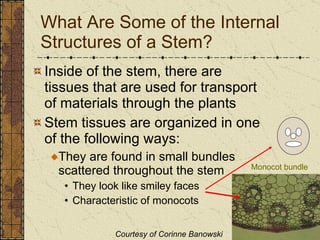
What Are Some of the Internal Structures of a Stem? Inside of the stem, there are tissues that are used for transport of materials through the plants Stem tissues are organized in one of the following ways: They are found in small bundles scattered throughout the stem They look like smiley faces Characteristic of monocots Courtesy of Corinne Banowski Monocot bundle
They are also found in rings around the stem They look like candy-corns Characteristic of dicots This is what gives the plant annual rings Determines the age of a plant Dicot bundle Courtesy of McGraw Hill Publishers
There are three important tissues found inside the stem: A)  xylem  – conducts the water and minerals upward throughout the plant Made of tube-like cells which grow together to conduct liquids Tends to be found closer to the center of the stem B)  phloem  – conducts the food that is produced in the leaf downward to the rest of the plant These cells also form tubes Tends to be found towards the outside of the stem
C)  Cambium  – the tissue responsible for the production of new xylem & phloem Also increases the girth (width) of a stem Generally found between the xylem and phloem
Location of Vascular Tissues Xylem Phloem Vascular Cambium Notice that monocots do not have cambium
What Are Some Different Kinds of Specialized Stems? We generally expect stems to be upright and above ground; however there are many stems that do not fit this mold Some stems are modified to store food or help the plant reproduce Some stems grow beneath the soil instead of above it There are five types of specialized stems
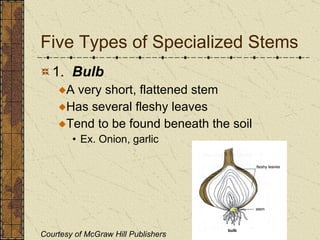
Five Types of Specialized Stems 1.  Bulb A very short, flattened stem Has several fleshy leaves Tend to be found beneath the soil Ex. Onion, garlic Courtesy of McGraw Hill Publishers
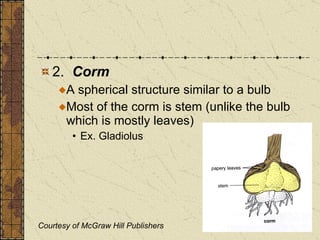
2.  Corm   A spherical structure similar to a bulb Most of the corm is stem (unlike the bulb which is mostly leaves) Ex. Gladiolus  Courtesy of McGraw Hill Publishers
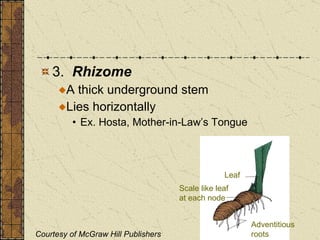
3.  Rhizome A thick underground stem  Lies horizontally Ex. Hosta, Mother-in-Law’s Tongue Leaf Scale like leaf at each node Adventitious roots Courtesy of McGraw Hill Publishers
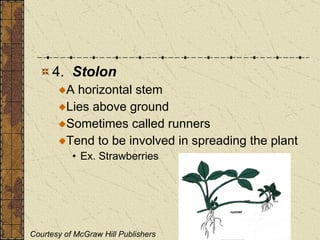
4.  Stolon A horizontal stem Lies above ground Sometimes called runners Tend to be involved in spreading the plant Ex. Strawberries Courtesy of McGraw Hill Publishers
5.  Tuber A rhizome with a tip that is swollen with stored food Ex. Potatoes Courtesy of McGraw Hill Publishers
Summary Name the four functions of the stem. What is the tip of the external stem called?  What kind of tissue does it have inside that allows it to grow? Where does a leaf and bud attach to the stem? When a leaf or bud falls off, what is left behind? Name the three types of internal tissues and their functions.
Summary continued In what directions do the xylem and phloem conduct materials? What increases the girth of a plant? Where does gas exchange occur on a stem? Name the five types of modified stems and give an example of each.

Stem anatomy

  • 1.
  • 2.
    Vocabulary Apical meristemBud scales Bud scale scar Bulb Cambium Corm Internode Lateral bud Leaf scar Lenticels Node Phloem Rhizome Stolon Terminal bud Tuber Xylem
  • 3.
    What Are theFunctions of a Stem? Stems have many important jobs in a plant They are responsible for the size and shape of a plant Some are made of wood and some are herbaceous There are four functions of the stem
  • 4.
    Functions of aStem 1. Stems support the leaves Able to stretch the leaves into the best positions for catching sunlight 2. Move water, minerals and food through the whole plant 3. Can also produced food through photosynthesis Not its main job, but will occur in plants with small or no leaves 4. Store food that has been manufactured by the plant Stems of bamboo plant Courtesy of McGraw Hill Publishing
  • 5.
    What Are Someof the Structures on the Outside of a Stem? There are many structures on the stem which are very useful to us in identifying plants Sometimes it is easier to identify a plant by its stem rather than its leaves There are eight structures found on the outside of a stem: 1. Terminal bud – contains apical meristem; found at the tip of a stem; it increases the length of a stem
  • 6.
    2. Node – where the leaf and bud attaches to the stem 3. Internode – distance between two nodes; tells how much the tree grew in one season 4. Lateral bud – also called the axillary bud; develops into a leaf or flower 5. Lateral and terminal buds are protected by bud scales – helps the bud survive harsh climate changes; when the bud opens in the spring, the scales fall off leaving a bud scale scar
  • 7.
    6. Leafscar – is the remains of the leaf after it has fallen off of the tree; it is just below the lateral bud If you look closely at the scar, you can see the remains of the vascular tissue (xylem & phloem) 7. Lenticels – are small spots on the stem that allow a stem to exchange gases (oxygen & carbon dioxide) with the environment
  • 8.
    External Parts ofa Stem Terminal bud Leaf scar with vascular bundle scars Lateral bud Lenticel Bud scale scar Node – where leaf & bud attach Internode – distance between 2 nodes
  • 9.
    What Are Someof the Internal Structures of a Stem? Inside of the stem, there are tissues that are used for transport of materials through the plants Stem tissues are organized in one of the following ways: They are found in small bundles scattered throughout the stem They look like smiley faces Characteristic of monocots Courtesy of Corinne Banowski Monocot bundle
  • 10.
    They are alsofound in rings around the stem They look like candy-corns Characteristic of dicots This is what gives the plant annual rings Determines the age of a plant Dicot bundle Courtesy of McGraw Hill Publishers
  • 11.
    There are threeimportant tissues found inside the stem: A) xylem – conducts the water and minerals upward throughout the plant Made of tube-like cells which grow together to conduct liquids Tends to be found closer to the center of the stem B) phloem – conducts the food that is produced in the leaf downward to the rest of the plant These cells also form tubes Tends to be found towards the outside of the stem
  • 12.
    C) Cambium – the tissue responsible for the production of new xylem & phloem Also increases the girth (width) of a stem Generally found between the xylem and phloem
  • 13.
    Location of VascularTissues Xylem Phloem Vascular Cambium Notice that monocots do not have cambium
  • 14.
    What Are SomeDifferent Kinds of Specialized Stems? We generally expect stems to be upright and above ground; however there are many stems that do not fit this mold Some stems are modified to store food or help the plant reproduce Some stems grow beneath the soil instead of above it There are five types of specialized stems
  • 15.
    Five Types ofSpecialized Stems 1. Bulb A very short, flattened stem Has several fleshy leaves Tend to be found beneath the soil Ex. Onion, garlic Courtesy of McGraw Hill Publishers
  • 16.
    2. Corm A spherical structure similar to a bulb Most of the corm is stem (unlike the bulb which is mostly leaves) Ex. Gladiolus Courtesy of McGraw Hill Publishers
  • 17.
    3. RhizomeA thick underground stem Lies horizontally Ex. Hosta, Mother-in-Law’s Tongue Leaf Scale like leaf at each node Adventitious roots Courtesy of McGraw Hill Publishers
  • 18.
    4. StolonA horizontal stem Lies above ground Sometimes called runners Tend to be involved in spreading the plant Ex. Strawberries Courtesy of McGraw Hill Publishers
  • 19.
    5. TuberA rhizome with a tip that is swollen with stored food Ex. Potatoes Courtesy of McGraw Hill Publishers
  • 20.
    Summary Name thefour functions of the stem. What is the tip of the external stem called? What kind of tissue does it have inside that allows it to grow? Where does a leaf and bud attach to the stem? When a leaf or bud falls off, what is left behind? Name the three types of internal tissues and their functions.
  • 21.
    Summary continued Inwhat directions do the xylem and phloem conduct materials? What increases the girth of a plant? Where does gas exchange occur on a stem? Name the five types of modified stems and give an example of each.

Editor's Notes

  • #5 Plant examples: Producing food in the stem = Scotch broom (if is used in floral designing) Storing food in stem = Jade plant and Asparagus fern
  • #6 Review apical meristem with your students. They should remember its general function when you talked about roots.