PLANT ANATOMY
 The study of internal structure and
organization of plant is called plant Anatomy
(Greek: Ana = as under; temnein = to cut).
 Father of Plant Anatomy - Nehemiah Grew
 Plant anatomy or phytotomy is the general
term for the study of the
internal structure of plants
 A Tissue is a group of cells that are alike in
origin, structure and function. The study of
tissue is called Histology.
 A plant is made up of different types of
tissues. There are two principal groups:
◦ 1. Meristematic tissues
◦ 2. Permanent tissues
 A meristem is the tissue in most plants
containing undifferentiated cells
(meristematic cells), found in zones of the
plant where growth can take place
 Meristematic Tissue
Characteristics and classification
The term meristem is coined by C. Nageli
o The meristematic cells are isodiametric and they
may be, oval, spherical or polygonal in shape.
o They have generally dense cytoplasm with
prominent nucleus.
o Generally the vacuoles in them are either small or
absent.
o Their cell wall is thin, elastic and essentially made
up of cellulose.
o These are most actively dividing cells. •
Meristematic cells are self-perpetuating
Based on position
 Apical meristem - Present in apices of root
and shoot. It is responsible for increase in
the length of the plant, it is called as primary
growth
 Intercalary meristem - Occurs between the
mature tissues. It is responsible for
elongation of internodes
 Lateral meristem - Occurs along the
longitudinal axis of stem and root. It is
responsible for secondary tissues and
thickening of stem and root. Eg: vascular
cambium and cork cambium.
Based on origin
 Primary Meristem - It is derived from
embryonic stages and differentiated
into primary permanent tissues.
 Secondary meristem - It is derived
during later stage of development of
the plant body. It produces cork
cambium and interfascicular cambium.
Based on function
 Protoderm - It gives rise to epidermal
tissue system and develops into
epidermis, stomata and hairs.
 Procambium - It gives rise to primary
vascular tissues. Example: xylem and
phloem .
 Ground Meristem - It gives rise to all
tissues except epidermis and vascular
strands.
Based on plane of division
 Mass meristem - It divides in all planes.
Example: endosperm,young embryo
and sporangium
 Rib meristem or File meristem - It
divides anticlinally in one plane.
Example: development of cortex and
pith
 Plate meristem - It divides anticlinally
in two planes. Example: development of
epidermis
Permanent Tissue
 The Permanent tissues develop from
apical meristem. They lose the power of
cell division either permanently or
temporarily.
They are classified into two types:
1. Simple permanent tissues.
2. Complex permanent tissues
Simple Permanent Tissues
 Simple tissues are composed of one
type of cells only.
 The cells are structurally and
functionally similar.
 It is of three types.
1. Parenchyma
2. Collenchyma
3. Sclerenchyma
Parenchyma
 Parenchyma is generally present in all organs of the
plant.
 It forms the ground tissue in a plant. Parenchyma is
a living tissue and made up of thin walled cells.
 The cell wall is made up of cellulose.
 Parenchyma cells may be oval, polyhedral,
cylindrical, irregular, elongated or armed.
 Parenchyma may store various types of materials
like, water, air, ergastic substances.
 It is usually colourless.
 The turgid parenchyma cells help in giving rigidity
to the plant body. Partial conduction of water is also
maintained through parenchymatous cells.
Types of parenchyma
1) Aerenchyma: Parenchyma which
contains air in its intercellular spaces.
It helps in aeration and buoyancy. Eg:
Nymphae and Hydrilla.
2) Storage Parenchyma: Parenchyma
stores food materials. Eg: Root and
stem tubers.
3) Stellate Parenchyma: Star shaped
parenchyma. Eg: Petioles of Banana
and Canna.
4. Chlorenchyma: Parenchyma cells with
chlorophyll. Function is
photosynthesis. Example: Mesophyll
of leaves.
5. Prosenchyma: Parenchyma cells
became elongated, pointed and
slightly thick walled. It provides
mechanical support.
Collenchyma
 Collenchyma is a simple, living mechanical
tissue.
 Collenchyma generally occurs in
hypodermis of dicot stem.
 It is absent in the roots and also occurs in
petioles and pedicels.
 The cells are elongated and appear
polygonal in cross section.
 The cell wall is unevenly thickened. It
contains more of hemicellulose and pectin
besides cellulose.
 It provides mechanical support and
elasticity to the growing parts of the plant.
Collenchyma types
 Angular collenchyma -
It is the most common type of
collenchyma with irregular arrangement
and thickening at the angles where cells
meets. Eg:Hypodermis of Datura and
Nicotiana
 Lacunar collenchyma -
The collenchyma cells are irregularly
arranged. Cell wall is thickening on the
walls bordering intercellular spaces.
Eg:Hypodermis of Ipomoea
 Lamellar collenchyma
The collenchyma cells are arranged
compactly in layers(rows). The Cell wall
is thickening is at tangential walls.
These thickening appear as successive
tangential layers. Eg: Hypodermis of
Helianthus
Sclerenchyma
 Sclerenchyma
The sclerenchyma is a dead cell and
lacks protoplasm. The cells are long or
short, narrow thick walled and lignified
secondary walls. The cell walls of these
cells are uniformly and strongly
thickened. The sclerenchymatous cells
are of two types:
1. Sclereids
2. Fibres
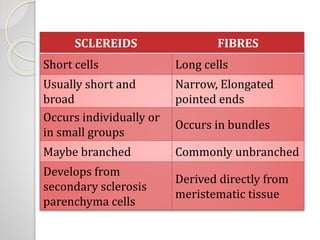
SCLEREIDS FIBRES
Short cells Long cells
Usually short and
broad
Narrow, Elongated
pointed ends
Occurs individually or
in small groups
Occurs in bundles
Maybe branched Commonly unbranched
Develops from
secondary sclerosis
parenchyma cells
Derived directly from
meristematic tissue
Prepared by

Plant anatomy 1

  • 2.
    PLANT ANATOMY  Thestudy of internal structure and organization of plant is called plant Anatomy (Greek: Ana = as under; temnein = to cut).  Father of Plant Anatomy - Nehemiah Grew  Plant anatomy or phytotomy is the general term for the study of the internal structure of plants
  • 3.
     A Tissueis a group of cells that are alike in origin, structure and function. The study of tissue is called Histology.  A plant is made up of different types of tissues. There are two principal groups: ◦ 1. Meristematic tissues ◦ 2. Permanent tissues  A meristem is the tissue in most plants containing undifferentiated cells (meristematic cells), found in zones of the plant where growth can take place
  • 4.
     Meristematic Tissue Characteristicsand classification The term meristem is coined by C. Nageli o The meristematic cells are isodiametric and they may be, oval, spherical or polygonal in shape. o They have generally dense cytoplasm with prominent nucleus. o Generally the vacuoles in them are either small or absent. o Their cell wall is thin, elastic and essentially made up of cellulose. o These are most actively dividing cells. • Meristematic cells are self-perpetuating
  • 5.
    Based on position Apical meristem - Present in apices of root and shoot. It is responsible for increase in the length of the plant, it is called as primary growth  Intercalary meristem - Occurs between the mature tissues. It is responsible for elongation of internodes  Lateral meristem - Occurs along the longitudinal axis of stem and root. It is responsible for secondary tissues and thickening of stem and root. Eg: vascular cambium and cork cambium.
  • 6.
    Based on origin Primary Meristem - It is derived from embryonic stages and differentiated into primary permanent tissues.  Secondary meristem - It is derived during later stage of development of the plant body. It produces cork cambium and interfascicular cambium.
  • 7.
    Based on function Protoderm - It gives rise to epidermal tissue system and develops into epidermis, stomata and hairs.  Procambium - It gives rise to primary vascular tissues. Example: xylem and phloem .  Ground Meristem - It gives rise to all tissues except epidermis and vascular strands.
  • 8.
    Based on planeof division  Mass meristem - It divides in all planes. Example: endosperm,young embryo and sporangium  Rib meristem or File meristem - It divides anticlinally in one plane. Example: development of cortex and pith  Plate meristem - It divides anticlinally in two planes. Example: development of epidermis
  • 9.
    Permanent Tissue  ThePermanent tissues develop from apical meristem. They lose the power of cell division either permanently or temporarily. They are classified into two types: 1. Simple permanent tissues. 2. Complex permanent tissues
  • 10.
    Simple Permanent Tissues Simple tissues are composed of one type of cells only.  The cells are structurally and functionally similar.  It is of three types. 1. Parenchyma 2. Collenchyma 3. Sclerenchyma
  • 11.
    Parenchyma  Parenchyma isgenerally present in all organs of the plant.  It forms the ground tissue in a plant. Parenchyma is a living tissue and made up of thin walled cells.  The cell wall is made up of cellulose.  Parenchyma cells may be oval, polyhedral, cylindrical, irregular, elongated or armed.  Parenchyma may store various types of materials like, water, air, ergastic substances.  It is usually colourless.  The turgid parenchyma cells help in giving rigidity to the plant body. Partial conduction of water is also maintained through parenchymatous cells.
  • 12.
    Types of parenchyma 1)Aerenchyma: Parenchyma which contains air in its intercellular spaces. It helps in aeration and buoyancy. Eg: Nymphae and Hydrilla. 2) Storage Parenchyma: Parenchyma stores food materials. Eg: Root and stem tubers. 3) Stellate Parenchyma: Star shaped parenchyma. Eg: Petioles of Banana and Canna.
  • 13.
    4. Chlorenchyma: Parenchymacells with chlorophyll. Function is photosynthesis. Example: Mesophyll of leaves. 5. Prosenchyma: Parenchyma cells became elongated, pointed and slightly thick walled. It provides mechanical support.
  • 14.
    Collenchyma  Collenchyma isa simple, living mechanical tissue.  Collenchyma generally occurs in hypodermis of dicot stem.  It is absent in the roots and also occurs in petioles and pedicels.  The cells are elongated and appear polygonal in cross section.  The cell wall is unevenly thickened. It contains more of hemicellulose and pectin besides cellulose.  It provides mechanical support and elasticity to the growing parts of the plant.
  • 15.
    Collenchyma types  Angularcollenchyma - It is the most common type of collenchyma with irregular arrangement and thickening at the angles where cells meets. Eg:Hypodermis of Datura and Nicotiana  Lacunar collenchyma - The collenchyma cells are irregularly arranged. Cell wall is thickening on the walls bordering intercellular spaces. Eg:Hypodermis of Ipomoea
  • 16.
     Lamellar collenchyma Thecollenchyma cells are arranged compactly in layers(rows). The Cell wall is thickening is at tangential walls. These thickening appear as successive tangential layers. Eg: Hypodermis of Helianthus
  • 17.
    Sclerenchyma  Sclerenchyma The sclerenchymais a dead cell and lacks protoplasm. The cells are long or short, narrow thick walled and lignified secondary walls. The cell walls of these cells are uniformly and strongly thickened. The sclerenchymatous cells are of two types: 1. Sclereids 2. Fibres
  • 18.
    SCLEREIDS FIBRES Short cellsLong cells Usually short and broad Narrow, Elongated pointed ends Occurs individually or in small groups Occurs in bundles Maybe branched Commonly unbranched Develops from secondary sclerosis parenchyma cells Derived directly from meristematic tissue
  • 19.