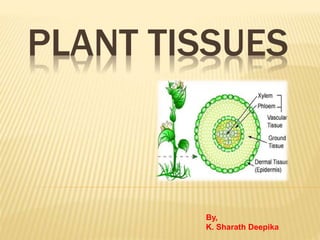
PLANT TISSUES
By,
K. Sharath Deepika
WHAT IS A TISSUE?
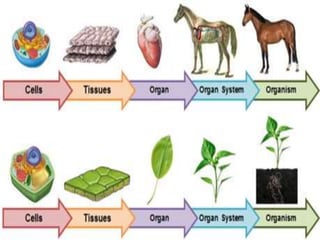
 A tissue is an ensemble of similar cells and
from the same origin, that together carry out
a specific function.
 These are called tissues because of their
identical functioning.
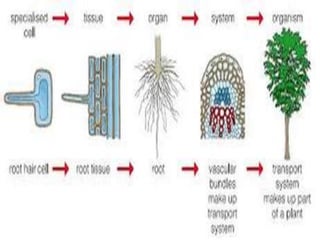
 Tissue systems are then formed by the
functional grouping together of multiple
tissues.
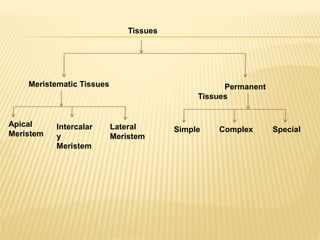
Tissues
Meristematic Tissues Permanent
Tissues
Apical
Meristem
Lateral
Meristem
Simple Complex SpecialIntercalar
y
Meristem
MERISTEMATIC TISSUE
 Meristematic tissue is the composition of the
meristematic cells.
 The Meristematic cells are usually thin walled
living cells with dense cytoplasm and a large
nucleus.
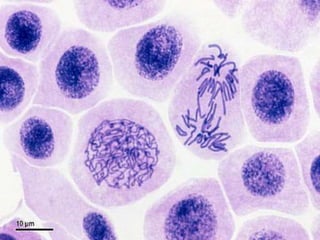
 Meristems are called the group of young
cells that have capacity to divide into new
cells.
KINDS OF MERISTEMS
Kinds of meristems:
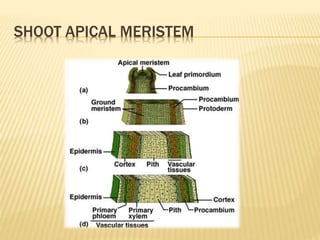
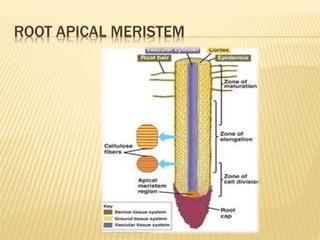
 Apical meristems – found at the tip of stems & roots
- types: 1. Shoot Apex, 2.Root Apex.
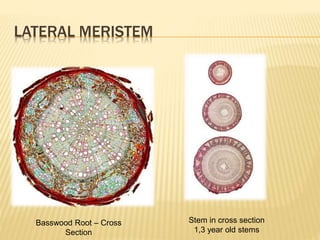
 Lateral meristems – cambium
- found along the sides of roots & stems
- increase width or diameter of stems & roots
- types: 1. vascular cambium 2. cork cambium
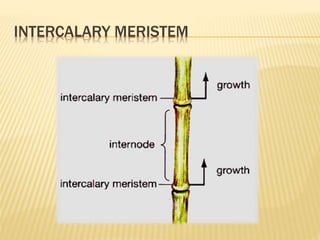
 Intercallary meristems – found at the bases of young
leaves & internodes
- responsible for further lengthening of stems &
leaves
SHOOT APICAL MERISTEM
ROOT APICAL MERISTEM
LATERAL MERISTEM
Basswood Root – Cross
Section
Stem in cross section
1,3 year old stems
INTERCALARY MERISTEM
PERMANENT TISSUES
 A Permanent Tissue is formed by the division
and differentiation of meristematic cells.
 The cells of these tissues have lost the
power of division permanently.
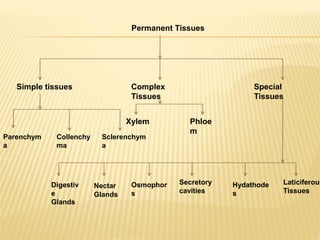
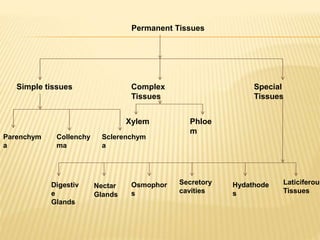
 Permanent Tissues can be classified into
three types – (i) Simple, (ii) Complex, (iii)
Special Tissues.
Permanent Tissues
Simple tissues Complex
Tissues
Special
Tissues
Xylem Phloe
m
Parenchym
a
Collenchy
ma
Sclerenchym
a
Digestiv
e
Glands
Nectar
Glands
Osmophor
s
Hydathode
s
Laticiferous
Tissues
Secretory
cavities
SIMPLE TISSUES
 A group of similar cells that perform a
common function is called a Simple Tissue.
 It is of three different types, they are
- Parenchyma
- Collenchyma
- Sclerenchyma
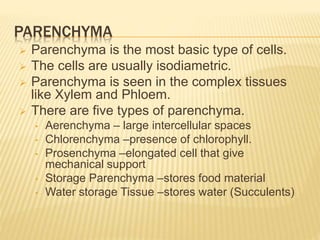
PARENCHYMA
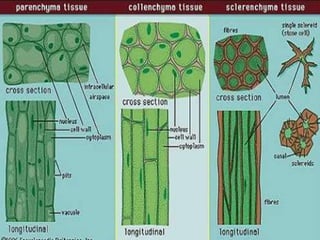
 Parenchyma is the most basic type of cells.
 The cells are usually isodiametric.
 Parenchyma is seen in the complex tissues
like Xylem and Phloem.
 There are five types of parenchyma.
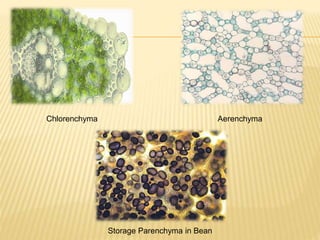
• Aerenchyma – large intercellular spaces
• Chlorenchyma –presence of chlorophyll.
• Prosenchyma –elongated cell that give
mechanical support
• Storage Parenchyma –stores food material
• Water storage Tissue –stores water (Succulents)
Chlorenchyma Aerenchyma
Storage Parenchyma in Bean
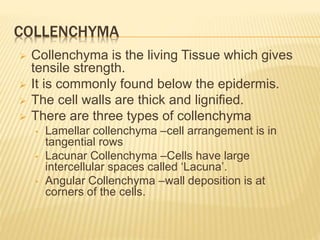
COLLENCHYMA
 Collenchyma is the living Tissue which gives
tensile strength.
 It is commonly found below the epidermis.
 The cell walls are thick and lignified.
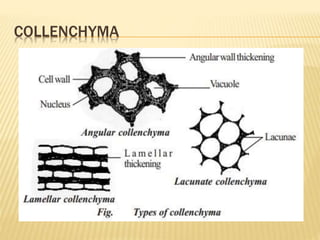
 There are three types of collenchyma
• Lamellar collenchyma –cell arrangement is in
tangential rows
• Lacunar Collenchyma –Cells have large
intercellular spaces called ‘Lacuna’.
• Angular Collenchyma –wall deposition is at
corners of the cells.
COLLENCHYMA
SCLERENCHYMA
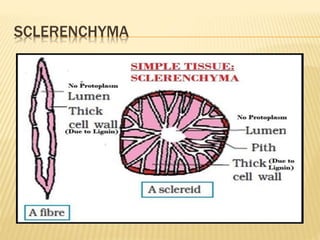
 Sclerenchyma is a dead tissue that gives
mechanical support.
 The cell wall is made of cellulose and lignin.
 They are of two types:
• Fibres –elongated cell with tappering ends.
(i) Xylary fibres – present in xylem
(ii) Extra xylary fibres –present other than xylem
• Sclereids –short and are irregular in shapes.
Ex: astro sclerieds, osteo sclereids etc.
SCLERENCHYMA
FUNCTIONS OF SIMPLE TISSUES
 Parenchyma plays a vital role in
Photosynthesis, Respiration, Storage and
Secretion.
 Parenchyma gives turgidity to the young
plants.
 Collenchyma gives flexibility an elasticity to
the plant.
 Sclerenchyma protects the plant from
stretching, bending, weight, pressure.
COMPLEX TISSUES
 Tissues with different kinds of cells perform
similar function.
 They are mainly helpful in conduction.
 There are two main types:
• Xylem
• Phloem
XYLEM
 Xylem in the water conducting tissue and
also provides mechanical support.
 It originates from two sources like
procambium and the vascular cambium.
 The first formed cells are called protoxylem
and the latter are called metaxylem
elements.
STRUCTURE OF XYLEM
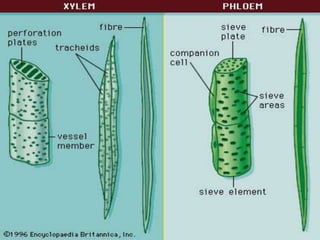
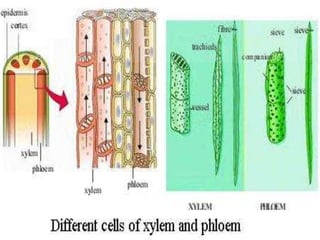
 It is composed of three types of cells.
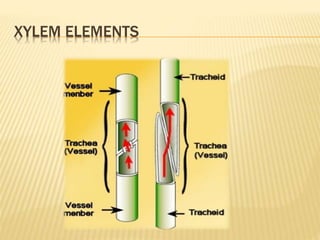
• Tracheary elements –There are dead cells, conduct
water.
(i) Tracheids: elongated with tappering ends.
(ii) Vessel elements: wide and cylindrical structures.
• Vessel Elements –They are wide and cylindrical.
• Xylem Fibres –They are dead with thick lignified
walls.
• Xylem Parenchyma –normal parenchyma cells.
(i) Axial Parenchyma – develops from fusiform cells
(ii) Ray Parenchyma –develops from ray initials.
XYLEM ELEMENTS
PHLOEM
 Phloem conducts water, minerals and gives
mechanical support.
 It originates from two sources like
procambium and vascular cambium.
 The first formed cells are called protophloem
and latter are metaphloem.
STRUCTURE OF PHLOEM
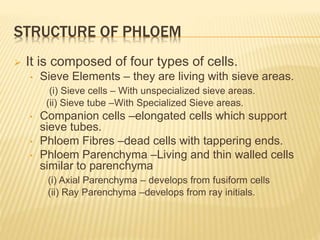
 It is composed of four types of cells.
• Sieve Elements – they are living with sieve areas.
(i) Sieve cells – With unspecialized sieve areas.
(ii) Sieve tube –With Specialized Sieve areas.
• Companion cells –elongated cells which support
sieve tubes.
• Phloem Fibres –dead cells with tappering ends.
• Phloem Parenchyma –Living and thin walled cells
similar to parenchyma
(i) Axial Parenchyma – develops from fusiform cells
(ii) Ray Parenchyma –develops from ray initials.
Permanent Tissues
Simple tissues Complex
Tissues
Special
Tissues
Xylem Phloe
m
Parenchym
a
Collenchy
ma
Sclerenchym
a
Digestiv
e
Glands
Nectar
Glands
Osmophor
s
Hydathode
s
Laticiferous
Tissues
Secretory
cavities
SECRETORY (OR) SPECIAL TISSUES
 The cells or tissues that are concerned with
secretion or excretion from the plant body.
 They are located in different parts of the plant
body and are widely distributed.
 Many plant secretions are of high
considerable economic importance.
 They include rubber, gums, oils, resins and
mucilage.
TYPES OF SPECIAL TISSUES
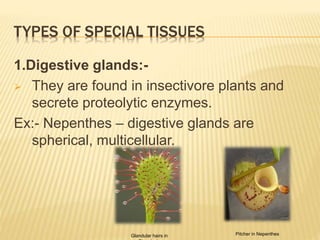
1.Digestive glands:-
 They are found in insectivore plants and
secrete proteolytic enzymes.
Ex:- Nepenthes – digestive glands are
spherical, multicellular.
Glandular hairs in Pitcher in Nepenthes
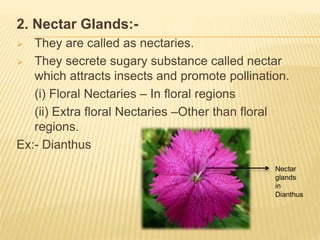
2. Nectar Glands:-
 They are called as nectaries.
 They secrete sugary substance called nectar
which attracts insects and promote pollination.
(i) Floral Nectaries – In floral regions
(ii) Extra floral Nectaries –Other than floral
regions.
Ex:- Dianthus
Nectar
glands
in
Dianthus
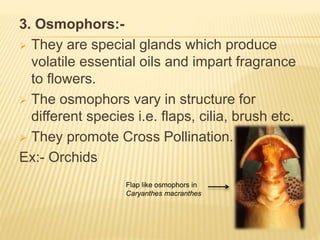
3. Osmophors:-
 They are special glands which produce
volatile essential oils and impart fragrance
to flowers.
 The osmophors vary in structure for
different species i.e. flaps, cilia, brush etc.
 They promote Cross Pollination.
Ex:- Orchids
Flap like osmophors in
Caryanthes macranthes
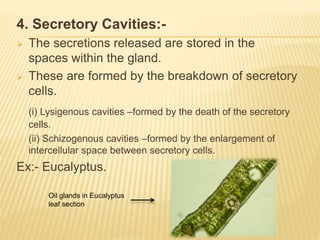
4. Secretory Cavities:-
 The secretions released are stored in the
spaces within the gland.
 These are formed by the breakdown of secretory
cells.
(i) Lysigenous cavities –formed by the death of the secretory
cells.
(ii) Schizogenous cavities –formed by the enlargement of
intercellular space between secretory cells.
Ex:- Eucalyptus.
Oil glands in Eucalyptus
leaf section
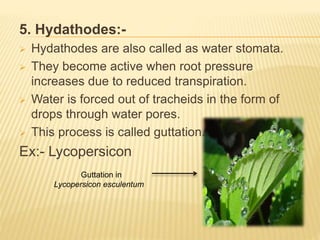
5. Hydathodes:-
 Hydathodes are also called as water stomata.
 They become active when root pressure
increases due to reduced transpiration.
 Water is forced out of tracheids in the form of
drops through water pores.
 This process is called guttation.
Ex:- Lycopersicon
Guttation in
Lycopersicon esculentum
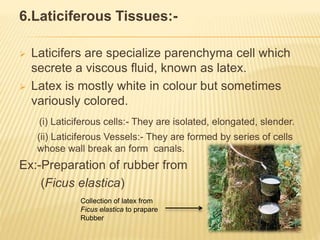
6.Laticiferous Tissues:-
 Laticifers are specialize parenchyma cell which
secrete a viscous fluid, known as latex.
 Latex is mostly white in colour but sometimes
variously colored.
(i) Laticiferous cells:- They are isolated, elongated, slender.
(ii) Laticiferous Vessels:- They are formed by series of cells
whose wall break an form canals.
Ex:-Preparation of rubber from
(Ficus elastica)
Collection of latex from
Ficus elastica to prapare
Rubber
REFERENCE
 www.wikipedia.org – Tissue, Types of Tissue
– 23/12/2012.
 www.googleimages.com – tissue pictures -
23/12/2012
 Common core a textbook of Botany –
Special Tissues – 23/12/2012.
Botany ppt on tissues

Botany ppt on tissues

  • 1.
  • 3.
    WHAT IS ATISSUE?  A tissue is an ensemble of similar cells and from the same origin, that together carry out a specific function.  These are called tissues because of their identical functioning.  Tissue systems are then formed by the functional grouping together of multiple tissues.
  • 5.
  • 6.
    MERISTEMATIC TISSUE  Meristematictissue is the composition of the meristematic cells.  The Meristematic cells are usually thin walled living cells with dense cytoplasm and a large nucleus.  Meristems are called the group of young cells that have capacity to divide into new cells.
  • 8.
    KINDS OF MERISTEMS Kindsof meristems:  Apical meristems – found at the tip of stems & roots - types: 1. Shoot Apex, 2.Root Apex.  Lateral meristems – cambium - found along the sides of roots & stems - increase width or diameter of stems & roots - types: 1. vascular cambium 2. cork cambium  Intercallary meristems – found at the bases of young leaves & internodes - responsible for further lengthening of stems & leaves
  • 9.
  • 10.
  • 11.
    LATERAL MERISTEM Basswood Root– Cross Section Stem in cross section 1,3 year old stems
  • 12.
  • 13.
    PERMANENT TISSUES  APermanent Tissue is formed by the division and differentiation of meristematic cells.  The cells of these tissues have lost the power of division permanently.  Permanent Tissues can be classified into three types – (i) Simple, (ii) Complex, (iii) Special Tissues.
  • 14.
    Permanent Tissues Simple tissuesComplex Tissues Special Tissues Xylem Phloe m Parenchym a Collenchy ma Sclerenchym a Digestiv e Glands Nectar Glands Osmophor s Hydathode s Laticiferous Tissues Secretory cavities
  • 15.
    SIMPLE TISSUES  Agroup of similar cells that perform a common function is called a Simple Tissue.  It is of three different types, they are - Parenchyma - Collenchyma - Sclerenchyma
  • 17.
    PARENCHYMA  Parenchyma isthe most basic type of cells.  The cells are usually isodiametric.  Parenchyma is seen in the complex tissues like Xylem and Phloem.  There are five types of parenchyma. • Aerenchyma – large intercellular spaces • Chlorenchyma –presence of chlorophyll. • Prosenchyma –elongated cell that give mechanical support • Storage Parenchyma –stores food material • Water storage Tissue –stores water (Succulents)
  • 18.
  • 19.
    COLLENCHYMA  Collenchyma isthe living Tissue which gives tensile strength.  It is commonly found below the epidermis.  The cell walls are thick and lignified.  There are three types of collenchyma • Lamellar collenchyma –cell arrangement is in tangential rows • Lacunar Collenchyma –Cells have large intercellular spaces called ‘Lacuna’. • Angular Collenchyma –wall deposition is at corners of the cells.
  • 20.
  • 21.
    SCLERENCHYMA  Sclerenchyma isa dead tissue that gives mechanical support.  The cell wall is made of cellulose and lignin.  They are of two types: • Fibres –elongated cell with tappering ends. (i) Xylary fibres – present in xylem (ii) Extra xylary fibres –present other than xylem • Sclereids –short and are irregular in shapes. Ex: astro sclerieds, osteo sclereids etc.
  • 22.
  • 23.
    FUNCTIONS OF SIMPLETISSUES  Parenchyma plays a vital role in Photosynthesis, Respiration, Storage and Secretion.  Parenchyma gives turgidity to the young plants.  Collenchyma gives flexibility an elasticity to the plant.  Sclerenchyma protects the plant from stretching, bending, weight, pressure.
  • 24.
    COMPLEX TISSUES  Tissueswith different kinds of cells perform similar function.  They are mainly helpful in conduction.  There are two main types: • Xylem • Phloem
  • 25.
    XYLEM  Xylem inthe water conducting tissue and also provides mechanical support.  It originates from two sources like procambium and the vascular cambium.  The first formed cells are called protoxylem and the latter are called metaxylem elements.
  • 26.
    STRUCTURE OF XYLEM It is composed of three types of cells. • Tracheary elements –There are dead cells, conduct water. (i) Tracheids: elongated with tappering ends. (ii) Vessel elements: wide and cylindrical structures. • Vessel Elements –They are wide and cylindrical. • Xylem Fibres –They are dead with thick lignified walls. • Xylem Parenchyma –normal parenchyma cells. (i) Axial Parenchyma – develops from fusiform cells (ii) Ray Parenchyma –develops from ray initials.
  • 27.
  • 28.
    PHLOEM  Phloem conductswater, minerals and gives mechanical support.  It originates from two sources like procambium and vascular cambium.  The first formed cells are called protophloem and latter are metaphloem.
  • 30.
    STRUCTURE OF PHLOEM It is composed of four types of cells. • Sieve Elements – they are living with sieve areas. (i) Sieve cells – With unspecialized sieve areas. (ii) Sieve tube –With Specialized Sieve areas. • Companion cells –elongated cells which support sieve tubes. • Phloem Fibres –dead cells with tappering ends. • Phloem Parenchyma –Living and thin walled cells similar to parenchyma (i) Axial Parenchyma – develops from fusiform cells (ii) Ray Parenchyma –develops from ray initials.
  • 32.
    Permanent Tissues Simple tissuesComplex Tissues Special Tissues Xylem Phloe m Parenchym a Collenchy ma Sclerenchym a Digestiv e Glands Nectar Glands Osmophor s Hydathode s Laticiferous Tissues Secretory cavities
  • 33.
    SECRETORY (OR) SPECIALTISSUES  The cells or tissues that are concerned with secretion or excretion from the plant body.  They are located in different parts of the plant body and are widely distributed.  Many plant secretions are of high considerable economic importance.  They include rubber, gums, oils, resins and mucilage.
  • 34.
    TYPES OF SPECIALTISSUES 1.Digestive glands:-  They are found in insectivore plants and secrete proteolytic enzymes. Ex:- Nepenthes – digestive glands are spherical, multicellular. Glandular hairs in Pitcher in Nepenthes
  • 35.
    2. Nectar Glands:- They are called as nectaries.  They secrete sugary substance called nectar which attracts insects and promote pollination. (i) Floral Nectaries – In floral regions (ii) Extra floral Nectaries –Other than floral regions. Ex:- Dianthus Nectar glands in Dianthus
  • 36.
    3. Osmophors:-  Theyare special glands which produce volatile essential oils and impart fragrance to flowers.  The osmophors vary in structure for different species i.e. flaps, cilia, brush etc.  They promote Cross Pollination. Ex:- Orchids Flap like osmophors in Caryanthes macranthes
  • 37.
    4. Secretory Cavities:- The secretions released are stored in the spaces within the gland.  These are formed by the breakdown of secretory cells. (i) Lysigenous cavities –formed by the death of the secretory cells. (ii) Schizogenous cavities –formed by the enlargement of intercellular space between secretory cells. Ex:- Eucalyptus. Oil glands in Eucalyptus leaf section
  • 38.
    5. Hydathodes:-  Hydathodesare also called as water stomata.  They become active when root pressure increases due to reduced transpiration.  Water is forced out of tracheids in the form of drops through water pores.  This process is called guttation. Ex:- Lycopersicon Guttation in Lycopersicon esculentum
  • 39.
    6.Laticiferous Tissues:-  Laticifersare specialize parenchyma cell which secrete a viscous fluid, known as latex.  Latex is mostly white in colour but sometimes variously colored. (i) Laticiferous cells:- They are isolated, elongated, slender. (ii) Laticiferous Vessels:- They are formed by series of cells whose wall break an form canals. Ex:-Preparation of rubber from (Ficus elastica) Collection of latex from Ficus elastica to prapare Rubber
  • 40.
    REFERENCE  www.wikipedia.org –Tissue, Types of Tissue – 23/12/2012.  www.googleimages.com – tissue pictures - 23/12/2012  Common core a textbook of Botany – Special Tissues – 23/12/2012.