ROOTS
GROUP 3
OUTLINE:
I. A Brief Definition of Roots
II. Perspective: evolution of the root
III. Gross morphology (Tap Root and Fibrous Root)
IV. Apical meristems
V. Primary Structures
A. Primary tissues and tissue regions
• Epidermis
• Cortex
• Endodermis
• Pericycle
• Vascular System
B. Development of primary tissues
VI. Development of Lateral Roots
VII. Development of Adventitious Roots
VIII. Root Morphogenesis
IX. Secondary Structure
A. Initiation and Activity of Vascular Cambium
B. Initiation and Activity of Cork Cambium
C. Cambial Activity in Storage Roots
(Anomalous Roots)
X. Modified Roots
A. Contractile Roots
B. Mycorrhiza
C. Root Nodules
•Nitrogen fixation in root nodules
D. Other Modified Roots
XI. Lateral transport of water and minerals in the
young root
XII. Types of Roots and Specialized Roots
XIII. Application of Roots
ROOT “the hidden half”
 constitutes the underground part of the plant
axis
 organ of a plant that typically lies below the
surface of the soil
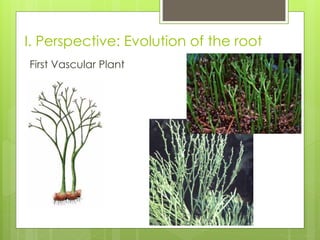
I. Perspective: Evolution of the root
First Vascular Plant
 Rhyniophytes
 Trimerophytes
 Progymnosperms
 Seed plants
 Lycophytes
 Spenophytes
 Ferns
 Anchorage
 Absorption
 Transport of
minerals and water
 Storage of
photosynthate
Rhaphanus sativus (radish)
Arabidopsis thaliana
Two categories:
TAP ROOT SYSTEM
 common in
dicotyledons
 a vertical oriented
single large main root
with small lateral
roots
 develops from a
meristem of the lower
end of the hypocotyl
of the embryo
FIBROUS ROOT SYSTEM
 common in
monocotyledons
 roots in a system that
is made up of many
threadlike members
of more or less equal
length
APICAL MERISTEM
 Pteridophytes – single apical initial
 Lycophytes – small cluster of apical initials
 Monocotyledons – having three tiers of initials
MONOCOTYLEDON
DICOTYLEDON
CLOWES 1959 Hanstein 19th century
The quiescent center and its
role in development
 Ponce et. al.
described quiescent center as “an architectural
template in the root apical meristem of all
angiosperms and gymnosperm root tips” (which
with surrounding initials)
May regulate the positional and structural
expression of …genes ( which control the
differentiation of tissue region in roots)
TISSUES OF A ROOT
 Root tissues can be regarded as a series of
concentric rings of different tissues
EPIDERMIS
• Single layer of cells
on the exterior of
the root
• NOT covered with
a cuticle
root is designed
for water uptake
 cuticle is a
barrier
to water
VELAMEN
 composed of
compactly arranged
non-living cells
 bearing secondary
wall thickenings
 primary role as
mechanical
protection and
reduction in loss of
water from the cortex
PNEUMATODES
 present in velamen
 cells have spiral
thickenings
 help in gaseous
exchange
Cell type found in epidermis
ROOT HAIRS
 developed from the
epidermal cells away
from the root tip
 increasing the surface
area available for
water and mineral
absorption
CORTEX
• comprised of large
undifferentiated
cells (band of
parenchyma cells)
• functions in the
storage of food
reserves (proteins
and starches) in
root tissues
ENDODERMIS
• regulate the uptake
of water and nutrients
into the plant
• spaces between the
cells are covered with
a waxy layer, called
suberin
 Similar to grout
between ceramic
tiles, and serves a
similar function
Epidermis
Cortex
Endodermis
Pericycle
Vascular
System
Phloem
Cambium
Xylem
Cell type found in endodermis
CASPARIAN STRIP
 prevents water
and solutes from
passing between
cells into vascular
cylinder
 transports proteins
and controls the
flow
In plant anatomy, the Casparian strip is a band of cell wall
material deposited on the radial and transverse walls of the
endodermis, and is chemically different from the rest of the
cell wall, being made of suberin and lignin. It blocks the
passive flow of materials such as water and solutes into the
stele of a plant. The band was first recognized as a wall
structure by Robert Caspary (1818–1887).
PERICYCLE
• a thin layer of
undifferentiated
cells (parenchyma
cells)
• a meristem tissue
• the source of new
lateral or
secondary roots
• surrounds the
vascular bundles
Vascular tissue
 the transport system
 Phloem
living cells comprised of seive tube
elements and companion cells
 Cambium
a meristematic tissue supplying cells
that will develop into vascular
structures
 Xylem
dead cells with thickened cell walls,
typically larger than phloem cells
functions in the transport of water and
mineral nutrients
PITH
 a very small area in the center
(parenchymatous cells with
intercellular space)
Root Morphogenesis: The root
apex
 The part of the root where growth and
development starts.
 Close to the tip is where the production of
new cells and the elongation of the recently-
made cells take place. Such growth in cell
length and cell numbers is how roots can
make their way towards the soil and search
for untapped water and minerals. The
expanded network of roots can also provide
anchorage for the plant.
Primary Development of the
Root Tip  Region of cell division
~1 mm in length.
Apical meristem
 Region of cell elongation
~2 mm in length.
Cells elongate, functional
xylem starts to develop and
phloem is mature
 Region of maturation
~2 mm in length.
Root hairs are
produced, functional xylem
and phloem are present.
Development of Lateral Roots
A, B – Stele
C, D – Endodermis
E, F –
Endodermis/Stele
Development of
Adventitious Roots
 Adventitious roots
 the roots developing from any part other than
the radicle.
 they cover those roots that develop from stems
(both aerial and underground) and their
branches, from leaves, from large roots and from
the hypocotyls of young plants.
 the adventitious roots have a deep seated origin.
 they are found in the cortical tissue of bonds and
hypocotyls, stem pericycle, ray parenchyma
between pericycle and cambium, non-
differentiated secondary phloem and cambium
between the vascular bundles, interfascicular
cambium and pericycle or the stem pith,
parenchymatous regions in secondary xylem
formed due to the presence of leaf gaps or
tissues of leaf margins and petioles.
 Adventitious roots
are most easily
seen in an
epiphytic orchid.
Though these stems
are more upright,
they are
modifications of
creeping rhizomes.
Root Penetration
Root depth and distance
depend on soil:
 Moisture
 Temperature
 Composition
 Feeder Roots- those
involved in uptake of
water and minerals,
occur usually in the
upper 1 meter of the
soil.
Types of Roots
and
Specialized
Roots
Adventitious roots
 If primary root stops growing early on and
new roots grow from the stem, it is a Fibrous
Root System
 They commonly occur in monocots and
pteridophytes, but also in dicot
 Growth of radicle is usually arrested at an
early stage and is replaced by numerous
root that develop from the stem.
Tap Root
 If primary root becomes the
main root
 A persistent taproot system
forms when the radicle keeps
growing and smaller lateral roots
form along the taproot.
The shape of taproots can vary
but the typical shapes include:
 Conical root: this type of root tuber is conical in
shape, i.e. widest at the top and tapering steadily
towards the bottom.
e.g. carrot
 Fusiform root: this root is widest in the middle and
tapers towards the top and the bottom.
e.g. radish
 Napiform root: the root has a top-like
appearance. It is very broad at the top and tapers
suddenly like a tail at the bottom.
e.g. Turnips
Fibrous vs. Taproot
Aerating roots (or knee root or
knee or pneumatophores or
Cypress knee):
 Roots rising above the ground,
especially above water such as
in some mangrove genera
(Avicennia, Sonneratia)
 the erect roots have a large
number of breathing pores
for exchange of gases.
Aerial Root
 roots entirely above the ground
 Many aerial roots, are used to receive
water and nutrient intake directly from the
air - from fogs, dew or humidity in the air.
 Epiphytes - plants living above the surface
on other plants, aerial roots serve for
reaching to water sources or reaching the
surface, and then functioning as regular
surface roots.
Contractile roots:
 they pull bulbs or corms
of monocots deeper in
the soil through
expanding radially
 and contracting
longitudinally
 they have a wrinkled
surface
 help to pull the plant
deeper
 into the soil
Coarse Root
 Roots that have undergone
secondary thickening and
have a woody structure.
 These roots have some ability
to absorb water and
nutrients
 main function transport and
 to provide a structure to
 connect the smaller
diameter,
 fine roots to the rest of
 the plant.
Fine Roots
 Primary roots usually
<2 mm diameter that
have the function of
waterand nutrient
uptake.
 They are often heavily
 branched
 and support mycorrhizas.
 These roots may be short
 lived, but are replaced
 by the plant in an
ongoing
 process of root 'turnover'.
Storage Roots
 these roots are modified for storage of
food or water, such as carrots and beets.
They include some taproots and tuberous
roots.
Stilt Roots  these are adventitious support
roots, common among
mangroves. They grow down
from lateral branches, branching
in the soil.
Structural Roots
 large roots that have
undergone
considerable
secondary thickening
and provide
mechanical support
to woody plants and
trees.
Haustorial Roots
 roots of parasitic plants that can absorb water and
nutrients from another plant, such as in mistletoe
(Viscum album) and dodder.
APPLICATION
Of ROOTS
 Anchorage and support
 Absorption and conduction
 Storage
 Photosynthesis
 Aeration
 Movement
 Reproduction

ROOTS

  • 1.
  • 2.
    OUTLINE: I. A BriefDefinition of Roots II. Perspective: evolution of the root III. Gross morphology (Tap Root and Fibrous Root) IV. Apical meristems V. Primary Structures A. Primary tissues and tissue regions • Epidermis • Cortex • Endodermis • Pericycle • Vascular System B. Development of primary tissues
  • 3.
    VI. Development ofLateral Roots VII. Development of Adventitious Roots VIII. Root Morphogenesis IX. Secondary Structure A. Initiation and Activity of Vascular Cambium B. Initiation and Activity of Cork Cambium C. Cambial Activity in Storage Roots (Anomalous Roots) X. Modified Roots A. Contractile Roots B. Mycorrhiza C. Root Nodules •Nitrogen fixation in root nodules D. Other Modified Roots
  • 4.
    XI. Lateral transportof water and minerals in the young root XII. Types of Roots and Specialized Roots XIII. Application of Roots
  • 5.
    ROOT “the hiddenhalf”  constitutes the underground part of the plant axis  organ of a plant that typically lies below the surface of the soil
  • 6.
    I. Perspective: Evolutionof the root First Vascular Plant
  • 7.
     Rhyniophytes  Trimerophytes Progymnosperms  Seed plants  Lycophytes  Spenophytes  Ferns  Anchorage  Absorption  Transport of minerals and water  Storage of photosynthate
  • 8.
  • 9.
    Two categories: TAP ROOTSYSTEM  common in dicotyledons  a vertical oriented single large main root with small lateral roots
  • 10.
     develops froma meristem of the lower end of the hypocotyl of the embryo
  • 11.
    FIBROUS ROOT SYSTEM common in monocotyledons  roots in a system that is made up of many threadlike members of more or less equal length
  • 13.
    APICAL MERISTEM  Pteridophytes– single apical initial  Lycophytes – small cluster of apical initials  Monocotyledons – having three tiers of initials
  • 14.
  • 15.
  • 16.
  • 17.
    The quiescent centerand its role in development  Ponce et. al. described quiescent center as “an architectural template in the root apical meristem of all angiosperms and gymnosperm root tips” (which with surrounding initials) May regulate the positional and structural expression of …genes ( which control the differentiation of tissue region in roots)
  • 19.
    TISSUES OF AROOT  Root tissues can be regarded as a series of concentric rings of different tissues
  • 20.
    EPIDERMIS • Single layerof cells on the exterior of the root • NOT covered with a cuticle root is designed for water uptake  cuticle is a barrier to water
  • 21.
    VELAMEN  composed of compactlyarranged non-living cells  bearing secondary wall thickenings  primary role as mechanical protection and reduction in loss of water from the cortex PNEUMATODES  present in velamen  cells have spiral thickenings  help in gaseous exchange
  • 22.
    Cell type foundin epidermis ROOT HAIRS  developed from the epidermal cells away from the root tip  increasing the surface area available for water and mineral absorption
  • 23.
    CORTEX • comprised oflarge undifferentiated cells (band of parenchyma cells) • functions in the storage of food reserves (proteins and starches) in root tissues
  • 24.
    ENDODERMIS • regulate theuptake of water and nutrients into the plant • spaces between the cells are covered with a waxy layer, called suberin  Similar to grout between ceramic tiles, and serves a similar function Epidermis Cortex Endodermis Pericycle Vascular System Phloem Cambium Xylem
  • 25.
    Cell type foundin endodermis CASPARIAN STRIP  prevents water and solutes from passing between cells into vascular cylinder  transports proteins and controls the flow
  • 26.
    In plant anatomy,the Casparian strip is a band of cell wall material deposited on the radial and transverse walls of the endodermis, and is chemically different from the rest of the cell wall, being made of suberin and lignin. It blocks the passive flow of materials such as water and solutes into the stele of a plant. The band was first recognized as a wall structure by Robert Caspary (1818–1887).
  • 27.
    PERICYCLE • a thinlayer of undifferentiated cells (parenchyma cells) • a meristem tissue • the source of new lateral or secondary roots • surrounds the vascular bundles
  • 28.
    Vascular tissue  thetransport system  Phloem living cells comprised of seive tube elements and companion cells  Cambium a meristematic tissue supplying cells that will develop into vascular structures
  • 29.
     Xylem dead cellswith thickened cell walls, typically larger than phloem cells functions in the transport of water and mineral nutrients
  • 33.
    PITH  a verysmall area in the center (parenchymatous cells with intercellular space)
  • 34.
    Root Morphogenesis: Theroot apex  The part of the root where growth and development starts.  Close to the tip is where the production of new cells and the elongation of the recently- made cells take place. Such growth in cell length and cell numbers is how roots can make their way towards the soil and search for untapped water and minerals. The expanded network of roots can also provide anchorage for the plant.
  • 42.
    Primary Development ofthe Root Tip  Region of cell division ~1 mm in length. Apical meristem  Region of cell elongation ~2 mm in length. Cells elongate, functional xylem starts to develop and phloem is mature  Region of maturation ~2 mm in length. Root hairs are produced, functional xylem and phloem are present.
  • 45.
  • 46.
    A, B –Stele C, D – Endodermis E, F – Endodermis/Stele
  • 49.
  • 50.
     Adventitious roots the roots developing from any part other than the radicle.  they cover those roots that develop from stems (both aerial and underground) and their branches, from leaves, from large roots and from the hypocotyls of young plants.  the adventitious roots have a deep seated origin.  they are found in the cortical tissue of bonds and hypocotyls, stem pericycle, ray parenchyma between pericycle and cambium, non- differentiated secondary phloem and cambium between the vascular bundles, interfascicular cambium and pericycle or the stem pith, parenchymatous regions in secondary xylem formed due to the presence of leaf gaps or tissues of leaf margins and petioles.
  • 51.
     Adventitious roots aremost easily seen in an epiphytic orchid. Though these stems are more upright, they are modifications of creeping rhizomes.
  • 52.
    Root Penetration Root depthand distance depend on soil:  Moisture  Temperature  Composition  Feeder Roots- those involved in uptake of water and minerals, occur usually in the upper 1 meter of the soil.
  • 53.
  • 54.
    Adventitious roots  Ifprimary root stops growing early on and new roots grow from the stem, it is a Fibrous Root System  They commonly occur in monocots and pteridophytes, but also in dicot  Growth of radicle is usually arrested at an early stage and is replaced by numerous root that develop from the stem.
  • 57.
    Tap Root  Ifprimary root becomes the main root  A persistent taproot system forms when the radicle keeps growing and smaller lateral roots form along the taproot.
  • 59.
    The shape oftaproots can vary but the typical shapes include:  Conical root: this type of root tuber is conical in shape, i.e. widest at the top and tapering steadily towards the bottom. e.g. carrot  Fusiform root: this root is widest in the middle and tapers towards the top and the bottom. e.g. radish  Napiform root: the root has a top-like appearance. It is very broad at the top and tapers suddenly like a tail at the bottom. e.g. Turnips
  • 61.
  • 62.
    Aerating roots (orknee root or knee or pneumatophores or Cypress knee):  Roots rising above the ground, especially above water such as in some mangrove genera (Avicennia, Sonneratia)  the erect roots have a large number of breathing pores for exchange of gases.
  • 63.
    Aerial Root  rootsentirely above the ground  Many aerial roots, are used to receive water and nutrient intake directly from the air - from fogs, dew or humidity in the air.  Epiphytes - plants living above the surface on other plants, aerial roots serve for reaching to water sources or reaching the surface, and then functioning as regular surface roots.
  • 64.
    Contractile roots:  theypull bulbs or corms of monocots deeper in the soil through expanding radially  and contracting longitudinally  they have a wrinkled surface  help to pull the plant deeper  into the soil
  • 66.
    Coarse Root  Rootsthat have undergone secondary thickening and have a woody structure.  These roots have some ability to absorb water and nutrients  main function transport and  to provide a structure to  connect the smaller diameter,  fine roots to the rest of  the plant.
  • 67.
    Fine Roots  Primaryroots usually <2 mm diameter that have the function of waterand nutrient uptake.  They are often heavily  branched  and support mycorrhizas.  These roots may be short  lived, but are replaced  by the plant in an ongoing  process of root 'turnover'.
  • 68.
    Storage Roots  theseroots are modified for storage of food or water, such as carrots and beets. They include some taproots and tuberous roots.
  • 69.
    Stilt Roots these are adventitious support roots, common among mangroves. They grow down from lateral branches, branching in the soil.
  • 70.
    Structural Roots  largeroots that have undergone considerable secondary thickening and provide mechanical support to woody plants and trees.
  • 71.
    Haustorial Roots  rootsof parasitic plants that can absorb water and nutrients from another plant, such as in mistletoe (Viscum album) and dodder.
  • 84.
  • 85.
  • 86.
  • 87.
  • 88.
  • 89.
  • 90.
  • 91.