Morphology
of
Flowering Plants
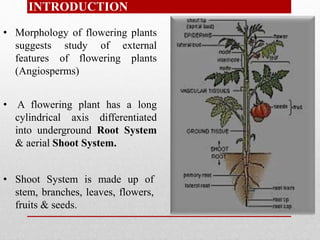
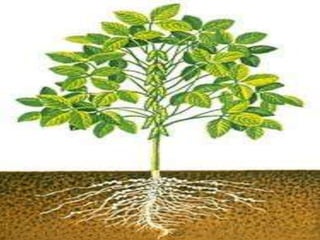
• A flowering plant has a long
cylindrical axis differentiated
into underground Root System
& aerial Shoot System.
• Shoot System is made up of
stem, branches, leaves, flowers,
fruits & seeds.
• Morphology of flowering plants
suggests study of external
features of flowering plants
(Angiosperms)
• INTRODUCTION
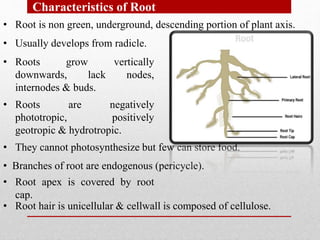
• Root is non green, underground, descending portion of plant axis.
• Usually develops from radicle.
• Roots grow vertically
downwards, lack nodes,
internodes & buds.
• Roots are negatively
phototropic, positively
geotropic & hydrotropic.
• They cannot photosynthesize but few can store food.
Characteristics of Root
• Branches of root are endogenous (pericycle).
• Root apex is covered by root
cap.
• Root hair is unicellular & cellwall is composed of cellulose.
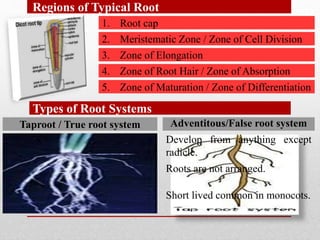
Regions of Typical Root
1. Root cap
2. Meristematic Zone / Zone of Cell Division
3. Zone of Elongation
4. Zone of Root Hair / Zone of Absorption
5. Zone of Maturation / Zone of Differentiation
Types of Root Systems
Taproot / True root system
Develop from Radicle.
Arrangement is Primary,
Secondary, Tertiary & Rootlets
Acropetal succession
(older at base & new at apex).
Roots are not arranged.
Adventitous/False root system
Short lived common in monocots.
Develop from anything except
radicle.
Functions of Root
2. Absorption
4. Transport of Nutrients
1. Anchorage
3. Conduction of water & minerals
Modifications in
Root
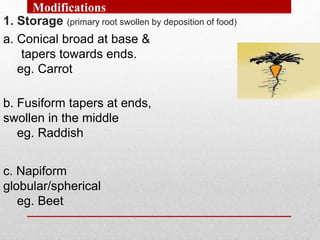
1. Storage (primary root swollen by deposition of food)
a. Conical broad at base &
tapers towards ends.
eg. Carrot
b. Fusiform tapers at ends,
swollen in the middle
eg. Raddish
c. Napiform
globular/spherical
eg. Beet
Modifications
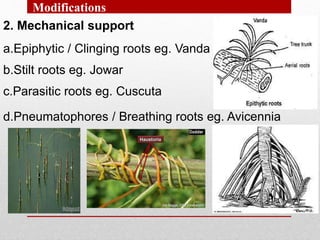
2. Mechanical support
a.Epiphytic / Clinging roots eg. Vanda
Modifications
b.Stilt roots eg. Jowar
c.Parasitic roots eg. Cuscuta
d.Pneumatophores / Breathing roots eg. Avicennia
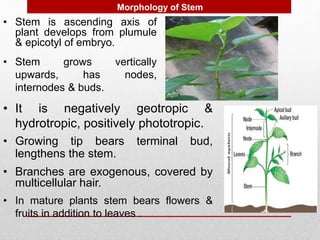
• Stem is ascending axis of
plant develops from plumule
& epicotyl of embryo.
• Stem grows vertically
upwards, has nodes,
internodes & buds.
• It is negatively geotropic &
hydrotropic, positively phototropic.
Morphology of Stem
• Growing tip bears terminal bud,
lengthens the stem.
• Branches are exogenous, covered by
multicellular hair.
• In mature plants stem bears flowers &
fruits in addition to leaves .
• Young underdeveloped shoot with compressed axis &
tender leaves arching over the apex is called as bud.
• Vegetative buds – forms only leafy shoot
• Floral buds – forms flowers.
• Mixed buds – forms both leafy shoot & flowers
• Apical buds / Terminal buds – at the apex
• Axillary buds – occur in axils of the leaf
Buds & its types
Functions of Stem
• Exposure of leaves for photosynthesis
• Conducts water & minerals
• Conducts organic food
• Production of similar organs & branches.
• Holds flowers for pollination & fertilisation.
• Vegetative propogation
• Perrenation
• Bears fruits & seeds
• Phylloclade & Cladode perform photosynthesis
• Thorns are protective in function.
• Tendrils help in climbing.
Modifications in
Stem
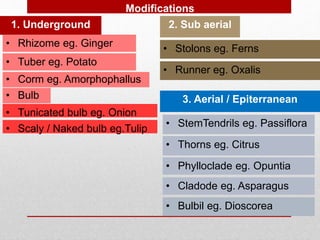
Modifications
1. Underground
• Rhizome eg. Ginger
• Bulb
• Tuber eg. Potato
• Corm eg. Amorphophallus
• Scaly / Naked bulb eg.Tulip
• Tunicated bulb eg. Onion
2. Sub aerial
• Stolons eg. Ferns
• Runner eg. Oxalis
3. Aerial / Epiterranean
• StemTendrils eg. Passiflora
• Cladode eg. Asparagus
• Thorns eg. Citrus
• Phylloclade eg. Opuntia
• Bulbil eg. Dioscorea
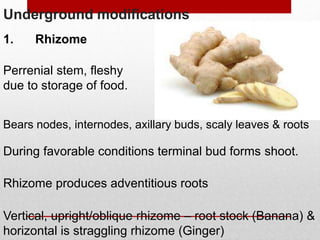
Underground modifications
1. Rhizome
Perrenial stem, fleshy
due to storage of food.
Bears nodes, internodes, axillary buds, scaly leaves & roots
During favorable conditions terminal bud forms shoot.
Rhizome produces adventitious roots
Vertical, upright/oblique rhizome – root stock (Banana) &
horizontal is straggling rhizome (Ginger)
Underground modifications
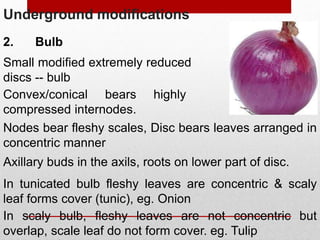
2. Bulb
Small modified extremely reduced
discs -- bulb
Convex/conical bears highly
compressed internodes.
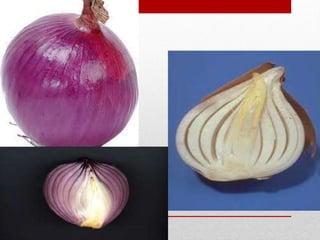
Nodes bear fleshy scales, Disc bears leaves arranged in
concentric manner
Axillary buds in the axils, roots on lower part of disc.
In tunicated bulb fleshy leaves are concentric & scaly
leaf forms cover (tunic), eg. Onion
In scaly bulb, fleshy leaves are not concentric but
overlap, scale leaf do not form cover. eg. Tulip
Underground modifications
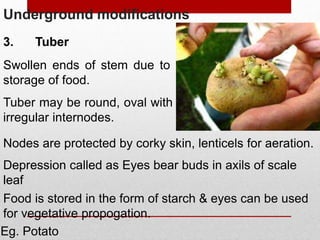
3. Tuber
Swollen ends of stem due to
storage of food.
Tuber may be round, oval with
irregular internodes.
Nodes are protected by corky skin, lenticels for aeration.
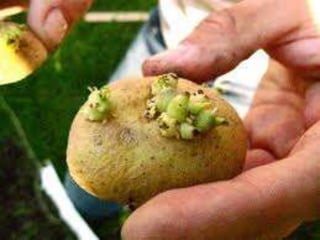
Depression called as Eyes bear buds in axils of scale
leaf
Food is stored in the form of starch & eyes can be used
for vegetative propogation.
Eg. Potato
Underground modifications
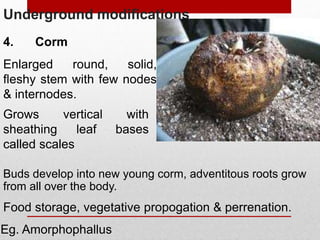
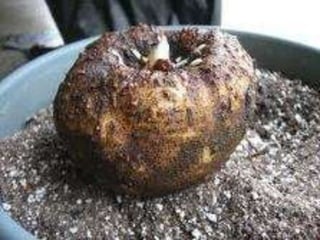
4. Corm
Enlarged round, solid,
fleshy stem with few nodes
& internodes.
Grows vertical with
sheathing leaf bases
called scales
Buds develop into new young corm, adventitous roots grow
from all over the body.
Food storage, vegetative propogation & perrenation.
Eg. Amorphophallus
Sub Aerial modifications
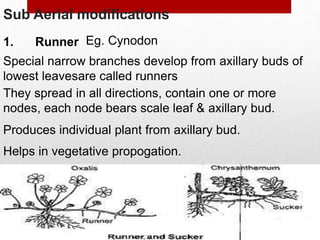
1. Runner
Special narrow branches develop from axillary buds of
lowest leavesare called runners
They spread in all directions, contain one or more
nodes, each node bears scale leaf & axillary bud.
Produces individual plant from axillary bud.
Helps in vegetative propogation.
Eg. Cynodon
Sub Aerial modifications
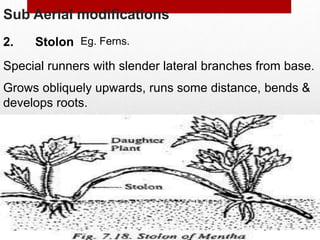
2. Stolon
Special runners with slender lateral branches from base.
Grows obliquely upwards, runs some distance, bends &
develops roots.
Eg. Ferns.
Aerial modifications
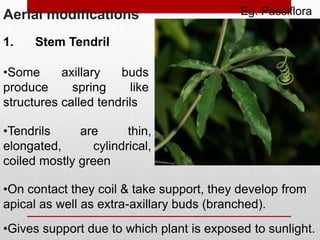
1. Stem Tendril
•Some axillary buds
produce spring like
structures called tendrils
•Tendrils are thin,
elongated, cylindrical,
coiled mostly green
•On contact they coil & take support, they develop from
apical as well as extra-axillary buds (branched).
•Gives support due to which plant is exposed to sunlight.
Eg. Passiflora
Aerial modifications
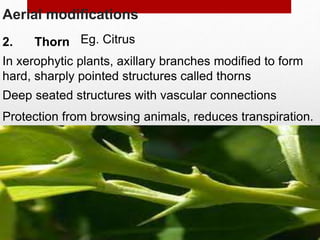
2. Thorn
In xerophytic plants, axillary branches modified to form
hard, sharply pointed structures called thorns
Deep seated structures with vascular connections
Protection from browsing animals, reduces transpiration.
Eg. Citrus
Aerial modifications
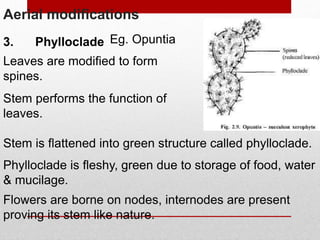
3. Phylloclade
Leaves are modified to form
spines.
Stem performs the function of
leaves.
Stem is flattened into green structure called phylloclade.
Phylloclade is fleshy, green due to storage of food, water
& mucilage.
Eg. Opuntia
Flowers are borne on nodes, internodes are present
proving its stem like nature.
Aerial modifications
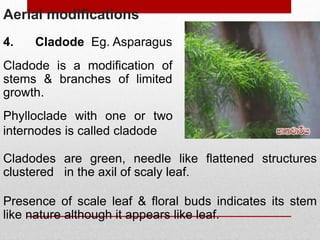
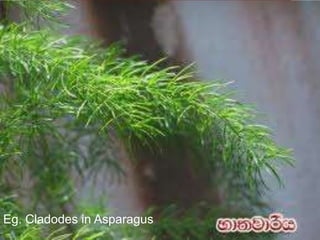
4. Cladode
Cladode is a modification of
stems & branches of limited
growth.
Phylloclade with one or two
internodes is called cladode
Cladodes are green, needle like flattened structures
clustered in the axil of scaly leaf.
Presence of scale leaf & floral buds indicates its stem
like nature although it appears like leaf.
Eg. Asparagus
Eg. Cladodes in Asparagus
Aerial modifications
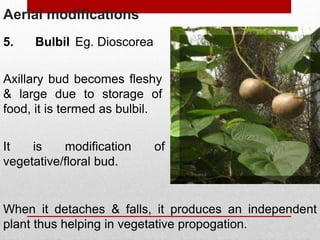
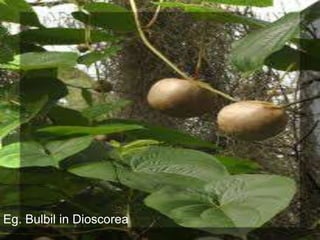
5. Bulbil
Axillary bud becomes fleshy
& large due to storage of
food, it is termed as bulbil.
It is modification of
vegetative/floral bud.
When it detaches & falls, it produces an independent
plant thus helping in vegetative propogation.
Eg. Dioscorea
Eg. Bulbil in Dioscorea
• Lateral dissimilar appendage of stem
• Borne at the nodes
• Axillary bud is present in the axil of the leaf.
• Exogenous & originates from swollen leaf primordium
of growing apex.
• Growth is limited without apical bud.
• Leaf has leaf base, petiole, lamina & lateral
outgrowths called stipules (sometimes)
• Lamina is traversed by vascular strands, called veins.
CHARACTERISTICS OF LEAF
• Leaf base/Hypopodium
• Petiole/Mesopodium/
Leaf stalk
• Leaf blade/lamina/Epipodium
PARTS OF LEAF
• Leaf base/Hypopodium
• Inconspicuous, not visible.
• Basal part by which leaf is attached to stem.
• If it is swollen/cushion like it is termed as pulvinus.
Eg. Mango
• Small pair of outgrowth – stipules Stipulate (Rose) /
exstipulate (Eg. Mango)
• Stipule like outgrowth at the base of compound leaf is
called stipels (clitoria).
• Additional outgrowth between leaf-base & lamina is
called ligule. (Ligulate (Eg. Jowar ) / Eligulate Eg.
Banana )
• Petiole/Leaf stalk/Mesopodium
• Petiole pushes lamina to get optimum sunlight.
• Long / short cylindrical / subcylindrical part, joins
lamina & leaf base. (Petiolate / Expetiolate or sessile)
• Conducts water & minerals from stem to lamina &
organic compounds from lamina to conducting tissues.
• Leaf Lamina/Leaf blade/Epipodium
• Site of photosynthesis, gaseous exchange &
transpiration.
• Thin, green, expanded portion.
• A strong vein midrib runs centrally from base to apex.
• The arrangement of these veins & veinlets is to two
types namely -
• From the midrib are thinner lateral veins which gets
branched & are called veinlets.
Reticulate venation. Parallel venation
• Lamina dorsiventral (both the surfaces are dissimilar) /
isobilateral (both the surfaces are similar)
• In certain leaves (cylindrical) surfaces cannot be
distinguished such leaves are called as centric leaves.
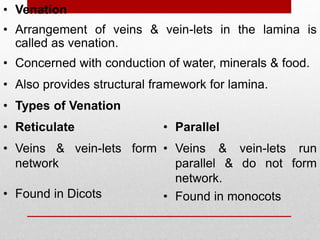
• Venation
• Concerned with conduction of water, minerals & food.
• Arrangement of veins & vein-lets in the lamina is
called as venation.
• Also provides structural framework for lamina.
• Reticulate
• Types of Venation
• Parallel
• Found in Dicots
• Veins & vein-lets form
network
• Found in monocots
• Veins & vein-lets run
parallel & do not form
network.
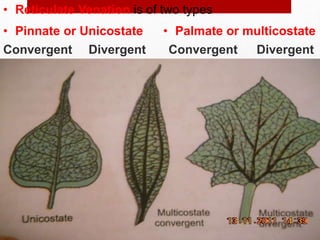
• Reticulate Venation is of two types
Convergent
• Palmate or multicostate
• Pinnate or Unicostate
Divergent
Convergent Divergent
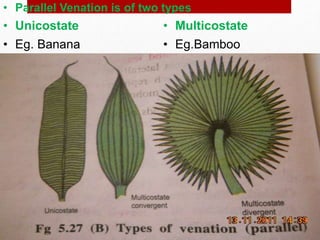
• Unicostate
• Parallel Venation is of two types
• Multicostate
• Eg. Banana • Eg.Bamboo
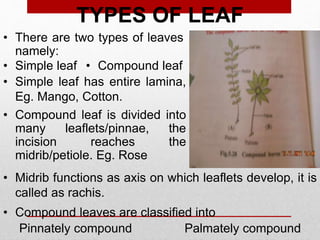
• Simple leaf
• There are two types of leaves
namely:
• Compound leaf is divided into
many leaflets/pinnae, the
incision reaches the
midrib/petiole. Eg. Rose
• Simple leaf has entire lamina,
Eg. Mango, Cotton.
Pinnately compound Palmately compound
• Midrib functions as axis on which leaflets develop, it is
called as rachis.
• Compound leaves are classified into
TYPES OF LEAF
• Compound leaf
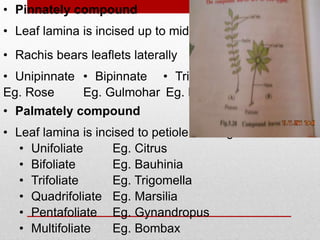
• Unifoliate
• Leaf lamina is incised up to midrib.
• Unipinnate
• Rachis bears leaflets laterally
• Pinnately compound
• Palmately compound
• Leaf lamina is incised to petiole forming leaf lobes
• Bifoliate
• Bipinnate • Tripinnate
Eg. Moringa
Eg. Rose Eg. Gulmohar
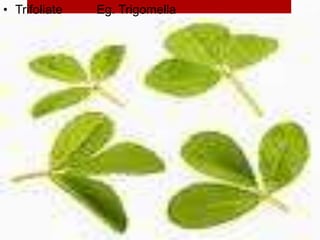
• Trifoliate
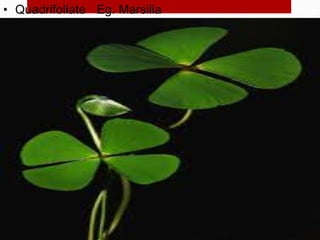
• Quadrifoliate
• Pentafoliate
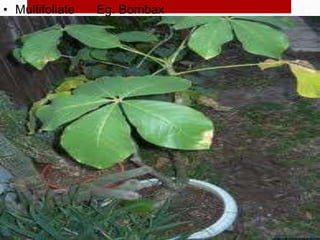
• Multifoliate
Eg. Citrus
Eg. Bauhinia
Eg. Trigomella
Eg. Marsilia
Eg. Gynandropus
Eg. Bombax
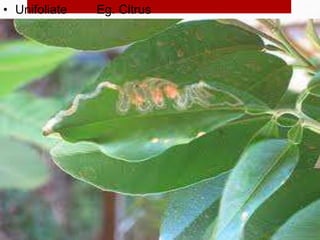
• Unifoliate Eg. Citrus
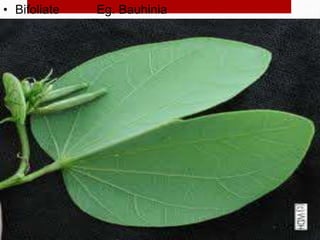
• Bifoliate Eg. Bauhinia
• Trifoliate Eg. Trigomella
• Quadrifoliate Eg. Marsilia
• Multifoliate Eg. Bombax
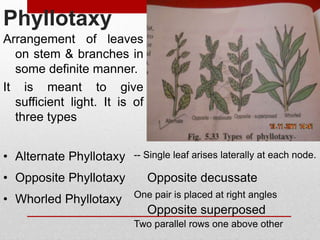
Phyllotaxy
Arrangement of leaves
on stem & branches in
some definite manner.
It is meant to give
sufficient light. It is of
three types
• Alternate Phyllotaxy
• Opposite Phyllotaxy
• Whorled Phyllotaxy
Opposite decussate
Opposite superposed
-- Single leaf arises laterally at each node.
One pair is placed at right angles
Two parallel rows one above other
Modifications in
LEAF
Modifications
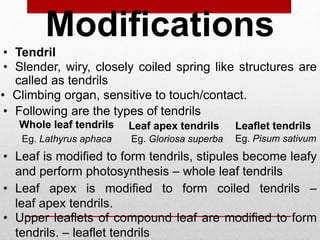
• Tendril
Whole leaf tendrils Leaf apex tendrils Leaflet tendrils
• Slender, wiry, closely coiled spring like structures are
called as tendrils
• Climbing organ, sensitive to touch/contact.
• Following are the types of tendrils
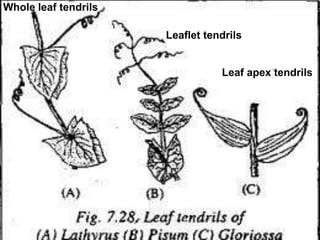
Eg. Lathyrus aphaca Eg. Gloriosa superba Eg. Pisum sativum
• Leaf is modified to form tendrils, stipules become leafy
and perform photosynthesis – whole leaf tendrils
• Leaf apex is modified to form coiled tendrils –
leaf apex tendrils.
• Upper leaflets of compound leaf are modified to form
tendrils. – leaflet tendrils
Whole leaf tendrils
Leaf apex tendrils
Leaflet tendrils
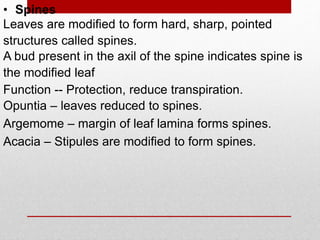
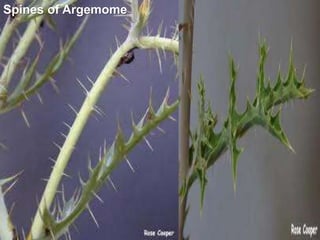
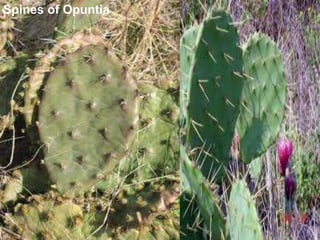
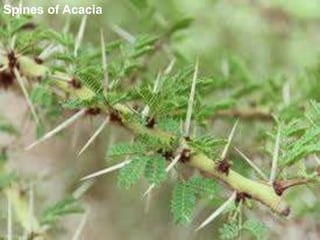
• Spines
Leaves are modified to form hard, sharp, pointed
structures called spines.
A bud present in the axil of the spine indicates spine is
the modified leaf
Function -- Protection, reduce transpiration.
Opuntia – leaves reduced to spines.
Argemome – margin of leaf lamina forms spines.
Acacia – Stipules are modified to form spines.
Spines of Argemome
Spines of Opuntia
Spines of Acacia
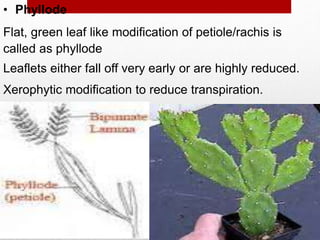
• Phyllode
Flat, green leaf like modification of petiole/rachis is
called as phyllode
Leaflets either fall off very early or are highly reduced.
Xerophytic modification to reduce transpiration.
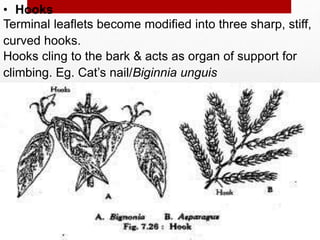
• Hooks
Terminal leaflets become modified into three sharp, stiff,
curved hooks.
Hooks cling to the bark & acts as organ of support for
climbing. Eg. Cat’s nail/Biginnia unguis
Functions of Leaf
• Photosynthesis
• Gaseous exchange
• Transpiration
• Protection of buds.
• Conduction.
• Sometimes protection, climbing, vegetative propogation.
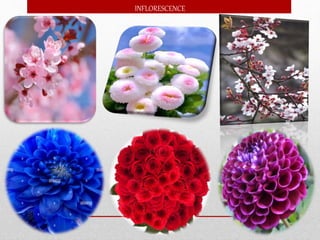
INFLORESCENCE
INFLORESCENCE
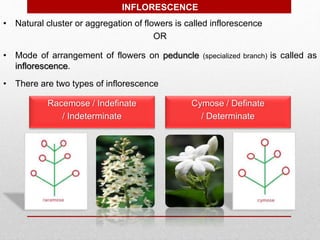
• Natural cluster or aggregation of flowers is called inflorescence
OR
• Mode of arrangement of flowers on peduncle (specialized branch) is called as
inflorescence.
• There are two types of inflorescence
Racemose / Indefinate
/ Indeterminate
Cymose / Definate
/ Determinate
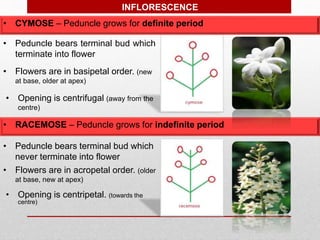
• CYMOSE – Peduncle grows for definite period
• Peduncle bears terminal bud which
terminate into flower
• Flowers are in basipetal order. (new
at base, older at apex)
• Opening is centrifugal (away from the
centre)
• RACEMOSE – Peduncle grows for indefinite period
• Peduncle bears terminal bud which
never terminate into flower
• Flowers are in acropetal order. (older
at base, new at apex)
• Opening is centripetal. (towards the
centre)
INFLORESCENCE
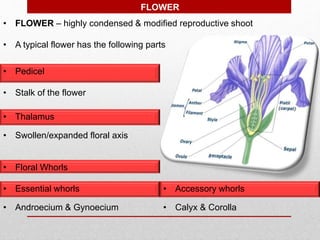
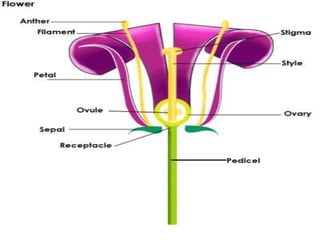
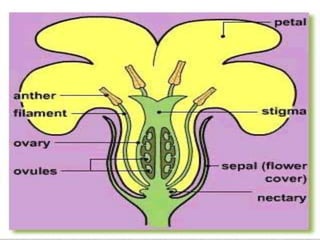
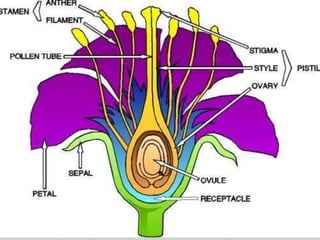
• FLOWER – highly condensed & modified reproductive shoot
• A typical flower has the following parts
• Pedicel
• Thalamus
• Floral Whorls
• Essential whorls • Accessory whorls
FLOWER
• Stalk of the flower
• Swollen/expanded floral axis
• Androecium & Gynoecium • Calyx & Corolla
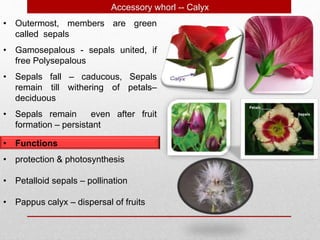
• Outermost, members are green
called sepals
Accessory whorl -- Calyx
• Gamosepalous - sepals united, if
free Polysepalous
• Sepals fall – caducous, Sepals
remain till withering of petals–
deciduous
• Sepals remain even after fruit
formation – persistant
• Functions
• protection & photosynthesis
• Petalloid sepals – pollination
• Pappus calyx – dispersal of fruits
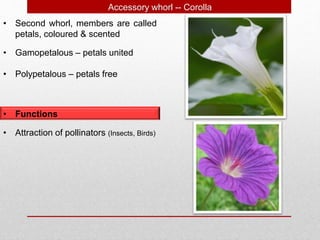
• Second whorl, members are called
petals, coloured & scented
Accessory whorl -- Corolla
• Gamopetalous – petals united
• Polypetalous – petals free
• Functions
• Attraction of pollinators (Insects, Birds)
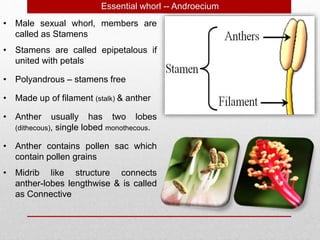
• Male sexual whorl, members are
called as Stamens
Essential whorl -- Androecium
• Stamens are called epipetalous if
united with petals
• Polyandrous – stamens free
• Made up of filament (stalk) & anther
• Anther usually has two lobes
(dithecous), single lobed monothecous.
• Anther contains pollen sac which
contain pollen grains
• Midrib like structure connects
anther-lobes lengthwise & is called
as Connective
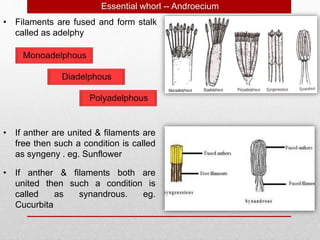
• Filaments are fused and form stalk
called as adelphy
• If anther are united & filaments are
free then such a condition is called
as syngeny . eg. Sunflower
Essential whorl -- Androecium
• If anther & filaments both are
united then such a condition is
called as synandrous. eg.
Cucurbita
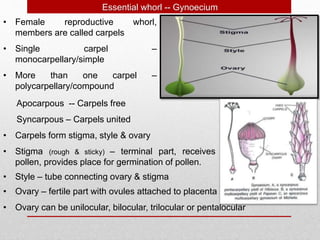
• Female reproductive whorl,
members are called carpels
Essential whorl -- Gynoecium
• Single carpel –
monocarpellary/simple
• More than one carpel –
polycarpellary/compound
• Carpels form stigma, style & ovary
Syncarpous – Carpels united
Apocarpous -- Carpels free
• Ovary – fertile part with ovules attached to placenta
• Ovary can be unilocular, bilocular, trilocular or pentalocular
• Stigma (rough & sticky) – terminal part, receives
pollen, provides place for germination of pollen.
• Style – tube connecting ovary & stigma
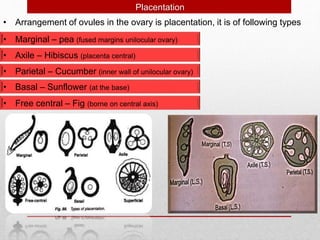
Placentation
• Marginal – pea (fused margins unilocular ovary)
• Axile – Hibiscus (placenta central)
• Parietal – Cucumber (inner wall of unilocular ovary)
• Basal – Sunflower (at the base)
• Arrangement of ovules in the ovary is placentation, it is of following types
• Free central – Fig (borne on central axis)
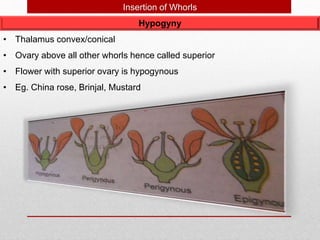
Hypogyny
Insertion of Whorls
• Thalamus convex/conical
• Ovary above all other whorls hence called superior
• Flower with superior ovary is hypogynous
• Eg. China rose, Brinjal, Mustard
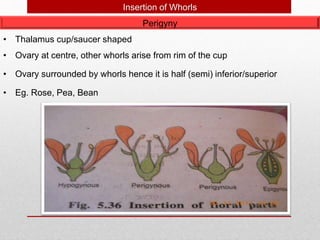
Perigyny
• Thalamus cup/saucer shaped
• Ovary at centre, other whorls arise from rim of the cup
• Ovary surrounded by whorls hence it is half (semi) inferior/superior
• Eg. Rose, Pea, Bean
Insertion of Whorls
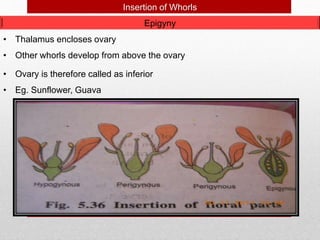
• Thalamus encloses ovary
• Other whorls develop from above the ovary
• Ovary is therefore called as inferior
• Eg. Sunflower, Guava
Insertion of Whorls
Epigyny
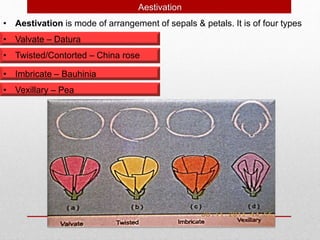
• Aestivation is mode of arrangement of sepals & petals. It is of four types
• Valvate – Datura
• Twisted/Contorted – China rose
• Imbricate – Bauhinia
• Vexillary – Pea
Aestivation
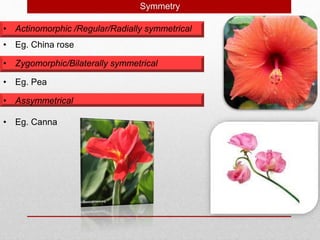
• Actinomorphic /Regular/Radially symmetrical
Symmetry
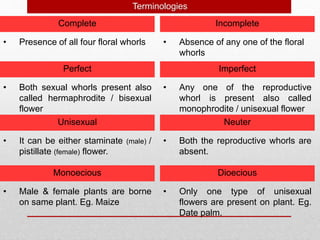
• Zygomorphic/Bilaterally symmetrical
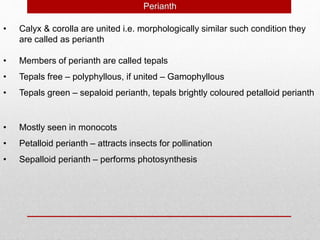
• Assymmetrical
• Eg. China rose
• Eg. Pea
• Eg. Canna
• Calyx & corolla are united i.e. morphologically similar such condition they
are called as perianth
Perianth
• Members of perianth are called tepals
• Tepals free – polyphyllous, if united – Gamophyllous
• Tepals green – sepaloid perianth, tepals brightly coloured petalloid perianth
• Mostly seen in monocots
• Petalloid perianth – attracts insects for pollination
• Sepalloid perianth – performs photosynthesis
Complete
Terminologies
Incomplete
Perfect Imperfect
Unisexual Neuter
Monoecious Dioecious
• Presence of all four floral whorls • Absence of any one of the floral
whorls
• Both sexual whorls present also
called hermaphrodite / bisexual
flower
• Any one of the reproductive
whorl is present also called
monophrodite / unisexual flower
• It can be either staminate (male) /
pistillate (female) flower.
• Both the reproductive whorls are
absent.
• Male & female plants are borne
on same plant. Eg. Maize
• Only one type of unisexual
flowers are present on plant. Eg.
Date palm.
• FRUIT -- Metamorphosed or ripened ovary with or
without one or more seeds
• When fruit is developed from ovary then it is true fruit.
• If fruit develops from parts other than ovary then it is
called false fruit. Eg Apple (thalamus)
• PARTS OF FRUIT
• Mainly made up to two parts namely, pericarp & seed
• Pericarp – develops from wall of the ovary
• In some fruits it is differentiated into Epi, meso & endo
• Epicarp – outer part/skin, protective
• Mesocarp – middle part, major pulpy or juicy
• Endocarp – inner part, thin, membranous/hard & stony
• In some fruits it is single Eg. Pea, Beans.
• Eg. Mango, Plum & Coconut
CLASSIFICATION OF FRUITS
• They are classified into 1. Simple, 2. Aggregate or
Etario 3. Multiple or Composite.
• When ovary with or without other floral parts develops
into single fruit it is said to be simple fruit.
• They are further divided into Dry & fleshy fruits
• Fleshy fruits are Tomato, Guava, Mango
• Dry fruits are Lady’s finger,, Cotton, Pea
• In Dry fruits pericarp becomes dry & thin at maturity
• SIMPLE FRUITS
• Ovary may be monocarpellary or polycarpellary
syncarpous.
CLASSIFICATION OF FRUITS
• Aggregate or Etario
• Develops from polycarpellary, apocarpous gynoecium
of a single flower.
• A collection of such fruitlets forms agregate fruit.
• Composite fruit
• Composite fruits are of following types
• Sorosis eg.Pine apple
• Synconus eg. Fig
• It develops from entire inflorescence.
• Carpels are free & ovary of each carpel develops into
fruitlet.
• Eg. Custard apple (Anona squamosa) -- Sitaphal
• SEED – fertilized & metamorphosed ovule containing
an embryo enclosed in resistant protective coat.
• It is composed of two layers Testa & Tegmen.
• A small pore close to Hilum is called micropyle
• Enclosed internally is Embryo which is differentiated
into Embryo axis & Cotyledons.
• First node is the point of attachment of cotyledons.
• Part of embryo axis between radicle & first node is
Hypocotyl similarly between plumule & first node is
Epicotyl
• Embryo axis/Tigellum is differentiated into Plumule,
First node & Radicle
• It is attached to the inner wall of fruit by small stalk
called funicle at a point called Hilum visible as a scar.
• Ridge in continuation with Hilum is called as Raphae
PLANT
TISSUES
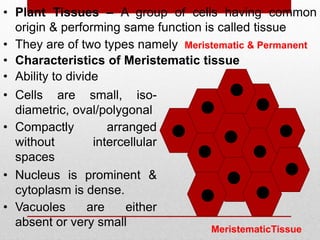
• Plant Tissues – A group of cells having common
origin & performing same function is called tissue
• They are of two types namely
• Ability to divide
• Compactly arranged
without intercellular
spaces
• Characteristics of Meristematic tissue
• Cells are small, iso-
diametric, oval/polygonal
Meristematic & Permanent
MeristematicTissue
• Nucleus is prominent &
cytoplasm is dense.
• Vacuoles are either
absent or very small
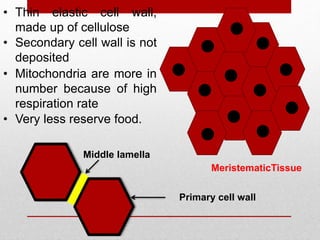
• Mitochondria are more in
number because of high
respiration rate
• Very less reserve food.
• Secondary cell wall is not
deposited
• Thin elastic cell wall,
made up of cellulose
MeristematicTissue
Middle lamella
Primary cell wall
• Classification of Meristematic tissue
• They are classified depending on
• On the basis of Origin it is of three types namely
Primary Meristem
1. Origin & Development 2. Position 3. Function
Promeristem Secondary Meristem
• Cells representing primary stage of meristematic
tissue.
• Occupies small area at the tip in the embryonic stage
• Gives rise to primary meristem
• Originate from promeristem, exist right from begining
• Actively dividing, forms primary permanent tissues
• Present at the apices
Primary Meristem
Promeristem
• Arise from primary permanent tissue (Parenchyma)
• Adds to the girth of the plant
• Parenchyma regains capacity to divide
Secondary Meristem
• On the basis of Position it is of three types namely
Intercalary meristem
Apical meristem Lateral meristem
• Found in apices, responsible for linear growth
• Between permanent tissues
• Portions of apical meristems separated from apex
during growth of axis.
Intercalary Meristem
Apical meristem
• Present at the base of nodes/internodes, they are
short lived.
• Arranged parallel to axis
• Composed of initials which divide periclinically (in one
plane only)
Lateral Meristem
• Increase the diameter/girth
• On the basis of function it is of three types namely
Procambium
Protoderm Ground meristem
• Outermost layer forming epidermis
• Forms primary vascular tissue
Procambium
Protoderm
• Forms hypodermis, cortex, endodermis, pericycle,
medullary rays and pith.
Ground Meristem
• Formation of new leaves, branches & other parts.
• Intercalary helps in elongation of internodes, petioles.
Functions
• Vascular cambium replaces old tissue with new
increases the girth.
Permanent Tissue is group of cells which have
acquired permanent shape, size, functions & have lost
power of division
• Cells are either living or dead, thick/thin walled.
• They are of two types namely; Simple & Complex
• Simple Permanent Tissue is of following types
Parenchyma
• Cells of simple permanent tissue resemble eachother
in shape, size, function & form.
Collenchyma Sclerenchyma
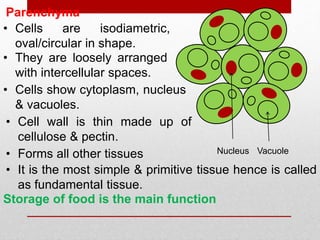
• Cells are isodiametric,
oval/circular in shape.
• They are loosely arranged
with intercellular spaces.
Parenchyma
• Cells show cytoplasm, nucleus
& vacuoles.
• Cell wall is thin made up of
cellulose & pectin.
• It is the most simple & primitive tissue hence is called
as fundamental tissue.
• Forms all other tissues Nucleus Vacuole
Storage of food is the main function
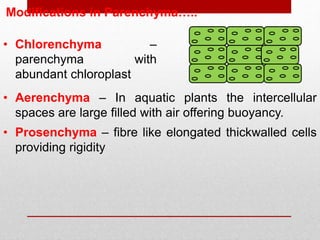
• Chlorenchyma –
parenchyma with
abundant chloroplast
• Aerenchyma – In aquatic plants the intercellular
spaces are large filled with air offering buoyancy.
Modifications in Parenchyma…..
• Prosenchyma – fibre like elongated thickwalled cells
providing rigidity
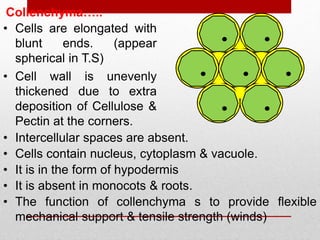
• Cells are elongated with
blunt ends. (appear
spherical in T.S)
Collenchyma…..
• Cell wall is unevenly
thickened due to extra
deposition of Cellulose &
Pectin at the corners.
• Intercellular spaces are absent.
• Cells contain nucleus, cytoplasm & vacuole.
• It is in the form of hypodermis
• It is absent in monocots & roots.
• The function of collenchyma s to provide flexible
mechanical support & tensile strength (winds)
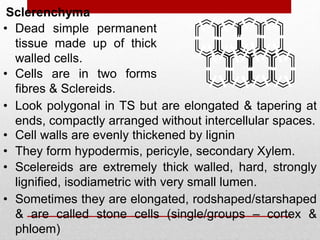
• Dead simple permanent
tissue made up of thick
walled cells.
Sclerenchyma
• Cells are in two forms
fibres & Sclereids.
• Look polygonal in TS but are elongated & tapering at
ends, compactly arranged without intercellular spaces.
• Cell walls are evenly thickened by lignin
• They form hypodermis, pericyle, secondary Xylem.
• Scelereids are extremely thick walled, hard, strongly
lignified, isodiametric with very small lumen.
• Sometimes they are elongated, rodshaped/starshaped
& are called stone cells (single/groups – cortex &
phloem)
• Functions:
• Mechanical strength & rigidity, bears compression, pull
& bending forces.
• Scelereids provide rigidity & strength to seed
coverings & stiffness to plant parts.
Complex
Permanent
TISSUEs
• Xylem (wood)
• Transports water & minerals, provides mechanical
strength, made up of four types of cells.
• Tracheids, Vessels(Trachea), Xylem fibres & Xylem
Parenchyma.
• Tracheids
• Elongated tubular cells with tapering ends, dead at
maturity. Cell wall thick due to lignification.
• Thickenings are of various kinds namely;
Annular -- form of rings
Spiral -- spring like/helical
Reticulate -- network
Scalariform/Pitted -- ladder like/thick circular areas pits
• Pitted is either bordered/simple (thickened circular
areas)
• Xylem (wood) contd…..
• Elongated tube like structures, placed end to end with
perforated transverse walls or they are dissolved.
• Walls are lignified less thicker than Tracheids, lumen
is wider.
• Vessels
• Protoxylem shows annular thickening & metaxylem
shows reticulate thickening.
• They are the characteristic feature of Angiosperms.
• Xylem Fibres
• Sclerenchymatous cells in xylem are called wood
fibres, elongated, narrow, spindle shaped with lignified
walls, provide mechanical support.
• Xylem (wood) Parenchyma
• Parenchyma in xylem, helping in lateral conduction.
• Phloem (bast)
• Passes organic food & is made up of 4 types of cells.
• Sieve cells / sieve tube elements, Companion cells,
Phloem Parenchyma, Phloem fibres.
• Sieve cells / sieve tube elements
• Sieve cells are narrow, elongated, spindle shaped with
sieve areas laterally. (Pteridophytes & Gymnosperms)
• Elongated, tubular tubes in linear rows, have sieve
plates (oblique/transverse perforated septa).
• Sieve tube is a living cell without nucleus.
• Sieve tube shows porous sieve plates for transport
• Companion cell
• Elongated cells with large nucleus on the sides of tube
• Thin walled communicate by sieve tubes by pits.
• Present only in Angiosperms
• Phloem Parenchyma
• Simple parenchyma cells store food material & help in
transport.
• Phloem fibres (Bast fibres)
• Sclerenchyma cells with lignified cellwall provides
mechanical support.

Chapter_9_Morphology_of_Flowering_Plants.pptx

  • 1.
  • 2.
    • A floweringplant has a long cylindrical axis differentiated into underground Root System & aerial Shoot System. • Shoot System is made up of stem, branches, leaves, flowers, fruits & seeds. • Morphology of flowering plants suggests study of external features of flowering plants (Angiosperms) • INTRODUCTION
  • 5.
    • Root isnon green, underground, descending portion of plant axis. • Usually develops from radicle. • Roots grow vertically downwards, lack nodes, internodes & buds. • Roots are negatively phototropic, positively geotropic & hydrotropic. • They cannot photosynthesize but few can store food. Characteristics of Root • Branches of root are endogenous (pericycle). • Root apex is covered by root cap. • Root hair is unicellular & cellwall is composed of cellulose.
  • 6.
    Regions of TypicalRoot 1. Root cap 2. Meristematic Zone / Zone of Cell Division 3. Zone of Elongation 4. Zone of Root Hair / Zone of Absorption 5. Zone of Maturation / Zone of Differentiation Types of Root Systems Taproot / True root system Develop from Radicle. Arrangement is Primary, Secondary, Tertiary & Rootlets Acropetal succession (older at base & new at apex). Roots are not arranged. Adventitous/False root system Short lived common in monocots. Develop from anything except radicle.
  • 7.
    Functions of Root 2.Absorption 4. Transport of Nutrients 1. Anchorage 3. Conduction of water & minerals
  • 8.
  • 9.
    1. Storage (primaryroot swollen by deposition of food) a. Conical broad at base & tapers towards ends. eg. Carrot b. Fusiform tapers at ends, swollen in the middle eg. Raddish c. Napiform globular/spherical eg. Beet Modifications
  • 10.
    2. Mechanical support a.Epiphytic/ Clinging roots eg. Vanda Modifications b.Stilt roots eg. Jowar c.Parasitic roots eg. Cuscuta d.Pneumatophores / Breathing roots eg. Avicennia
  • 12.
    • Stem isascending axis of plant develops from plumule & epicotyl of embryo. • Stem grows vertically upwards, has nodes, internodes & buds. • It is negatively geotropic & hydrotropic, positively phototropic. Morphology of Stem • Growing tip bears terminal bud, lengthens the stem. • Branches are exogenous, covered by multicellular hair. • In mature plants stem bears flowers & fruits in addition to leaves .
  • 13.
    • Young underdevelopedshoot with compressed axis & tender leaves arching over the apex is called as bud. • Vegetative buds – forms only leafy shoot • Floral buds – forms flowers. • Mixed buds – forms both leafy shoot & flowers • Apical buds / Terminal buds – at the apex • Axillary buds – occur in axils of the leaf Buds & its types
  • 14.
    Functions of Stem •Exposure of leaves for photosynthesis • Conducts water & minerals • Conducts organic food • Production of similar organs & branches. • Holds flowers for pollination & fertilisation. • Vegetative propogation • Perrenation • Bears fruits & seeds • Phylloclade & Cladode perform photosynthesis • Thorns are protective in function. • Tendrils help in climbing.
  • 15.
  • 16.
    Modifications 1. Underground • Rhizomeeg. Ginger • Bulb • Tuber eg. Potato • Corm eg. Amorphophallus • Scaly / Naked bulb eg.Tulip • Tunicated bulb eg. Onion 2. Sub aerial • Stolons eg. Ferns • Runner eg. Oxalis 3. Aerial / Epiterranean • StemTendrils eg. Passiflora • Cladode eg. Asparagus • Thorns eg. Citrus • Phylloclade eg. Opuntia • Bulbil eg. Dioscorea
  • 17.
    Underground modifications 1. Rhizome Perrenialstem, fleshy due to storage of food. Bears nodes, internodes, axillary buds, scaly leaves & roots During favorable conditions terminal bud forms shoot. Rhizome produces adventitious roots Vertical, upright/oblique rhizome – root stock (Banana) & horizontal is straggling rhizome (Ginger)
  • 18.
    Underground modifications 2. Bulb Smallmodified extremely reduced discs -- bulb Convex/conical bears highly compressed internodes. Nodes bear fleshy scales, Disc bears leaves arranged in concentric manner Axillary buds in the axils, roots on lower part of disc. In tunicated bulb fleshy leaves are concentric & scaly leaf forms cover (tunic), eg. Onion In scaly bulb, fleshy leaves are not concentric but overlap, scale leaf do not form cover. eg. Tulip
  • 20.
    Underground modifications 3. Tuber Swollenends of stem due to storage of food. Tuber may be round, oval with irregular internodes. Nodes are protected by corky skin, lenticels for aeration. Depression called as Eyes bear buds in axils of scale leaf Food is stored in the form of starch & eyes can be used for vegetative propogation. Eg. Potato
  • 22.
    Underground modifications 4. Corm Enlargedround, solid, fleshy stem with few nodes & internodes. Grows vertical with sheathing leaf bases called scales Buds develop into new young corm, adventitous roots grow from all over the body. Food storage, vegetative propogation & perrenation. Eg. Amorphophallus
  • 24.
    Sub Aerial modifications 1.Runner Special narrow branches develop from axillary buds of lowest leavesare called runners They spread in all directions, contain one or more nodes, each node bears scale leaf & axillary bud. Produces individual plant from axillary bud. Helps in vegetative propogation. Eg. Cynodon
  • 25.
    Sub Aerial modifications 2.Stolon Special runners with slender lateral branches from base. Grows obliquely upwards, runs some distance, bends & develops roots. Eg. Ferns.
  • 26.
    Aerial modifications 1. StemTendril •Some axillary buds produce spring like structures called tendrils •Tendrils are thin, elongated, cylindrical, coiled mostly green •On contact they coil & take support, they develop from apical as well as extra-axillary buds (branched). •Gives support due to which plant is exposed to sunlight. Eg. Passiflora
  • 27.
    Aerial modifications 2. Thorn Inxerophytic plants, axillary branches modified to form hard, sharply pointed structures called thorns Deep seated structures with vascular connections Protection from browsing animals, reduces transpiration. Eg. Citrus
  • 28.
    Aerial modifications 3. Phylloclade Leavesare modified to form spines. Stem performs the function of leaves. Stem is flattened into green structure called phylloclade. Phylloclade is fleshy, green due to storage of food, water & mucilage. Eg. Opuntia Flowers are borne on nodes, internodes are present proving its stem like nature.
  • 29.
    Aerial modifications 4. Cladode Cladodeis a modification of stems & branches of limited growth. Phylloclade with one or two internodes is called cladode Cladodes are green, needle like flattened structures clustered in the axil of scaly leaf. Presence of scale leaf & floral buds indicates its stem like nature although it appears like leaf. Eg. Asparagus
  • 30.
    Eg. Cladodes inAsparagus
  • 31.
    Aerial modifications 5. Bulbil Axillarybud becomes fleshy & large due to storage of food, it is termed as bulbil. It is modification of vegetative/floral bud. When it detaches & falls, it produces an independent plant thus helping in vegetative propogation. Eg. Dioscorea
  • 32.
    Eg. Bulbil inDioscorea
  • 34.
    • Lateral dissimilarappendage of stem • Borne at the nodes • Axillary bud is present in the axil of the leaf. • Exogenous & originates from swollen leaf primordium of growing apex. • Growth is limited without apical bud. • Leaf has leaf base, petiole, lamina & lateral outgrowths called stipules (sometimes) • Lamina is traversed by vascular strands, called veins. CHARACTERISTICS OF LEAF
  • 35.
    • Leaf base/Hypopodium •Petiole/Mesopodium/ Leaf stalk • Leaf blade/lamina/Epipodium PARTS OF LEAF
  • 36.
    • Leaf base/Hypopodium •Inconspicuous, not visible. • Basal part by which leaf is attached to stem. • If it is swollen/cushion like it is termed as pulvinus. Eg. Mango • Small pair of outgrowth – stipules Stipulate (Rose) / exstipulate (Eg. Mango) • Stipule like outgrowth at the base of compound leaf is called stipels (clitoria). • Additional outgrowth between leaf-base & lamina is called ligule. (Ligulate (Eg. Jowar ) / Eligulate Eg. Banana )
  • 37.
    • Petiole/Leaf stalk/Mesopodium •Petiole pushes lamina to get optimum sunlight. • Long / short cylindrical / subcylindrical part, joins lamina & leaf base. (Petiolate / Expetiolate or sessile) • Conducts water & minerals from stem to lamina & organic compounds from lamina to conducting tissues.
  • 38.
    • Leaf Lamina/Leafblade/Epipodium • Site of photosynthesis, gaseous exchange & transpiration. • Thin, green, expanded portion. • A strong vein midrib runs centrally from base to apex. • The arrangement of these veins & veinlets is to two types namely - • From the midrib are thinner lateral veins which gets branched & are called veinlets. Reticulate venation. Parallel venation • Lamina dorsiventral (both the surfaces are dissimilar) / isobilateral (both the surfaces are similar) • In certain leaves (cylindrical) surfaces cannot be distinguished such leaves are called as centric leaves.
  • 39.
    • Venation • Concernedwith conduction of water, minerals & food. • Arrangement of veins & vein-lets in the lamina is called as venation. • Also provides structural framework for lamina. • Reticulate • Types of Venation • Parallel • Found in Dicots • Veins & vein-lets form network • Found in monocots • Veins & vein-lets run parallel & do not form network.
  • 40.
    • Reticulate Venationis of two types Convergent • Palmate or multicostate • Pinnate or Unicostate Divergent Convergent Divergent
  • 41.
    • Unicostate • ParallelVenation is of two types • Multicostate • Eg. Banana • Eg.Bamboo
  • 42.
    • Simple leaf •There are two types of leaves namely: • Compound leaf is divided into many leaflets/pinnae, the incision reaches the midrib/petiole. Eg. Rose • Simple leaf has entire lamina, Eg. Mango, Cotton. Pinnately compound Palmately compound • Midrib functions as axis on which leaflets develop, it is called as rachis. • Compound leaves are classified into TYPES OF LEAF • Compound leaf
  • 43.
    • Unifoliate • Leaflamina is incised up to midrib. • Unipinnate • Rachis bears leaflets laterally • Pinnately compound • Palmately compound • Leaf lamina is incised to petiole forming leaf lobes • Bifoliate • Bipinnate • Tripinnate Eg. Moringa Eg. Rose Eg. Gulmohar • Trifoliate • Quadrifoliate • Pentafoliate • Multifoliate Eg. Citrus Eg. Bauhinia Eg. Trigomella Eg. Marsilia Eg. Gynandropus Eg. Bombax
  • 44.
  • 45.
  • 46.
  • 47.
  • 48.
  • 49.
    Phyllotaxy Arrangement of leaves onstem & branches in some definite manner. It is meant to give sufficient light. It is of three types • Alternate Phyllotaxy • Opposite Phyllotaxy • Whorled Phyllotaxy Opposite decussate Opposite superposed -- Single leaf arises laterally at each node. One pair is placed at right angles Two parallel rows one above other
  • 50.
  • 51.
    Modifications • Tendril Whole leaftendrils Leaf apex tendrils Leaflet tendrils • Slender, wiry, closely coiled spring like structures are called as tendrils • Climbing organ, sensitive to touch/contact. • Following are the types of tendrils Eg. Lathyrus aphaca Eg. Gloriosa superba Eg. Pisum sativum • Leaf is modified to form tendrils, stipules become leafy and perform photosynthesis – whole leaf tendrils • Leaf apex is modified to form coiled tendrils – leaf apex tendrils. • Upper leaflets of compound leaf are modified to form tendrils. – leaflet tendrils
  • 52.
    Whole leaf tendrils Leafapex tendrils Leaflet tendrils
  • 53.
    • Spines Leaves aremodified to form hard, sharp, pointed structures called spines. A bud present in the axil of the spine indicates spine is the modified leaf Function -- Protection, reduce transpiration. Opuntia – leaves reduced to spines. Argemome – margin of leaf lamina forms spines. Acacia – Stipules are modified to form spines.
  • 54.
  • 55.
  • 56.
  • 57.
    • Phyllode Flat, greenleaf like modification of petiole/rachis is called as phyllode Leaflets either fall off very early or are highly reduced. Xerophytic modification to reduce transpiration.
  • 58.
    • Hooks Terminal leafletsbecome modified into three sharp, stiff, curved hooks. Hooks cling to the bark & acts as organ of support for climbing. Eg. Cat’s nail/Biginnia unguis
  • 59.
    Functions of Leaf •Photosynthesis • Gaseous exchange • Transpiration • Protection of buds. • Conduction. • Sometimes protection, climbing, vegetative propogation.
  • 60.
  • 61.
    INFLORESCENCE • Natural clusteror aggregation of flowers is called inflorescence OR • Mode of arrangement of flowers on peduncle (specialized branch) is called as inflorescence. • There are two types of inflorescence Racemose / Indefinate / Indeterminate Cymose / Definate / Determinate
  • 62.
    • CYMOSE –Peduncle grows for definite period • Peduncle bears terminal bud which terminate into flower • Flowers are in basipetal order. (new at base, older at apex) • Opening is centrifugal (away from the centre) • RACEMOSE – Peduncle grows for indefinite period • Peduncle bears terminal bud which never terminate into flower • Flowers are in acropetal order. (older at base, new at apex) • Opening is centripetal. (towards the centre) INFLORESCENCE
  • 64.
    • FLOWER –highly condensed & modified reproductive shoot • A typical flower has the following parts • Pedicel • Thalamus • Floral Whorls • Essential whorls • Accessory whorls FLOWER • Stalk of the flower • Swollen/expanded floral axis • Androecium & Gynoecium • Calyx & Corolla
  • 65.
    • Outermost, membersare green called sepals Accessory whorl -- Calyx • Gamosepalous - sepals united, if free Polysepalous • Sepals fall – caducous, Sepals remain till withering of petals– deciduous • Sepals remain even after fruit formation – persistant • Functions • protection & photosynthesis • Petalloid sepals – pollination • Pappus calyx – dispersal of fruits
  • 66.
    • Second whorl,members are called petals, coloured & scented Accessory whorl -- Corolla • Gamopetalous – petals united • Polypetalous – petals free • Functions • Attraction of pollinators (Insects, Birds)
  • 67.
    • Male sexualwhorl, members are called as Stamens Essential whorl -- Androecium • Stamens are called epipetalous if united with petals • Polyandrous – stamens free • Made up of filament (stalk) & anther • Anther usually has two lobes (dithecous), single lobed monothecous. • Anther contains pollen sac which contain pollen grains • Midrib like structure connects anther-lobes lengthwise & is called as Connective
  • 68.
    • Filaments arefused and form stalk called as adelphy • If anther are united & filaments are free then such a condition is called as syngeny . eg. Sunflower Essential whorl -- Androecium • If anther & filaments both are united then such a condition is called as synandrous. eg. Cucurbita
  • 69.
    • Female reproductivewhorl, members are called carpels Essential whorl -- Gynoecium • Single carpel – monocarpellary/simple • More than one carpel – polycarpellary/compound • Carpels form stigma, style & ovary Syncarpous – Carpels united Apocarpous -- Carpels free • Ovary – fertile part with ovules attached to placenta • Ovary can be unilocular, bilocular, trilocular or pentalocular • Stigma (rough & sticky) – terminal part, receives pollen, provides place for germination of pollen. • Style – tube connecting ovary & stigma
  • 70.
    Placentation • Marginal –pea (fused margins unilocular ovary) • Axile – Hibiscus (placenta central) • Parietal – Cucumber (inner wall of unilocular ovary) • Basal – Sunflower (at the base) • Arrangement of ovules in the ovary is placentation, it is of following types • Free central – Fig (borne on central axis)
  • 71.
    Hypogyny Insertion of Whorls •Thalamus convex/conical • Ovary above all other whorls hence called superior • Flower with superior ovary is hypogynous • Eg. China rose, Brinjal, Mustard
  • 72.
    Perigyny • Thalamus cup/saucershaped • Ovary at centre, other whorls arise from rim of the cup • Ovary surrounded by whorls hence it is half (semi) inferior/superior • Eg. Rose, Pea, Bean Insertion of Whorls
  • 73.
    • Thalamus enclosesovary • Other whorls develop from above the ovary • Ovary is therefore called as inferior • Eg. Sunflower, Guava Insertion of Whorls Epigyny
  • 74.
    • Aestivation ismode of arrangement of sepals & petals. It is of four types • Valvate – Datura • Twisted/Contorted – China rose • Imbricate – Bauhinia • Vexillary – Pea Aestivation
  • 75.
    • Actinomorphic /Regular/Radiallysymmetrical Symmetry • Zygomorphic/Bilaterally symmetrical • Assymmetrical • Eg. China rose • Eg. Pea • Eg. Canna
  • 76.
    • Calyx &corolla are united i.e. morphologically similar such condition they are called as perianth Perianth • Members of perianth are called tepals • Tepals free – polyphyllous, if united – Gamophyllous • Tepals green – sepaloid perianth, tepals brightly coloured petalloid perianth • Mostly seen in monocots • Petalloid perianth – attracts insects for pollination • Sepalloid perianth – performs photosynthesis
  • 77.
    Complete Terminologies Incomplete Perfect Imperfect Unisexual Neuter MonoeciousDioecious • Presence of all four floral whorls • Absence of any one of the floral whorls • Both sexual whorls present also called hermaphrodite / bisexual flower • Any one of the reproductive whorl is present also called monophrodite / unisexual flower • It can be either staminate (male) / pistillate (female) flower. • Both the reproductive whorls are absent. • Male & female plants are borne on same plant. Eg. Maize • Only one type of unisexual flowers are present on plant. Eg. Date palm.
  • 79.
    • FRUIT --Metamorphosed or ripened ovary with or without one or more seeds • When fruit is developed from ovary then it is true fruit. • If fruit develops from parts other than ovary then it is called false fruit. Eg Apple (thalamus) • PARTS OF FRUIT • Mainly made up to two parts namely, pericarp & seed • Pericarp – develops from wall of the ovary • In some fruits it is differentiated into Epi, meso & endo • Epicarp – outer part/skin, protective • Mesocarp – middle part, major pulpy or juicy • Endocarp – inner part, thin, membranous/hard & stony • In some fruits it is single Eg. Pea, Beans. • Eg. Mango, Plum & Coconut
  • 80.
    CLASSIFICATION OF FRUITS •They are classified into 1. Simple, 2. Aggregate or Etario 3. Multiple or Composite. • When ovary with or without other floral parts develops into single fruit it is said to be simple fruit. • They are further divided into Dry & fleshy fruits • Fleshy fruits are Tomato, Guava, Mango • Dry fruits are Lady’s finger,, Cotton, Pea • In Dry fruits pericarp becomes dry & thin at maturity • SIMPLE FRUITS • Ovary may be monocarpellary or polycarpellary syncarpous.
  • 81.
    CLASSIFICATION OF FRUITS •Aggregate or Etario • Develops from polycarpellary, apocarpous gynoecium of a single flower. • A collection of such fruitlets forms agregate fruit. • Composite fruit • Composite fruits are of following types • Sorosis eg.Pine apple • Synconus eg. Fig • It develops from entire inflorescence. • Carpels are free & ovary of each carpel develops into fruitlet. • Eg. Custard apple (Anona squamosa) -- Sitaphal
  • 83.
    • SEED –fertilized & metamorphosed ovule containing an embryo enclosed in resistant protective coat. • It is composed of two layers Testa & Tegmen. • A small pore close to Hilum is called micropyle • Enclosed internally is Embryo which is differentiated into Embryo axis & Cotyledons. • First node is the point of attachment of cotyledons. • Part of embryo axis between radicle & first node is Hypocotyl similarly between plumule & first node is Epicotyl • Embryo axis/Tigellum is differentiated into Plumule, First node & Radicle • It is attached to the inner wall of fruit by small stalk called funicle at a point called Hilum visible as a scar. • Ridge in continuation with Hilum is called as Raphae
  • 87.
  • 88.
    • Plant Tissues– A group of cells having common origin & performing same function is called tissue • They are of two types namely • Ability to divide • Compactly arranged without intercellular spaces • Characteristics of Meristematic tissue • Cells are small, iso- diametric, oval/polygonal Meristematic & Permanent MeristematicTissue • Nucleus is prominent & cytoplasm is dense. • Vacuoles are either absent or very small
  • 89.
    • Mitochondria aremore in number because of high respiration rate • Very less reserve food. • Secondary cell wall is not deposited • Thin elastic cell wall, made up of cellulose MeristematicTissue Middle lamella Primary cell wall
  • 90.
    • Classification ofMeristematic tissue • They are classified depending on • On the basis of Origin it is of three types namely Primary Meristem 1. Origin & Development 2. Position 3. Function Promeristem Secondary Meristem • Cells representing primary stage of meristematic tissue. • Occupies small area at the tip in the embryonic stage • Gives rise to primary meristem • Originate from promeristem, exist right from begining • Actively dividing, forms primary permanent tissues • Present at the apices Primary Meristem Promeristem
  • 91.
    • Arise fromprimary permanent tissue (Parenchyma) • Adds to the girth of the plant • Parenchyma regains capacity to divide Secondary Meristem • On the basis of Position it is of three types namely Intercalary meristem Apical meristem Lateral meristem • Found in apices, responsible for linear growth • Between permanent tissues • Portions of apical meristems separated from apex during growth of axis. Intercalary Meristem Apical meristem • Present at the base of nodes/internodes, they are short lived.
  • 92.
    • Arranged parallelto axis • Composed of initials which divide periclinically (in one plane only) Lateral Meristem • Increase the diameter/girth • On the basis of function it is of three types namely Procambium Protoderm Ground meristem • Outermost layer forming epidermis • Forms primary vascular tissue Procambium Protoderm • Forms hypodermis, cortex, endodermis, pericycle, medullary rays and pith. Ground Meristem
  • 93.
    • Formation ofnew leaves, branches & other parts. • Intercalary helps in elongation of internodes, petioles. Functions • Vascular cambium replaces old tissue with new increases the girth. Permanent Tissue is group of cells which have acquired permanent shape, size, functions & have lost power of division • Cells are either living or dead, thick/thin walled. • They are of two types namely; Simple & Complex • Simple Permanent Tissue is of following types Parenchyma • Cells of simple permanent tissue resemble eachother in shape, size, function & form. Collenchyma Sclerenchyma
  • 94.
    • Cells areisodiametric, oval/circular in shape. • They are loosely arranged with intercellular spaces. Parenchyma • Cells show cytoplasm, nucleus & vacuoles. • Cell wall is thin made up of cellulose & pectin. • It is the most simple & primitive tissue hence is called as fundamental tissue. • Forms all other tissues Nucleus Vacuole Storage of food is the main function
  • 95.
    • Chlorenchyma – parenchymawith abundant chloroplast • Aerenchyma – In aquatic plants the intercellular spaces are large filled with air offering buoyancy. Modifications in Parenchyma….. • Prosenchyma – fibre like elongated thickwalled cells providing rigidity
  • 96.
    • Cells areelongated with blunt ends. (appear spherical in T.S) Collenchyma….. • Cell wall is unevenly thickened due to extra deposition of Cellulose & Pectin at the corners. • Intercellular spaces are absent. • Cells contain nucleus, cytoplasm & vacuole. • It is in the form of hypodermis • It is absent in monocots & roots. • The function of collenchyma s to provide flexible mechanical support & tensile strength (winds)
  • 97.
    • Dead simplepermanent tissue made up of thick walled cells. Sclerenchyma • Cells are in two forms fibres & Sclereids. • Look polygonal in TS but are elongated & tapering at ends, compactly arranged without intercellular spaces. • Cell walls are evenly thickened by lignin • They form hypodermis, pericyle, secondary Xylem. • Scelereids are extremely thick walled, hard, strongly lignified, isodiametric with very small lumen. • Sometimes they are elongated, rodshaped/starshaped & are called stone cells (single/groups – cortex & phloem)
  • 98.
    • Functions: • Mechanicalstrength & rigidity, bears compression, pull & bending forces. • Scelereids provide rigidity & strength to seed coverings & stiffness to plant parts.
  • 99.
  • 100.
    • Xylem (wood) •Transports water & minerals, provides mechanical strength, made up of four types of cells. • Tracheids, Vessels(Trachea), Xylem fibres & Xylem Parenchyma. • Tracheids • Elongated tubular cells with tapering ends, dead at maturity. Cell wall thick due to lignification. • Thickenings are of various kinds namely; Annular -- form of rings Spiral -- spring like/helical Reticulate -- network Scalariform/Pitted -- ladder like/thick circular areas pits • Pitted is either bordered/simple (thickened circular areas)
  • 101.
    • Xylem (wood)contd….. • Elongated tube like structures, placed end to end with perforated transverse walls or they are dissolved. • Walls are lignified less thicker than Tracheids, lumen is wider. • Vessels • Protoxylem shows annular thickening & metaxylem shows reticulate thickening. • They are the characteristic feature of Angiosperms. • Xylem Fibres • Sclerenchymatous cells in xylem are called wood fibres, elongated, narrow, spindle shaped with lignified walls, provide mechanical support. • Xylem (wood) Parenchyma • Parenchyma in xylem, helping in lateral conduction.
  • 102.
    • Phloem (bast) •Passes organic food & is made up of 4 types of cells. • Sieve cells / sieve tube elements, Companion cells, Phloem Parenchyma, Phloem fibres. • Sieve cells / sieve tube elements • Sieve cells are narrow, elongated, spindle shaped with sieve areas laterally. (Pteridophytes & Gymnosperms) • Elongated, tubular tubes in linear rows, have sieve plates (oblique/transverse perforated septa). • Sieve tube is a living cell without nucleus. • Sieve tube shows porous sieve plates for transport • Companion cell • Elongated cells with large nucleus on the sides of tube • Thin walled communicate by sieve tubes by pits. • Present only in Angiosperms
  • 103.
    • Phloem Parenchyma •Simple parenchyma cells store food material & help in transport. • Phloem fibres (Bast fibres) • Sclerenchyma cells with lignified cellwall provides mechanical support.