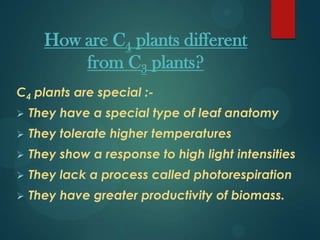
How are C4 plants different
from C3 plants?
C4 plants are special :-
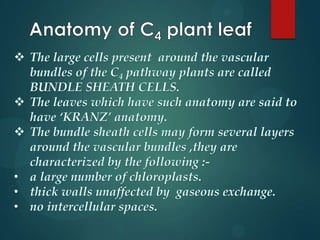
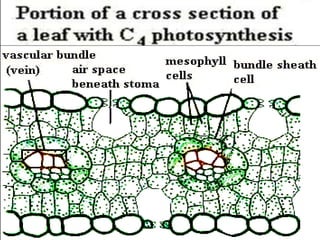
 They have a special type of leaf anatomy
 They tolerate higher temperatures
 They show a response to high light intensities
 They lack a process called photorespiration
 They have greater productivity of biomass.
What happens in Hatch and
Slack Pathway?
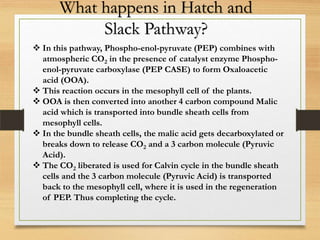
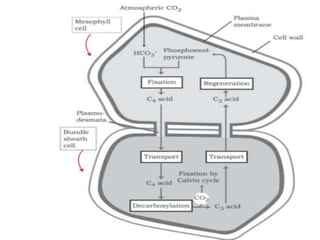
 In this pathway, Phospho-enol-pyruvate (PEP) combines with
atmospheric CO2 in the presence of catalyst enzyme Phospho-
enol-pyruvate carboxylase (PEP CASE) to form Oxaloacetic
acid (OOA).
 This reaction occurs in the mesophyll cell of the plants.
 OOA is then converted into another 4 carbon compound Malic
acid which is transported into bundle sheath cells from
mesophyll cells.
 In the bundle sheath cells, the malic acid gets decarboxylated or
breaks down to release CO2 and a 3 carbon molecule (Pyruvic
Acid).
 The CO2 liberated is used for Calvin cycle in the bundle sheath
cells and the 3 carbon molecule (Pyruvic Acid) is transported
back to the mesophyll cell, where it is used in the regeneration
of PEP. Thus completing the cycle.
Photorespiration
 In C3 plants some O2 does bind to RuBisCO and hence CO2 fixation
is decreased.
 So the RuBP instead of being converted to 2 molecules of PGA binds
with O2 to form 1molecule of phosphoglycerate and
phosphoglycolate in a pathway called Photorespiration.
 In the photorespiratory pathway, there is neither synthesis of
sugar nor of ATP but results in the release of CO2 with the
utilization of ATP.
 Therefore, photorespiration is regarded as a wasteful process.
 In C4 plants photorespiration does not occur. This is because they
have a mechanism that increases the concentration of CO2 at the
enzyme site.
 This results in increasing the intracellular concentration of CO2,
which ensures that the RuBisCO functions as carboxylase and
minimize the oxygenase activity.
Photosynthesis occur under the influence of many
factors both internal(plant) and external factors.
The plant/ internal factors include :-
The number, size, age and orientation of leaves
Mesophyll cells and chloroplasts
Internal CO2 concentration & the amount of
chlorophyll
These factors depend on the genetic predisposition and
the growth of the plant.
The external factors would include the availability of the following
:-
Sunlight
CO2 concentration
Temperature
Water
All these factors simultaneously affects the rate of photosynthesis.
Since all these factors interact and affect photosynthesis or CO2
fixation, one of these factors are the major cause or is the one that
limits the rate of photosynthesis. So at any point the rate will be
determined by the factors available at sub-optimal levels
When several factors affect any bio-chemical process, Blackman's
LAW OF LIMITING FACTORS comes into effect .
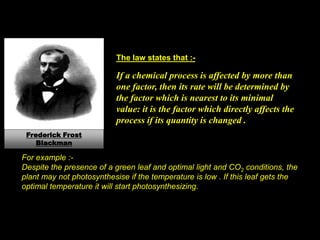
The law states that :-
If a chemical process is affected by more than
one factor, then its rate will be determined by
the factor which is nearest to its minimal
value: it is the factor which directly affects the
process if its quantity is changed .
Frederick Frost
Blackman
For example :-
Despite the presence of a green leaf and optimal light and CO2 conditions, the
plant may not photosynthesise if the temperature is low . If this leaf gets the
optimal temperature it will start photosynthesizing.
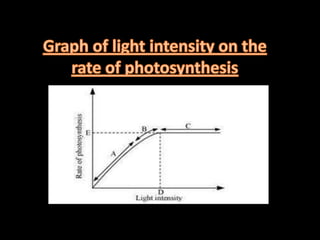
 There is a linear relationship between incident light and
CO2 fixation rates at low light intensities. At higher light
intensities gradually the rate does not show further
increase as other factors become limiting.
 The light saturation occurs at 10% of full sunlight. So
except for plants in shades or in dense forests, light is
rarely a limiting factor in nature.
 Also increase in incident light beyond a point causes the
breakdown of chlorophyll and a decrease in
photosynthesis.
AFFECTS
OF
CARBON DIOXIDE
CONCENTRATION
Carbon dioxide is the major limiting factor for
photosynthesis. The concentration of CO2 is very low in
atmosphere (0.03% to 0.04%). Increase in concentration
upto 0.05% can cause an increase CO2 fixation rates.
Beyond this, the levels can become damaging over longer
periods.
The C3 and C4 plants respond differently to CO3
concentrations :-
At high light conditions none of the group responds to
high CO2 conditions
At low light conditions both groups show increase in
the rates of photosynthesis.
The C4 plants show saturation at about 360µ1L-1 while
C3 responds to increase CO concentration and
saturation for them is seen only at 450 µ1L-1 and thus
current availability of CO2 levels is limiting to the C3
plants.
The dark reactions being enzymatic are
temperature controlled. Though light reactions
are also temperature sensitive they are affected
by temperature to a much lesser extent.
The C4 plants responds to higher temperature
and shows higher rate of photosynthesis
C3 plants have a much lesser temperature
optimum.
The temperature optimum for photosynthesis of
different plants depends upon the habitant they
are adapted to.
For example :- Tropical plants have a higher
temperature optimum than the plants adapted
to temperate climates.
Though water is one of the reactants in the
light reaction, the effect of water as a factor
is more on the plant, rather than directly on
photosynthesis.
Water stress causes the stomata to close
reducing the CO2 availability.
Water stress also makes leaves wilt, thus
reducing the surface area of the leaves and
their metabolic activity as well

The C4 pathway

  • 3.
    How are C4plants different from C3 plants? C4 plants are special :-  They have a special type of leaf anatomy  They tolerate higher temperatures  They show a response to high light intensities  They lack a process called photorespiration  They have greater productivity of biomass.
  • 7.
    What happens inHatch and Slack Pathway?  In this pathway, Phospho-enol-pyruvate (PEP) combines with atmospheric CO2 in the presence of catalyst enzyme Phospho- enol-pyruvate carboxylase (PEP CASE) to form Oxaloacetic acid (OOA).  This reaction occurs in the mesophyll cell of the plants.  OOA is then converted into another 4 carbon compound Malic acid which is transported into bundle sheath cells from mesophyll cells.  In the bundle sheath cells, the malic acid gets decarboxylated or breaks down to release CO2 and a 3 carbon molecule (Pyruvic Acid).  The CO2 liberated is used for Calvin cycle in the bundle sheath cells and the 3 carbon molecule (Pyruvic Acid) is transported back to the mesophyll cell, where it is used in the regeneration of PEP. Thus completing the cycle.
  • 9.
  • 10.
     In C3plants some O2 does bind to RuBisCO and hence CO2 fixation is decreased.  So the RuBP instead of being converted to 2 molecules of PGA binds with O2 to form 1molecule of phosphoglycerate and phosphoglycolate in a pathway called Photorespiration.  In the photorespiratory pathway, there is neither synthesis of sugar nor of ATP but results in the release of CO2 with the utilization of ATP.  Therefore, photorespiration is regarded as a wasteful process.  In C4 plants photorespiration does not occur. This is because they have a mechanism that increases the concentration of CO2 at the enzyme site.  This results in increasing the intracellular concentration of CO2, which ensures that the RuBisCO functions as carboxylase and minimize the oxygenase activity.
  • 12.
    Photosynthesis occur underthe influence of many factors both internal(plant) and external factors. The plant/ internal factors include :- The number, size, age and orientation of leaves Mesophyll cells and chloroplasts Internal CO2 concentration & the amount of chlorophyll These factors depend on the genetic predisposition and the growth of the plant.
  • 13.
    The external factorswould include the availability of the following :- Sunlight CO2 concentration Temperature Water All these factors simultaneously affects the rate of photosynthesis. Since all these factors interact and affect photosynthesis or CO2 fixation, one of these factors are the major cause or is the one that limits the rate of photosynthesis. So at any point the rate will be determined by the factors available at sub-optimal levels When several factors affect any bio-chemical process, Blackman's LAW OF LIMITING FACTORS comes into effect .
  • 14.
    The law statesthat :- If a chemical process is affected by more than one factor, then its rate will be determined by the factor which is nearest to its minimal value: it is the factor which directly affects the process if its quantity is changed . Frederick Frost Blackman For example :- Despite the presence of a green leaf and optimal light and CO2 conditions, the plant may not photosynthesise if the temperature is low . If this leaf gets the optimal temperature it will start photosynthesizing.
  • 16.
     There isa linear relationship between incident light and CO2 fixation rates at low light intensities. At higher light intensities gradually the rate does not show further increase as other factors become limiting.  The light saturation occurs at 10% of full sunlight. So except for plants in shades or in dense forests, light is rarely a limiting factor in nature.  Also increase in incident light beyond a point causes the breakdown of chlorophyll and a decrease in photosynthesis.
  • 18.
  • 19.
    Carbon dioxide isthe major limiting factor for photosynthesis. The concentration of CO2 is very low in atmosphere (0.03% to 0.04%). Increase in concentration upto 0.05% can cause an increase CO2 fixation rates. Beyond this, the levels can become damaging over longer periods. The C3 and C4 plants respond differently to CO3 concentrations :- At high light conditions none of the group responds to high CO2 conditions At low light conditions both groups show increase in the rates of photosynthesis. The C4 plants show saturation at about 360µ1L-1 while C3 responds to increase CO concentration and saturation for them is seen only at 450 µ1L-1 and thus current availability of CO2 levels is limiting to the C3 plants.
  • 21.
    The dark reactionsbeing enzymatic are temperature controlled. Though light reactions are also temperature sensitive they are affected by temperature to a much lesser extent. The C4 plants responds to higher temperature and shows higher rate of photosynthesis C3 plants have a much lesser temperature optimum. The temperature optimum for photosynthesis of different plants depends upon the habitant they are adapted to. For example :- Tropical plants have a higher temperature optimum than the plants adapted to temperate climates.
  • 23.
    Though water isone of the reactants in the light reaction, the effect of water as a factor is more on the plant, rather than directly on photosynthesis. Water stress causes the stomata to close reducing the CO2 availability. Water stress also makes leaves wilt, thus reducing the surface area of the leaves and their metabolic activity as well