The Calvin Cycle
- It occurs in the stroma
- NADPH and ATP molecules are
rapidly being provided to the
metabolic pathways in the stroma.
Therefore, ATP and NADPH formed
during the Light Dependent
reaction are used in the stroma to
fuel the Calvin Cycle reactions.
The Calvin Cycle
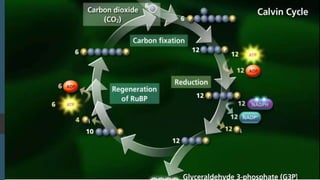
- The Calvin Cycle consists of a series of
reactions that reduce carbon dioxide
to produce the carbohydrate
glyceraldehyde-3-phospahte.
• Carbon Fixation
• Reduction
• Regeneration
The Calvin Cycle
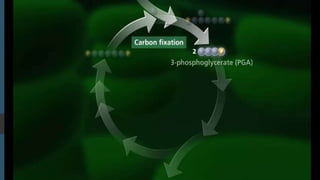
- Carbon Fixation
- In this step, carbon dioxide is
attached to ribulose 1,5-bisphophate
resulting in six carbon molecule that splits
into two three carbon molecules.
The Calvin Cycle
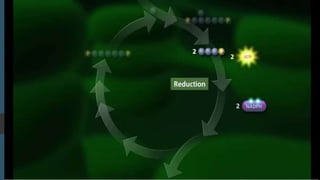
- Reduction
- This step is the sequence of
reactions using electrons from NADPH
and some of the ATP to reduce
carbon dioxide.
The Calvin Cycle
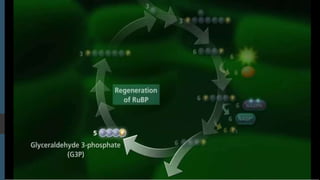
- Regeneration
- In the final step, ribulose 1,5-
bisphosphate is regenerated. For
every three turns of the cycle, five
molecules of glyceraldehyde-3-
phosphate are used to re-form 3
molecules of ribulose 1,5-
biphosphate.
The Calvin Cycle
- The remaining glyceraldehyde-3-phosphate is then
used to make glucose, fatty acids or glycerol. It takes
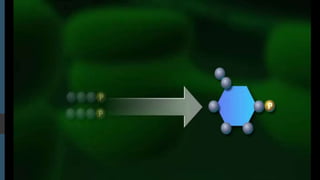
two molecules of glyceraldehyde-3-phosphate to
make one molecule of glucose phosphate. Thus, the
Calvin cycle has to run 6 times to produce one
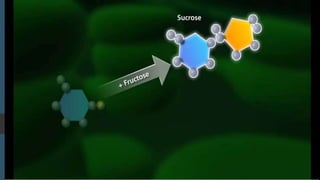
molecule of glucose. These molecules can remove
their phosphate and add fructose to form sucrose,
the molecule plants use to transport carbohydrates
throughout their system. Glucose phosphate is also
the starting molecule for the synthesis of starch and
cellulose.
Calvin Cycle
Calvin Cycle

Calvin Cycle

  • 2.
    The Calvin Cycle -It occurs in the stroma - NADPH and ATP molecules are rapidly being provided to the metabolic pathways in the stroma. Therefore, ATP and NADPH formed during the Light Dependent reaction are used in the stroma to fuel the Calvin Cycle reactions.
  • 3.
    The Calvin Cycle -The Calvin Cycle consists of a series of reactions that reduce carbon dioxide to produce the carbohydrate glyceraldehyde-3-phospahte. • Carbon Fixation • Reduction • Regeneration
  • 4.
    The Calvin Cycle -Carbon Fixation - In this step, carbon dioxide is attached to ribulose 1,5-bisphophate resulting in six carbon molecule that splits into two three carbon molecules.
  • 6.
    The Calvin Cycle -Reduction - This step is the sequence of reactions using electrons from NADPH and some of the ATP to reduce carbon dioxide.
  • 8.
    The Calvin Cycle -Regeneration - In the final step, ribulose 1,5- bisphosphate is regenerated. For every three turns of the cycle, five molecules of glyceraldehyde-3- phosphate are used to re-form 3 molecules of ribulose 1,5- biphosphate.
  • 10.
    The Calvin Cycle -The remaining glyceraldehyde-3-phosphate is then used to make glucose, fatty acids or glycerol. It takes two molecules of glyceraldehyde-3-phosphate to make one molecule of glucose phosphate. Thus, the Calvin cycle has to run 6 times to produce one molecule of glucose. These molecules can remove their phosphate and add fructose to form sucrose, the molecule plants use to transport carbohydrates throughout their system. Glucose phosphate is also the starting molecule for the synthesis of starch and cellulose.