Capparidaceae
Crateva religiosa
Cleome viscosa
Gynandropis pentaphylla
Systematic Position
• Kingdom - Phanerogams
• Class - Dicotyledones
• Sub-class - Polypetalae
• Series - Thalamiflorae
• Order - Parietales
• Family - Capparidaceae
Systematic Relationships
 Bentham & Hooker have placed the Capparidaceae in their second order the
Parietales of Dicotyledones.
 Dr. V. Puri showed that the parietal placentation in the families Moringaceae,
Brassicaceae and Capparidaceae has been derived from the axile type.
 According to Norris(1941) the Resedaceae and Capparidaceae are supposed to be
most primitive families of the order Rhoeadales.
 Hutchinson has separated the Capparidaceae as distinct order Capparidales with
herbaceous/woody plants.
Distribution
 There are about 45 genera and 700 species in this family.
 The members of this family are mainly distributed in the tropical parts
of the world. The plants occur mostly in dry regions.
 Several shrubby species of Capparis occur in the Mediterranean region.
 Several genera such as Capparis, Gynandropsis, Cleome, Crateva, etc.,
are commonly found in India.
Vegetative characters
 Habit - Gynandropsis pentaphylla is an annual rainy season herb, Capparis decidua
is a xerophytic shrub, Crateva religiosa is a tree, Species of Maerua are climbing
plants.
 Root - Tap and branched.
 Stem - Erect, branched, woody or herbaceous, solid, cylindrical, etc.
 Leaves - Simple or palmately compound. Stipules may or may not be present. In
Capparis spinosa stipules modified into spines. The leaves are altogether absent in
Capparis decidua.
Floral characters
• Inflorescence - Usually racemose type. Flowers of Cleome, Gynandropsis, etc.,
arranged in racemes; in Maerua and Capparis decidua arranged in corymbs; in
Capparis sepiaria flowers are arranged in umbels; Crateva nurvala they are
arranged in corymbose clusters. Rarely the flowers are solitary, e.g., Niebuhria.
• Flowers - Flowers are pedicellate and bracteate. Bracteoles absent. Flowers are
hermaphrodite, actinomorphic (zygomorphic in Capparis decidua), complete,
regular/irregular and hypogynous.
• Calyx - Consists of four sepals arranged in two whorls. Sepals are free
(polysepalous), valvate/imbricate.
• Corolla - It consists of 4 petals, polypetalous. Petals arranged diagonally. Usually
regular (irregular in Capparis decidua), imbricate/valvate.
• Androecium - The number of stamens vary much in different species. In different
species of Cleome the number of stamens ranges from four to indefinite.
Filaments are filiform, the anthers are basifixed and dithecous.
 The characteristic of this family presence of androphore, gynophore and
gynandrophore.
 If the internode is present between the petals and stamens which is known as
androphore.
 If the internode is present between the stamens and pistil which is known as
gynophore.
 The androphore and gynophore are known together as gynandrophore present
in Gynandropsis pentaphylla.
• Gynoecium - It situated on a gynophore. Consists of bicarpellary, syncarpous.
Rarely more than two carpels. Ovary is superior, unilocular. Sometimes it
becomes multilocular by ingrowth of parietal placentas. Placentation is parietal.
Ovules are many and campylotropous. Style is very short/absent.
• Fruit - The fruit is Siliqua. In Cleome is Siliqua with replum, Berry in Capparis,
Drupe in Rogdsia and Nut in Emblingia.
• Seeds - Non-endospermic. They are renifrom. Each seed contains a large variously
folded embryo.
• Pollination - Entomophilous (insects). Dichogamy and protandry are found.
Nectar also secreted.
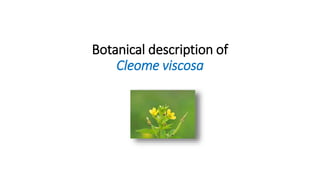
Botanical description of
Cleome viscosa
Vegetative characters
 Habit - An annual rainy season herb, weed, 1-3 feet high.
 Root - Tap and branched.
 Stem - Erect, branched, glandular pubescent, solid.
 Leaves - 3-5 foliate, leaflets sessile, ovate or obovate.
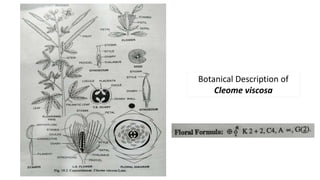
Botanical Description of
Cleome viscosa
Floral characters
• Inflorescence - Racemose, typical raceme.
• Flowers - Pedicellate (long pedicels), ebracteate, hermaphrodite, yellow,
actinomorphic, complete.
• Calyx - Four sepals, arranged in two whorls, polysepalous, ovate, acute, inferior,
valvate.
• Corolla - Four petals, polypetalous, two proximate and two spreading, obtuse,
clawed, yellow, inferior, valvate aestivation.
• Androecium - Many stamens (12-24), polyandrous, filaments long, inferior,
anthers introrse, basifixed.
• Gynoecium - Two carpels (bicarpellary), syncarpous, ovary superior, sessile or
sub-sessile, unilocular, parietal placentation, many ovules on two parietal
placentas, style short, stigma round.
• Fruit - Oblong or linear capsule.
Economic Importance of Family
• Capparis decidua; Syn. Capparis aphylla - The bark of this shrub is used in cough,
asthma and inflammation. The root is useful in fever and rheumatism. Wood is
used in making tool-handles.
• Capparis grandis - This tree yields oil which used as an illuminant.
• Capparis sepiaria - The climbing shrub is an medicinal plant used to cure skin
diseases.
• Capparis spinosa - Flower buds are used as condiment. The root bark is used in
the treatment of rheumatic pains.
• Capparis zeylanica; Syn. Capparis horrida -A thorny shrub used as hedge plant.
Fruits are edible.
• Cleome spinosa - A strongly scented herb grown as ornamental.
• Cleome viscosa - Seeds and leaves of this herb used for medicinal purposes.
Seeds are stimulant and carminative.
• Cleome icosandra - Seeds are carminative. Leaves used for curing ulcers and
wounds.
• Crateva nurvala; Syn. Crateva religiosa - Bark and leaves of this tree possess
medicinal properties. Pulp of this plant used as adhesive. Combs are prepared
from its wood.
• Gynandropsis pentaphylla - The leaves, roots and stem of this annual rainy
season herb possess several medicinal properties.
• Maerua sp. This climbing shrub used for ornamental value. The roots used as
tonic and stimulant.