Livestock
Species Cattle Swine Poultry Sheep Goats Horses Llamas Fish
Cattle
Terms Cow – female who has had a calf Heifer – female who has not calved Calf – young Steer – altered male Bull – intact male
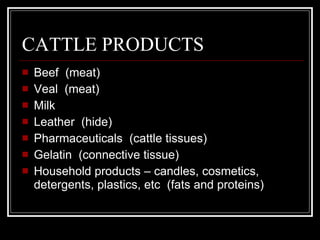
CATTLE PRODUCTS Beef  (meat) Veal  (meat) Milk Leather  (hide) Pharmaceuticals  (cattle tissues) Gelatin  (connective tissue) Household products – candles, cosmetics, detergents, plastics, etc  (fats and proteins)
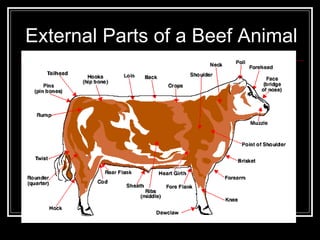
External Parts of a Beef Animal
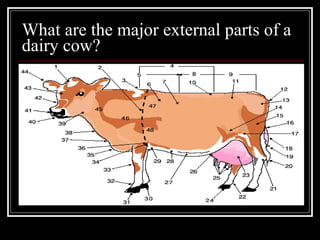
What are the major external parts of a dairy cow?
BEEF BREEDS
BEEF BREED TERMS? Polled born naturally without horns marbling desirable presence of fat in the muscle cutability amount of available retail cuts from the carcass dual-purpose breed traditionally used for both milk and beef production
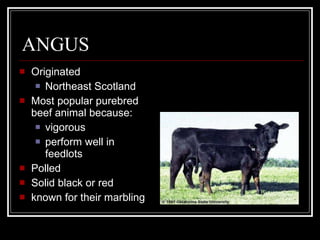
Originated  Northeast Scotland Most popular purebred beef animal because: vigorous perform well in feedlots Polled Solid black or red known for their marbling ANGUS
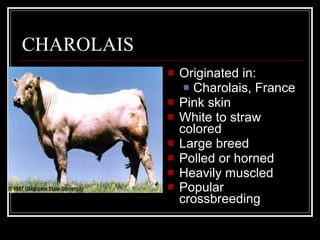
Originated in: Charolais, France Pink skin White to straw colored Large breed Polled or horned Heavily muscled Popular crossbreeding   CHAROLAIS
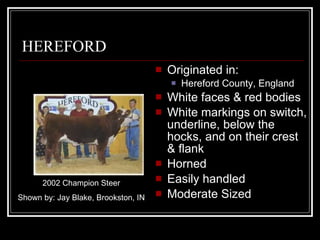
HEREFORD Originated in: Hereford County, England White faces & red bodies White markings on switch, underline, below the hocks, and on their crest & flank Horned Easily handled Moderate Sized 2002 Champion Steer Shown by: Jay Blake, Brookston, IN
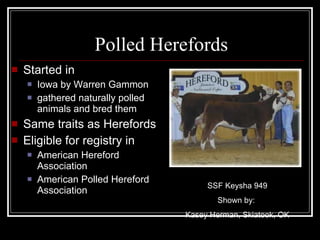
Started in Iowa by Warren Gammon gathered naturally polled animals and bred them  Same traits as Herefords Eligible for registry in American Hereford Association American Polled Hereford Association Polled Herefords SSF Keysha 949 Shown by:  Kasey Herman, Skiatook, OK
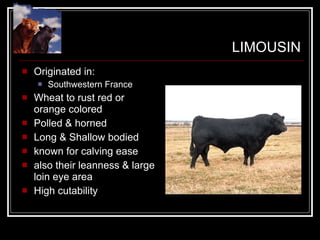
LIMOUSIN Originated in: Southwestern France Wheat to rust red or orange colored Polled & horned Long & Shallow bodied known for calving ease also their leanness & large loin eye area High cutability
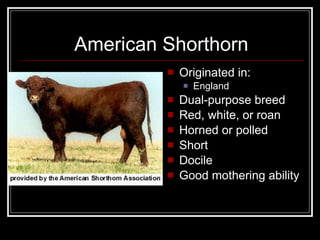
American Shorthorn Originated in: England Dual-purpose breed Red, white, or roan Horned or polled Short Docile Good mothering ability
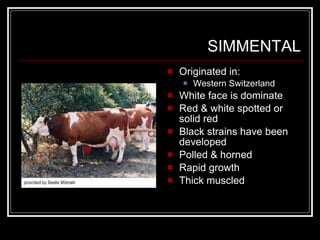
SIMMENTAL Originated in: Western Switzerland White face is dominate Red & white spotted or solid red Black strains have been developed Polled & horned Rapid growth Thick muscled
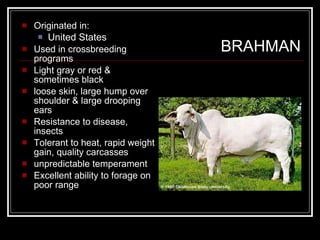
BRAHMAN Originated in: United States   Used in crossbreeding programs Light gray or red & sometimes black loose skin, large hump over shoulder & large drooping ears Resistance to disease, insects Tolerant to heat, rapid weight gain, quality carcasses unpredictable temperament Excellent ability to forage on poor range
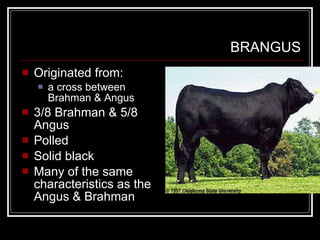
BRANGUS Originated from: a cross between Brahman & Angus 3/8 Brahman & 5/8 Angus Polled Solid black Many of the same characteristics as the Angus & Brahman
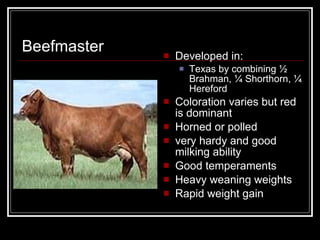
Beefmaster Developed in: Texas by combining ½ Brahman, ¼ Shorthorn, ¼ Hereford Coloration varies but red is dominant Horned or polled very hardy and good milking ability Good temperaments Heavy weaning weights Rapid weight gain
Beef Operations Cow-calf operation keeping mature cattle to produce calves cows bred every year  calves sold 2 ways Feeder calves weaned animals under a year old until sold to feedlot and raised to slaughter weight Yearling feeders calves between 1 and 2 years of age sold to another producer to feed out to slaughter weight
DAIRY BREEDS
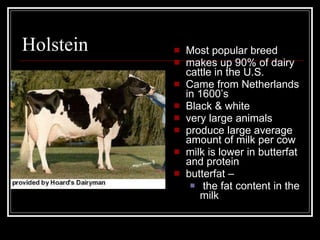
Holstein Most popular breed makes up 90% of dairy cattle in the U.S. Came from Netherlands in 1600’s Black & white very large animals produce large average amount of milk per cow milk is lower in butterfat and protein butterfat – the fat content in the milk
Red & White Holstein Evolved from the black & white Holstein Red & white in color all other characteristics very similar to Holstein large animals high milk production  low butterfat and protein
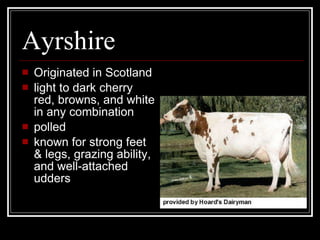
Ayrshire Originated in Scotland light to dark cherry red, browns, and white in any combination polled known for strong feet & legs, grazing ability, and well-attached udders
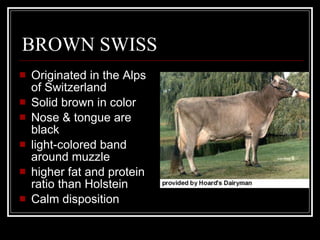
BROWN SWISS Originated in the Alps of Switzerland Solid brown in color Nose & tongue are black light-colored band around muzzle higher fat and protein ratio than Holstein Calm disposition
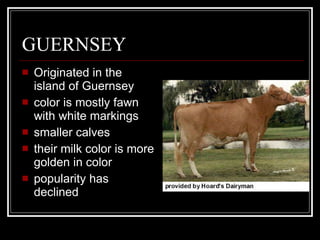
GUERNSEY Originated in the island of Guernsey color is mostly fawn with white markings smaller calves their milk color is more golden in color popularity has declined
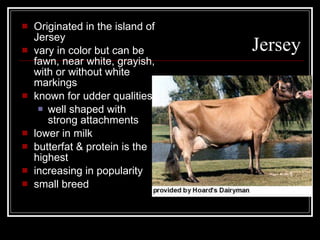
Jersey Originated in the island of Jersey vary in color but can be fawn, near white, grayish, with or without white markings known for udder qualities well shaped with strong attachments lower in milk butterfat & protein is the highest increasing in popularity small breed
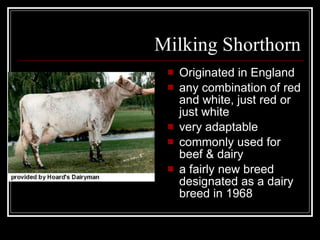
Milking Shorthorn Originated in England any combination of red and white, just red or just white very adaptable commonly used for beef & dairy a fairly new breed designated as a dairy breed in 1968
Dairy System Heifers are bred and calve When calves are 1-3 days old it is removed Cow is milked 2-4 times per day to maintain production Calf is fed milk replacer and sold or raised as future heifer
Dairy By-Products Terms Veal meat of young calves that are not used for replacement animals Beef meat from cattle Cattle by-products products made from various parts of the cattle
Swine
Swine Products Pork  (meat) Leather  (hide) Lubricants, waxes, plastics  (fat) Bone meal
Terms Piglet - a baby pig Barrow -  a male pig that was castrated at a young age Gilt -  a young female pig that has not given birth or farrowed Sow -  an older female pig Boar -  mature male hog
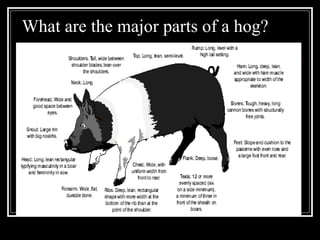
What are the major parts of a hog?
TERMS Prolificacy the ability to produce large numbers of offspring Meat-type hog hog that produces the greatest amount of high value meat cuts
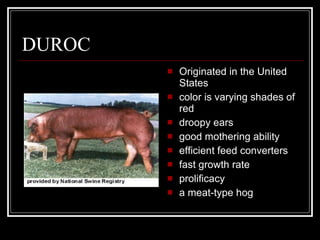
DUROC Originated in the United States color is varying shades of red droopy ears good mothering ability efficient feed converters fast growth rate prolificacy a meat-type hog
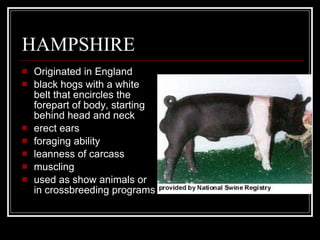
HAMPSHIRE Originated in England black hogs with a white belt that encircles the forepart of body, starting behind head and neck erect ears foraging ability leanness of carcass muscling used as show animals or in crossbreeding programs
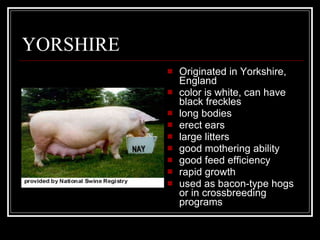
YORSHIRE Originated in Yorkshire, England color is white, can have black freckles long bodies erect ears large litters good mothering ability good feed efficiency rapid growth used as bacon-type hogs or in crossbreeding programs
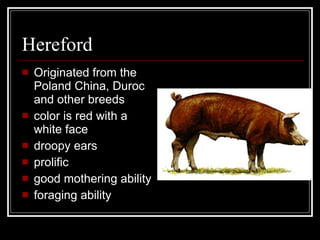
Hereford Originated from the Poland China, Duroc and other breeds color is red with a white face droopy ears prolific good mothering ability foraging ability
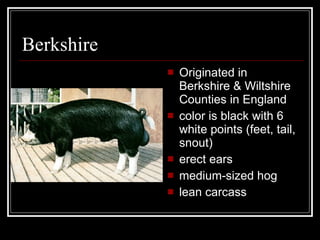
Berkshire Originated in Berkshire & Wiltshire Counties in England color is black with 6 white points (feet, tail, snout) erect ears medium-sized hog lean carcass
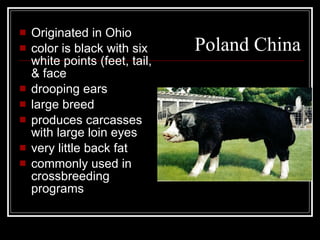
Poland China Originated in Ohio color is black with six white points (feet, tail, & face drooping ears large breed produces carcasses with large loin eyes very little back fat commonly used in crossbreeding programs
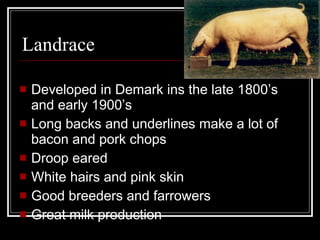
Landrace Developed in Demark ins the late 1800’s and early 1900’s Long backs and underlines make a lot of bacon and pork chops Droop eared White hairs and pink skin Good breeders and farrowers Great milk production
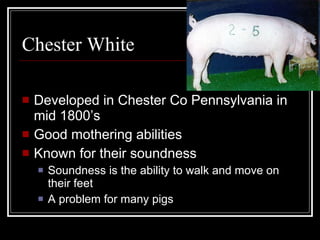
Chester White Developed in Chester Co Pennsylvania in mid 1800’s Good mothering abilities Known for their soundness Soundness is the ability to walk and move on their feet A problem for many pigs
What are the different production systems and how do they work? Terms Farrowing process of a female pig giving birth Feeder pigs a pig that has been weaned and weighs approximately 40 pounds
Sow and Litter Systems Pigs are farrowed and fed up to slaughter weight at the same farm confinement or pasture systems most common swine operations
Feeder Pig Production System breed & farrow litters of piglets this systems farrows and weans and sells the feeder pigs keeps a breeding herd of sows that farrow between 14 to 16 piglets each minimal investment is required must mange to keep a steady supply of feeder pigs to sell less feed is required in this system
Finishing Feeder-Pig System operations that buy feeder pigs and feed them until they are market weight approximately 240 pounds profit is based upon how much feed it takes to produce 1 pound of pork the less feed it takes the more profit balancing feed rations is very important in this system
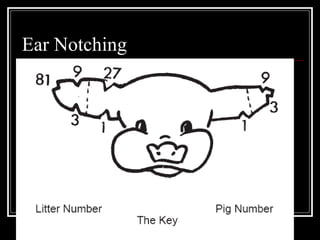
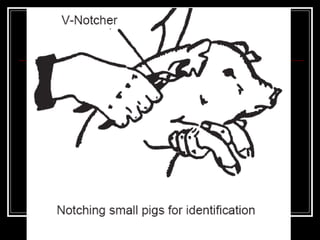
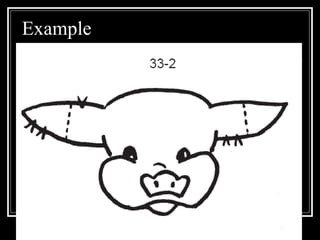
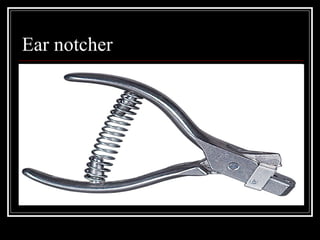
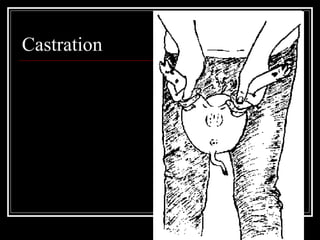
Processing Piglets When a sow farrows, we must “process” the piglets to allow for healthy identifiable piglets. We notch ears, cut needle teeth, castrate males, dock tales, and give iron shots. Usually done within 24-48 hrs of birth. The earlier, the better – less trauma.
Ear Notching
 
Example
Ear notcher
Clipping teeth
Clipping teeth Piglets bite the sow in their fight to get hold of one of her teats and suckle The pain disturbs the sow causing her to get up and prevents her young from feeding The cuts to the sow's udder also allow germs to infect the udder Piglets will also bite and injure one another
Tail docking
Tail docking Must dock tails in large operations because other pigs will chew on the tails and become more aggressive. The chewed tails often become infected and the animal becomes sick.
Castration
Poultry
Poultry Products Meat Eggs Feathers/Down
What is poultry? Poultry group name for all domesticated birds referred to as fowl have wings, backbones, & feathers some can swim
Species Chickens Turkeys Ducks Geese Game Birds
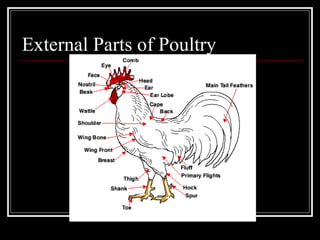
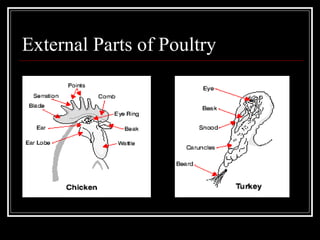
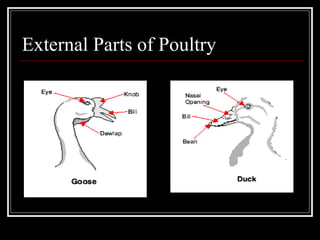
External Parts of Poultry
What are terms associated with poultry? Chickens Layers chickens that are used to produce large quantities of eggs eggs used for food and produce chicks Broilers young chickens that weigh about 4 pounds, are 6 to 7 weeks old and used for meat Chick baby chicken of either sex Cockerels young male chicken
What are terms associated with poultry? Chickens Roosters mature males Pullets young female chickens Hens mature females Bantams miniature chickens Turkeys Hens mature females Tom adult male gobbler Poult young turkey of either sex
What are terms associated with poultry? Ducks have down that grows under feathers Hens mature female Drake mature male Duckling young duck of both sexes Geese Goose female at maturity Gander male at maturity Goslings young geese
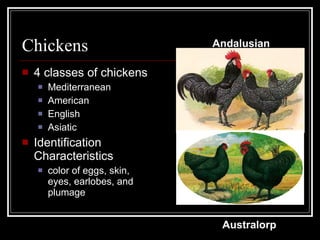
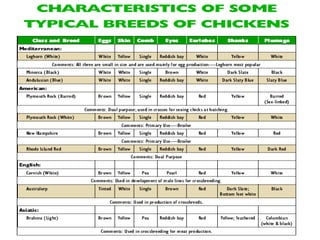
Chickens 4 classes of chickens Mediterranean American English Asiatic Identification Characteristics color of eggs, skin, eyes, earlobes, and plumage Andalusian   Australorp
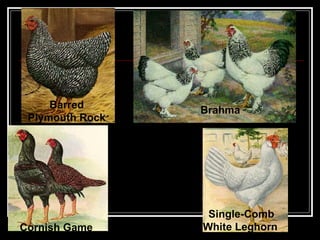
Brahma  Cornish Game   Single-Comb White Leghorn   Barred Plymouth Rock
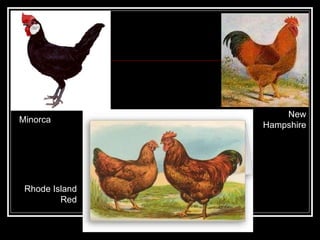
Minorca New Hampshire Rhode Island Red
 
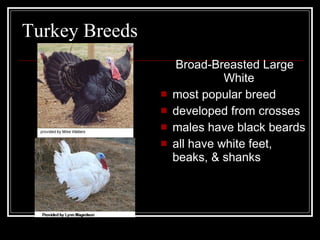
Turkey Breeds Broad-Breasted Large White  most popular breed developed from crosses males have black beards all have white feet, beaks, & shanks
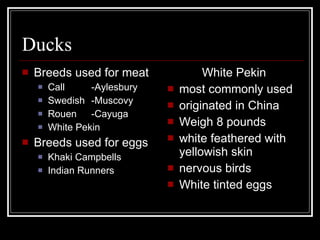
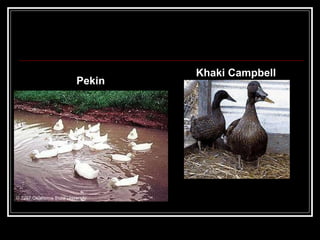
Ducks Breeds used for meat Call   -Aylesbury Swedish   -Muscovy Rouen   -Cayuga White Pekin Breeds used for eggs Khaki Campbells Indian Runners White Pekin most commonly used  originated in China Weigh 8 pounds white feathered with yellowish skin nervous birds White tinted eggs
Pekin Khaki Campbell
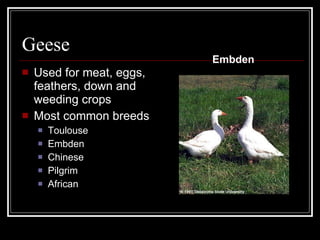
Geese Used for meat, eggs, feathers, down and weeding crops Most common breeds Toulouse Embden Chinese Pilgrim African Embden
Sheep & Goats
Sheep and Goat Products Lamb, Mutton, Cabrito, Chevon (Meat) Milk Wool Leather Keep fields clean
Terms Doe - female goat or sheep Buck - male goat at any age Kid - goat of either sex under 1 year of age Yearling - goat of either sex over one year, but under 2 years of age Wether - male goat or sheep that has been castrated when young Ram - male sheep used for breeding purposes
Terms (cont.) Ewe -  a female sheep Kidding -  process of a goat giving birth Lambing -  process of a sheep giving birth Lamb -  sheep under one year old / meat from a young sheep Mutton -  meat from a sheep that is over one year of age Chammy -  leather made from sheep and goats Wool -  a sheep’s coat that is used as a fiber for products such as clothing
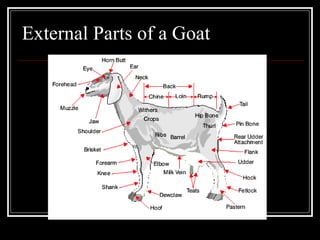
External Parts of a Goat
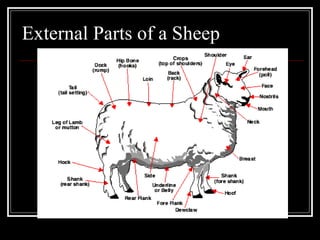
External Parts of a Sheep
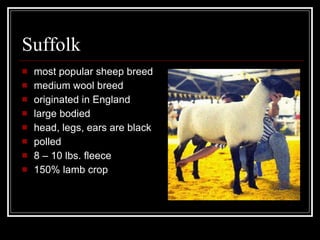
Suffolk most popular sheep breed medium wool breed originated in England large bodied head, legs, ears are black polled 8 – 10 lbs. fleece 150% lamb crop
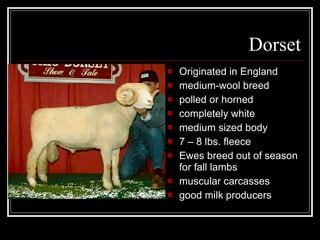
Dorset Originated in England medium-wool breed polled or horned completely white medium sized body 7 – 8 lbs. fleece Ewes breed out of season for fall lambs muscular carcasses good milk producers
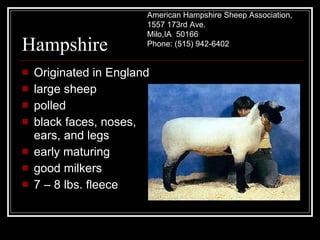
Hampshire Originated in England large sheep polled black faces, noses, ears, and legs early maturing good milkers 7 – 8 lbs. fleece American Hampshire Sheep Association, 1557 173rd Ave.  Milo,IA  50166    Phone: (515) 942-6402
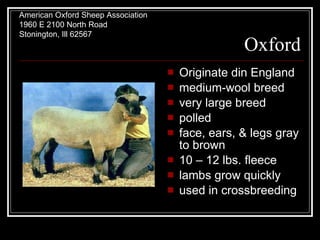
Oxford Originate din England medium-wool breed very large breed polled face, ears, & legs gray to brown 10 – 12 lbs. fleece lambs grow quickly used in crossbreeding American Oxford Sheep Association  1960 E 2100 North Road  Stonington, Ill 62567
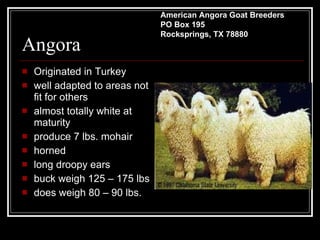
Angora Originated in Turkey well adapted to areas not fit for others almost totally white at maturity produce 7 lbs. mohair horned  long droopy ears buck weigh 125 – 175 lbs does weigh 80 – 90 lbs. American Angora Goat Breeders PO Box 195 Rocksprings, TX 78880
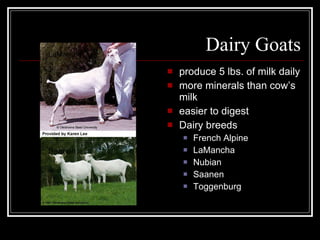
Dairy Goats produce 5 lbs. of milk daily more minerals than cow’s milk easier to digest Dairy breeds French Alpine LaMancha Nubian Saanen Toggenburg LaMancha Saanen
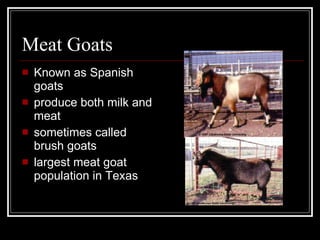
Meat Goats Known as Spanish goats produce both milk and meat sometimes called brush goats largest meat goat population in Texas
Cashmere Goats Developed by selective breeding Cashmere soft undercoat of fine down produced by goats large demand for cashmere Solid colored goats are preferred in cashmere production
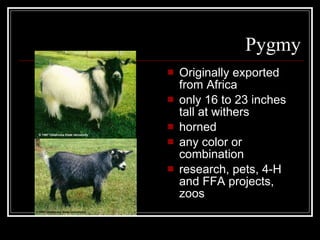
Pygmy Originally exported from Africa only 16 to 23 inches tall at withers horned any color or combination research, pets, 4-H and FFA projects, zoos
Horses (Equine)
Horse Products Recreation / Sport Cheval (meat) Dog/cat food (meat) Glue (hooves)
What are some terms you may need to know to understand horses? Horses are also referred to as equine. Horses, ponies, donkeys, & mules are members of the horse family. Hand unique measurement for horses or racing 4 inches or 10.2 centimeters Height of horses measured from ground to highest point of the withers
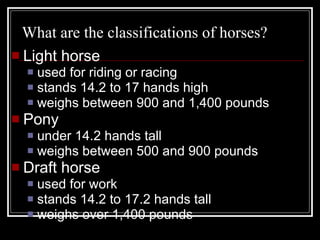
What are the classifications of horses? Light horse used for riding or racing stands 14.2 to 17 hands high weighs between 900 and 1,400 pounds Pony under 14.2 hands tall weighs between 500 and 900 pounds Draft horse used for work stands 14.2 to 17.2 hands tall weighs over 1,400 pounds
Equine Terms Filly Thoroughbred under 4 years of age or any other breed under 3 years of age Stud horse male that is kept for breeding Foal horse of either gender that has not been weaned
More Horse Terms Gelding male horse that has been castrated before reaching sexual maturity Mare mature female horse Stallion mature male horse Colt male horse that is not mature
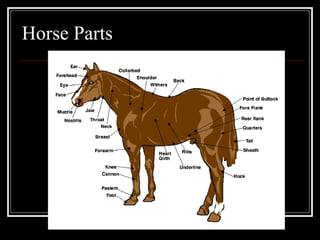
Horse Parts
Horse Coat Colors Color variations dun gray roan pinto palomino Colors Bay Black Brown Chestnut White
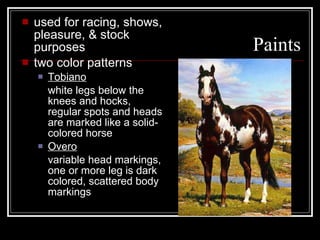
Paints used for racing, shows, pleasure, & stock purposes two color patterns Tobiano white legs below the knees and hocks, regular spots and heads are marked like a solid-colored horse Overo variable head markings, one or more leg is dark colored, scattered body markings
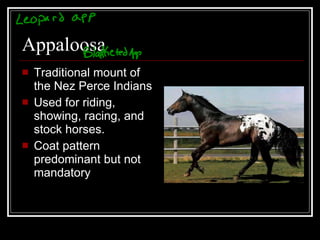
Appaloosa Traditional mount of the Nez Perce Indians Used for riding, showing, racing, and stock horses. Coat pattern predominant but not mandatory
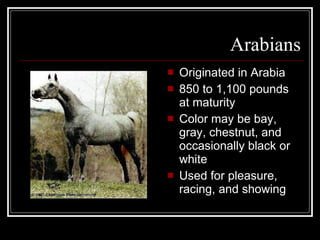
Arabians Originated in Arabia 850 to 1,100 pounds at maturity Color may be bay, gray, chestnut, and occasionally black or white Used for pleasure, racing, and showing
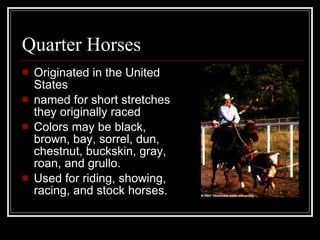
Quarter Horses Originated in the United States named for short stretches they originally raced Colors may be black, brown, bay, sorrel, dun, chestnut, buckskin, gray, roan, and grullo. Used for riding, showing, racing, and stock horses.
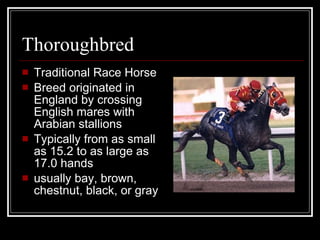
Thoroughbred Traditional Race Horse Breed originated in England by crossing English mares with Arabian stallions Typically from as small as 15.2 to as large as 17.0 hands  usually bay, brown, chestnut, black, or gray
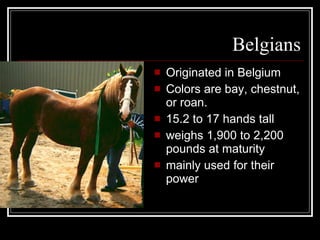
Belgians Originated in Belgium Colors are bay, chestnut, or roan. 15.2 to 17 hands tall weighs 1,900 to 2,200 pounds at maturity mainly used for their power
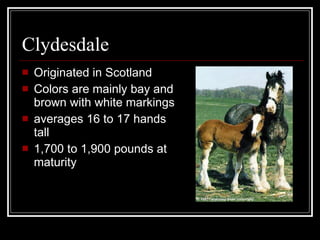
Clydesdale Originated in Scotland Colors are mainly bay and brown with white markings averages 16 to 17 hands tall 1,700 to 1,900 pounds at maturity
LLAMAS & ALPACAS
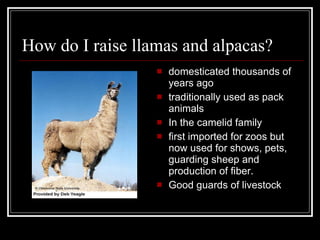
How do I raise llamas and alpacas? domesticated thousands of years ago traditionally used as pack animals In the camelid family first imported for zoos but now used for shows, pets, guarding sheep and production of fiber. Good guards of livestock
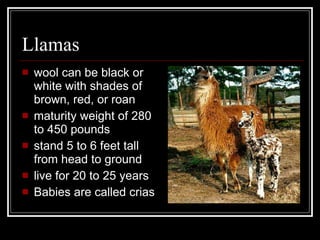
Llamas wool can be black or white with shades of brown, red, or roan maturity weight of 280 to 450 pounds stand 5 to 6 feet tall from head to ground live for 20 to 25 years Babies are called crias
Alpacas 22 different colors 2 different classes based on type of fleece Haucaya dense, crimped fiber Suri white fleece that is not crimped but hangs down and is curly weighs between 100 to 175 pounds stand 4 ½ feet tall live for 20 to 25 years both llamas and alpaca graze and are suited to live on harsh terrains
How do I market my llamas and Alpacas? done mainly from grower to grower few places to that slaughter and process the animals breeding stock cost between $300 to $6,000 per animal Used mainly for show in U.S.
FISH
Terms used in fish production aquaculture production of aquatic vegetation and animals aqua-crop commercially produced water species freshwater water that contains little or no salt saltwater water containing over 16.5 parts per thousand of salt fish animals that have gills instead of lungs and are vertebrates (having backbones) hatchery facility where eggs are incubated and hatched by artificial means Fry a newly hatched fish
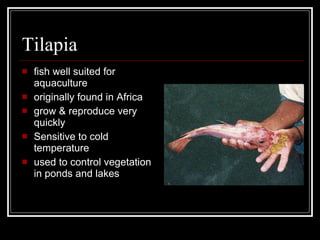
Tilapia fish well suited for aquaculture originally found in Africa grow & reproduce very quickly Sensitive to cold temperature used to control vegetation in ponds and lakes
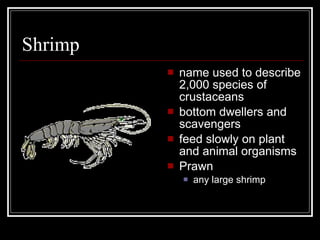
Shrimp name used to describe 2,000 species of crustaceans bottom dwellers and scavengers feed slowly on plant and animal organisms Prawn any large shrimp
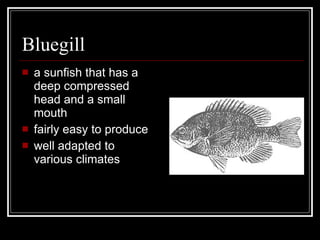
Bluegill a sunfish that has a deep compressed head and a small mouth fairly easy to produce well adapted to various climates
The End (thank goodness)

Livestock

  • 1.
  • 2.
    Species Cattle SwinePoultry Sheep Goats Horses Llamas Fish
  • 3.
  • 4.
    Terms Cow –female who has had a calf Heifer – female who has not calved Calf – young Steer – altered male Bull – intact male
  • 5.
    CATTLE PRODUCTS Beef (meat) Veal (meat) Milk Leather (hide) Pharmaceuticals (cattle tissues) Gelatin (connective tissue) Household products – candles, cosmetics, detergents, plastics, etc (fats and proteins)
  • 6.
    External Parts ofa Beef Animal
  • 7.
    What are themajor external parts of a dairy cow?
  • 8.
  • 9.
    BEEF BREED TERMS?Polled born naturally without horns marbling desirable presence of fat in the muscle cutability amount of available retail cuts from the carcass dual-purpose breed traditionally used for both milk and beef production
  • 10.
    Originated NortheastScotland Most popular purebred beef animal because: vigorous perform well in feedlots Polled Solid black or red known for their marbling ANGUS
  • 11.
    Originated in: Charolais,France Pink skin White to straw colored Large breed Polled or horned Heavily muscled Popular crossbreeding CHAROLAIS
  • 12.
    HEREFORD Originated in:Hereford County, England White faces & red bodies White markings on switch, underline, below the hocks, and on their crest & flank Horned Easily handled Moderate Sized 2002 Champion Steer Shown by: Jay Blake, Brookston, IN
  • 13.
    Started in Iowaby Warren Gammon gathered naturally polled animals and bred them Same traits as Herefords Eligible for registry in American Hereford Association American Polled Hereford Association Polled Herefords SSF Keysha 949 Shown by: Kasey Herman, Skiatook, OK
  • 14.
    LIMOUSIN Originated in:Southwestern France Wheat to rust red or orange colored Polled & horned Long & Shallow bodied known for calving ease also their leanness & large loin eye area High cutability
  • 15.
    American Shorthorn Originatedin: England Dual-purpose breed Red, white, or roan Horned or polled Short Docile Good mothering ability
  • 16.
    SIMMENTAL Originated in:Western Switzerland White face is dominate Red & white spotted or solid red Black strains have been developed Polled & horned Rapid growth Thick muscled
  • 17.
    BRAHMAN Originated in:United States Used in crossbreeding programs Light gray or red & sometimes black loose skin, large hump over shoulder & large drooping ears Resistance to disease, insects Tolerant to heat, rapid weight gain, quality carcasses unpredictable temperament Excellent ability to forage on poor range
  • 18.
    BRANGUS Originated from:a cross between Brahman & Angus 3/8 Brahman & 5/8 Angus Polled Solid black Many of the same characteristics as the Angus & Brahman
  • 19.
    Beefmaster Developed in:Texas by combining ½ Brahman, ¼ Shorthorn, ¼ Hereford Coloration varies but red is dominant Horned or polled very hardy and good milking ability Good temperaments Heavy weaning weights Rapid weight gain
  • 20.
    Beef Operations Cow-calfoperation keeping mature cattle to produce calves cows bred every year calves sold 2 ways Feeder calves weaned animals under a year old until sold to feedlot and raised to slaughter weight Yearling feeders calves between 1 and 2 years of age sold to another producer to feed out to slaughter weight
  • 21.
  • 22.
    Holstein Most popularbreed makes up 90% of dairy cattle in the U.S. Came from Netherlands in 1600’s Black & white very large animals produce large average amount of milk per cow milk is lower in butterfat and protein butterfat – the fat content in the milk
  • 23.
    Red & WhiteHolstein Evolved from the black & white Holstein Red & white in color all other characteristics very similar to Holstein large animals high milk production low butterfat and protein
  • 24.
    Ayrshire Originated inScotland light to dark cherry red, browns, and white in any combination polled known for strong feet & legs, grazing ability, and well-attached udders
  • 25.
    BROWN SWISS Originatedin the Alps of Switzerland Solid brown in color Nose & tongue are black light-colored band around muzzle higher fat and protein ratio than Holstein Calm disposition
  • 26.
    GUERNSEY Originated inthe island of Guernsey color is mostly fawn with white markings smaller calves their milk color is more golden in color popularity has declined
  • 27.
    Jersey Originated inthe island of Jersey vary in color but can be fawn, near white, grayish, with or without white markings known for udder qualities well shaped with strong attachments lower in milk butterfat & protein is the highest increasing in popularity small breed
  • 28.
    Milking Shorthorn Originatedin England any combination of red and white, just red or just white very adaptable commonly used for beef & dairy a fairly new breed designated as a dairy breed in 1968
  • 29.
    Dairy System Heifersare bred and calve When calves are 1-3 days old it is removed Cow is milked 2-4 times per day to maintain production Calf is fed milk replacer and sold or raised as future heifer
  • 30.
    Dairy By-Products TermsVeal meat of young calves that are not used for replacement animals Beef meat from cattle Cattle by-products products made from various parts of the cattle
  • 31.
  • 32.
    Swine Products Pork (meat) Leather (hide) Lubricants, waxes, plastics (fat) Bone meal
  • 33.
    Terms Piglet -a baby pig Barrow - a male pig that was castrated at a young age Gilt - a young female pig that has not given birth or farrowed Sow - an older female pig Boar - mature male hog
  • 34.
    What are themajor parts of a hog?
  • 35.
    TERMS Prolificacy theability to produce large numbers of offspring Meat-type hog hog that produces the greatest amount of high value meat cuts
  • 36.
    DUROC Originated inthe United States color is varying shades of red droopy ears good mothering ability efficient feed converters fast growth rate prolificacy a meat-type hog
  • 37.
    HAMPSHIRE Originated inEngland black hogs with a white belt that encircles the forepart of body, starting behind head and neck erect ears foraging ability leanness of carcass muscling used as show animals or in crossbreeding programs
  • 38.
    YORSHIRE Originated inYorkshire, England color is white, can have black freckles long bodies erect ears large litters good mothering ability good feed efficiency rapid growth used as bacon-type hogs or in crossbreeding programs
  • 39.
    Hereford Originated fromthe Poland China, Duroc and other breeds color is red with a white face droopy ears prolific good mothering ability foraging ability
  • 40.
    Berkshire Originated inBerkshire & Wiltshire Counties in England color is black with 6 white points (feet, tail, snout) erect ears medium-sized hog lean carcass
  • 41.
    Poland China Originatedin Ohio color is black with six white points (feet, tail, & face drooping ears large breed produces carcasses with large loin eyes very little back fat commonly used in crossbreeding programs
  • 42.
    Landrace Developed inDemark ins the late 1800’s and early 1900’s Long backs and underlines make a lot of bacon and pork chops Droop eared White hairs and pink skin Good breeders and farrowers Great milk production
  • 43.
    Chester White Developedin Chester Co Pennsylvania in mid 1800’s Good mothering abilities Known for their soundness Soundness is the ability to walk and move on their feet A problem for many pigs
  • 44.
    What are thedifferent production systems and how do they work? Terms Farrowing process of a female pig giving birth Feeder pigs a pig that has been weaned and weighs approximately 40 pounds
  • 45.
    Sow and LitterSystems Pigs are farrowed and fed up to slaughter weight at the same farm confinement or pasture systems most common swine operations
  • 46.
    Feeder Pig ProductionSystem breed & farrow litters of piglets this systems farrows and weans and sells the feeder pigs keeps a breeding herd of sows that farrow between 14 to 16 piglets each minimal investment is required must mange to keep a steady supply of feeder pigs to sell less feed is required in this system
  • 47.
    Finishing Feeder-Pig Systemoperations that buy feeder pigs and feed them until they are market weight approximately 240 pounds profit is based upon how much feed it takes to produce 1 pound of pork the less feed it takes the more profit balancing feed rations is very important in this system
  • 48.
    Processing Piglets Whena sow farrows, we must “process” the piglets to allow for healthy identifiable piglets. We notch ears, cut needle teeth, castrate males, dock tales, and give iron shots. Usually done within 24-48 hrs of birth. The earlier, the better – less trauma.
  • 49.
  • 50.
  • 51.
  • 52.
  • 53.
  • 54.
    Clipping teeth Pigletsbite the sow in their fight to get hold of one of her teats and suckle The pain disturbs the sow causing her to get up and prevents her young from feeding The cuts to the sow's udder also allow germs to infect the udder Piglets will also bite and injure one another
  • 55.
  • 56.
    Tail docking Mustdock tails in large operations because other pigs will chew on the tails and become more aggressive. The chewed tails often become infected and the animal becomes sick.
  • 57.
  • 58.
  • 59.
    Poultry Products MeatEggs Feathers/Down
  • 60.
    What is poultry?Poultry group name for all domesticated birds referred to as fowl have wings, backbones, & feathers some can swim
  • 61.
    Species Chickens TurkeysDucks Geese Game Birds
  • 62.
  • 63.
  • 64.
  • 65.
    What are termsassociated with poultry? Chickens Layers chickens that are used to produce large quantities of eggs eggs used for food and produce chicks Broilers young chickens that weigh about 4 pounds, are 6 to 7 weeks old and used for meat Chick baby chicken of either sex Cockerels young male chicken
  • 66.
    What are termsassociated with poultry? Chickens Roosters mature males Pullets young female chickens Hens mature females Bantams miniature chickens Turkeys Hens mature females Tom adult male gobbler Poult young turkey of either sex
  • 67.
    What are termsassociated with poultry? Ducks have down that grows under feathers Hens mature female Drake mature male Duckling young duck of both sexes Geese Goose female at maturity Gander male at maturity Goslings young geese
  • 68.
    Chickens 4 classesof chickens Mediterranean American English Asiatic Identification Characteristics color of eggs, skin, eyes, earlobes, and plumage Andalusian Australorp
  • 69.
    Brahma CornishGame Single-Comb White Leghorn Barred Plymouth Rock
  • 70.
    Minorca New HampshireRhode Island Red
  • 71.
  • 72.
    Turkey Breeds Broad-BreastedLarge White most popular breed developed from crosses males have black beards all have white feet, beaks, & shanks
  • 73.
    Ducks Breeds usedfor meat Call -Aylesbury Swedish -Muscovy Rouen -Cayuga White Pekin Breeds used for eggs Khaki Campbells Indian Runners White Pekin most commonly used originated in China Weigh 8 pounds white feathered with yellowish skin nervous birds White tinted eggs
  • 74.
  • 75.
    Geese Used formeat, eggs, feathers, down and weeding crops Most common breeds Toulouse Embden Chinese Pilgrim African Embden
  • 76.
  • 77.
    Sheep and GoatProducts Lamb, Mutton, Cabrito, Chevon (Meat) Milk Wool Leather Keep fields clean
  • 78.
    Terms Doe -female goat or sheep Buck - male goat at any age Kid - goat of either sex under 1 year of age Yearling - goat of either sex over one year, but under 2 years of age Wether - male goat or sheep that has been castrated when young Ram - male sheep used for breeding purposes
  • 79.
    Terms (cont.) Ewe- a female sheep Kidding - process of a goat giving birth Lambing - process of a sheep giving birth Lamb - sheep under one year old / meat from a young sheep Mutton - meat from a sheep that is over one year of age Chammy - leather made from sheep and goats Wool - a sheep’s coat that is used as a fiber for products such as clothing
  • 80.
  • 81.
  • 82.
    Suffolk most popularsheep breed medium wool breed originated in England large bodied head, legs, ears are black polled 8 – 10 lbs. fleece 150% lamb crop
  • 83.
    Dorset Originated inEngland medium-wool breed polled or horned completely white medium sized body 7 – 8 lbs. fleece Ewes breed out of season for fall lambs muscular carcasses good milk producers
  • 84.
    Hampshire Originated inEngland large sheep polled black faces, noses, ears, and legs early maturing good milkers 7 – 8 lbs. fleece American Hampshire Sheep Association, 1557 173rd Ave. Milo,IA  50166   Phone: (515) 942-6402
  • 85.
    Oxford Originate dinEngland medium-wool breed very large breed polled face, ears, & legs gray to brown 10 – 12 lbs. fleece lambs grow quickly used in crossbreeding American Oxford Sheep Association 1960 E 2100 North Road Stonington, Ill 62567
  • 86.
    Angora Originated inTurkey well adapted to areas not fit for others almost totally white at maturity produce 7 lbs. mohair horned long droopy ears buck weigh 125 – 175 lbs does weigh 80 – 90 lbs. American Angora Goat Breeders PO Box 195 Rocksprings, TX 78880
  • 87.
    Dairy Goats produce5 lbs. of milk daily more minerals than cow’s milk easier to digest Dairy breeds French Alpine LaMancha Nubian Saanen Toggenburg LaMancha Saanen
  • 88.
    Meat Goats Knownas Spanish goats produce both milk and meat sometimes called brush goats largest meat goat population in Texas
  • 89.
    Cashmere Goats Developedby selective breeding Cashmere soft undercoat of fine down produced by goats large demand for cashmere Solid colored goats are preferred in cashmere production
  • 90.
    Pygmy Originally exportedfrom Africa only 16 to 23 inches tall at withers horned any color or combination research, pets, 4-H and FFA projects, zoos
  • 91.
  • 92.
    Horse Products Recreation/ Sport Cheval (meat) Dog/cat food (meat) Glue (hooves)
  • 93.
    What are someterms you may need to know to understand horses? Horses are also referred to as equine. Horses, ponies, donkeys, & mules are members of the horse family. Hand unique measurement for horses or racing 4 inches or 10.2 centimeters Height of horses measured from ground to highest point of the withers
  • 94.
    What are theclassifications of horses? Light horse used for riding or racing stands 14.2 to 17 hands high weighs between 900 and 1,400 pounds Pony under 14.2 hands tall weighs between 500 and 900 pounds Draft horse used for work stands 14.2 to 17.2 hands tall weighs over 1,400 pounds
  • 95.
    Equine Terms FillyThoroughbred under 4 years of age or any other breed under 3 years of age Stud horse male that is kept for breeding Foal horse of either gender that has not been weaned
  • 96.
    More Horse TermsGelding male horse that has been castrated before reaching sexual maturity Mare mature female horse Stallion mature male horse Colt male horse that is not mature
  • 97.
  • 98.
    Horse Coat ColorsColor variations dun gray roan pinto palomino Colors Bay Black Brown Chestnut White
  • 99.
    Paints used forracing, shows, pleasure, & stock purposes two color patterns Tobiano white legs below the knees and hocks, regular spots and heads are marked like a solid-colored horse Overo variable head markings, one or more leg is dark colored, scattered body markings
  • 100.
    Appaloosa Traditional mountof the Nez Perce Indians Used for riding, showing, racing, and stock horses. Coat pattern predominant but not mandatory
  • 101.
    Arabians Originated inArabia 850 to 1,100 pounds at maturity Color may be bay, gray, chestnut, and occasionally black or white Used for pleasure, racing, and showing
  • 102.
    Quarter Horses Originatedin the United States named for short stretches they originally raced Colors may be black, brown, bay, sorrel, dun, chestnut, buckskin, gray, roan, and grullo. Used for riding, showing, racing, and stock horses.
  • 103.
    Thoroughbred Traditional RaceHorse Breed originated in England by crossing English mares with Arabian stallions Typically from as small as 15.2 to as large as 17.0 hands usually bay, brown, chestnut, black, or gray
  • 104.
    Belgians Originated inBelgium Colors are bay, chestnut, or roan. 15.2 to 17 hands tall weighs 1,900 to 2,200 pounds at maturity mainly used for their power
  • 105.
    Clydesdale Originated inScotland Colors are mainly bay and brown with white markings averages 16 to 17 hands tall 1,700 to 1,900 pounds at maturity
  • 106.
  • 107.
    How do Iraise llamas and alpacas? domesticated thousands of years ago traditionally used as pack animals In the camelid family first imported for zoos but now used for shows, pets, guarding sheep and production of fiber. Good guards of livestock
  • 108.
    Llamas wool canbe black or white with shades of brown, red, or roan maturity weight of 280 to 450 pounds stand 5 to 6 feet tall from head to ground live for 20 to 25 years Babies are called crias
  • 109.
    Alpacas 22 differentcolors 2 different classes based on type of fleece Haucaya dense, crimped fiber Suri white fleece that is not crimped but hangs down and is curly weighs between 100 to 175 pounds stand 4 ½ feet tall live for 20 to 25 years both llamas and alpaca graze and are suited to live on harsh terrains
  • 110.
    How do Imarket my llamas and Alpacas? done mainly from grower to grower few places to that slaughter and process the animals breeding stock cost between $300 to $6,000 per animal Used mainly for show in U.S.
  • 111.
  • 112.
    Terms used infish production aquaculture production of aquatic vegetation and animals aqua-crop commercially produced water species freshwater water that contains little or no salt saltwater water containing over 16.5 parts per thousand of salt fish animals that have gills instead of lungs and are vertebrates (having backbones) hatchery facility where eggs are incubated and hatched by artificial means Fry a newly hatched fish
  • 113.
    Tilapia fish wellsuited for aquaculture originally found in Africa grow & reproduce very quickly Sensitive to cold temperature used to control vegetation in ponds and lakes
  • 114.
    Shrimp name usedto describe 2,000 species of crustaceans bottom dwellers and scavengers feed slowly on plant and animal organisms Prawn any large shrimp
  • 115.
    Bluegill a sunfishthat has a deep compressed head and a small mouth fairly easy to produce well adapted to various climates
  • 116.
    The End (thankgoodness)