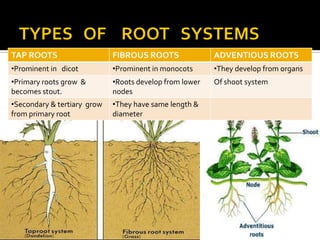
1) Morphology is the study of the external features, arrangement, and relationships of plant organs. Roots grow underground and absorb water and minerals, anchoring the plant. Stems grow above ground and transport nutrients between roots and leaves.
2) Roots have various modifications including storage roots, prop roots, stilt roots, climbing roots, and parasitic roots. Stems also have modifications underground like bulbs, corms, rhizomes, and above ground like runners, stolons, and suckers.
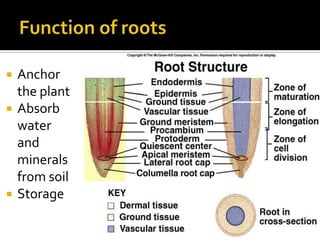
3) Vegetative plant organs include roots, stems, and leaves. Roots have different root systems and serve functions of anchoring, absorption, and storage. Stems support leaves and
Introduction to root and stem morphology, definitions and key features of plants including vegetative and reproductive organs.
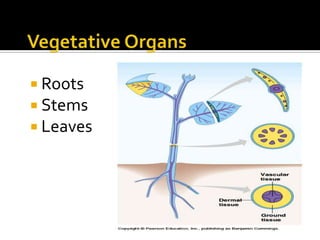
Overview of vegetative organs including roots, stems, and leaves.
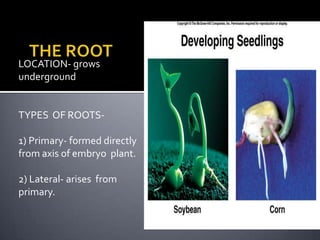
Types of roots: primary and lateral. Functions of roots like anchoring, absorption, and storage.
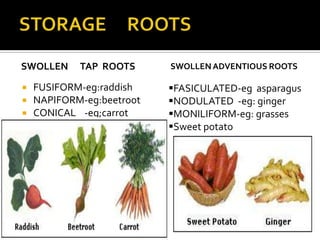
Various types of storage roots including fusiform, napiform, and conical with examples like radish and carrot.
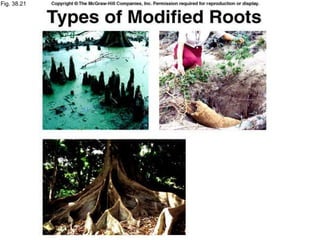
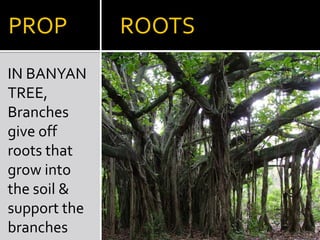
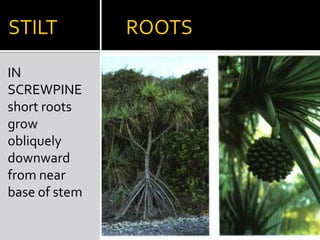
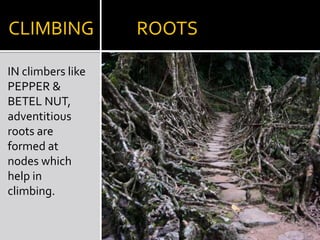
Types of roots that provide support, such as prop roots, stilt roots, and climbing roots in different plants.
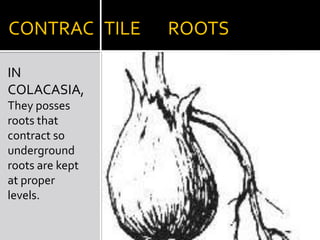
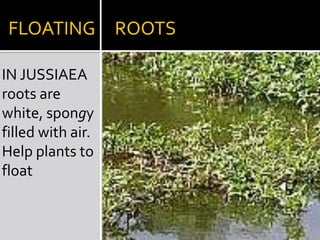
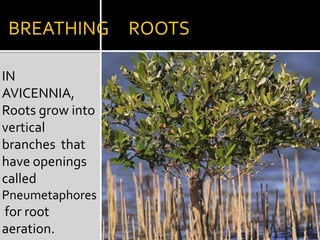
Specialized functional roots including contractile, floating, breathing, and assimilatory roots with examples.
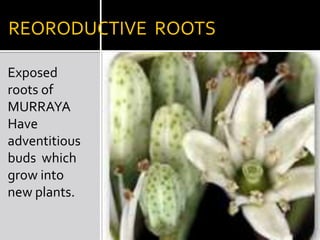
Tubercular roots in sweet potato, reproductive roots in Murraya, and parasitic roots in Cuscuta.Description of stem growth, support functions, and transport of materials.
Modifications of stems for storage and propagation including bulbs, rhizomes, runners, and suckers.
Aerial stem modifications including tendrils and cladodes, along with bulbils.
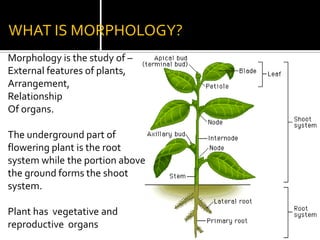
WHAT IS MORPHOLOGY?Morphologyis the study of –External features of plants,Arrangement,RelationshipOf organs.The underground part of flowering plant is the root system while the portion above the ground forms the shoot system.Plant has vegetative and reproductive organs
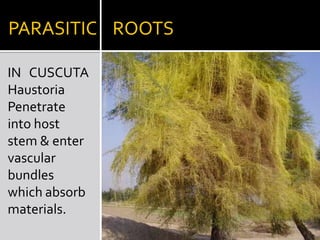
PARASITIC ROOTSIN CUSCUTAHaustoriaPenetrate into host stem & enter vascular bundles which absorb materials.
20.
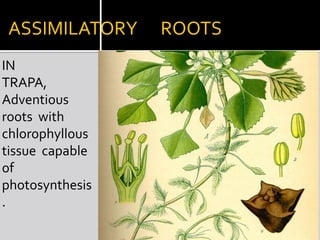
ASSIMILATORY ROOTSIN TRAPA,Adventious roots with chlorophyllous tissue capable of photosynthesis.
21.
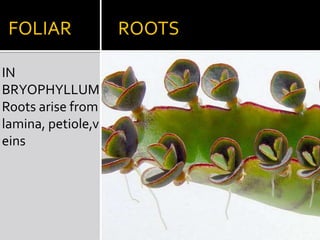
FOLIAR ROOTSINBRYOPHYLLUMRoots arise from lamina, petiole,veins
22.
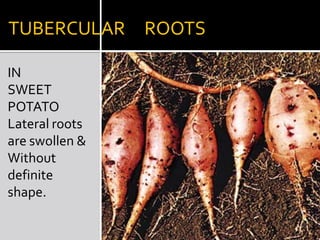
TUBERCULAR ROOTSIN SWEET POTATOLateral roots are swollen &Without definite shape.
23.
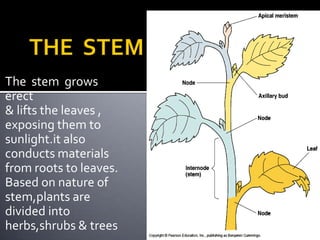
THE STEMThe stem grows erect& lifts the leaves , exposing them to sunlight.it also conducts materials from roots to leaves. Based on nature of stem,plants are divided into herbs,shrubs & trees
24.
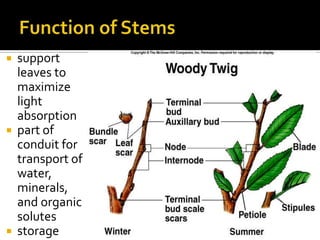
Function of Stemssupportleaves to maximize light absorptionpart of conduit for transport of water, minerals, and organic solutesstorage
25.
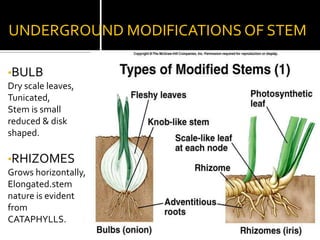
UNDERGROUND MODIFICATIONS OFSTEMBULBDry scale leaves,Tunicated,Stem is small reduced & disk shaped.RHIZOMESGrows horizontally,Elongated.stem nature is evident from CATAPHYLLS.
26.
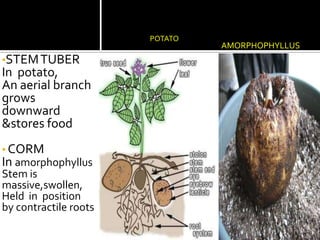
AMORPHOPHYLLUSPOTATOSTEM TUBERIn potato,An aerial branch grows downward &stores food CORMIn amorphophyllusStem is massive,swollen,Held in position by contractile roots
27.
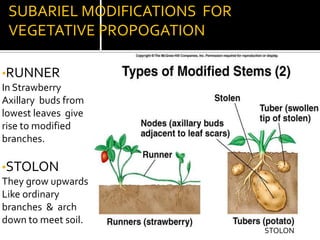
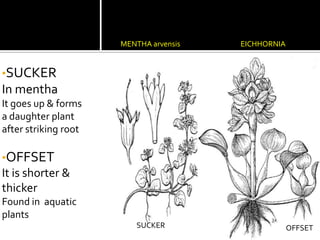
SUBARIEL MODIFICATIONS FOR VEGETATIVE PROPOGATIONRUNNERIn StrawberryAxillary buds from lowest leaves give rise to modified branches.STOLONThey grow upwardsLike ordinary branches & arch down to meet soil.STOLON
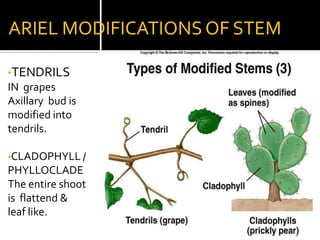
ARIEL MODIFICATIONS OFSTEMTENDRILSIN grapesAxillary bud is modified into tendrils.CLADOPHYLL /PHYLLOCLADEThe entire shoot is flattend & leaf like.
30.
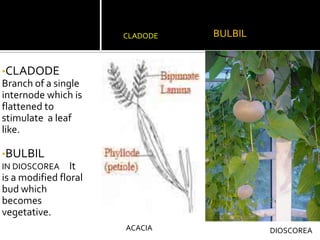
BULBILCLADODE CLADODEBranch ofa single internode which is flattened to stimulate a leaf like.BULBILINDIOSCOREA It is a modified floral bud which becomes vegetative.ACACIADIOSCOREA