DR. DILIP V. HANDE
A S S O C IA T E P R O FE S S OR
D E P T OF B OT A N Y
S H R I SH I V AJ I SC I E NC E CO L L E G E
A M R A V AT I
SEM- III
2020-2021
BOTANY
3S- BOTANY
ANGIOSPERM SYSTEMATICS, ANATOMY & EMBRYOLOGY
UNIT I : Angiosperm Systematics and Biodiversity.
1.1Angiosperms: Origin and Evolution (Pteridospermean and
Bennititalean Theory)
1.2 Botanical Nomenclature: Principles of rules, Taxonomic Ranks, Type
concept, Valid publication.
1.3 Herbarium – Concept & significance, Royal Botanical Garden, Kolkata.
1.4 Concept of biodiversity, Ex situ and In situ conservation
1.5 Concept & importance of Biodiversity.
UNIT II: Angiosperm Systematics
2.1 Systems of Classification: Bentham and Hooker’s System, Engler and
Prantle’s system.
2.2 Systematic studies & economic importance of following Families
Dicotyledons (Polypetalae) : Malvaceae, Brassicaceae, Leguminosae,
Apiaceae,
UNIT III: Angiosperm Systematics
3.1 Systematic studies & economic importance of following
Families
Dicotyledons (Gamopetalae): Asteraceae, Asclepiadaceae,
Apocynaceae, Solanaceae, Verbenaceae, Lamiaceae.
3.2 Dicotyledons ( Monoclamydeae): Euphorbiaceae.
3.3 Monocotyledons: Liliaceae, Poaceae.
UNIT IV: Anatomy
4.1 Types of Tissues:
Meristematic – Types of meristems
Permanent – Simple and complex.
4.2 Characteristics of growth rings, Sapwood and heartwood.
4.3 Anatomy of root: Primary structure in dicot and
monocot root, normal secondary growth in dicot root.
5.3 Leaf Anatomy: Internal structure in Nerium and Maize
leaf.
UNIT VI : Embryology
5.1Microsporangium, microsporogenesis, development of
male gametophyte.
5.2Megasporangium, types of ovules, megasporogenesis,
development of female gametophyte (monosporic, Bisporic
& tetrasporic).
5.3 Double fertilization and triple fusion.
5.4 Embryo – Classification of embryo.
5.5 Endosperm types & significance, Suspended animation
UNIT V: Anatomy
5.1 Anatomy of stem: Primary structure in monocot and
dicot stem, normal secondary growth in dicot stem.
5.2 Anomalies in primary structure in Boerhhavia stem,
secondary structure in Bignonia and Dracaena
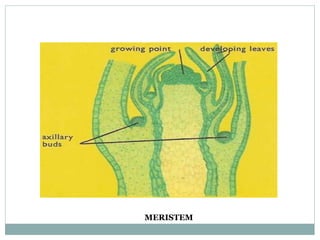
MERISTEM
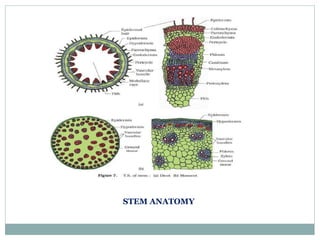
STEM ANATOMY
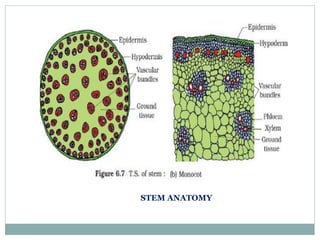
STEM ANATOMY
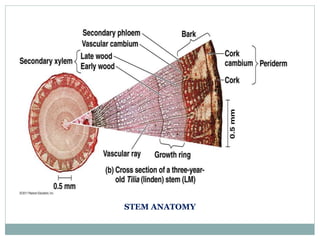
STEM ANATOMY
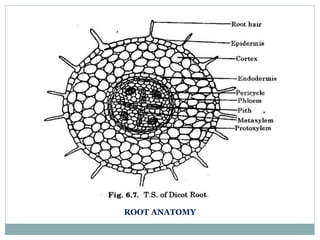
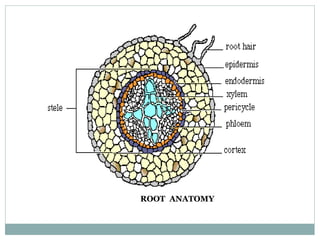
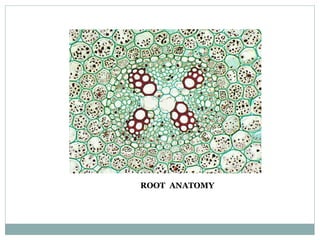
ROOT ANATOMY
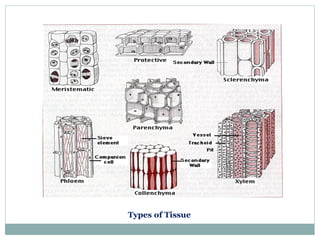
Types of Tissue
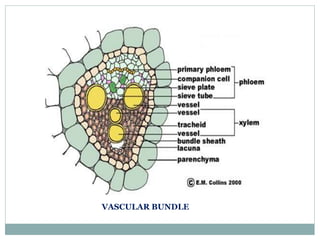
VASCULAR BUNDLE
ROOT ANATOMY
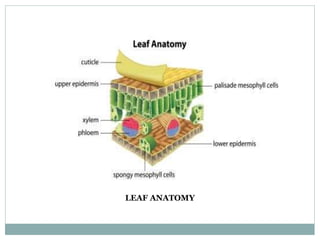
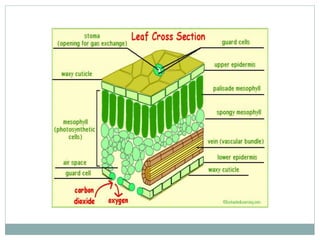
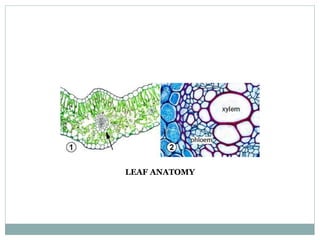
LEAF ANATOMY
LEAF ANATOMY
LEAF ANATOMY
LEAF ANATOMY
LEAF ANATOMY
ROOT ANATOMY
.
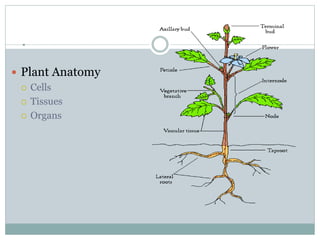
 Plant Anatomy
 Cells
 Tissues
 Organs
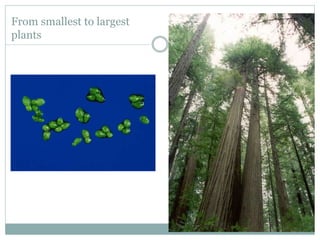
From smallest to largest
plants
What is plant anatomy?
 ANATOMY: study of the structure of
organisms… looking at cells, tissues
 (Morphology: Study of form)
TISSUE:
MERISTIMATIC
PERMANENT
SECRETARY
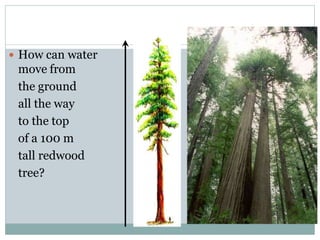
 How can water
move from
the ground
all the way
to the top
of a 100 m
tall redwood
tree?
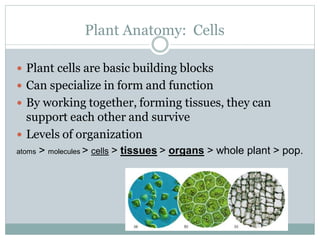
Plant Anatomy: Cells
 Plant cells are basic building blocks
 Can specialize in form and function
 By working together, forming tissues, they can
support each other and survive
 Levels of organization
atoms > molecules > cells > tissues > organs > whole plant > pop.
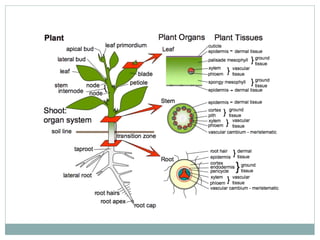
Plant Tissues Types
All plant organs (roots, stems, leaves) are composed
of the same tissue types.
There are three types of tissue:
 1. Dermal – outermost layer
 2. Vascular – conducting tissue, transport
 3. Ground – bulk of inner layers
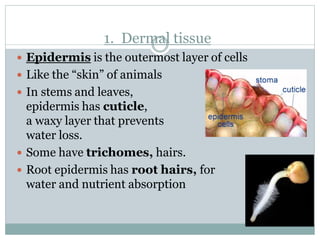
1. Dermal tissue
 Epidermis is the outermost layer of cells
 Like the “skin” of animals
 In stems and leaves,
epidermis has cuticle,
a waxy layer that prevents
water loss.
 Some have trichomes, hairs.
 Root epidermis has root hairs, for
water and nutrient absorption
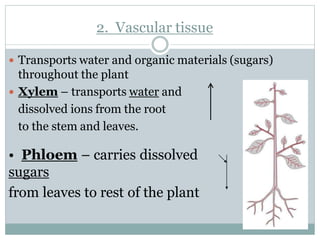
2. Vascular tissue
 Transports water and organic materials (sugars)
throughout the plant
 Xylem – transports water and
dissolved ions from the root
to the stem and leaves.
• Phloem – carries dissolved
sugars
from leaves to rest of the plant
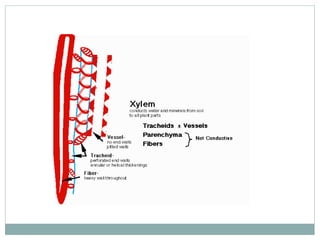
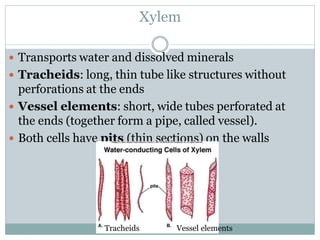
Xylem
 Transports water and dissolved minerals
 Tracheids: long, thin tube like structures without
perforations at the ends
 Vessel elements: short, wide tubes perforated at
the ends (together form a pipe, called vessel).
 Both cells have pits (thin sections) on the walls
Tracheids Vessel elements
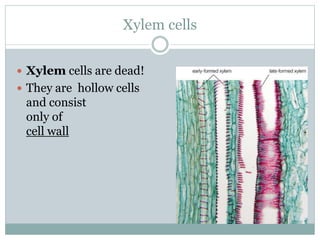
Xylem cells
 Xylem cells are dead!
 They are hollow cells
and consist
only of
cell wall
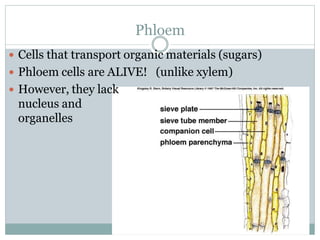
Phloem
 Cells that transport organic materials (sugars)
 Phloem cells are ALIVE! (unlike xylem)
 However, they lack
nucleus and
organelles
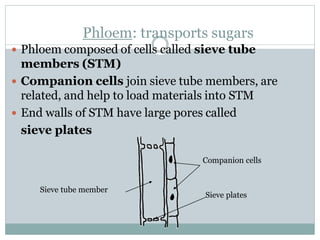
Phloem: transports sugars
 Phloem composed of cells called sieve tube
members (STM)
 Companion cells join sieve tube members, are
related, and help to load materials into STM
 End walls of STM have large pores called
sieve plates
Sieve tube member
Companion cells
Sieve plates
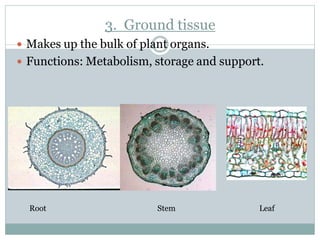
3. Ground tissue
 Makes up the bulk of plant organs.
 Functions: Metabolism, storage and support.
Root Stem Leaf
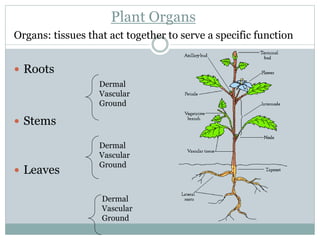
Plant Organs
Organs: tissues that act together to serve a specific function
 Roots
 Stems
 Leaves
Dermal
Vascular
Ground
Dermal
Vascular
Ground
Dermal
Vascular
Ground
Functions of plant organs:
 ROOTS: Anchorage, water/nutrient absorption from
soil, storage, water/nutrient transport
 STEMS: Support, water/nutrient transport
 LEAVES: Photosynthesis (food production)
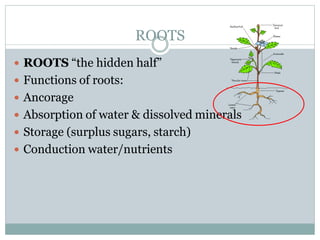
ROOTS
 ROOTS “the hidden half”
 Functions of roots:
 Ancorage
 Absorption of water & dissolved minerals
 Storage (surplus sugars, starch)
 Conduction water/nutrients
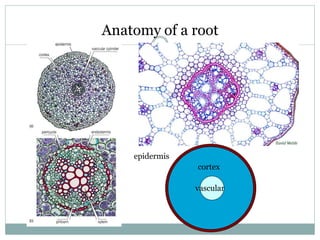
Anatomy of a root
epidermis
cortex
vascular
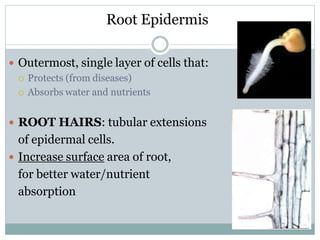
Root Epidermis
 Outermost, single layer of cells that:
 Protects (from diseases)
 Absorbs water and nutrients
 ROOT HAIRS: tubular extensions
of epidermal cells.
 Increase surface area of root,
for better water/nutrient
absorption
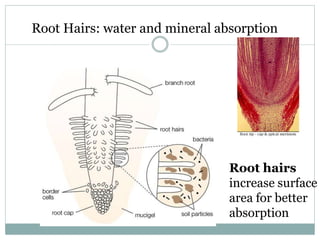
Root Hairs: water and mineral absorption
Root hairs
increase surface
area for better
absorption
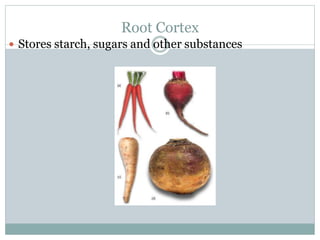
Root Cortex
 Stores starch, sugars and other substances
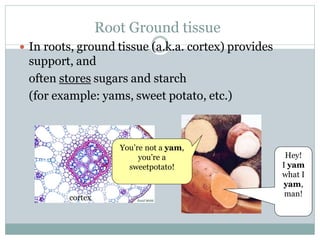
Root Ground tissue
 In roots, ground tissue (a.k.a. cortex) provides
support, and
often stores sugars and starch
(for example: yams, sweet potato, etc.)
Hey!
I yam
what I
yam,
man!
You’re not a yam,
you’re a
sweetpotato!
cortex
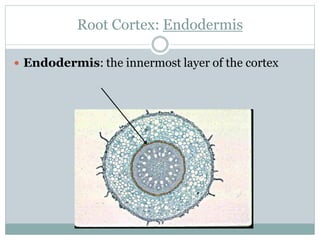
Root Cortex: Endodermis
 Endodermis: the innermost layer of the cortex
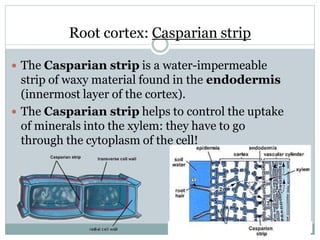
Root cortex: Casparian strip
 The Casparian strip is a water-impermeable
strip of waxy material found in the endodermis
(innermost layer of the cortex).
 The Casparian strip helps to control the uptake
of minerals into the xylem: they have to go
through the cytoplasm of the cell!
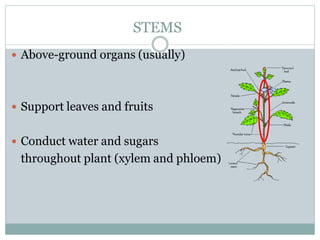
STEMS
 Above-ground organs (usually)
 Support leaves and fruits
 Conduct water and sugars
throughout plant (xylem and phloem)
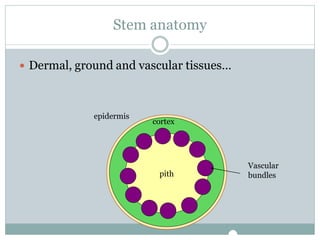
Stem anatomy
 Dermal, ground and vascular tissues…
pith
cortex
epidermis
Vascular
bundles
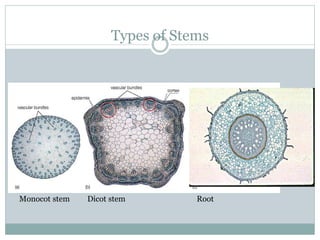
Types of Stems
Monocot stem Dicot stem Root
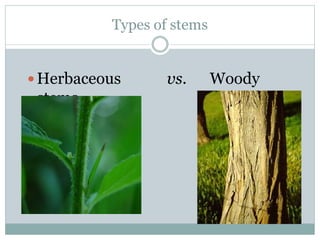
Types of stems
Herbaceous vs. Woody
stems
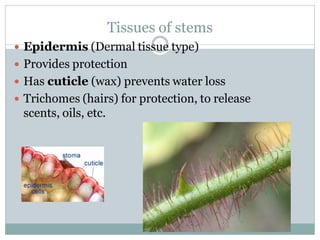
Tissues of stems
 Epidermis (Dermal tissue type)
 Provides protection
 Has cuticle (wax) prevents water loss
 Trichomes (hairs) for protection, to release
scents, oils, etc.
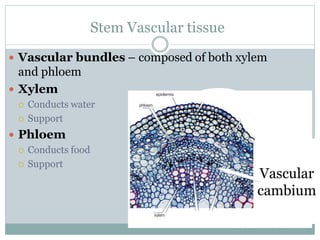
Stem Vascular tissue
 Vascular bundles – composed of both xylem
and phloem
 Xylem
 Conducts water
 Support
 Phloem
 Conducts food
 Support
Vascular
cambium
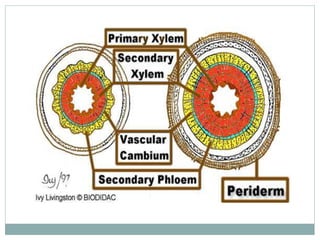
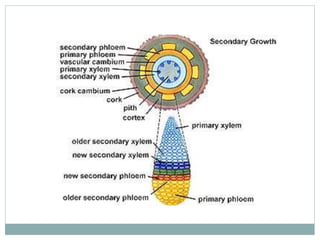
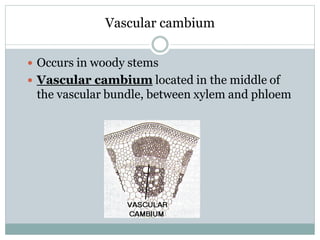
Vascular cambium
 Occurs in woody stems
 Vascular cambium located in the middle of
the vascular bundle, between xylem and phloem
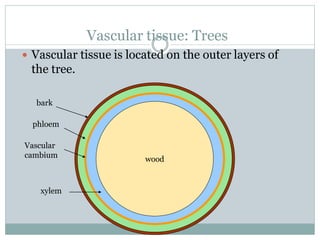
Vascular tissue: Trees
 Vascular tissue is located on the outer layers of
the tree.
wood
phloem
xylem
bark
Vascular
cambium
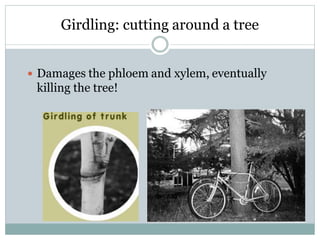
Girdling: cutting around a tree
 Damages the phloem and xylem, eventually
killing the tree!
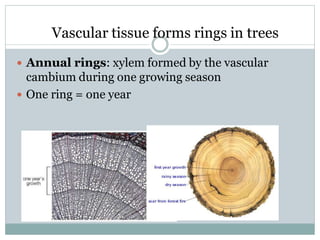
Vascular tissue forms rings in trees
 Annual rings: xylem formed by the vascular
cambium during one growing season
 One ring = one year
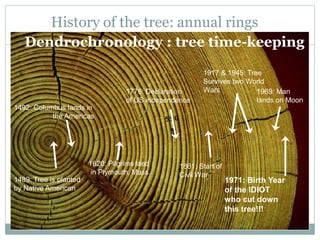
History of the tree: annual rings
1489: Tree is planted
by Native American
1492: Columbus lands in
the Americas
1620: Pilgrims land
in Plymouth, Mass.
1776: Declaration
of US independence
1861: Start of
Civil War
1969: Man
lands on Moon
1917 & 1945: Tree
Survives two World
Wars
1971: Birth Year
of the IDIOT
who cut down
this tree!!!
Dendrochronology : tree time-keeping
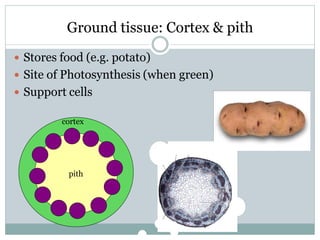
Ground tissue: Cortex & pith
 Stores food (e.g. potato)
 Site of Photosynthesis (when green)
 Support cells
pith
cortex
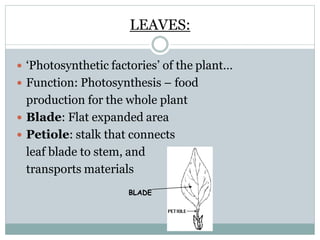
LEAVES:
 ‘Photosynthetic factories’ of the plant…
 Function: Photosynthesis – food
production for the whole plant
 Blade: Flat expanded area
 Petiole: stalk that connects
leaf blade to stem, and
transports materials
BLADE
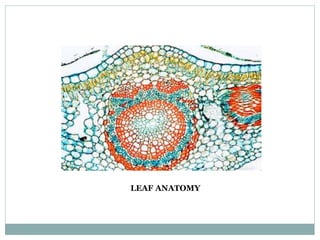
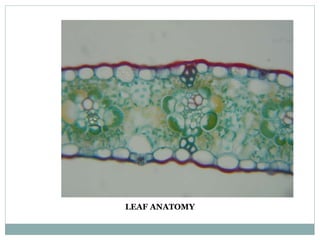
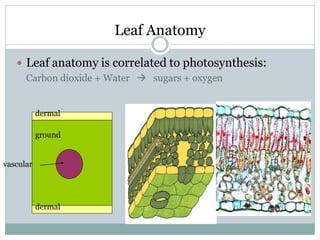
Leaf Anatomy
 Leaf anatomy is correlated to photosynthesis:
Carbon dioxide + Water  sugars + oxygen
dermal
ground
vascular
dermal
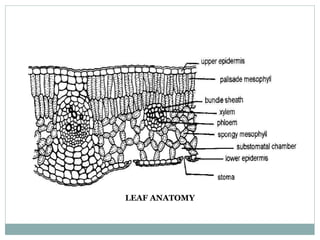
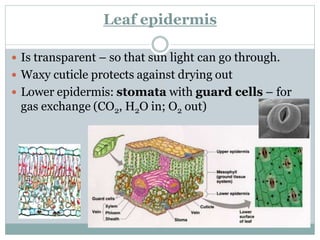
Leaf epidermis
 Is transparent – so that sun light can go through.
 Waxy cuticle protects against drying out
 Lower epidermis: stomata with guard cells – for
gas exchange (CO2, H2O in; O2 out)
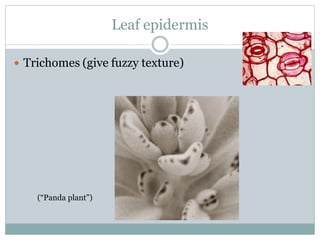
Leaf epidermis
 Trichomes (give fuzzy texture)
(“Panda plant”)
Leaf vascular tissue
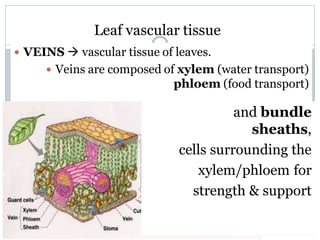
 VEINS  vascular tissue of leaves.
 Veins are composed of xylem (water transport)
phloem (food transport)
and bundle
sheaths,
cells surrounding the
xylem/phloem for
strength & support
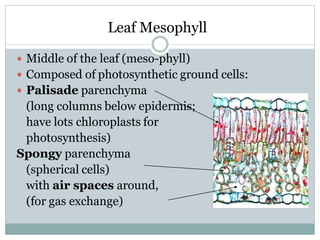
Leaf Mesophyll
 Middle of the leaf (meso-phyll)
 Composed of photosynthetic ground cells:
 Palisade parenchyma
(long columns below epidermis;
have lots chloroplasts for
photosynthesis)
Spongy parenchyma
(spherical cells)
with air spaces around,
(for gas exchange)
ASSIGNMENT : 1
WRITE COMMENTS ON PLANT ANATOMY
WRITE ONE PAGE AND SENT TO GOOGLE CLASSROOM IN PDF FORMAT
Plant Anatomy-1

Plant Anatomy-1

  • 1.
    DR. DILIP V.HANDE A S S O C IA T E P R O FE S S OR D E P T OF B OT A N Y S H R I SH I V AJ I SC I E NC E CO L L E G E A M R A V AT I SEM- III 2020-2021
  • 2.
    BOTANY 3S- BOTANY ANGIOSPERM SYSTEMATICS,ANATOMY & EMBRYOLOGY UNIT I : Angiosperm Systematics and Biodiversity. 1.1Angiosperms: Origin and Evolution (Pteridospermean and Bennititalean Theory) 1.2 Botanical Nomenclature: Principles of rules, Taxonomic Ranks, Type concept, Valid publication. 1.3 Herbarium – Concept & significance, Royal Botanical Garden, Kolkata. 1.4 Concept of biodiversity, Ex situ and In situ conservation 1.5 Concept & importance of Biodiversity. UNIT II: Angiosperm Systematics 2.1 Systems of Classification: Bentham and Hooker’s System, Engler and Prantle’s system. 2.2 Systematic studies & economic importance of following Families Dicotyledons (Polypetalae) : Malvaceae, Brassicaceae, Leguminosae, Apiaceae,
  • 3.
    UNIT III: AngiospermSystematics 3.1 Systematic studies & economic importance of following Families Dicotyledons (Gamopetalae): Asteraceae, Asclepiadaceae, Apocynaceae, Solanaceae, Verbenaceae, Lamiaceae. 3.2 Dicotyledons ( Monoclamydeae): Euphorbiaceae. 3.3 Monocotyledons: Liliaceae, Poaceae. UNIT IV: Anatomy 4.1 Types of Tissues: Meristematic – Types of meristems Permanent – Simple and complex. 4.2 Characteristics of growth rings, Sapwood and heartwood. 4.3 Anatomy of root: Primary structure in dicot and monocot root, normal secondary growth in dicot root.
  • 4.
    5.3 Leaf Anatomy:Internal structure in Nerium and Maize leaf. UNIT VI : Embryology 5.1Microsporangium, microsporogenesis, development of male gametophyte. 5.2Megasporangium, types of ovules, megasporogenesis, development of female gametophyte (monosporic, Bisporic & tetrasporic). 5.3 Double fertilization and triple fusion. 5.4 Embryo – Classification of embryo. 5.5 Endosperm types & significance, Suspended animation UNIT V: Anatomy 5.1 Anatomy of stem: Primary structure in monocot and dicot stem, normal secondary growth in dicot stem. 5.2 Anomalies in primary structure in Boerhhavia stem, secondary structure in Bignonia and Dracaena
  • 16.
  • 17.
  • 18.
  • 19.
  • 20.
  • 21.
  • 22.
  • 23.
  • 26.
  • 27.
  • 28.
  • 29.
  • 31.
  • 33.
  • 34.
    .  Plant Anatomy Cells  Tissues  Organs
  • 35.
    From smallest tolargest plants
  • 36.
    What is plantanatomy?  ANATOMY: study of the structure of organisms… looking at cells, tissues  (Morphology: Study of form) TISSUE: MERISTIMATIC PERMANENT SECRETARY
  • 37.
     How canwater move from the ground all the way to the top of a 100 m tall redwood tree?
  • 38.
    Plant Anatomy: Cells Plant cells are basic building blocks  Can specialize in form and function  By working together, forming tissues, they can support each other and survive  Levels of organization atoms > molecules > cells > tissues > organs > whole plant > pop.
  • 39.
    Plant Tissues Types Allplant organs (roots, stems, leaves) are composed of the same tissue types. There are three types of tissue:  1. Dermal – outermost layer  2. Vascular – conducting tissue, transport  3. Ground – bulk of inner layers
  • 40.
    1. Dermal tissue Epidermis is the outermost layer of cells  Like the “skin” of animals  In stems and leaves, epidermis has cuticle, a waxy layer that prevents water loss.  Some have trichomes, hairs.  Root epidermis has root hairs, for water and nutrient absorption
  • 41.
    2. Vascular tissue Transports water and organic materials (sugars) throughout the plant  Xylem – transports water and dissolved ions from the root to the stem and leaves. • Phloem – carries dissolved sugars from leaves to rest of the plant
  • 42.
    Xylem  Transports waterand dissolved minerals  Tracheids: long, thin tube like structures without perforations at the ends  Vessel elements: short, wide tubes perforated at the ends (together form a pipe, called vessel).  Both cells have pits (thin sections) on the walls Tracheids Vessel elements
  • 43.
    Xylem cells  Xylemcells are dead!  They are hollow cells and consist only of cell wall
  • 44.
    Phloem  Cells thattransport organic materials (sugars)  Phloem cells are ALIVE! (unlike xylem)  However, they lack nucleus and organelles
  • 45.
    Phloem: transports sugars Phloem composed of cells called sieve tube members (STM)  Companion cells join sieve tube members, are related, and help to load materials into STM  End walls of STM have large pores called sieve plates Sieve tube member Companion cells Sieve plates
  • 46.
    3. Ground tissue Makes up the bulk of plant organs.  Functions: Metabolism, storage and support. Root Stem Leaf
  • 47.
    Plant Organs Organs: tissuesthat act together to serve a specific function  Roots  Stems  Leaves Dermal Vascular Ground Dermal Vascular Ground Dermal Vascular Ground
  • 48.
    Functions of plantorgans:  ROOTS: Anchorage, water/nutrient absorption from soil, storage, water/nutrient transport  STEMS: Support, water/nutrient transport  LEAVES: Photosynthesis (food production)
  • 49.
    ROOTS  ROOTS “thehidden half”  Functions of roots:  Ancorage  Absorption of water & dissolved minerals  Storage (surplus sugars, starch)  Conduction water/nutrients
  • 50.
    Anatomy of aroot epidermis cortex vascular
  • 51.
    Root Epidermis  Outermost,single layer of cells that:  Protects (from diseases)  Absorbs water and nutrients  ROOT HAIRS: tubular extensions of epidermal cells.  Increase surface area of root, for better water/nutrient absorption
  • 52.
    Root Hairs: waterand mineral absorption Root hairs increase surface area for better absorption
  • 53.
    Root Cortex  Storesstarch, sugars and other substances
  • 54.
    Root Ground tissue In roots, ground tissue (a.k.a. cortex) provides support, and often stores sugars and starch (for example: yams, sweet potato, etc.) Hey! I yam what I yam, man! You’re not a yam, you’re a sweetpotato! cortex
  • 55.
    Root Cortex: Endodermis Endodermis: the innermost layer of the cortex
  • 56.
    Root cortex: Casparianstrip  The Casparian strip is a water-impermeable strip of waxy material found in the endodermis (innermost layer of the cortex).  The Casparian strip helps to control the uptake of minerals into the xylem: they have to go through the cytoplasm of the cell!
  • 57.
    STEMS  Above-ground organs(usually)  Support leaves and fruits  Conduct water and sugars throughout plant (xylem and phloem)
  • 58.
    Stem anatomy  Dermal,ground and vascular tissues… pith cortex epidermis Vascular bundles
  • 59.
    Types of Stems Monocotstem Dicot stem Root
  • 60.
  • 61.
    Tissues of stems Epidermis (Dermal tissue type)  Provides protection  Has cuticle (wax) prevents water loss  Trichomes (hairs) for protection, to release scents, oils, etc.
  • 62.
    Stem Vascular tissue Vascular bundles – composed of both xylem and phloem  Xylem  Conducts water  Support  Phloem  Conducts food  Support Vascular cambium
  • 63.
    Vascular cambium  Occursin woody stems  Vascular cambium located in the middle of the vascular bundle, between xylem and phloem
  • 64.
    Vascular tissue: Trees Vascular tissue is located on the outer layers of the tree. wood phloem xylem bark Vascular cambium
  • 65.
    Girdling: cutting arounda tree  Damages the phloem and xylem, eventually killing the tree!
  • 66.
    Vascular tissue formsrings in trees  Annual rings: xylem formed by the vascular cambium during one growing season  One ring = one year
  • 67.
    History of thetree: annual rings 1489: Tree is planted by Native American 1492: Columbus lands in the Americas 1620: Pilgrims land in Plymouth, Mass. 1776: Declaration of US independence 1861: Start of Civil War 1969: Man lands on Moon 1917 & 1945: Tree Survives two World Wars 1971: Birth Year of the IDIOT who cut down this tree!!! Dendrochronology : tree time-keeping
  • 68.
    Ground tissue: Cortex& pith  Stores food (e.g. potato)  Site of Photosynthesis (when green)  Support cells pith cortex
  • 69.
    LEAVES:  ‘Photosynthetic factories’of the plant…  Function: Photosynthesis – food production for the whole plant  Blade: Flat expanded area  Petiole: stalk that connects leaf blade to stem, and transports materials BLADE
  • 70.
    Leaf Anatomy  Leafanatomy is correlated to photosynthesis: Carbon dioxide + Water  sugars + oxygen dermal ground vascular dermal
  • 71.
    Leaf epidermis  Istransparent – so that sun light can go through.  Waxy cuticle protects against drying out  Lower epidermis: stomata with guard cells – for gas exchange (CO2, H2O in; O2 out)
  • 72.
    Leaf epidermis  Trichomes(give fuzzy texture) (“Panda plant”)
  • 73.
    Leaf vascular tissue VEINS  vascular tissue of leaves.  Veins are composed of xylem (water transport) phloem (food transport) and bundle sheaths, cells surrounding the xylem/phloem for strength & support
  • 74.
    Leaf Mesophyll  Middleof the leaf (meso-phyll)  Composed of photosynthetic ground cells:  Palisade parenchyma (long columns below epidermis; have lots chloroplasts for photosynthesis) Spongy parenchyma (spherical cells) with air spaces around, (for gas exchange)
  • 75.
    ASSIGNMENT : 1 WRITECOMMENTS ON PLANT ANATOMY WRITE ONE PAGE AND SENT TO GOOGLE CLASSROOM IN PDF FORMAT