.
.
Definition :
• A Flower is :
• Highly modified form of shoot
• Have reproductive characteristic
• With floral leaves
• Calyx, Corolla collectively called Perianth and
Androecium ,Gynoecium
• These are arranged at Thalamus
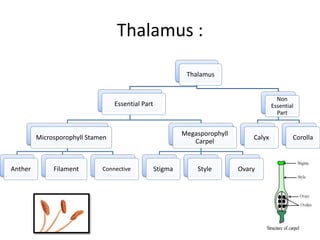
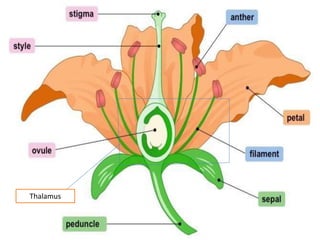
Thalamus :
Thalamus
Essential Part
Microsporophyll Stamen
Anther Filament Connective
Megasporophyll
Carpel
Stigma Style Ovary
Non
Essential
Part
Calyx Corolla
Thalamus
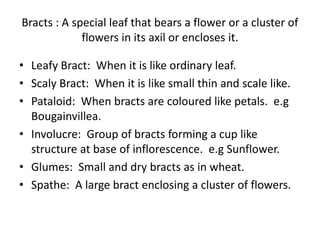
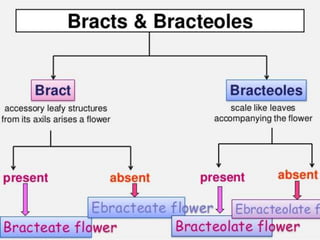
Bracts : A special leaf that bears a flower or a cluster of
flowers in its axil or encloses it.
• Leafy Bract: When it is like ordinary leaf.
• Scaly Bract: When it is like small thin and scale like.
• Pataloid: When bracts are coloured like petals. e.g
Bougainvillea.
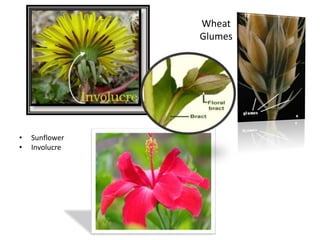
• Involucre: Group of bracts forming a cup like
structure at base of inflorescence. e.g Sunflower.
• Glumes: Small and dry bracts as in wheat.
• Spathe: A large bract enclosing a cluster of flowers.
Wheat
Glumes
• Sunflower
• Involucre
Petaloid
Bougonviella
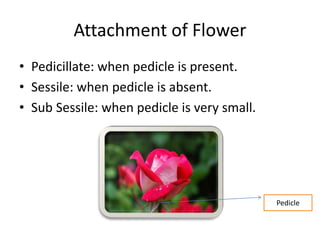
Attachment of Flower
• Pedicillate: when pedicle is present.
• Sessile: when pedicle is absent.
• Sub Sessile: when pedicle is very small.
Pedicle
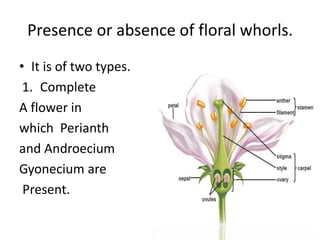
Presence or absence of floral whorls.
• It is of two types.
1. Complete
A flower in
which Perianth
and Androecium
Gyonecium are
Present.
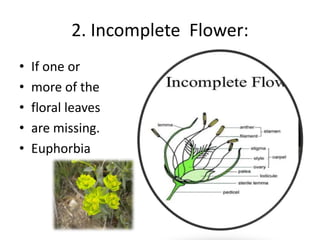
2. Incomplete Flower:
• If one or
• more of the
• floral leaves
• are missing.
• Euphorbia
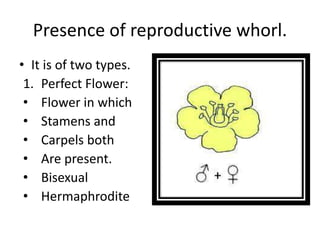
Presence of reproductive whorl.
• It is of two types.
1. Perfect Flower:
• Flower in which
• Stamens and
• Carpels both
• Are present.
• Bisexual
• Hermaphrodite
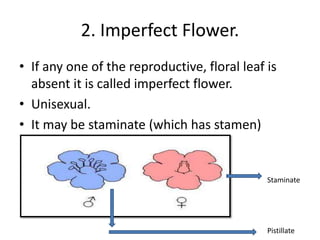
2. Imperfect Flower.
• If any one of the reproductive, floral leaf is
absent it is called imperfect flower.
• Unisexual.
• It may be staminate (which has stamen)
• Or pistillate (which has carpel).
Staminate
Pistillate
Symmetry of Flower.
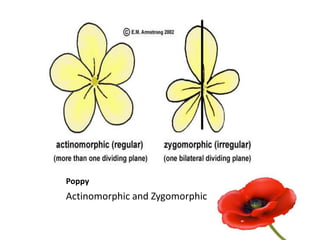
• Actinomorphic. When flower can be
divided into two equal halves in more
than one plane. E.g Poppy
• Zygomorphic. When flower can be
divided into two equal halve in one plane
only. E.g Ocimum
Poppy
Actinomorphic and Zygomorphic
Position of Floral leaves at Receptacle.
• It may be
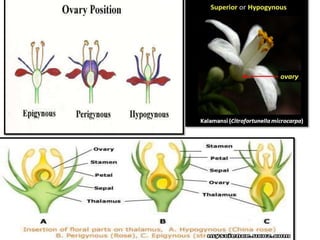
• Hypogynous: Gynoecium develops at top of thalamus
while all other floral leaves grow below thalamus.
• Epigynous: Thalamus is cup shaped become fused
with ovary while all other floral leaves are present
below.
• Perigynous: thalamus is flattened in the form of
circular disc, gynoecium is in centre while all other
floral leaves are at sides,
Calyx
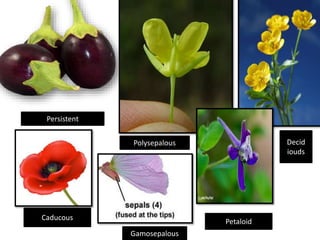
• Outermost whorl consisting of sepals.
• Caducous: Sepals fall as flower opens. Poppy
• Decedious: sepals fall as flower withers. Buttercup
• Persistent: Sepals remain in place. Brinjal
• Petaloid: Sepals are like petals. Larkspur
• Polysepalous: Sepals are free. Brassica
• Gamosepalous: Sepals are fused. Citrus
.
• /
Persistent
Decid
iouds
Petaloid
Polysepalous
Caducous
Gamosepalous
Shape of Calyx.
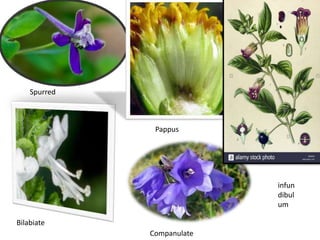
• Tubular: Sepals are like tube. Verbena
• Campanulate: Sepals unite to form bell shaped structure.
Petunia Alba
• Infundibulum: It is funnel like. Atropa Belladona
• Pappus: Sepals are much reduced and are like hairs.
Sunflower
• Bilabiate: Sepals fuse to form a bilibbed structure.
• Spurred: Sepals form a hollow tube spur. Larkspur
• Hooded: One or more sepals are modified into hood like
structure. Monk hood
.
• .
Spurred
Pappus
Bilabiate
Companulate
infun
dibul
um
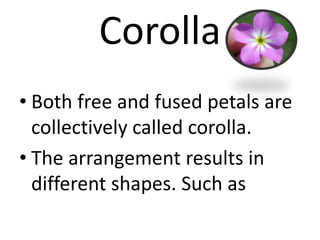
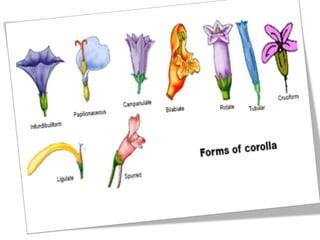
Corolla
• Both free and fused petals are
collectively called corolla.
• The arrangement results in
different shapes. Such as
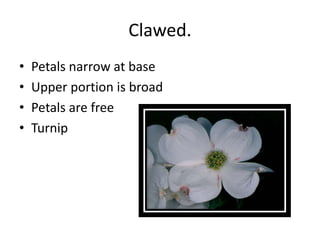
Clawed.
• Petals narrow at base
• Upper portion is broad
• Petals are free
• Turnip
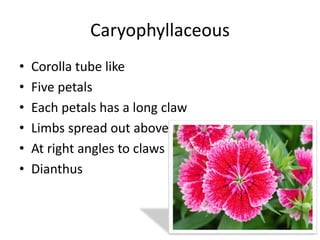
Caryophyllaceous
• Corolla tube like
• Five petals
• Each petals has a long claw
• Limbs spread out above tube
• At right angles to claws
• Dianthus
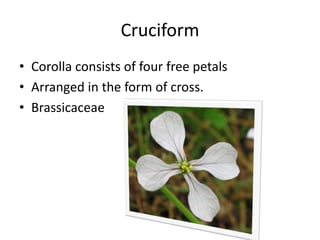
Cruciform
• Corolla consists of four free petals
• Arranged in the form of cross.
• Brassicaceae
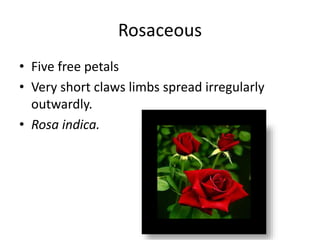
Rosaceous
• Five free petals
• Very short claws limbs spread irregularly
outwardly.
• Rosa indica.
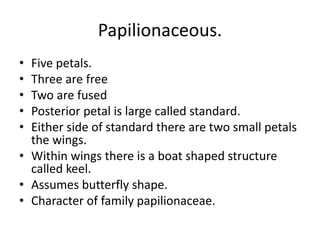
Papilionaceous.
• Five petals.
• Three are free
• Two are fused
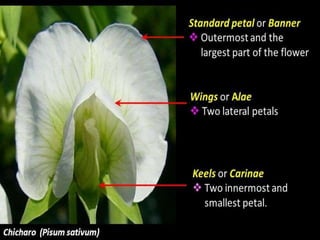
• Posterior petal is large called standard.
• Either side of standard there are two small petals
the wings.
• Within wings there is a boat shaped structure
called keel.
• Assumes butterfly shape.
• Character of family papilionaceae.
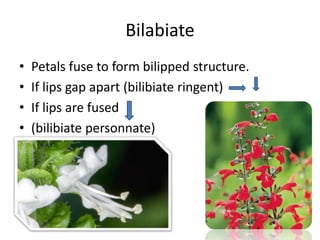
Bilabiate
• Petals fuse to form bilipped structure.
• If lips gap apart (bilibiate ringent)
• If lips are fused
• (bilibiate personnate)
• Libiatae
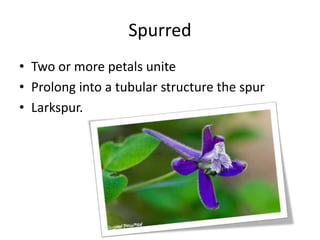
Spurred
• Two or more petals unite
• Prolong into a tubular structure the spur
• Larkspur.
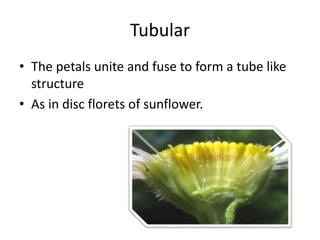
Tubular
• The petals unite and fuse to form a tube like
structure
• As in disc florets of sunflower.
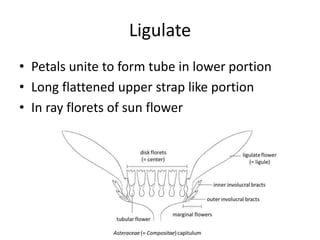
Ligulate
• Petals unite to form tube in lower portion
• Long flattened upper strap like portion
• In ray florets of sun flower
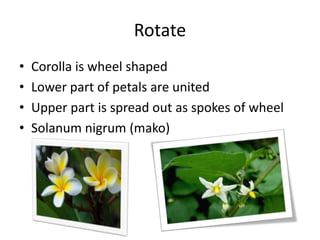
Rotate
• Corolla is wheel shaped
• Lower part of petals are united
• Upper part is spread out as spokes of wheel
• Solanum nigrum (mako)
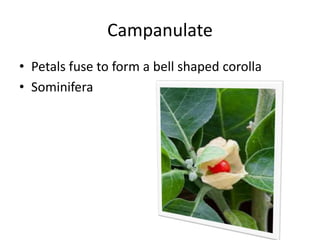
Campanulate
• Petals fuse to form a bell shaped corolla
• Sominifera
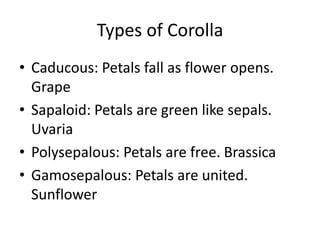
Types of Corolla
• Caducous: Petals fall as flower opens.
Grape
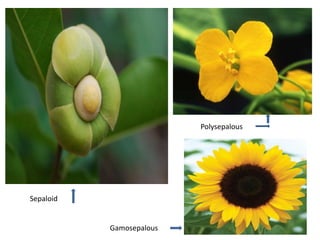
• Sapaloid: Petals are green like sepals.
Uvaria
• Polysepalous: Petals are free. Brassica
• Gamosepalous: Petals are united.
Sunflower
• ,
Polysepalous
Sepaloid
Gamosepalous

The Flower Calyx Corolla

  • 1.
  • 2.
    Definition : • AFlower is : • Highly modified form of shoot • Have reproductive characteristic • With floral leaves • Calyx, Corolla collectively called Perianth and Androecium ,Gynoecium • These are arranged at Thalamus
  • 3.
    Thalamus : Thalamus Essential Part MicrosporophyllStamen Anther Filament Connective Megasporophyll Carpel Stigma Style Ovary Non Essential Part Calyx Corolla
  • 4.
  • 5.
    Bracts : Aspecial leaf that bears a flower or a cluster of flowers in its axil or encloses it. • Leafy Bract: When it is like ordinary leaf. • Scaly Bract: When it is like small thin and scale like. • Pataloid: When bracts are coloured like petals. e.g Bougainvillea. • Involucre: Group of bracts forming a cup like structure at base of inflorescence. e.g Sunflower. • Glumes: Small and dry bracts as in wheat. • Spathe: A large bract enclosing a cluster of flowers.
  • 6.
  • 8.
    Attachment of Flower •Pedicillate: when pedicle is present. • Sessile: when pedicle is absent. • Sub Sessile: when pedicle is very small. Pedicle
  • 9.
    Presence or absenceof floral whorls. • It is of two types. 1. Complete A flower in which Perianth and Androecium Gyonecium are Present.
  • 10.
    2. Incomplete Flower: •If one or • more of the • floral leaves • are missing. • Euphorbia
  • 11.
    Presence of reproductivewhorl. • It is of two types. 1. Perfect Flower: • Flower in which • Stamens and • Carpels both • Are present. • Bisexual • Hermaphrodite
  • 12.
    2. Imperfect Flower. •If any one of the reproductive, floral leaf is absent it is called imperfect flower. • Unisexual. • It may be staminate (which has stamen) • Or pistillate (which has carpel). Staminate Pistillate
  • 13.
    Symmetry of Flower. •Actinomorphic. When flower can be divided into two equal halves in more than one plane. E.g Poppy • Zygomorphic. When flower can be divided into two equal halve in one plane only. E.g Ocimum
  • 14.
  • 15.
    Position of Floralleaves at Receptacle. • It may be • Hypogynous: Gynoecium develops at top of thalamus while all other floral leaves grow below thalamus. • Epigynous: Thalamus is cup shaped become fused with ovary while all other floral leaves are present below. • Perigynous: thalamus is flattened in the form of circular disc, gynoecium is in centre while all other floral leaves are at sides,
  • 17.
    Calyx • Outermost whorlconsisting of sepals. • Caducous: Sepals fall as flower opens. Poppy • Decedious: sepals fall as flower withers. Buttercup • Persistent: Sepals remain in place. Brinjal • Petaloid: Sepals are like petals. Larkspur • Polysepalous: Sepals are free. Brassica • Gamosepalous: Sepals are fused. Citrus
  • 18.
  • 19.
    Shape of Calyx. •Tubular: Sepals are like tube. Verbena • Campanulate: Sepals unite to form bell shaped structure. Petunia Alba • Infundibulum: It is funnel like. Atropa Belladona • Pappus: Sepals are much reduced and are like hairs. Sunflower • Bilabiate: Sepals fuse to form a bilibbed structure. • Spurred: Sepals form a hollow tube spur. Larkspur • Hooded: One or more sepals are modified into hood like structure. Monk hood
  • 20.
  • 21.
    Corolla • Both freeand fused petals are collectively called corolla. • The arrangement results in different shapes. Such as
  • 22.
    Clawed. • Petals narrowat base • Upper portion is broad • Petals are free • Turnip
  • 23.
    Caryophyllaceous • Corolla tubelike • Five petals • Each petals has a long claw • Limbs spread out above tube • At right angles to claws • Dianthus
  • 24.
    Cruciform • Corolla consistsof four free petals • Arranged in the form of cross. • Brassicaceae
  • 25.
    Rosaceous • Five freepetals • Very short claws limbs spread irregularly outwardly. • Rosa indica.
  • 26.
    Papilionaceous. • Five petals. •Three are free • Two are fused • Posterior petal is large called standard. • Either side of standard there are two small petals the wings. • Within wings there is a boat shaped structure called keel. • Assumes butterfly shape. • Character of family papilionaceae.
  • 28.
    Bilabiate • Petals fuseto form bilipped structure. • If lips gap apart (bilibiate ringent) • If lips are fused • (bilibiate personnate) • Libiatae
  • 29.
    Spurred • Two ormore petals unite • Prolong into a tubular structure the spur • Larkspur.
  • 30.
    Tubular • The petalsunite and fuse to form a tube like structure • As in disc florets of sunflower.
  • 31.
    Ligulate • Petals uniteto form tube in lower portion • Long flattened upper strap like portion • In ray florets of sun flower
  • 32.
    Rotate • Corolla iswheel shaped • Lower part of petals are united • Upper part is spread out as spokes of wheel • Solanum nigrum (mako)
  • 33.
    Campanulate • Petals fuseto form a bell shaped corolla • Sominifera
  • 35.
    Types of Corolla •Caducous: Petals fall as flower opens. Grape • Sapaloid: Petals are green like sepals. Uvaria • Polysepalous: Petals are free. Brassica • Gamosepalous: Petals are united. Sunflower
  • 36.