Morphology of 
flowering plants 
dr.aarif 
1.Root 
2.Stem 
3.Leaf 
4.Flower 
5.Fruit 
6.Seed
dr.aarif 
Morphology of Root 
Characteristics : 
1. Root is defined as the descending part of the plant axis. 
2. It is positively geotropic. 
3. It is positively hydrotropic 
4. It is negatively phototropic. 
5. It develops from the radicle of the embryo during seed germination. 
6. Roots are generally non green and cylindrical. 
7. They produce only similar organs i.e. secondary and tertiary roots 
8. They do not show nodes and internodes
Morphology of Root 
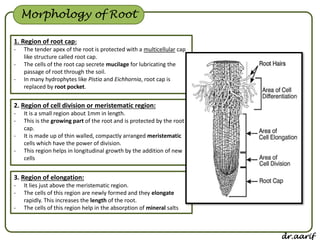
1. Region of root cap: 
- The tender apex of the root is protected with a multicellular cap 
like structure called root cap. 
- The cells of the root cap secrete mucilage for lubricating the 
passage of root through the soil. 
- In many hydrophytes like Pistia and Eichhornia, root cap is 
replaced by root pocket. 
2. Region of cell division or meristematic region: 
- It is a small region about 1mm in length. 
- This is the growing part of the root and is protected by the root 
cap. 
- It is made up of thin walled, compactly arranged meristematic 
cells which have the power of division. 
- This region helps in longitudinal growth by the addition of new 
cells 
3. Region of elongation: 
- It lies just above the meristematic region. 
- The cells of this region are newly formed and they elongate 
rapidly. This increases the length of the root. 
- The cells of this region help in the absorption of mineral salts 
dr.aarif
Morphology of Root 
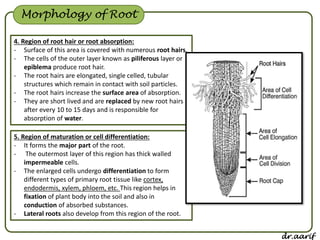
4. Region of root hair or root absorption: 
- Surface of this area is covered with numerous root hairs. 
- The cells of the outer layer known as piliferous layer or 
epiblema produce root hair. 
- The root hairs are elongated, single celled, tubular 
structures which remain in contact with soil particles. 
- The root hairs increase the surface area of absorption. 
- They are short lived and are replaced by new root hairs 
after every 10 to 15 days and is responsible for 
absorption of water. 
5. Region of maturation or cell differentiation: 
- It forms the major part of the root. 
- The outermost layer of this region has thick walled 
impermeable cells. 
- The enlarged cells undergo differentiation to form 
different types of primary root tissue like cortex, 
endodermis, xylem, phloem, etc. This region helps in 
fixation of plant body into the soil and also in 
conduction of absorbed substances. 
- Lateral roots also develop from this region of the root. 
dr.aarif
Morphology of Root 
dr.aarif 
FUNCTIONS OF THE ROOT: 
PRIMARY : 
- The normal functions of the roots are fixation or anchorage of the plant body into 
the soil (substratum), absorption of water and minerals from the soil and conduction 
of absorbed materials up to the base of the stem. 
SECONDARY : 
- In some plants roots perform certain special functions and such roots undergo 
necessary modifications. Some roots become fleshy or swollen for the storage of 
food materials e.g. carrot, radish, asparagus, sweet potato, Dahlia, etc. 
- After becoming green some roots manufacture food by photosynthesis e.g. 
Tinospora, Trapa, Orchids etc. 
- Some roots help in exchange of gases (respiration) e.g. Rhizopora, Sonneratia etc. 
- In parasitic plants like Cuscuta, adventitious roots penetrate the host stem to obtain 
food and water. 
- Sometimes roots also take part in vegetative reproduction e.g. Sweet potato. 
- Aerial roots absorb moisture from the air e.g. Orchids. Thus modified roots perform 
different functions.
dr.aarif 
Morphology of Root 
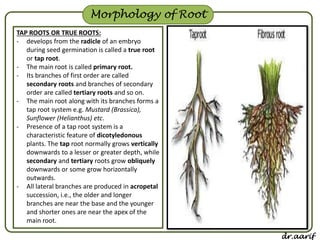
TAP ROOTS OR TRUE ROOTS: 
- develops from the radicle of an embryo 
during seed germination is called a true root 
or tap root. 
- The main root is called primary root. 
- Its branches of first order are called 
secondary roots and branches of secondary 
order are called tertiary roots and so on. 
- The main root along with its branches forms a 
tap root system e.g. Mustard (Brassica), 
Sunflower (Helianthus) etc. 
- Presence of a tap root system is a 
characteristic feature of dicotyledonous 
plants. The tap root normally grows vertically 
downwards to a lesser or greater depth, while 
secondary and tertiary roots grow obliquely 
downwards or some grow horizontally 
outwards. 
- All lateral branches are produced in acropetal 
succession, i.e., the older and longer 
branches are near the base and the younger 
and shorter ones are near the apex of the 
main root.
dr.aarif 
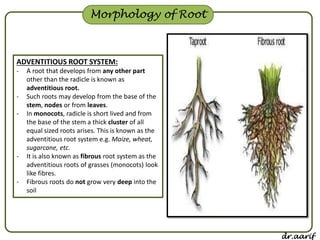
ADVENTITIOUS ROOT SYSTEM: 
- A root that develops from any other part 
other than the radicle is known as 
adventitious root. 
- Such roots may develop from the base of the 
stem, nodes or from leaves. 
- In monocots, radicle is short lived and from 
the base of the stem a thick cluster of all 
equal sized roots arises. This is known as the 
adventitious root system e.g. Maize, wheat, 
sugarcane, etc. 
- It is also known as fibrous root system as the 
adventitious roots of grasses (monocots) look 
like fibres. 
- Fibrous roots do not grow very deep into the 
soil 
Morphology of Root
dr.aarif 
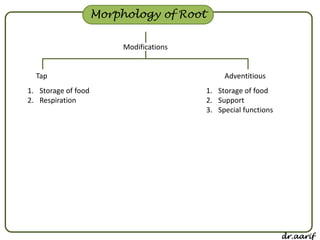
Morphology of Root 
Modifications 
Tap Adventitious 
1. Storage of food 
2. Respiration 
1. Storage of food 
2. Support 
3. Special functions
dr.aarif 
Morphology of Root 
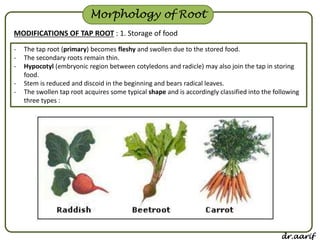
MODIFICATIONS OF TAP ROOT : 1. Storage of food 
- The tap root (primary) becomes fleshy and swollen due to the stored food. 
- The secondary roots remain thin. 
- Hypocotyl (embryonic region between cotyledons and radicle) may also join the tap in storing 
food. 
- Stem is reduced and discoid in the beginning and bears radical leaves. 
- The swollen tap root acquires some typical shape and is accordingly classified into the following 
three types :
dr.aarif 
Morphology of Root 
MODIFICATIONS OF TAP ROOT : 1. Storage of food 
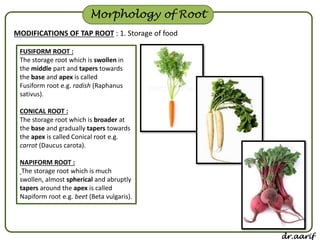
FUSIFORM ROOT : 
The storage root which is swollen in 
the middle part and tapers towards 
the base and apex is called 
Fusiform root e.g. radish (Raphanus 
sativus). 
CONICAL ROOT : 
The storage root which is broader at 
the base and gradually tapers towards 
the apex is called Conical root e.g. 
carrot (Daucus carota). 
NAPIFORM ROOT : 
The storage root which is much 
swollen, almost spherical and abruptly 
tapers around the apex is called 
Napiform root e.g. beet (Beta vulgaris).
dr.aarif 
Morphology of Root 
MODIFICATIONS OF TAP ROOT : 2. Respiration 
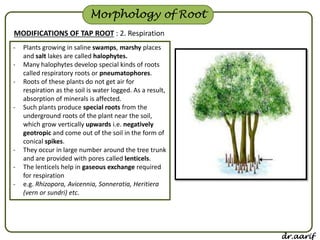
- Plants growing in saline swamps, marshy places 
and salt lakes are called halophytes. 
- Many halophytes develop special kinds of roots 
called respiratory roots or pneumatophores. 
- Roots of these plants do not get air for 
respiration as the soil is water logged. As a result, 
absorption of minerals is affected. 
- Such plants produce special roots from the 
underground roots of the plant near the soil, 
which grow vertically upwards i.e. negatively 
geotropic and come out of the soil in the form of 
conical spikes. 
- They occur in large number around the tree trunk 
and are provided with pores called lenticels. 
- The lenticels help in gaseous exchange required 
for respiration 
- e.g. Rhizopora, Avicennia, Sonneratia, Heritiera 
(vern or sundri) etc.
dr.aarif 
Morphology of Root 
MODIFICATIONS OF ADVENTITIOUS ROOT : 1. Storage of food 
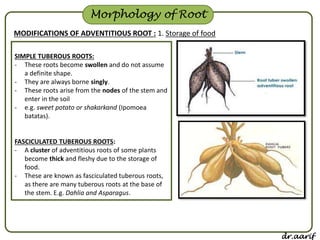
SIMPLE TUBEROUS ROOTS: 
- These roots become swollen and do not assume 
a definite shape. 
- They are always borne singly. 
- These roots arise from the nodes of the stem and 
enter in the soil 
- e.g. sweet potato or shakarkand (Ipomoea 
batatas). 
FASCICULATED TUBEROUS ROOTS: 
- A cluster of adventitious roots of some plants 
become thick and fleshy due to the storage of 
food. 
- These are known as fasciculated tuberous roots, 
as there are many tuberous roots at the base of 
the stem. E.g. Dahlia and Asparagus.
dr.aarif 
Morphology of Root 
MODIFICATIONS OF ADVENTITIOUS ROOT : 2. Mechanical Support 
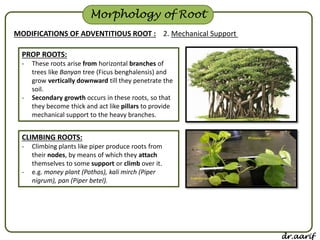
PROP ROOTS: 
- These roots arise from horizontal branches of 
trees like Banyan tree (Ficus benghalensis) and 
grow vertically downward till they penetrate the 
soil. 
- Secondary growth occurs in these roots, so that 
they become thick and act like pillars to provide 
mechanical support to the heavy branches. 
CLIMBING ROOTS: 
- Climbing plants like piper produce roots from 
their nodes, by means of which they attach 
themselves to some support or climb over it. 
- e.g. money plant (Pothos), kali mirch (Piper 
nigrum), pan (Piper betel).
dr.aarif 
Morphology of Root 
MODIFICATIONS OF ADVENTITIOUS ROOT : 2. Mechanical Support 
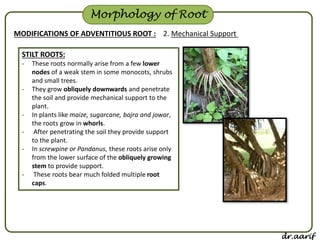
STILT ROOTS: 
- These roots normally arise from a few lower 
nodes of a weak stem in some monocots, shrubs 
and small trees. 
- They grow obliquely downwards and penetrate 
the soil and provide mechanical support to the 
plant. 
- In plants like maize, sugarcane, bajra and jowar, 
the roots grow in whorls. 
- After penetrating the soil they provide support 
to the plant. 
- In screwpine or Pandanus, these roots arise only 
from the lower surface of the obliquely growing 
stem to provide support. 
- These roots bear much folded multiple root 
caps.
dr.aarif 
Morphology of Root 
MODIFICATIONS OF ADVENTITIOUS ROOT : 3. Special Functions 
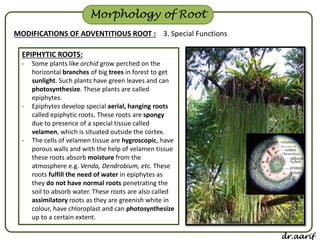
EPIPHYTIC ROOTS: 
- Some plants like orchid grow perched on the 
horizontal branches of big trees in forest to get 
sunlight. Such plants have green leaves and can 
photosynthesize. These plants are called 
epiphytes. 
- Epiphytes develop special aerial, hanging roots 
called epiphytic roots. These roots are spongy 
due to presence of a special tissue called 
velamen, which is situated outside the cortex. 
- The cells of velamen tissue are hygroscopic, have 
porous walls and with the help of velamen tissue 
these roots absorb moisture from the 
atmosphere e.g. Venda, Dendrobium, etc. These 
roots fulfill the need of water in epiphytes as 
they do not have normal roots penetrating the 
soil to absorb water. These roots are also called 
assimilatory roots as they are greenish white in 
colour, have chloroplast and can photosynthesize 
up to a certain extent.
dr.aarif 
Morphology of Root 
MODIFICATIONS OF ADVENTITIOUS ROOT : 3. Special Functions 
SUCKING ROOTS OR HAUSTORIA: 
- These are highly specialized and microscopic 
roots, developed by parasites to absorb 
nourishment from the host. 
- In partial parasites like Viscum album, they 
penetrate only xylem elements of the host to 
absorb water and minerals. 
- In total parasites like Dodder or Cuscuta 
(Amarvel), they establish a connection with the 
vascular strand of host and suck food directly 
from phloem and water and minerals from the 
xylem. 
- Such roots are called parasitic roots, sucking 
roots or Haustoria.
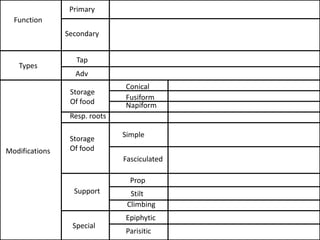
Function 
Types 
Modifications 
Primary 
Secondary 
Tap 
Adv 
Storage 
Of food 
Support 
Special 
Conical 
Fusiform 
Napiform 
Prop 
Stilt 
Climbing 
Epiphytic 
Parisitic 
Resp. roots 
Storage 
Of food 
Simple 
Fasciculated
dr.aarif 
Morphology of Stem 
CHARACTERISTICS : 
- The aerial part of the plant body is collectively described as shoot 
system. 
- Main axis of this shoot system is called the stem. 
- Stem can be defined as the ascending part of the plant axis, which 
develops from the plumule, 
- It is usually negatively hydrotropic, negatively geotropic and 
positively phototropic. 
- It bears a terminal bud and axillary buds in the axils of leaves, for 
growth. 
- It is differentiated into nodes and internodes. 
- At the nodes, it produces dissimilar organs such as leaves and 
flowers and similar organs such as branches, exogenously i.e. 
originate from outer tissue. 
- The young stem is green and is capable of performing 
photosynthesis.
dr.aarif 
Morphology of Stem 
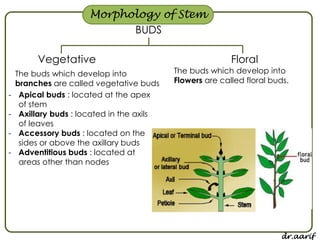
BUDS 
Vegetative Floral 
The buds which develop into 
branches are called vegetative buds 
- Apical buds : located at the apex 
of stem 
- Axillary buds : located in the axils 
of leaves 
- Accessory buds : located on the 
sides or above the axillary buds 
- Adventitious buds : located at 
areas other than nodes 
The buds which develop into 
Flowers are called floral buds.
dr.aarif 
Morphology of Stem 
FUNCTIONS OF STEM: 
- The primary functions of stem are to produce and support lateral 
appendages such as branches, leaves, flowers and fruits, 
conduction of water and minerals to different parts of shoots and 
transport food to all plant parts. 
- Stem may, however, get modified to perform additional or functions 
such as 
- storage of food and water, 
- proliferation and propagation, 
- procuring support for climbing, 
- perennation i.e. to tide over unfavorable conditions 
- synthesis of food (photosynthesis).
dr.aarif 
Morphology of Stem 
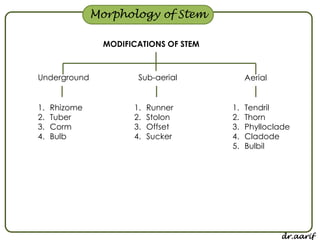
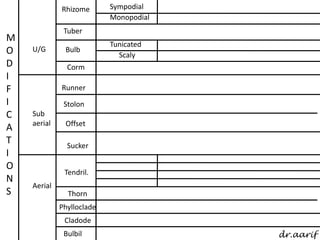
MODIFICATIONS OF STEM 
Underground Sub-aerial Aerial 
1. Rhizome 
2. Tuber 
3. Corm 
4. Bulb 
1. Runner 
2. Stolon 
3. Offset 
4. Sucker 
1. Tendril 
2. Thorn 
3. Phylloclade 
4. Cladode 
5. Bulbil
dr.aarif 
Morphology of Stem 
UNDERGROUND MODIFICATIONS 
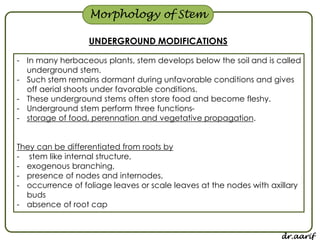
- In many herbaceous plants, stem develops below the soil and is called 
underground stem. 
- Such stem remains dormant during unfavorable conditions and gives 
off aerial shoots under favorable conditions. 
- These underground stems often store food and become fleshy. 
- Underground stem perform three functions- 
- storage of food, perennation and vegetative propagation. 
They can be differentiated from roots by 
- stem like internal structure, 
- exogenous branching, 
- presence of nodes and internodes, 
- occurrence of foliage leaves or scale leaves at the nodes with axillary 
buds 
- absence of root cap
dr.aarif 
Morphology of Stem 
UNDERGROUND MODIFICATIONS 
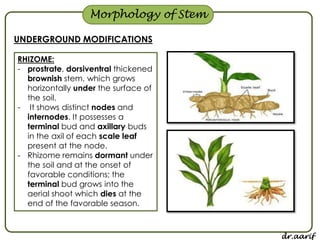
RHIZOME: 
- prostrate, dorsiventral thickened 
brownish stem, which grows 
horizontally under the surface of 
the soil. 
- It shows distinct nodes and 
internodes. It possesses a 
terminal bud and axillary buds 
in the axil of each scale leaf 
present at the node. 
- Rhizome remains dormant under 
the soil and at the onset of 
favorable conditions; the 
terminal bud grows into the 
aerial shoot which dies at the 
end of the favorable season.
dr.aarif 
Morphology of Stem 
UNDERGROUND MODIFICATIONS 
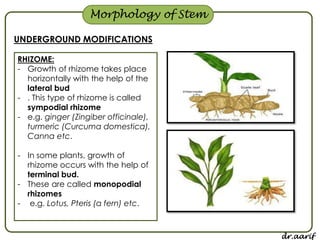
RHIZOME: 
- Growth of rhizome takes place 
horizontally with the help of the 
lateral bud 
- . This type of rhizome is called 
sympodial rhizome 
- e.g. ginger (Zingiber officinale), 
turmeric (Curcuma domestica), 
Canna etc. 
- In some plants, growth of 
rhizome occurs with the help of 
terminal bud. 
- These are called monopodial 
rhizomes 
- e.g. Lotus, Pteris (a fern) etc.
dr.aarif 
Morphology of Stem 
UNDERGROUND MODIFICATIONS 
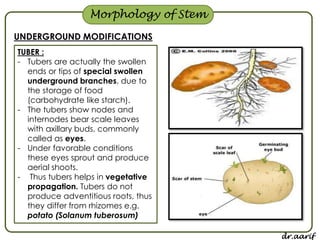
TUBER : 
- Tubers are actually the swollen 
ends or tips of special swollen 
underground branches, due to 
the storage of food 
(carbohydrate like starch). 
- The tubers show nodes and 
internodes bear scale leaves 
with axillary buds, commonly 
called as eyes. 
- Under favorable conditions 
these eyes sprout and produce 
aerial shoots. 
- Thus tubers helps in vegetative 
propagation. Tubers do not 
produce adventitious roots, thus 
they differ from rhizomes e.g. 
potato (Solanum tuberosum)
dr.aarif 
Morphology of Stem 
UNDERGROUND MODIFICATIONS 
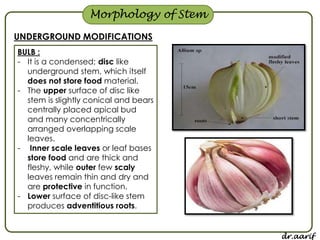
BULB : 
- It is a condensed; disc like 
underground stem, which itself 
does not store food material. 
- The upper surface of disc like 
stem is slightly conical and bears 
centrally placed apical bud 
and many concentrically 
arranged overlapping scale 
leaves. 
- Inner scale leaves or leaf bases 
store food and are thick and 
fleshy, while outer few scaly 
leaves remain thin and dry and 
are protective in function. 
- Lower surface of disc-like stem 
produces adventitious roots.
dr.aarif 
Morphology of Stem 
UNDERGROUND MODIFICATIONS 
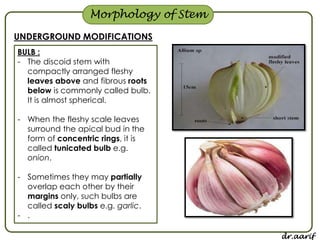
BULB : 
- The discoid stem with 
compactly arranged fleshy 
leaves above and fibrous roots 
below is commonly called bulb. 
It is almost spherical. 
- When the fleshy scale leaves 
surround the apical bud in the 
form of concentric rings, it is 
called tunicated bulb e.g. 
onion. 
- Sometimes they may partially 
overlap each other by their 
margins only, such bulbs are 
called scaly bulbs e.g. garlic. 
- .
dr.aarif 
Morphology of Stem 
UNDERGROUND MODIFICATIONS 
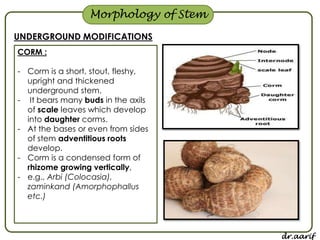
CORM : 
- Corm is a short, stout, fleshy, 
upright and thickened 
underground stem. 
- It bears many buds in the axils 
of scale leaves which develop 
into daughter corms. 
- At the bases or even from sides 
of stem adventitious roots 
develop. 
- Corm is a condensed form of 
rhizome growing vertically, 
- e.g., Arbi (Colocasia), 
zaminkand (Amorphophallus 
etc.)
dr.aarif 
Morphology of Stem 
AERIAL MODIFICATIONS 
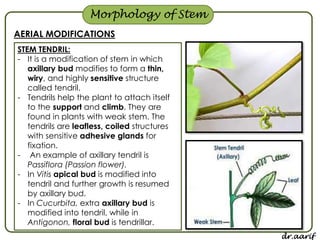
STEM TENDRIL: 
- It is a modification of stem in which 
axillary bud modifies to form a thin, 
wiry, and highly sensitive structure 
called tendril. 
- Tendrils help the plant to attach itself 
to the support and climb. They are 
found in plants with weak stem. The 
tendrils are leafless, coiled structures 
with sensitive adhesive glands for 
fixation. 
- An example of axillary tendril is 
Passiflora (Passion flower). 
- In Vitis apical bud is modified into 
tendril and further growth is resumed 
by axillary bud. 
- In Cucurbita, extra axillary bud is 
modified into tendril, while in 
Antigonon, floral bud is tendrillar.
dr.aarif 
Morphology of Stem 
AERIAL MODIFICATIONS 
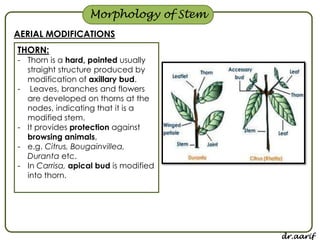
THORN: 
- Thorn is a hard, pointed usually 
straight structure produced by 
modification of axillary bud. 
- Leaves, branches and flowers 
are developed on thorns at the 
nodes, indicating that it is a 
modified stem. 
- It provides protection against 
browsing animals, 
- e.g. Citrus, Bougainvillea, 
Duranta etc. 
- In Carrisa, apical bud is modified 
into thorn.
dr.aarif 
Morphology of Stem 
AERIAL MODIFICATIONS 
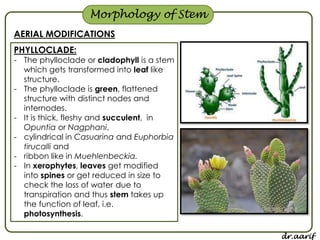
PHYLLOCLADE: 
- The phylloclade or cladophyll is a stem 
which gets transformed into leaf like 
structure. 
- The phylloclade is green, flattened 
structure with distinct nodes and 
internodes. 
- It is thick, fleshy and succulent, in 
Opuntia or Nagphani, 
- cylindrical in Casuarina and Euphorbia 
tirucalli and 
- ribbon like in Muehlenbeckia. 
- In xerophytes, leaves get modified 
into spines or get reduced in size to 
check the loss of water due to 
transpiration and thus stem takes up 
the function of leaf, i.e. 
photosynthesis.
dr.aarif 
Morphology of Stem 
AERIAL MODIFICATIONS 
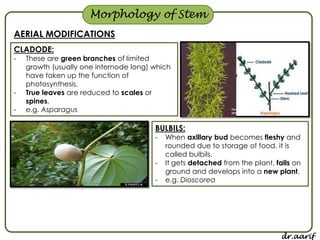
CLADODE: 
- These are green branches of limited 
growth (usually one internode long) which 
have taken up the function of 
photosynthesis. 
- True leaves are reduced to scales or 
spines, 
- e.g. Asparagus 
BULBILS: 
- When axillary bud becomes fleshy and 
rounded due to storage of food, it is 
called bulbils. 
- It gets detached from the plant, falls on 
ground and develops into a new plant, 
- e.g. Dioscorea
dr.aarif 
Morphology of Stem 
SUB - AERIAL MODIFICATIONS 
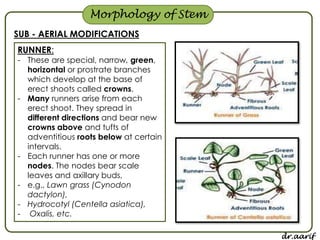
RUNNER: 
- These are special, narrow, green, 
horizontal or prostrate branches 
which develop at the base of 
erect shoots called crowns. 
- Many runners arise from each 
erect shoot. They spread in 
different directions and bear new 
crowns above and tufts of 
adventitious roots below at certain 
intervals. 
- Each runner has one or more 
nodes. The nodes bear scale 
leaves and axillary buds, 
- e.g., Lawn grass (Cynodon 
dactylon), 
- Hydrocotyl (Centella asiatica), 
- Oxalis, etc.
dr.aarif 
Morphology of Stem 
SUB - AERIAL MODIFICATIONS 
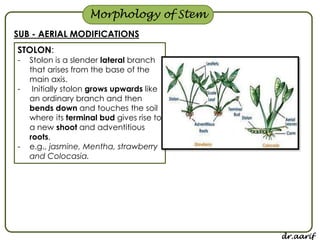
STOLON: 
- Stolon is a slender lateral branch 
that arises from the base of the 
main axis. 
- Initially stolon grows upwards like 
an ordinary branch and then 
bends down and touches the soil 
where its terminal bud gives rise to 
a new shoot and adventitious 
roots, 
- e.g., jasmine, Mentha, strawberry 
and Colocasia.
dr.aarif 
Morphology of Stem 
SUB - AERIAL MODIFICATIONS 
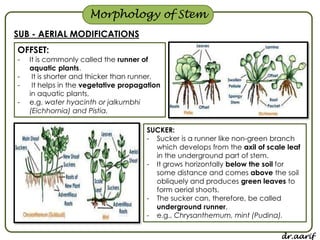
OFFSET: 
- It is commonly called the runner of 
aquatic plants. 
- It is shorter and thicker than runner. 
- It helps in the vegetative propagation 
in aquatic plants, 
- e.g. water hyacinth or jalkumbhi 
(Eichhornia) and Pistia. 
SUCKER: 
- Sucker is a runner like non-green branch 
which develops from the axil of scale leaf 
in the underground part of stem. 
- It grows horizontally below the soil for 
some distance and comes above the soil 
obliquely and produces green leaves to 
form aerial shoots. 
- The sucker can, therefore, be called 
underground runner, 
- e.g., Chrysanthemum, mint (Pudina).
dr.aarif 
M 
O 
D 
I 
F 
I 
C 
A 
T 
I 
O 
N 
S 
U/G 
Sub 
aerial 
Aerial 
Rhizome 
Tuber 
Bulb 
Corm 
Runner 
Stolon 
Offset 
Sucker 
Tendril. 
Thorn 
Phylloclade 
Cladode 
Bulbil 
Sympodial 
Monopodial 
Tunicated 
Scaly
A dorsi-ventrally compressed, lateral appendage of stem produced at the 
nodes and is specialized to perform photosynthesis 
dr.aarif 
Morphology of Leaf 
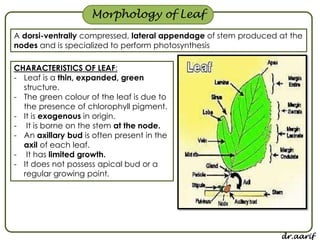
CHARACTERISTICS OF LEAF: 
- Leaf is a thin, expanded, green 
structure. 
- The green colour of the leaf is due to 
the presence of chlorophyll pigment. 
- It is exogenous in origin. 
- It is borne on the stem at the node. 
- An axillary bud is often present in the 
axil of each leaf. 
- It has limited growth. 
- It does not possess apical bud or a 
regular growing point.
PARTS OF A TYPICAL LEAF : 
LEAF BASE OR HYPOPODIUM: The part of leaf attached to the stem or branch is known as 
leaf base. It may assume different shapes in different plants. In some leguminous plants, 
the leaf blade may become swollen which is caonocots, the leaf base expands into a sheath 
covering the stem partially or completely. Leaves of some plants possess a pair of lateral 
dr.aarif 
Morphology of Leaf 
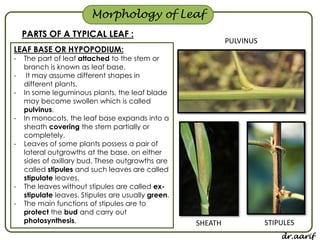
LEAF BASE OR HYPOPODIUM: 
- The part of leaf attached to the stem or 
branch is known as leaf base. 
- It may assume different shapes in 
different plants. 
- In some leguminous plants, the leaf blade 
may become swollen which is called 
pulvinus. 
- In monocots, the leaf base expands into a 
sheath covering the stem partially or 
completely. 
- Leaves of some plants possess a pair of 
lateral outgrowths at the base, on either 
sides of axillary bud. These outgrowths are 
called stipules and such leaves are called 
stipulate leaves. 
- The leaves without stipules are called ex-stipulate 
leaves. Stipules are usually green. 
- The main functions of stipules are to 
protect the bud and carry out 
photosynthesis. 
PULVINUS 
SHEATH STIPULES
PARTS OF A TYPICAL LEAF : 
LEAF BASE OR HYPOPODIUM: The part of leaf attached to the stem or branch is known as 
leaf base. It may assume different shapes in different plants. In some leguminous plants, 
the leaf blade may become swollen which is called pulvinousIn monocots, the leaf base 
expands into a sheath covering the stem partially or completely. Leaves of some plants 
possess a pair of lateral 
dr.aarif 
Morphology of Leaf 
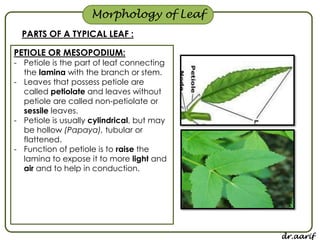
PETIOLE OR MESOPODIUM: 
- Petiole is the part of leaf connecting 
the lamina with the branch or stem. 
- Leaves that possess petiole are 
called petiolate and leaves without 
petiole are called non-petiolate or 
sessile leaves. 
- Petiole is usually cylindrical, but may 
be hollow (Papaya), tubular or 
flattened. 
- Function of petiole is to raise the 
lamina to expose it to more light and 
air and to help in conduction.
PARTS OF A TYPICAL LEAF : 
LEAF BASE OR HYPOPODIUM: The part of leaf attached to the stem or branch is known as 
leaf base. It may assume different shapes in different plants. In some leguminous plants, 
the leaf blade may become swollen which is called pulvinousIn monocots, the leaf base 
expands into a sheath covering the stem partially or completely. Leaves of some plants 
possess a pair of lateral 
dr.aarif 
Morphology of Leaf 
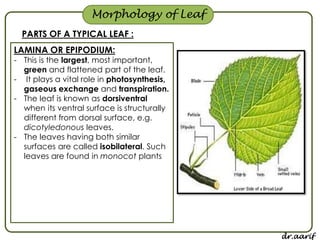
LAMINA OR EPIPODIUM: 
- This is the largest, most important, 
green and flattened part of the leaf. 
- It plays a vital role in photosynthesis, 
gaseous exchange and transpiration. 
- The leaf is known as dorsiventral 
when its ventral surface is structurally 
different from dorsal surface, e.g. 
dicotyledonous leaves. 
- The leaves having both similar 
surfaces are called isobilateral. Such 
leaves are found in monocot plants
LEAF BASE OR HYPOPODIUM: The part of leaf attached to the stem or branch is known as 
leaf base. It may assume different shapes in different plants. In some leguminous plants, 
the leaf blade may become swollen which is called pulvinousInmonocots,heleafbase 
expands into a sheath covering the stem partially or completely. Leaves of some plants 
possess a pair of lateral 
dr.aarif 
Morphology of Leaf 
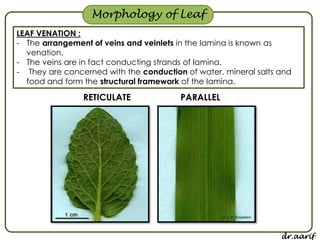
LEAF VENATION : 
- The arrangement of veins and veinlets in the lamina is known as 
venation. 
- The veins are in fact conducting strands of lamina. 
- They are concerned with the conduction of water, mineral salts and 
food and form the structural framework of the lamina. 
RETICULATE PARALLEL
o a sheath covering the stem partially or completely. Leaves of some plants possess a pair 
of lateral 
dr.aarif 
Morphology of Leaf 
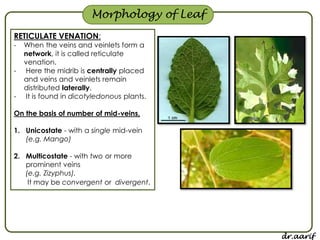
RETICULATE VENATION: 
- When the veins and veinlets form a 
network, it is called reticulate 
venation. 
- Here the midrib is centrally placed 
and veins and veinlets remain 
distributed laterally. 
- It is found in dicotyledonous plants. 
On the basis of number of mid-veins, 
1. Unicostate - with a single mid-vein 
(e.g. Mango) 
2. Multicostate - with two or more 
prominent veins 
(e.g. Zizyphus). 
It may be convergent or divergent.
o a sheath covering the stem partially or completely. Leaves of some plants possess a pair 
of lateral 
dr.aarif 
Morphology of Leaf 
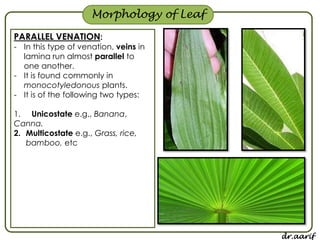
PARALLEL VENATION: 
- In this type of venation, veins in 
lamina run almost parallel to 
one another. 
- It is found commonly in 
monocotyledonous plants. 
- It is of the following two types: 
1. Unicostate e.g., Banana, 
Canna. 
2. Multicostate e.g., Grass, rice, 
bamboo, etc
o a sheath covering the stem partially or completely. Leaves of some plants possess a pair 
of lateral 
dr.aarif 
Morphology of Leaf 
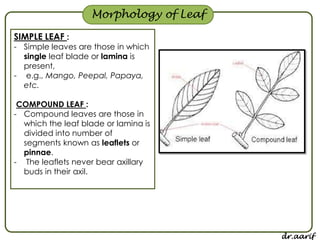
SIMPLE LEAF : 
- Simple leaves are those in which 
single leaf blade or lamina is 
present, 
- e.g., Mango, Peepal, Papaya, 
etc. 
COMPOUND LEAF : 
- Compound leaves are those in 
which the leaf blade or lamina is 
divided into number of 
segments known as leaflets or 
pinnae. 
- The leaflets never bear axillary 
buds in their axil.
o a sheath covering the stem partially or completely. Leaves of some plants possess a pair 
of lateral 
dr.aarif 
Morphology of Leaf 
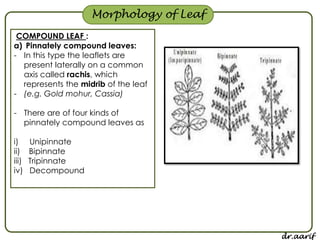
COMPOUND LEAF : 
a) Pinnately compound leaves: 
- In this type the leaflets are 
present laterally on a common 
axis called rachis, which 
represents the midrib of the leaf 
- (e.g. Gold mohur, Cassia) 
- There are of four kinds of 
pinnately compound leaves as 
i) Unipinnate 
ii) Bipinnate 
iii) Tripinnate 
iv) Decompound
o a sheath covering the stem partially or completely. Leaves of some plants possess a pair 
of lateral 
dr.aarif 
Morphology of Leaf 
COMPOUND LEAF : 
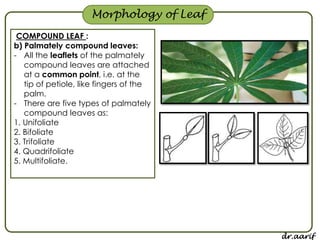
b) Palmately compound leaves: 
- All the leaflets of the palmately 
compound leaves are attached 
at a common point, i.e. at the 
tip of petiole, like fingers of the 
palm. 
- There are five types of palmately 
compound leaves as: 
1. Unifoliate 
2. Bifoliate 
3. Trifoliate 
4. Quadrifoliate 
5. Multifoliate.
stem or branches, e.g., Sunflower, Mango, China rose, Mustard etc. 
e laterally on the stem or branches, e.g., Sunflower, Mango, China rose, Mustard etverithe 
stem partially or completely. Leaves of some plants possess a pair of lateral 
dr.aarif 
Morphology of Leaf 
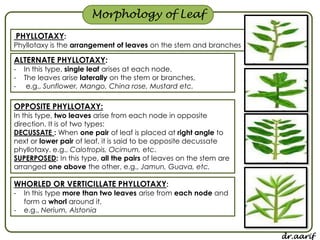
PHYLLOTAXY: 
Phyllotaxy is the arrangement of leaves on the stem and branches 
ALTERNATE PHYLLOTAXY: 
- In this type, single leaf arises at each node. 
- The leaves arise laterally on the stem or branches, 
- e.g., Sunflower, Mango, China rose, Mustard etc. 
OPPOSITE PHYLLOTAXY: 
In this type, two leaves arise from each node in opposite 
direction. It is of two types: 
DECUSSATE : When one pair of leaf is placed at right angle to 
next or lower pair of leaf, it is said to be opposite decussate 
phyllotaxy. e.g., Calotropis, Ocimum, etc. 
SUPERPOSED: In this type, all the pairs of leaves on the stem are 
arranged one above the other, e.g., Jamun, Guava, etc. 
WHORLED OR VERTICILLATE PHYLLOTAXY: 
- In this type more than two leaves arise from each node and 
form a whorl around it. 
- e.g., Nerium, Alstonia
MODIFICATIONS OF LEAVES: 
stem or branches, e.g., Sunflower, Mango, China rose, Mustard etc. 
e laterally on the stem or branches, e.g., Sunflower, Mango, China rose, Mustardstem 
partially or completely. Leaves of some plants possess a pair of lateral 
dr.aarif 
Morphology of Leaf 
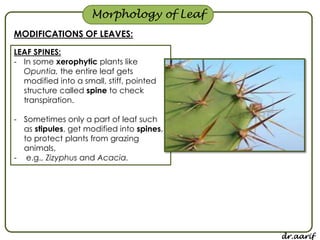
LEAF SPINES: 
- In some xerophytic plants like 
Opuntia, the entire leaf gets 
modified into a small, stiff, pointed 
structure called spine to check 
transpiration. 
- Sometimes only a part of leaf such 
as stipules, get modified into spines, 
to protect plants from grazing 
animals, 
- e.g., Zizyphus and Acacia.
MODIFICATIONS OF LEAVES: 
stem or branches, e.g., Sunflower, Mango, China rose, Mustard etc. 
e laterally on the stem or branches, e.g., Sunflower, Mango, China rose, Mustardstem 
partially or completely. Leaves of some plants possess a pair of lateral 
dr.aarif 
Morphology of Leaf 
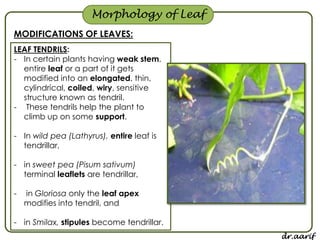
LEAF TENDRILS: 
- In certain plants having weak stem, 
entire leaf or a part of it gets 
modified into an elongated, thin, 
cylindrical, coiled, wiry, sensitive 
structure known as tendril. 
- These tendrils help the plant to 
climb up on some support. 
- In wild pea (Lathyrus), entire leaf is 
tendrillar, 
- in sweet pea (Pisum sativum) 
terminal leaflets are tendrillar, 
- in Gloriosa only the leaf apex 
modifies into tendril, and 
- in Smilax, stipules become tendrillar.
MODIFICATIONS OF LEAVES: 
stem or branches, e.g., Sunflower, Mango, China rose, Mustard etc. 
e laterally on the stem or branches, e.g., Sunflower, Mango, China rose, Mustards partially 
or completely. Leaves of some plants possess a pair of lateral 
dr.aarif 
Morphology of Leaf 
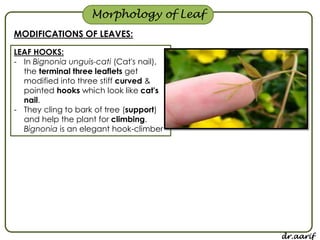
LEAF HOOKS: 
- In Bignonia unguis-cati (Cat's nail), 
the terminal three leaflets get 
modified into three stiff curved & 
pointed hooks which look like cat's 
nail. 
- They cling to bark of tree (support) 
and help the plant for climbing. 
Bignonia is an elegant hook-climber
MODIFICATIONS OF LEAVES: 
stem or branches, e.g., Sunflower, Mango, China rose, Mustard etc. 
e laterally on the stem or branches, e.g., Sunflower, Mango, China rose, Mustards partially 
or completely. Leaves of some plants possess a pair of lateral 
dr.aarif 
Morphology of Leaf 
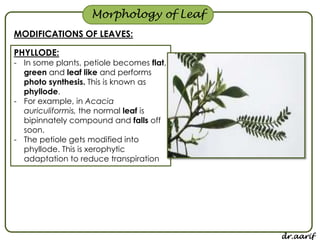
PHYLLODE: 
- In some plants, petiole becomes flat, 
green and leaf like and performs 
photo synthesis. This is known as 
phyllode. 
- For example, in Acacia 
auriculiformis, the normal leaf is 
bipinnately compound and falls off 
soon. 
- The petiole gets modified into 
phyllode. This is xerophytic 
adaptation to reduce transpiration
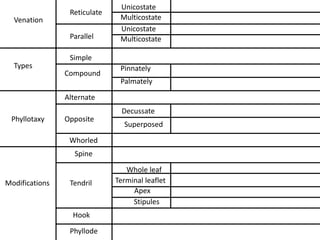
Venation 
Reticulate 
Parallel 
Unicostate 
Multicostate 
Unicostate 
Multicostate 
Types 
Simple 
Compound 
Pinnately 
Palmately 
Phyllotaxy 
Alternate 
Opposite 
Whorled 
Decussate 
Superposed 
Modifications 
Spine 
Tendril 
Hook 
Phyllode 
Whole leaf 
Terminal leaflet 
Apex 
Stipules