Name
Muhammad Adnan
Roll No
BBOF18BM010
Submitted To
Ma’am Rabia Saba
Subject
Plant Anatomy
Topic
Phloem
BS-BOT(6th)
University of Sargodha Sub campus Bhakker
Content
 Phloem
 Classification of phloem
 Competents of phloem
 Sieve Elements
1) Sieve cells
2) Sieve tubes
 Companion Cells
Phloem
 It is type of complex tissue found in the vascular system
which may also becalled bast or leptome.
 Usually phloem is present external to xylem
 In leaves phloem is located on the abaxial side (lower
side)
 Internal phloem: phloem present internal to xylem
 External phloem: phloem present external to xylem
 Intra-xylary phloem: new term describing internal phloem
 Inter-xylary phloem: phloem seen included inside the
secondary xylem (iti s also called as included phloem)
Classification of phloem
 Based on development, two types of phloem
1. Primary phloem
2. Secondary phloem
 Primary phloem derived from pro-cambium during primary
growth
 Secondry phloem formed from vascular cambium during
secondary growth
Components of phloem
 Phloem composed of several elements
 Thecomponents of phloem are:
1. Sieve elements
2. Companion cells
3. Phloem parenchyma
4. Phloem fibres and Sclereids
1. Sieve elements
 Living cells inthe phloem
 With protoplasm
 No lignified secondary cell wall
 Sieve elements are of two types:
I. Sieve cells
Il. Sieve tubes
Sieve cells
 These are narrow elongated cells without conspicuous
sieve areas, and taper at their ends or have greatly
inclined walls which overlap in the tissue.
 These are found among members of lower vascular plants
and gymnosperms
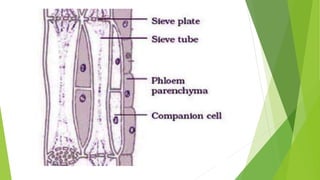
Sieve tubes
 Advanced type of sieve element
 Occurs in angiosperms
 Longitudinal series of cells
 Each cell is called sieve tube member or sieve tube
element
 Sieve area are located on the end wall
 Sieve area are more specialized in sieve tubes than sieve
cells
 Sieve plate: the part of cell wall bearing sieve area
 End wall of sieve tube inclined to transverse
 The sieve plate is the more specialised area found usually
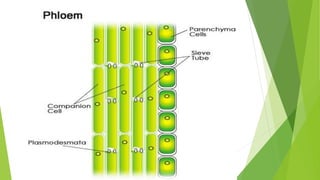
Companion cells
 These are specialised parenchymatous cells found Slane
Associated with sieve elements in origin, position and
function. Pues Mevelof from same.
 meristematic cell that gives rise to the sieve element.
Such a meristematic cell divides longitudinally and one of
them differentiates into sieve tube and other into
companion cell,
 Normally, a single companion cell is founc aor a eve tube
in thé primary phloem, but in certain plants, such as
carrot, more than one cell have been reported.
 However, solitary long companion cells are common in
primary phloem, and in groups, in secondary phloem.
 In a cross-section, the companion cell appears rounded OF
polygonal,
 These are living cells and have dense cytoplasm,
prominent nucleus, several " vacuoles, and other
cytoplasmic organelles.
 Starch grains are never found in. ‘€ompanion cells.
Thank you