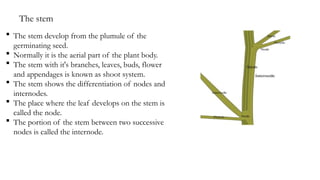
The stemdevelop from the plumule of the
germinating seed.
Normally it is the aerial part of the plant body.
The stem with it's branches, leaves, buds, flower
and appendages is known as shoot system.
The stem shows the differentiation of nodes and
internodes.
The place where the leaf develops on the stem is
called the node.
The portion of the stem between two successive
nodes is called the internode.
The stem
3.
1. Stem isan ascending axis of the plant and develops from the plumule
and epicotyl of the embryo.
2. It is generally erect and grows away from the soil towards light.
3. The growing apex of stem bears a terminal bud for growth in length.
4. In flowering plants, stem is differentiated into nodes and internodes.
5. The lateral organs of stem (i.e., leaves and branches) are exogenous in
origin (from cortical region).
6. The young stem is green and photosynthetic.
7. Hair, if present, are generally multicellular.
8. In mature plants, stem and its branches bear flowers and fruits.
Characteristics of the stem
Aerial stem
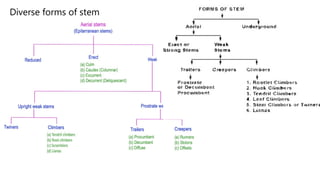
Aerialstem are above ground stem which may be
erect, rigid and strong, holding themselves in an
upright position.
In contrast, others may be too weak to support
themselves in upright position hence they either trail
on ground or climb on neighbouring plants and other
objects.
Erect or strong stem
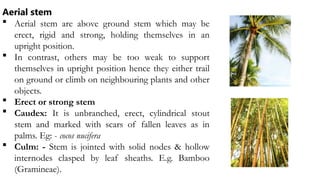
Caudex: It is unbranched, erect, cylindrical stout
stem and marked with scars of fallen leaves as in
palms. Eg: - cocos nucifera
Culm: - Stem is jointed with solid nodes & hollow
internodes clasped by leaf sheaths. E.g. Bamboo
(Gramineae).
6.
Excurrent
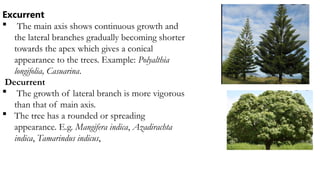
The mainaxis shows continuous growth and
the lateral branches gradually becoming shorter
towards the apex which gives a conical
appearance to the trees. Example: Polyalthia
longifolia, Casuarina.
Decurrent
The growth of lateral branch is more vigorous
than that of main axis.
The tree has a rounded or spreading
appearance. E.g. Mangifera indica, Azadirachta
indica, Tamarindus indicus,
7.
Scape:- In somemonocotyledons there is no aerial stem
instead there are aerial shoot (Branch) which bear flowers.
Eg:- Onion and aroids
Aerial stem cont...
8.
Weak stem
Weak stemsare of three kinds
1. Trailers
2. Creepers
3. Climbers
Trailers: Shoots made up of thin and long or
short branches which trail along the soil surface
with or without rooting at the nodes.
There three types of trailers;
1. Prostrate – trailers which lie prostrate on the
ground, e.g Oxalis spp
2. Decumbent – trailers whose branches after
trailing for some distances tend rise at the apex
3. Diffuse – trailers which produce several
branches which spread out on ground in all
directions
9.
Creepers - Weakshoots having long or short branches creeping along the
soil surface and produce roots at the nodes.
There four types of creepers;
1. Runners e.g.Cynodon dactylon
2. Stolon,
3. Offset and
4. Sucker - the main stem grow in the soil but branches develop from
nodes above the soil e.g. Pineapple,
Climbers - plants that attach themselves to any neighboring object, often by
special device, e.g pea, passion flower, guard, vine, etc.
10.
Parasites – plantswhich grow upon other living plants or animals and absorb
organic nutrients from the host by their sucking root Haustoria. There four
categories of parasitic plants
1. Total stem parasites – (Dodder (Cascuta spp)
2. Partial stem parasites –
3. Total root parasites – parasites on plant roots
4. Partial root parasite – Witch weed (Striga spp)
Special type of plants
11.
Plants that growon other plants but do not suck or absorb nutrients from them.
They develop three types of roots
Clinging roots – grow into cracks and crevices in the barks of the supporting
plant and fix the epiphyte in proper position for anchorage.
Absorbing roots – develop from clinging roots and project into the humus from
which they draw nutrients
Hanging roots- they have outer covering of a special absorptive tissue called
velamen which usually consist of 4-5 layers of oblong polygonal cells.
The cells are dead containing only air and water.
They play role to absorb moistures from the surroundings.
Epiphytes
12.
Stems developunderground and lodge permanently lying dormant, defoliated for
some time and then sprouting aerial shoots annually when conditions are
favorable.
They are always thick and fleshy, containing a heavy deposit of food.
They differ from roots in the following aspects;
Have nodes and internodes
Have scale leaves
Have buds (axillary and terminal)
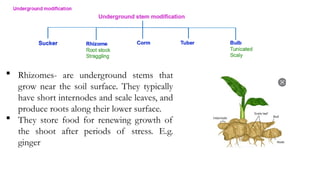
Underground stem modification
13.
Rhizomes- areunderground stems that
grow near the soil surface. They typically
have short internodes and scale leaves, and
produce roots along their lower surface.
They store food for renewing growth of
the shoot after periods of stress. E.g.
ginger
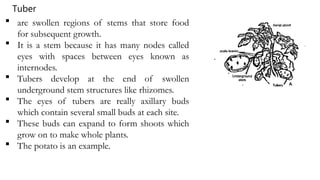
14.
are swollenregions of stems that store food
for subsequent growth.
It is a stem because it has many nodes called
eyes with spaces between eyes known as
internodes.
Tubers develop at the end of swollen
underground stem structures like rhizomes.
The eyes of tubers are really axillary buds
which contain several small buds at each site.
These buds can expand to form shoots which
grow on to make whole plants.
The potato is an example.
Tuber
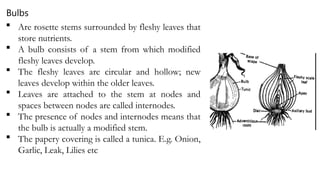
15.
Are rosettestems surrounded by fleshy leaves that
store nutrients.
A bulb consists of a stem from which modified
fleshy leaves develop.
The fleshy leaves are circular and hollow; new
leaves develop within the older leaves.
Leaves are attached to the stem at nodes and
spaces between nodes are called internodes.
The presence of nodes and internodes means that
the bulb is actually a modified stem.
The papery covering is called a tunica. E.g. Onion,
Garlic, Leak, Lilies etc
Bulbs
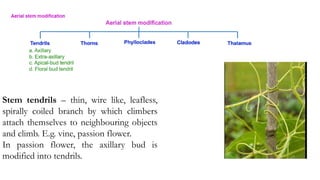
16.
Stem tendrils –thin, wire like, leafless,
spirally coiled branch by which climbers
attach themselves to neighbouring objects
and climb. E.g. vine, passion flower.
In passion flower, the axillary bud is
modified into tendrils.
17.
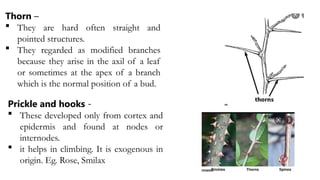
Thorn –
Theyare hard often straight and
pointed structures.
They regarded as modified branches
because they arise in the axil of a leaf
or sometimes at the apex of a branch
which is the normal position of a bud.
Prickle and hooks -
These developed only from cortex and
epidermis and found at nodes or
internodes.
it helps in climbing. It is exogenous in
origin. Eg. Rose, Smilax
18.
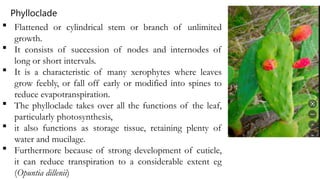
Flattened orcylindrical stem or branch of unlimited
growth.
It consists of succession of nodes and internodes of
long or short intervals.
It is a characteristic of many xerophytes where leaves
grow feebly, or fall off early or modified into spines to
reduce evapotranspiration.
The phylloclade takes over all the functions of the leaf,
particularly photosynthesis,
it also functions as storage tissue, retaining plenty of
water and mucilage.
Furthermore because of strong development of cuticle,
it can reduce transpiration to a considerable extent eg
(Opuntia dillenii)
Phylloclade
19.
i. It bearsand support leaves, flowers and fruits.
ii. The various appendages borne on the stem are placed in such a fashion that
they are able to carry out their functions most effectively.
iii. It conducts the water and minerals from roots to leaves and fruits.
iv. Stem bears flowers and fruits in position to facilitate the processes of
pollination and fertilization.
v. Every year it adds new cells, tissues and organs which are required for the
continued functioning of the plants.
Primary functions of Stem
20.
i. Storage offood: In a large number of plants, the stems store food and water.
Perennation: The underground stems help to tide over the unfavourable growing
period
ii. Vegetative propagation: In a large number of plants, the stems are used for
vegetative multiplication
iii. Photosyntheis: In some xerophytes, the stem becomes green and modified into
leaf-like structures
iv. Protection against browsing
v. As climbers: The stems may be modified into tendrils, hooks, thorns etc. to.
vi. Receptacle for floral organs: In a flower, the floral organs are borne on the
thalamus. The thalamus is a modified stem which has condensed and overlapping
nodes and internodes.
Secondary function of the stem
21.
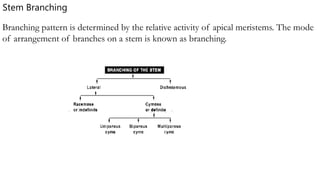
Branching pattern isdetermined by the relative activity of apical meristems. The mode
of arrangement of branches on a stem is known as branching.
Stem Branching
22.
Branches are producedlaterally, that is from the sides of the main stem. There are
two kinds of lateral branching,
1. Racemose/indefinite or monopodial and
2. cymose or definite.
Lateral branching
Racemose
The growth of the stem is indefinite or indeterminate.
It continues to grow indefinitely by the terminal bud and
give off branches laterally in acropetal succession. I.e. lower
branches are older and longer than the upper ones.
It is also called monopodial type because there is single
continuous axis.
The plants canopy takes a conical shape.
23.
Growth ofthe main stem is definite (determinate). i.e. the
terminal bud does not continue to grow indefinitely, but the stem
produce one or more lower branches which grow vigorously than
the terminal bud.
The process may be repeated more and more resulting to a dome
shaped canopy.
Cymose lateral branching is categorized into three;
1. Uniparous or monochasial cyme
2. Biparous cyme or dichasial
3. Multiparous cyme
Cymose
24.
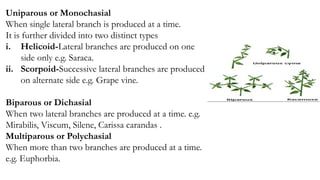
Uniparous or Monochasial
Whensingle lateral branch is produced at a time.
It is further divided into two distinct types
i. Helicoid-Lateral branches are produced on one
side only e.g. Saraca.
ii. Scorpoid-Successive lateral branches are produced
on alternate side e.g. Grape vine.
Biparous or Dichasial
When two lateral branches are produced at a time. e.g.
Mirabilis, Viscum, Silene, Carissa carandas .
Multiparous or Polychasial
When more than two branches are produced at a time.
e.g. Euphorbia.
25.
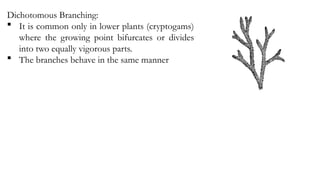
Dichotomous Branching:
Itis common only in lower plants (cryptogams)
where the growing point bifurcates or divides
into two equally vigorous parts.
The branches behave in the same manner
26.
Functions of stem
Bear leaves and expose them for proper functioning
Bear flowers and expose them for efficient pollination
Support branches which push leaves and flowers further for
more exposure
Conduction of water and minerals and manufactured
photosynthetic products
Storage site in some plants
Manufacture of food in some plants
 Most read
 Most read