Channel estimation using OFDM systems
Group no.12
Advanced Communications Systems 2014
Group no.12 Advanced Communications Systems 2014 1 / 26
Motivation
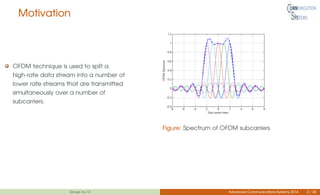
OFDM technique is used to split a
high-rate data stream into a number of
lower rate streams that are transmitted
simultaneously over a number of
subcarriers.
Figure: Spectrum of OFDM subcarriers
Group no.12 Advanced Communications Systems 2014 2 / 26
Motivation
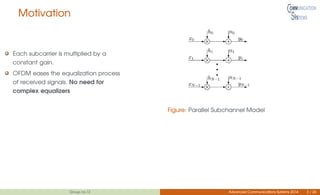
Each subcarrier is multiplied by a
constant gain.
OFDM eases the equalization process
of received signals. No need for
complex equalizers
Figure: Parallel Subchannel Model
Group no.12 Advanced Communications Systems 2014 3 / 26
Motivation
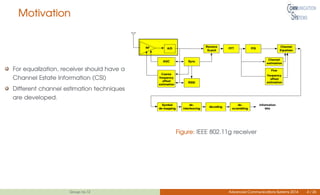
For equalization, receiver should have a
Channel Estate Information (CSI)
Different channel estimation techniques
are developed.
Figure: IEEE 802.11g receiver
Group no.12 Advanced Communications Systems 2014 4 / 26
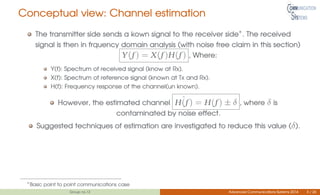
Conceptual view: Channel estimation
The transmitter side sends a kown signal to the receiver side∗
. The received
signal is then in frquency domain analysis (with noise free claim in this section)
Y(f ) = X(f )H(f ) , Where:
Y(f): Spectrum of received signal (know at Rx).
X(f): Spectrum of reference signal (known at Tx and Rx).
H(f): Frequency response of the channel(un known).
However, the estimated channel ˆH(f ) = H(f ) ± δ , where δ is
contaminated by noise effect.
Suggested techniques of estimation are investigated to reduce this value (δ).
∗
Basic point to point communications case
Group no.12 Advanced Communications Systems 2014 5 / 26
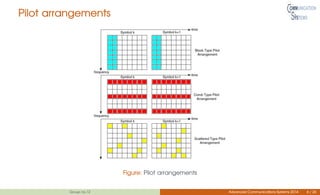
Pilot arrangements
Figure: Pilot arrangements
Group no.12 Advanced Communications Systems 2014 6 / 26
Pilot arrangements
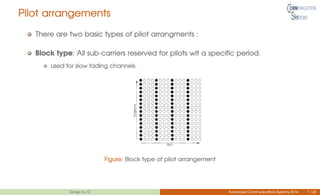
There are two basic types of pilot arrangments :
Block type: All sub-carriers reserved for pilots wit a specific period.
used for slow fading channels.
Figure: Block type of pilot arrangement
Group no.12 Advanced Communications Systems 2014 7 / 26
Pilot arrangements
There are two basic types of pilot arrangments :
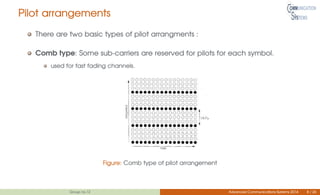
Comb type: Some sub-carriers are reserved for pilots for each symbol.
used for fast fading channels.
Figure: Comb type of pilot arrangement
Group no.12 Advanced Communications Systems 2014 8 / 26
Block type pilot channel estimation
Least Squares
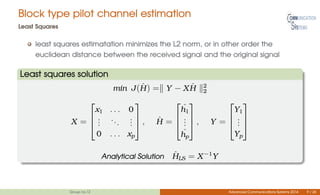
least squares estimatation minimizes the L2 norm, or in other order the
euclidean distance between the received signal and the original signal
Least squares solution
min J( ˆH) = Y − X ˆH 2
2
X =



x1 . . . 0
...
...
...
0 . . . xp


 , ˆH =



ˆh1
...
ˆhp


 , Y =



Y1
...
Yp



Analytical Solution ˆHLS = X−1
Y
Group no.12 Advanced Communications Systems 2014 9 / 26
Block type pilot channel estimation
Least Squares
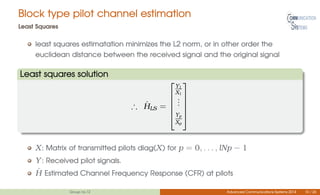
least squares estimatation minimizes the L2 norm, or in other order the
euclidean distance between the received signal and the original signal
Least squares solution
∴ ˆHLS =





Y1
X1
...
Yp
Xp





X: Matrix of transmitted pilots diag(X) for p = 0, . . . , lNp − 1
Y: Received pilot signals.
ˆH Estimated Channel Frequency Response (CFR) at pilots
Group no.12 Advanced Communications Systems 2014 10 / 26
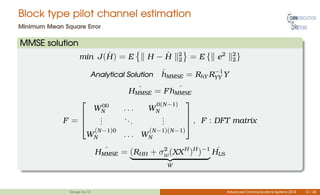
Block type pilot channel estimation
Minimum Mean Square Error
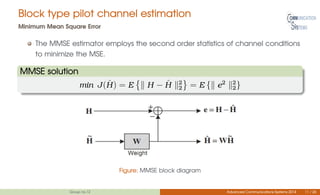
The MMSE estimator employs the second order statistics of channel conditions
to minimize the MSE.
MMSE solution
min J( ˆH) = E H − ˆH 2
2 = E { e2 2
2}
Figure: MMSE block diagram
Group no.12 Advanced Communications Systems 2014 11 / 26
Block type pilot channel estimation
Minimum Mean Square Error
MMSE solution
min J( ˆH) = E H − ˆH 2
2 = E { e2 2
2}
Analytical Solution ˆhMMSE = RhY R−1
YY Y
ˆHMMSE = F ˆhMMSE
F =



W00
N . . . W
0(N−1)
N
...
...
...
W
(N−1)0
N . . . W
(N−1)(N−1)
N


 , F : DFT matrix
ˆHMMSE = (RHH + σ2
w(XXH
)H
)−1
W
ˆHLS
Group no.12 Advanced Communications Systems 2014 12 / 26
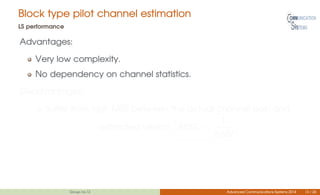
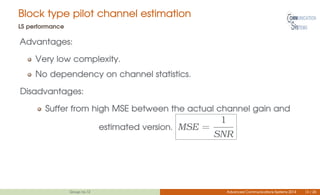
Block type pilot channel estimation
LS performance
Advantages:
Very low complexity.
No dependency on channel statistics.
Disadvantages:
Suffer from high MSE between the actual channel gain and
estimated version. MSE =
1
SNR
Group no.12 Advanced Communications Systems 2014 13 / 26
Block type pilot channel estimation
LS performance
Advantages:
Very low complexity.
No dependency on channel statistics.
Disadvantages:
Suffer from high MSE between the actual channel gain and
estimated version. MSE =
1
SNR
Group no.12 Advanced Communications Systems 2014 13 / 26
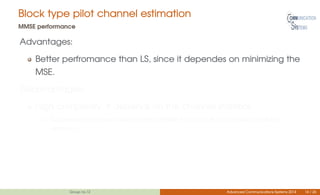
Block type pilot channel estimation
MMSE performance
Advantages:
Better perfromance than LS, since it dependes on minimizing the
MSE.
Disadvantages:
High complexity, it depends on the channel statistics.
Suggested technique called Modified MMSE to reduce the complexity of MMSE
estimator.
Group no.12 Advanced Communications Systems 2014 14 / 26
Block type pilot channel estimation
MMSE performance
Advantages:
Better perfromance than LS, since it dependes on minimizing the
MSE.
Disadvantages:
High complexity, it depends on the channel statistics.
Suggested technique called Modified MMSE to reduce the complexity of MMSE
estimator.
Group no.12 Advanced Communications Systems 2014 14 / 26
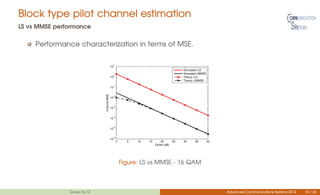
Block type pilot channel estimation
LS vs MMSE performance
Performance characterization in terms of MSE.
0 5 10 15 20 25 30 35 40
10
−6
10
−5
10
−4
10
−3
10
−2
10
−1
10
0
10
1
Eb/No (dB)
ChannelMSE
Simulated−LS
Simulated−MMSE
Theory−LS
Theory−LMMSE
Figure: LS vs MMSE - 16 QAM
Group no.12 Advanced Communications Systems 2014 15 / 26
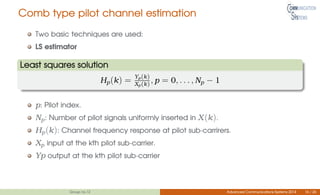
Comb type pilot channel estimation
Two basic techniques are used:
LS estimator
Least squares solution
Hp(k) = Yp(k)
Xp(k), p = 0, . . . , Np − 1
p: Pilot index.
Np: Number of pilot signals uniformly inserted in X(k).
Hp(k): Channel frequency response at pilot sub-carrirers.
Xp input at the kth pilot sub-carrier.
Yp output at the kth pilot sub-carrier
Group no.12 Advanced Communications Systems 2014 16 / 26
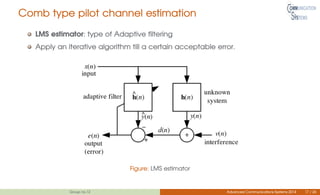
Comb type pilot channel estimation
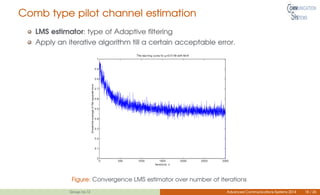
LMS estimator: type of Adaptive filtering
Apply an iterative algorithm till a certain acceptable error.
Figure: LMS estimator
Group no.12 Advanced Communications Systems 2014 17 / 26
Comb type pilot channel estimation
LMS estimator: type of Adaptive filtering
Apply an iterative algorithm till a certain acceptable error.
Figure: Convergence LMS estimator over number of iterations
Group no.12 Advanced Communications Systems 2014 18 / 26
Interpolation for Comb type
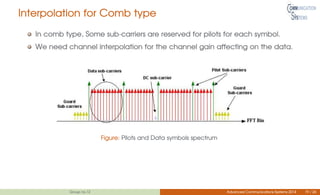
In comb type, Some sub-carriers are reserved for pilots for each symbol.
We need channel interpolation for the channel gain affecting on the data.
Figure: Pilots and Data symbols spectrum
Group no.12 Advanced Communications Systems 2014 19 / 26
Interpolation for Comb type
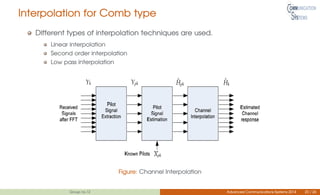
Different types of interpolation techniques are used.
Linear interpolation
Second order interpolation
Low pass interpolation
Figure: Channel Interpolation
Group no.12 Advanced Communications Systems 2014 20 / 26
Interpolation for Comb type
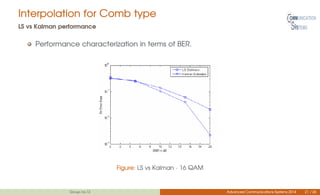
LS vs Kalman performance
Performance characterization in terms of BER.
Figure: LS vs Kalman - 16 QAM
Group no.12 Advanced Communications Systems 2014 21 / 26
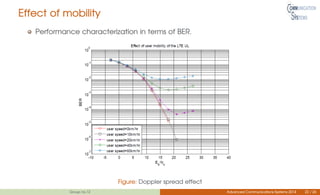
Effect of mobility
Performance characterization in terms of BER.
Figure: Doppler spread effect
Group no.12 Advanced Communications Systems 2014 22 / 26
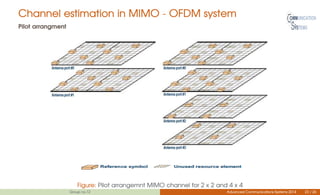
Channel estimation in MIMO - OFDM system
Pilot arrangment
Figure: Pilot arrangemnt MIMO channel for 2 x 2 and 4 x 4
Group no.12 Advanced Communications Systems 2014 23 / 26
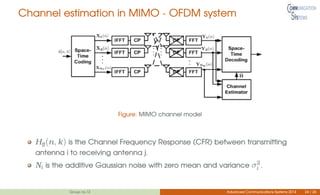
Channel estimation in MIMO - OFDM system
Figure: MIMO channel model
Hij(n, k) is the Channel Frequency Response (CFR) between transmitting
antenna i to receiving antenna j.
Ni is the additive Gaussian noise with zero mean and variance σ2
i .
Group no.12 Advanced Communications Systems 2014 24 / 26
Channel estimation in MIMO - OFDM system
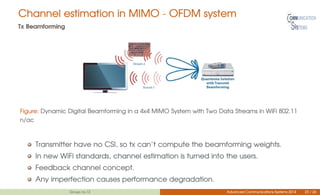
Tx Beamforming
Figure: Dynamic Digital Beamforming in a 4x4 MIMO System with Two Data Streams in WiFi 802.11
n/ac
Transmitter have no CSI, so tx can’t compute the beamforming weights.
In new WiFi standards, channel estimation is turned into the users.
Feedback channel concept.
Any imperfection causes performance degradation.
Group no.12 Advanced Communications Systems 2014 25 / 26
Thank you !
Group no.12 Advanced Communications Systems 2014 26 / 26

Short survey for Channel estimation using OFDM systems

  • 1.
    Channel estimation usingOFDM systems Group no.12 Advanced Communications Systems 2014 Group no.12 Advanced Communications Systems 2014 1 / 26
  • 2.
    Motivation OFDM technique isused to split a high-rate data stream into a number of lower rate streams that are transmitted simultaneously over a number of subcarriers. Figure: Spectrum of OFDM subcarriers Group no.12 Advanced Communications Systems 2014 2 / 26
  • 3.
    Motivation Each subcarrier ismultiplied by a constant gain. OFDM eases the equalization process of received signals. No need for complex equalizers Figure: Parallel Subchannel Model Group no.12 Advanced Communications Systems 2014 3 / 26
  • 4.
    Motivation For equalization, receivershould have a Channel Estate Information (CSI) Different channel estimation techniques are developed. Figure: IEEE 802.11g receiver Group no.12 Advanced Communications Systems 2014 4 / 26
  • 5.
    Conceptual view: Channelestimation The transmitter side sends a kown signal to the receiver side∗ . The received signal is then in frquency domain analysis (with noise free claim in this section) Y(f ) = X(f )H(f ) , Where: Y(f): Spectrum of received signal (know at Rx). X(f): Spectrum of reference signal (known at Tx and Rx). H(f): Frequency response of the channel(un known). However, the estimated channel ˆH(f ) = H(f ) ± δ , where δ is contaminated by noise effect. Suggested techniques of estimation are investigated to reduce this value (δ). ∗ Basic point to point communications case Group no.12 Advanced Communications Systems 2014 5 / 26
  • 6.
    Pilot arrangements Figure: Pilotarrangements Group no.12 Advanced Communications Systems 2014 6 / 26
  • 7.
    Pilot arrangements There aretwo basic types of pilot arrangments : Block type: All sub-carriers reserved for pilots wit a specific period. used for slow fading channels. Figure: Block type of pilot arrangement Group no.12 Advanced Communications Systems 2014 7 / 26
  • 8.
    Pilot arrangements There aretwo basic types of pilot arrangments : Comb type: Some sub-carriers are reserved for pilots for each symbol. used for fast fading channels. Figure: Comb type of pilot arrangement Group no.12 Advanced Communications Systems 2014 8 / 26
  • 9.
    Block type pilotchannel estimation Least Squares least squares estimatation minimizes the L2 norm, or in other order the euclidean distance between the received signal and the original signal Least squares solution min J( ˆH) = Y − X ˆH 2 2 X =    x1 . . . 0 ... ... ... 0 . . . xp    , ˆH =    ˆh1 ... ˆhp    , Y =    Y1 ... Yp    Analytical Solution ˆHLS = X−1 Y Group no.12 Advanced Communications Systems 2014 9 / 26
  • 10.
    Block type pilotchannel estimation Least Squares least squares estimatation minimizes the L2 norm, or in other order the euclidean distance between the received signal and the original signal Least squares solution ∴ ˆHLS =      Y1 X1 ... Yp Xp      X: Matrix of transmitted pilots diag(X) for p = 0, . . . , lNp − 1 Y: Received pilot signals. ˆH Estimated Channel Frequency Response (CFR) at pilots Group no.12 Advanced Communications Systems 2014 10 / 26
  • 11.
    Block type pilotchannel estimation Minimum Mean Square Error The MMSE estimator employs the second order statistics of channel conditions to minimize the MSE. MMSE solution min J( ˆH) = E H − ˆH 2 2 = E { e2 2 2} Figure: MMSE block diagram Group no.12 Advanced Communications Systems 2014 11 / 26
  • 12.
    Block type pilotchannel estimation Minimum Mean Square Error MMSE solution min J( ˆH) = E H − ˆH 2 2 = E { e2 2 2} Analytical Solution ˆhMMSE = RhY R−1 YY Y ˆHMMSE = F ˆhMMSE F =    W00 N . . . W 0(N−1) N ... ... ... W (N−1)0 N . . . W (N−1)(N−1) N    , F : DFT matrix ˆHMMSE = (RHH + σ2 w(XXH )H )−1 W ˆHLS Group no.12 Advanced Communications Systems 2014 12 / 26
  • 13.
    Block type pilotchannel estimation LS performance Advantages: Very low complexity. No dependency on channel statistics. Disadvantages: Suffer from high MSE between the actual channel gain and estimated version. MSE = 1 SNR Group no.12 Advanced Communications Systems 2014 13 / 26
  • 14.
    Block type pilotchannel estimation LS performance Advantages: Very low complexity. No dependency on channel statistics. Disadvantages: Suffer from high MSE between the actual channel gain and estimated version. MSE = 1 SNR Group no.12 Advanced Communications Systems 2014 13 / 26
  • 15.
    Block type pilotchannel estimation MMSE performance Advantages: Better perfromance than LS, since it dependes on minimizing the MSE. Disadvantages: High complexity, it depends on the channel statistics. Suggested technique called Modified MMSE to reduce the complexity of MMSE estimator. Group no.12 Advanced Communications Systems 2014 14 / 26
  • 16.
    Block type pilotchannel estimation MMSE performance Advantages: Better perfromance than LS, since it dependes on minimizing the MSE. Disadvantages: High complexity, it depends on the channel statistics. Suggested technique called Modified MMSE to reduce the complexity of MMSE estimator. Group no.12 Advanced Communications Systems 2014 14 / 26
  • 17.
    Block type pilotchannel estimation LS vs MMSE performance Performance characterization in terms of MSE. 0 5 10 15 20 25 30 35 40 10 −6 10 −5 10 −4 10 −3 10 −2 10 −1 10 0 10 1 Eb/No (dB) ChannelMSE Simulated−LS Simulated−MMSE Theory−LS Theory−LMMSE Figure: LS vs MMSE - 16 QAM Group no.12 Advanced Communications Systems 2014 15 / 26
  • 18.
    Comb type pilotchannel estimation Two basic techniques are used: LS estimator Least squares solution Hp(k) = Yp(k) Xp(k), p = 0, . . . , Np − 1 p: Pilot index. Np: Number of pilot signals uniformly inserted in X(k). Hp(k): Channel frequency response at pilot sub-carrirers. Xp input at the kth pilot sub-carrier. Yp output at the kth pilot sub-carrier Group no.12 Advanced Communications Systems 2014 16 / 26
  • 19.
    Comb type pilotchannel estimation LMS estimator: type of Adaptive filtering Apply an iterative algorithm till a certain acceptable error. Figure: LMS estimator Group no.12 Advanced Communications Systems 2014 17 / 26
  • 20.
    Comb type pilotchannel estimation LMS estimator: type of Adaptive filtering Apply an iterative algorithm till a certain acceptable error. Figure: Convergence LMS estimator over number of iterations Group no.12 Advanced Communications Systems 2014 18 / 26
  • 21.
    Interpolation for Combtype In comb type, Some sub-carriers are reserved for pilots for each symbol. We need channel interpolation for the channel gain affecting on the data. Figure: Pilots and Data symbols spectrum Group no.12 Advanced Communications Systems 2014 19 / 26
  • 22.
    Interpolation for Combtype Different types of interpolation techniques are used. Linear interpolation Second order interpolation Low pass interpolation Figure: Channel Interpolation Group no.12 Advanced Communications Systems 2014 20 / 26
  • 23.
    Interpolation for Combtype LS vs Kalman performance Performance characterization in terms of BER. Figure: LS vs Kalman - 16 QAM Group no.12 Advanced Communications Systems 2014 21 / 26
  • 24.
    Effect of mobility Performancecharacterization in terms of BER. Figure: Doppler spread effect Group no.12 Advanced Communications Systems 2014 22 / 26
  • 25.
    Channel estimation inMIMO - OFDM system Pilot arrangment Figure: Pilot arrangemnt MIMO channel for 2 x 2 and 4 x 4 Group no.12 Advanced Communications Systems 2014 23 / 26
  • 26.
    Channel estimation inMIMO - OFDM system Figure: MIMO channel model Hij(n, k) is the Channel Frequency Response (CFR) between transmitting antenna i to receiving antenna j. Ni is the additive Gaussian noise with zero mean and variance σ2 i . Group no.12 Advanced Communications Systems 2014 24 / 26
  • 27.
    Channel estimation inMIMO - OFDM system Tx Beamforming Figure: Dynamic Digital Beamforming in a 4x4 MIMO System with Two Data Streams in WiFi 802.11 n/ac Transmitter have no CSI, so tx can’t compute the beamforming weights. In new WiFi standards, channel estimation is turned into the users. Feedback channel concept. Any imperfection causes performance degradation. Group no.12 Advanced Communications Systems 2014 25 / 26
  • 28.
    Thank you ! Groupno.12 Advanced Communications Systems 2014 26 / 26