MILLIMETER WAVE FOR 5G CELLULAR
GUIDED BY
MS. SANIYA SALIM
ASST,.PROFESSOR
ECE DEPT, KMPCE
SUBMITTED BY
SUDEESH V S
ECE, S7
ROLL NO:31
INTRODUCTION
• Global bandwidth shortage.
• Wireless service providers (W.S.P) are facing many
challenges.
• Carrier frequency spectrum is between 700mhz to 2.6ghz.
• WSP requires simultaneous management of multiple
technologies.
• The base station should be backward compatible.
2
• M B N need to support higher data rate requirement.
• Efficient radio access technology combined with more spectrum
availability is required.
3
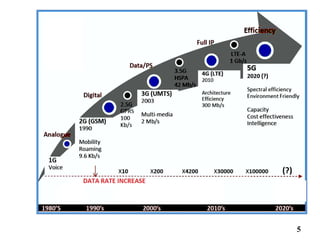
WIRELESS EVOLUTION
The generation Access protocols Key features Level of evolution
1G FDMA Analog, primarily voice, less
secure, support for low bit
rate data
Access to and roaming across
single type of analog wireless
networks
2G&2.5G TDMA,CDMA Digital, more secure, voice
and data
Access to and roaming across
single type of digital wireless
networks and access to 1G
3G&3.5G CDMA 2000,W-
CDMA,HSDPA,TD-SCDMA
Digital, multimedia, global
roaming across a single type
of wireless network(for
example, cellular), limited IP
interoperability,
2Mbps to several Mbps
Access to and roaming across
digital multimedia wireless
networks and access to 2G
and 1G
4G OFDM Global roaming across
multiple wireless networks,
10Mbps-100Mbps, IP
interoperability for seamless
mobile internet
Access to and roaming across
diverse and heterogeneous
mobile and wireless
Broadband networks and
access to 3G,2G and 1G
4
5
5G
WIRELESS COMMUNICATION
• Greater frequency allocation at millimeter wave.
• Highly directional beam forming antennas.
• All IP networks
• Finest Quality Of Service(QOS)
6
ADVANTAGES OF USING 5G
• Longer battery life.
• Lower infrastructure cost.
• Higher data rates .
• More efficient.
• High reliability.
• High security.
7
• The back bone networks for 5G will move to millimeter wave
wireless communication.
TO
8
MILLIMETER(MM) WAVE
TECHNOLOGY
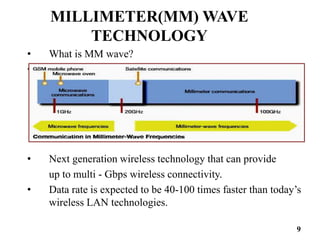
• What is MM wave?
•
• Next generation wireless technology that can provide
up to multi - Gbps wireless connectivity.
• Data rate is expected to be 40-100 times faster than today’s
wireless LAN technologies.
9
• Frequency range is from 25GHz to 300GHz.
• Wavelength is between 10mm to 1mm.
• Advantages of using this
•The radio spectrum is still rather undeveloped .
•Hence higher data rates is achieved.
•Security and privacy is better at mm-wave.
10
BANDWIDTH
• The spectral bandwidth of 5ghz being available in these
ranges.
• Current speeds of 1.25gbps full duplex.
• Potential throughput speeds of up to 10gbps.
• Expand channel band width way beyond 40mhz.
11
BEAM WIDTH INTERFERENCE
RESISTANCE AND SECURITY
• Narrow beam width (approx. 2 degree beam width).
• Reduces the interference.
• Spectrum reuse can be done.
• Cross-polarization techniques.
• Waves are highly directional.
• This offers high security.
12
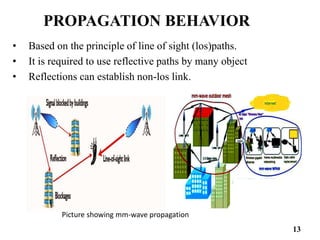
PROPAGATION BEHAVIOR
• Based on the principle of line of sight (los)paths.
• It is required to use reflective paths by many object
• Reflections can establish non-los link.
Picture showing mm-wave propagation
13
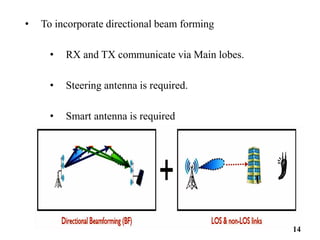
• To incorporate directional beam forming
• RX and TX communicate via Main lobes.
• Steering antenna is required.
• Smart antenna is required
14
ANTENNA USED
• Narrow beam are the new feature of mm-wave.
• They reduces fading, multi-path, and interference.
• Antenna geometry is at chip size.
15
• The physical size of antennas are so small .
• Complex antenna arrays.
• Further integrate them on chip or pcb.
• It is possible to generate circuit which operate at mm wave
frequencies.
• Several array smart antenna which is adaptable in nature .
16
ADVANTAGES
• Larger bandwidth and Higher transmission rate.
• Capability of spread spectrum and is more immune to
interference.
• Extremely high frequencies allow multiple short-distance .
• Requires the narrow beam width.
• Higher the frequency - smaller the antenna and Reduces
hardware size.
17
DISADVANTAGES
• Higher costs in manufacturing .
• Extremely high frequencies- significant attenuation.
• Millimeter waves - long distance applications.
• The penetration power of mm wave -concrete walls is
known less.
• Interferences with oxygen & rain also.
18
CONCLUSION
• Millimeter wave - 5G cellular communication.
• Bandwidth and higher data rates .
• Further research is going on to remove the limitations.
• Reliability and efficiency in using these spectrum.
19
REFERENCES
• T. S. Rappaport, Shu Sun, Rimma Mayzus et al ``Millimeter wave mobile
communications for 5G cellular: it will work!,'' Proc. IEEE, vol. 1, 2013, no. 10,
pp. 335_349, may. 2013.
• T. S. Rappaport, J. N. Murdock, and F. Gutierrez, ``State of the art in 60 GHz
integrated circuits & systems for wireless communications,'' Proc.int IEEE, vol.
99, no. 8, pp. 1390_1436, Aug. 2011.
• M. Cudak, A. Ghosh, T. Kovarik, R. Ratasuk, T. Thomas, F. Vook, and P. Moorut,
``Moving towards mmwave-based beyond-4G (B-4G) Technology,'' in Proc. IEEE
Veh. Technol. Soc. Conf., 2013, pp. 1_17.
• Y. Chen, S. De, R. Kernchen, and K. Moessner, ``Device discovery in future
service platforms through SIP,'' in Proc. IEEE Veh. Technol. Conf., Sep. 2012, pp.
1_5.
URL’s:
• http://www.cablinginstall.com/articles/2013/12/millimeter-wave-article.html
• http://nsn.com/news-events/insight-newsletter/articles/5g-ultra-wideband-
enhanced- local-area-systems-at-millimeter-wave
• http://global.samsungtomorrow.com/?p=24093
• http://www.mobileinfo.com/3G/4G_Sun_MobileIP.htm
• http://www.athenawave.com/products/about-millimeter-wave
• http://www.profheath.org/hot-topics/millimeter-wave-cellular-systems
• http://www.ieeeexpoler.Org
20
MILLIMETER WAVE FOR 5G CELLULAR

MILLIMETER WAVE FOR 5G CELLULAR

  • 1.
    MILLIMETER WAVE FOR5G CELLULAR GUIDED BY MS. SANIYA SALIM ASST,.PROFESSOR ECE DEPT, KMPCE SUBMITTED BY SUDEESH V S ECE, S7 ROLL NO:31
  • 2.
    INTRODUCTION • Global bandwidthshortage. • Wireless service providers (W.S.P) are facing many challenges. • Carrier frequency spectrum is between 700mhz to 2.6ghz. • WSP requires simultaneous management of multiple technologies. • The base station should be backward compatible. 2
  • 3.
    • M BN need to support higher data rate requirement. • Efficient radio access technology combined with more spectrum availability is required. 3
  • 4.
    WIRELESS EVOLUTION The generationAccess protocols Key features Level of evolution 1G FDMA Analog, primarily voice, less secure, support for low bit rate data Access to and roaming across single type of analog wireless networks 2G&2.5G TDMA,CDMA Digital, more secure, voice and data Access to and roaming across single type of digital wireless networks and access to 1G 3G&3.5G CDMA 2000,W- CDMA,HSDPA,TD-SCDMA Digital, multimedia, global roaming across a single type of wireless network(for example, cellular), limited IP interoperability, 2Mbps to several Mbps Access to and roaming across digital multimedia wireless networks and access to 2G and 1G 4G OFDM Global roaming across multiple wireless networks, 10Mbps-100Mbps, IP interoperability for seamless mobile internet Access to and roaming across diverse and heterogeneous mobile and wireless Broadband networks and access to 3G,2G and 1G 4
  • 5.
  • 6.
    5G WIRELESS COMMUNICATION • Greaterfrequency allocation at millimeter wave. • Highly directional beam forming antennas. • All IP networks • Finest Quality Of Service(QOS) 6
  • 7.
    ADVANTAGES OF USING5G • Longer battery life. • Lower infrastructure cost. • Higher data rates . • More efficient. • High reliability. • High security. 7
  • 8.
    • The backbone networks for 5G will move to millimeter wave wireless communication. TO 8
  • 9.
    MILLIMETER(MM) WAVE TECHNOLOGY • Whatis MM wave? • • Next generation wireless technology that can provide up to multi - Gbps wireless connectivity. • Data rate is expected to be 40-100 times faster than today’s wireless LAN technologies. 9
  • 10.
    • Frequency rangeis from 25GHz to 300GHz. • Wavelength is between 10mm to 1mm. • Advantages of using this •The radio spectrum is still rather undeveloped . •Hence higher data rates is achieved. •Security and privacy is better at mm-wave. 10
  • 11.
    BANDWIDTH • The spectralbandwidth of 5ghz being available in these ranges. • Current speeds of 1.25gbps full duplex. • Potential throughput speeds of up to 10gbps. • Expand channel band width way beyond 40mhz. 11
  • 12.
    BEAM WIDTH INTERFERENCE RESISTANCEAND SECURITY • Narrow beam width (approx. 2 degree beam width). • Reduces the interference. • Spectrum reuse can be done. • Cross-polarization techniques. • Waves are highly directional. • This offers high security. 12
  • 13.
    PROPAGATION BEHAVIOR • Basedon the principle of line of sight (los)paths. • It is required to use reflective paths by many object • Reflections can establish non-los link. Picture showing mm-wave propagation 13
  • 14.
    • To incorporatedirectional beam forming • RX and TX communicate via Main lobes. • Steering antenna is required. • Smart antenna is required 14
  • 15.
    ANTENNA USED • Narrowbeam are the new feature of mm-wave. • They reduces fading, multi-path, and interference. • Antenna geometry is at chip size. 15
  • 16.
    • The physicalsize of antennas are so small . • Complex antenna arrays. • Further integrate them on chip or pcb. • It is possible to generate circuit which operate at mm wave frequencies. • Several array smart antenna which is adaptable in nature . 16
  • 17.
    ADVANTAGES • Larger bandwidthand Higher transmission rate. • Capability of spread spectrum and is more immune to interference. • Extremely high frequencies allow multiple short-distance . • Requires the narrow beam width. • Higher the frequency - smaller the antenna and Reduces hardware size. 17
  • 18.
    DISADVANTAGES • Higher costsin manufacturing . • Extremely high frequencies- significant attenuation. • Millimeter waves - long distance applications. • The penetration power of mm wave -concrete walls is known less. • Interferences with oxygen & rain also. 18
  • 19.
    CONCLUSION • Millimeter wave- 5G cellular communication. • Bandwidth and higher data rates . • Further research is going on to remove the limitations. • Reliability and efficiency in using these spectrum. 19
  • 20.
    REFERENCES • T. S.Rappaport, Shu Sun, Rimma Mayzus et al ``Millimeter wave mobile communications for 5G cellular: it will work!,'' Proc. IEEE, vol. 1, 2013, no. 10, pp. 335_349, may. 2013. • T. S. Rappaport, J. N. Murdock, and F. Gutierrez, ``State of the art in 60 GHz integrated circuits & systems for wireless communications,'' Proc.int IEEE, vol. 99, no. 8, pp. 1390_1436, Aug. 2011. • M. Cudak, A. Ghosh, T. Kovarik, R. Ratasuk, T. Thomas, F. Vook, and P. Moorut, ``Moving towards mmwave-based beyond-4G (B-4G) Technology,'' in Proc. IEEE Veh. Technol. Soc. Conf., 2013, pp. 1_17. • Y. Chen, S. De, R. Kernchen, and K. Moessner, ``Device discovery in future service platforms through SIP,'' in Proc. IEEE Veh. Technol. Conf., Sep. 2012, pp. 1_5. URL’s: • http://www.cablinginstall.com/articles/2013/12/millimeter-wave-article.html • http://nsn.com/news-events/insight-newsletter/articles/5g-ultra-wideband- enhanced- local-area-systems-at-millimeter-wave • http://global.samsungtomorrow.com/?p=24093 • http://www.mobileinfo.com/3G/4G_Sun_MobileIP.htm • http://www.athenawave.com/products/about-millimeter-wave • http://www.profheath.org/hot-topics/millimeter-wave-cellular-systems • http://www.ieeeexpoler.Org 20