Transportation of MIMO Radio Signals over
RoF-Distributed Antenna System and its
Performance Analysis in the Presence of
Incomplete Synchronization in Optical TDM
Nara Institute of Science and Technology , Japan
Network System Lab
Tatsuya Kidani, Takeshi Higashino, Minoru Okada

1
Outline
• Background
• Concept of RoF-DAS using optical TDM
• Configuration of RoF-DAS using optical
TDM
• Channel Model with synchronization
mismatch
• Simulation
• Summary & Future Work

2
Background


Requirements of Next Generation Network

Source2

Source1

High speed and
large capacity
wireless access

Adaptive
control of base
station

Accommodations
of various
communication
standards
(Heterogeneous)

Source1:Cisco VNI Mobile, 2011
Source2:ZTE ZTE technology N0.1, 2011



RoF-DAS using optical TDM (Time Division
Multiplexing)

[Radio on Fiber (RoF),Distributed Antenna System (DAS)]

3
RoF-DAS
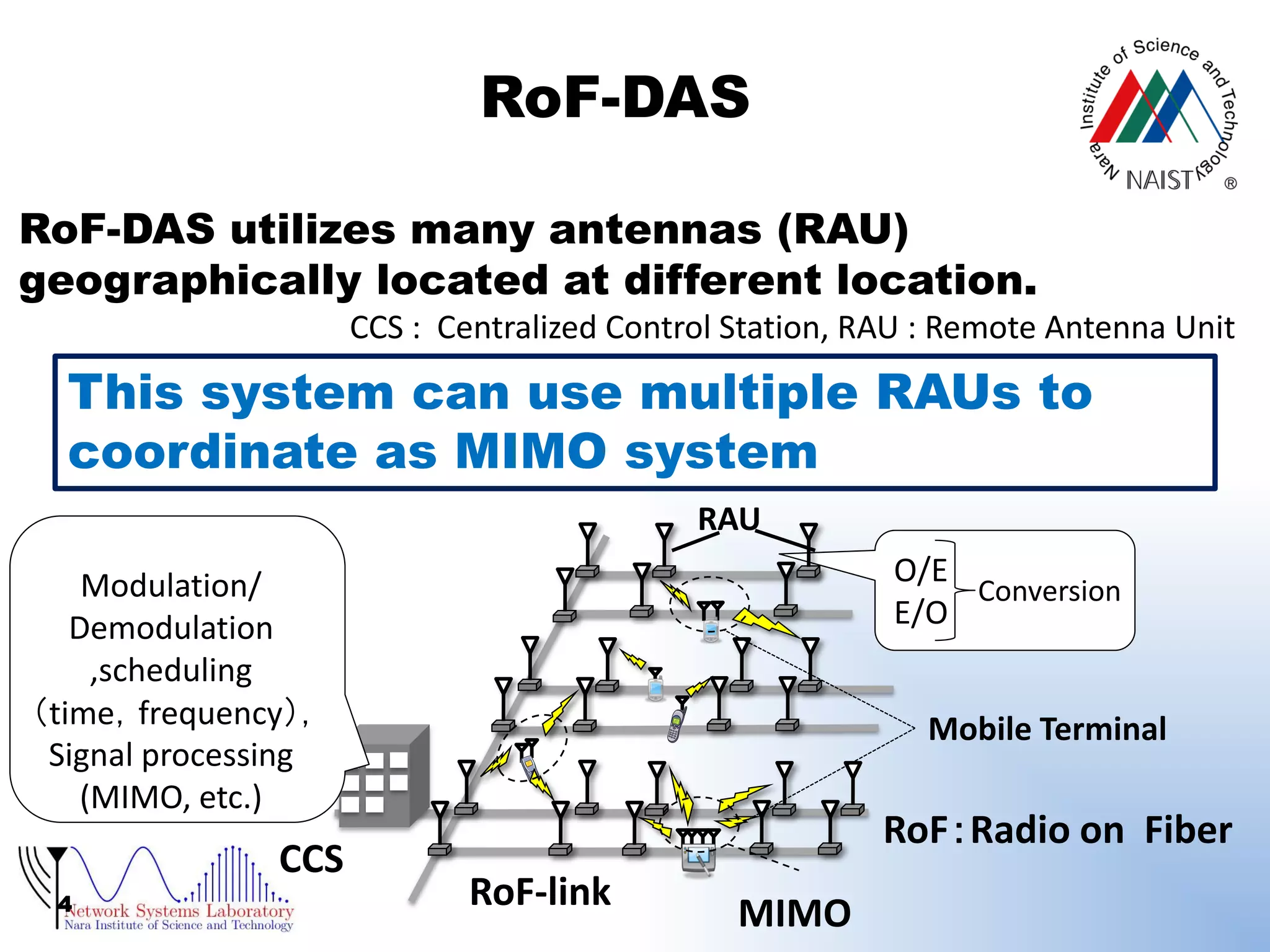
RoF-DAS utilizes many antennas (RAU)
geographically located at different location.
CCS : Centralized Control Station, RAU : Remote Antenna Unit

This system can use multiple RAUs to
coordinate as MIMO system
RAU
O/E
Conversion
E/O

Modulation/
Demodulation
,scheduling
(time,frequency),
Signal processing
(MIMO, etc.)

CCS
4

Mobile Terminal

RoF:Radio on Fiber
RoF-link

MIMO
Concept of RoF-DAS using
optical TDM
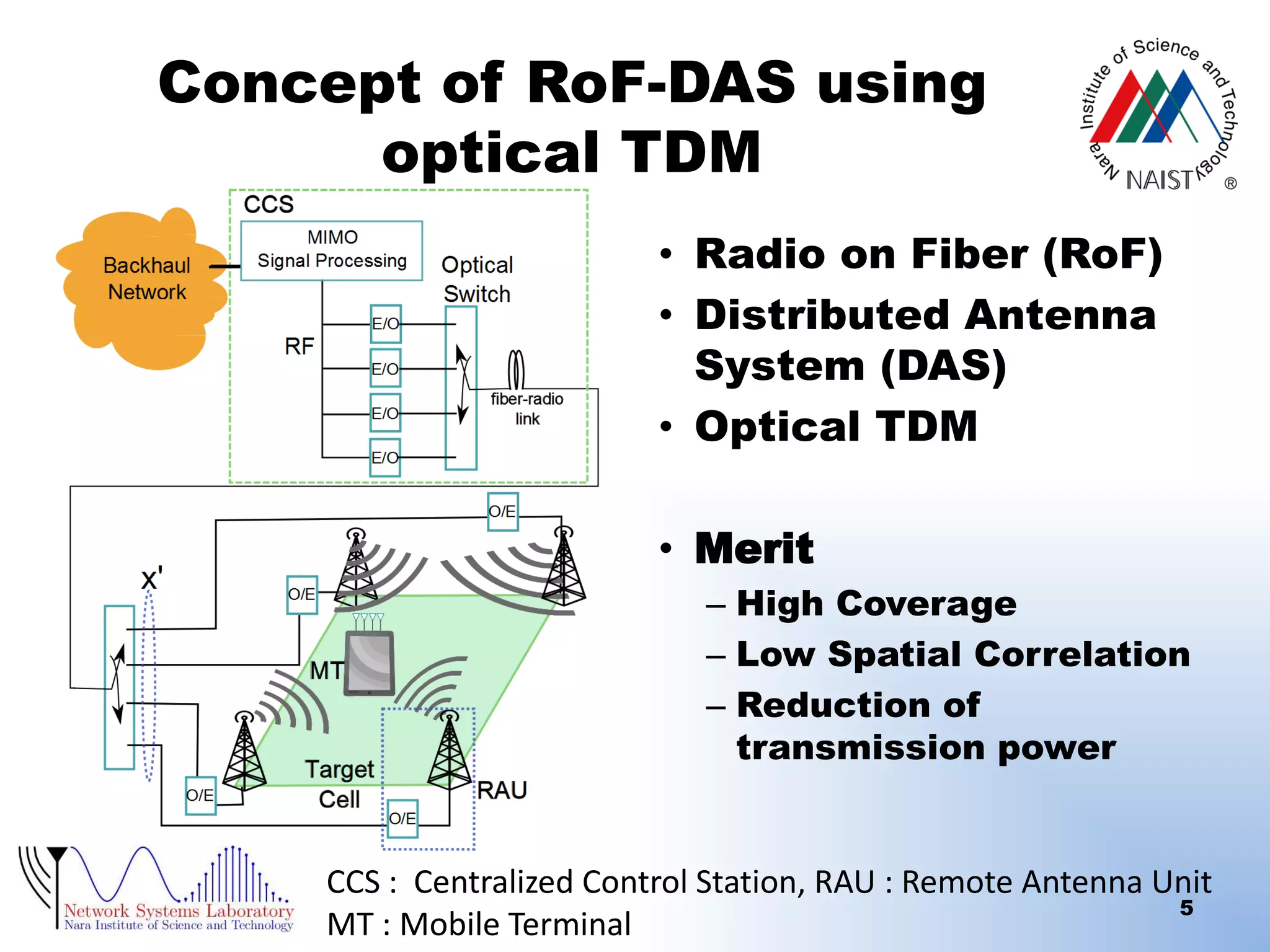
• Radio on Fiber (RoF)
• Distributed Antenna
System (DAS)
• Optical TDM
• Merit
– High Coverage
– Low Spatial Correlation
– Reduction of
transmission power

CCS : Centralized Control Station, RAU : Remote Antenna Unit
5
MT : Mobile Terminal
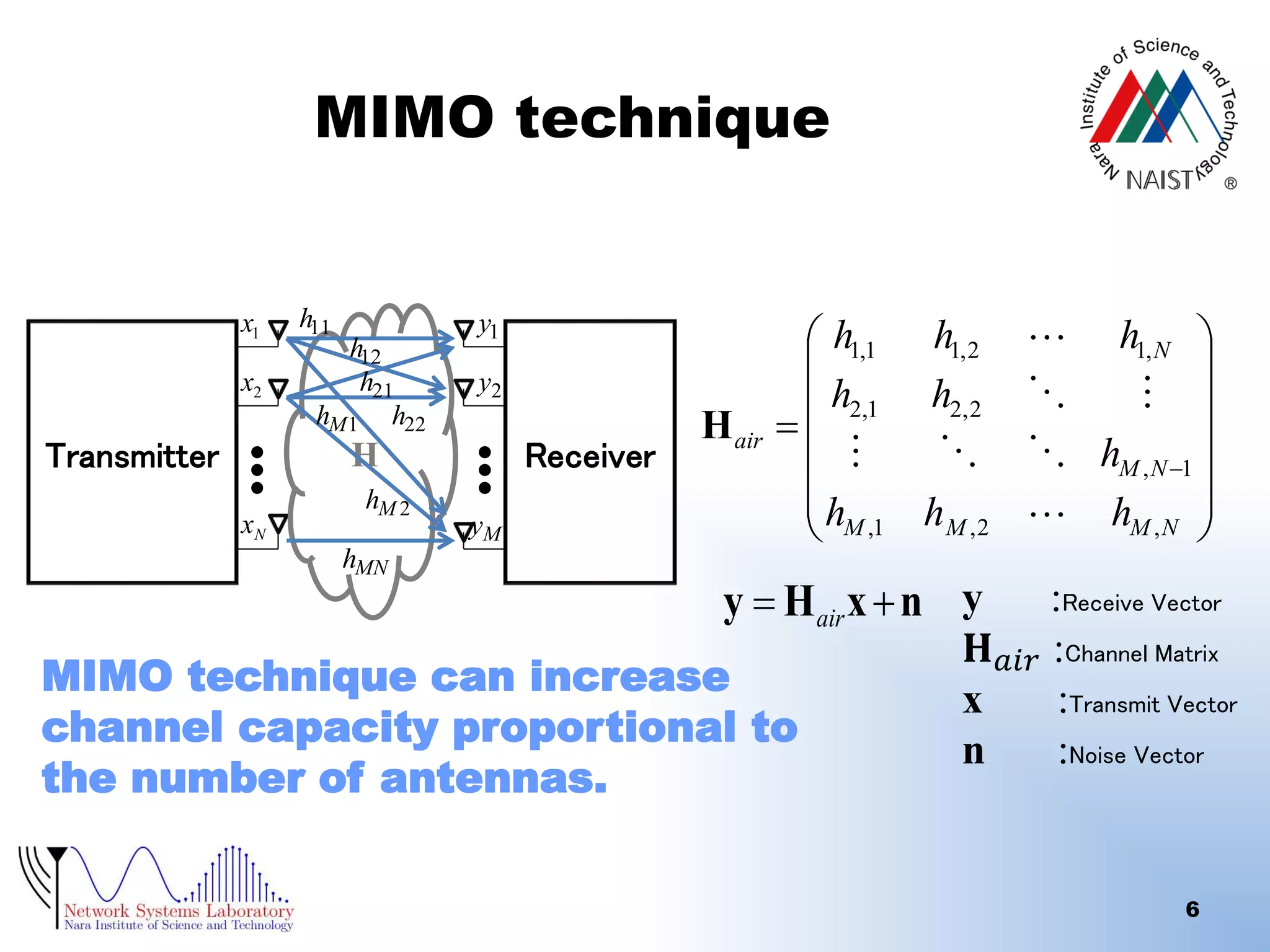
MIMO technique

x1

x2

Transmitter

h11

h12
h21
hM 1 h22

y1
y2

Receiver

H
xN

hM 2

hMN

yM

H air

 h1,1 h1, 2

 h2,1 h2, 2




h
 M ,1 h M , 2

 h1, N 


 
 hM , N 1 

 hM , N 


y  H air x  n y

MIMO technique can increase
channel capacity proportional to
the number of antennas.

:Receive Vector
𝐇 𝑎𝑖𝑟 :Channel Matrix
x
:Transmit Vector
n
:Noise Vector

6
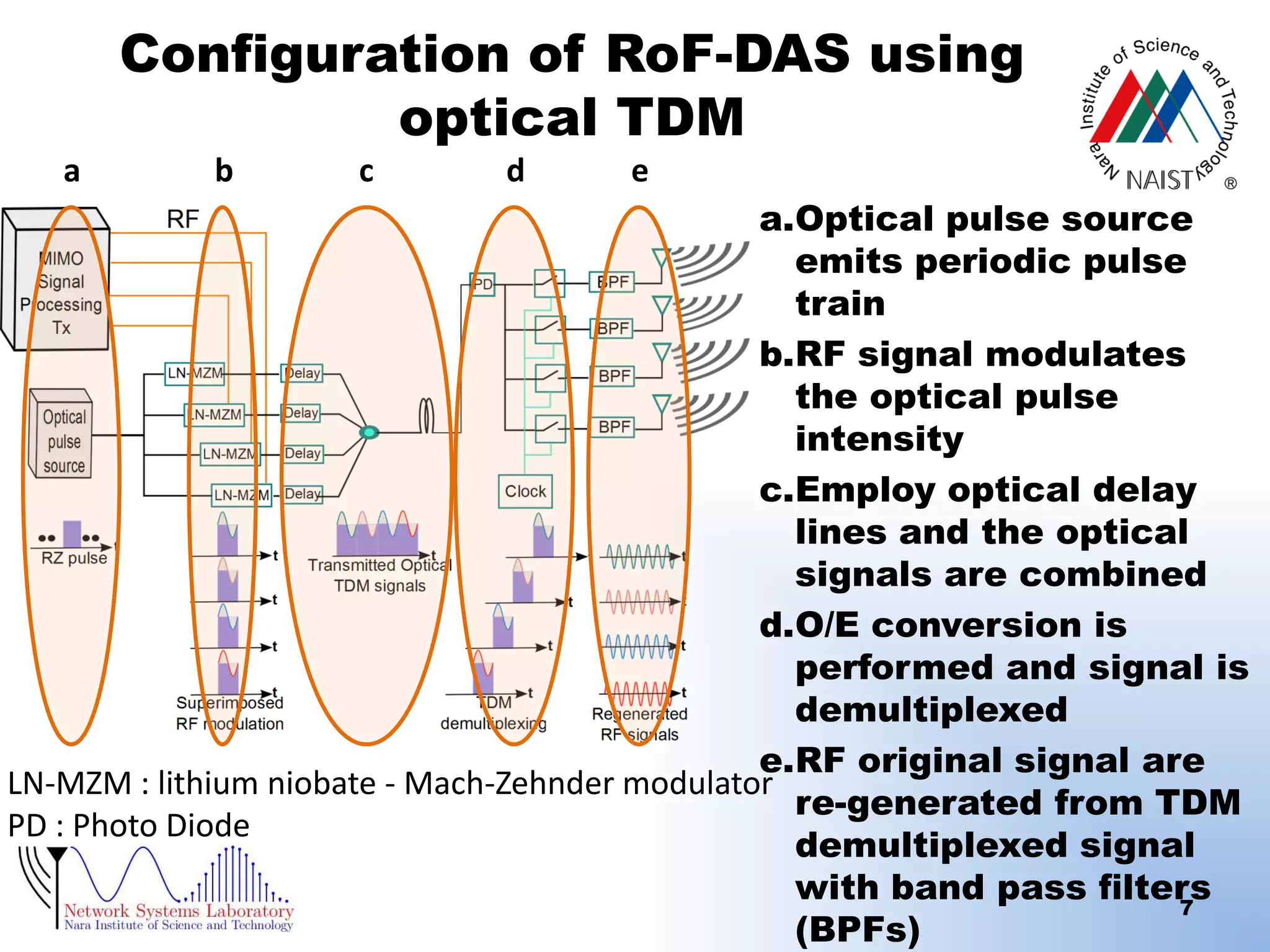
Configuration of RoF-DAS using
optical TDM
a

b

c

d

e

a.Optical pulse source
emits periodic pulse
train
b.RF signal modulates
the optical pulse
intensity
c.Employ optical delay
lines and the optical
signals are combined
d.O/E conversion is
performed and signal is
demultiplexed
e.RF original signal are
LN-MZM : lithium niobate - Mach-Zehnder modulator
re-generated from TDM
PD : Photo Diode
demultiplexed signal
with band pass filters
7
(BPFs)
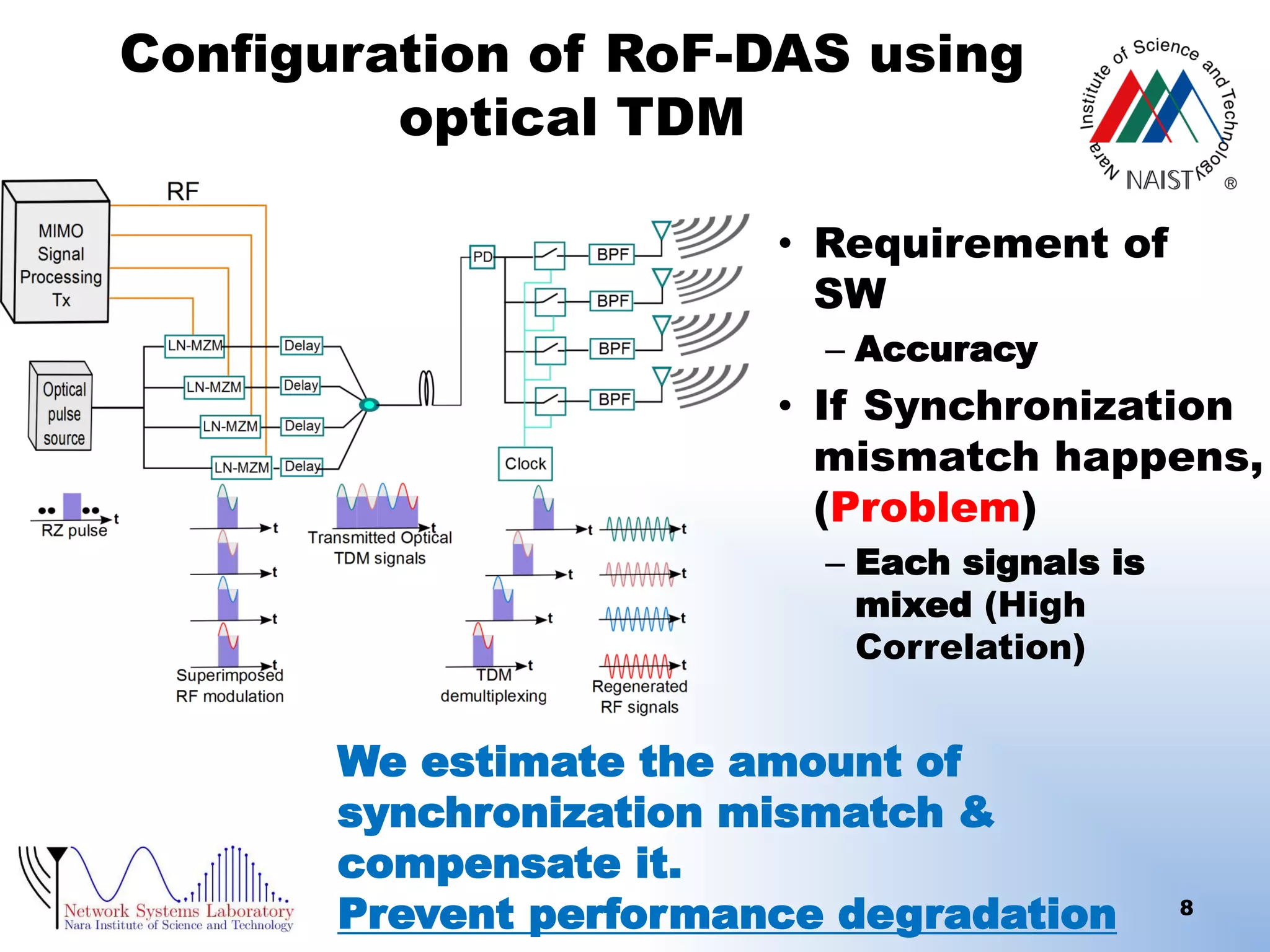
Configuration of RoF-DAS using
optical TDM
• Requirement of
SW
– Accuracy

• If Synchronization
mismatch happens,
(Problem)
– Each signals is
mixed (High
Correlation)

We estimate the amount of
synchronization mismatch &
compensate it.
Prevent performance degradation

8
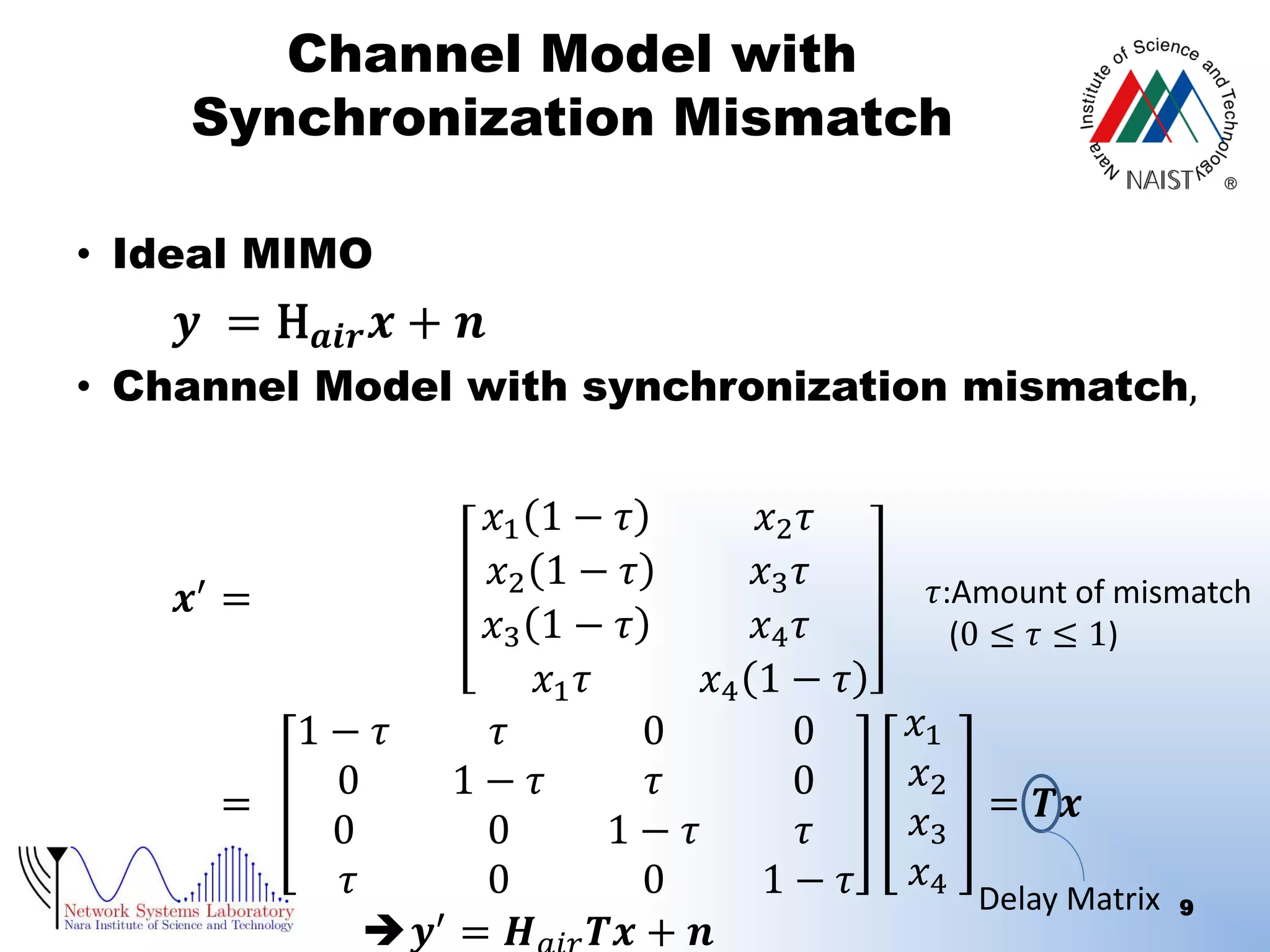
Channel Model with
Synchronization Mismatch
• Ideal MIMO

𝒚 = H 𝒂𝒊𝒓 𝒙 + 𝒏

• Channel Model with synchronization mismatch,

𝒙′ =

=

𝑥1 1 − 𝜏
𝑥2 𝜏
𝑥2 1 − 𝜏
𝑥3 𝜏
𝑥3 1 − 𝜏
𝑥4 𝜏
𝑥1 𝜏
𝑥4 1 − 𝜏
1− 𝜏
𝜏
0
0
0
1− 𝜏
𝜏
0
0
0
1− 𝜏
𝜏
𝜏
0
0
1− 𝜏
𝒚′ = 𝑯 𝑻𝒙 + 𝒏

𝜏:Amount of mismatch
(0 ≤ 𝜏 ≤ 1)

𝑥1
𝑥2
𝑥3 = 𝑻𝒙
𝑥4

Delay Matrix

9
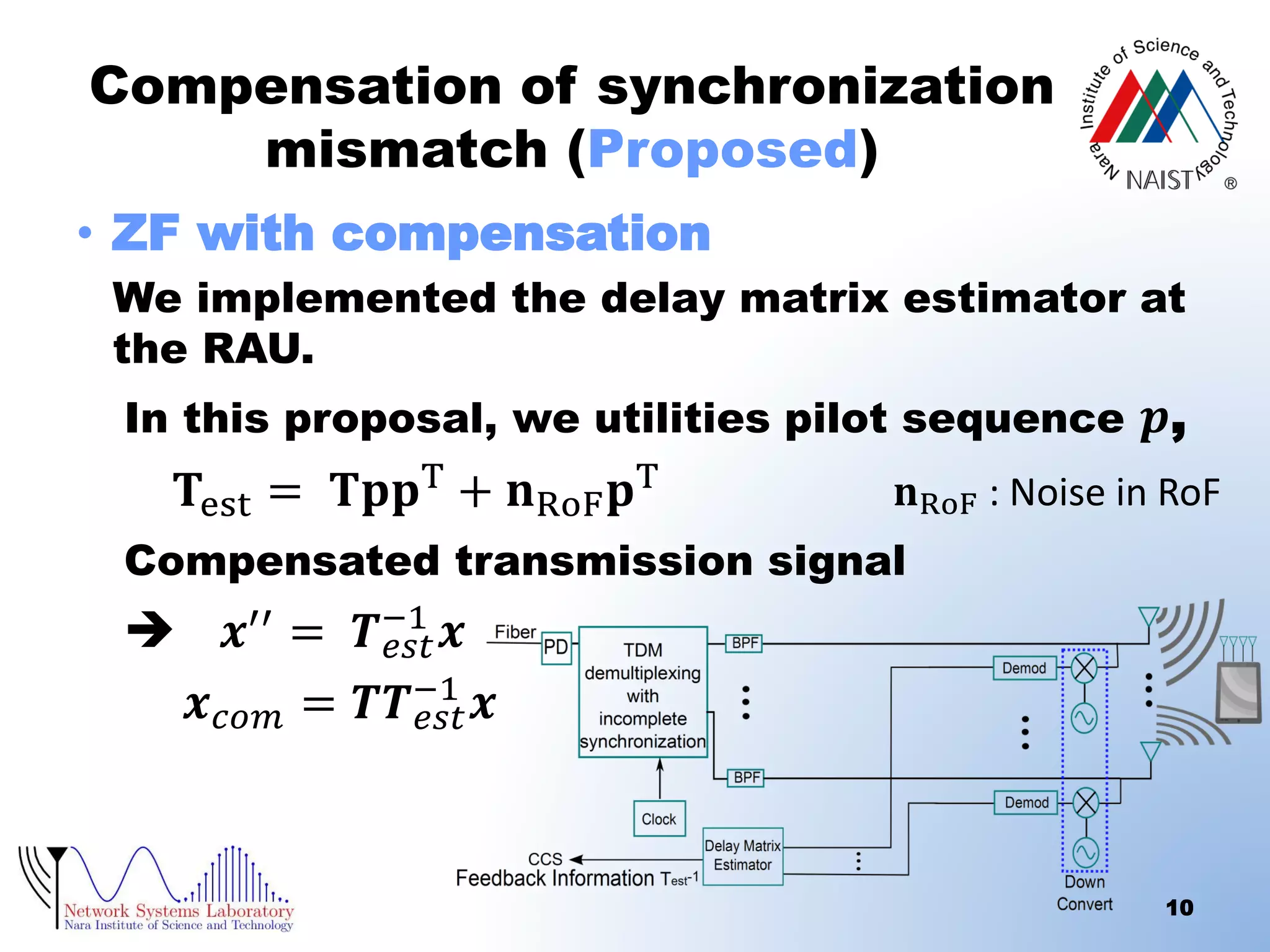
Compensation of synchronization
mismatch (Proposed)
• ZF with compensation
We implemented the delay matrix estimator at
the RAU.
In this proposal, we utilities pilot sequence 𝒑,

𝐓est = 𝐓𝐩𝐩T + 𝐧RoF 𝐩T

𝐧RoF : Noise in RoF

Compensated transmission signal



𝒙′′ = 𝑻−1 𝒙
𝑒𝑠𝑡
𝒙 𝑐𝑜𝑚 = 𝑻𝑻−1 𝒙
𝑒𝑠𝑡

10
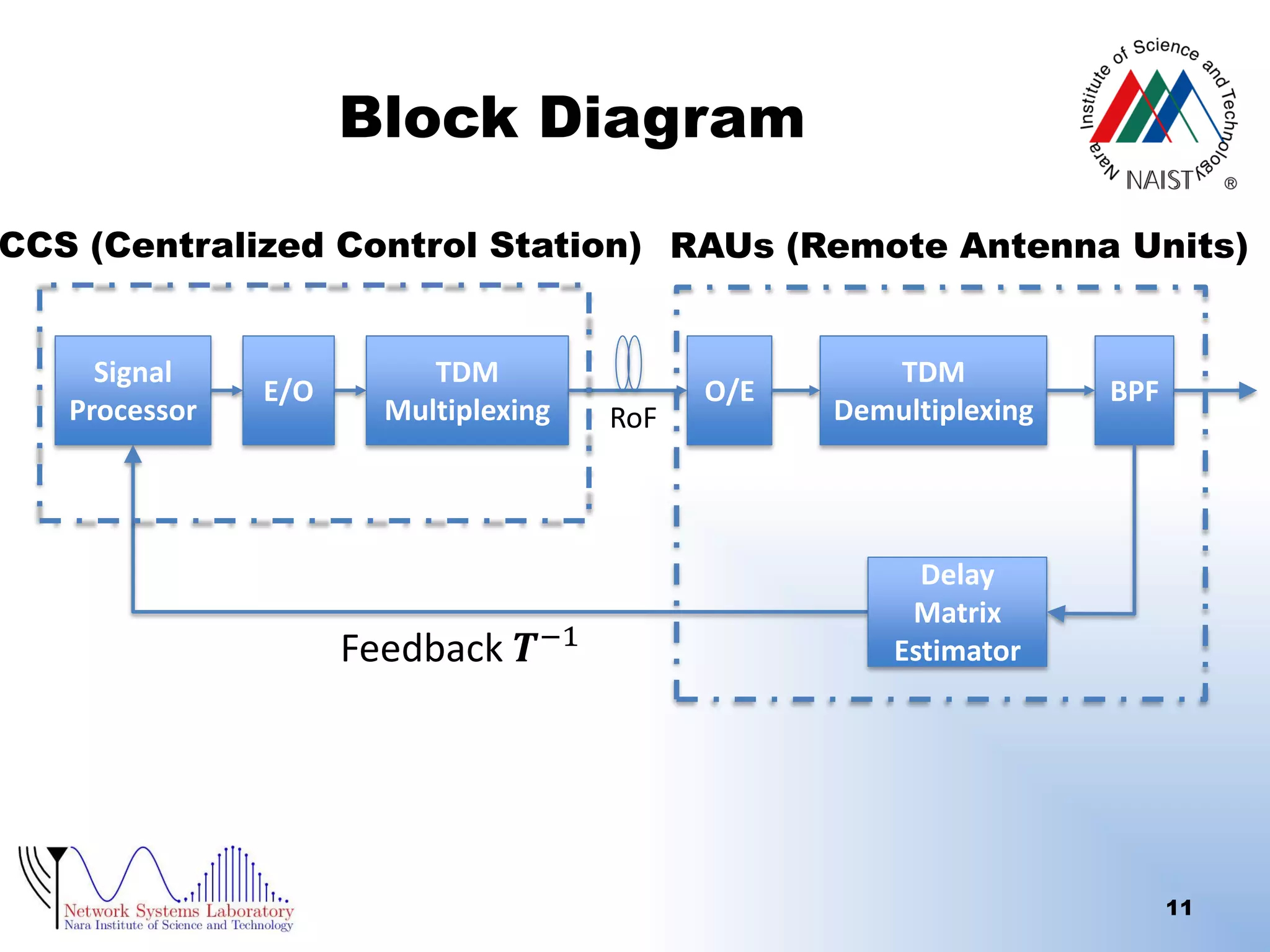
Block Diagram

CCS (Centralized Control Station) RAUs (Remote Antenna Units)

Signal
Processor

E/O

TDM
Multiplexing

Feedback 𝑻−1

RoF

O/E

TDM
Demultiplexing

BPF

Delay
Matrix
Estimator

11
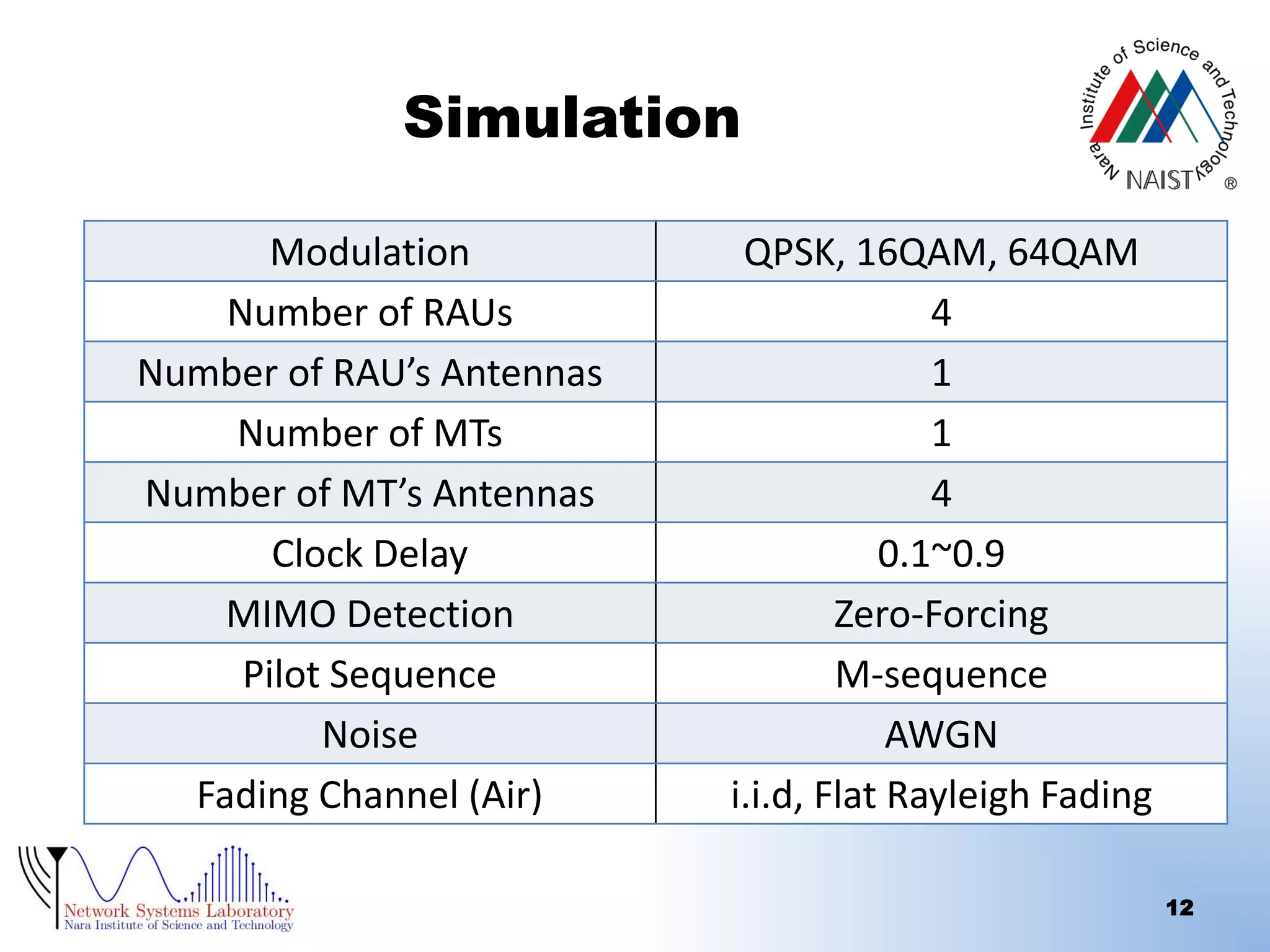
Simulation
Modulation
Number of RAUs
Number of RAU’s Antennas
Number of MTs
Number of MT’s Antennas
Clock Delay
MIMO Detection
Pilot Sequence
Noise
Fading Channel (Air)

QPSK, 16QAM, 64QAM
4
1
1
4
0.1~0.9
Zero-Forcing
M-sequence
AWGN
i.i.d, Flat Rayleigh Fading
12
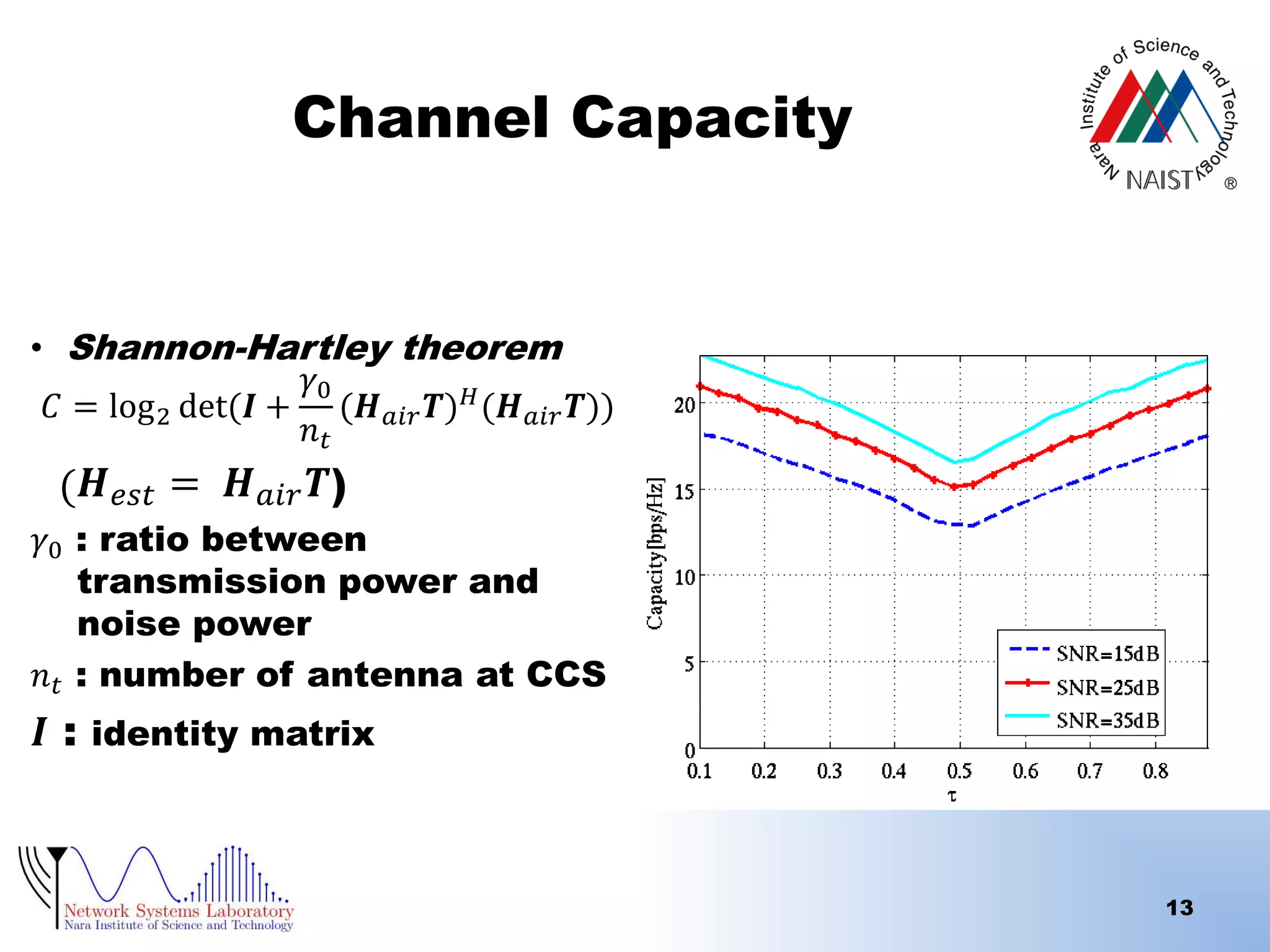
Channel Capacity

• Shannon-Hartley theorem
𝛾0
𝐶 = log 2 det(𝑰 + (𝑯 𝑎𝑖𝑟 𝑻) 𝐻 (𝑯 𝑎𝑖𝑟 𝑻))
𝑛𝑡

( 𝑯 𝑒𝑠𝑡 = 𝑯 𝑎𝑖𝑟 𝑻)

𝛾0 : ratio between
transmission power and
noise power
𝑛 𝑡 : number of antenna at CCS

𝑰 : identity matrix

13
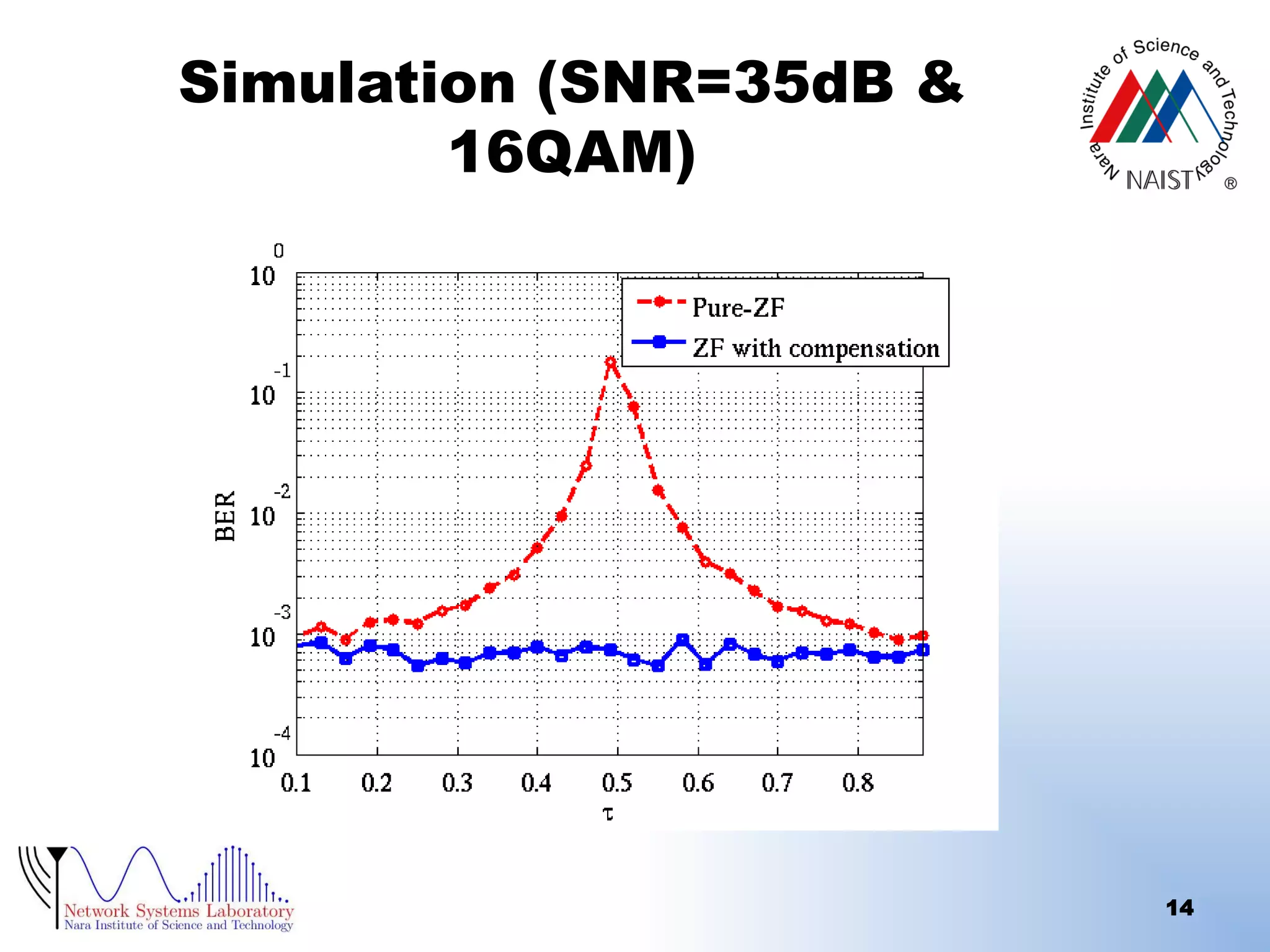
Simulation (SNR=35dB &
16QAM)

14
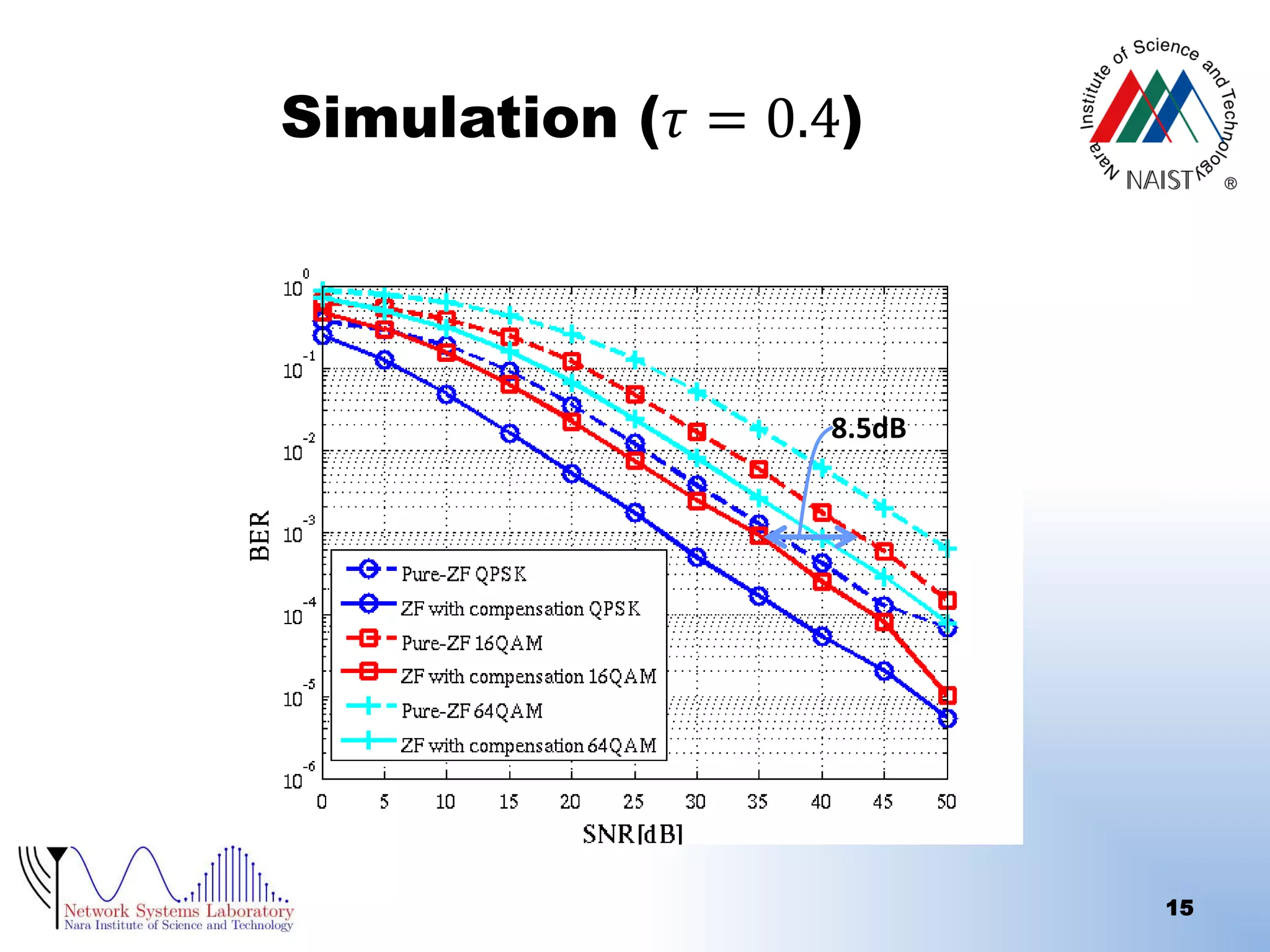
Simulation (𝜏 = 0.4)

8.5dB

15
Summary & Future Work
• Summary
– To avoid critical degradation due to the
incomplete synchronization, a new
compensation scheme is proposed.
– This scheme can estimate amount of
synchronization mismatch and also gives an
improvement in BER performance.

• Future Work
– Application of Optical OFDM (Orthogonal
Frequency Division Modulation).
– The compensation of nonlinear distortion due
to RoF characteristic.
16

Transportation of MIMO Radio Signals over RoF-Distributed Antenna System and its Performance Analysis in the Presence of Incomplete Synchronization in Optical TDM

  • 1.
    Transportation of MIMORadio Signals over RoF-Distributed Antenna System and its Performance Analysis in the Presence of Incomplete Synchronization in Optical TDM Nara Institute of Science and Technology , Japan Network System Lab Tatsuya Kidani, Takeshi Higashino, Minoru Okada 1
  • 2.
    Outline • Background • Conceptof RoF-DAS using optical TDM • Configuration of RoF-DAS using optical TDM • Channel Model with synchronization mismatch • Simulation • Summary & Future Work 2
  • 3.
    Background  Requirements of NextGeneration Network Source2 Source1 High speed and large capacity wireless access Adaptive control of base station Accommodations of various communication standards (Heterogeneous) Source1:Cisco VNI Mobile, 2011 Source2:ZTE ZTE technology N0.1, 2011  RoF-DAS using optical TDM (Time Division Multiplexing) [Radio on Fiber (RoF),Distributed Antenna System (DAS)] 3
  • 4.
    RoF-DAS RoF-DAS utilizes manyantennas (RAU) geographically located at different location. CCS : Centralized Control Station, RAU : Remote Antenna Unit This system can use multiple RAUs to coordinate as MIMO system RAU O/E Conversion E/O Modulation/ Demodulation ,scheduling (time,frequency), Signal processing (MIMO, etc.) CCS 4 Mobile Terminal RoF:Radio on Fiber RoF-link MIMO
  • 5.
    Concept of RoF-DASusing optical TDM • Radio on Fiber (RoF) • Distributed Antenna System (DAS) • Optical TDM • Merit – High Coverage – Low Spatial Correlation – Reduction of transmission power CCS : Centralized Control Station, RAU : Remote Antenna Unit 5 MT : Mobile Terminal
  • 6.
    MIMO technique x1 x2 Transmitter h11 h12 h21 hM 1h22 y1 y2 Receiver H xN hM 2 hMN yM H air  h1,1 h1, 2   h2,1 h2, 2     h  M ,1 h M , 2  h1, N       hM , N 1    hM , N   y  H air x  n y MIMO technique can increase channel capacity proportional to the number of antennas. :Receive Vector 𝐇 𝑎𝑖𝑟 :Channel Matrix x :Transmit Vector n :Noise Vector 6
  • 7.
    Configuration of RoF-DASusing optical TDM a b c d e a.Optical pulse source emits periodic pulse train b.RF signal modulates the optical pulse intensity c.Employ optical delay lines and the optical signals are combined d.O/E conversion is performed and signal is demultiplexed e.RF original signal are LN-MZM : lithium niobate - Mach-Zehnder modulator re-generated from TDM PD : Photo Diode demultiplexed signal with band pass filters 7 (BPFs)
  • 8.
    Configuration of RoF-DASusing optical TDM • Requirement of SW – Accuracy • If Synchronization mismatch happens, (Problem) – Each signals is mixed (High Correlation) We estimate the amount of synchronization mismatch & compensate it. Prevent performance degradation 8
  • 9.
    Channel Model with SynchronizationMismatch • Ideal MIMO 𝒚 = H 𝒂𝒊𝒓 𝒙 + 𝒏 • Channel Model with synchronization mismatch, 𝒙′ = = 𝑥1 1 − 𝜏 𝑥2 𝜏 𝑥2 1 − 𝜏 𝑥3 𝜏 𝑥3 1 − 𝜏 𝑥4 𝜏 𝑥1 𝜏 𝑥4 1 − 𝜏 1− 𝜏 𝜏 0 0 0 1− 𝜏 𝜏 0 0 0 1− 𝜏 𝜏 𝜏 0 0 1− 𝜏 𝒚′ = 𝑯 𝑻𝒙 + 𝒏 𝜏:Amount of mismatch (0 ≤ 𝜏 ≤ 1) 𝑥1 𝑥2 𝑥3 = 𝑻𝒙 𝑥4 Delay Matrix 9
  • 10.
    Compensation of synchronization mismatch(Proposed) • ZF with compensation We implemented the delay matrix estimator at the RAU. In this proposal, we utilities pilot sequence 𝒑, 𝐓est = 𝐓𝐩𝐩T + 𝐧RoF 𝐩T 𝐧RoF : Noise in RoF Compensated transmission signal  𝒙′′ = 𝑻−1 𝒙 𝑒𝑠𝑡 𝒙 𝑐𝑜𝑚 = 𝑻𝑻−1 𝒙 𝑒𝑠𝑡 10
  • 11.
    Block Diagram CCS (CentralizedControl Station) RAUs (Remote Antenna Units) Signal Processor E/O TDM Multiplexing Feedback 𝑻−1 RoF O/E TDM Demultiplexing BPF Delay Matrix Estimator 11
  • 12.
    Simulation Modulation Number of RAUs Numberof RAU’s Antennas Number of MTs Number of MT’s Antennas Clock Delay MIMO Detection Pilot Sequence Noise Fading Channel (Air) QPSK, 16QAM, 64QAM 4 1 1 4 0.1~0.9 Zero-Forcing M-sequence AWGN i.i.d, Flat Rayleigh Fading 12
  • 13.
    Channel Capacity • Shannon-Hartleytheorem 𝛾0 𝐶 = log 2 det(𝑰 + (𝑯 𝑎𝑖𝑟 𝑻) 𝐻 (𝑯 𝑎𝑖𝑟 𝑻)) 𝑛𝑡 ( 𝑯 𝑒𝑠𝑡 = 𝑯 𝑎𝑖𝑟 𝑻) 𝛾0 : ratio between transmission power and noise power 𝑛 𝑡 : number of antenna at CCS 𝑰 : identity matrix 13
  • 14.
  • 15.
    Simulation (𝜏 =0.4) 8.5dB 15
  • 16.
    Summary & FutureWork • Summary – To avoid critical degradation due to the incomplete synchronization, a new compensation scheme is proposed. – This scheme can estimate amount of synchronization mismatch and also gives an improvement in BER performance. • Future Work – Application of Optical OFDM (Orthogonal Frequency Division Modulation). – The compensation of nonlinear distortion due to RoF characteristic. 16