Location-based Channel Estimation
for Massive Full-Dimensional MIMO
Systems
Authors: Wendong Liu, Chen Qian and Zhaocheng Wang
Presenter: Qian Han
2
Outline
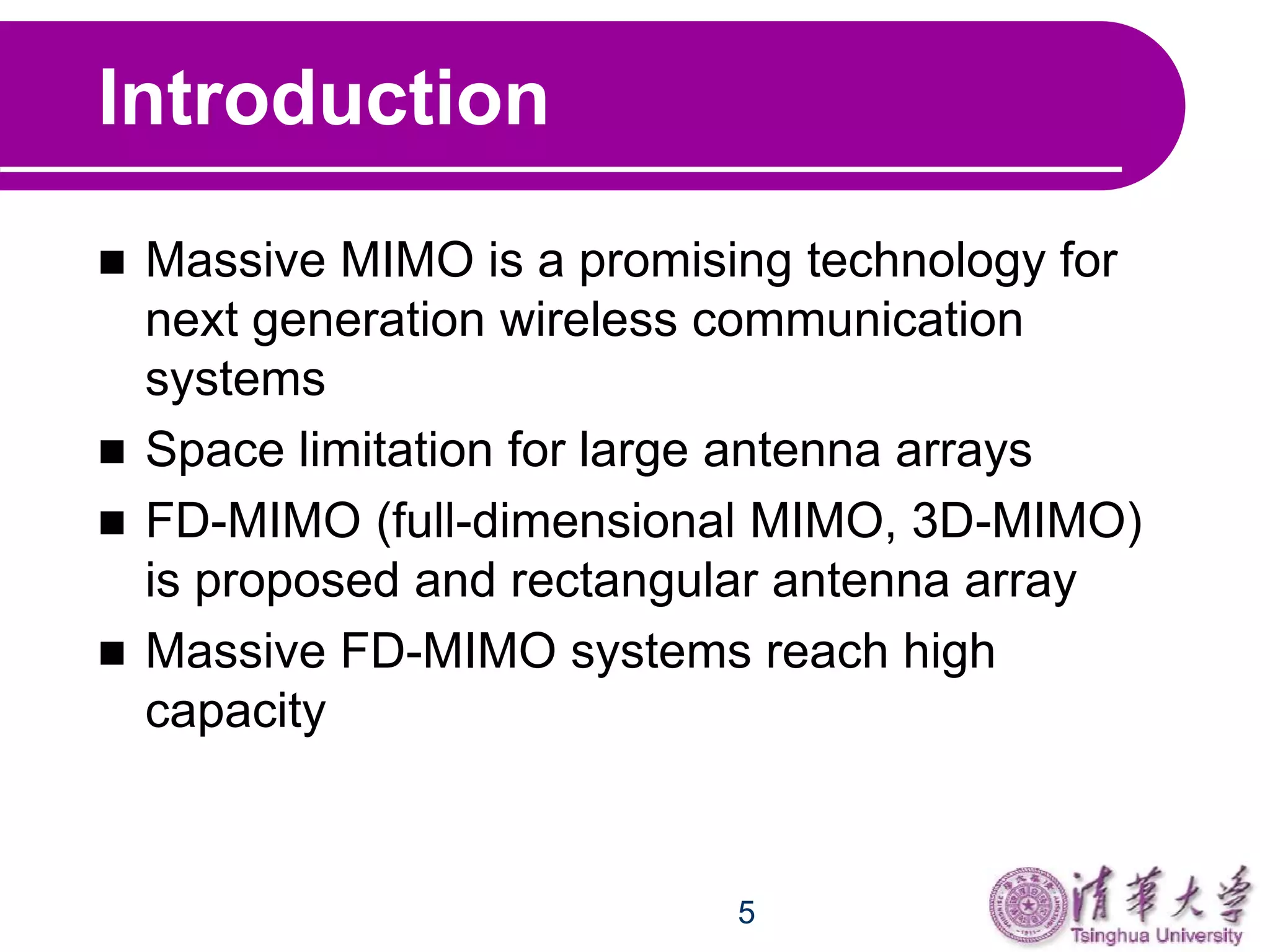
 Abstract
 Introduction
 System model
 Proposal
 Simulation results
 References
3
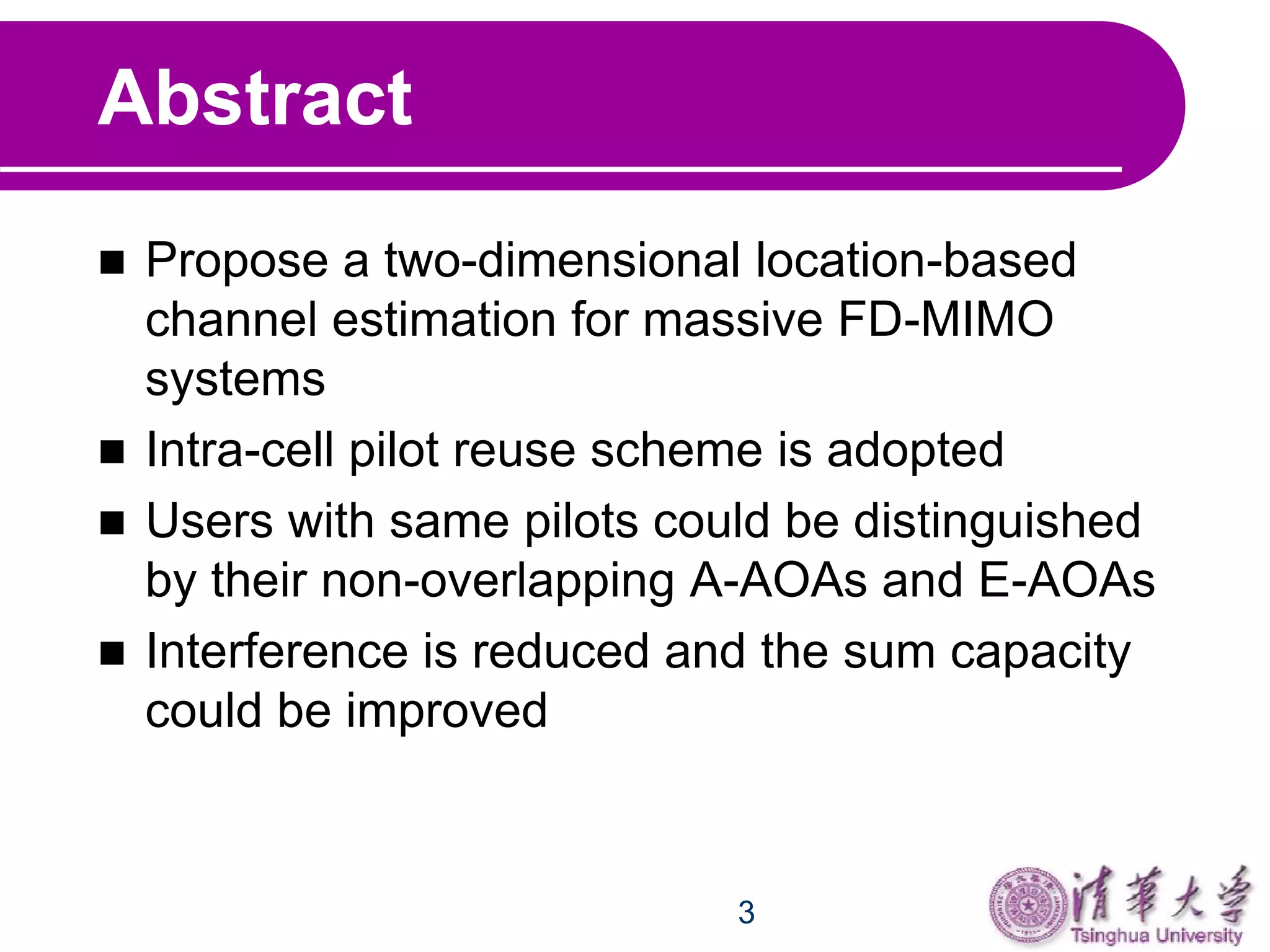
Abstract
 Propose a two-dimensional location-based
channel estimation for massive FD-MIMO
systems
 Intra-cell pilot reuse scheme is adopted
 Users with same pilots could be distinguished
by their non-overlapping A-AOAs and E-AOAs
 Interference is reduced and the sum capacity
could be improved
4
Outline
 Abstract
 Introduction
 System model
 Proposal
 Simulation results
 References
5
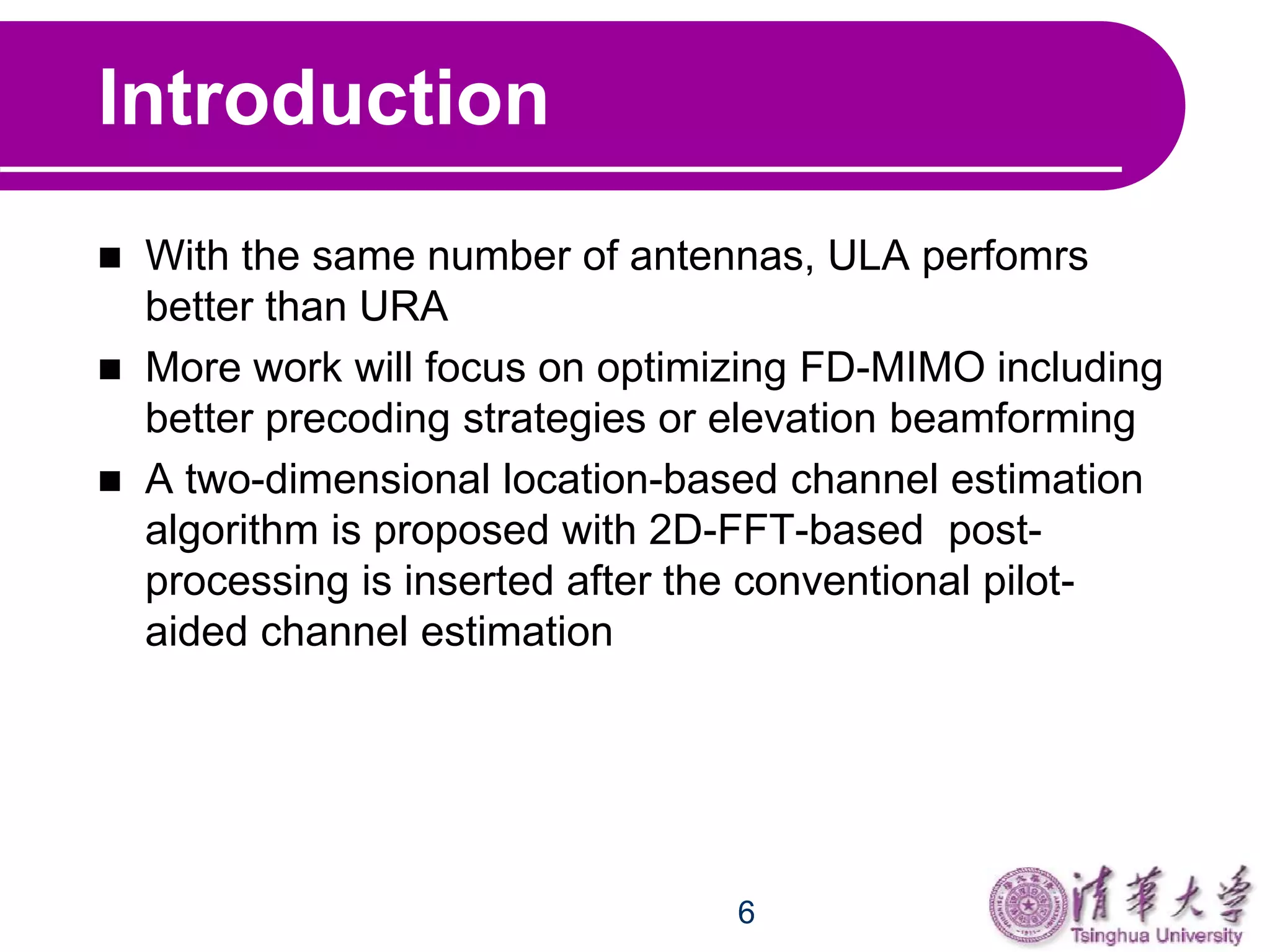
Introduction
 Massive MIMO is a promising technology for
next generation wireless communication
systems
 Space limitation for large antenna arrays
 FD-MIMO (full-dimensional MIMO, 3D-MIMO)
is proposed and rectangular antenna array
 Massive FD-MIMO systems reach high
capacity
6
Introduction
 With the same number of antennas, ULA perfomrs
better than URA
 More work will focus on optimizing FD-MIMO including
better precoding strategies or elevation beamforming
 A two-dimensional location-based channel estimation
algorithm is proposed with 2D-FFT-based post-
processing is inserted after the conventional pilot-
aided channel estimation
7
Outline
 Abstract
 Introduction
 System model
 Proposal
 Simulation results
 References
8
System model
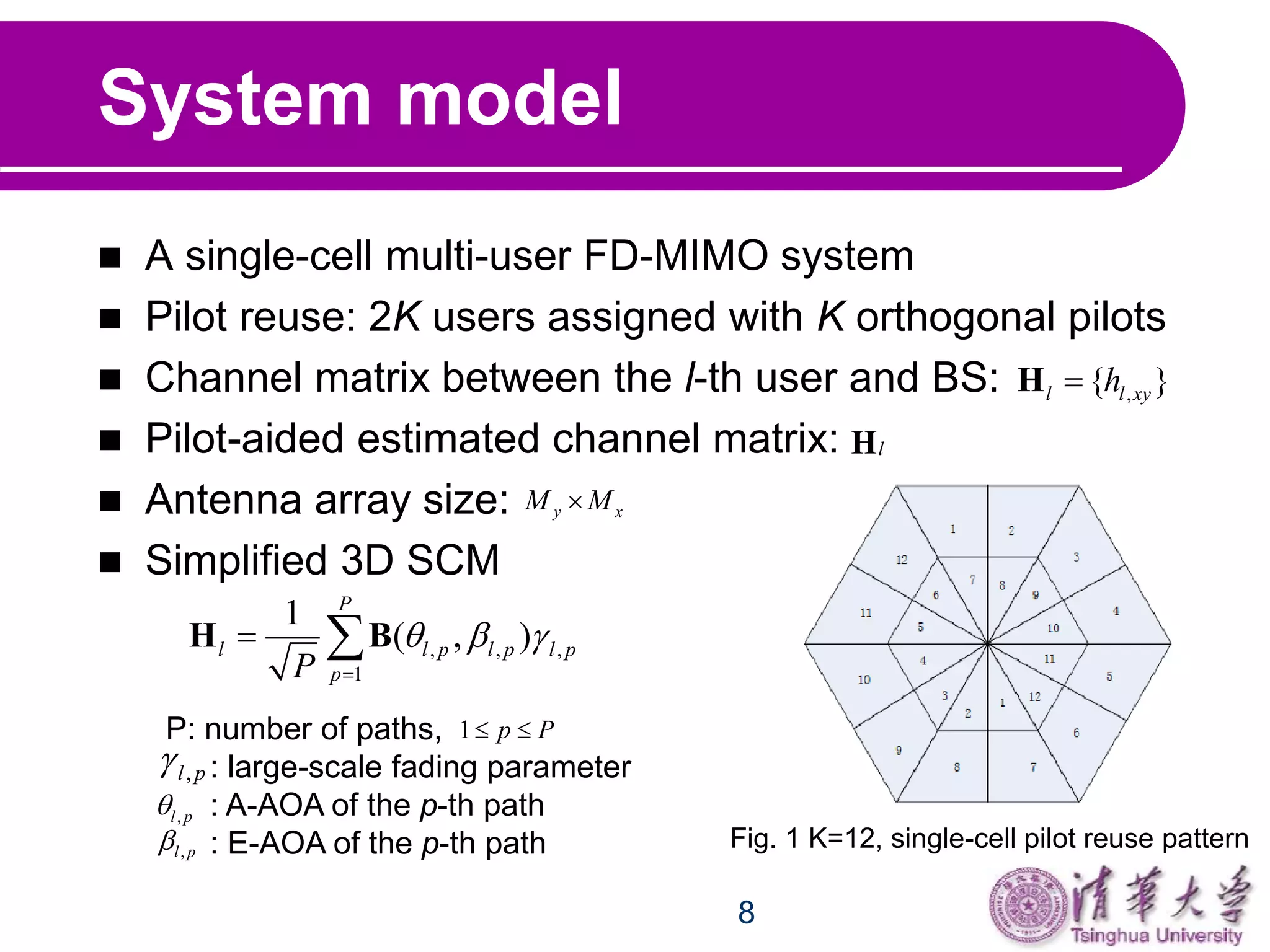
 A single-cell multi-user FD-MIMO system
 Pilot reuse: 2K users assigned with K orthogonal pilots
 Channel matrix between the l-th user and BS:
 Pilot-aided estimated channel matrix:
 Antenna array size:
 Simplified 3D SCM
Fig. 1 K=12, single-cell pilot reuse pattern
,{ }l l xyhH
lH
y xM M
, , ,
1
1
( , )
P
l l p l p l p
pP
  

 H B
P: number of paths,
: large-scale fading parameter
: A-AOA of the p-th path
: E-AOA of the p-th path
,l p
,l p
,l p
1 p P 
9
System model
 Steering matrix :
 Assumption: angular spread of A-AOA is small. E-
AOAs are determined by locations of users.
 Inner part user:
 Outer part user:
( , ) { }xyb  B
 cos cos sin
, ( , )
jkD x y
x yb e
  
   

0, 1, 0, 1x yx M y M     
D: antenna spacing, , is the wavelength2 /k   
, min max[ , ]l l
l p  
min max m
arctan ,arctan , arctan ,arctanin out
mid id
L L L L
r r r r
 
   
    
   
min m[ , ]in idd r r
m max[ , ]out idd r r
10
Outline
 Abstract
 Introduction
 System model
 Proposal
 Simulation results
 References
11
Proposal: 2D-DFT Analysis
 Horizontal domain:
 can be seen as a single-frequency signal with
 Vertical domain:
 : single-frequency signal with
 2D-DFT of tends to a 2D- function with infinity
number of antennas. Different users have different
impulse position and could be distinguished in angle
domain.
1 2[ , , , ]y
h h h
M B b b b
cos cos
sin
cos cos
1
y
jkD
h jkDy
y
jkDM
e
e
e
 

 



 
 
 
 
 
  
b
h
yb cos cosh
D
f  


sincos cos sin
1 yjkDMv jkDx jkD
x e e e
    
   b
v
xb sinv
D
f 


B 
12
Proposal: 2D-DFT Analysis
Perform 2D-DFT of :
11
2 ( ) 2 ( )
0 0
11
2 ( ) 2 ( )
0 0
| ( , ) | | || |
| | | |
yx
h h v v
yx
h h v v
MM
j q k j q k
h v
x y
MM
j q k j q k
x y
x y
X k k e e
e e
M M M
 
 

 
 

 
 


  
 
 
Let and( ) cos cosh
x
D k
q k
N
 

  ( ) sinv
y
D k
q k
N


 
( , ) B
| ( , ) |h vX k k reaches maximum value when and both are integers( )hq k( )vq k
( , , )
( , )
h h x
v v y
k g N
k g N
 

    

   
cos cos , [0, )
2
( , , )
cos cos , [ , ]
2
x x
h x
x
D
N N
g N
D
N

  
 

   


 
 
 

min max( , ) sin , [ , ]v y y y
D
g N N N    

  Means rounding operation  
13
Proposal: Procedure
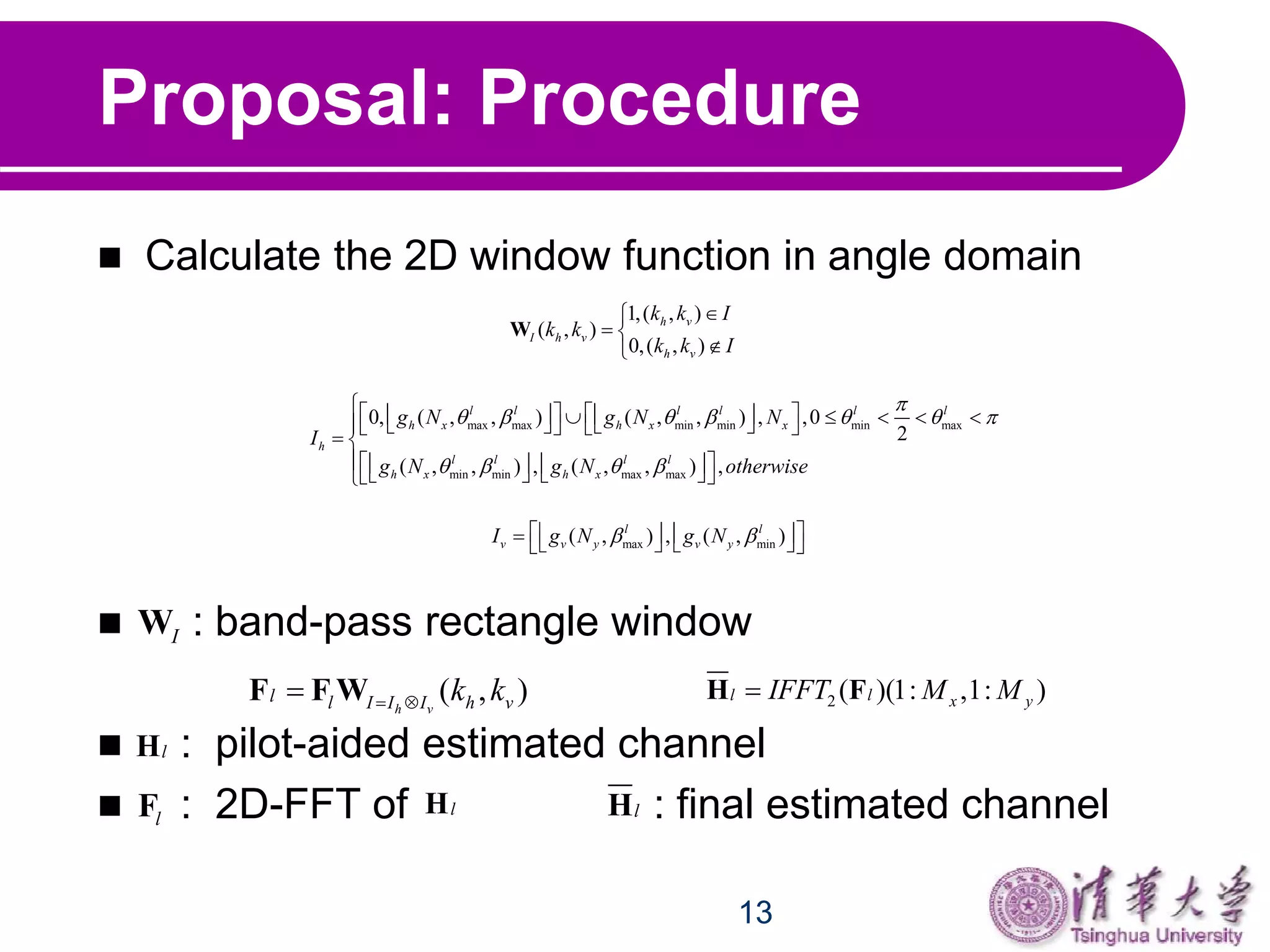
 Calculate the 2D window function in angle domain
 : band-pass rectangle window
 : pilot-aided estimated channel
 : 2D-FFT of : final estimated channel
1,( , )
( , )
0,( , )
h v
I h v
h v
k k I
k k
k k I

 

W
max max min min min max
min min max max
0, ( , , ) ( , , ) , ,0
2
( , , ) , ( , , ) ,
l l l l l l
h x h x x
h
l l l l
h x h x
g N g N N
I
g N g N otherwise

      
   
                
 
        
max min( , ) , ( , )l l
v v y v yI g N g N          
IW
( , )h v
l l I I I h vk k F F W
lH
lF lH
2 ( )(1: ,1: )l l x yIFFT M MH F
lH
14
Outline
 Abstract
 Introduction
 System model
 Proposal
 Simulation results
 References
15
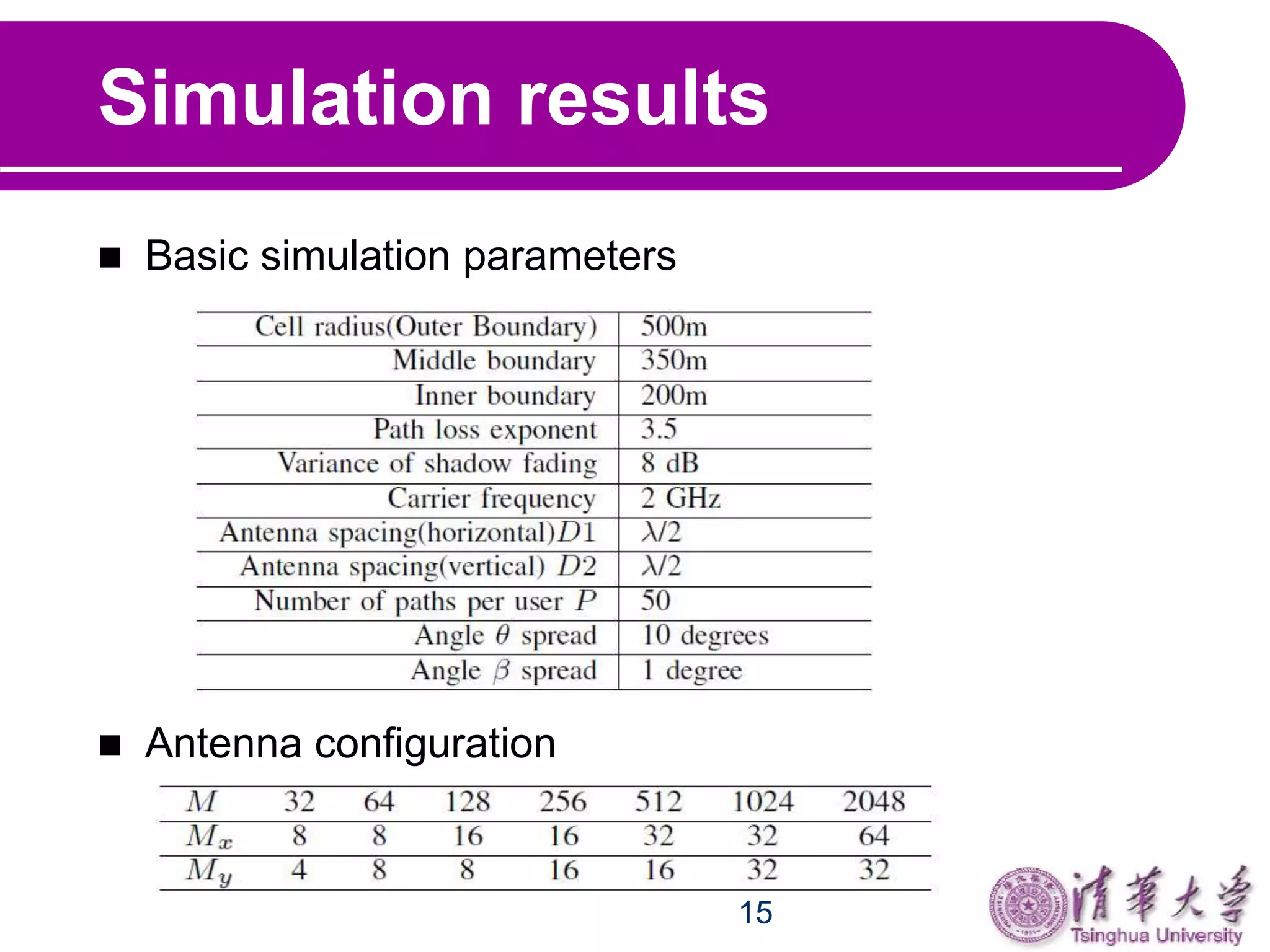
Simulation results
 Basic simulation parameters
 Antenna configuration
16
Simulation results
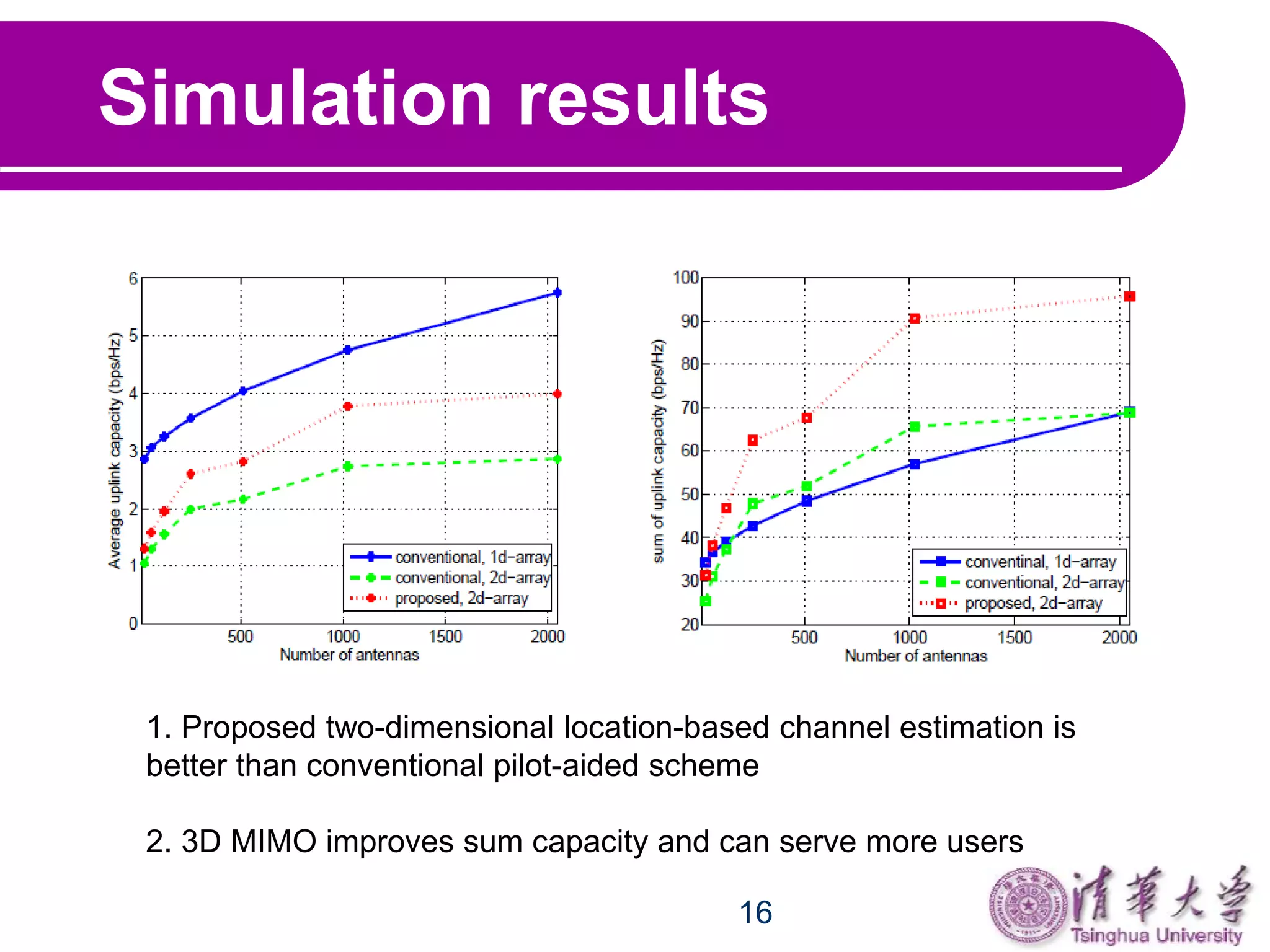
1. Proposed two-dimensional location-based channel estimation is
better than conventional pilot-aided scheme
2. 3D MIMO improves sum capacity and can serve more users
17
References
Thank you and
questions please!

VTC-location based channel estimation for massive full-dimensional MIMO systems

  • 1.
    Location-based Channel Estimation forMassive Full-Dimensional MIMO Systems Authors: Wendong Liu, Chen Qian and Zhaocheng Wang Presenter: Qian Han
  • 2.
    2 Outline  Abstract  Introduction System model  Proposal  Simulation results  References
  • 3.
    3 Abstract  Propose atwo-dimensional location-based channel estimation for massive FD-MIMO systems  Intra-cell pilot reuse scheme is adopted  Users with same pilots could be distinguished by their non-overlapping A-AOAs and E-AOAs  Interference is reduced and the sum capacity could be improved
  • 4.
    4 Outline  Abstract  Introduction System model  Proposal  Simulation results  References
  • 5.
    5 Introduction  Massive MIMOis a promising technology for next generation wireless communication systems  Space limitation for large antenna arrays  FD-MIMO (full-dimensional MIMO, 3D-MIMO) is proposed and rectangular antenna array  Massive FD-MIMO systems reach high capacity
  • 6.
    6 Introduction  With thesame number of antennas, ULA perfomrs better than URA  More work will focus on optimizing FD-MIMO including better precoding strategies or elevation beamforming  A two-dimensional location-based channel estimation algorithm is proposed with 2D-FFT-based post- processing is inserted after the conventional pilot- aided channel estimation
  • 7.
    7 Outline  Abstract  Introduction System model  Proposal  Simulation results  References
  • 8.
    8 System model  Asingle-cell multi-user FD-MIMO system  Pilot reuse: 2K users assigned with K orthogonal pilots  Channel matrix between the l-th user and BS:  Pilot-aided estimated channel matrix:  Antenna array size:  Simplified 3D SCM Fig. 1 K=12, single-cell pilot reuse pattern ,{ }l l xyhH lH y xM M , , , 1 1 ( , ) P l l p l p l p pP      H B P: number of paths, : large-scale fading parameter : A-AOA of the p-th path : E-AOA of the p-th path ,l p ,l p ,l p 1 p P 
  • 9.
    9 System model  Steeringmatrix :  Assumption: angular spread of A-AOA is small. E- AOAs are determined by locations of users.  Inner part user:  Outer part user: ( , ) { }xyb  B  cos cos sin , ( , ) jkD x y x yb e         0, 1, 0, 1x yx M y M      D: antenna spacing, , is the wavelength2 /k    , min max[ , ]l l l p   min max m arctan ,arctan , arctan ,arctanin out mid id L L L L r r r r                min m[ , ]in idd r r m max[ , ]out idd r r
  • 10.
    10 Outline  Abstract  Introduction System model  Proposal  Simulation results  References
  • 11.
    11 Proposal: 2D-DFT Analysis Horizontal domain:  can be seen as a single-frequency signal with  Vertical domain:  : single-frequency signal with  2D-DFT of tends to a 2D- function with infinity number of antennas. Different users have different impulse position and could be distinguished in angle domain. 1 2[ , , , ]y h h h M B b b b cos cos sin cos cos 1 y jkD h jkDy y jkDM e e e                      b h yb cos cosh D f     sincos cos sin 1 yjkDMv jkDx jkD x e e e         b v xb sinv D f    B 
  • 12.
    12 Proposal: 2D-DFT Analysis Perform2D-DFT of : 11 2 ( ) 2 ( ) 0 0 11 2 ( ) 2 ( ) 0 0 | ( , ) | | || | | | | | yx h h v v yx h h v v MM j q k j q k h v x y MM j q k j q k x y x y X k k e e e e M M M                        Let and( ) cos cosh x D k q k N      ( ) sinv y D k q k N     ( , ) B | ( , ) |h vX k k reaches maximum value when and both are integers( )hq k( )vq k ( , , ) ( , ) h h x v v y k g N k g N              cos cos , [0, ) 2 ( , , ) cos cos , [ , ] 2 x x h x x D N N g N D N                     min max( , ) sin , [ , ]v y y y D g N N N        Means rounding operation  
  • 13.
    13 Proposal: Procedure  Calculatethe 2D window function in angle domain  : band-pass rectangle window  : pilot-aided estimated channel  : 2D-FFT of : final estimated channel 1,( , ) ( , ) 0,( , ) h v I h v h v k k I k k k k I     W max max min min min max min min max max 0, ( , , ) ( , , ) , ,0 2 ( , , ) , ( , , ) , l l l l l l h x h x x h l l l l h x h x g N g N N I g N g N otherwise                                         max min( , ) , ( , )l l v v y v yI g N g N           IW ( , )h v l l I I I h vk k F F W lH lF lH 2 ( )(1: ,1: )l l x yIFFT M MH F lH
  • 14.
    14 Outline  Abstract  Introduction System model  Proposal  Simulation results  References
  • 15.
    15 Simulation results  Basicsimulation parameters  Antenna configuration
  • 16.
    16 Simulation results 1. Proposedtwo-dimensional location-based channel estimation is better than conventional pilot-aided scheme 2. 3D MIMO improves sum capacity and can serve more users
  • 17.
  • 18.