Background System Model
Sparse Spectrum Sensing in
Infrastructure-less Cognitive Radio
Networks via Binary Consensus
Algorithms
Mohamed Seif1
1Wireless Intelligent Networks Center (WINC), Nile University, Egypt
January, 2016
Mohamed Seif Nile University
Sparse Spectrum Sensing in Infrastructure-less Cognitive Radio Networks via Binary Consensus Algorithms 1
Background System Model
Sampling Theory
Shannon/Nyquist sampling theorem:
No information loss if we
sample at 2x signal bandwidth
DSP revolution: Sample first and ask
questions later (Compression,
Storage, ..., etc)
Increasing pressure on DSP
hardware, algorithms
Mohamed Seif Nile University
Sparse Spectrum Sensing in Infrastructure-less Cognitive Radio Networks via Binary Consensus Algorithms 2
Background System Model
Compressive Sensing
Compressive sensing (CS) theory combines the signal
acquisition and compression steps into a single step.
The main requirement is that the acquired data is sparse in
some transform domain.
Mohamed Seif Nile University
Sparse Spectrum Sensing in Infrastructure-less Cognitive Radio Networks via Binary Consensus Algorithms 3
Background System Model
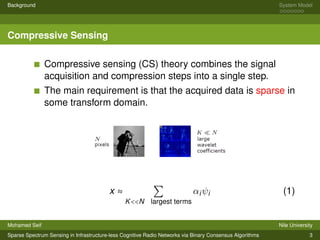
Compressive Sensing
Compressive sensing (CS) theory combines the signal
acquisition and compression steps into a single step.
The main requirement is that the acquired data is sparse in
some transform domain.
x ≈ ∑
K<<N largest terms
αiψi (1)
Mohamed Seif Nile University
Sparse Spectrum Sensing in Infrastructure-less Cognitive Radio Networks via Binary Consensus Algorithms 3
Background System Model
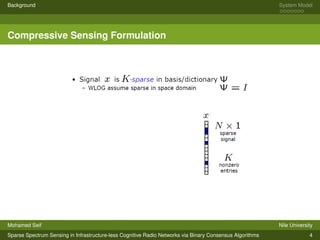
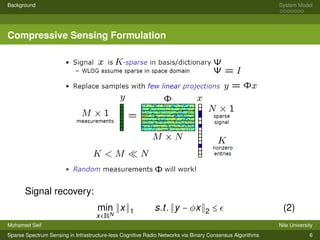
Compressive Sensing Formulation
Mohamed Seif Nile University
Sparse Spectrum Sensing in Infrastructure-less Cognitive Radio Networks via Binary Consensus Algorithms 4
Background System Model
Compressive Sensing Formulation
Mohamed Seif Nile University
Sparse Spectrum Sensing in Infrastructure-less Cognitive Radio Networks via Binary Consensus Algorithms 5
Background System Model
Compressive Sensing Formulation
Signal recovery:
min
x∈RN
x 1 s.t. y − φx 2 ≤ (2)
Mohamed Seif Nile University
Sparse Spectrum Sensing in Infrastructure-less Cognitive Radio Networks via Binary Consensus Algorithms 6
Background System Model
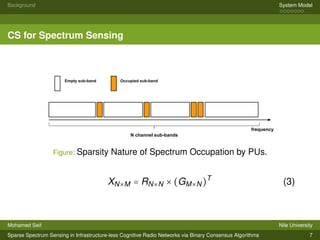
CS for Spectrum Sensing
frequency
N channel sub-bands
Empty sub-band Occupied sub-band
Figure: Sparsity Nature of Spectrum Occupation by PUs.
XN×M = RN×N × (GM×N)T
(3)
Mohamed Seif Nile University
Sparse Spectrum Sensing in Infrastructure-less Cognitive Radio Networks via Binary Consensus Algorithms 7
Background System Model
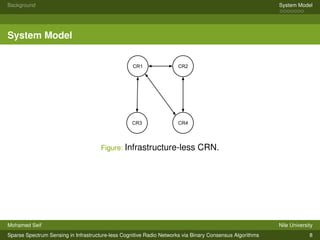
System Model
CR1
CR3
CR2
CR4
Figure: Infrastructure-less CRN.
Mohamed Seif Nile University
Sparse Spectrum Sensing in Infrastructure-less Cognitive Radio Networks via Binary Consensus Algorithms 8
Background System Model
System Model
CR1
CR3
CR2
CR4
Figure: Infrastructure-less CRN.
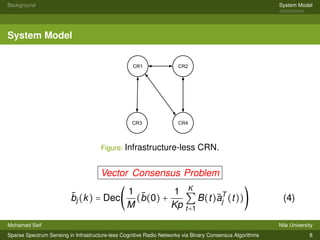
Vector Consensus Problem
Mohamed Seif Nile University
Sparse Spectrum Sensing in Infrastructure-less Cognitive Radio Networks via Binary Consensus Algorithms 8
Background System Model
System Model
CR1
CR3
CR2
CR4
Figure: Infrastructure-less CRN.
Vector Consensus Problem
¯bj(k) = Dec(
1
M
(¯b(0) +
1
Kp
K
∑
t=1
B(t)¯aT
j (t))) (4)
Mohamed Seif Nile University
Sparse Spectrum Sensing in Infrastructure-less Cognitive Radio Networks via Binary Consensus Algorithms 8
Background System Model
Numerical Results
Simulation Results
Parameter Realization
N 200
T 30
M 12
P 4
dmin 10 m
A 1000 m ×1000 m
K 10
α 2
No. iterations 100
Table: Simulation Parameters.
Mohamed Seif Nile University
Sparse Spectrum Sensing in Infrastructure-less Cognitive Radio Networks via Binary Consensus Algorithms 9
Background System Model
Numerical Results
Simulation Results
0 5 10 15 20 25
0.4
0.5
0.6
0.7
0.8
0.9
1
SNR (dB)
P
d
Centralized − Majority Rule
Infrastructure−less, K = 10
Infrastructure−less, K = 11
Infrastructure−less, K = 12
Figure: Comperison between two architectures (Fusion based vs
Infrastructure-less).
Mohamed Seif Nile University
Sparse Spectrum Sensing in Infrastructure-less Cognitive Radio Networks via Binary Consensus Algorithms 10
Background System Model
Numerical Results
Simulation Results
0 5 10 15 20 25
0.1
0.2
0.3
0.4
0.5
0.6
0.7
0.8
0.9
SNR (dB)
P
d
p=0.3
p=0.5
p=0.8
Figure: Effect of link quality on probability of detection.
Mohamed Seif Nile University
Sparse Spectrum Sensing in Infrastructure-less Cognitive Radio Networks via Binary Consensus Algorithms 11
Background System Model
Numerical Results
Simulation Results
0 5 10 15 20 25
0.45
0.5
0.55
0.6
0.65
0.7
0.75
0.8
0.85
0.9
0.95
SNR (dB)
P
d
T = 30
T = 50
T = 90
Figure: Effect of number of measurements on probability of detection.
Mohamed Seif Nile University
Sparse Spectrum Sensing in Infrastructure-less Cognitive Radio Networks via Binary Consensus Algorithms 12
Background System Model
Numerical Results
Simulation Results
1 2 3 4 5 6 7 8 9 10
0.55
0.6
0.65
0.7
0.75
0.8
0.85
0.9
0.95
1
P
d
(k)
k
p = 0.2
p = 0.8
Figure: Effect of link quality - (not final)
Mohamed Seif Nile University
Sparse Spectrum Sensing in Infrastructure-less Cognitive Radio Networks via Binary Consensus Algorithms 13
Background System Model
Numerical Results
Simulation Results
1 2 3 4 5 6 7 8 9 10
0
0.1
0.2
0.3
0.4
0.5
0.6
0.7
0.8
0.9
1
k
P
d
(k)
t=150
t=90
Figure: Effect of number of measurements - (not final)
Mohamed Seif Nile University
Sparse Spectrum Sensing in Infrastructure-less Cognitive Radio Networks via Binary Consensus Algorithms 14
Background System Model
Numerical Results
Thank You!
Mohamed Seif Nile University
Sparse Spectrum Sensing in Infrastructure-less Cognitive Radio Networks via Binary Consensus Algorithms 15

Sparse Spectrum Sensing in Infrastructure-less Cognitive Radio Networks via Binary Consensus Algorithms

  • 1.
    Background System Model SparseSpectrum Sensing in Infrastructure-less Cognitive Radio Networks via Binary Consensus Algorithms Mohamed Seif1 1Wireless Intelligent Networks Center (WINC), Nile University, Egypt January, 2016 Mohamed Seif Nile University Sparse Spectrum Sensing in Infrastructure-less Cognitive Radio Networks via Binary Consensus Algorithms 1
  • 2.
    Background System Model SamplingTheory Shannon/Nyquist sampling theorem: No information loss if we sample at 2x signal bandwidth DSP revolution: Sample first and ask questions later (Compression, Storage, ..., etc) Increasing pressure on DSP hardware, algorithms Mohamed Seif Nile University Sparse Spectrum Sensing in Infrastructure-less Cognitive Radio Networks via Binary Consensus Algorithms 2
  • 3.
    Background System Model CompressiveSensing Compressive sensing (CS) theory combines the signal acquisition and compression steps into a single step. The main requirement is that the acquired data is sparse in some transform domain. Mohamed Seif Nile University Sparse Spectrum Sensing in Infrastructure-less Cognitive Radio Networks via Binary Consensus Algorithms 3
  • 4.
    Background System Model CompressiveSensing Compressive sensing (CS) theory combines the signal acquisition and compression steps into a single step. The main requirement is that the acquired data is sparse in some transform domain. x ≈ ∑ K<<N largest terms αiψi (1) Mohamed Seif Nile University Sparse Spectrum Sensing in Infrastructure-less Cognitive Radio Networks via Binary Consensus Algorithms 3
  • 5.
    Background System Model CompressiveSensing Formulation Mohamed Seif Nile University Sparse Spectrum Sensing in Infrastructure-less Cognitive Radio Networks via Binary Consensus Algorithms 4
  • 6.
    Background System Model CompressiveSensing Formulation Mohamed Seif Nile University Sparse Spectrum Sensing in Infrastructure-less Cognitive Radio Networks via Binary Consensus Algorithms 5
  • 7.
    Background System Model CompressiveSensing Formulation Signal recovery: min x∈RN x 1 s.t. y − φx 2 ≤ (2) Mohamed Seif Nile University Sparse Spectrum Sensing in Infrastructure-less Cognitive Radio Networks via Binary Consensus Algorithms 6
  • 8.
    Background System Model CSfor Spectrum Sensing frequency N channel sub-bands Empty sub-band Occupied sub-band Figure: Sparsity Nature of Spectrum Occupation by PUs. XN×M = RN×N × (GM×N)T (3) Mohamed Seif Nile University Sparse Spectrum Sensing in Infrastructure-less Cognitive Radio Networks via Binary Consensus Algorithms 7
  • 9.
    Background System Model SystemModel CR1 CR3 CR2 CR4 Figure: Infrastructure-less CRN. Mohamed Seif Nile University Sparse Spectrum Sensing in Infrastructure-less Cognitive Radio Networks via Binary Consensus Algorithms 8
  • 10.
    Background System Model SystemModel CR1 CR3 CR2 CR4 Figure: Infrastructure-less CRN. Vector Consensus Problem Mohamed Seif Nile University Sparse Spectrum Sensing in Infrastructure-less Cognitive Radio Networks via Binary Consensus Algorithms 8
  • 11.
    Background System Model SystemModel CR1 CR3 CR2 CR4 Figure: Infrastructure-less CRN. Vector Consensus Problem ¯bj(k) = Dec( 1 M (¯b(0) + 1 Kp K ∑ t=1 B(t)¯aT j (t))) (4) Mohamed Seif Nile University Sparse Spectrum Sensing in Infrastructure-less Cognitive Radio Networks via Binary Consensus Algorithms 8
  • 12.
    Background System Model NumericalResults Simulation Results Parameter Realization N 200 T 30 M 12 P 4 dmin 10 m A 1000 m ×1000 m K 10 α 2 No. iterations 100 Table: Simulation Parameters. Mohamed Seif Nile University Sparse Spectrum Sensing in Infrastructure-less Cognitive Radio Networks via Binary Consensus Algorithms 9
  • 13.
    Background System Model NumericalResults Simulation Results 0 5 10 15 20 25 0.4 0.5 0.6 0.7 0.8 0.9 1 SNR (dB) P d Centralized − Majority Rule Infrastructure−less, K = 10 Infrastructure−less, K = 11 Infrastructure−less, K = 12 Figure: Comperison between two architectures (Fusion based vs Infrastructure-less). Mohamed Seif Nile University Sparse Spectrum Sensing in Infrastructure-less Cognitive Radio Networks via Binary Consensus Algorithms 10
  • 14.
    Background System Model NumericalResults Simulation Results 0 5 10 15 20 25 0.1 0.2 0.3 0.4 0.5 0.6 0.7 0.8 0.9 SNR (dB) P d p=0.3 p=0.5 p=0.8 Figure: Effect of link quality on probability of detection. Mohamed Seif Nile University Sparse Spectrum Sensing in Infrastructure-less Cognitive Radio Networks via Binary Consensus Algorithms 11
  • 15.
    Background System Model NumericalResults Simulation Results 0 5 10 15 20 25 0.45 0.5 0.55 0.6 0.65 0.7 0.75 0.8 0.85 0.9 0.95 SNR (dB) P d T = 30 T = 50 T = 90 Figure: Effect of number of measurements on probability of detection. Mohamed Seif Nile University Sparse Spectrum Sensing in Infrastructure-less Cognitive Radio Networks via Binary Consensus Algorithms 12
  • 16.
    Background System Model NumericalResults Simulation Results 1 2 3 4 5 6 7 8 9 10 0.55 0.6 0.65 0.7 0.75 0.8 0.85 0.9 0.95 1 P d (k) k p = 0.2 p = 0.8 Figure: Effect of link quality - (not final) Mohamed Seif Nile University Sparse Spectrum Sensing in Infrastructure-less Cognitive Radio Networks via Binary Consensus Algorithms 13
  • 17.
    Background System Model NumericalResults Simulation Results 1 2 3 4 5 6 7 8 9 10 0 0.1 0.2 0.3 0.4 0.5 0.6 0.7 0.8 0.9 1 k P d (k) t=150 t=90 Figure: Effect of number of measurements - (not final) Mohamed Seif Nile University Sparse Spectrum Sensing in Infrastructure-less Cognitive Radio Networks via Binary Consensus Algorithms 14
  • 18.
    Background System Model NumericalResults Thank You! Mohamed Seif Nile University Sparse Spectrum Sensing in Infrastructure-less Cognitive Radio Networks via Binary Consensus Algorithms 15