PIC MICROCONTROLLER
ARCHITECTURE
PIC microcontroller architecture
Bock diagram
Advantages
ARCHITECTURE:
 IC Microcontroller architecture is based on Harvard
architecture and supports RISC architecture
(Reduced Instruction Set Computer).
 PIC microcontroller architecture consists of
memory organization (RAM, ROM, STACK), CPU,
timers, counter, ADC, DAC, serial communication,
CCP module and I/O ports.
 PIC microcontroller also supports the protocols like
CAN, SPI, UART for interfacing with other
peripherals.
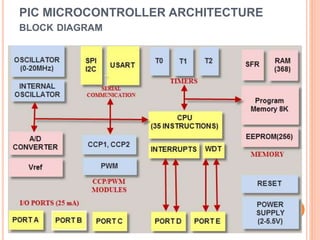
PIC MICROCONTROLLER ARCHITECTURE
BLOCK DIAGRAM
CPU (Central Processing Unit):
PIC microcontroller’s CPU consists of
1. Arithmetic logic unit (ALU)
2. Memory unit (MU)
3. Control unit (CU)
4. Accumulator
 ALU is used for arithmetic operations and for logical decisions.
 Memory is used for storing the instructions after processing.
 Control unit is used to control the internal and external peripherals
which are connected to the CPU and accumulator is used for storing
the results.
MEMORY ORGANIZATION:
 PIC microcontroller memory module consists of mainly 3 types of
memories:
1. Program memory
2. Data memory
PROGRAM MEMORY:
 It contains the written program after we burned it in
microcontroller.
 Program Counter executes commands stored in the
program memory, one after the other.
 PIC microcontroller can have 8K words x 14 bits of
Flash program memory that can be electrically
erased and reprogrammed.
 Whenever we burn program into the micro, we
erase an old program and write a new one.
DATA MEMORY:
 It is a RAM type which is used to store the data
temporarily in its registers.
 The RAM memory is classified into banks. Each
bank extends up to 7Fh (128 bytes).
 Number of banks may vary depending on the
microcontroller.
 PIC16F84 has only two banks. Banks contain
Special Function Registers (SFR) and General
Purpose Registers (GPR).
 The lower locations of each bank are reserved for
the Special Function Registers and upper locations
are for General Purpose Registers.
General Purpose Registers (GPR):
oThese registers don’t have any special function.
o These are used for general purpose for multiplying, addition or
subtraction and then storing the results in other registers.
o CPU can easily access the data in these registers.
Special Function Registers (SFR):
oThese registers are used for special purposes and they cannot
be used as normal registers.
oTheir function is set at the time of manufacturing.
o They perform the function assigned to them and user cannot
change the function of SFR.
o Three important SFRs for programming are:
1. STATUS register : It changes the bank
2. PORT registers : It assigns logic values 0 or 1 to the ports
3. TRIS registers : It is a data direction register for input and
output
DATA EEPROM:
 This memory allows storing the variables as a result
of burning the written program.
 It is readable and writable during normal operation
(over the full VDD range).
 This memory is not directly mapped in the register
file.
 It is indirectly addressed through the SFRs.
 There are six SFRs which are used to read and
write to this memory (EECON1, EECON2,
EEDATA, EEDATH, EEADR, EEADRH).
ADVANTAGES
 Small instruction set to learn.
 RISC architecture.
 Built-in oscillator with selectable speeds.
 Easy entry level, in-circuit programming plus in-
circuit debugging PIC kit units available for less
than $50.
 Inexpensive microcontrollers.
 Wide range of interfaces including I²C, SPI, USB,
USART, A/D, programmable comparators, PWM,
LIN, CAN, PSP, and Ethernet.
 Availability of processors in DIL package make
them easy to handle for hobby use.

Pic microcontroller architecture

  • 1.
    PIC MICROCONTROLLER ARCHITECTURE PIC microcontrollerarchitecture Bock diagram Advantages
  • 2.
    ARCHITECTURE:  IC Microcontrollerarchitecture is based on Harvard architecture and supports RISC architecture (Reduced Instruction Set Computer).  PIC microcontroller architecture consists of memory organization (RAM, ROM, STACK), CPU, timers, counter, ADC, DAC, serial communication, CCP module and I/O ports.  PIC microcontroller also supports the protocols like CAN, SPI, UART for interfacing with other peripherals.
  • 3.
  • 4.
    CPU (Central ProcessingUnit): PIC microcontroller’s CPU consists of 1. Arithmetic logic unit (ALU) 2. Memory unit (MU) 3. Control unit (CU) 4. Accumulator  ALU is used for arithmetic operations and for logical decisions.  Memory is used for storing the instructions after processing.  Control unit is used to control the internal and external peripherals which are connected to the CPU and accumulator is used for storing the results. MEMORY ORGANIZATION:  PIC microcontroller memory module consists of mainly 3 types of memories: 1. Program memory 2. Data memory
  • 5.
    PROGRAM MEMORY:  Itcontains the written program after we burned it in microcontroller.  Program Counter executes commands stored in the program memory, one after the other.  PIC microcontroller can have 8K words x 14 bits of Flash program memory that can be electrically erased and reprogrammed.  Whenever we burn program into the micro, we erase an old program and write a new one.
  • 6.
    DATA MEMORY:  Itis a RAM type which is used to store the data temporarily in its registers.  The RAM memory is classified into banks. Each bank extends up to 7Fh (128 bytes).  Number of banks may vary depending on the microcontroller.  PIC16F84 has only two banks. Banks contain Special Function Registers (SFR) and General Purpose Registers (GPR).  The lower locations of each bank are reserved for the Special Function Registers and upper locations are for General Purpose Registers.
  • 7.
    General Purpose Registers(GPR): oThese registers don’t have any special function. o These are used for general purpose for multiplying, addition or subtraction and then storing the results in other registers. o CPU can easily access the data in these registers. Special Function Registers (SFR): oThese registers are used for special purposes and they cannot be used as normal registers. oTheir function is set at the time of manufacturing. o They perform the function assigned to them and user cannot change the function of SFR. o Three important SFRs for programming are: 1. STATUS register : It changes the bank 2. PORT registers : It assigns logic values 0 or 1 to the ports 3. TRIS registers : It is a data direction register for input and output
  • 8.
    DATA EEPROM:  Thismemory allows storing the variables as a result of burning the written program.  It is readable and writable during normal operation (over the full VDD range).  This memory is not directly mapped in the register file.  It is indirectly addressed through the SFRs.  There are six SFRs which are used to read and write to this memory (EECON1, EECON2, EEDATA, EEDATH, EEADR, EEADRH).
  • 9.
    ADVANTAGES  Small instructionset to learn.  RISC architecture.  Built-in oscillator with selectable speeds.  Easy entry level, in-circuit programming plus in- circuit debugging PIC kit units available for less than $50.  Inexpensive microcontrollers.  Wide range of interfaces including I²C, SPI, USB, USART, A/D, programmable comparators, PWM, LIN, CAN, PSP, and Ethernet.  Availability of processors in DIL package make them easy to handle for hobby use.