Channel Estimation Techniques
Based on Pilot Arrangement in
OFDM Systems
SINEM COLERI, MUSTAFA ERGEN, ANUJ PURI, AND AHMAD BAHAI
Presented By: Belal Essam Eldiwany
31 January 2017
Agenda
• Why Channel Estimation in OFDM Systems?
• System Description
• Channel Estimation Based on Block-Type Pilot Arrangement
• Channel Estimation Based on Comb-Type Pilot Arrangement
• Interpolation Techniques in Comb-Type Pilot Arrangement
• Simulations
31 January 2017
Before We Start …
• Published:
◦ in IEEE Transactions On Broadcasting,
◦ on September 2002.
• Till now, cited by 1617 other works.
31 January 2017
Why Channel Estimation in OFDM
Systems?
• A dynamic estimation of channel is necessary before the demodulation of
OFDM signals since the radio channel is frequency selective and time-varying
for wideband mobile communication systems.
31 January 2017
System Description
31 January 2017
System Description (Cont’d)
• The received signal is given by:
where h(n) is the channel impulse response and w(n) is Additive White Gaussian
Noise (AWGN).
• The channel response can be represented by [1]:
31 January 2017
System Description (Cont’d)
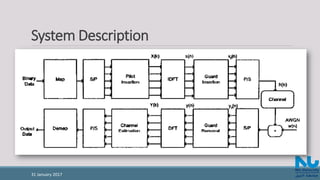
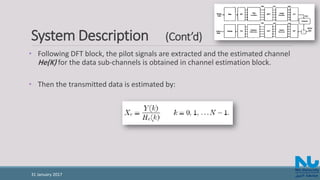
• Following DFT block, the pilot signals are extracted and the estimated channel
He(K) for the data sub-channels is obtained in channel estimation block.
• Then the transmitted data is estimated by:
31 January 2017
Channel Estimation Based on Block-Type
Pilot Arrangement
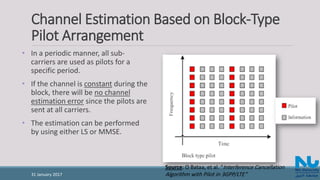
• In a periodic manner, all sub-
carriers are used as pilots for a
specific period.
• If the channel is constant during the
block, there will be no channel
estimation error since the pilots are
sent at all carriers.
• The estimation can be performed
by using either LS or MMSE.
Source: O Bataa, et al. “Interference Cancellation
Algorithm with Pilot in 3GPP/LTE ”31 January 2017
Channel Estimation Based on Block-Type
Pilot Arrangement (Cont’d)
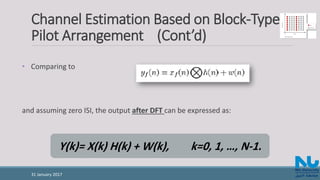
• Comparing to
and assuming zero ISI, the output after DFT can be expressed as:
Y(k)= X(k) H(k) + W(k), k=0, 1, …, N-1.
31 January 2017
Channel Estimation Based on Block-Type
Pilot Arrangement (Cont’d)
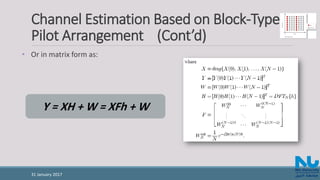
• Or in matrix form as:
Y = XH + W = XFh + W
31 January 2017
Channel Estimation Based on Block-Type
Pilot Arrangement (Cont’d)
• If the time domain channel vector h is Gaussian and uncorrelated with the
channel noise W, then the frequency domain MMSE estimate of is given from
[2] as:
31 January 2017
Channel Estimation Based on Block-Type
Pilot Arrangement (Cont’d)
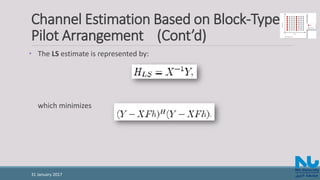
• The LS estimate is represented by:
which minimizes
31 January 2017
Channel Estimation Based on Comb-Type
Pilot Arrangement
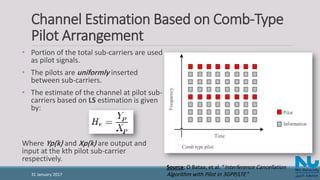
• Portion of the total sub-carriers are used
as pilot signals.
• The pilots are uniformly inserted
between sub-carriers.
• The estimate of the channel at pilot sub-
carriers based on LS estimation is given
by:
Where Yp(k) and Xp(k) are output and
input at the kth pilot sub-carrier
respectively.
Source: O Bataa, et al. “Interference Cancellation
Algorithm with Pilot in 3GPP/LTE ”31 January 2017
Interpolation Techniques in Comb-Type Pilot
Arrangement
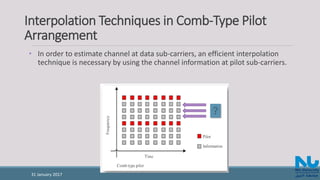
• In order to estimate channel at data sub-carriers, an efficient interpolation
technique is necessary by using the channel information at pilot sub-carriers.
31 January 2017
Interpolation Techniques in Comb-Type
Pilot Arrangement (Cont’d)
• Linear interpolation
For any data sub-carrier, form a linear combination of the preceding and following pilot sub-
carrier with proper weights.
• Second-order interpolation
Form a second order polynomial using three estimated pilot sub-carriers.
• The spline cubic interpolation
Produces a smooth and continuous polynomial fitted to given data points.
31 January 2017
Interpolation Techniques in Comb-Type Pilot
Arrangement (Cont’d)
• Low-pass interpolation
Performed by inserting zeros into the original sequence and then applying a low-pass FIR
filter that allows the original data to pass through unchanged and interpolates between such
that the mean-square error between the interpolated points and their ideal values is
minimized.
• Time domain interpolation
A high-resolution interpolation based on zero-padding and DFT/IDFT [8].
31 January 2017
Least Mean Squares Estimator
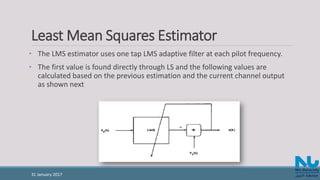
• The LMS estimator uses one tap LMS adaptive filter at each pilot frequency.
• The first value is found directly through LS and the following values are
calculated based on the previous estimation and the current channel output
as shown next
31 January 2017
Simulations
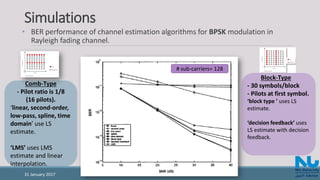
• BER performance of channel estimation algorithms for BPSK modulation in
Rayleigh fading channel.
Block-Type
- 30 symbols/block
- Pilots at first symbol.
‘block type ’ uses LS
estimate.
‘decision feedback’ uses
LS estimate with decision
feedback.
Comb-Type
- Pilot ratio is 1/8
(16 pilots).
‘linear, second-order,
low-pass, spline, time
domain’ use LS
estimate.
‘LMS’ uses LMS
estimate and linear
interpolation.
# sub-carriers= 128
31 January 2017
Simulations (cont’d)
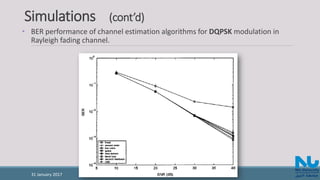
• BER performance of channel estimation algorithms for DQPSK modulation in
Rayleigh fading channel.
31 January 2017
Simulations (cont’d)
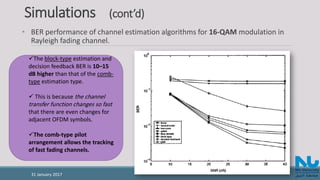
• BER performance of channel estimation algorithms for 16-QAM modulation in
Rayleigh fading channel.
The block-type estimation and
decision feedback BER is 10–15
dB higher than that of the comb-
type estimation type.
 This is because the channel
transfer function changes so fast
that there are even changes for
adjacent OFDM symbols.
The comb-type pilot
arrangement allows the tracking
of fast fading channels.
31 January 2017
Simulations (cont’d)
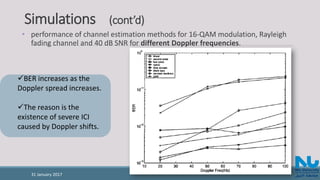
• performance of channel estimation methods for 16-QAM modulation, Rayleigh
fading channel and 40 dB SNR for different Doppler frequencies.
BER increases as the
Doppler spread increases.
The reason is the
existence of severe ICI
caused by Doppler shifts.
31 January 2017
References
• [1] R. Steele, Mobile Radio Communications. London, England: Pentech Press
Limited, 1992.
• [2] O. Edfors, M. Sandell, J. J. van de Beek, S. K. Wilson and P. Ola Borjesson,
"OFDM channel estimation by singular value decomposition," Proceedings of
Vehicular Technology Conference - VTC, Atlanta, GA, 1996.
• [3]Yuping Zhao and Aiping Huang, "A novel channel estimation method for
OFDM mobile communication systems based on pilot signals and transform-
domain processing," 1997 IEEE 47th Vehicular Technology Conference.
Technology in Motion, Phoenix, AZ, 1997.
31 January 2017
Questions?
____________________________________________
Thank You
31 January 2017

Channel Estimation Techniques Based on Pilot Arrangement in OFDM Systems

  • 1.
    Channel Estimation Techniques Basedon Pilot Arrangement in OFDM Systems SINEM COLERI, MUSTAFA ERGEN, ANUJ PURI, AND AHMAD BAHAI Presented By: Belal Essam Eldiwany 31 January 2017
  • 2.
    Agenda • Why ChannelEstimation in OFDM Systems? • System Description • Channel Estimation Based on Block-Type Pilot Arrangement • Channel Estimation Based on Comb-Type Pilot Arrangement • Interpolation Techniques in Comb-Type Pilot Arrangement • Simulations 31 January 2017
  • 3.
    Before We Start… • Published: ◦ in IEEE Transactions On Broadcasting, ◦ on September 2002. • Till now, cited by 1617 other works. 31 January 2017
  • 4.
    Why Channel Estimationin OFDM Systems? • A dynamic estimation of channel is necessary before the demodulation of OFDM signals since the radio channel is frequency selective and time-varying for wideband mobile communication systems. 31 January 2017
  • 5.
  • 6.
    System Description (Cont’d) •The received signal is given by: where h(n) is the channel impulse response and w(n) is Additive White Gaussian Noise (AWGN). • The channel response can be represented by [1]: 31 January 2017
  • 7.
    System Description (Cont’d) •Following DFT block, the pilot signals are extracted and the estimated channel He(K) for the data sub-channels is obtained in channel estimation block. • Then the transmitted data is estimated by: 31 January 2017
  • 8.
    Channel Estimation Basedon Block-Type Pilot Arrangement • In a periodic manner, all sub- carriers are used as pilots for a specific period. • If the channel is constant during the block, there will be no channel estimation error since the pilots are sent at all carriers. • The estimation can be performed by using either LS or MMSE. Source: O Bataa, et al. “Interference Cancellation Algorithm with Pilot in 3GPP/LTE ”31 January 2017
  • 9.
    Channel Estimation Basedon Block-Type Pilot Arrangement (Cont’d) • Comparing to and assuming zero ISI, the output after DFT can be expressed as: Y(k)= X(k) H(k) + W(k), k=0, 1, …, N-1. 31 January 2017
  • 10.
    Channel Estimation Basedon Block-Type Pilot Arrangement (Cont’d) • Or in matrix form as: Y = XH + W = XFh + W 31 January 2017
  • 11.
    Channel Estimation Basedon Block-Type Pilot Arrangement (Cont’d) • If the time domain channel vector h is Gaussian and uncorrelated with the channel noise W, then the frequency domain MMSE estimate of is given from [2] as: 31 January 2017
  • 12.
    Channel Estimation Basedon Block-Type Pilot Arrangement (Cont’d) • The LS estimate is represented by: which minimizes 31 January 2017
  • 13.
    Channel Estimation Basedon Comb-Type Pilot Arrangement • Portion of the total sub-carriers are used as pilot signals. • The pilots are uniformly inserted between sub-carriers. • The estimate of the channel at pilot sub- carriers based on LS estimation is given by: Where Yp(k) and Xp(k) are output and input at the kth pilot sub-carrier respectively. Source: O Bataa, et al. “Interference Cancellation Algorithm with Pilot in 3GPP/LTE ”31 January 2017
  • 14.
    Interpolation Techniques inComb-Type Pilot Arrangement • In order to estimate channel at data sub-carriers, an efficient interpolation technique is necessary by using the channel information at pilot sub-carriers. 31 January 2017
  • 15.
    Interpolation Techniques inComb-Type Pilot Arrangement (Cont’d) • Linear interpolation For any data sub-carrier, form a linear combination of the preceding and following pilot sub- carrier with proper weights. • Second-order interpolation Form a second order polynomial using three estimated pilot sub-carriers. • The spline cubic interpolation Produces a smooth and continuous polynomial fitted to given data points. 31 January 2017
  • 16.
    Interpolation Techniques inComb-Type Pilot Arrangement (Cont’d) • Low-pass interpolation Performed by inserting zeros into the original sequence and then applying a low-pass FIR filter that allows the original data to pass through unchanged and interpolates between such that the mean-square error between the interpolated points and their ideal values is minimized. • Time domain interpolation A high-resolution interpolation based on zero-padding and DFT/IDFT [8]. 31 January 2017
  • 17.
    Least Mean SquaresEstimator • The LMS estimator uses one tap LMS adaptive filter at each pilot frequency. • The first value is found directly through LS and the following values are calculated based on the previous estimation and the current channel output as shown next 31 January 2017
  • 18.
    Simulations • BER performanceof channel estimation algorithms for BPSK modulation in Rayleigh fading channel. Block-Type - 30 symbols/block - Pilots at first symbol. ‘block type ’ uses LS estimate. ‘decision feedback’ uses LS estimate with decision feedback. Comb-Type - Pilot ratio is 1/8 (16 pilots). ‘linear, second-order, low-pass, spline, time domain’ use LS estimate. ‘LMS’ uses LMS estimate and linear interpolation. # sub-carriers= 128 31 January 2017
  • 19.
    Simulations (cont’d) • BERperformance of channel estimation algorithms for DQPSK modulation in Rayleigh fading channel. 31 January 2017
  • 20.
    Simulations (cont’d) • BERperformance of channel estimation algorithms for 16-QAM modulation in Rayleigh fading channel. The block-type estimation and decision feedback BER is 10–15 dB higher than that of the comb- type estimation type.  This is because the channel transfer function changes so fast that there are even changes for adjacent OFDM symbols. The comb-type pilot arrangement allows the tracking of fast fading channels. 31 January 2017
  • 21.
    Simulations (cont’d) • performanceof channel estimation methods for 16-QAM modulation, Rayleigh fading channel and 40 dB SNR for different Doppler frequencies. BER increases as the Doppler spread increases. The reason is the existence of severe ICI caused by Doppler shifts. 31 January 2017
  • 22.
    References • [1] R.Steele, Mobile Radio Communications. London, England: Pentech Press Limited, 1992. • [2] O. Edfors, M. Sandell, J. J. van de Beek, S. K. Wilson and P. Ola Borjesson, "OFDM channel estimation by singular value decomposition," Proceedings of Vehicular Technology Conference - VTC, Atlanta, GA, 1996. • [3]Yuping Zhao and Aiping Huang, "A novel channel estimation method for OFDM mobile communication systems based on pilot signals and transform- domain processing," 1997 IEEE 47th Vehicular Technology Conference. Technology in Motion, Phoenix, AZ, 1997. 31 January 2017
  • 23.