What is Communication
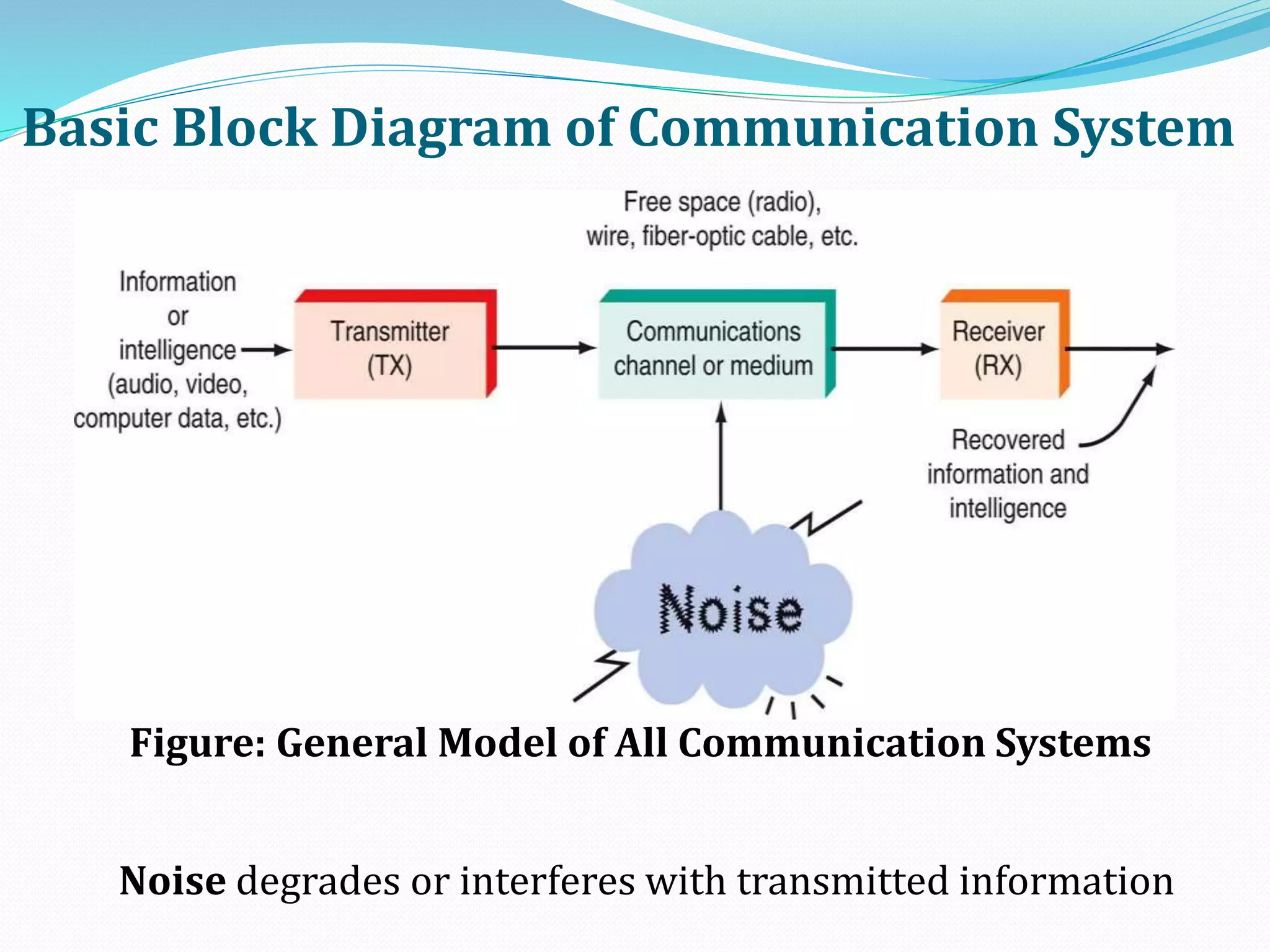
 Communication is the process of exchanging information.
 Sending and receiving of messages from one place to
another is called communication.
 The basic elements involved in communication—
1. Information Source
2. Transmitter
3. Communication Channel
4. Receiver
Types of Electronic Communication
Simplex
This type of communication is one-way. Examples are:
 Radio
 TV broadcasting
 Beeper (personal receiver)
Half Duplex
The form of two-way communication in which only one party
transmits at a time is known as half duplex. Examples are:
 Police, military, etc. radio transmissions
 Citizen band (CB)
 Family radio
 Amateur radio
Full Duplex
• Most electronic communication is two-way and is referred to as Full-
duplex.
• When people can talk and listen simultaneously, it is called full
duplex. The telephone is an example of this type of communication.
Types of Communication
 Analog Communication
AM, FM, PM etc.
 Digital Communication
ASK, FSK, PSK, QPSK etc.
 Microwave Communication
Communication through radio/microwaves/frequencies
 Optical Communication
Communication through Light
Basic Block Diagram of Communication System
Noise degrades or interferes with transmitted information
Figure: General Model of All Communication Systems
Basic Concepts of Communication
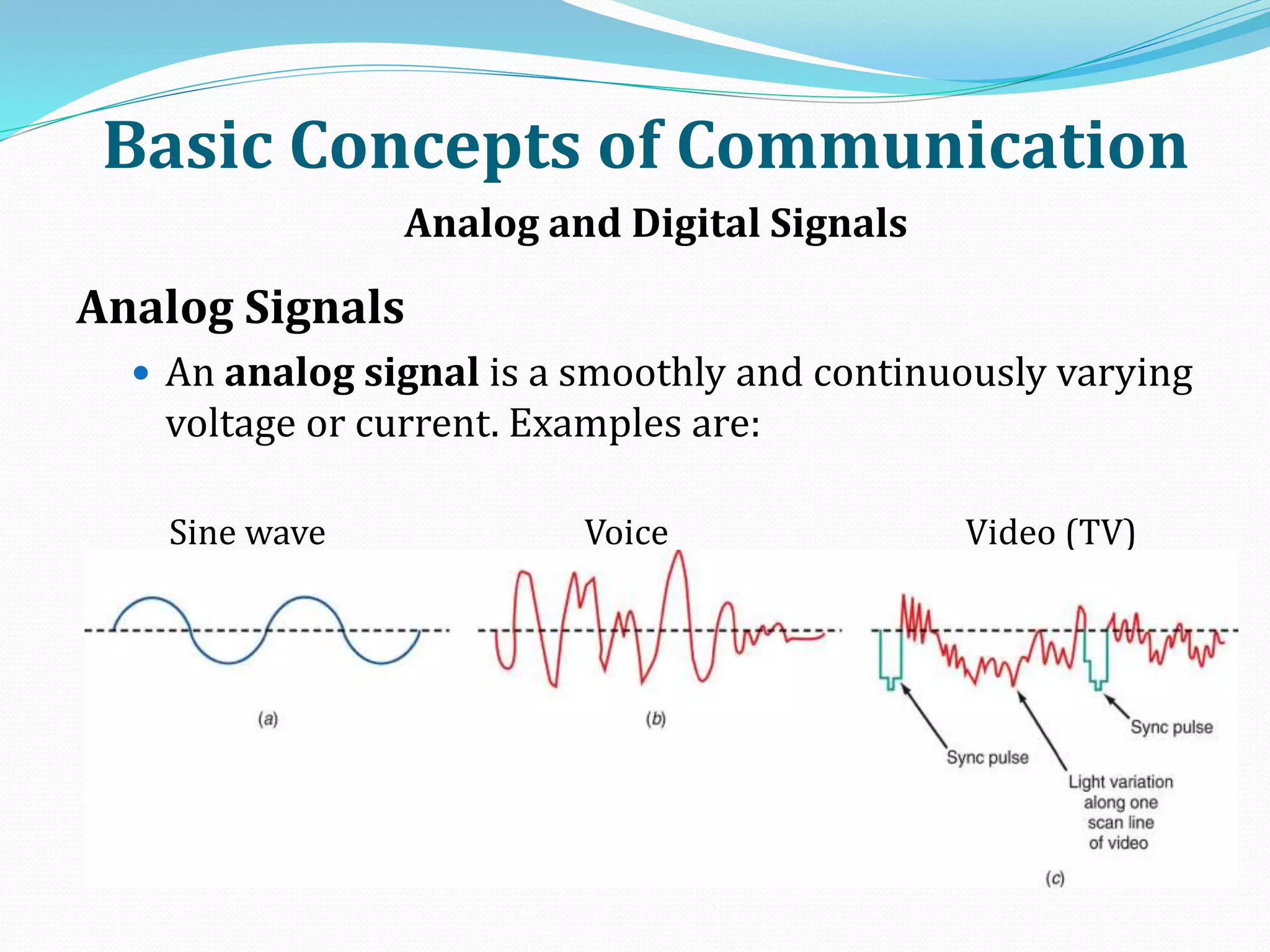
Analog Signals
 An analog signal is a smoothly and continuously varying
voltage or current. Examples are:
Sine wave Voice Video (TV)
Analog and Digital Signals
Basic Concepts of Communication
Digital Signals
 Digital signals change in steps or in discrete increments. Most digital
signals use binary or two-state codes. Examples are:
 Telegraph (Morse code)
 Continuous wave (CW) code
 Serial binary code (used in computers)
Analog and Digital Signals
Channel Multiplexing and Modulation
Modulation and multiplexing are electronic
techniques for transmitting information efficiently
from one place to another.
Modulation makes the information signal more
compatible with the medium.
Multiplexing allows more than one signal to be
transmitted concurrently over a single medium.
Channel Multiplexing and Modulation
Figure: Multiplexing and Modulation at The Transmitter
Channel Multiplexing and Modulation
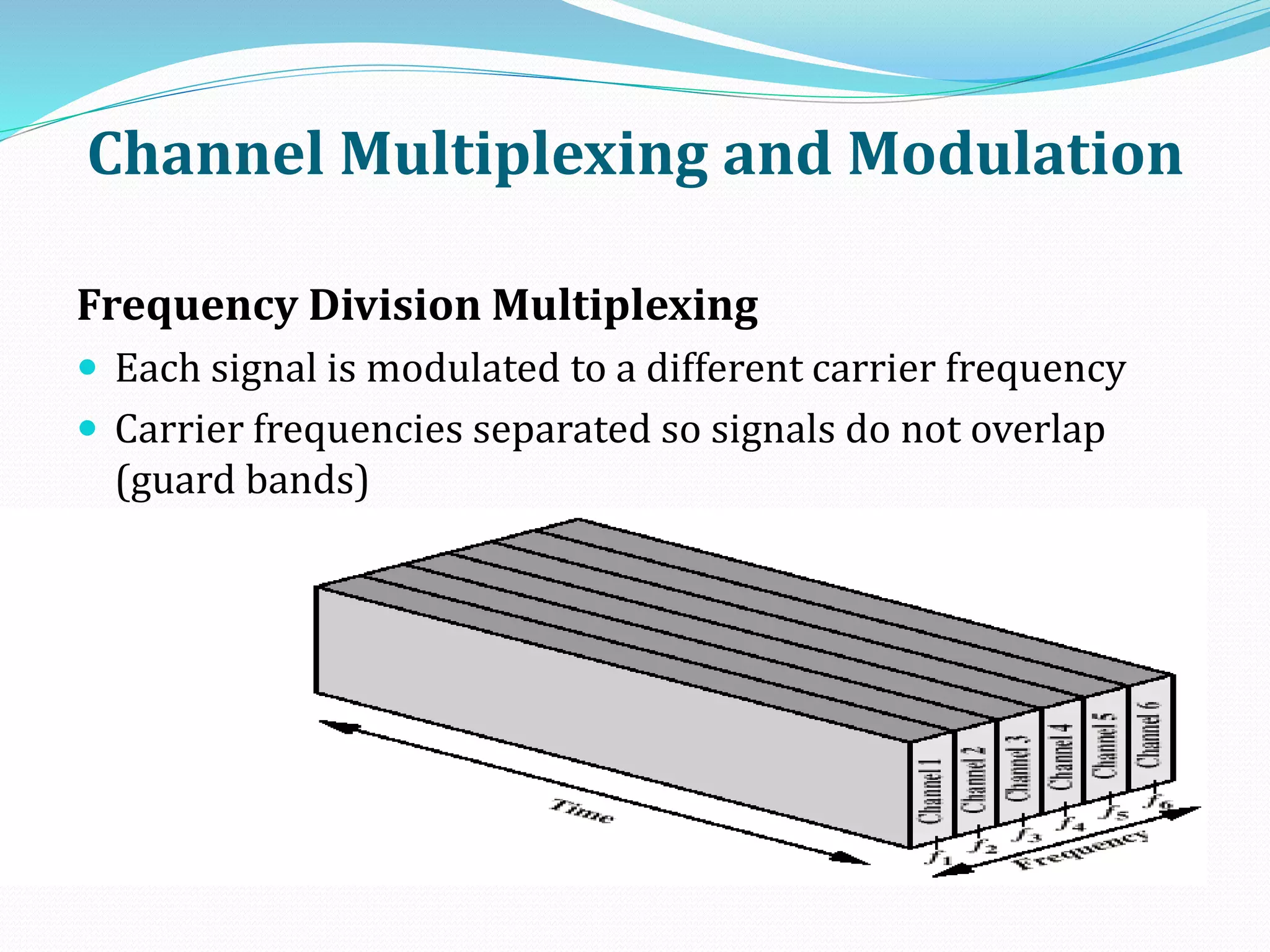
Frequency Division Multiplexing
 Each signal is modulated to a different carrier frequency
 Carrier frequencies separated so signals do not overlap
(guard bands)
Channel Multiplexing and Modulation
Time Division Multiplexing
 Multiple digital signals interleaved in time domain.
 Time slots preassigned to sources and fixed.
Modulation Formats
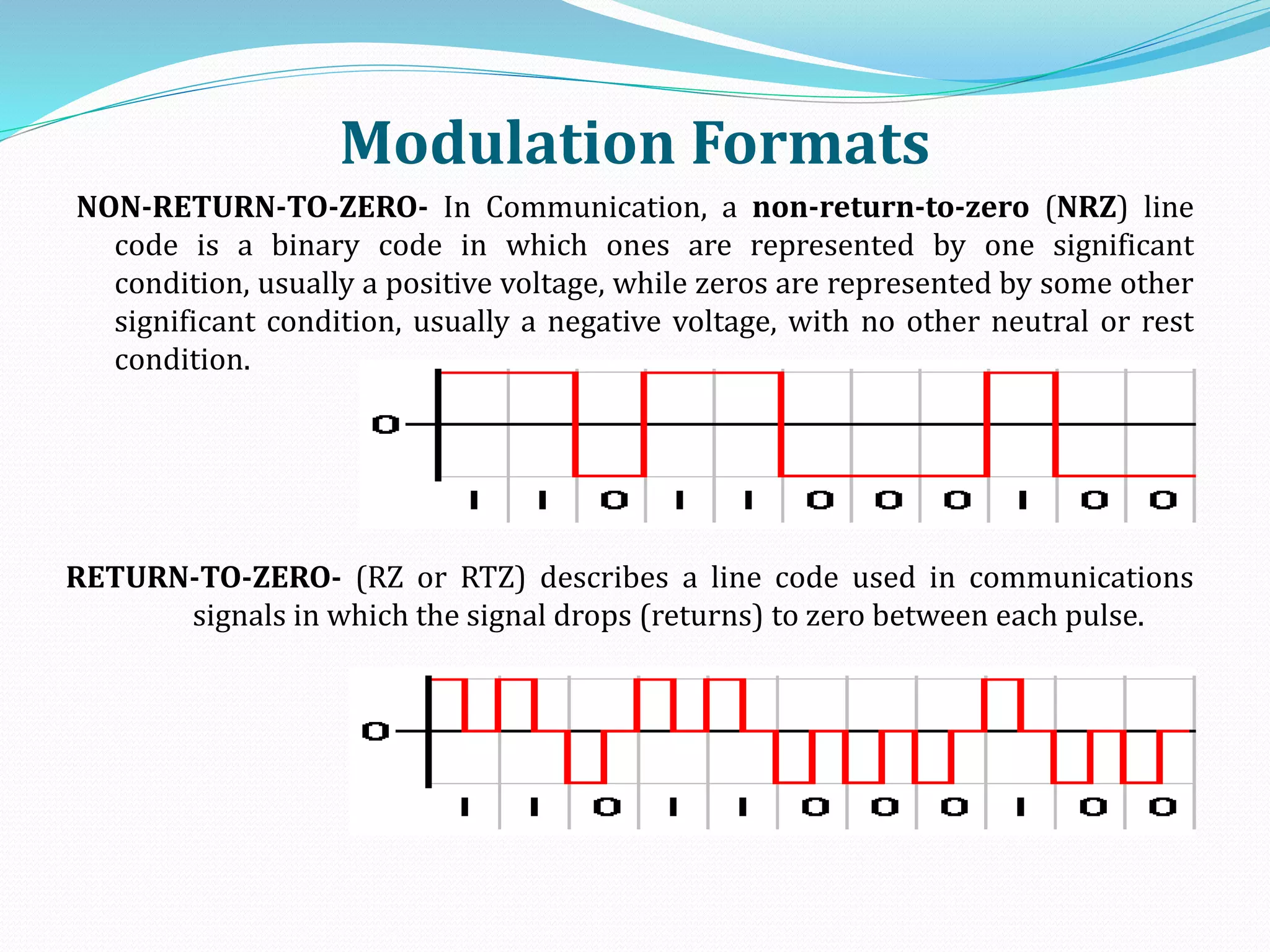
NON-RETURN-TO-ZERO- In Communication, a non-return-to-zero (NRZ) line
code is a binary code in which ones are represented by one significant
condition, usually a positive voltage, while zeros are represented by some other
significant condition, usually a negative voltage, with no other neutral or rest
condition.
RETURN-TO-ZERO- (RZ or RTZ) describes a line code used in communications
signals in which the signal drops (returns) to zero between each pulse.
12
Need of Fiber Optic Communications
 Fiber communication promised extremely high data rates,
which allow high capacity transmission quickly.
 It also had the potential for transmission over long
distances without the need to amplify and retransmit along
the way.
 Speed limit of electronic processing, limited bandwidth of
copper/coaxial cables.
 Optical fiber has very high-bandwidth (~30 THz)
 Optical fiber has very low loss (~0.25dB/km @1550nm)
 suitable for long-distance transmission
Increase of the bit rate distance
product BL for different
communication Technologies
over time.
Evaluation of Lightwave Communication Systems
A figure of merit of communication
systems is the bit rate–distance product,
BL, where B is the bit rate and L is the
repeater spacing.
Frequency and Wavelength Graph
15
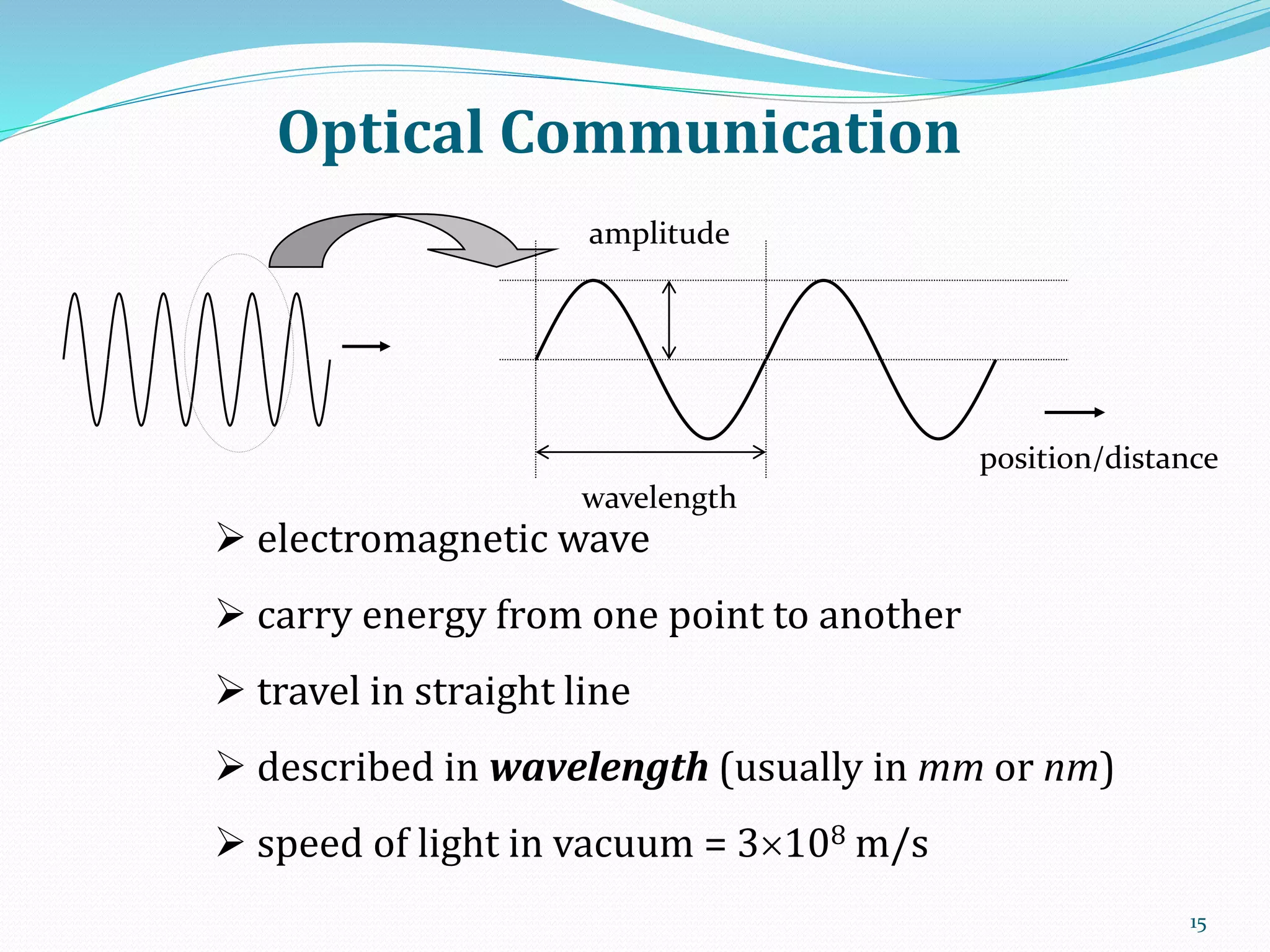
Optical Communication
amplitude
wavelength
position/distance
 electromagnetic wave
 carry energy from one point to another
 travel in straight line
 described in wavelength (usually in mm or nm)
 speed of light in vacuum = 3108 m/s
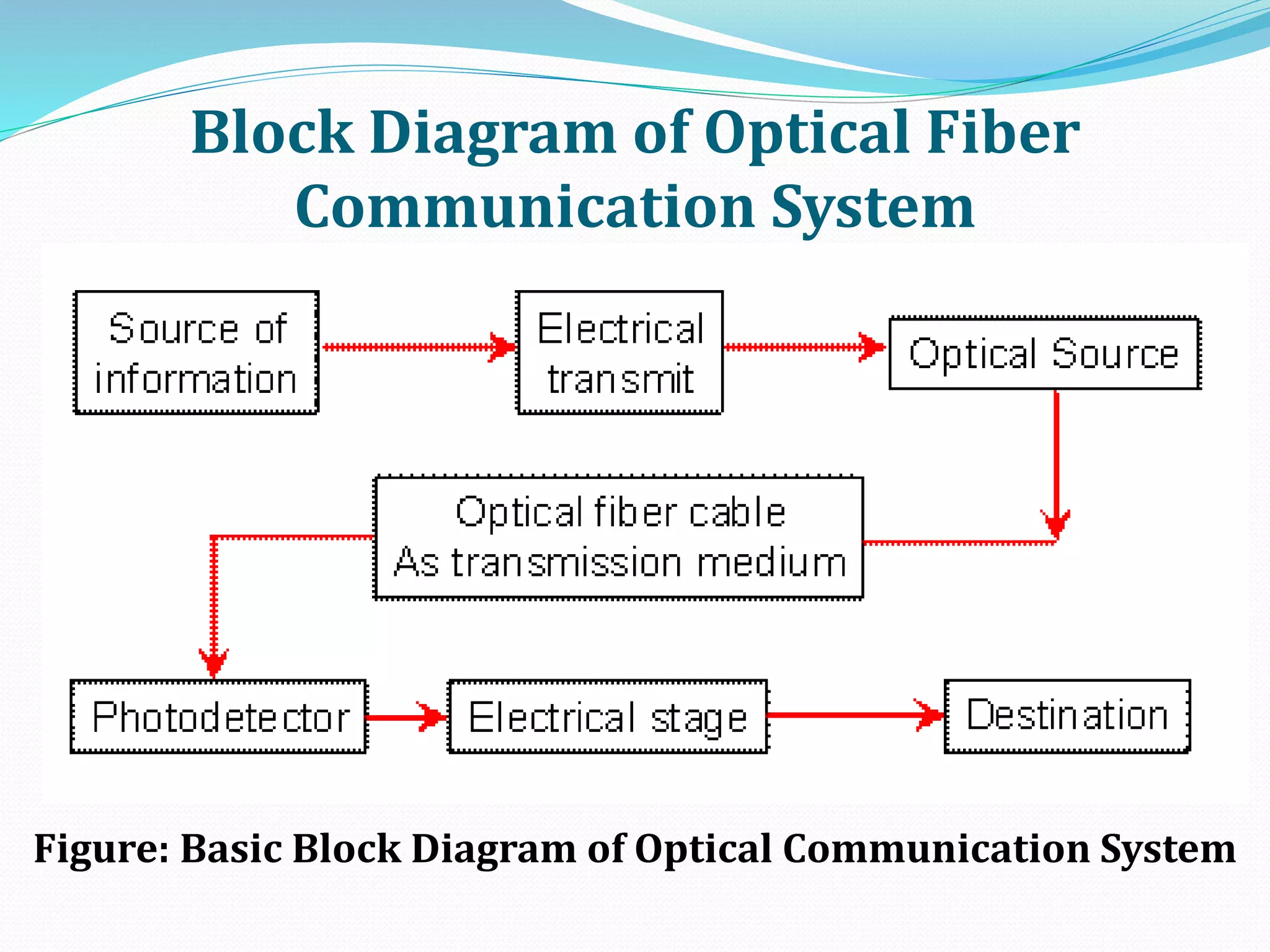
Block Diagram of Optical Fiber
Communication System
Figure: Basic Block Diagram of Optical Communication System
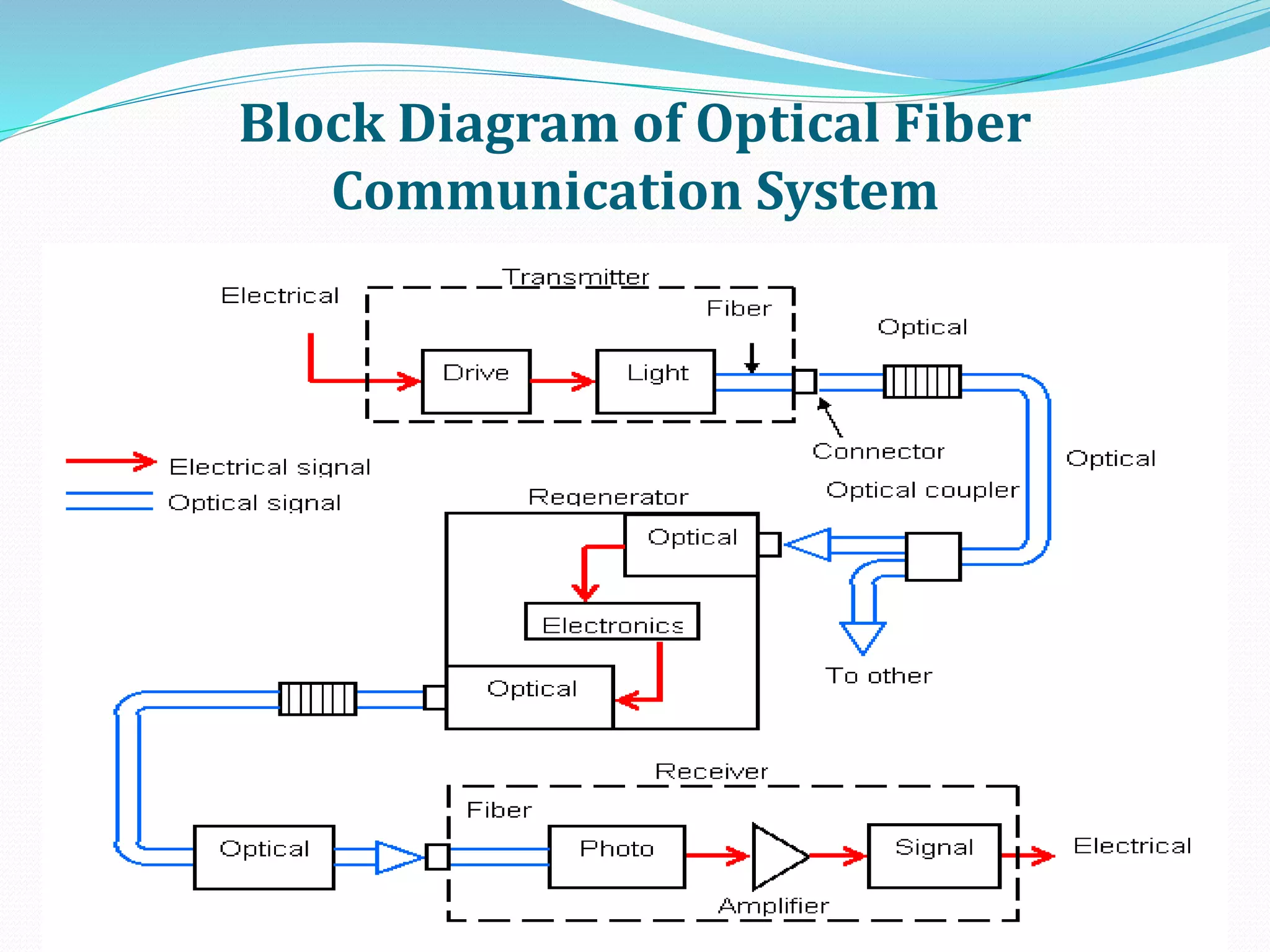
Block Diagram of Optical Fiber
Communication System
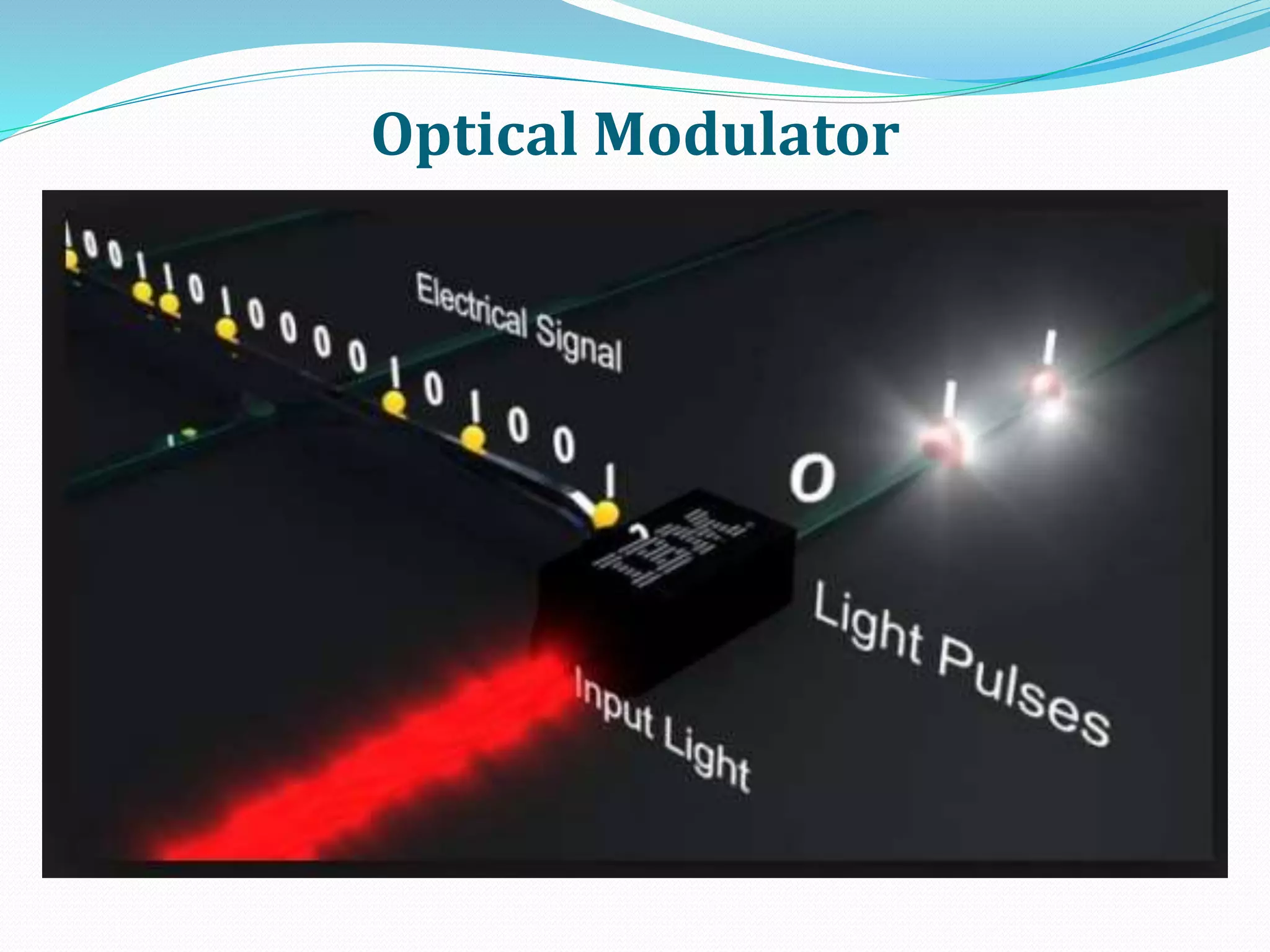
Optical Transmitter
Optical Modulator
Optical Receiver
Advantages of optical fiber communication
 Increased Bandwidth and Channel Capacity
 Low Signal Attenuation
 Immune to Noise
 No Crosstalk
 Lower Bit Error Rates
 Signal Security
 Electrical Isolation
 Reduced Size and Weight of Cables
 Radiation Resistant and Environment Friendly
 Resistant to Temperature Variations etc.
Disadvantages of optical fiber
communication
 Specialist skills needed
 Cost of installation
 Cost of transmission equipment from electrical to
optical signals
 Optical fibers can not carry electrical power
Applications of optical fiber communication
 As fibers are very flexible, they are used in flexible digital cameras.
 Fibers are used in mechanical imaging i.e. for inspection of mechanical welds in
pipes and engines of rockets, space shuttles, airplanes.
 Fibers are used in medical imaging such as endoscopes and laparoscopes.
 Fibers can be used under sea communication.
 Fibers are used in military applications such as aircrafts, ships, tanks etc.
 Nuclear testing applications use optical fiber phase sensors and transducers
 Fibers are used in public utility organizations like railways, TV transmission etc.
 Fibers are used in LAN systems of offices, industrial plants and colleges etc.
 Fibers are used in telecommunication such as voice telephones, video phones,
telegraph services, message services and data networks.
Queries……..
?

Optical Fiber communication

  • 1.
    What is Communication Communication is the process of exchanging information.  Sending and receiving of messages from one place to another is called communication.  The basic elements involved in communication— 1. Information Source 2. Transmitter 3. Communication Channel 4. Receiver
  • 2.
    Types of ElectronicCommunication Simplex This type of communication is one-way. Examples are:  Radio  TV broadcasting  Beeper (personal receiver) Half Duplex The form of two-way communication in which only one party transmits at a time is known as half duplex. Examples are:  Police, military, etc. radio transmissions  Citizen band (CB)  Family radio  Amateur radio Full Duplex • Most electronic communication is two-way and is referred to as Full- duplex. • When people can talk and listen simultaneously, it is called full duplex. The telephone is an example of this type of communication.
  • 3.
    Types of Communication Analog Communication AM, FM, PM etc.  Digital Communication ASK, FSK, PSK, QPSK etc.  Microwave Communication Communication through radio/microwaves/frequencies  Optical Communication Communication through Light
  • 4.
    Basic Block Diagramof Communication System Noise degrades or interferes with transmitted information Figure: General Model of All Communication Systems
  • 5.
    Basic Concepts ofCommunication Analog Signals  An analog signal is a smoothly and continuously varying voltage or current. Examples are: Sine wave Voice Video (TV) Analog and Digital Signals
  • 6.
    Basic Concepts ofCommunication Digital Signals  Digital signals change in steps or in discrete increments. Most digital signals use binary or two-state codes. Examples are:  Telegraph (Morse code)  Continuous wave (CW) code  Serial binary code (used in computers) Analog and Digital Signals
  • 7.
    Channel Multiplexing andModulation Modulation and multiplexing are electronic techniques for transmitting information efficiently from one place to another. Modulation makes the information signal more compatible with the medium. Multiplexing allows more than one signal to be transmitted concurrently over a single medium.
  • 8.
    Channel Multiplexing andModulation Figure: Multiplexing and Modulation at The Transmitter
  • 9.
    Channel Multiplexing andModulation Frequency Division Multiplexing  Each signal is modulated to a different carrier frequency  Carrier frequencies separated so signals do not overlap (guard bands)
  • 10.
    Channel Multiplexing andModulation Time Division Multiplexing  Multiple digital signals interleaved in time domain.  Time slots preassigned to sources and fixed.
  • 11.
    Modulation Formats NON-RETURN-TO-ZERO- InCommunication, a non-return-to-zero (NRZ) line code is a binary code in which ones are represented by one significant condition, usually a positive voltage, while zeros are represented by some other significant condition, usually a negative voltage, with no other neutral or rest condition. RETURN-TO-ZERO- (RZ or RTZ) describes a line code used in communications signals in which the signal drops (returns) to zero between each pulse.
  • 12.
    12 Need of FiberOptic Communications  Fiber communication promised extremely high data rates, which allow high capacity transmission quickly.  It also had the potential for transmission over long distances without the need to amplify and retransmit along the way.  Speed limit of electronic processing, limited bandwidth of copper/coaxial cables.  Optical fiber has very high-bandwidth (~30 THz)  Optical fiber has very low loss (~0.25dB/km @1550nm)  suitable for long-distance transmission
  • 13.
    Increase of thebit rate distance product BL for different communication Technologies over time. Evaluation of Lightwave Communication Systems A figure of merit of communication systems is the bit rate–distance product, BL, where B is the bit rate and L is the repeater spacing.
  • 14.
  • 15.
    15 Optical Communication amplitude wavelength position/distance  electromagneticwave  carry energy from one point to another  travel in straight line  described in wavelength (usually in mm or nm)  speed of light in vacuum = 3108 m/s
  • 16.
    Block Diagram ofOptical Fiber Communication System Figure: Basic Block Diagram of Optical Communication System
  • 17.
    Block Diagram ofOptical Fiber Communication System
  • 18.
  • 19.
  • 20.
  • 21.
    Advantages of opticalfiber communication  Increased Bandwidth and Channel Capacity  Low Signal Attenuation  Immune to Noise  No Crosstalk  Lower Bit Error Rates  Signal Security  Electrical Isolation  Reduced Size and Weight of Cables  Radiation Resistant and Environment Friendly  Resistant to Temperature Variations etc.
  • 22.
    Disadvantages of opticalfiber communication  Specialist skills needed  Cost of installation  Cost of transmission equipment from electrical to optical signals  Optical fibers can not carry electrical power
  • 23.
    Applications of opticalfiber communication  As fibers are very flexible, they are used in flexible digital cameras.  Fibers are used in mechanical imaging i.e. for inspection of mechanical welds in pipes and engines of rockets, space shuttles, airplanes.  Fibers are used in medical imaging such as endoscopes and laparoscopes.  Fibers can be used under sea communication.  Fibers are used in military applications such as aircrafts, ships, tanks etc.  Nuclear testing applications use optical fiber phase sensors and transducers  Fibers are used in public utility organizations like railways, TV transmission etc.  Fibers are used in LAN systems of offices, industrial plants and colleges etc.  Fibers are used in telecommunication such as voice telephones, video phones, telegraph services, message services and data networks.
  • 24.