Improving Coverage and Capacity in Cellular Systems
When cellular service providers build their networks, their networks are designed to provide coverage to
the area of desire with the expectation of possible increase in population in the near future.

-In some cases, it may be difficult to predict the need for network expansion or even when network
expansion is predictable, the time for network expansion arrives. There are several techniques to
expand an already existing network or to add more capacity to a network being built. In the following
we discuss two techniques.

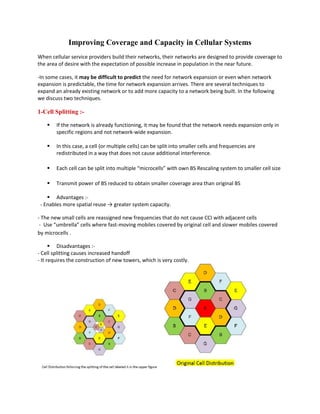
1-Cell Splitting :-

       If the network is already functioning, it may be found that the network needs expansion only in
        specific regions and not network‐wide expansion.

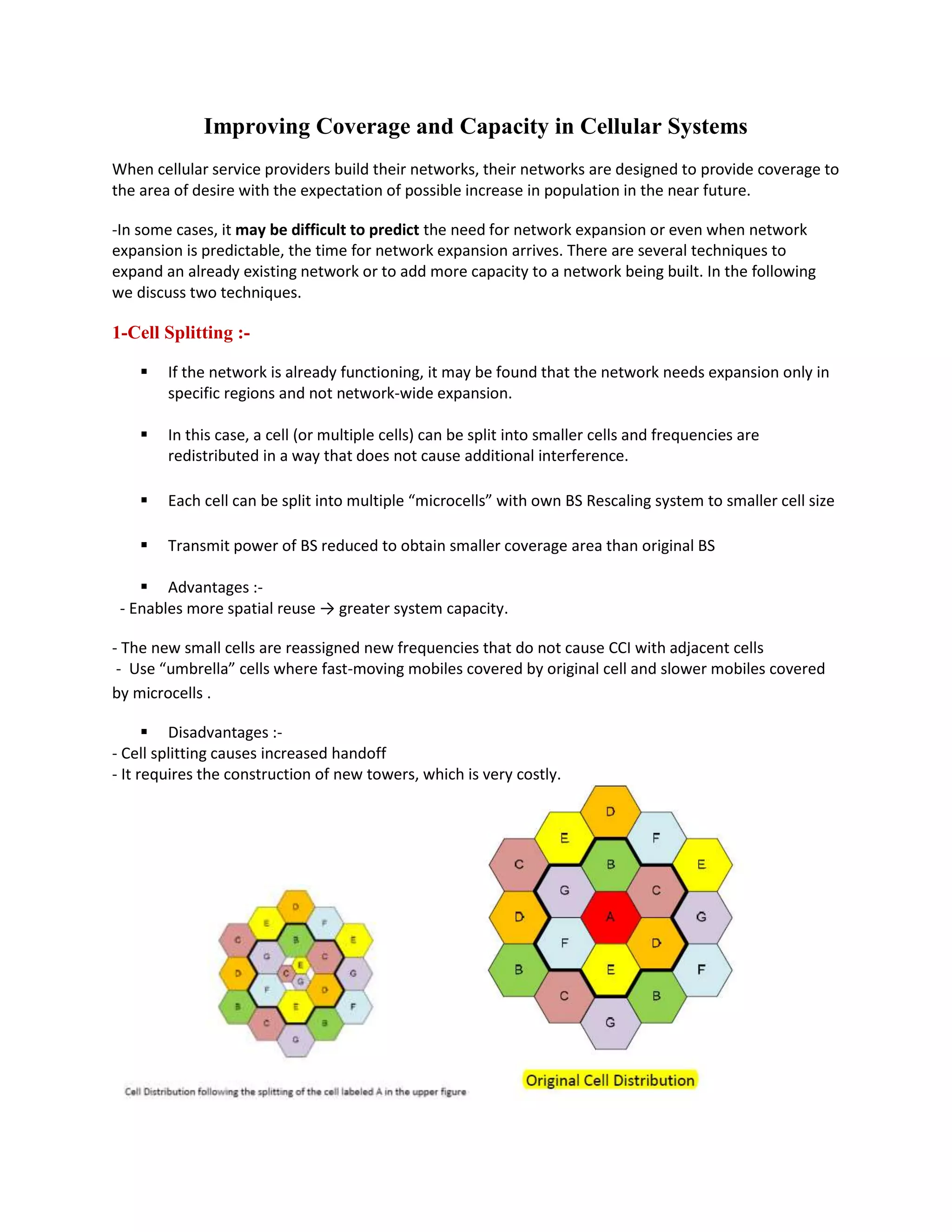
       In this case, a cell (or multiple cells) can be split into smaller cells and frequencies are
        redistributed in a way that does not cause additional interference.

       Each cell can be split into multiple “microcells” with own BS Rescaling system to smaller cell size

       Transmit power of BS reduced to obtain smaller coverage area than original BS

     Advantages :-
 - Enables more spatial reuse → greater system capacity.

- The new small cells are reassigned new frequencies that do not cause CCI with adjacent cells
 - Use “umbrella” cells where fast-moving mobiles covered by original cell and slower mobiles covered
by microcells .

       Disadvantages :-
- Cell splitting causes increased handoff
- It requires the construction of new towers, which is very costly.
2-Beam Tilting :-
    By tilting down the antenna beam, the power outside

    the cell, causing CCI reduces .


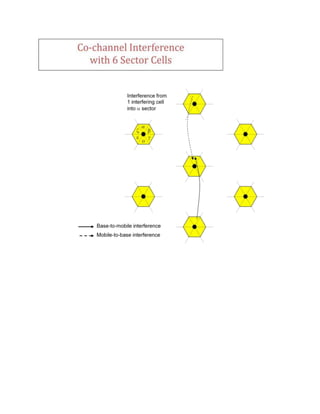
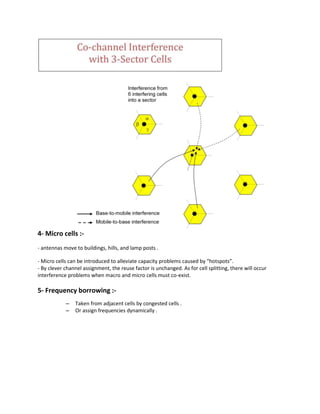
    3- Cell sectoring :-
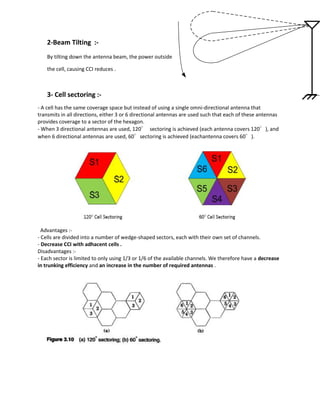
- A cell has the same coverage space but instead of using a single omni‐directional antenna that
transmits in all directions, either 3 or 6 directional antennas are used such that each of these antennas
provides coverage to a sector of the hexagon.
- When 3 directional antennas are used, 120° sectoring is achieved (each antenna covers 120°), and
when 6 directional antennas are used, 60°sectoring is achieved (eachantenna covers 60°).


  Advantages :-
- Cells are divided into a number of wedge-shaped sectors, each with their own set of channels.
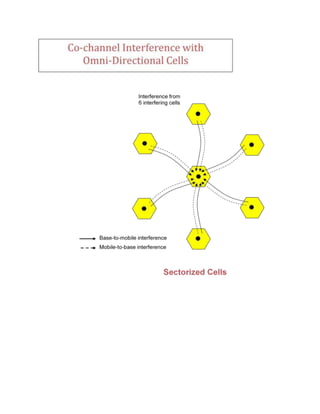
- Decrease CCI with adhacent cells .
Disadvantages :-
- Each sector is limited to only using 1/3 or 1/6 of the available channels. We therefore have a decrease
in trunking efficiency and an increase in the number of required antennas .
4- Micro cells :-
- antennas move to buildings, hills, and lamp posts .

- Micro cells can be introduced to alleviate capacity problems caused by “hotspots”.
- By clever channel assignment, the reuse factor is unchanged. As for cell splitting, there will occur
interference problems when macro and micro cells must co-exist.

5- Frequency borrowing :-
            –   Taken from adjacent cells by congested cells .
            –   Or assign frequencies dynamically .
Approaches to Cope with Increasing Capacity in
cellular Mobile system

Name : Tarek Nader Esmat

Sec : 8

Group : B


Under supervision By :
Dr.Hamed El-Shaneway

Improving coverage and capacity in cellular systems

  • 1.
    Improving Coverage andCapacity in Cellular Systems When cellular service providers build their networks, their networks are designed to provide coverage to the area of desire with the expectation of possible increase in population in the near future. -In some cases, it may be difficult to predict the need for network expansion or even when network expansion is predictable, the time for network expansion arrives. There are several techniques to expand an already existing network or to add more capacity to a network being built. In the following we discuss two techniques. 1-Cell Splitting :-  If the network is already functioning, it may be found that the network needs expansion only in specific regions and not network‐wide expansion.  In this case, a cell (or multiple cells) can be split into smaller cells and frequencies are redistributed in a way that does not cause additional interference.  Each cell can be split into multiple “microcells” with own BS Rescaling system to smaller cell size  Transmit power of BS reduced to obtain smaller coverage area than original BS  Advantages :- - Enables more spatial reuse → greater system capacity. - The new small cells are reassigned new frequencies that do not cause CCI with adjacent cells - Use “umbrella” cells where fast-moving mobiles covered by original cell and slower mobiles covered by microcells .  Disadvantages :- - Cell splitting causes increased handoff - It requires the construction of new towers, which is very costly.
  • 2.
    2-Beam Tilting :- By tilting down the antenna beam, the power outside the cell, causing CCI reduces . 3- Cell sectoring :- - A cell has the same coverage space but instead of using a single omni‐directional antenna that transmits in all directions, either 3 or 6 directional antennas are used such that each of these antennas provides coverage to a sector of the hexagon. - When 3 directional antennas are used, 120° sectoring is achieved (each antenna covers 120°), and when 6 directional antennas are used, 60°sectoring is achieved (eachantenna covers 60°). Advantages :- - Cells are divided into a number of wedge-shaped sectors, each with their own set of channels. - Decrease CCI with adhacent cells . Disadvantages :- - Each sector is limited to only using 1/3 or 1/6 of the available channels. We therefore have a decrease in trunking efficiency and an increase in the number of required antennas .
  • 5.
    4- Micro cells:- - antennas move to buildings, hills, and lamp posts . - Micro cells can be introduced to alleviate capacity problems caused by “hotspots”. - By clever channel assignment, the reuse factor is unchanged. As for cell splitting, there will occur interference problems when macro and micro cells must co-exist. 5- Frequency borrowing :- – Taken from adjacent cells by congested cells . – Or assign frequencies dynamically .
  • 6.
    Approaches to Copewith Increasing Capacity in cellular Mobile system Name : Tarek Nader Esmat Sec : 8 Group : B Under supervision By : Dr.Hamed El-Shaneway