

04/21/15 1
Ashis Kumar Chanda
MS (2014-15), Roll 343
Department of Computer Science and Engineering
University of Dhaka
Submitted to:
Prof. Hafiz Md. Hasan Babu
 Logical Circuits
 Sequential Logical Circuits
 Finite State Machine
 Minimization Methods
 Applications
 Summary
04/21/15 2
If you have good CGPA score AND
publications
apply for research assistantship
If you have good score OR presentation skill
apply for teacher assistantship
04/21/15 3
04/21/15 4
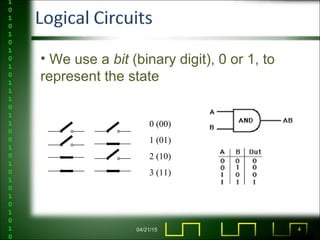
• We use a bit (binary digit), 0 or 1, to
represent the state
0 (00)
1 (01)
2 (10)
3 (11)
04/21/15 5
 Combinational Logical Circuits
o The logic level at the output depends on the
combination of logic levels present at the inputs
o It has no memory characteristic
 Sequential Logical Circuits
o The output follows a predetermined states
o It has memory characteristic
04/21/15 6
 The word “Sequential” means that things
happen in a “sequence”
Why is it important?
Need to follow synchronous process using
clock signal
04/21/15 7
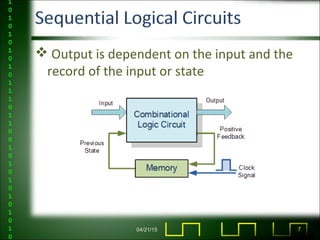
 Output is dependent on the input and the
record of the input or state
04/21/15 8
 What is Finite State Diagrams?
o The behavioral view of sequential circuits at
logic level
Why will we express a circuit in Finite State
Diagrams?
o state diagrams encapsulate the traces that the
corresponding circuit can accept and produce
04/21/15 9
oA set of primary input patterns, X
oA set of primary output patterns, Y
oA set of states, S
oA state transition function
oAn output transition function (Mealy
model, Moore model)
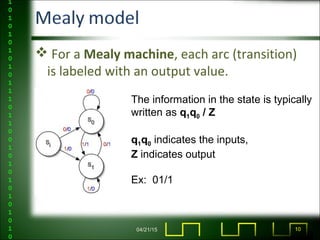
 For a Mealy machine, each arc (transition)
is labeled with an output value.
04/21/15 10
The information in the state is typically
written as q1q0 / Z 
q1q0 indicates the inputs,
Z indicates output
Ex: 01/1
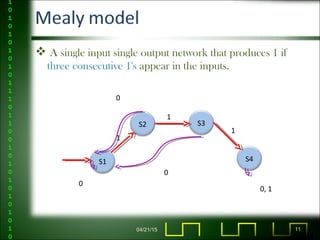
 A single input single output network that produces 1 if
three consecutive 1's appear in the inputs.
04/21/15 11
S1
S2 S3
S4
1
1
1
0
0
0
0, 1
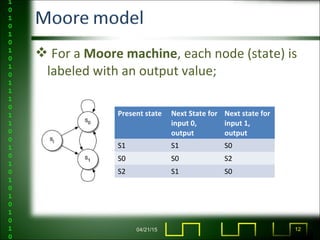
 For a Moore machine, each node (state) is
labeled with an output value;
04/21/15 12
Present state Next State for
input 0,
output
Next state for
input 1,
output
S1 S1 S0
S0 S0 S2
S2 S1 S0
04/21/15 13
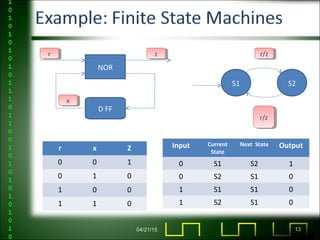
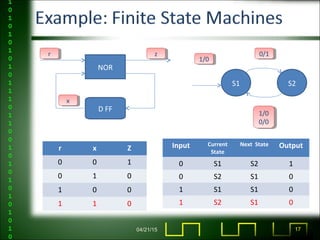
NOR
D FF
rr
xx
zz
Input Current
State
Next State Output
0 S1 S2 1
0 S2 S1 0
1 S1 S1 0
1 S2 S1 0
r x Z
0 0 1
0 1 0
1 0 0
1 1 0
S1 S2
r/zr/z
r/zr/z
04/21/15 14
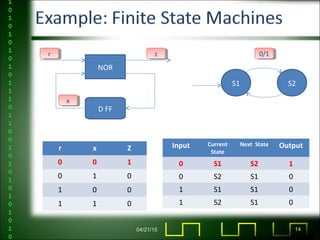
NOR
D FF
rr
xx
zz
Input Current
State
Next State Output
0 S1 S2 1
0 S2 S1 0
1 S1 S1 0
1 S2 S1 0
r x Z
0 0 1
0 1 0
1 0 0
1 1 0
S1 S2
0/10/1
04/21/15 15
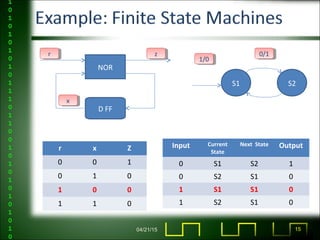
NOR
D FF
rr
xx
zz
r x Z
0 0 1
0 1 0
1 0 0
1 1 0
S1 S2
1/01/0
0/10/1
Input Current
State
Next State Output
0 S1 S2 1
0 S2 S1 0
1 S1 S1 0
1 S2 S1 0
04/21/15 16
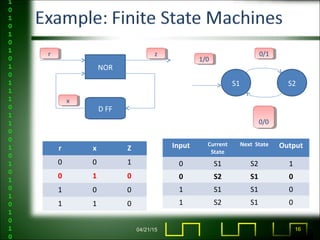
NOR
D FF
rr
xx
zz
r x Z
0 0 1
0 1 0
1 0 0
1 1 0
S1 S2
1/01/0
0/10/1
0/00/0
Input Current
State
Next State Output
0 S1 S2 1
0 S2 S1 0
1 S1 S1 0
1 S2 S1 0
04/21/15 17
NOR
D FF
rr
xx
zz
r x Z
0 0 1
0 1 0
1 0 0
1 1 0
S1 S2
1/01/0
0/10/1
1/0
0/0
1/0
0/0
Input Current
State
Next State Output
0 S1 S2 1
0 S2 S1 0
1 S1 S1 0
1 S2 S1 0
04/21/15 18
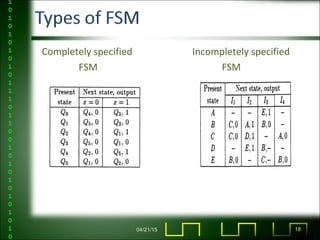
Completely specified Incompletely specified
FSM FSM
04/21/15 19
04/21/15 20
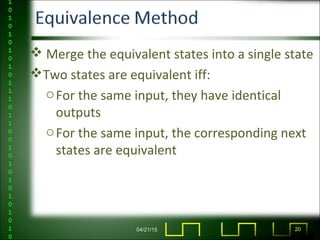
 Merge the equivalent states into a single state
Two states are equivalent iff:
oFor the same input, they have identical
outputs
oFor the same input, the corresponding next
states are equivalent
04/21/15 21
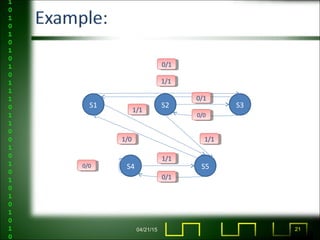
S3S1 S2
S4 S5
0/10/1
1/11/1
1/11/1
1/11/1
1/11/1
0/10/1
0/10/1
0/00/0
0/00/0
1/01/0
04/21/15 22
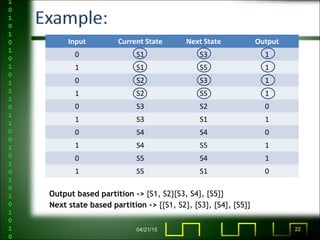
Input Current State Next State Output
0 S1 S3 1
1 S1 S5 1
0 S2 S3 1
1 S2 S5 1
0 S3 S2 0
1 S3 S1 1
0 S4 S4 0
1 S4 S5 1
0 S5 S4 1
1 S5 S1 0
Output based partition -> {S1, S2}
Next state based partition -> {{S1, S2}, {S3}, {S4}, {S5}}
{S3, S4}, {S5}}
04/21/15 23
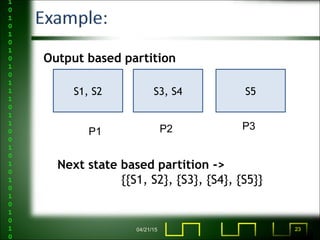
Output based partition
Next state based partition ->
{{S1, S2}, {S3}, {S4}, {S5}}
S1, S2 S3, S4 S5
P1 P2 P3
04/21/15 24
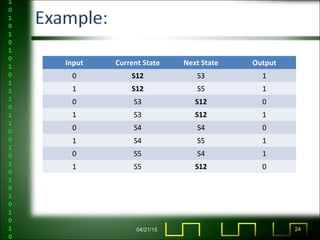
Input Current State Next State Output
0 S12 S3 1
1 S12 S5 1
0 S3 S12 0
1 S3 S12 1
0 S4 S4 0
1 S4 S5 1
0 S5 S4 1
1 S5 S12 0
04/21/15 25
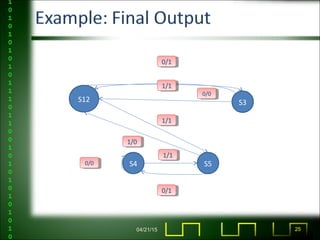
S3S12
S4 S5
1/01/0
0/00/0
0/00/0
1/11/1
1/11/1
1/11/1
0/10/1
0/10/1
04/21/15 26
 The optimization process will reduce the
area of circuit.
 So, we can save cost.
 It ensures better performance
04/21/15 27
Computer memory
Delay and storage elements
Finite state machines
Minimizing ensures smaller circuit area
Better performance from fewer number of
components
04/21/15 28
 Sequential logic circuit
 The minimization process
 Improvement in speed and cost
 Applications
Questions?
04/21/15 29
Digital systems principles and applications
oBy Tocci 2001
Synthesis And Optimization of Digital
circuits
o Giovani De Micheli
Digital Logic Design [Sequential circuits]
oDr. Eng. Ahmed H. Madian
 http://en.wikipedia.org/wiki/Moore_machine
 http://en.wikipedia.org/wiki/Mealy_machine
04/21/15 30
Sequential logic circuit optimization

Sequential logic circuit optimization

  • 1.
    04/21/15 1 Ashis KumarChanda MS (2014-15), Roll 343 Department of Computer Science and Engineering University of Dhaka Submitted to: Prof. Hafiz Md. Hasan Babu
  • 2.
     Logical Circuits Sequential Logical Circuits  Finite State Machine  Minimization Methods  Applications  Summary 04/21/15 2
  • 3.
    If you havegood CGPA score AND publications apply for research assistantship If you have good score OR presentation skill apply for teacher assistantship 04/21/15 3
  • 4.
    04/21/15 4 • Weuse a bit (binary digit), 0 or 1, to represent the state 0 (00) 1 (01) 2 (10) 3 (11)
  • 5.
    04/21/15 5  CombinationalLogical Circuits o The logic level at the output depends on the combination of logic levels present at the inputs o It has no memory characteristic  Sequential Logical Circuits o The output follows a predetermined states o It has memory characteristic
  • 6.
    04/21/15 6  Theword “Sequential” means that things happen in a “sequence” Why is it important? Need to follow synchronous process using clock signal
  • 7.
    04/21/15 7  Outputis dependent on the input and the record of the input or state
  • 8.
    04/21/15 8  Whatis Finite State Diagrams? o The behavioral view of sequential circuits at logic level Why will we express a circuit in Finite State Diagrams? o state diagrams encapsulate the traces that the corresponding circuit can accept and produce
  • 9.
    04/21/15 9 oA setof primary input patterns, X oA set of primary output patterns, Y oA set of states, S oA state transition function oAn output transition function (Mealy model, Moore model)
  • 10.
     For aMealy machine, each arc (transition) is labeled with an output value. 04/21/15 10 The information in the state is typically written as q1q0 / Z  q1q0 indicates the inputs, Z indicates output Ex: 01/1
  • 11.
     A singleinput single output network that produces 1 if three consecutive 1's appear in the inputs. 04/21/15 11 S1 S2 S3 S4 1 1 1 0 0 0 0, 1
  • 12.
     For aMoore machine, each node (state) is labeled with an output value; 04/21/15 12 Present state Next State for input 0, output Next state for input 1, output S1 S1 S0 S0 S0 S2 S2 S1 S0
  • 13.
    04/21/15 13 NOR D FF rr xx zz InputCurrent State Next State Output 0 S1 S2 1 0 S2 S1 0 1 S1 S1 0 1 S2 S1 0 r x Z 0 0 1 0 1 0 1 0 0 1 1 0 S1 S2 r/zr/z r/zr/z
  • 14.
    04/21/15 14 NOR D FF rr xx zz InputCurrent State Next State Output 0 S1 S2 1 0 S2 S1 0 1 S1 S1 0 1 S2 S1 0 r x Z 0 0 1 0 1 0 1 0 0 1 1 0 S1 S2 0/10/1
  • 15.
    04/21/15 15 NOR D FF rr xx zz rx Z 0 0 1 0 1 0 1 0 0 1 1 0 S1 S2 1/01/0 0/10/1 Input Current State Next State Output 0 S1 S2 1 0 S2 S1 0 1 S1 S1 0 1 S2 S1 0
  • 16.
    04/21/15 16 NOR D FF rr xx zz rx Z 0 0 1 0 1 0 1 0 0 1 1 0 S1 S2 1/01/0 0/10/1 0/00/0 Input Current State Next State Output 0 S1 S2 1 0 S2 S1 0 1 S1 S1 0 1 S2 S1 0
  • 17.
    04/21/15 17 NOR D FF rr xx zz rx Z 0 0 1 0 1 0 1 0 0 1 1 0 S1 S2 1/01/0 0/10/1 1/0 0/0 1/0 0/0 Input Current State Next State Output 0 S1 S2 1 0 S2 S1 0 1 S1 S1 0 1 S2 S1 0
  • 18.
    04/21/15 18 Completely specifiedIncompletely specified FSM FSM
  • 19.
  • 20.
    04/21/15 20  Mergethe equivalent states into a single state Two states are equivalent iff: oFor the same input, they have identical outputs oFor the same input, the corresponding next states are equivalent
  • 21.
    04/21/15 21 S3S1 S2 S4S5 0/10/1 1/11/1 1/11/1 1/11/1 1/11/1 0/10/1 0/10/1 0/00/0 0/00/0 1/01/0
  • 22.
    04/21/15 22 Input CurrentState Next State Output 0 S1 S3 1 1 S1 S5 1 0 S2 S3 1 1 S2 S5 1 0 S3 S2 0 1 S3 S1 1 0 S4 S4 0 1 S4 S5 1 0 S5 S4 1 1 S5 S1 0 Output based partition -> {S1, S2} Next state based partition -> {{S1, S2}, {S3}, {S4}, {S5}} {S3, S4}, {S5}}
  • 23.
    04/21/15 23 Output basedpartition Next state based partition -> {{S1, S2}, {S3}, {S4}, {S5}} S1, S2 S3, S4 S5 P1 P2 P3
  • 24.
    04/21/15 24 Input CurrentState Next State Output 0 S12 S3 1 1 S12 S5 1 0 S3 S12 0 1 S3 S12 1 0 S4 S4 0 1 S4 S5 1 0 S5 S4 1 1 S5 S12 0
  • 25.
  • 26.
    04/21/15 26  Theoptimization process will reduce the area of circuit.  So, we can save cost.  It ensures better performance
  • 27.
    04/21/15 27 Computer memory Delayand storage elements Finite state machines Minimizing ensures smaller circuit area Better performance from fewer number of components
  • 28.
    04/21/15 28  Sequentiallogic circuit  The minimization process  Improvement in speed and cost  Applications
  • 29.
  • 30.
    Digital systems principlesand applications oBy Tocci 2001 Synthesis And Optimization of Digital circuits o Giovani De Micheli Digital Logic Design [Sequential circuits] oDr. Eng. Ahmed H. Madian  http://en.wikipedia.org/wiki/Moore_machine  http://en.wikipedia.org/wiki/Mealy_machine 04/21/15 30

Editor's Notes

  • #7 In general, human operator activates an input switch at random time. It is asynchronous process. This randomness can produce unpredictable and undesirable results. Thus, we need to follow synchronous process using clock signal