2.3 Build sequential
    logic circuit
      Combinational logic circuit
        Sequential logic circuit
               Flip-flop
    Build flip-flop using logic gates
                                        1
Objectives:
•
1 Define sequential logic circuit.
•
2 Differentiate between combinational logic circuit and
   sequential logic circuit.
•
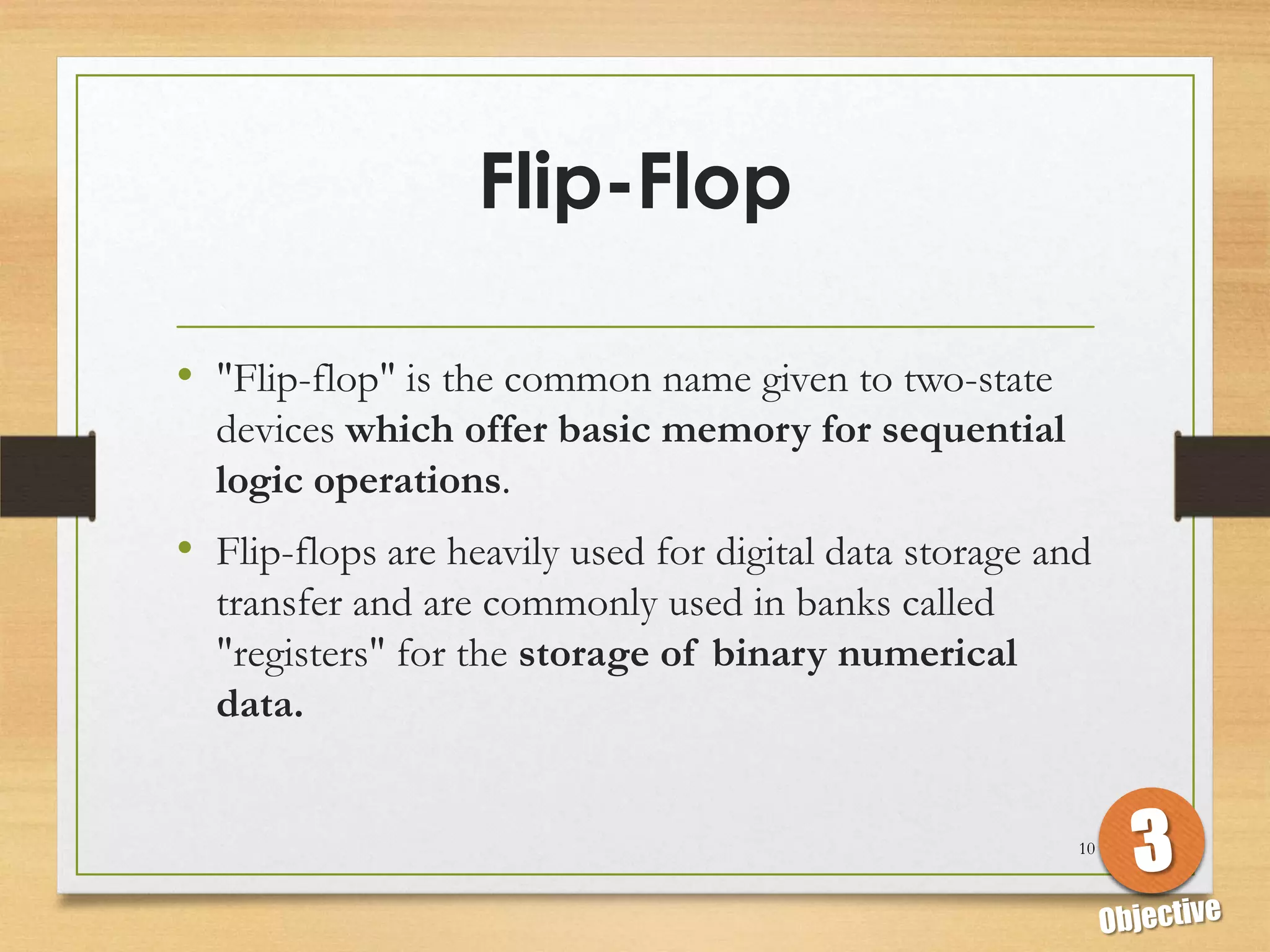
3 Describe flip - flop.
•
4 Identify various types of flip-flops.
•
5 Build SR, JK, T and D flip – flop using logic gates.
•
6 Draw the symbol and truth table of SR, JK, T and D flip
   – flop.

                                                            2
Sequential & Combinational
                 logic circuit
1 Define sequential logic circuit.
2 Differentiate between combinational logic circuit and
  sequential logic circuit.


                                                          3
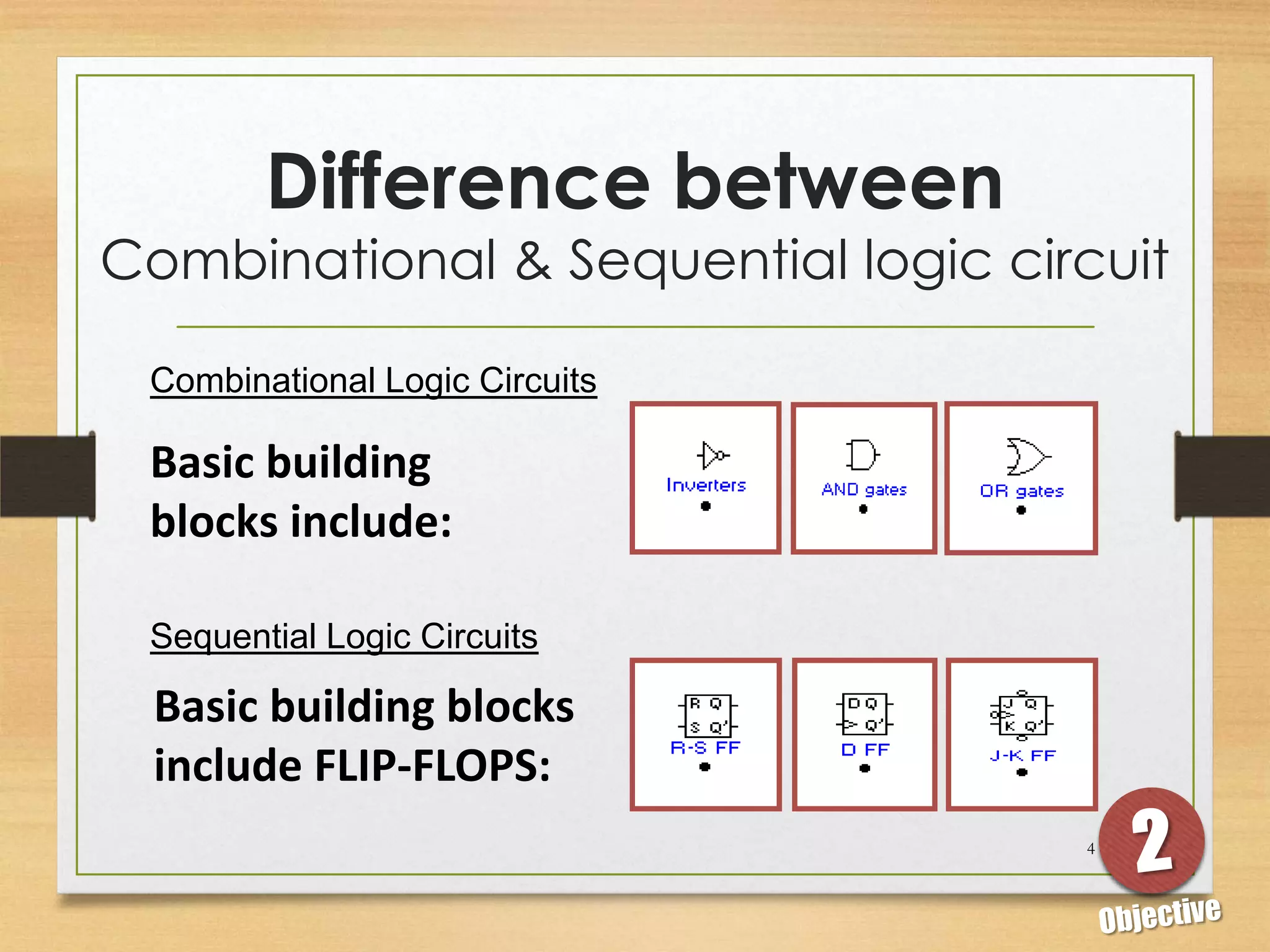
Difference between
Combinational & Sequential logic circuit

 Combinational Logic Circuits

 Basic building
 blocks include:

 Sequential Logic Circuits

  Basic building blocks
  include FLIP-FLOPS:
                                    4
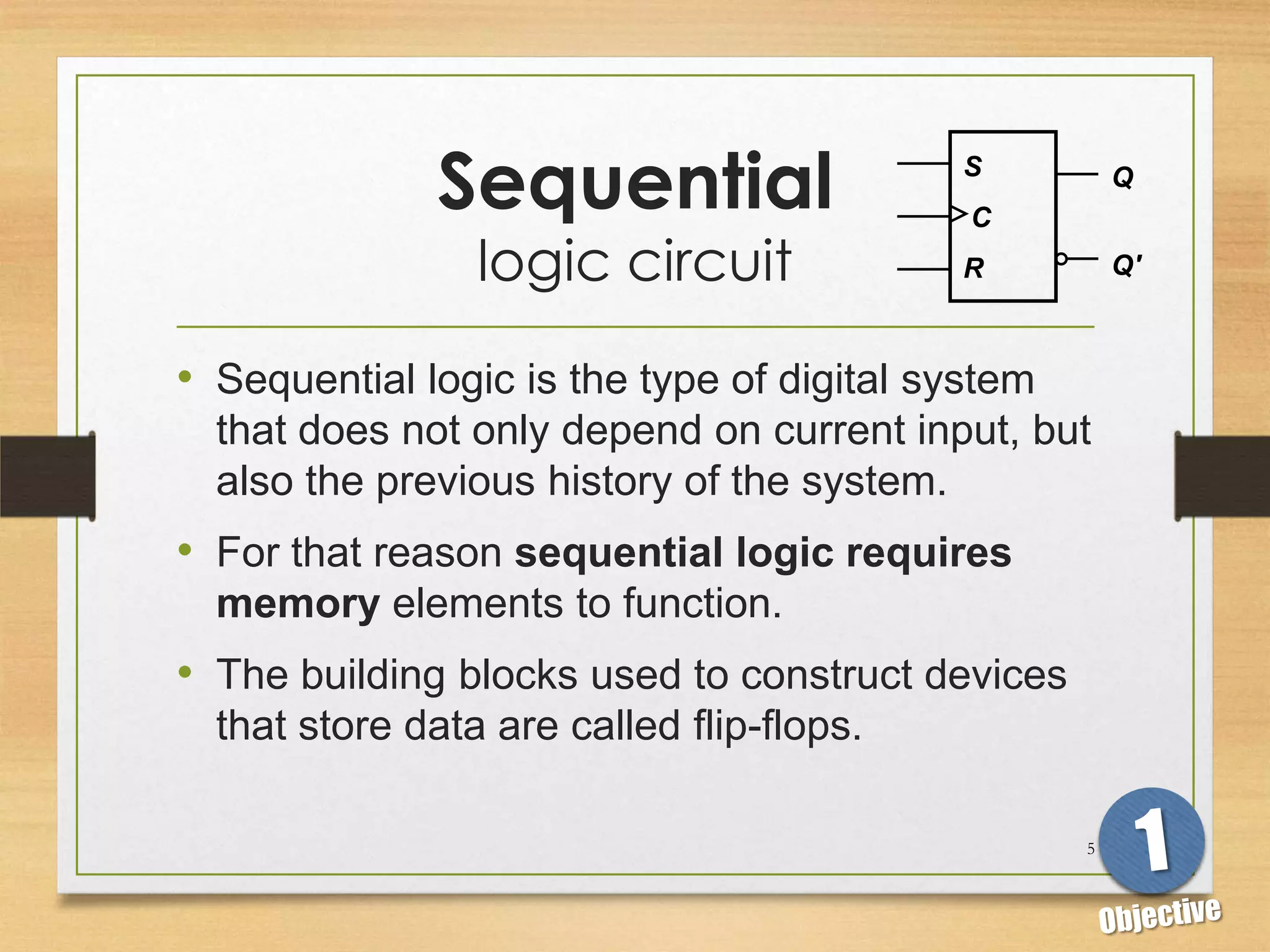
Sequential                   S
                                            C
                                                       Q


                 logic circuit             R           Q'


• Sequential logic is the type of digital system
  that does not only depend on current input, but
  also the previous history of the system.
• For that reason sequential logic requires
  memory elements to function.
• The building blocks used to construct devices
  that store data are called flip-flops.

                                                   5
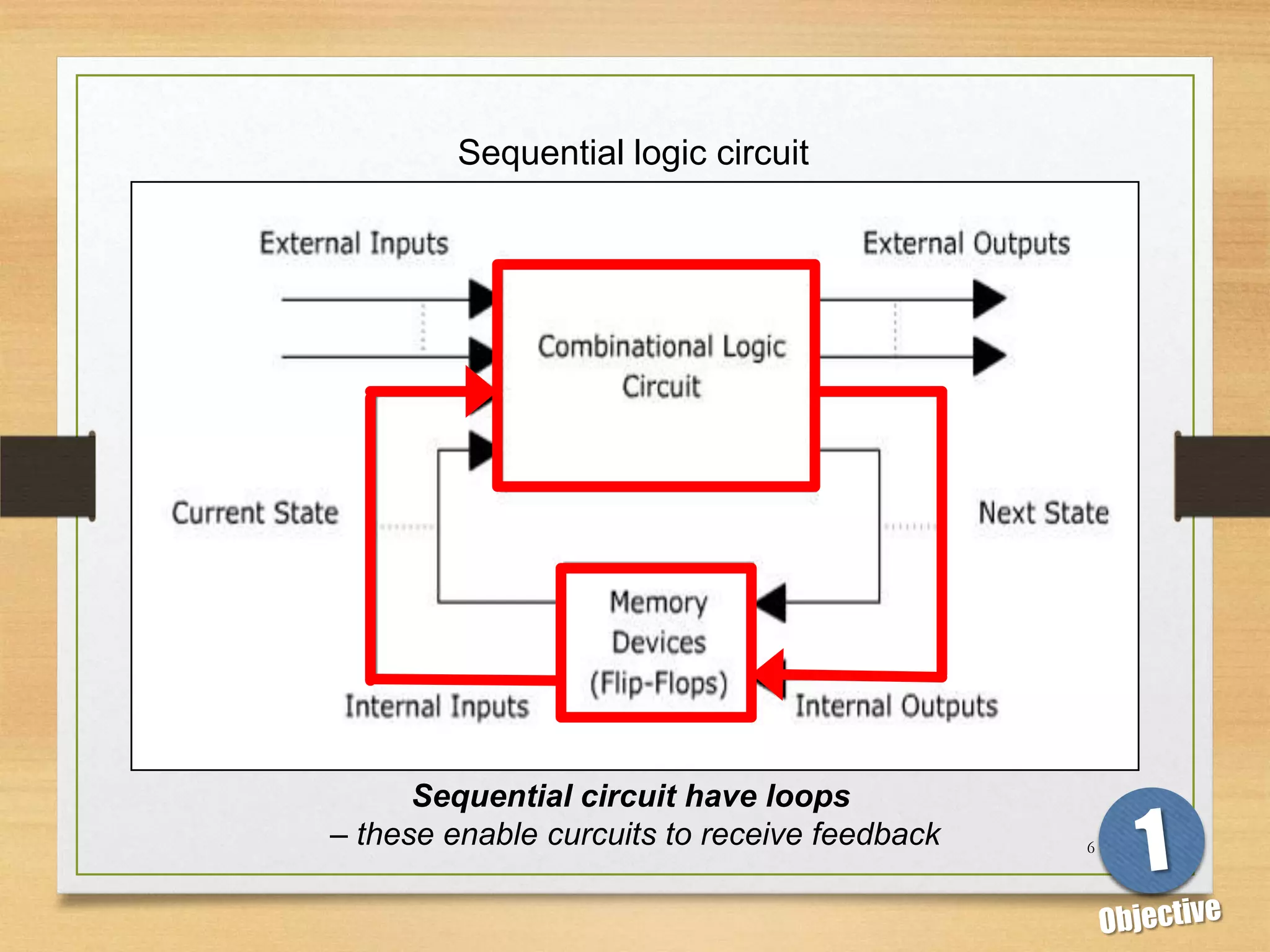
Sequential logic circuit


      Sequential circuit have loops
– these enable curcuits to receive feedback   6
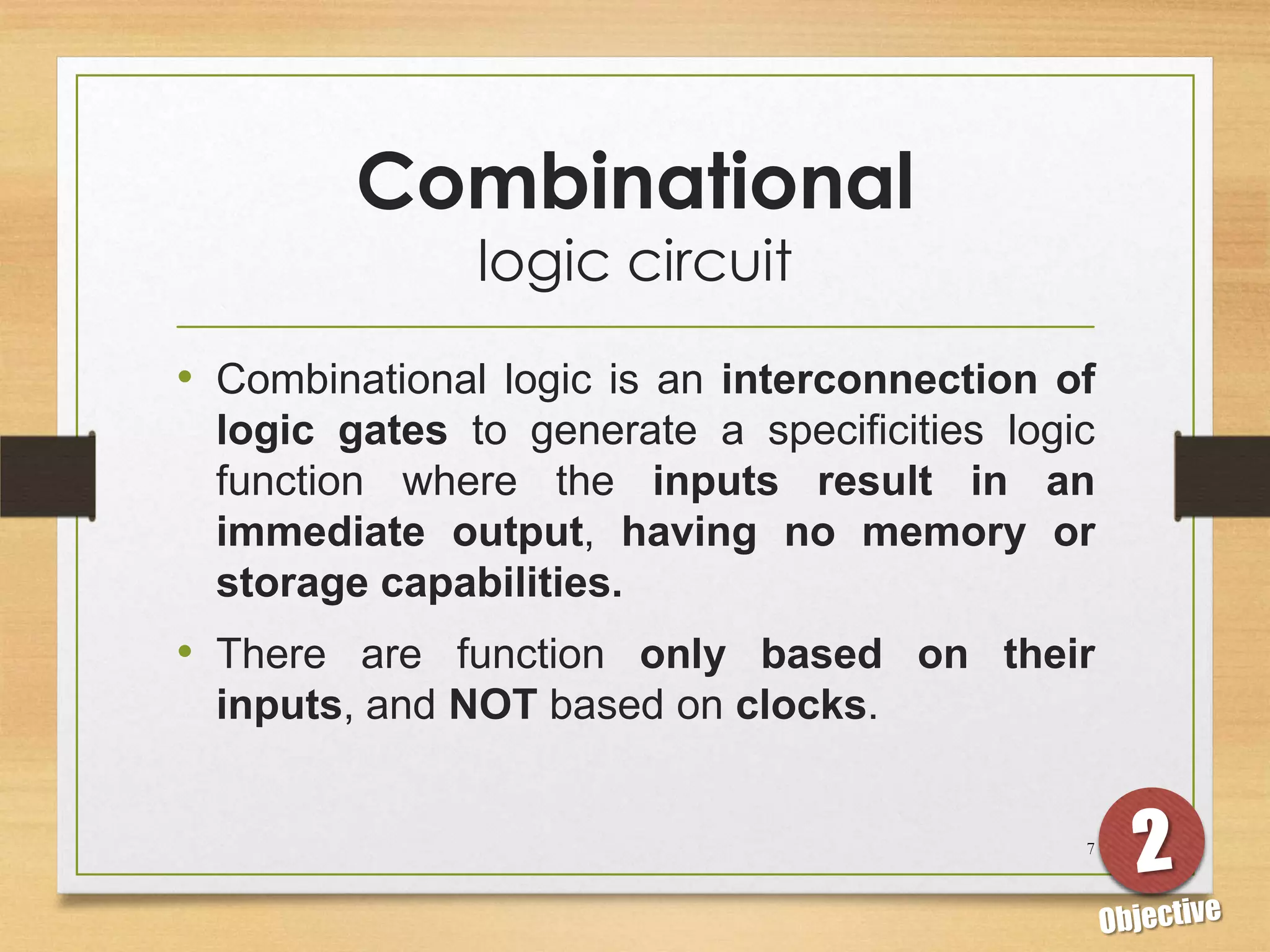
Combinational
               logic circuit
• Combinational logic is an interconnection of
 logic gates to generate a specificities logic
 function where the inputs result in an
 immediate output, having no memory or
 storage capabilities.
• There are function only based on their
 inputs, and NOT based on clocks.


                                             7
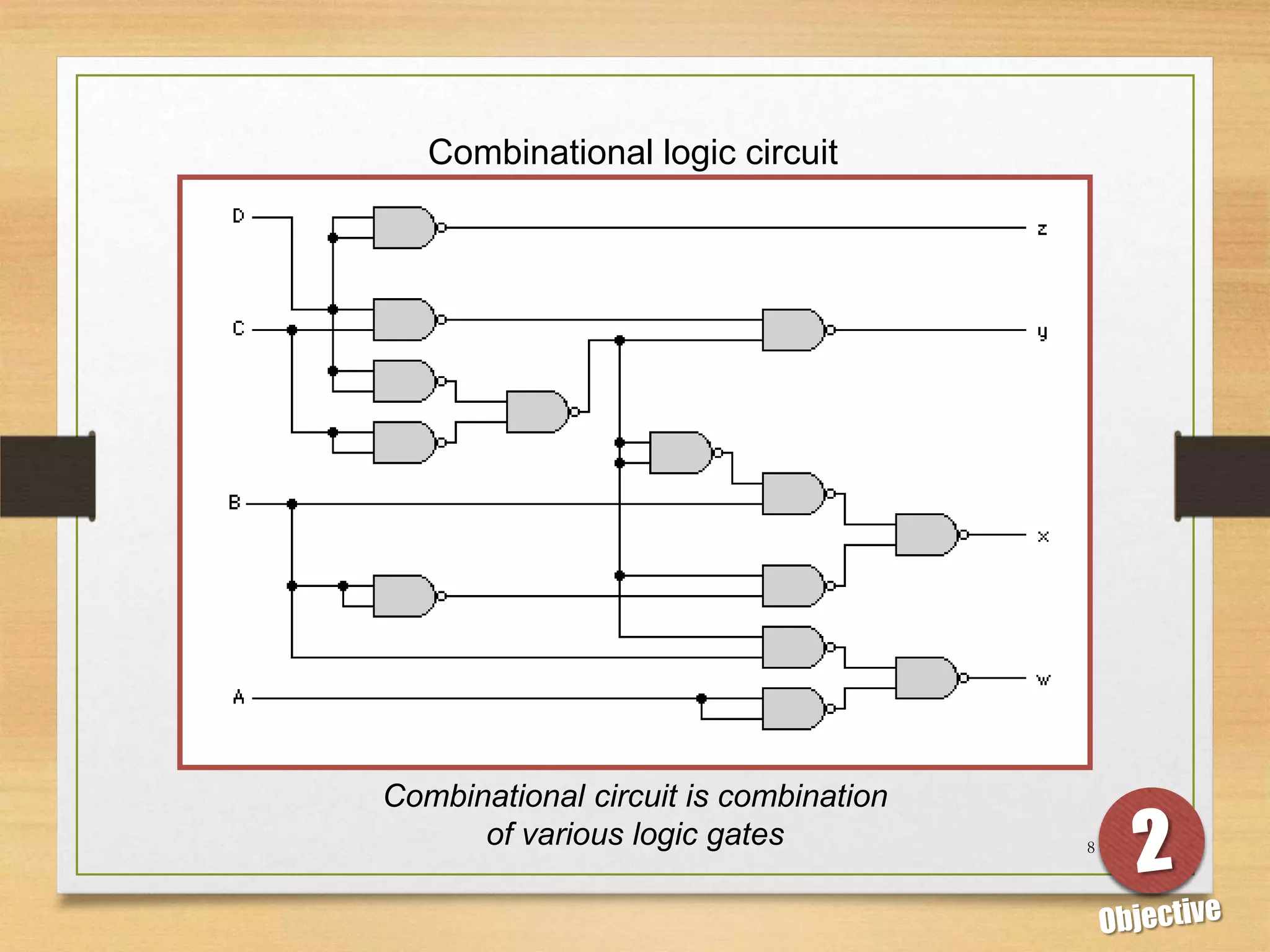
Combinational logic circuit


Combinational circuit is combination
      of various logic gates           8
Flip-Flop

3 Describe flip - flop.


                            9
Flip-Flop

• "Flip-flop" is the common name given to two-state
  devices which offer basic memory for sequential
  logic operations.
• Flip-flops are heavily used for digital data storage and
  transfer and are commonly used in banks called
  "registers" for the storage of binary numerical
  data.


                                                         10
Flip-Flop
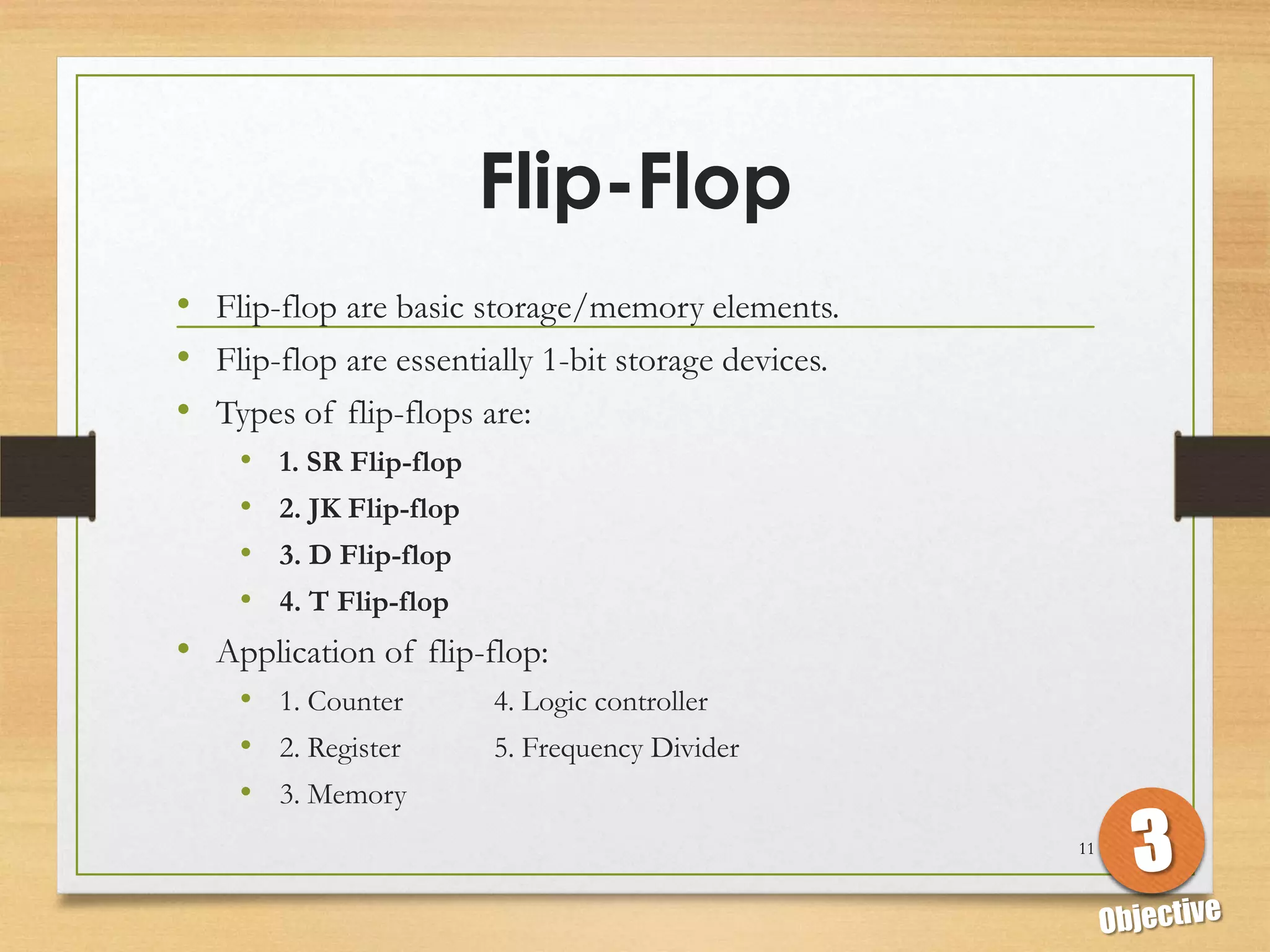
• Flip-flop are basic storage/memory elements.
• Flip-flop are essentially 1-bit storage devices.
• Types of flip-flops are:
   • 1. SR Flip-flop
   • 2. JK Flip-flop
   • 3. D Flip-flop
   • 4. T Flip-flop
• Application of flip-flop:
   • 1. Counter        4. Logic controller
   • 2. Register       5. Frequency Divider
   • 3. Memory
                                                     11
SR Flip-Flop

4 Identify various types of flip-flops.
5 Build SR, JK, T and D flip – flop using logic gates.
6 Draw the symbol and truth table of SR, JK, T and D flip
  – flop.


                                                            12
SR Flip-Flop                       S          Q

                                                 R          Q'


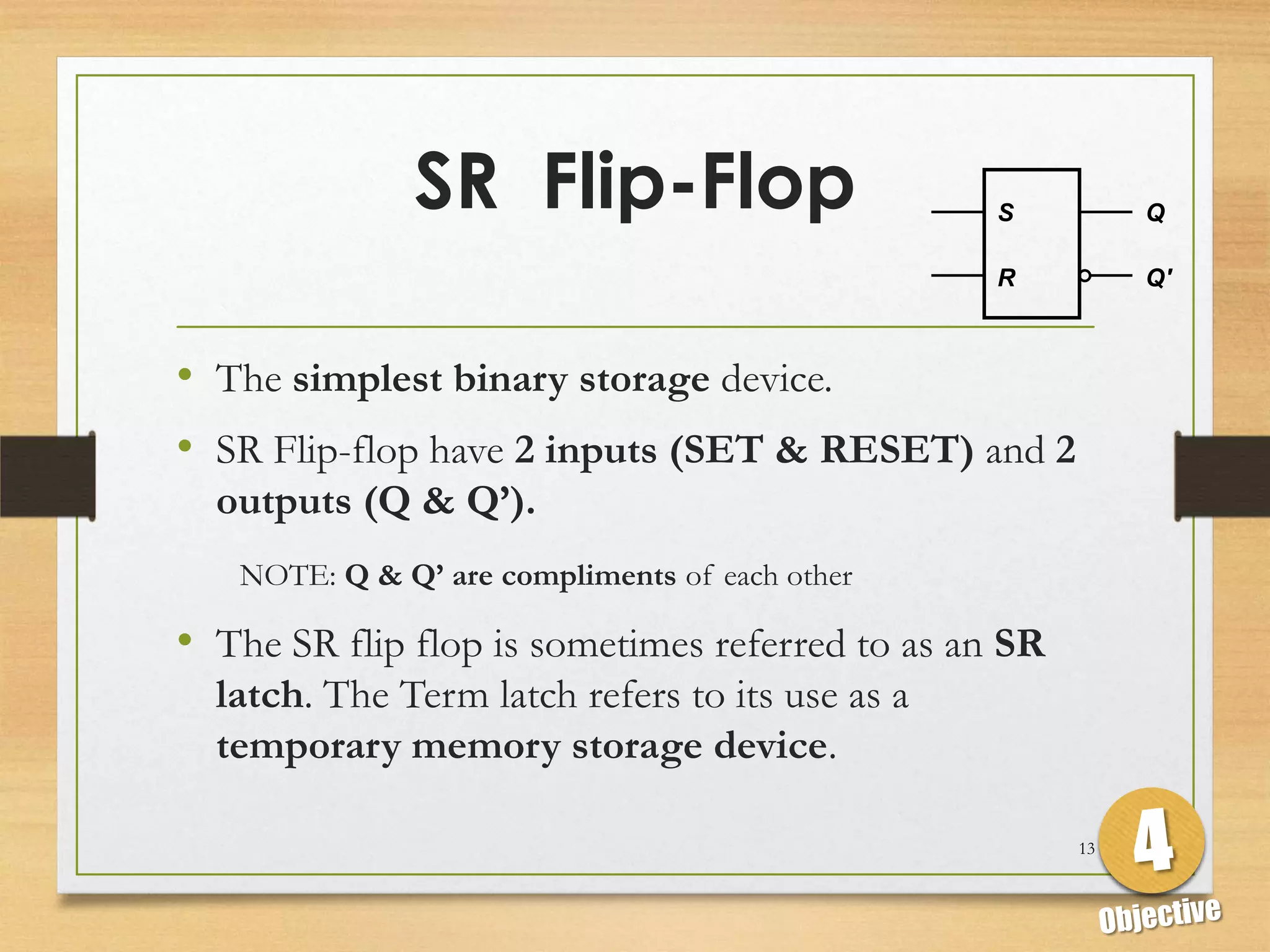
• The simplest binary storage device.
• SR Flip-flop have 2 inputs (SET & RESET) and 2
  outputs (Q & Q’).
   NOTE: Q & Q’ are compliments of each other

• The SR flip flop is sometimes referred to as an SR
  latch. The Term latch refers to its use as a
  temporary memory storage device.

                                                       13
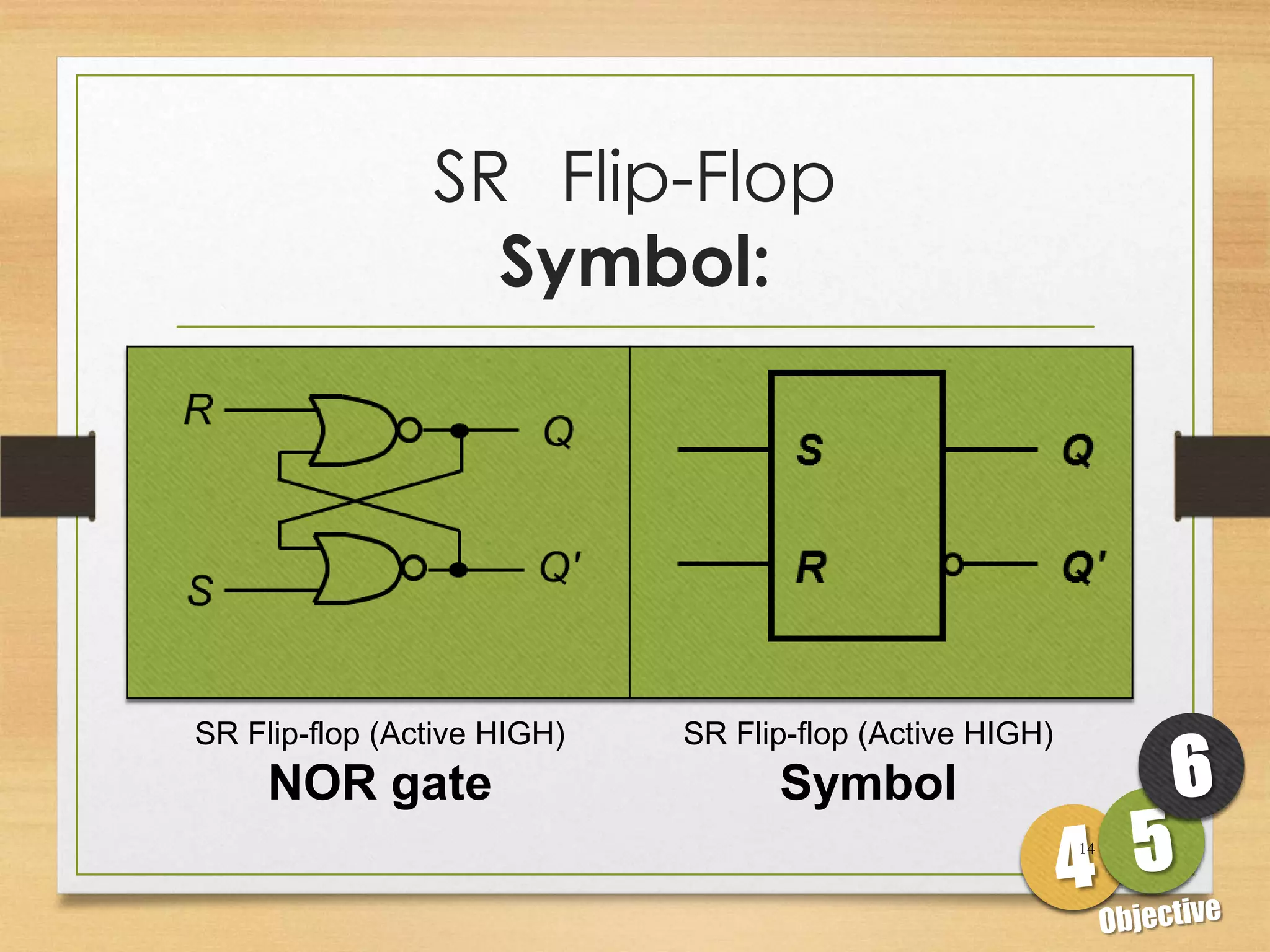
SR Flip-Flop
                  Symbol:


SR Flip-flop (Active HIGH)   SR Flip-flop (Active HIGH)
     NOR gate                      Symbol
                                                          14
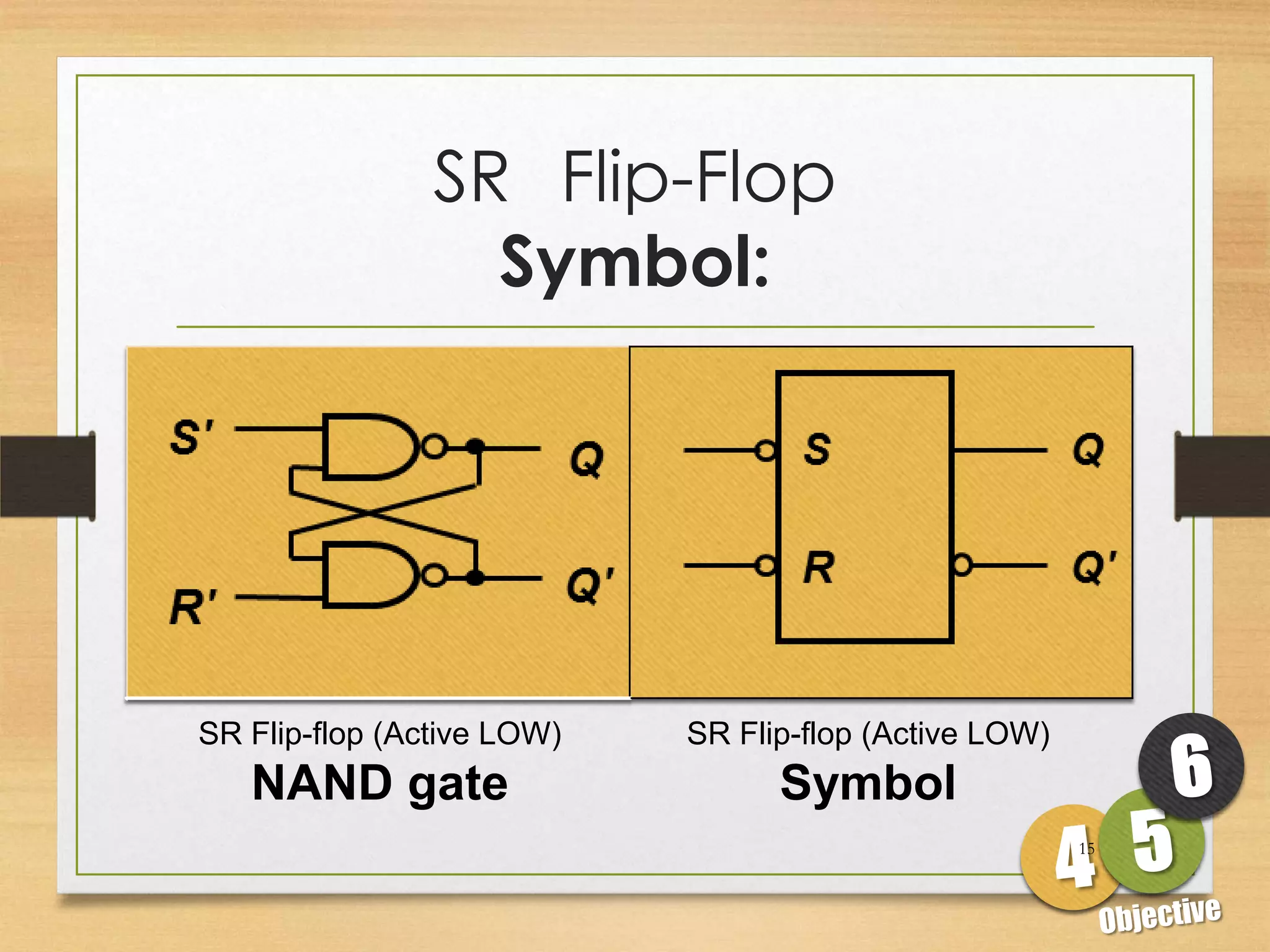
SR Flip-Flop
                  Symbol:


SR Flip-flop (Active LOW)   SR Flip-flop (Active LOW)
   NAND gate                      Symbol
                                                        15
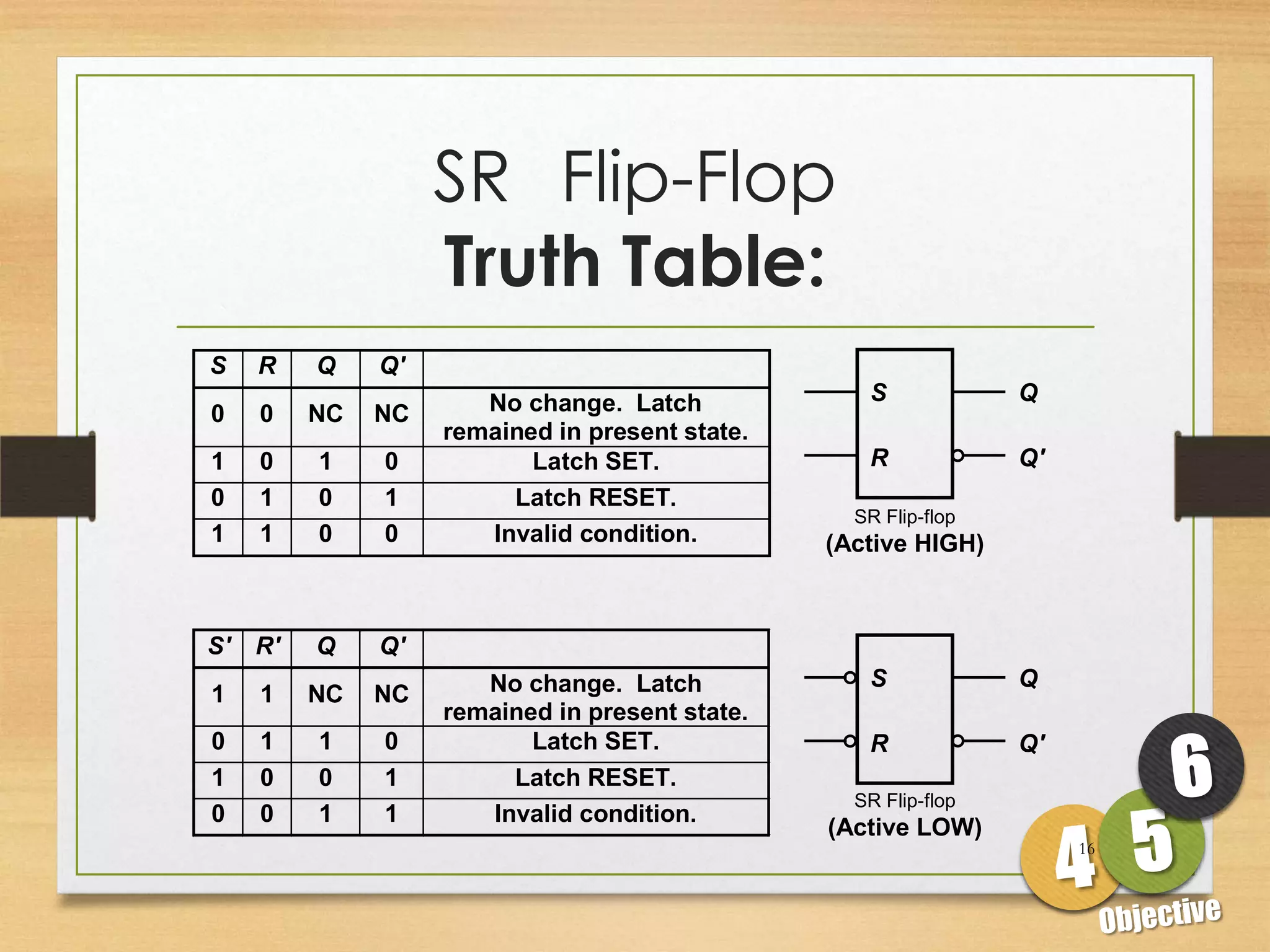
SR Flip-Flop
                    Truth Table:
S    R    Q    Q'
                       No change. Latch             S             Q
0    0    NC   NC
                    remained in present state.
1    0    1    0           Latch SET.               R             Q'
0    1    0    1         Latch RESET.
                                                   SR Flip-flop
1    1    0    0       Invalid condition.        (Active HIGH)


S'   R'   Q    Q'
                       No change. Latch             S             Q
1    1    NC   NC
                    remained in present state.
0    1    1    0           Latch SET.               R             Q'
1    0    0    1         Latch RESET.
                                                   SR Flip-flop
0    0    1    1       Invalid condition.
                                                 (Active LOW)
                                                                       16
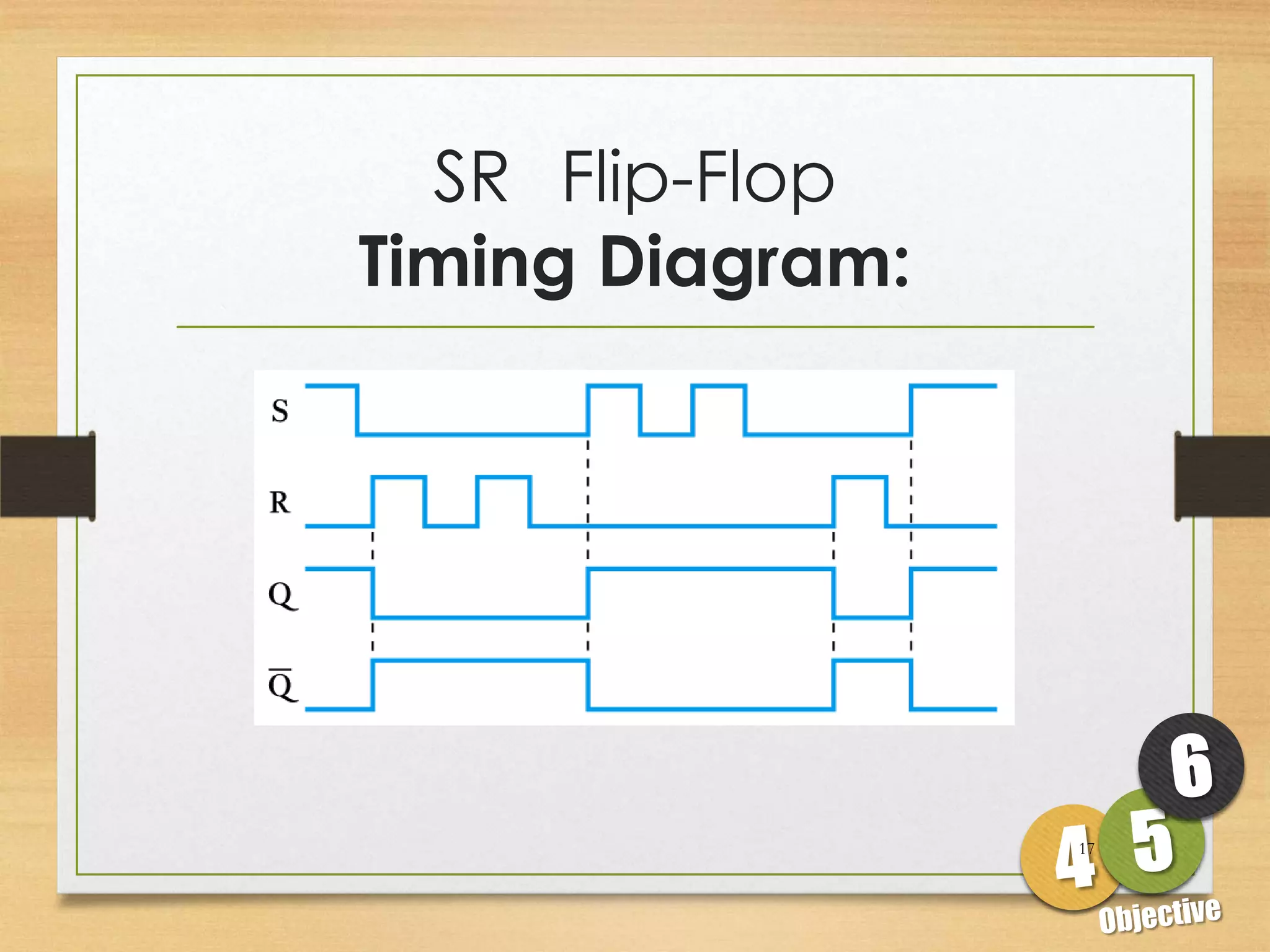
SR Flip-Flop
Timing Diagram:


                  17
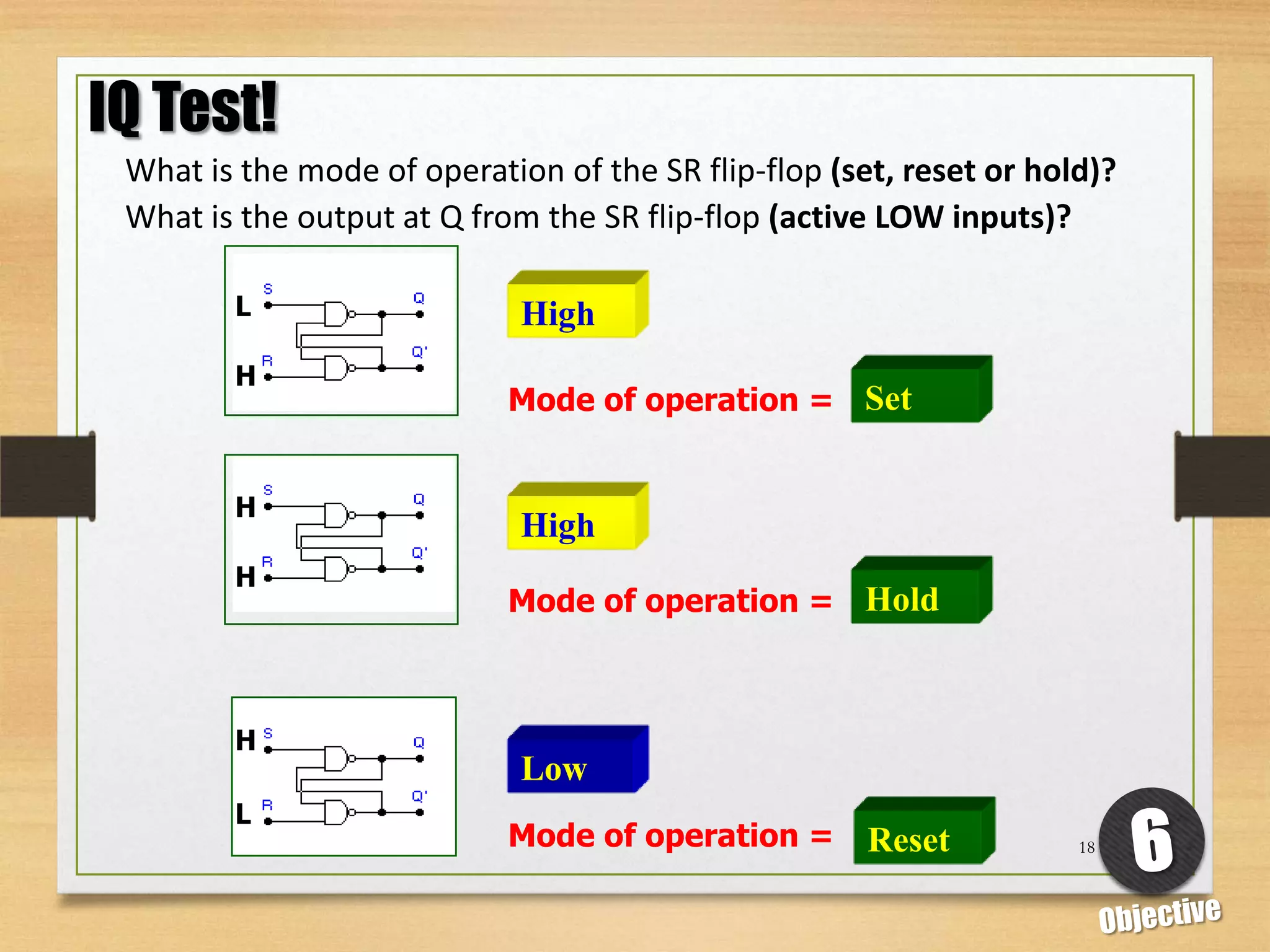
IQ Test!
 What is the mode of operation of the SR flip-flop (set, reset or hold)?
 What is the output at Q from the SR flip-flop (active LOW inputs)?

        L
                             ?
                             High
        H
                            Mode of operation = Set
                                                 ?


        H
                             ?
                             High
        H
                            Mode of operation = Hold
                                                 ?


        H
                             ?
                             Low
        L
                            Mode of operation =        ?
                                                      Reset          18
Clock
                SR Flip-Flop
4 Identify various types of flip-flops.
5 Build SR, JK, T and D flip – flop using logic gates.
6 Draw the symbol and truth table of SR, JK, T and D flip
  – flop.


                                                            19
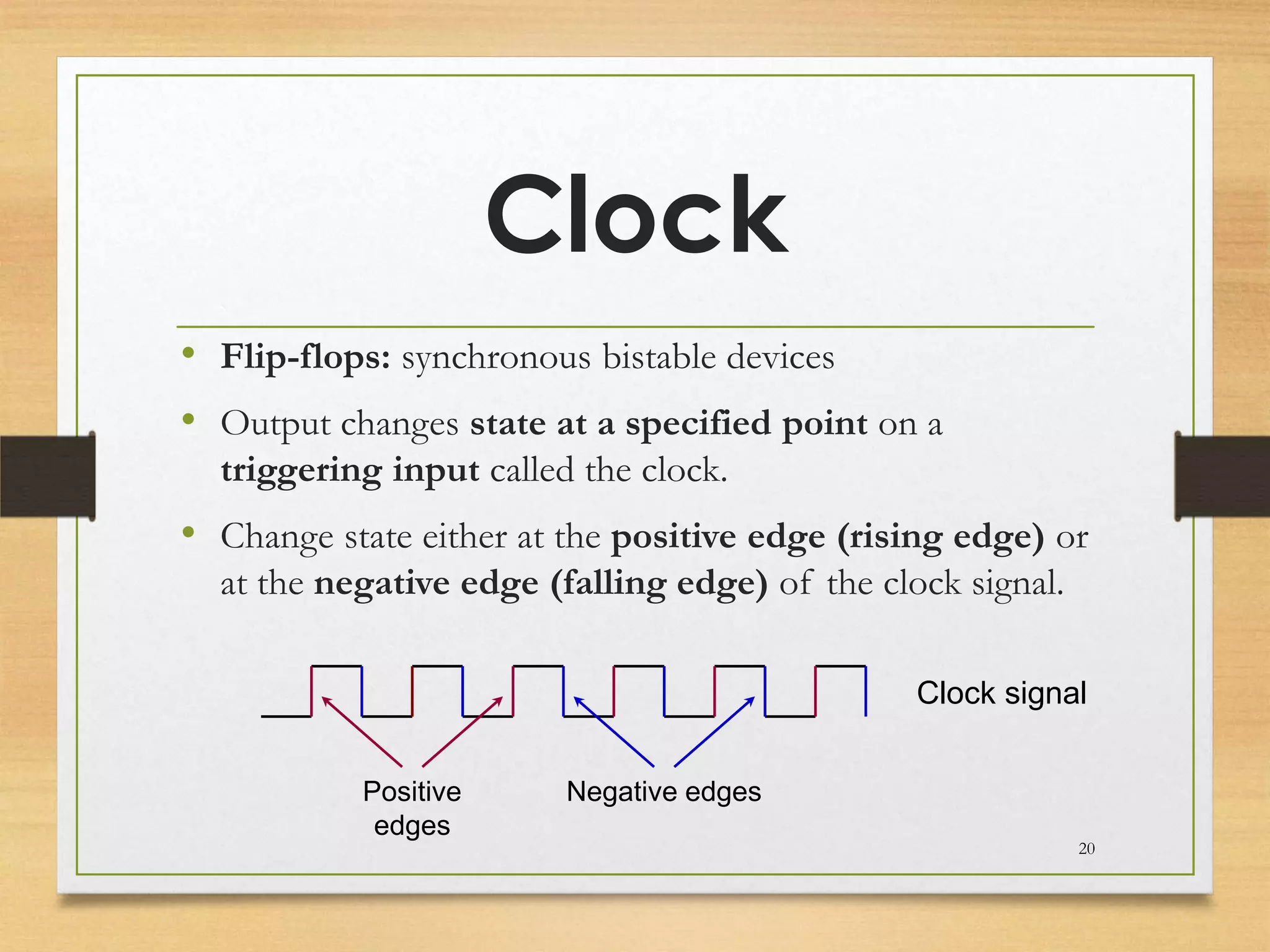
Clock
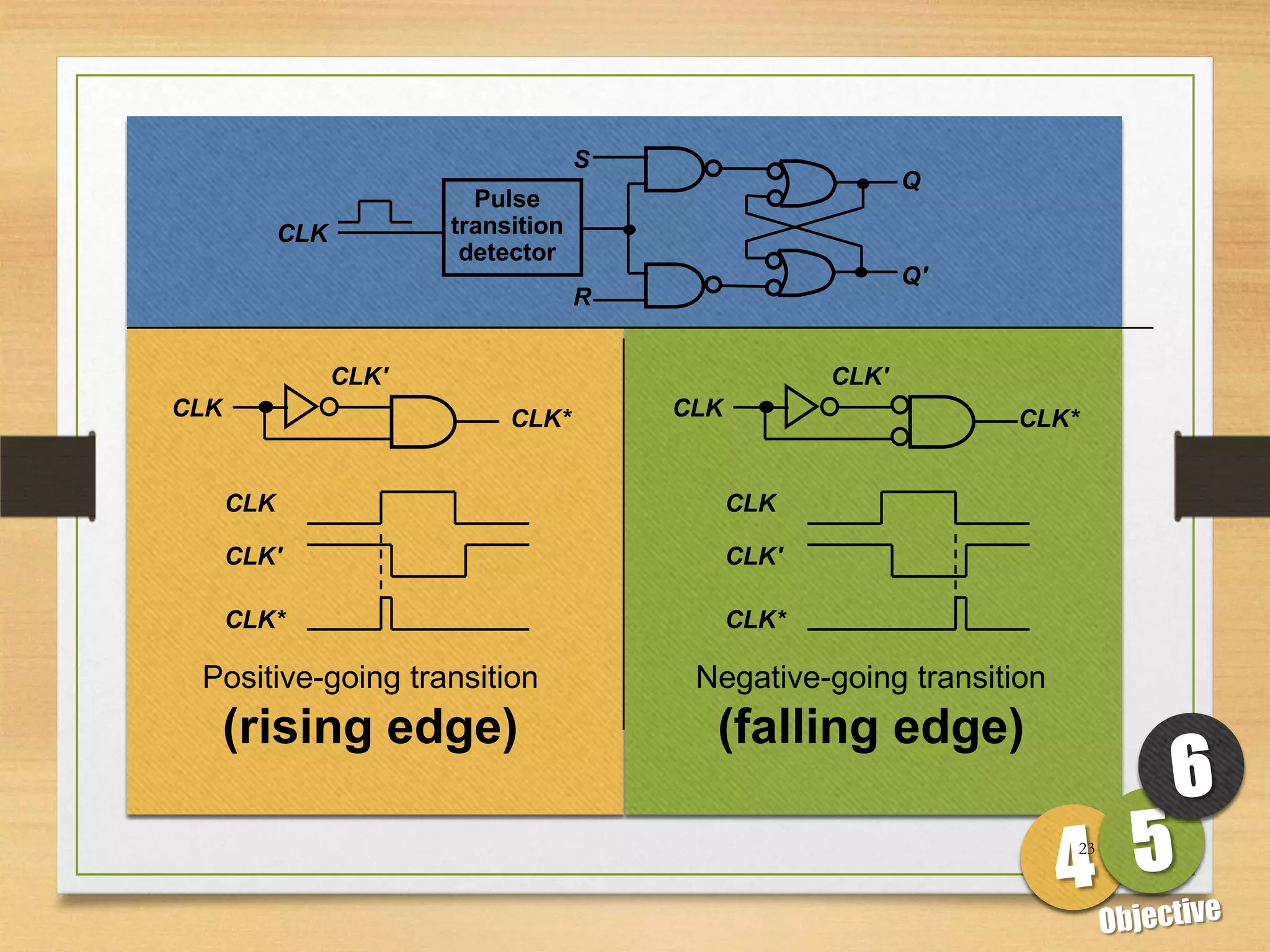
• Flip-flops: synchronous bistable devices
• Output changes state at a specified point on a
  triggering input called the clock.
• Change state either at the positive edge (rising edge) or
  at the negative edge (falling edge) of the clock signal.

                                                Clock signal


           Positive      Negative edges
            edges
                                                             20
Clock
                 SR Flip-Flop
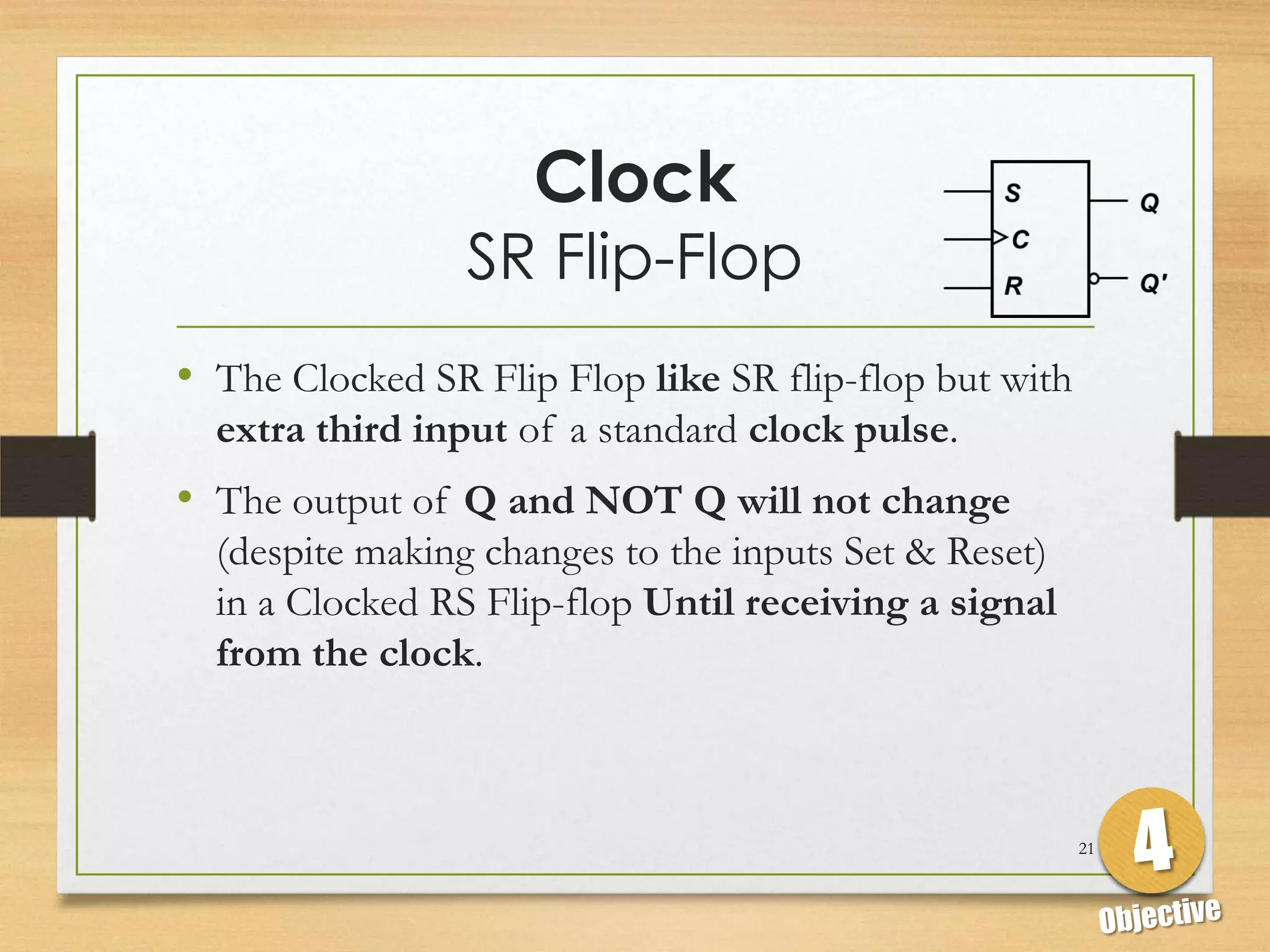
• The Clocked SR Flip Flop like SR flip-flop but with
  extra third input of a standard clock pulse.
• The output of Q and NOT Q will not change
  (despite making changes to the inputs Set & Reset)
  in a Clocked RS Flip-flop Until receiving a signal
  from the clock.


                                                        21
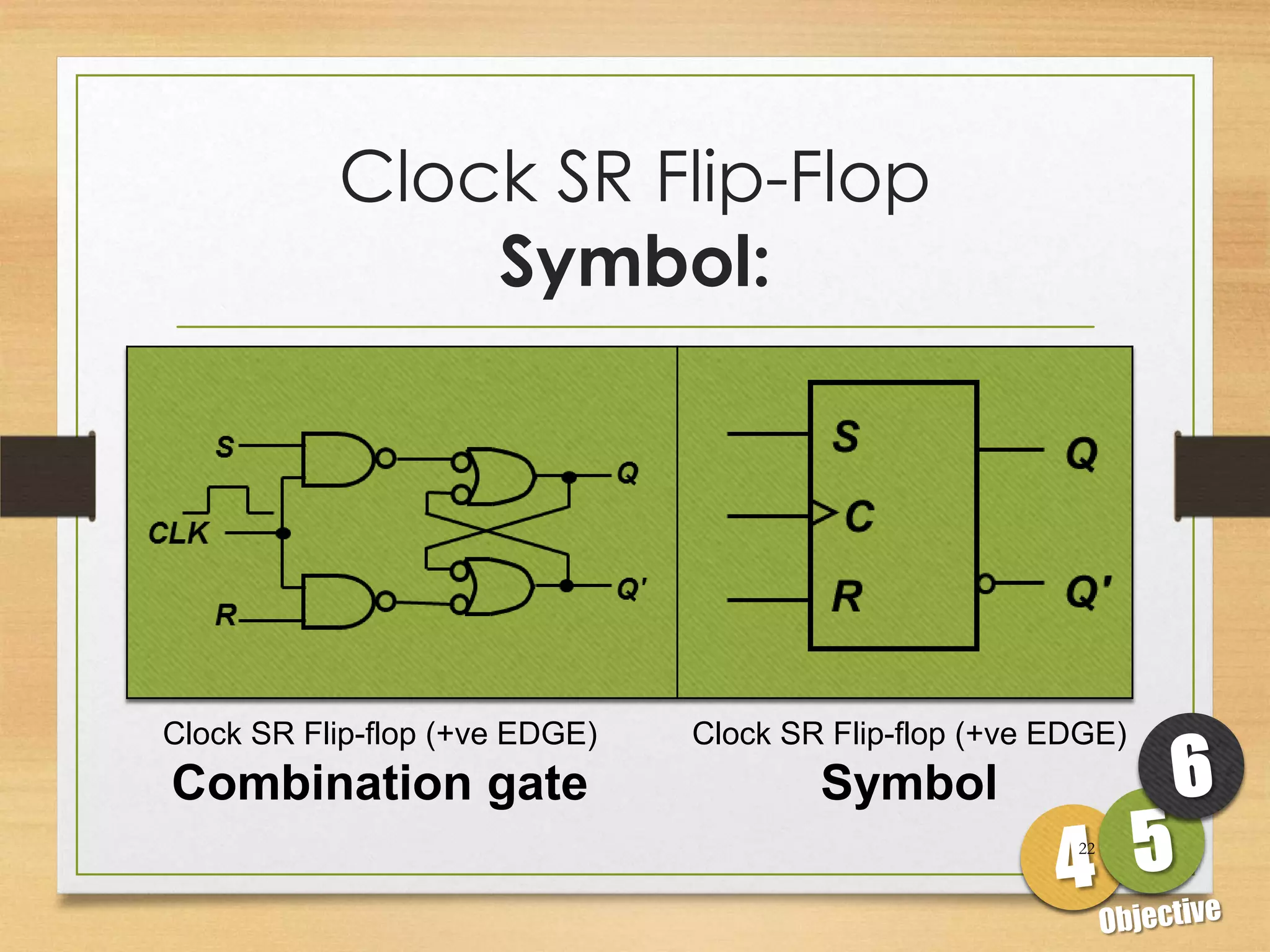
Clock SR Flip-Flop
               Symbol:


Clock SR Flip-flop (+ve EDGE)   Clock SR Flip-flop (+ve EDGE)
Combination gate                        Symbol
                                                         22
S
                                                              Q
                           Pulse
            CLK          transition
                          detector
                                                              Q'
                                      R


                  CLK'                                 CLK'
CLK                           CLK*        CLK                      CLK*


      CLK                                       CLK

      CLK'                                      CLK'

      CLK*                                      CLK*

 Positive-going transition                 Negative-going transition
      (rising edge)                         (falling edge)

                                                                          23
Clock SR Flip-Flop
                 Truth Table:
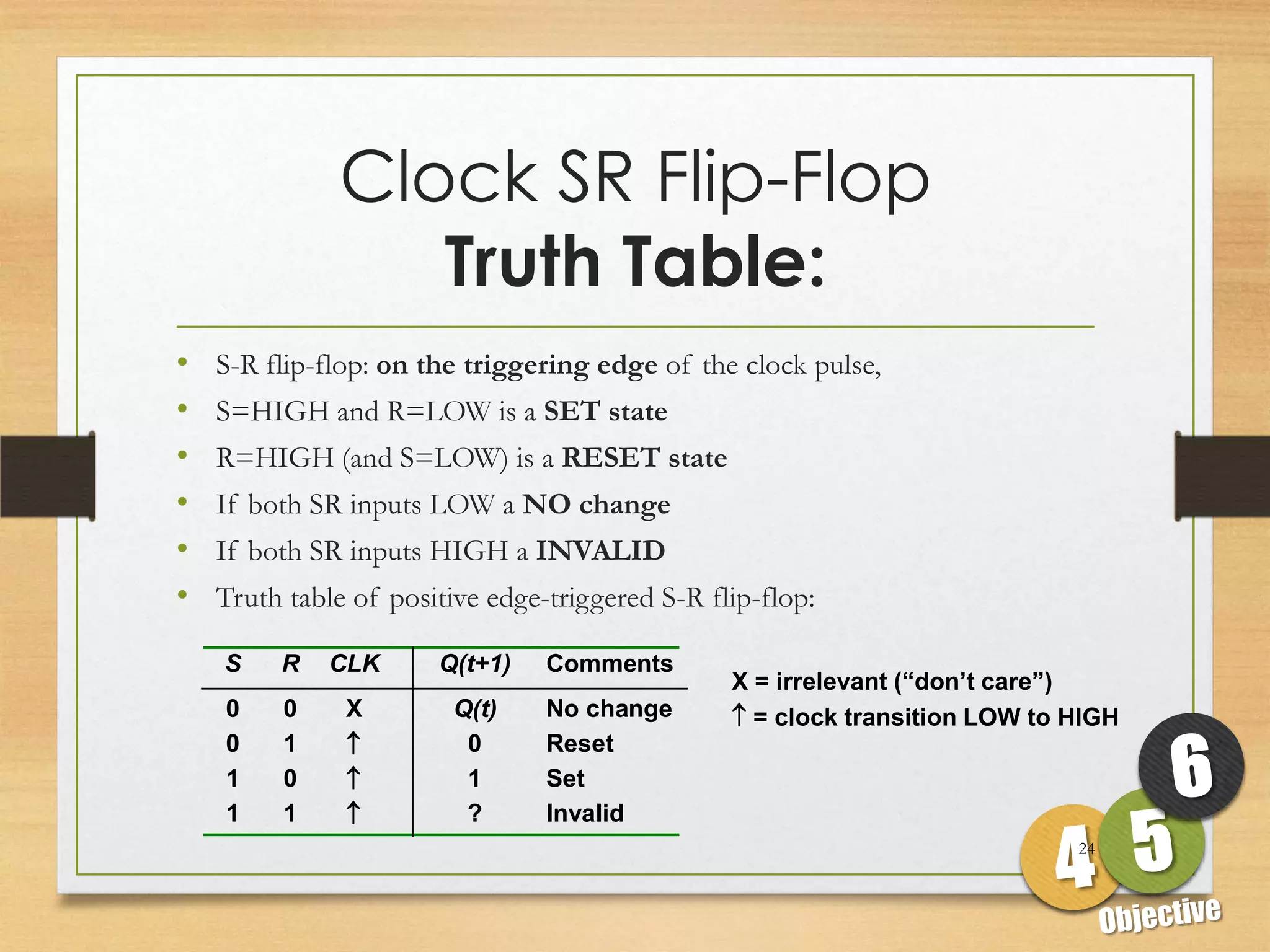
•   S-R flip-flop: on the triggering edge of the clock pulse,
•   S=HIGH and R=LOW is a SET state
•   R=HIGH (and S=LOW) is a RESET state
•   If both SR inputs LOW a NO change
•   If both SR inputs HIGH a INVALID
•   Truth table of positive edge-triggered S-R flip-flop:

    S    R   CLK       Q(t+1)    Comments
                                                 X = irrelevant (“don’t care”)
    0    0     X        Q(t)     No change        = clock transition LOW to HIGH
    0    1              0       Reset
    1    0              1       Set
    1    1              ?       Invalid
                                                                             24
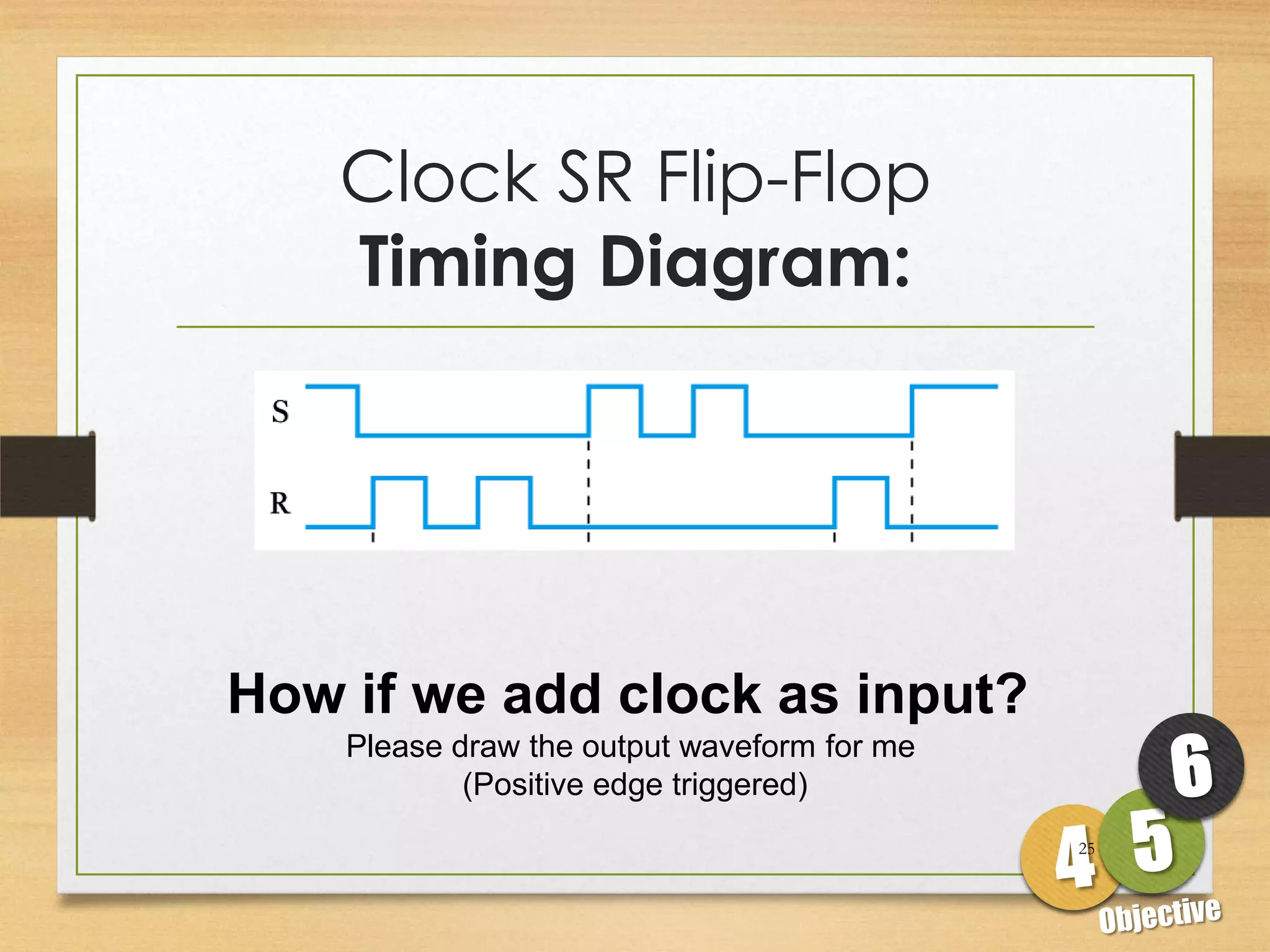
Clock SR Flip-Flop
    Timing Diagram:


How if we add clock as input?
    Please draw the output waveform for me
            (Positive edge triggered)
                                             25
D Flip-Flop
4 Identify various types of flip-flops.
5 Build SR, JK, T and D flip – flop using logic gates.
6 Draw the symbol and truth table of SR, JK, T and D flip
  – flop.


                                                            26
D Flip-Flop                               D            Q

                      Truth Table:
                                                                     C
                                                                              Q'


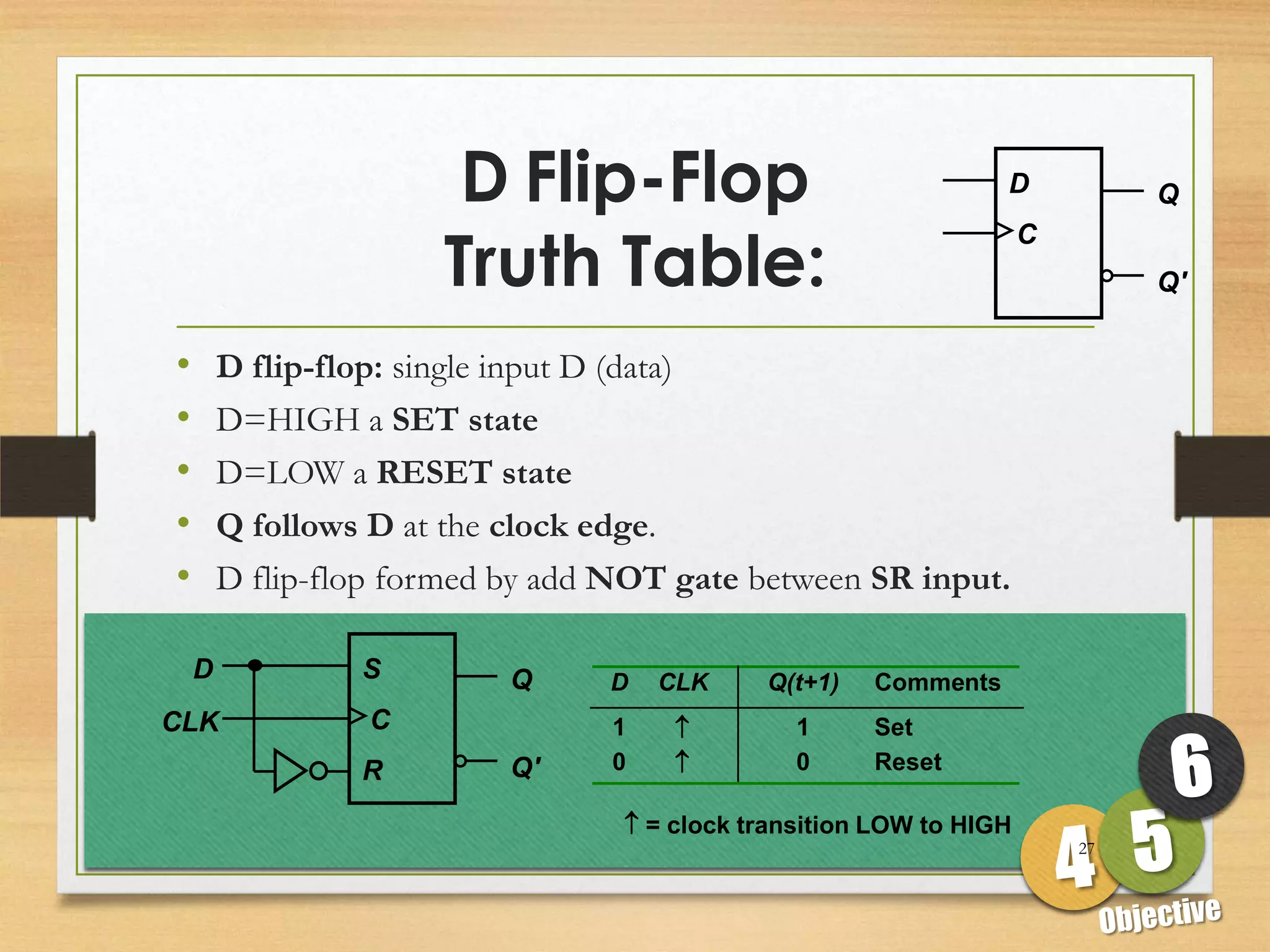
•       D flip-flop: single input D (data)
•       D=HIGH a SET state
•       D=LOW a RESET state
•       Q follows D at the clock edge.
•       D flip-flop formed by add NOT gate between SR input.

    D            S         Q     D   CLK     Q(t+1)   Comments
CLK               C              1             1     Set
                 R         Q'    0             0     Reset

                                   = clock transition LOW to HIGH
                                                                         27
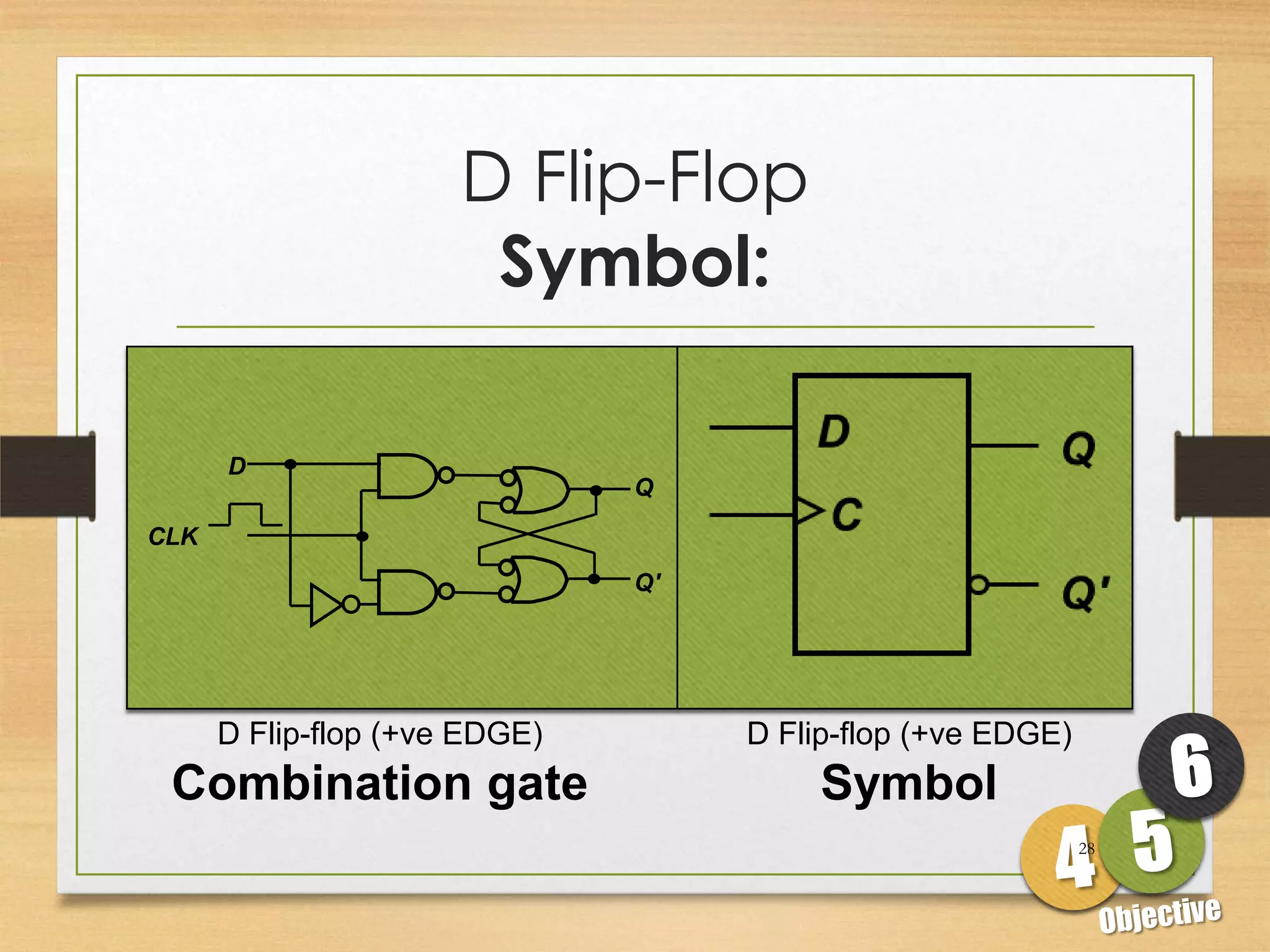
D Flip-Flop
                       Symbol:

      D
                               Q
CLK
                               Q'


      D Flip-flop (+ve EDGE)        D Flip-flop (+ve EDGE)
 Combination gate                       Symbol
                                                             28
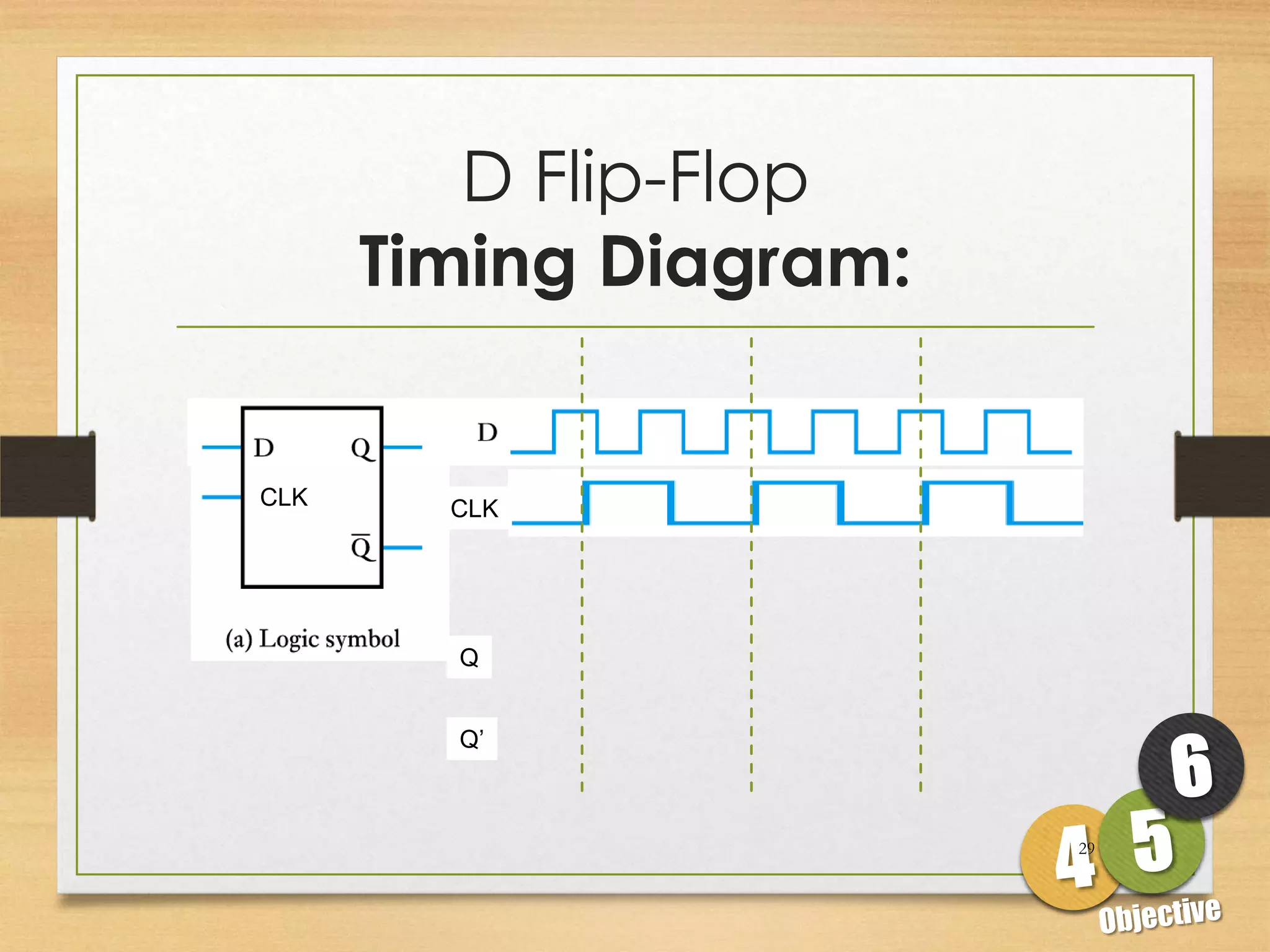
D Flip-Flop
      Timing Diagram:


CLK
CLK     CLK
        CLK


        Q


        Q’


                        29
JK Flip-Flop

4 Identify various types of flip-flops.
5 Build SR, JK, T and D flip – flop using logic gates.
6 Draw the symbol and truth table of SR, JK, T and D flip
  – flop.


                                                            30
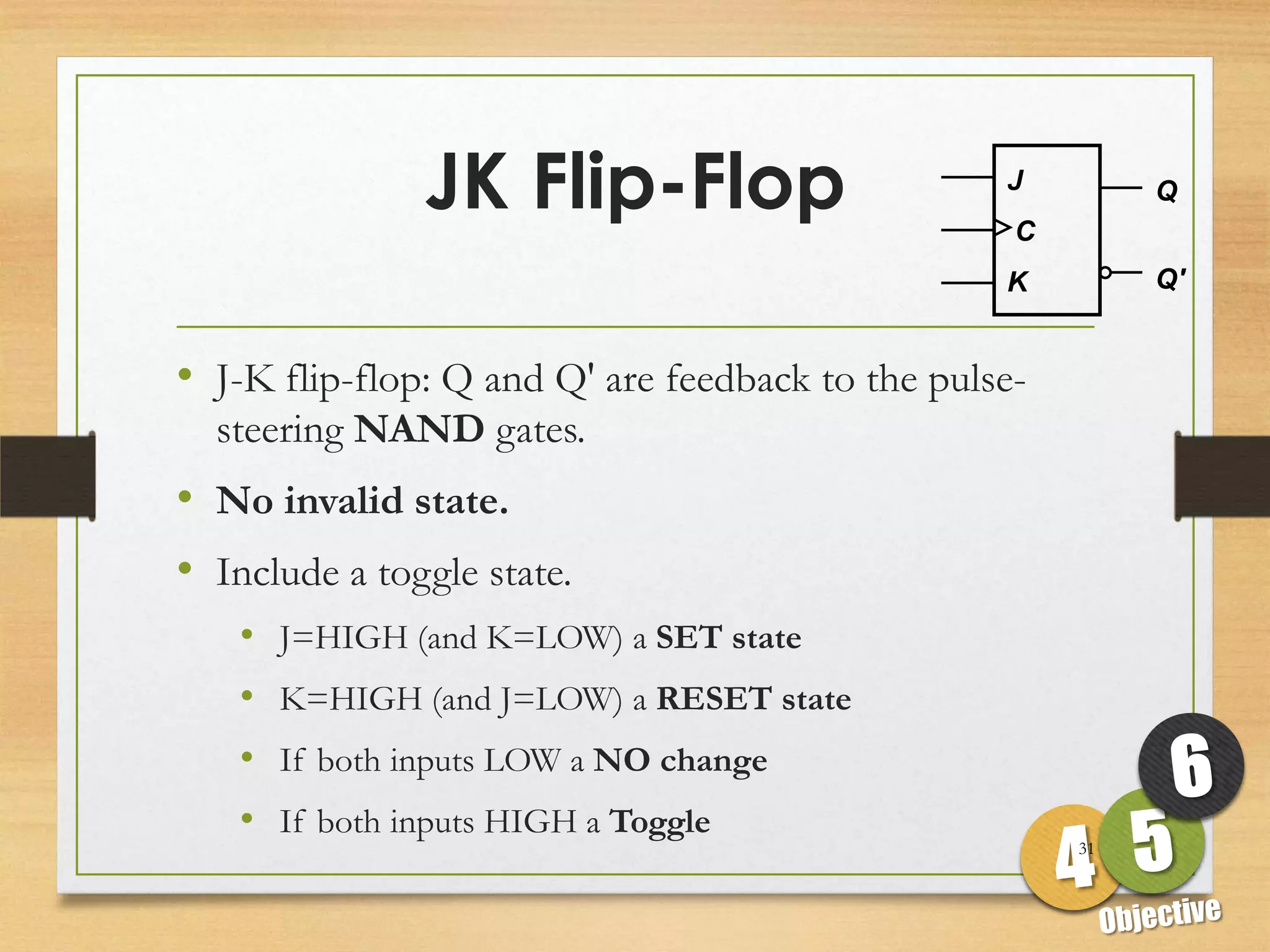
JK Flip-Flop                       J
                                                   C
                                                            Q


                                                  K         Q'


• J-K flip-flop: Q and Q' are feedback to the pulse-
  steering NAND gates.
• No invalid state.
• Include a toggle state.
    • J=HIGH (and K=LOW) a SET state
    • K=HIGH (and J=LOW) a RESET state
    • If both inputs LOW a NO change
    • If both inputs HIGH a Toggle
                                                       31
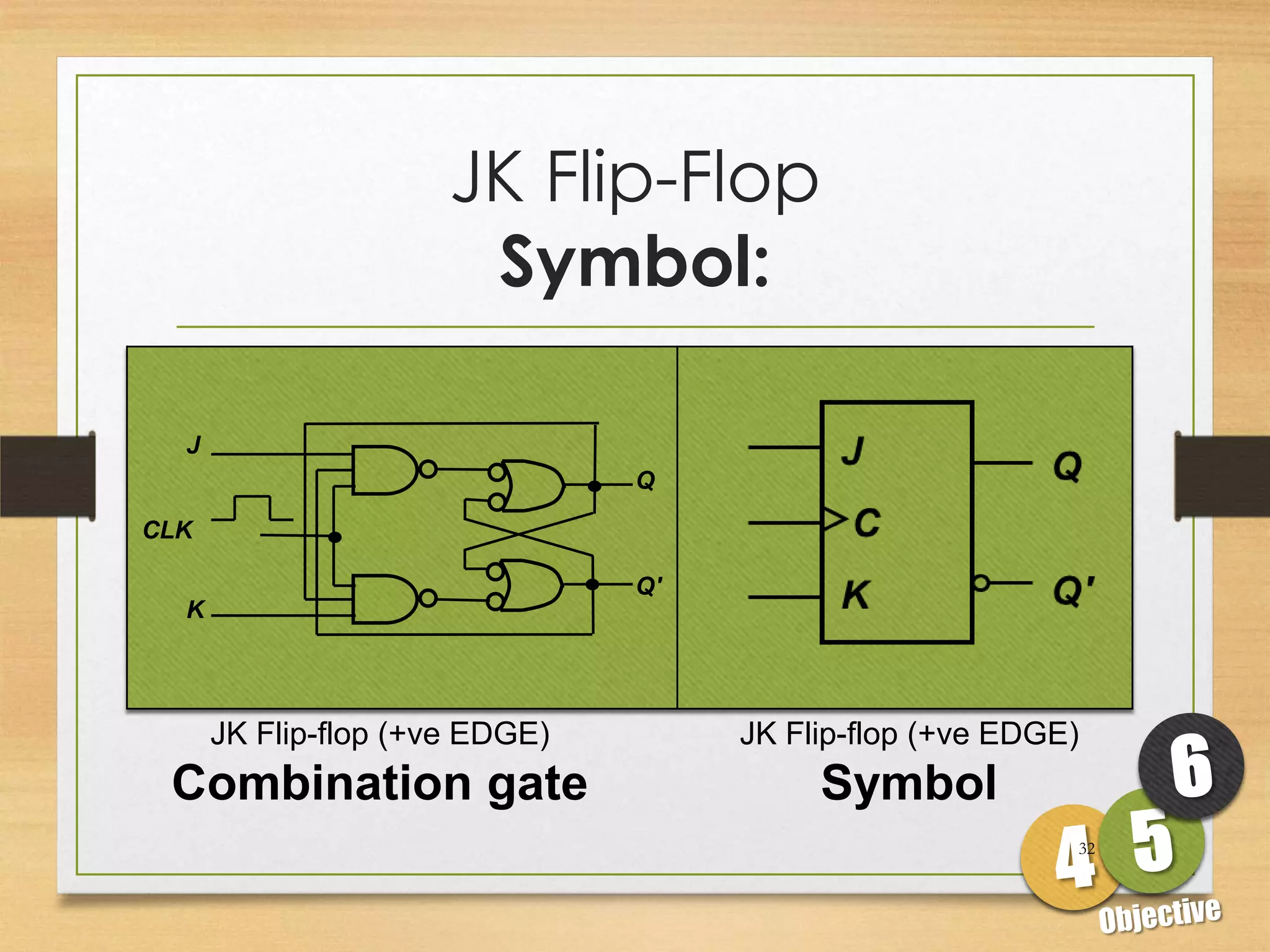
JK Flip-Flop
                       Symbol:

  J
                                Q

CLK

                                Q'
  K


      JK Flip-flop (+ve EDGE)        JK Flip-flop (+ve EDGE)
 Combination gate                         Symbol
                                                           32
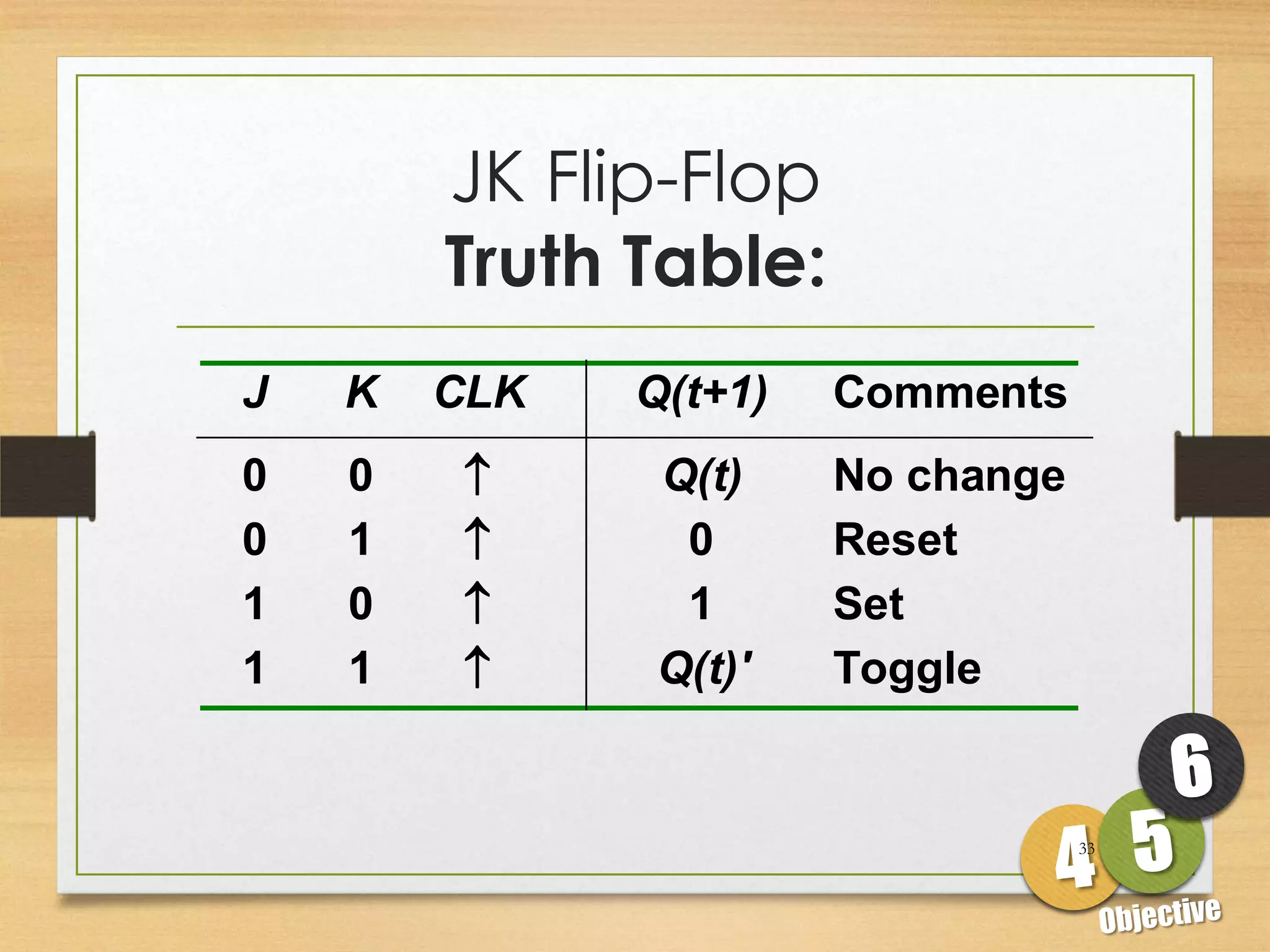
JK Flip-Flop
        Truth Table:
J   K   CLK   Q(t+1)   Comments
0   0        Q(t)     No change
0   1         0       Reset
1   0         1       Set
1   1        Q(t)'    Toggle


                                   33
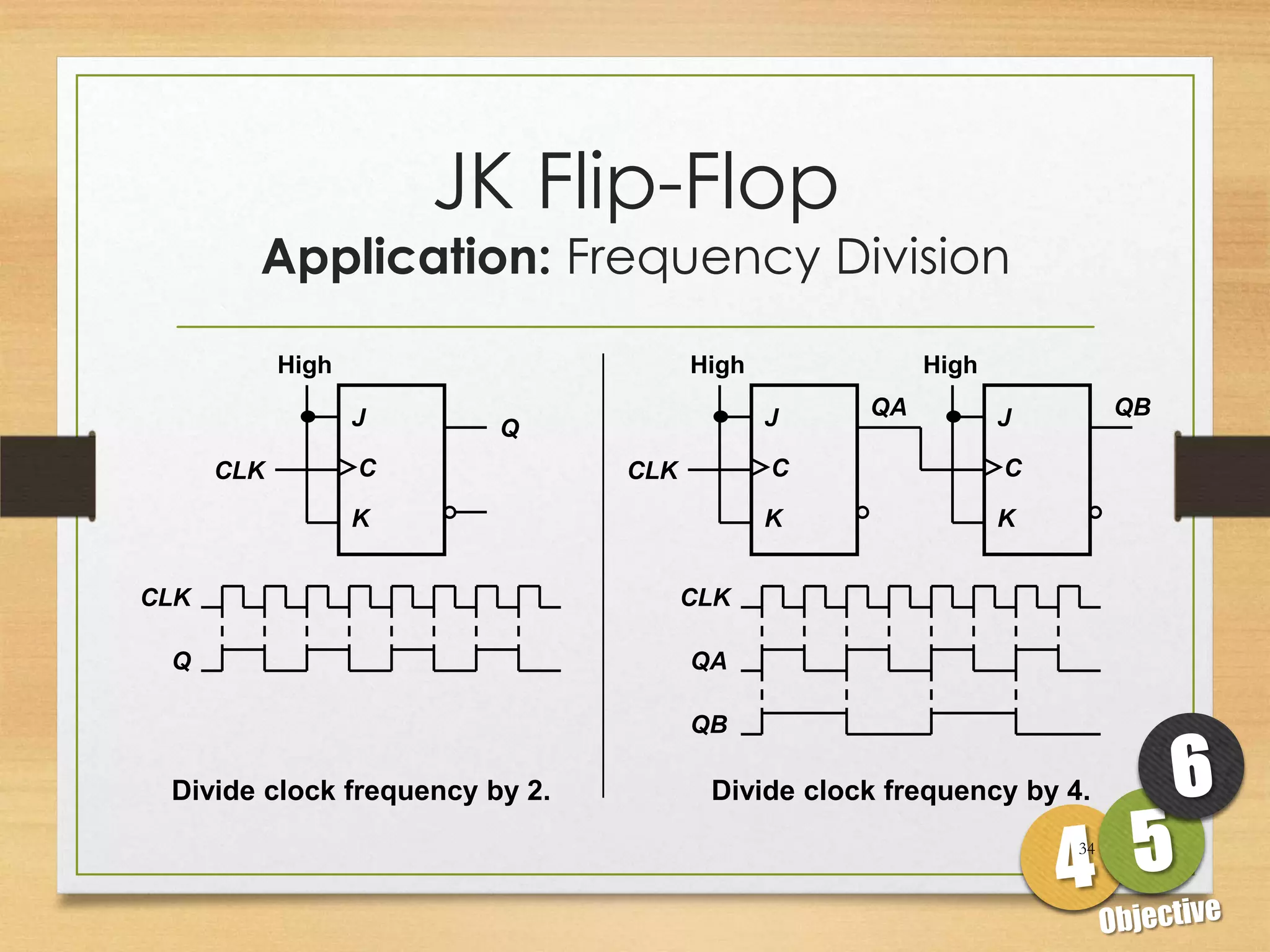
JK Flip-Flop
        Application: Frequency Division

            High                      High             High

                   J                         J    QA          J        QB
                         Q
      CLK          C            CLK          C                C

                   K                         K                K


CLK                                   CLK

 Q                                    QA

                                      QB

 Divide clock frequency by 2.          Divide clock frequency by 4.
                                                                  34
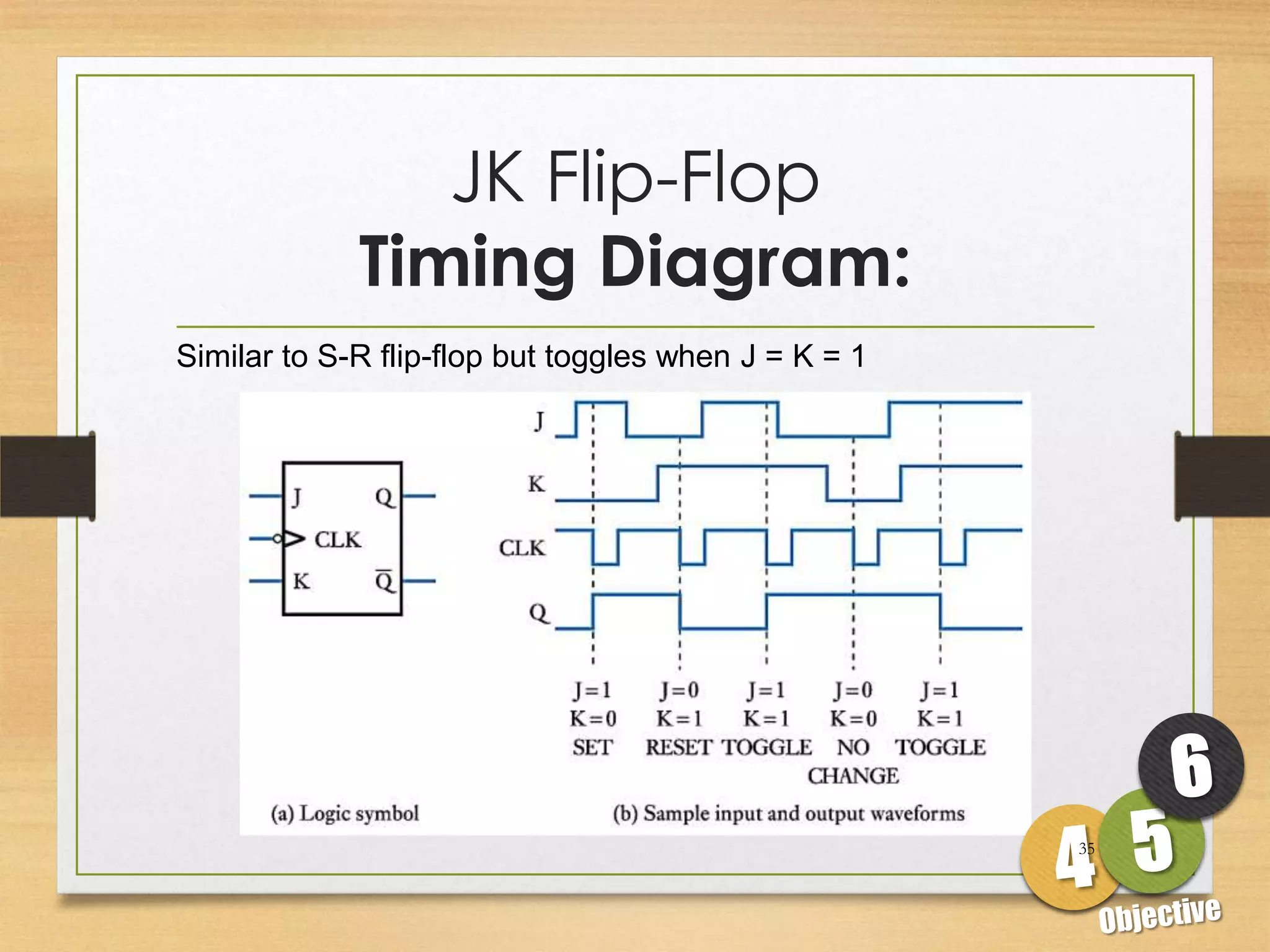
JK Flip-Flop
             Timing Diagram:
Similar to S-R flip-flop but toggles when J = K = 1


                                                      35
T Flip-Flop

4 Identify various types of flip-flops.
5 Build SR, JK, T and D flip – flop using logic gates.
6 Draw the symbol and truth table of SR, JK, T and D flip
  – flop.


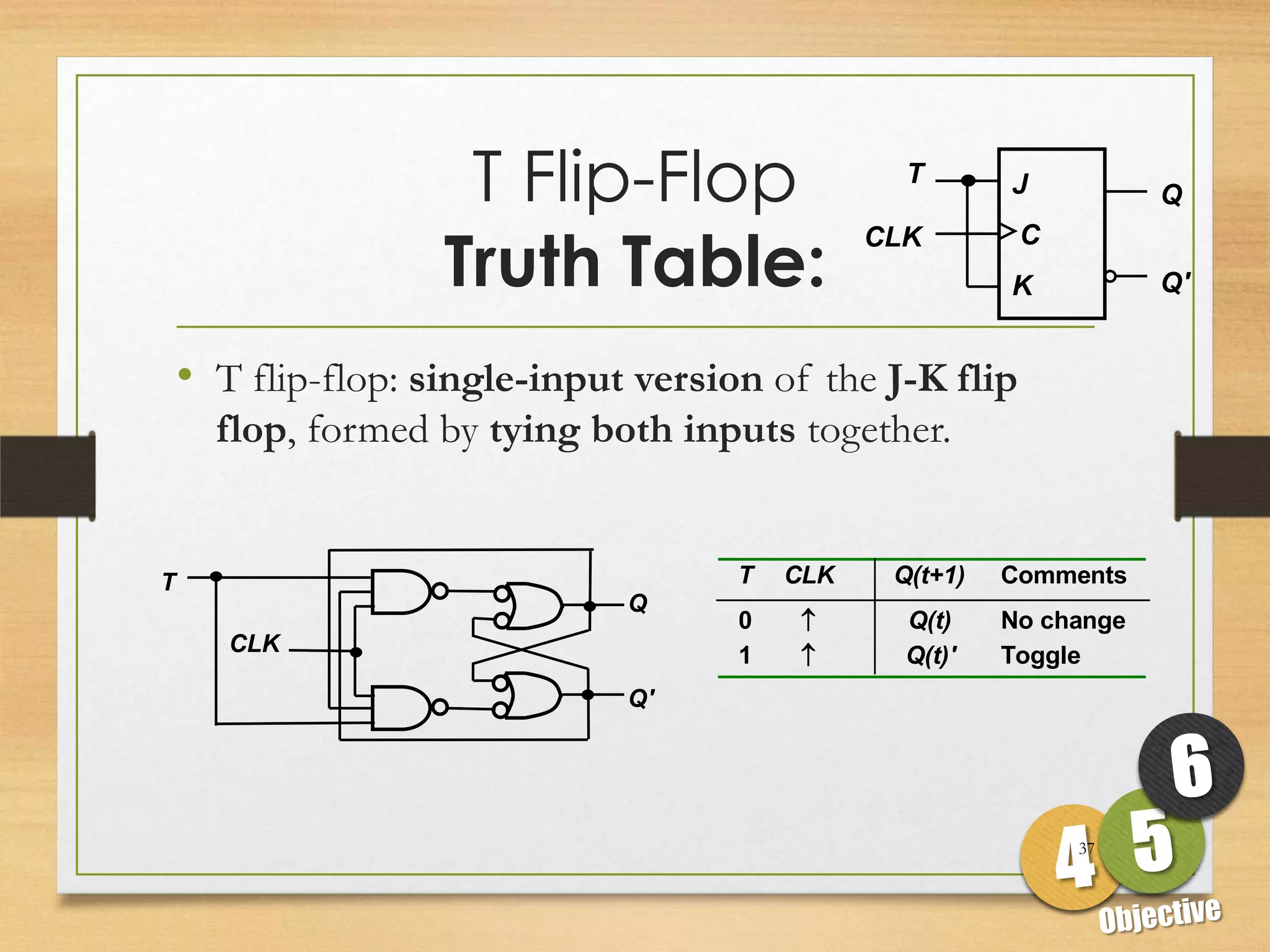
                                                            36
T Flip-Flop                  T       J           Q

                    Truth Table:
                                                CLK        C
                                                          K           Q'


    • T flip-flop: single-input version of the J-K flip
      flop, formed by tying both inputs together.


T                                     T   CLK    Q(t+1)   Comments
                               Q
                                      0          Q(t)    No change
       CLK                            1          Q(t)'   Toggle
                               Q'


                                                               37

2.3 sequantial logic circuit

  • 1.
    2.3 Build sequential logic circuit Combinational logic circuit Sequential logic circuit Flip-flop Build flip-flop using logic gates 1
  • 2.
    Objectives: • 1 Define sequentiallogic circuit. • 2 Differentiate between combinational logic circuit and sequential logic circuit. • 3 Describe flip - flop. • 4 Identify various types of flip-flops. • 5 Build SR, JK, T and D flip – flop using logic gates. • 6 Draw the symbol and truth table of SR, JK, T and D flip – flop. 2
  • 3.
    Sequential & Combinational logic circuit 1 Define sequential logic circuit. 2 Differentiate between combinational logic circuit and sequential logic circuit. 3
  • 4.
    Difference between Combinational &Sequential logic circuit Combinational Logic Circuits Basic building blocks include: Sequential Logic Circuits Basic building blocks include FLIP-FLOPS: 4
  • 5.
    Sequential S C Q logic circuit R Q' • Sequential logic is the type of digital system that does not only depend on current input, but also the previous history of the system. • For that reason sequential logic requires memory elements to function. • The building blocks used to construct devices that store data are called flip-flops. 5
  • 6.
    Sequential logic circuit Sequential circuit have loops – these enable curcuits to receive feedback 6
  • 7.
    Combinational logic circuit • Combinational logic is an interconnection of logic gates to generate a specificities logic function where the inputs result in an immediate output, having no memory or storage capabilities. • There are function only based on their inputs, and NOT based on clocks. 7
  • 8.
    Combinational logic circuit Combinationalcircuit is combination of various logic gates 8
  • 9.
  • 10.
    Flip-Flop • "Flip-flop" isthe common name given to two-state devices which offer basic memory for sequential logic operations. • Flip-flops are heavily used for digital data storage and transfer and are commonly used in banks called "registers" for the storage of binary numerical data. 10
  • 11.
    Flip-Flop • Flip-flop arebasic storage/memory elements. • Flip-flop are essentially 1-bit storage devices. • Types of flip-flops are: • 1. SR Flip-flop • 2. JK Flip-flop • 3. D Flip-flop • 4. T Flip-flop • Application of flip-flop: • 1. Counter 4. Logic controller • 2. Register 5. Frequency Divider • 3. Memory 11
  • 12.
    SR Flip-Flop 4 Identifyvarious types of flip-flops. 5 Build SR, JK, T and D flip – flop using logic gates. 6 Draw the symbol and truth table of SR, JK, T and D flip – flop. 12
  • 13.
    SR Flip-Flop S Q R Q' • The simplest binary storage device. • SR Flip-flop have 2 inputs (SET & RESET) and 2 outputs (Q & Q’). NOTE: Q & Q’ are compliments of each other • The SR flip flop is sometimes referred to as an SR latch. The Term latch refers to its use as a temporary memory storage device. 13
  • 14.
    SR Flip-Flop Symbol: SR Flip-flop (Active HIGH) SR Flip-flop (Active HIGH) NOR gate Symbol 14
  • 15.
    SR Flip-Flop Symbol: SR Flip-flop (Active LOW) SR Flip-flop (Active LOW) NAND gate Symbol 15
  • 16.
    SR Flip-Flop Truth Table: S R Q Q' No change. Latch S Q 0 0 NC NC remained in present state. 1 0 1 0 Latch SET. R Q' 0 1 0 1 Latch RESET. SR Flip-flop 1 1 0 0 Invalid condition. (Active HIGH) S' R' Q Q' No change. Latch S Q 1 1 NC NC remained in present state. 0 1 1 0 Latch SET. R Q' 1 0 0 1 Latch RESET. SR Flip-flop 0 0 1 1 Invalid condition. (Active LOW) 16
  • 17.
  • 18.
    IQ Test! Whatis the mode of operation of the SR flip-flop (set, reset or hold)? What is the output at Q from the SR flip-flop (active LOW inputs)? L ? High H Mode of operation = Set ? H ? High H Mode of operation = Hold ? H ? Low L Mode of operation = ? Reset 18
  • 19.
    Clock SR Flip-Flop 4 Identify various types of flip-flops. 5 Build SR, JK, T and D flip – flop using logic gates. 6 Draw the symbol and truth table of SR, JK, T and D flip – flop. 19
  • 20.
    Clock • Flip-flops: synchronousbistable devices • Output changes state at a specified point on a triggering input called the clock. • Change state either at the positive edge (rising edge) or at the negative edge (falling edge) of the clock signal. Clock signal Positive Negative edges edges 20
  • 21.
    Clock SR Flip-Flop • The Clocked SR Flip Flop like SR flip-flop but with extra third input of a standard clock pulse. • The output of Q and NOT Q will not change (despite making changes to the inputs Set & Reset) in a Clocked RS Flip-flop Until receiving a signal from the clock. 21
  • 22.
    Clock SR Flip-Flop Symbol: Clock SR Flip-flop (+ve EDGE) Clock SR Flip-flop (+ve EDGE) Combination gate Symbol 22
  • 23.
    S Q Pulse CLK transition detector Q' R CLK' CLK' CLK CLK* CLK CLK* CLK CLK CLK' CLK' CLK* CLK* Positive-going transition Negative-going transition (rising edge) (falling edge) 23
  • 24.
    Clock SR Flip-Flop Truth Table: • S-R flip-flop: on the triggering edge of the clock pulse, • S=HIGH and R=LOW is a SET state • R=HIGH (and S=LOW) is a RESET state • If both SR inputs LOW a NO change • If both SR inputs HIGH a INVALID • Truth table of positive edge-triggered S-R flip-flop: S R CLK Q(t+1) Comments X = irrelevant (“don’t care”) 0 0 X Q(t) No change  = clock transition LOW to HIGH 0 1  0 Reset 1 0  1 Set 1 1  ? Invalid 24
  • 25.
    Clock SR Flip-Flop Timing Diagram: How if we add clock as input? Please draw the output waveform for me (Positive edge triggered) 25
  • 26.
    D Flip-Flop 4 Identifyvarious types of flip-flops. 5 Build SR, JK, T and D flip – flop using logic gates. 6 Draw the symbol and truth table of SR, JK, T and D flip – flop. 26
  • 27.
    D Flip-Flop D Q Truth Table: C Q' • D flip-flop: single input D (data) • D=HIGH a SET state • D=LOW a RESET state • Q follows D at the clock edge. • D flip-flop formed by add NOT gate between SR input. D S Q D CLK Q(t+1) Comments CLK C 1  1 Set R Q' 0  0 Reset  = clock transition LOW to HIGH 27
  • 28.
    D Flip-Flop Symbol: D Q CLK Q' D Flip-flop (+ve EDGE) D Flip-flop (+ve EDGE) Combination gate Symbol 28
  • 29.
    D Flip-Flop Timing Diagram: CLK CLK CLK CLK Q Q’ 29
  • 30.
    JK Flip-Flop 4 Identifyvarious types of flip-flops. 5 Build SR, JK, T and D flip – flop using logic gates. 6 Draw the symbol and truth table of SR, JK, T and D flip – flop. 30
  • 31.
    JK Flip-Flop J C Q K Q' • J-K flip-flop: Q and Q' are feedback to the pulse- steering NAND gates. • No invalid state. • Include a toggle state. • J=HIGH (and K=LOW) a SET state • K=HIGH (and J=LOW) a RESET state • If both inputs LOW a NO change • If both inputs HIGH a Toggle 31
  • 32.
    JK Flip-Flop Symbol: J Q CLK Q' K JK Flip-flop (+ve EDGE) JK Flip-flop (+ve EDGE) Combination gate Symbol 32
  • 33.
    JK Flip-Flop Truth Table: J K CLK Q(t+1) Comments 0 0  Q(t) No change 0 1  0 Reset 1 0  1 Set 1 1  Q(t)' Toggle 33
  • 34.
    JK Flip-Flop Application: Frequency Division High High High J J QA J QB Q CLK C CLK C C K K K CLK CLK Q QA QB Divide clock frequency by 2. Divide clock frequency by 4. 34
  • 35.
    JK Flip-Flop Timing Diagram: Similar to S-R flip-flop but toggles when J = K = 1 35
  • 36.
    T Flip-Flop 4 Identifyvarious types of flip-flops. 5 Build SR, JK, T and D flip – flop using logic gates. 6 Draw the symbol and truth table of SR, JK, T and D flip – flop. 36
  • 37.
    T Flip-Flop T J Q Truth Table: CLK C K Q' • T flip-flop: single-input version of the J-K flip flop, formed by tying both inputs together. T T CLK Q(t+1) Comments Q 0  Q(t) No change CLK 1  Q(t)' Toggle Q' 37