ARM Processor Fundamentals
B.S.NAGESWARARAO (Ph.D.)
Dept. Of ECE
ASSISTANT PROFESSOR
ESWAR COLLEGE OF ENGINEERING
NARASARAOPET
Outline
ARM core Data flow Model
Registers
Current Program Status Registers (CPSR)
Pipeline
Exceptions, Interrupts, and Theory Vector Table.
Core Extensions
Memory Management
Architecture Revisions
ARM Processors Families
Specialized Processors
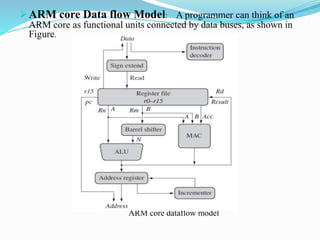
ARM core Data flow Model: A programmer can think of an
ARM core as functional units connected by data buses, as shown in
Figure.
ARM core dataflow model
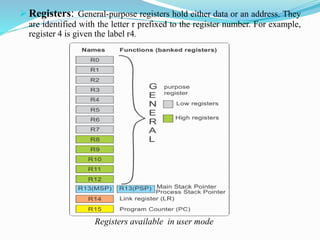
 Registers: General-purpose registers hold either data or an address. They
are identified with the letter r prefixed to the register number. For example,
register 4 is given the label r4.
Registers available in user mode
 Current Program Status Registers (CPSR)
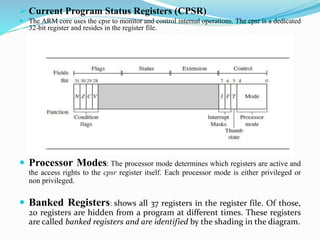
 The ARM core uses the cpsr to monitor and control internal operations. The cpsr is a dedicated
32-bit register and resides in the register file.
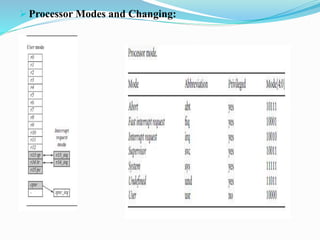
 Processor Modes: The processor mode determines which registers are active and
the access rights to the cpsr register itself. Each processor mode is either privileged or
non privileged.
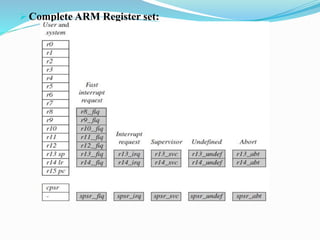
 Banked Registers: shows all 37 registers in the register file. Of those,
20 registers are hidden from a program at different times. These registers
are called banked registers and are identified by the shading in the diagram.
 Complete ARM Register set:
 Processor Modes and Changing:
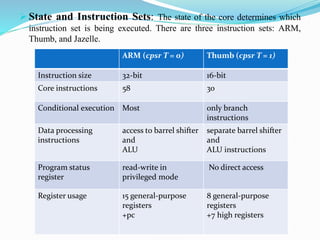
 State and Instruction Sets: The state of the core determines which
instruction set is being executed. There are three instruction sets: ARM,
Thumb, and Jazelle.
ARM (cpsr T = 0) Thumb (cpsr T = 1)
Instruction size 32-bit 16-bit
Core instructions 58 30
Conditional execution Most only branch
instructions
Data processing
instructions
access to barrel shifter
and
ALU
separate barrel shifter
and
ALU instructions
Program status
register
read-write in
privileged mode
No direct access
Register usage 15 general-purpose
registers
+pc
8 general-purpose
registers
+7 high registers
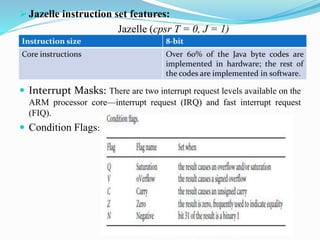
 Jazelle instruction set features:
Jazelle (cpsr T = 0, J = 1)
 Interrupt Masks: There are two interrupt request levels available on the
ARM processor core—interrupt request (IRQ) and fast interrupt request
(FIQ).
 Condition Flags:
Instruction size 8-bit
Core instructions Over 60% of the Java byte codes are
implemented in hardware; the rest of
the codes are implemented in software.
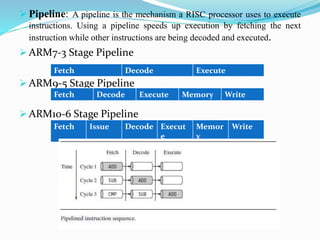
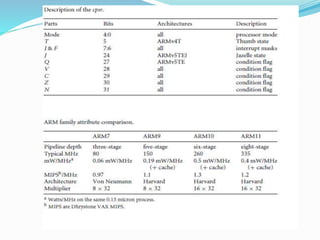
 Pipeline: A pipeline is the mechanism a RISC processor uses to execute
instructions. Using a pipeline speeds up execution by fetching the next
instruction while other instructions are being decoded and executed.
 ARM7-3 Stage Pipeline
 ARM9-5 Stage Pipeline
 ARM10-6 Stage Pipeline
Fetch Decode Execute
Fetch Decode Execute Memory Write
Fetch Issue Decode Execut
e
Memor
y
Write
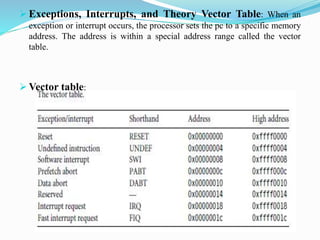
 Exceptions, Interrupts, and Theory Vector Table: When an
exception or interrupt occurs, the processor sets the pc to a specific memory
address. The address is within a special address range called the vector
table.
 Vector table:
 Core Extensions: There are three hardware extensions ARM wraps
around the core: cache and tightly coupled memory, memory management,
and the coprocessor interface.
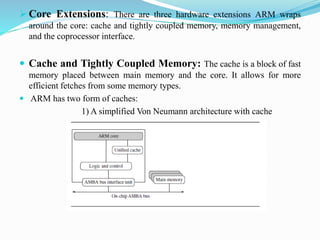
 Cache and Tightly Coupled Memory: The cache is a block of fast
memory placed between main memory and the core. It allows for more
efficient fetches from some memory types.
 ARM has two form of caches:
1) A simplified Von Neumann architecture with cache
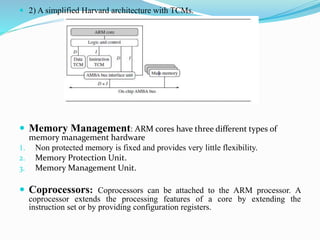
 2) A simplified Harvard architecture with TCMs.
 Memory Management: ARM cores have three different types of
memory management hardware
1. Non protected memory is fixed and provides very little flexibility.
2. Memory Protection Unit.
3. Memory Management Unit.
 Coprocessors: Coprocessors can be attached to the ARM processor. A
coprocessor extends the processing features of a core by extending the
instruction set or by providing configuration registers.
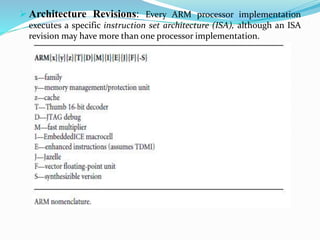
 Architecture Revisions: Every ARM processor implementation
executes a specific instruction set architecture (ISA), although an ISA
revision may have more than one processor implementation.
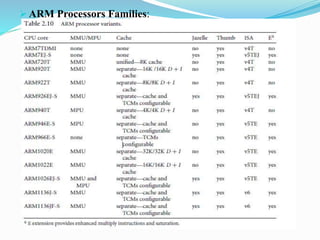
 ARM Processors Families:
 Specialized Processors: Strong ARM was originally co-developed by
Digital Semiconductor and is now exclusively licensed by Intel
Corporation. It is has been popular for PDAs and applications that require
performance with low power consumption. It is a Harvard architecture with
separate D+I caches.
 Intel’s XScale is a follow-on product to the Strong ARM and offers dramatic
increases in performance. At the time of writing, XScale was quoted as
being able to run up to 1 GHz.
 SC100 is at the other end of the performance spectrum. It is designed
specifically for low-power security applications. The SC100 is the first
Secure Core and is based on an ARM7TDMI core with an MPU.

Unit vi (2)

  • 1.
    ARM Processor Fundamentals B.S.NAGESWARARAO(Ph.D.) Dept. Of ECE ASSISTANT PROFESSOR ESWAR COLLEGE OF ENGINEERING NARASARAOPET
  • 2.
    Outline ARM core Dataflow Model Registers Current Program Status Registers (CPSR) Pipeline Exceptions, Interrupts, and Theory Vector Table. Core Extensions Memory Management Architecture Revisions ARM Processors Families Specialized Processors
  • 3.
    ARM core Dataflow Model: A programmer can think of an ARM core as functional units connected by data buses, as shown in Figure. ARM core dataflow model
  • 4.
     Registers: General-purposeregisters hold either data or an address. They are identified with the letter r prefixed to the register number. For example, register 4 is given the label r4. Registers available in user mode
  • 5.
     Current ProgramStatus Registers (CPSR)  The ARM core uses the cpsr to monitor and control internal operations. The cpsr is a dedicated 32-bit register and resides in the register file.  Processor Modes: The processor mode determines which registers are active and the access rights to the cpsr register itself. Each processor mode is either privileged or non privileged.  Banked Registers: shows all 37 registers in the register file. Of those, 20 registers are hidden from a program at different times. These registers are called banked registers and are identified by the shading in the diagram.
  • 6.
     Complete ARMRegister set:
  • 7.
     Processor Modesand Changing:
  • 8.
     State andInstruction Sets: The state of the core determines which instruction set is being executed. There are three instruction sets: ARM, Thumb, and Jazelle. ARM (cpsr T = 0) Thumb (cpsr T = 1) Instruction size 32-bit 16-bit Core instructions 58 30 Conditional execution Most only branch instructions Data processing instructions access to barrel shifter and ALU separate barrel shifter and ALU instructions Program status register read-write in privileged mode No direct access Register usage 15 general-purpose registers +pc 8 general-purpose registers +7 high registers
  • 9.
     Jazelle instructionset features: Jazelle (cpsr T = 0, J = 1)  Interrupt Masks: There are two interrupt request levels available on the ARM processor core—interrupt request (IRQ) and fast interrupt request (FIQ).  Condition Flags: Instruction size 8-bit Core instructions Over 60% of the Java byte codes are implemented in hardware; the rest of the codes are implemented in software.
  • 10.
     Pipeline: Apipeline is the mechanism a RISC processor uses to execute instructions. Using a pipeline speeds up execution by fetching the next instruction while other instructions are being decoded and executed.  ARM7-3 Stage Pipeline  ARM9-5 Stage Pipeline  ARM10-6 Stage Pipeline Fetch Decode Execute Fetch Decode Execute Memory Write Fetch Issue Decode Execut e Memor y Write
  • 11.
     Exceptions, Interrupts,and Theory Vector Table: When an exception or interrupt occurs, the processor sets the pc to a specific memory address. The address is within a special address range called the vector table.  Vector table:
  • 12.
     Core Extensions:There are three hardware extensions ARM wraps around the core: cache and tightly coupled memory, memory management, and the coprocessor interface.  Cache and Tightly Coupled Memory: The cache is a block of fast memory placed between main memory and the core. It allows for more efficient fetches from some memory types.  ARM has two form of caches: 1) A simplified Von Neumann architecture with cache
  • 13.
     2) Asimplified Harvard architecture with TCMs.  Memory Management: ARM cores have three different types of memory management hardware 1. Non protected memory is fixed and provides very little flexibility. 2. Memory Protection Unit. 3. Memory Management Unit.  Coprocessors: Coprocessors can be attached to the ARM processor. A coprocessor extends the processing features of a core by extending the instruction set or by providing configuration registers.
  • 14.
     Architecture Revisions:Every ARM processor implementation executes a specific instruction set architecture (ISA), although an ISA revision may have more than one processor implementation.
  • 15.
  • 17.
     Specialized Processors:Strong ARM was originally co-developed by Digital Semiconductor and is now exclusively licensed by Intel Corporation. It is has been popular for PDAs and applications that require performance with low power consumption. It is a Harvard architecture with separate D+I caches.  Intel’s XScale is a follow-on product to the Strong ARM and offers dramatic increases in performance. At the time of writing, XScale was quoted as being able to run up to 1 GHz.  SC100 is at the other end of the performance spectrum. It is designed specifically for low-power security applications. The SC100 is the first Secure Core and is based on an ARM7TDMI core with an MPU.