THE SOFTWARE PROCESS
CSE 470 : Software Engineering
Ashis Kumar Chanda
Lecturer, BRACU
2
What is a Process?
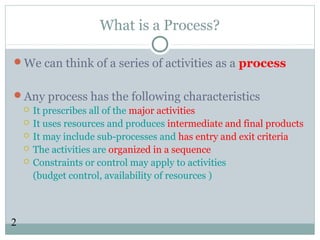
We can think of a series of activities as a process
Any process has the following characteristics
 It prescribes all of the major activities
 It uses resources and produces intermediate and final products
 It may include sub-processes and has entry and exit criteria
 The activities are organized in a sequence
 Constraints or control may apply to activities
(budget control, availability of resources )
3
Software Processes
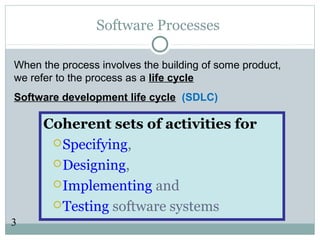
Coherent sets of activities for
Specifying,
Designing,
Implementing and
Testing software systems
When the process involves the building of some product,
we refer to the process as a life cycle
Software development life cycle (SDLC)
4
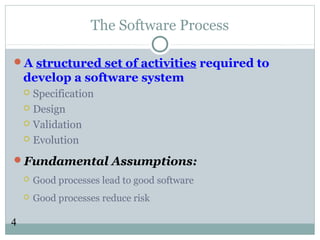
The Software Process
A structured set of activities required to
develop a software system
 Specification
 Design
 Validation
 Evolution
Fundamental Assumptions:
 Good processes lead to good software
 Good processes reduce risk
5
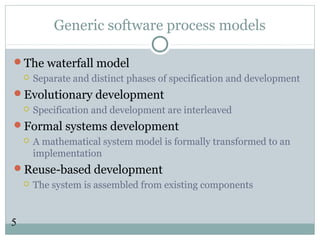
Generic software process models
The waterfall model
 Separate and distinct phases of specification and development
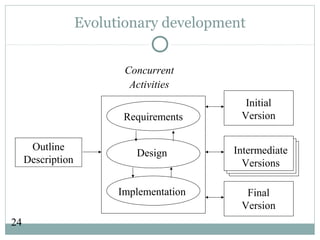
Evolutionary development
 Specification and development are interleaved
Formal systems development
 A mathematical system model is formally transformed to an
implementation
Reuse-based development
 The system is assembled from existing components
6
Fundamental activities
Requirements
System & Software Design
Implementation (Programming)
Integration & Testing
Maintenance
7
Requirements Analysis and Definition
The system's services, constraints and goals are established by
consultation with system users. They are then defined in a
manner that is understandable by both users and development
staff.
This phase can be divided into:
 Feasibility study (often carried out separately)
 Requirements analysis
 Requirements definition
 Requirements specification
8
System and Software Design
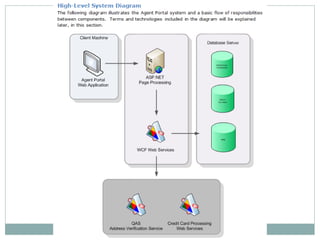
System design: Partition the requirements to hardware or
software systems. Establishes an overall system
architecture
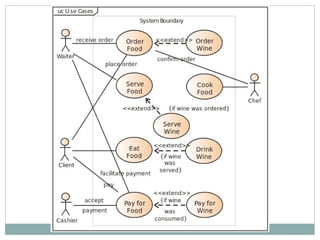
Software design: Represent the software system
functions in a form that can be transformed into one or
more executable programs
 Unified Modeling Language (UML)
11
Programming and Unit Testing
The software design is realized as a set of programs or
program units. (Written specifically, acquired from
elsewhere, or modified.)
Individual components are tested against specifications.
12
Integration and System Testing
The individual program units are:
 integrated and tested as a complete system
 tested against the requirements as specified
 delivered to the client
13
Operation and Maintenance
 Operation: The system is put into practical use.
 Maintenance: Errors and problems are identified and
fixed.
 Evolution: The system evolves over time as
requirements change, to add new functions or adapt the
technical environment.
 Phase out: The system is withdrawn from service.
14
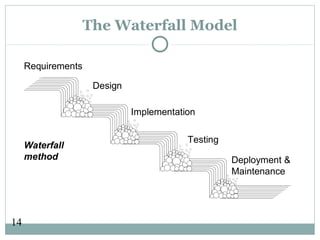
Deployment &
Maintenance
Requirements
Design
Implementation
Testing
Waterfall
method
The Waterfall Model
15
Advantages of the Waterfall Approach
Develop requirements before design
Design before writing code
Write code before integrating it
Test programs after integrating them
Have milestone reviews
16
Any problems?
Real life is not a straight line
17
Some Realities of Software Development
1. Requirements always change because of:
 changing customer desires and user needs
 initial requirements analysis inadequate
 understandings and insights gained through experience
 changing technology
 changing competitive situation
 personnel turnover: engineering, management, marketing, customer
2. The design is never right the first time
 design is a creative, problem solving process
3. Frequent demonstrations of progress and early
warning of problems are desirable
18
The Waterfall Approach
The Waterfall Model requires that we (attempt to):
 specify the requirements completely, consistently, correctly,
and unambiguously on the first attempt
 design the software completely and correctly on the first
attempt
 write all of the software interfaces and internal details correctly
on the first attempt
 integrate the components in one large step
 do system testing and acceptance testing at the end
The linear waterfall model is a one-pass process
19
Discussion of the Waterfall Model
Advantages:
-Identifies systems requirements long before programming
begins.
- Only appropriate when the requirements are well-understood
Disadvantages:
-Takes long time to deliver since developing requirements.
- Difficult to adapt to changing requirements
- Each stage in the process reveals new understanding of the
previous stages, that requires the earlier stages to be revised.
20
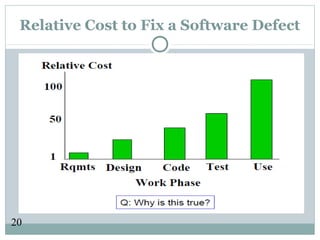
Relative Cost to Fix a Software Defect
21
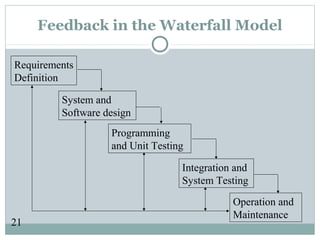
Feedback in the Waterfall Model
Requirements
Definition
System and
Software design
Programming
and Unit Testing
Integration and
System Testing
Operation and
Maintenance
22
Evolutionary development
Exploratory development
- Objective is to work with customers and to evolve a final
system from an initial outline specification.
- The system evolves by adding new features as they are
proposed by customer.
23
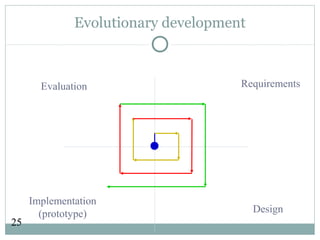
Evolutionary development
Rapid prototyping
 Objective is to understand the system requirements.
 Develop “quick and dirty” system in short time;
 Expose to user comment & feedback;
 Refine;
Repeat until adequate system developed.
 Particularly suitable where:
- detailed requirements not possible;
- powerful development tools (CASE) available
24
Evolutionary development
Outline
Description
Concurrent
Activities
Requirements
Design
Implementation
Initial
Version
Intermediate
Versions
Final
Version
25
Evolutionary development
Requirements
Design
Implementation
(prototype)
Evaluation
26
Evolutionary development
Problems
 Lack of process visibility
 Systems are often poorly structured
 Special skills (e.g. in languages for rapid prototyping)
may be required
Applicability
 For small or medium-size interactive systems
 For parts of large systems (e.g. the user interface)
27
Process iteration
• Modern development processes take iteration as a fundamental
concept.
•System requirements ALWAYS evolve during the course of a
project; so process iteration where earlier stages are reworked is
always part of the process for large systems.
•Iteration can be applied to any of the generic process models.
•Two (related) approaches:
• Incremental development
• Spiral development
28
Incremental development
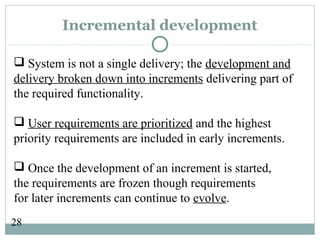
 System is not a single delivery; the development and
delivery broken down into increments delivering part of
the required functionality.
 User requirements are prioritized and the highest
priority requirements are included in early increments.
 Once the development of an increment is started,
the requirements are frozen though requirements
for later increments can continue to evolve.
29
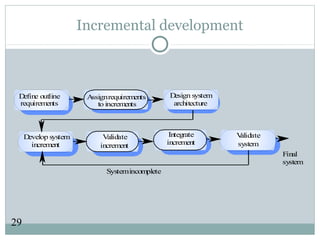
Incremental development
Validate
increment
Develop system
increment
Design system
architecture
Integrate
increment
Validate
system
Define outline
requirements
Assignrequirements
to increments
Systemincomplete
Final
system
30
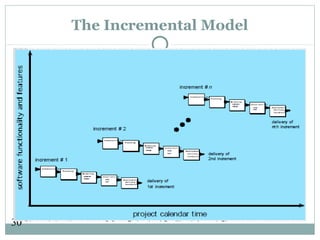
The Incremental Model
31
Incremental development advantages
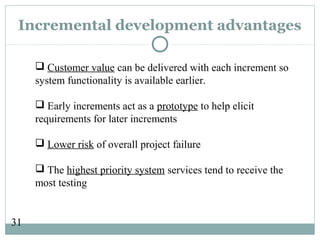
 Customer value can be delivered with each increment so
system functionality is available earlier.
 Early increments act as a prototype to help elicit
requirements for later increments
 Lower risk of overall project failure
 The highest priority system services tend to receive the
most testing
32
Incremental development problems
 The process is not visible.
o Managers need regular deliverables to measure
progress. If systems are developed quickly, it is not cost-
effective to produce documents that reflect every version
of the system.
 System structure tends to degrade as new increments are
added.
o Unless time and money is spent on refactoring to
improve the software, regular change tends to corrupt its
structure. Incorporating further software changes becomes
increasingly difficult and costly.
33
Spiral Model
 The spiral model is a risk-driven process model
generator for software projects. Based on the unique risk
patterns of a given project, the spiral model guides a team to
adopt elements of one or more process models, such as
incremental, waterfall, or evolutionary prototyping.
This model was first described by Barry Boehm in his
1986 paper "A Spiral Model of Software Development and
Enhancement".
34
Spiral development
 Process is represented as a spiral rather than as a sequence of
activities with backtracking.
 Each loop in the spiral represents a phase in the process.
 No fixed phases such as specification or design – loops in the
spiral are chosen depending on what is required.
 Risks are explicitly assessed and resolved throughout the
process.
35
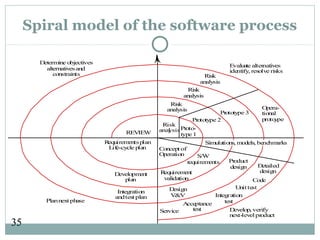
Spiral model of the software process
Risk
analysis
Risk
analysis
Risk
analysis
Risk
analysisProto-
type 1
Prototype 2
Prototype 3
Opera-
tional
protoype
Conceptof
Operation
Simulations, models, benchmarks
S/W
requirements
Requirement
validation
Design
V&V
Product
design Detailed
design
Code
Unittest
Integration
testAcceptance
testService Develop, verify
next-levelproduct
Evaluate alternatives
identify, resolve risks
Determine objectives
alternativesand
constraints
Plannextphase
Integration
andtestplan
Development
plan
Requirementsplan
Life-cycle plan
REVIEW
36
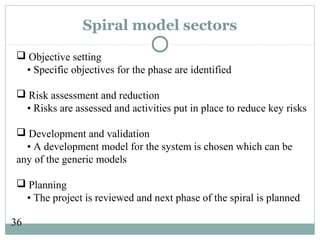
Spiral model sectors
 Objective setting
• Specific objectives for the phase are identified
 Risk assessment and reduction
• Risks are assessed and activities put in place to reduce key risks
 Development and validation
• A development model for the system is chosen which can be
any of the generic models
 Planning
• The project is reviewed and next phase of the spiral is planned
37
Spiral model usage
 Spiral model has been very influential in helping
people think about iteration in software processes and
introducing the risk-driven approach to development.
 In practice, however, the model is rarely used as
published for practical software development.
38
References
Cornell University, USA
http://www.cs.cornell.edu/courses/cs501/2000fa/slides.html
Picture collect from: Ivan Marsic, Rutgers
University
Ian Sommerville, Software Engineering, 9th
edition, Pearson, 2011
Roger s. pressman, Software Engineering a
practitioners approach, 7th
ed
2. Software process

2. Software process

  • 1.
    THE SOFTWARE PROCESS CSE470 : Software Engineering Ashis Kumar Chanda Lecturer, BRACU
  • 2.
    2 What is aProcess? We can think of a series of activities as a process Any process has the following characteristics  It prescribes all of the major activities  It uses resources and produces intermediate and final products  It may include sub-processes and has entry and exit criteria  The activities are organized in a sequence  Constraints or control may apply to activities (budget control, availability of resources )
  • 3.
    3 Software Processes Coherent setsof activities for Specifying, Designing, Implementing and Testing software systems When the process involves the building of some product, we refer to the process as a life cycle Software development life cycle (SDLC)
  • 4.
    4 The Software Process Astructured set of activities required to develop a software system  Specification  Design  Validation  Evolution Fundamental Assumptions:  Good processes lead to good software  Good processes reduce risk
  • 5.
    5 Generic software processmodels The waterfall model  Separate and distinct phases of specification and development Evolutionary development  Specification and development are interleaved Formal systems development  A mathematical system model is formally transformed to an implementation Reuse-based development  The system is assembled from existing components
  • 6.
    6 Fundamental activities Requirements System &Software Design Implementation (Programming) Integration & Testing Maintenance
  • 7.
    7 Requirements Analysis andDefinition The system's services, constraints and goals are established by consultation with system users. They are then defined in a manner that is understandable by both users and development staff. This phase can be divided into:  Feasibility study (often carried out separately)  Requirements analysis  Requirements definition  Requirements specification
  • 8.
    8 System and SoftwareDesign System design: Partition the requirements to hardware or software systems. Establishes an overall system architecture Software design: Represent the software system functions in a form that can be transformed into one or more executable programs  Unified Modeling Language (UML)
  • 11.
    11 Programming and UnitTesting The software design is realized as a set of programs or program units. (Written specifically, acquired from elsewhere, or modified.) Individual components are tested against specifications.
  • 12.
    12 Integration and SystemTesting The individual program units are:  integrated and tested as a complete system  tested against the requirements as specified  delivered to the client
  • 13.
    13 Operation and Maintenance Operation: The system is put into practical use.  Maintenance: Errors and problems are identified and fixed.  Evolution: The system evolves over time as requirements change, to add new functions or adapt the technical environment.  Phase out: The system is withdrawn from service.
  • 14.
  • 15.
    15 Advantages of theWaterfall Approach Develop requirements before design Design before writing code Write code before integrating it Test programs after integrating them Have milestone reviews
  • 16.
    16 Any problems? Real lifeis not a straight line
  • 17.
    17 Some Realities ofSoftware Development 1. Requirements always change because of:  changing customer desires and user needs  initial requirements analysis inadequate  understandings and insights gained through experience  changing technology  changing competitive situation  personnel turnover: engineering, management, marketing, customer 2. The design is never right the first time  design is a creative, problem solving process 3. Frequent demonstrations of progress and early warning of problems are desirable
  • 18.
    18 The Waterfall Approach TheWaterfall Model requires that we (attempt to):  specify the requirements completely, consistently, correctly, and unambiguously on the first attempt  design the software completely and correctly on the first attempt  write all of the software interfaces and internal details correctly on the first attempt  integrate the components in one large step  do system testing and acceptance testing at the end The linear waterfall model is a one-pass process
  • 19.
    19 Discussion of theWaterfall Model Advantages: -Identifies systems requirements long before programming begins. - Only appropriate when the requirements are well-understood Disadvantages: -Takes long time to deliver since developing requirements. - Difficult to adapt to changing requirements - Each stage in the process reveals new understanding of the previous stages, that requires the earlier stages to be revised.
  • 20.
    20 Relative Cost toFix a Software Defect
  • 21.
    21 Feedback in theWaterfall Model Requirements Definition System and Software design Programming and Unit Testing Integration and System Testing Operation and Maintenance
  • 22.
    22 Evolutionary development Exploratory development -Objective is to work with customers and to evolve a final system from an initial outline specification. - The system evolves by adding new features as they are proposed by customer.
  • 23.
    23 Evolutionary development Rapid prototyping Objective is to understand the system requirements.  Develop “quick and dirty” system in short time;  Expose to user comment & feedback;  Refine; Repeat until adequate system developed.  Particularly suitable where: - detailed requirements not possible; - powerful development tools (CASE) available
  • 24.
  • 25.
  • 26.
    26 Evolutionary development Problems  Lackof process visibility  Systems are often poorly structured  Special skills (e.g. in languages for rapid prototyping) may be required Applicability  For small or medium-size interactive systems  For parts of large systems (e.g. the user interface)
  • 27.
    27 Process iteration • Moderndevelopment processes take iteration as a fundamental concept. •System requirements ALWAYS evolve during the course of a project; so process iteration where earlier stages are reworked is always part of the process for large systems. •Iteration can be applied to any of the generic process models. •Two (related) approaches: • Incremental development • Spiral development
  • 28.
    28 Incremental development  Systemis not a single delivery; the development and delivery broken down into increments delivering part of the required functionality.  User requirements are prioritized and the highest priority requirements are included in early increments.  Once the development of an increment is started, the requirements are frozen though requirements for later increments can continue to evolve.
  • 29.
    29 Incremental development Validate increment Develop system increment Designsystem architecture Integrate increment Validate system Define outline requirements Assignrequirements to increments Systemincomplete Final system
  • 30.
  • 31.
    31 Incremental development advantages Customer value can be delivered with each increment so system functionality is available earlier.  Early increments act as a prototype to help elicit requirements for later increments  Lower risk of overall project failure  The highest priority system services tend to receive the most testing
  • 32.
    32 Incremental development problems The process is not visible. o Managers need regular deliverables to measure progress. If systems are developed quickly, it is not cost- effective to produce documents that reflect every version of the system.  System structure tends to degrade as new increments are added. o Unless time and money is spent on refactoring to improve the software, regular change tends to corrupt its structure. Incorporating further software changes becomes increasingly difficult and costly.
  • 33.
    33 Spiral Model  Thespiral model is a risk-driven process model generator for software projects. Based on the unique risk patterns of a given project, the spiral model guides a team to adopt elements of one or more process models, such as incremental, waterfall, or evolutionary prototyping. This model was first described by Barry Boehm in his 1986 paper "A Spiral Model of Software Development and Enhancement".
  • 34.
    34 Spiral development  Processis represented as a spiral rather than as a sequence of activities with backtracking.  Each loop in the spiral represents a phase in the process.  No fixed phases such as specification or design – loops in the spiral are chosen depending on what is required.  Risks are explicitly assessed and resolved throughout the process.
  • 35.
    35 Spiral model ofthe software process Risk analysis Risk analysis Risk analysis Risk analysisProto- type 1 Prototype 2 Prototype 3 Opera- tional protoype Conceptof Operation Simulations, models, benchmarks S/W requirements Requirement validation Design V&V Product design Detailed design Code Unittest Integration testAcceptance testService Develop, verify next-levelproduct Evaluate alternatives identify, resolve risks Determine objectives alternativesand constraints Plannextphase Integration andtestplan Development plan Requirementsplan Life-cycle plan REVIEW
  • 36.
    36 Spiral model sectors Objective setting • Specific objectives for the phase are identified  Risk assessment and reduction • Risks are assessed and activities put in place to reduce key risks  Development and validation • A development model for the system is chosen which can be any of the generic models  Planning • The project is reviewed and next phase of the spiral is planned
  • 37.
    37 Spiral model usage Spiral model has been very influential in helping people think about iteration in software processes and introducing the risk-driven approach to development.  In practice, however, the model is rarely used as published for practical software development.
  • 38.
    38 References Cornell University, USA http://www.cs.cornell.edu/courses/cs501/2000fa/slides.html Picturecollect from: Ivan Marsic, Rutgers University Ian Sommerville, Software Engineering, 9th edition, Pearson, 2011 Roger s. pressman, Software Engineering a practitioners approach, 7th ed

Editor's Notes

  • #3 A series/flow of activities
  • #4 What is SDLC? We already know, water life cycle, frog, CO2 , Oxyzen life cycle
  • #8 Feasibility = work able study /practical need
  • #15 Picture collect from: Ivan Marsic, Rutgers University You can compare it with arrange marriage. You have to know all requirement at first. And spiral model is love marriage. requirement is changing, relationship is developing শুধু আমিই তোমার ঘর করে গেলাম। অন্য কেউ হলে চলে যেত। Same to old software
  • #34 Mesh model