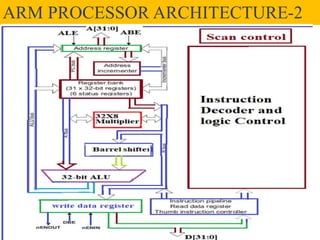
Block Diagram of ARM7ARM PROCESSOR ARCHITECTURE-2
ARM 7TDMI Processor
• The ARM7TDMI is a member of the ARM family
v4 of general-purpose 32-bit microprocessors.
• The ARM family offers high performance for very
low-power consumption .
• ARM 7 is mainly based on Load/Store architecture.
• Only load, store, and swap instructions can access
data from memory using the registers.
• To increase the efficiency of ARM7 a three stage
pipeline architecture is used during the execution.
Load/Store Explanation
• Let us consider an instruction : LDR R2,[R4]
contd
• Let us now consider the instruction : STR R3,[R1].
• Here the data from the register is stored into
memory location.
• The operation is opposite to LDR where data from
memory location is copied to Register.
• Also in STR Rn,[Rx] , Rn is the source and [Rx] is
the destination, which is also opposite as compared
to LDR.
• In LDR R2,[R4] instruction ,[R4] is the source and
R2 is the destination.
Load/Store Explanation
• Let us now consider the instruction : STR R3,[R1]
ARM 7TDMI Processor
• The ARM7TDMI is a member of the ARM family
v4 of general-purpose 32-bit microprocessors.
• The ARM family offers high performance for very
low-power consumption .
• ARM 7 is mainly based on Load/Store architecture.
• Only load, store, and swap instructions can access
data from memory using the registers.
• To increase the efficiency of ARM7 a three stage
pipeline architecture is used during the execution.
Two Architectures
• There are two popular computer architectures are in
use.The first one was Von Neumann model after a
famous Hungerian –American mathematician called
John Luis von Neumann and the other model is
Harvard Architecture.
• The earlier computers were based on Von Neumann
architecture (which is also popularly known as
Princeton Architecture).This architecture uses same
bus to carry both address and data from the
memory.
• As a single bus was used to perform both address
and data operations naturally there was some delay..
Explanation
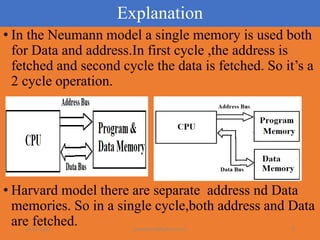
• In the Neumann model a single memory is used both
for Data and address.In first cycle ,the address is
fetched and second cycle the data is fetched. So it’s a
2 cycle operation.
• Harvard model there are separate address nd Data
memories. So in a single cycle,both address and Data
are fetched.24-07-2020 yayavaram@yahoo.com 8
contd
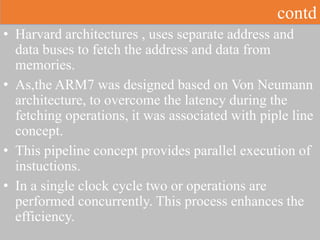
• Harvard architectures , uses separate address and
data buses to fetch the address and data from
memories.
• As,the ARM7 was designed based on Von Neumann
architecture, to overcome the latency during the
fetching operations, it was associated with piple line
concept.
• This pipeline concept provides parallel execution of
instuctions.
• In a single clock cycle two or operations are
performed concurrently. This process enhances the
efficiency.
Three Stage Pipeline
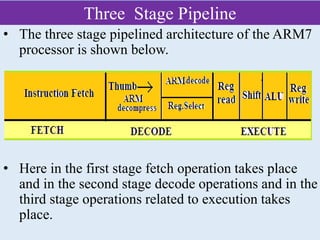
• The three stage pipelined architecture of the ARM7
processor is shown below.
• Here in the first stage fetch operation takes place
and in the second stage decode operations and in the
third stage operations related to execution takes
place.
contd
• In addition to 3-stage pipe line concept ARM also
uses the Advanced Microcontroller Bus
Architecture (AMBA bus architecture).
• This AMBA include two system buses: the AMBA
High-Speed Bus (AHB) or the Advanced System
Bus (ASB), and the Advanced Peripheral Bus
(APB).
• While the ARM 7 is based on Neumann
architecture , ARM 9 is based on Harvard model
with 5 stage pipe line architecture.
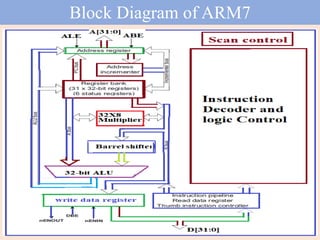
Block Diagram of ARM7
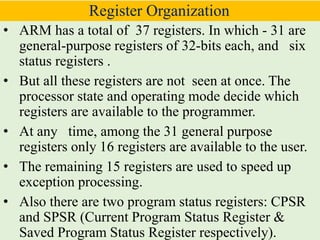
Register Organization
• ARM has a total of 37 registers. In which - 31 are
general-purpose registers of 32-bits each, and six
status registers .
• But all these registers are not seen at once. The
processor state and operating mode decide which
registers are available to the programmer.
• At any time, among the 31 general purpose
registers only 16 registers are available to the user.
• The remaining 15 registers are used to speed up
exception processing.
• Also there are two program status registers: CPSR
and SPSR (Current Program Status Register &
Saved Program Status Register respectively).
contd
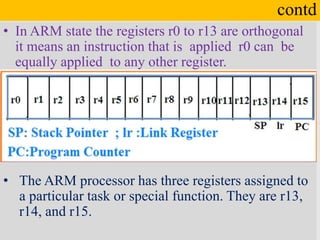
• In ARM state the registers r0 to r13 are orthogonal
it means an instruction that is applied r0 can be
equally applied to any other register.
• The ARM processor has three registers assigned to
a particular task or special function. They are r13,
r14, and r15.
contd
• The general purpose
register usage is given
below.
Ex : MOV r5, r2
ADD r1, r2
LDR r0, [r1]
STR R5,[R0]
contd
• Register r13 is traditionally used as the stack
pointer (sp) and stores the top of the stack in the
current processor mode.
• The Stack Pointer can be used as a general-purpose
register in ARM state only. In Thumb, SP is strictly
defined as the stack pointer.
• R14 is used as the subroutine link register to store a
copy of R15 when a Branch and Link (BL)
instruction is executed.
• In User mode, lr (or R14) is used as a link register
and lr is used as a general-purpose register if the
return address is stored on the stack.
contd
• R15 is used as a Program counter which stores the
address of the next instruction in the pipeline.
• Also, the branch instructions load the destination
address into PC.
• At all other times these registers may be treated as
a general-purpose registers.
24-07-2020 yayavaram@yahoo.com 18

Lect 2 ARM processor architecture

  • 1.
    Block Diagram ofARM7ARM PROCESSOR ARCHITECTURE-2
  • 2.
    ARM 7TDMI Processor •The ARM7TDMI is a member of the ARM family v4 of general-purpose 32-bit microprocessors. • The ARM family offers high performance for very low-power consumption . • ARM 7 is mainly based on Load/Store architecture. • Only load, store, and swap instructions can access data from memory using the registers. • To increase the efficiency of ARM7 a three stage pipeline architecture is used during the execution.
  • 3.
    Load/Store Explanation • Letus consider an instruction : LDR R2,[R4]
  • 4.
    contd • Let usnow consider the instruction : STR R3,[R1]. • Here the data from the register is stored into memory location. • The operation is opposite to LDR where data from memory location is copied to Register. • Also in STR Rn,[Rx] , Rn is the source and [Rx] is the destination, which is also opposite as compared to LDR. • In LDR R2,[R4] instruction ,[R4] is the source and R2 is the destination.
  • 5.
    Load/Store Explanation • Letus now consider the instruction : STR R3,[R1]
  • 6.
    ARM 7TDMI Processor •The ARM7TDMI is a member of the ARM family v4 of general-purpose 32-bit microprocessors. • The ARM family offers high performance for very low-power consumption . • ARM 7 is mainly based on Load/Store architecture. • Only load, store, and swap instructions can access data from memory using the registers. • To increase the efficiency of ARM7 a three stage pipeline architecture is used during the execution.
  • 7.
    Two Architectures • Thereare two popular computer architectures are in use.The first one was Von Neumann model after a famous Hungerian –American mathematician called John Luis von Neumann and the other model is Harvard Architecture. • The earlier computers were based on Von Neumann architecture (which is also popularly known as Princeton Architecture).This architecture uses same bus to carry both address and data from the memory. • As a single bus was used to perform both address and data operations naturally there was some delay..
  • 8.
    Explanation • In theNeumann model a single memory is used both for Data and address.In first cycle ,the address is fetched and second cycle the data is fetched. So it’s a 2 cycle operation. • Harvard model there are separate address nd Data memories. So in a single cycle,both address and Data are fetched.24-07-2020 yayavaram@yahoo.com 8
  • 9.
    contd • Harvard architectures, uses separate address and data buses to fetch the address and data from memories. • As,the ARM7 was designed based on Von Neumann architecture, to overcome the latency during the fetching operations, it was associated with piple line concept. • This pipeline concept provides parallel execution of instuctions. • In a single clock cycle two or operations are performed concurrently. This process enhances the efficiency.
  • 10.
    Three Stage Pipeline •The three stage pipelined architecture of the ARM7 processor is shown below. • Here in the first stage fetch operation takes place and in the second stage decode operations and in the third stage operations related to execution takes place.
  • 11.
    contd • In additionto 3-stage pipe line concept ARM also uses the Advanced Microcontroller Bus Architecture (AMBA bus architecture). • This AMBA include two system buses: the AMBA High-Speed Bus (AHB) or the Advanced System Bus (ASB), and the Advanced Peripheral Bus (APB). • While the ARM 7 is based on Neumann architecture , ARM 9 is based on Harvard model with 5 stage pipe line architecture.
  • 12.
  • 13.
    Register Organization • ARMhas a total of 37 registers. In which - 31 are general-purpose registers of 32-bits each, and six status registers . • But all these registers are not seen at once. The processor state and operating mode decide which registers are available to the programmer. • At any time, among the 31 general purpose registers only 16 registers are available to the user. • The remaining 15 registers are used to speed up exception processing. • Also there are two program status registers: CPSR and SPSR (Current Program Status Register & Saved Program Status Register respectively).
  • 14.
    contd • In ARMstate the registers r0 to r13 are orthogonal it means an instruction that is applied r0 can be equally applied to any other register. • The ARM processor has three registers assigned to a particular task or special function. They are r13, r14, and r15.
  • 15.
    contd • The generalpurpose register usage is given below. Ex : MOV r5, r2 ADD r1, r2 LDR r0, [r1] STR R5,[R0]
  • 16.
    contd • Register r13is traditionally used as the stack pointer (sp) and stores the top of the stack in the current processor mode. • The Stack Pointer can be used as a general-purpose register in ARM state only. In Thumb, SP is strictly defined as the stack pointer. • R14 is used as the subroutine link register to store a copy of R15 when a Branch and Link (BL) instruction is executed. • In User mode, lr (or R14) is used as a link register and lr is used as a general-purpose register if the return address is stored on the stack.
  • 17.
    contd • R15 isused as a Program counter which stores the address of the next instruction in the pipeline. • Also, the branch instructions load the destination address into PC. • At all other times these registers may be treated as a general-purpose registers.
  • 18.