Sequential
logic circuits
Combinational logic circuit
Sequential logic circuit
Flip-flop
Build flip-flop using logic gates
1
Objectives:
• Define sequential logic circuit.
• Differentiate between combinational logic circuit and
sequential logic circuit.
• Describe flip - flop.
• Identify various types of flip-flops.
• Build SR and T flip – flop using logic gates.
• Draw the symbol and truth table of SR and T flip – flop.
1
2
3
4
5
6
2
T Flip-Flop
Identify various types of flip-flops.
Build SR and T flip – flop using logic gates.
Draw the symbol and truth table of SR and T flip – flop.
4
5
6
3
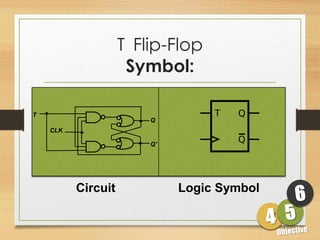
T Flip-Flop
Symbol:
Circuit Logic Symbol
4
T
Q
Q'
CLK
T Flip-Flop
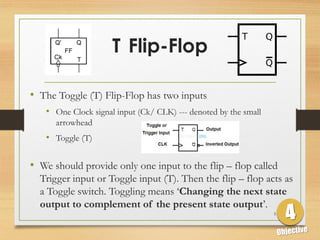
• The Toggle (T) Flip-Flop has two inputs
• One Clock signal input (Ck/ CLK) --- denoted by the small
arrowhead
• Toggle (T)
• We should provide only one input to the flip – flop called
Trigger input or Toggle input (T). Then the flip – flop acts as
a Toggle switch. Toggling means ‘Changing the next state
output to complement of the present state output’.
5
T Flip-Flop
Truth Table:
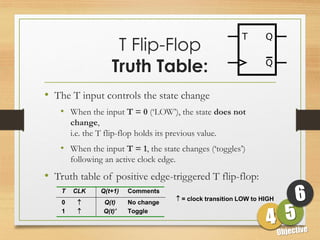
• The T input controls the state change
• When the input T = 0 (‘LOW’), the state does not
change,
i.e. the T flip-flop holds its previous value.
• When the input T = 1, the state changes (‘toggles’)
following an active clock edge.
• Truth table of positive edge-triggered T flip-flop:
T CLK Q(t+1) Comments
0  Q(t) No change
1  Q(t)' Toggle 6
 = clock transition LOW to HIGH
Clock
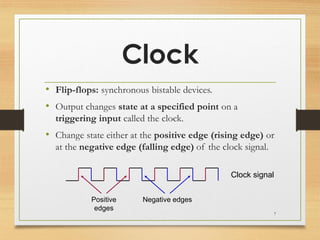
• Flip-flops: synchronous bistable devices.
• Output changes state at a specified point on a
triggering input called the clock.
• Change state either at the positive edge (rising edge) or
at the negative edge (falling edge) of the clock signal.
Positive
edges
Negative edges
Clock signal
7
T Flip-Flop
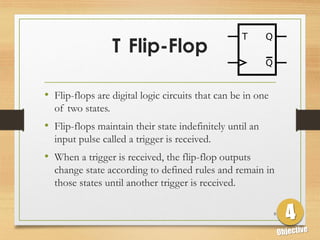
• Flip-flops are digital logic circuits that can be in one
of two states.
• Flip-flops maintain their state indefinitely until an
input pulse called a trigger is received.
• When a trigger is received, the flip-flop outputs
change state according to defined rules and remain in
those states until another trigger is received.
8
T Flip-Flop
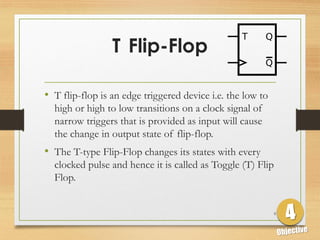
• T flip-flop is an edge triggered device i.e. the low to
high or high to low transitions on a clock signal of
narrow triggers that is provided as input will cause
the change in output state of flip-flop.
• The T-type Flip-Flop changes its states with every
clocked pulse and hence it is called as Toggle (T) Flip
Flop.
9
T Flip-Flop
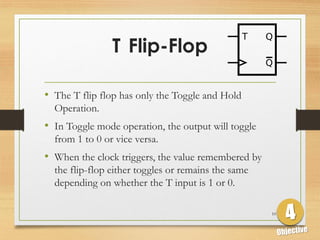
• The T flip flop has only the Toggle and Hold
Operation.
• In Toggle mode operation, the output will toggle
from 1 to 0 or vice versa.
• When the clock triggers, the value remembered by
the flip-flop either toggles or remains the same
depending on whether the T input is 1 or 0.
10
SR NOR gate latch
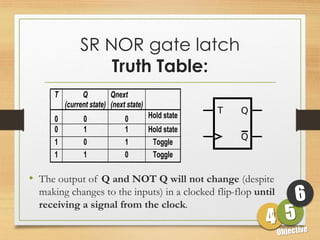
Truth Table:
T Q
(current state)
Qnext
(next state)
0 0 0 Hold state
0 1 1 Hold state
1 0 1 Toggle
1 1 0 Toggle
11
• The output of Q and NOT Q will not change (despite
making changes to the inputs) in a clocked flip-flop until
receiving a signal from the clock.
T-type Flip-Flop
Timing Diagram
12
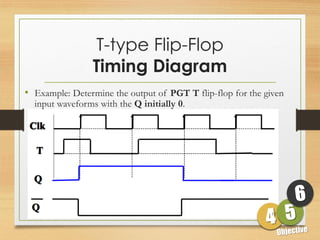
• Example: Determine the output of PGT T flip-flop for the given
input waveforms with the Q initially 0.
T-type Flip-Flop
Timing Diagram
13
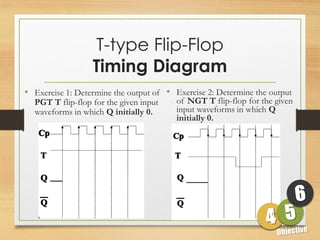
• Exercise 2: Determine the output
of NGT T flip-flop for the given
input waveforms in which Q
initially 0.
• Exercise 1: Determine the output of
PGT T flip-flop for the given input
waveforms in which Q initially 0.

Sequential logic circuits flip-flop pt 3

  • 1.
    Sequential logic circuits Combinational logiccircuit Sequential logic circuit Flip-flop Build flip-flop using logic gates 1
  • 2.
    Objectives: • Define sequentiallogic circuit. • Differentiate between combinational logic circuit and sequential logic circuit. • Describe flip - flop. • Identify various types of flip-flops. • Build SR and T flip – flop using logic gates. • Draw the symbol and truth table of SR and T flip – flop. 1 2 3 4 5 6 2
  • 3.
    T Flip-Flop Identify varioustypes of flip-flops. Build SR and T flip – flop using logic gates. Draw the symbol and truth table of SR and T flip – flop. 4 5 6 3
  • 4.
  • 5.
    T Flip-Flop • TheToggle (T) Flip-Flop has two inputs • One Clock signal input (Ck/ CLK) --- denoted by the small arrowhead • Toggle (T) • We should provide only one input to the flip – flop called Trigger input or Toggle input (T). Then the flip – flop acts as a Toggle switch. Toggling means ‘Changing the next state output to complement of the present state output’. 5
  • 6.
    T Flip-Flop Truth Table: •The T input controls the state change • When the input T = 0 (‘LOW’), the state does not change, i.e. the T flip-flop holds its previous value. • When the input T = 1, the state changes (‘toggles’) following an active clock edge. • Truth table of positive edge-triggered T flip-flop: T CLK Q(t+1) Comments 0  Q(t) No change 1  Q(t)' Toggle 6  = clock transition LOW to HIGH
  • 7.
    Clock • Flip-flops: synchronousbistable devices. • Output changes state at a specified point on a triggering input called the clock. • Change state either at the positive edge (rising edge) or at the negative edge (falling edge) of the clock signal. Positive edges Negative edges Clock signal 7
  • 8.
    T Flip-Flop • Flip-flopsare digital logic circuits that can be in one of two states. • Flip-flops maintain their state indefinitely until an input pulse called a trigger is received. • When a trigger is received, the flip-flop outputs change state according to defined rules and remain in those states until another trigger is received. 8
  • 9.
    T Flip-Flop • Tflip-flop is an edge triggered device i.e. the low to high or high to low transitions on a clock signal of narrow triggers that is provided as input will cause the change in output state of flip-flop. • The T-type Flip-Flop changes its states with every clocked pulse and hence it is called as Toggle (T) Flip Flop. 9
  • 10.
    T Flip-Flop • TheT flip flop has only the Toggle and Hold Operation. • In Toggle mode operation, the output will toggle from 1 to 0 or vice versa. • When the clock triggers, the value remembered by the flip-flop either toggles or remains the same depending on whether the T input is 1 or 0. 10
  • 11.
    SR NOR gatelatch Truth Table: T Q (current state) Qnext (next state) 0 0 0 Hold state 0 1 1 Hold state 1 0 1 Toggle 1 1 0 Toggle 11 • The output of Q and NOT Q will not change (despite making changes to the inputs) in a clocked flip-flop until receiving a signal from the clock.
  • 12.
    T-type Flip-Flop Timing Diagram 12 •Example: Determine the output of PGT T flip-flop for the given input waveforms with the Q initially 0.
  • 13.
    T-type Flip-Flop Timing Diagram 13 •Exercise 2: Determine the output of NGT T flip-flop for the given input waveforms in which Q initially 0. • Exercise 1: Determine the output of PGT T flip-flop for the given input waveforms in which Q initially 0.