DIFFERENTIALAMPLIFIER
using MOSFET
DONEBY,
NITHYAPRIYA
PRASHANNA
S.PRAVEENKUMAR
PREETHI
SATHISHKUMAR
SHAGARI
Differential amplifier
• Amplifies the difference between the input signals
INPUTS:
Differential input:
Vid = Vi1-Vi2
Common input:
Vic=( Vi1+Vi2)/2
OUTPUTS:
Differential output:
Vod = Vo1-Vo2
Common output:
Voc=( Vo1+Vo2)/2
Why differential amplifiers are
popular?
• Less sensitive to noise(CMRR>>1)
• Biasing:
1) Relatively easy direct coupling of stages
2) Biasing resistor doesnot affect the
differential gain(no need for bypass capacitor)
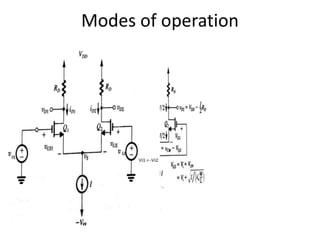
MOS differential amplifier
Modes of operation
Regions of operation
• Cut off region- VGS ≤ Vt
• Active region- VDS ≤ VOV
• Saturation region- VDS ≥ VOV
TO DERIVE DRAIN CURRENT EQUATION
|Q|/unit channel length = Cox W VOV
Drift velocity= μn|E|= μn (VDS/L)
The drain current is the product of charge per unit length and drift velocity
ID=[( μnCox)(W/L) VOV] VDS
ID=[( μnCox)(W/L) VGS-Vt] VDS
ID=[kn’(W/L) VGS-Vt] VDS
Replacing VOV by (VOV-(1/2) VDS)
ID=kn’(W/L) (VOV-(1/2) VDS) VDS
At saturation mode, VDS ≥ VOV,
ID=(1/2) kn’(W/L)V2
OV
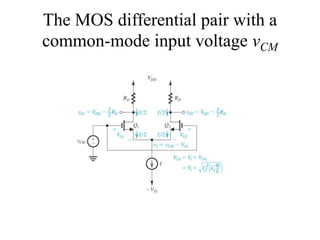
The MOS differential pair with a
common-mode input voltage vCM
Operation with common mode input
• The two gate terminals are connected to a
voltage VCM called common mode voltage.
• So VG1 = VG2 =VCM
• The drain currents are,
• Voltage at sources, will be
2
21
21
I
II
QQ
DD 

GSCMs Vvv 
• Neglecting the channel length modulation and
using the relation between VGS and ID is,(at
saturation)
• Where,
W=width of the channel
L=length of the channel
VGS =gain to source voltage
Vt =threshold voltage
Kn
’ = µn Cox
2'
)(
2
1
tGSnD VV
L
W
kI 
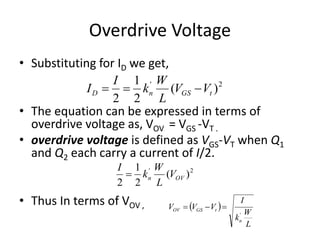
Overdrive Voltage
• Substituting for ID we get,
• The equation can be expressed in terms of
overdrive voltage as, VOV = VGS -VT .
• overdrive voltage is defined as VGS-VT when Q1
and Q2 each carry a current of I/2.
• Thus In terms of VOV ,
2'
)(
2
1
2
tGSnD VV
L
W
k
I
I 
2'
)(
2
1
2
OVn V
L
W
k
I

 
L
W
k
I
VVV
n
tGSOV
'

Common mode rejection
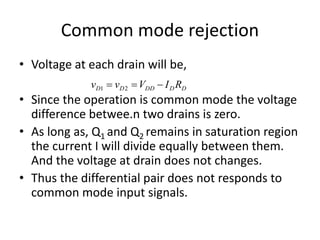
• Voltage at each drain will be,
• Since the operation is common mode the voltage
difference betwee.n two drains is zero.
• As long as, Q1 and Q2 remains in saturation region
the current I will divide equally between them.
And the voltage at drain does not changes.
• Thus the differential pair does not responds to
common mode input signals.
DDDDDD RIVvv  21
Input common mode range
• The highest value of VCM ensures that Q1 and
Q2 remains in saturation region.
• The lowest value of VCM is determined by
presence of sufficient voltage VCS across
current source I for its proper operation.
• This is the range of VCM over which the
differential pair works properly.
DDDtCM R
I
VVv
2
(max) 
)((min) tGStCSssCM VVVVVv 
PROBLEM based on common mode:
For an NMOS differential pair with a common-mode voltage Vcm
applied as Shown in Fig.
Let Vdd=Vss=2.5V,Kn’(W/L)=3(mA/V2),Vt =0.7V,I=0.2mA,RD =5KΩ and
neglect channel length modulation.
a)Find Vov and VGS for each transistor.
b)For Vcm =0 find Vs,iD1,iD2,VD1 and VD2.
c)For Vcm =+1V.
d)For Vcm =-1V.
e)What is the highest value of Vcm for which Q1 and Q2 remain in
saturation?
f)If current source I requires a minimum voltage of 0.3v to operate
properly, what is the lowest value allowed for Vs and hence for Vcm ?
GIVEN:
VDD=VSS=2.5V, Kn’(W/L)=3(mA/V2) , Vt=0.7V , I=0.2mA,
RD=5KΩ
SOLUTION:
VOV=
=
=0.26V
1) VS1= VS2= Vcm - VGS
=0-0.96=-0.96V
2) ID1=ID2=I/2=0.1mA
3) VD1=VD2 =VDD -(I/2)*RD
=+2.5-(0.1*2.5)=2.25V
c) If Vcm =+1
1)VS1= VS2= Vcm - VGS =1-0.96
=0.04V
2) ID1=ID2=I/2=0.1mA
3) VD1=VD2 =VDD -(I/2)*RD
=+2.5-(0.1*2.5)=2.25V.
Contd…
d) If Vcm =-1V
1)VS1= VS2= Vcm - VGS =-1-0.96
=-1.96V
2) ID1=ID2=I/2=0.1mA
3) VD1=VD2 =VDD -(I/2)*RD
=+2.5-(0.1*2.5)=2.25V.
e)VCMAX = Vt +VDD -(I/2)*RD
= 0.7+2.5-(0.1*2.5)=+2.95V.
f)VCMIN = -VSS + VCS +Vt +VOV
=-2.5+0.3+0.7+0.26 = -1.24V
VSMIN = VCMIN -VGS
= -1.24 - 0.96 = -2.2V.
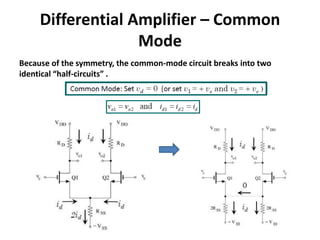
Differential Amplifier – Common
Mode
Because of the symmetry, the common-mode circuit breaks into two
identical “half-circuits” .
Differential Amplifier – Differential
Mode
Because of the symmetry, the differential-mode circuit also breaks into two
identical half-circuits.
OPERATION OF MOS DIFFERENTIAL
AMPLIFIER IN DIFFERENCE MODE
Vid is applied to gate of Q1 and gate of Q2 is grounded.
Applying KVL,
Vid = VGS1 - VGS2
we know that,
Vd1 = Vdd - id1RD
Vd2 = Vdd - id2RD
case(i)
Vid is positive
VGS1 > VGS2
id1 > id2
Vd1 < Vd2
Hence, Vd2 - Vd1 is positive.
case(ii)
Vid is negative
VGS1 <VGS2
id1 < id2
Vd1 > Vd2
Hence, Vd2 - Vd1 is negative
Differential pair responds to difference mode or
differential input signals by providing a
corresponding differential output signal between
the two drains.
If the full bias current flows through the Q1 , VG2 is reduced to Vt
, at which point VS = - Vt , id1 = I.
I =
1
2
kn’ (
𝑊
𝐿
)(𝑉𝐺𝑆1 − 𝑉𝑡)2
by simplyfication, VGS1 = Vt+ 2𝐼/kn’(
𝑊
𝐿
)
But, VOV = 𝐼/kn’(
𝑊
𝐿
)
hence, VGS1 = Vt+ 𝟐 VOV
Where, kn’-process transconductance parameter which is the product of electron
mobility( µ 𝑛) and oxide capacitance (𝐶 𝑜𝑥).
where VOV is the overdrive voltage corresponds to the drain current of I/2.
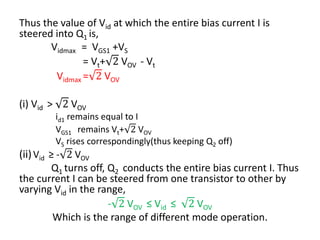
Thus the value of Vid at which the entire bias current I is
steered into Q1 is,
Vidmax = VGS1 +VS
= Vt+ 2 VOV - Vt
Vidmax = 2 VOV
(i) Vid > 2 VOV
id1 remains equal to I
VGS1 remains Vt+ 2 VOV
VS rises correspondingly(thus keeping Q2 off)
(ii)Vid ≥ - 2 VOV
Q1 turns off, Q2 conducts the entire bias current I. Thus
the current I can be steered from one transistor to other by
varying Vid in the range,
- 2 VOV ≤ Vid ≤ 2 VOV
Which is the range of different mode operation.
Advantages
• Manipulating differential signals
• High input impedance
• Not sensitive to temperature
• Fabrication is easier
• Provides immunity to external noise
• A 6 db increase in dynamic range which is a
clear advantage for low voltage systems
• Reduces second order harmonics
Disadvantages
• Lower gain
• Complexity
• Need for negative voltage source for proper
bias
Applications
• Analog systems
• DC amplifiers
• Audio amplifiers
- speakers and microphone circuits in
cellphones
• Servocontrol systems
• Analog computers

DIFFERENTIAL AMPLIFIER using MOSFET

  • 1.
  • 2.
    Differential amplifier • Amplifiesthe difference between the input signals INPUTS: Differential input: Vid = Vi1-Vi2 Common input: Vic=( Vi1+Vi2)/2 OUTPUTS: Differential output: Vod = Vo1-Vo2 Common output: Voc=( Vo1+Vo2)/2
  • 3.
    Why differential amplifiersare popular? • Less sensitive to noise(CMRR>>1) • Biasing: 1) Relatively easy direct coupling of stages 2) Biasing resistor doesnot affect the differential gain(no need for bypass capacitor)
  • 4.
  • 5.
  • 6.
    Regions of operation •Cut off region- VGS ≤ Vt • Active region- VDS ≤ VOV • Saturation region- VDS ≥ VOV TO DERIVE DRAIN CURRENT EQUATION |Q|/unit channel length = Cox W VOV Drift velocity= μn|E|= μn (VDS/L) The drain current is the product of charge per unit length and drift velocity ID=[( μnCox)(W/L) VOV] VDS ID=[( μnCox)(W/L) VGS-Vt] VDS ID=[kn’(W/L) VGS-Vt] VDS Replacing VOV by (VOV-(1/2) VDS) ID=kn’(W/L) (VOV-(1/2) VDS) VDS At saturation mode, VDS ≥ VOV, ID=(1/2) kn’(W/L)V2 OV
  • 7.
    The MOS differentialpair with a common-mode input voltage vCM
  • 8.
    Operation with commonmode input • The two gate terminals are connected to a voltage VCM called common mode voltage. • So VG1 = VG2 =VCM • The drain currents are, • Voltage at sources, will be 2 21 21 I II QQ DD   GSCMs Vvv 
  • 9.
    • Neglecting thechannel length modulation and using the relation between VGS and ID is,(at saturation) • Where, W=width of the channel L=length of the channel VGS =gain to source voltage Vt =threshold voltage Kn ’ = µn Cox 2' )( 2 1 tGSnD VV L W kI 
  • 10.
    Overdrive Voltage • Substitutingfor ID we get, • The equation can be expressed in terms of overdrive voltage as, VOV = VGS -VT . • overdrive voltage is defined as VGS-VT when Q1 and Q2 each carry a current of I/2. • Thus In terms of VOV , 2' )( 2 1 2 tGSnD VV L W k I I  2' )( 2 1 2 OVn V L W k I    L W k I VVV n tGSOV ' 
  • 11.
    Common mode rejection •Voltage at each drain will be, • Since the operation is common mode the voltage difference betwee.n two drains is zero. • As long as, Q1 and Q2 remains in saturation region the current I will divide equally between them. And the voltage at drain does not changes. • Thus the differential pair does not responds to common mode input signals. DDDDDD RIVvv  21
  • 12.
    Input common moderange • The highest value of VCM ensures that Q1 and Q2 remains in saturation region. • The lowest value of VCM is determined by presence of sufficient voltage VCS across current source I for its proper operation. • This is the range of VCM over which the differential pair works properly. DDDtCM R I VVv 2 (max)  )((min) tGStCSssCM VVVVVv 
  • 13.
    PROBLEM based oncommon mode: For an NMOS differential pair with a common-mode voltage Vcm applied as Shown in Fig. Let Vdd=Vss=2.5V,Kn’(W/L)=3(mA/V2),Vt =0.7V,I=0.2mA,RD =5KΩ and neglect channel length modulation. a)Find Vov and VGS for each transistor. b)For Vcm =0 find Vs,iD1,iD2,VD1 and VD2. c)For Vcm =+1V. d)For Vcm =-1V. e)What is the highest value of Vcm for which Q1 and Q2 remain in saturation? f)If current source I requires a minimum voltage of 0.3v to operate properly, what is the lowest value allowed for Vs and hence for Vcm ?
  • 14.
    GIVEN: VDD=VSS=2.5V, Kn’(W/L)=3(mA/V2) ,Vt=0.7V , I=0.2mA, RD=5KΩ
  • 15.
    SOLUTION: VOV= = =0.26V 1) VS1= VS2=Vcm - VGS =0-0.96=-0.96V 2) ID1=ID2=I/2=0.1mA 3) VD1=VD2 =VDD -(I/2)*RD =+2.5-(0.1*2.5)=2.25V c) If Vcm =+1 1)VS1= VS2= Vcm - VGS =1-0.96 =0.04V 2) ID1=ID2=I/2=0.1mA 3) VD1=VD2 =VDD -(I/2)*RD =+2.5-(0.1*2.5)=2.25V.
  • 16.
    Contd… d) If Vcm=-1V 1)VS1= VS2= Vcm - VGS =-1-0.96 =-1.96V 2) ID1=ID2=I/2=0.1mA 3) VD1=VD2 =VDD -(I/2)*RD =+2.5-(0.1*2.5)=2.25V. e)VCMAX = Vt +VDD -(I/2)*RD = 0.7+2.5-(0.1*2.5)=+2.95V. f)VCMIN = -VSS + VCS +Vt +VOV =-2.5+0.3+0.7+0.26 = -1.24V VSMIN = VCMIN -VGS = -1.24 - 0.96 = -2.2V.
  • 17.
    Differential Amplifier –Common Mode Because of the symmetry, the common-mode circuit breaks into two identical “half-circuits” .
  • 18.
    Differential Amplifier –Differential Mode Because of the symmetry, the differential-mode circuit also breaks into two identical half-circuits.
  • 19.
    OPERATION OF MOSDIFFERENTIAL AMPLIFIER IN DIFFERENCE MODE Vid is applied to gate of Q1 and gate of Q2 is grounded. Applying KVL, Vid = VGS1 - VGS2 we know that, Vd1 = Vdd - id1RD Vd2 = Vdd - id2RD case(i) Vid is positive VGS1 > VGS2 id1 > id2 Vd1 < Vd2 Hence, Vd2 - Vd1 is positive.
  • 20.
    case(ii) Vid is negative VGS1<VGS2 id1 < id2 Vd1 > Vd2 Hence, Vd2 - Vd1 is negative Differential pair responds to difference mode or differential input signals by providing a corresponding differential output signal between the two drains.
  • 21.
    If the fullbias current flows through the Q1 , VG2 is reduced to Vt , at which point VS = - Vt , id1 = I. I = 1 2 kn’ ( 𝑊 𝐿 )(𝑉𝐺𝑆1 − 𝑉𝑡)2 by simplyfication, VGS1 = Vt+ 2𝐼/kn’( 𝑊 𝐿 ) But, VOV = 𝐼/kn’( 𝑊 𝐿 ) hence, VGS1 = Vt+ 𝟐 VOV Where, kn’-process transconductance parameter which is the product of electron mobility( µ 𝑛) and oxide capacitance (𝐶 𝑜𝑥). where VOV is the overdrive voltage corresponds to the drain current of I/2.
  • 22.
    Thus the valueof Vid at which the entire bias current I is steered into Q1 is, Vidmax = VGS1 +VS = Vt+ 2 VOV - Vt Vidmax = 2 VOV (i) Vid > 2 VOV id1 remains equal to I VGS1 remains Vt+ 2 VOV VS rises correspondingly(thus keeping Q2 off) (ii)Vid ≥ - 2 VOV Q1 turns off, Q2 conducts the entire bias current I. Thus the current I can be steered from one transistor to other by varying Vid in the range, - 2 VOV ≤ Vid ≤ 2 VOV Which is the range of different mode operation.
  • 23.
    Advantages • Manipulating differentialsignals • High input impedance • Not sensitive to temperature • Fabrication is easier • Provides immunity to external noise • A 6 db increase in dynamic range which is a clear advantage for low voltage systems • Reduces second order harmonics
  • 24.
    Disadvantages • Lower gain •Complexity • Need for negative voltage source for proper bias
  • 25.
    Applications • Analog systems •DC amplifiers • Audio amplifiers - speakers and microphone circuits in cellphones • Servocontrol systems • Analog computers