Finite State Machines
Contents
• Digital circuits
• Finite State Machines (FSM)
• Types of FSM
• FSM Representations
• Example for FSM
• Applications of FSM
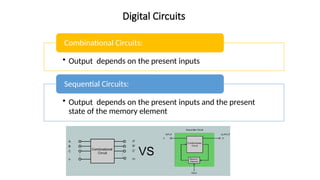
Digital Circuits
• Output depends on the present inputs
Combinational Circuits:
• Output depends on the present inputs and the present
state of the memory element
Sequential Circuits:
What is a Finite State Machine?
• FSM is a computational model with a finite number of states.
• FSM is abstract model to represent sequential circuits.
• It transitions between states based on inputs.
• Used to design logic in digital systems.
• FSM Comprises of States (S) which accepts finite set of inputs (I) to produce finite set of outputs
(O)
• It defines two functions;
• State Function: S x I = S
• Machine Function : S x I= O
Core Components
• States: Distinct conditions of the system.
• Inputs: External signals that trigger transitions.
• Transitions: Rules for moving between states.
• Initial state: Starting state.
• Final states (optional): End states.
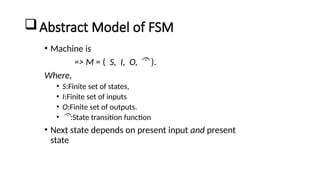
Abstract Model of FSM
• Machine is
=> M = ( S, I, O,  ).
Where,
• S:Finite set of states,
• I:Finite set of inputs
• O:Finite set of outputs.
• :State transition function
• Next state depends on present input and present
state
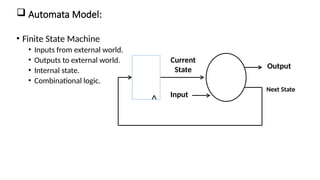
 Automata Model:
• Finite State Machine
• Inputs from external world.
• Outputs to external world.
• Internal state.
• Combinational logic.
Next State
Current
State
Input
Output
Registers
Comb.
Logic
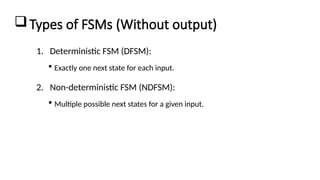
Types of FSMs (Without output)
1. Deterministic FSM (DFSM):
 Exactly one next state for each input.
2. Non-deterministic FSM (NDFSM):
 Multiple possible next states for a given input.
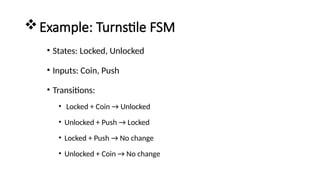
Example: Turnstile FSM
• States: Locked, Unlocked
• Inputs: Coin, Push
• Transitions:
• Locked + Coin → Unlocked
• Unlocked + Push → Locked
• Locked + Push → No change
• Unlocked + Coin → No change
Types of FSMs (With output)
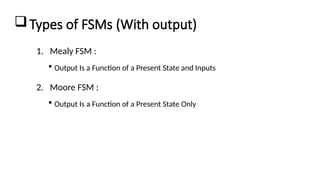
1. Mealy FSM :
 Output Is a Function of a Present State and Inputs
2. Moore FSM :
 Output Is a Function of a Present State Only
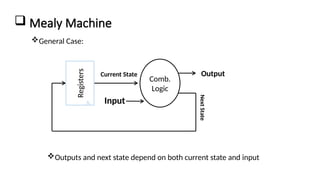
 Mealy Machine
Next
State
Current State
Input
Output
Registers Comb.
Logic
General Case:
Outputs and next state depend on both current state and input
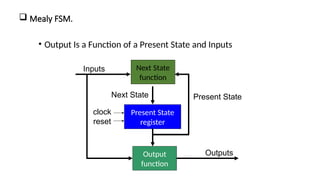
 Mealy FSM.
• Output Is a Function of a Present State and Inputs
Next State
function
Output
function
Inputs
Present State
Next State
Outputs
Present State
register
clock
reset
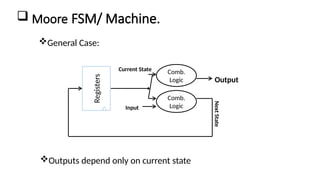
 Moore FSM/ Machine.
Next
State
Current State
Input
Output
Registers
Comb.
Logic
Comb.
Logic
Outputs depend only on current state
General Case:
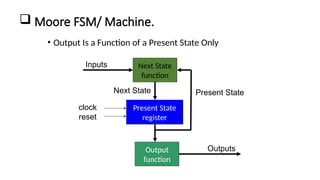
 Moore FSM/ Machine.
• Output Is a Function of a Present State Only
Present State
register
Next State
function
Output
function
Inputs
Present State
Next State
Outputs
clock
reset
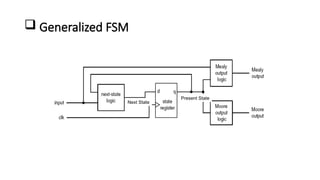
 Generalized FSM
Next State
Present State
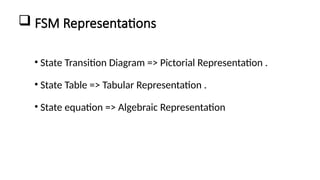
 FSM Representations
• State Transition Diagram => Pictorial Representation .
• State Table => Tabular Representation .
• State equation => Algebraic Representation
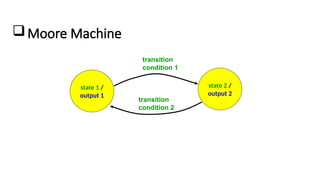
Moore Machine
state 1 /
output 1
state 2 /
output 2
transition
condition 1
transition
condition 2
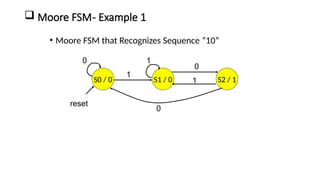
 Moore FSM- Example 1
• Moore FSM that Recognizes Sequence “10”
S0 / 0 S1 / 0 S2 / 1
0
0
0
1
1
1
reset
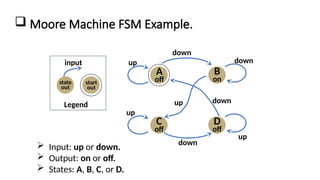
 Moore Machine FSM Example.
Legend
state
out
input
start
out
A
off
B
on
C
off
D
off
down
up down
down
up
up
down
up
 Input: up or down.
 Output: on or off.
 States: A, B, C, or D.
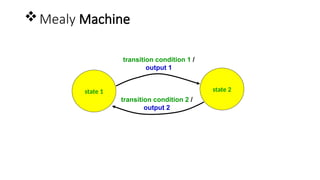
Mealy Machine
state 1 state 2
transition condition 1 /
output 1
transition condition 2 /
output 2
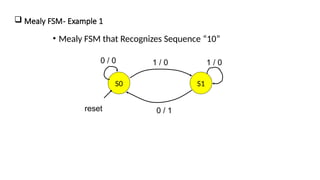
 Mealy FSM- Example 1
• Mealy FSM that Recognizes Sequence “10”
S0 S1
0 / 0 1 / 0 1 / 0
0 / 1
reset
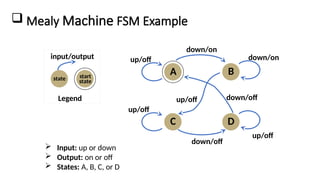
 Mealy Machine FSM Example
Legend
state
input/output
start
state
A B
C D
down/on
up/off down/on
down/off
up/off
up/off
down/off
up/off
 Input: up or down
 Output: on or off
 States: A, B, C, or D
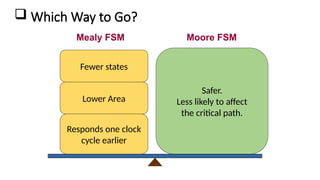
 Which Way to Go?
Safer.
Less likely to affect
the critical path.
Mealy FSM Moore FSM
Lower Area
Responds one clock
cycle earlier
Fewer states
Applications of FSMs
 Vending machine
 Seat belt warning
 Traffic light control
 Elevator control systems
 Digital circuit design
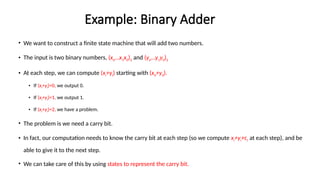
Example: Binary Adder
• We want to construct a finite state machine that will add two numbers.
• The input is two binary numbers, (xn…x1x0)2 and (yn…y1y0)2
• At each step, we can compute (xi+yi) starting with (x0+y0).
• If (xi+yi)=0, we output 0.
• If (xi+yi)=1, we output 1.
• If (xi+yi)=2, we have a problem.
• The problem is we need a carry bit.
• In fact, our computation needs to know the carry bit at each step (so we compute xi+yi+ci at each step), and be
able to give it to the next step.
• We can take care of this by using states to represent the carry bit.
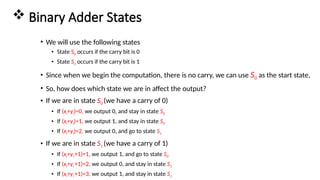
 Binary Adder States
• We will use the following states
• State S0 occurs if the carry bit is 0
• State S1 occurs if the carry bit is 1
• Since when we begin the computation, there is no carry, we can use S0 as the start state,
• So, how does which state we are in affect the output?
• If we are in state S0 (we have a carry of 0)
• If (xi+yi)=0, we output 0, and stay in state S0
• If (xi+yi)=1, we output 1, and stay in state S0
• If (xi+yi)=2, we output 0, and go to state S1
• If we are in state S1 (we have a carry of 1)
• If (xi+yi +1)=1, we output 1, and go to state S0
• If (xi+yi +1)=2, we output 0, and stay in state S1
• If (xi+yi +1)=3, we output 1, and stay in state S1
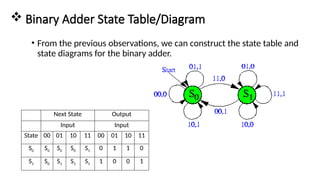
 Binary Adder State Table/Diagram
• From the previous observations, we can construct the state table and
state diagrams for the binary adder.
Next State Output
Input Input
State 00 01 10 11 00 01 10 11
S0 S0 S0 S0 S1 0 1 1 0
S1 S0 S1 S1 S1 1 0 0 1
Thank You

FSM definition, types,working principle,

  • 1.
  • 2.
    Contents • Digital circuits •Finite State Machines (FSM) • Types of FSM • FSM Representations • Example for FSM • Applications of FSM
  • 3.
    Digital Circuits • Outputdepends on the present inputs Combinational Circuits: • Output depends on the present inputs and the present state of the memory element Sequential Circuits:
  • 4.
    What is aFinite State Machine? • FSM is a computational model with a finite number of states. • FSM is abstract model to represent sequential circuits. • It transitions between states based on inputs. • Used to design logic in digital systems. • FSM Comprises of States (S) which accepts finite set of inputs (I) to produce finite set of outputs (O) • It defines two functions; • State Function: S x I = S • Machine Function : S x I= O
  • 5.
    Core Components • States:Distinct conditions of the system. • Inputs: External signals that trigger transitions. • Transitions: Rules for moving between states. • Initial state: Starting state. • Final states (optional): End states.
  • 6.
    Abstract Model ofFSM • Machine is => M = ( S, I, O,  ). Where, • S:Finite set of states, • I:Finite set of inputs • O:Finite set of outputs. • :State transition function • Next state depends on present input and present state
  • 7.
     Automata Model: •Finite State Machine • Inputs from external world. • Outputs to external world. • Internal state. • Combinational logic. Next State Current State Input Output Registers Comb. Logic
  • 8.
    Types of FSMs(Without output) 1. Deterministic FSM (DFSM):  Exactly one next state for each input. 2. Non-deterministic FSM (NDFSM):  Multiple possible next states for a given input.
  • 9.
    Example: Turnstile FSM •States: Locked, Unlocked • Inputs: Coin, Push • Transitions: • Locked + Coin → Unlocked • Unlocked + Push → Locked • Locked + Push → No change • Unlocked + Coin → No change
  • 10.
    Types of FSMs(With output) 1. Mealy FSM :  Output Is a Function of a Present State and Inputs 2. Moore FSM :  Output Is a Function of a Present State Only
  • 11.
     Mealy Machine Next State CurrentState Input Output Registers Comb. Logic General Case: Outputs and next state depend on both current state and input
  • 12.
     Mealy FSM. •Output Is a Function of a Present State and Inputs Next State function Output function Inputs Present State Next State Outputs Present State register clock reset
  • 14.
     Moore FSM/Machine. Next State Current State Input Output Registers Comb. Logic Comb. Logic Outputs depend only on current state General Case:
  • 15.
     Moore FSM/Machine. • Output Is a Function of a Present State Only Present State register Next State function Output function Inputs Present State Next State Outputs clock reset
  • 17.
     Generalized FSM NextState Present State
  • 18.
     FSM Representations •State Transition Diagram => Pictorial Representation . • State Table => Tabular Representation . • State equation => Algebraic Representation
  • 19.
    Moore Machine state 1/ output 1 state 2 / output 2 transition condition 1 transition condition 2
  • 20.
     Moore FSM-Example 1 • Moore FSM that Recognizes Sequence “10” S0 / 0 S1 / 0 S2 / 1 0 0 0 1 1 1 reset
  • 21.
     Moore MachineFSM Example. Legend state out input start out A off B on C off D off down up down down up up down up  Input: up or down.  Output: on or off.  States: A, B, C, or D.
  • 22.
    Mealy Machine state 1state 2 transition condition 1 / output 1 transition condition 2 / output 2
  • 23.
     Mealy FSM-Example 1 • Mealy FSM that Recognizes Sequence “10” S0 S1 0 / 0 1 / 0 1 / 0 0 / 1 reset
  • 24.
     Mealy MachineFSM Example Legend state input/output start state A B C D down/on up/off down/on down/off up/off up/off down/off up/off  Input: up or down  Output: on or off  States: A, B, C, or D
  • 25.
     Which Wayto Go? Safer. Less likely to affect the critical path. Mealy FSM Moore FSM Lower Area Responds one clock cycle earlier Fewer states
  • 26.
    Applications of FSMs Vending machine  Seat belt warning  Traffic light control  Elevator control systems  Digital circuit design
  • 27.
    Example: Binary Adder •We want to construct a finite state machine that will add two numbers. • The input is two binary numbers, (xn…x1x0)2 and (yn…y1y0)2 • At each step, we can compute (xi+yi) starting with (x0+y0). • If (xi+yi)=0, we output 0. • If (xi+yi)=1, we output 1. • If (xi+yi)=2, we have a problem. • The problem is we need a carry bit. • In fact, our computation needs to know the carry bit at each step (so we compute xi+yi+ci at each step), and be able to give it to the next step. • We can take care of this by using states to represent the carry bit.
  • 28.
     Binary AdderStates • We will use the following states • State S0 occurs if the carry bit is 0 • State S1 occurs if the carry bit is 1 • Since when we begin the computation, there is no carry, we can use S0 as the start state, • So, how does which state we are in affect the output? • If we are in state S0 (we have a carry of 0) • If (xi+yi)=0, we output 0, and stay in state S0 • If (xi+yi)=1, we output 1, and stay in state S0 • If (xi+yi)=2, we output 0, and go to state S1 • If we are in state S1 (we have a carry of 1) • If (xi+yi +1)=1, we output 1, and go to state S0 • If (xi+yi +1)=2, we output 0, and stay in state S1 • If (xi+yi +1)=3, we output 1, and stay in state S1
  • 29.
     Binary AdderState Table/Diagram • From the previous observations, we can construct the state table and state diagrams for the binary adder. Next State Output Input Input State 00 01 10 11 00 01 10 11 S0 S0 S0 S0 S1 0 1 1 0 S1 S0 S1 S1 S1 1 0 0 1
  • 30.

Editor's Notes

  • #7 Put sequential logic term on slide
  • #23 Also show a mealy machine