Potentiometry (Chapter 14)
Potentiometry
Ecellw/o current flow info abt. a chemical system
• endpoint in a titration
• Measure [ion]
Rapid; Simple; Inexpensive
Need
Reference electrode
Indicator electrode
Potential measuring device
2.
Potentiometry
Typical Cell
Reference electrode/ salt bridge / analyte soln / Indicator electrode
Eref Ej Eind
Reference electrode: Anode by convention
Ecell = Ecath - Eanode
= Eind - Eref + Ej
Potentiometry
A. Junction Potential(Ej)
– Potential that develops across the boundary between
2 electrolyte solns of different composition
– Fundamental problem in Potentiometry
– Limits accuracy
– Small unk. value
A junction potential of ~ 3 mV produces an error of ~ 0.05 pH units
(12% error in [H+])
Potentiometry
B. Reference Electrodes
Whyis the SHE not useful as a reference in potentiometry
a. Limited practical use
b. Difficult to prepare electrode surfaces
c. Difficult to control the activity of H+
d. All of the above
Which one of the following is a arbitrary reference electrode
for measuring electrode potentials
a. Ag/AgCl
b. Saturated Calomel Electrode
c. Normal Hydrogen electrode
d. All of the above
8.
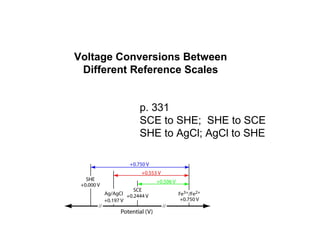
1. Ag/AgCl
Ag /AgCl, KCl (x M) //
AgCls + 1e-
Ags + Cl-
E0
= 0.222 V
Potential determined by [Cl-
]
Sat’d, E = 0.197 V
Two common Reference Electrodes
Ag/AgCl
SCE
9.
2. calomel electrode
Hg/ Hg2Cl2 (sat’d), KCl (x M) //
Hg2Cl2(s) + 2e- 2Hgl + 2Cl-
Potential determined by [Cl-
]
Standard conditions: E0
= 0.268 V
Sat’d calomel electrode (SCE) E = 0.241 V
Why are sat’d solutions used?
C. Indicator Electrodes
Electrodethat responds directly to the analyte
Ideal:
Responds rapidly, reproducibly
Selective
Two main types
1- metallic
2- membrane
12.
Potentiometry
1. Metallic Electrodes
Example,
Ptin a solution of Fe2+
/Fe3+
Potential determined by the
Nernst Equation
Eind = E0
– 0.0592 log [Fe2+
]/[Fe3+
]
Ecell = Eind – E AgCl + Ej
Not selective
13.
Potentiometry
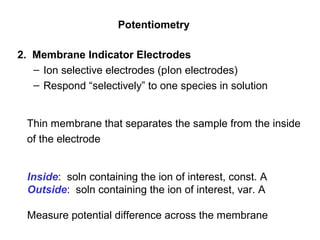
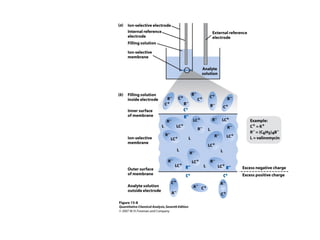
2. Membrane IndicatorElectrodes
– Ion selective electrodes (pIon electrodes)
– Respond “selectively” to one species in solution
Inside: soln containing the ion of interest, const. A
Outside: soln containing the ion of interest, var. A
Measure potential difference across the membrane
Thin membrane that separates the sample from the inside
of the electrode
Functions by exchangeof ions at the surface
H+
Gls = H+
aq + Gl-
s
Glass 1 Soln 1
H+
Gls = H+
aq + Gl-
s
Glass 2 Soln 2
Eb = E1 – E2 = 0.05916 log Ain / Aout
Eb = L – 0.0592pH
Position of these two equil. are determined by aH+ in soln
on the two sides of the membrane
Activity becomes importantwhen
a. Ions have divalent or trivalent charges
b. Ionic strength of the solution is high
c. All of the above
d. None of the above
Activity vs Concentration
21.
Calibrating a glasselectrode
Eind = K + 0.0592 Log [H+]
For every 10 fold change in
activity, the potential should
change by 59.2 mV
Slope = ?
22.
Potentiometry
Errors (limitations) inpH measurements
1- must calibrate electrode
2- junction potential and drift
3- alkaline (sodium) error
4- acid error
5- allow membrane to equilibrate
6- membrane must be hydrated
7- Temperature
23.
Other examples ofISE
Eind = K + (0.0592 / 2)Log [Ca2+
]
Liquid-based ISE
24.
E = K– 0.0592 Log [F-]
Slope = ?
Solid State ISE
Linear range = ?
26.
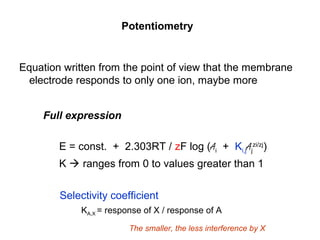
Potentiometry
Equation written fromthe point of view that the membrane
electrode responds to only one ion, maybe more
Full expression
E = const. + 2.303RT / zF log (Ai + Ki,jAj
zi/zj
)
K ranges from 0 to values greater than 1
Selectivity coefficient
KA,X = response of X / response of A
The smaller, the less interference by X
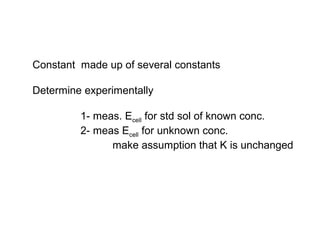
Constant made upof several constants
Determine experimentally
1- meas. Ecell for std sol of known conc.
2- meas Ecell for unknown conc.
make assumption that K is unchanged
29.
Advantages (Figures ofMerit) and other characteristics
a.Linear response over a wide range
b.Non destructive
c.Non contaminating
d.Short response time (min)
e.Unaffected by color and turbidity
f.Precision: OK (1% at best)
g.Sensitivity/Detection limits: (10-6
to 10-9***
M)
h.Standard addition method often used (Why ?)
30.
Problems:
Questions to ask:Membrane or Metal ISE??
If membrane,
Ecell = Emem
–
Eref
Ememb = const +/− 0.0592 log a
If metal,
Ecell = Ecathode
–
Eref
Ecathode Nernst Eq
31.
Calculate the potentialof the following cell when the
aqueous solution is 7.40 x 10⁻³
M Hg2+
SCE // aq soln / Hg
SCE is the saturated Calomel electrode, E0’
= 0.244 V
32.
Example
A pH glass/calomelelectrode was found to develop
a potential of –0.0412 V when used with a buffer of
pH 6.00. With an unk soln, the potential was
–0.2004 V. Calculate the pH of the solution.
![Potentiometry (Chapter 14)
Potentiometry
Ecell w/o current flow info abt. a chemical system
• endpoint in a titration
• Measure [ion]
Rapid; Simple; Inexpensive
Need
Reference electrode
Indicator electrode
Potential measuring device](https://image.slidesharecdn.com/potentiometry-140702115517-phpapp01/85/Potentiometry-1-320.jpg)


![Potentiometry
A. Junction Potential (Ej)
– Potential that develops across the boundary between
2 electrolyte solns of different composition
– Fundamental problem in Potentiometry
– Limits accuracy
– Small unk. value
A junction potential of ~ 3 mV produces an error of ~ 0.05 pH units
(12% error in [H+])](https://image.slidesharecdn.com/potentiometry-140702115517-phpapp01/85/Potentiometry-4-320.jpg)


![1. Ag/AgCl
Ag / AgCl, KCl (x M) //
AgCls + 1e-
Ags + Cl-
E0
= 0.222 V
Potential determined by [Cl-
]
Sat’d, E = 0.197 V
Two common Reference Electrodes
Ag/AgCl
SCE](https://image.slidesharecdn.com/potentiometry-140702115517-phpapp01/85/Potentiometry-8-320.jpg)
![2. calomel electrode
Hg / Hg2Cl2 (sat’d), KCl (x M) //
Hg2Cl2(s) + 2e- 2Hgl + 2Cl-
Potential determined by [Cl-
]
Standard conditions: E0
= 0.268 V
Sat’d calomel electrode (SCE) E = 0.241 V
Why are sat’d solutions used?](https://image.slidesharecdn.com/potentiometry-140702115517-phpapp01/85/Potentiometry-9-320.jpg)

![Potentiometry
1. Metallic Electrodes
Example,
Pt in a solution of Fe2+
/Fe3+
Potential determined by the
Nernst Equation
Eind = E0
– 0.0592 log [Fe2+
]/[Fe3+
]
Ecell = Eind – E AgCl + Ej
Not selective](https://image.slidesharecdn.com/potentiometry-140702115517-phpapp01/85/Potentiometry-12-320.jpg)


![Glass Electrode Potential
Three components
1- boundary potential
2- potential of internal Ag/AgCl reference electrode
3- small asymmetry potential
Eind = Eb + Eref2 + Easy
Eind = L’ + 0.0592 Log A1 + Eref2 + Easy
Eind = K + 0.0592 Log [H+]
Eind = K + β0.0592 Log [H+]
Electromotive efficiency](https://image.slidesharecdn.com/potentiometry-140702115517-phpapp01/85/Potentiometry-19-320.jpg)

![Calibrating a glass electrode
Eind = K + 0.0592 Log [H+]
For every 10 fold change in
activity, the potential should
change by 59.2 mV
Slope = ?](https://image.slidesharecdn.com/potentiometry-140702115517-phpapp01/85/Potentiometry-21-320.jpg)

![Other examples of ISE
Eind = K + (0.0592 / 2)Log [Ca2+
]
Liquid-based ISE](https://image.slidesharecdn.com/potentiometry-140702115517-phpapp01/85/Potentiometry-23-320.jpg)
![E = K – 0.0592 Log [F-]
Slope = ?
Solid State ISE
Linear range = ?](https://image.slidesharecdn.com/potentiometry-140702115517-phpapp01/85/Potentiometry-24-320.jpg)