3/12/2019 1
Prepared By
Shanta Majumder
M.Sc. 1st Semester
Session: 2016-217
Department of Chemistry
Comilla University
3/12/2019 2
Presentation On
Electro analytical
Methods of Analysis
3/12/2019 3
Definition
Why to use???
A class of analytical technique that
studies an analyte by measuring
potentials or currents in an
electrochemical cell containing the
analyte
i) Specific for a particular oxidation state of an element.
Example: Determination of Ce (iii) & Ce (iv) separately
from a mixture.
ii) Instruments are relatively inexpensive.
iii) Provides information about activities of a species rather
than its concentration.
3/12/2019 4
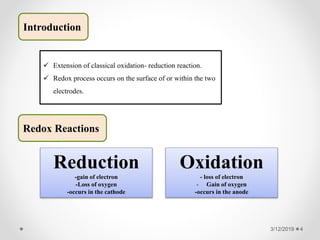
Introduction
 Extension of classical oxidation- reduction reaction.
 Redox process occurs on the surface of or within the two
electrodes.
Reduction
-gain of electron
-Loss of oxygen
-occurs in the cathode
Oxidation
- loss of electron
- Gain of oxygen
-occurs in the anode
Redox Reactions
3/12/2019 5
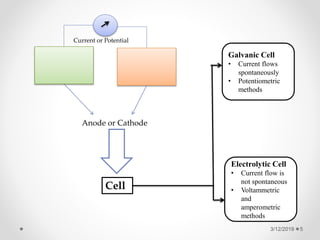
Anode or Cathode
Current or Potential
Cell
Galvanic Cell
• Current flows
spontaneously
• Potentiometric
methods
Electrolytic Cell
• Current flow is
not spontaneous
• Voltammetric
and
amperometric
methods
3/12/2019 6
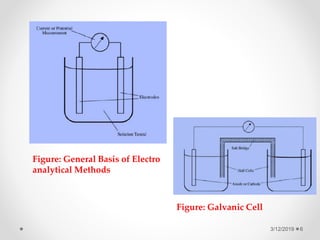
Figure: General Basis of Electro
analytical Methods
Figure: Galvanic Cell
3/12/2019 7
Standard Electrode Potential
𝐸°
𝑐𝑒𝑙𝑙 = 𝐸°
𝑐𝑎𝑡ℎ𝑜𝑑𝑒 − 𝐸°
𝑎𝑛𝑜𝑑𝑒
Example: Calculation of cell potential for following reaction:
Solution:
3/12/2019 8
Calculation of Cell Potential
• An equation has been derived to calculate the cell potential when
conditions other than standard conditions are present. This equation is
called the Nernst equation.
• It is used to calculate the true E (cell potential) from the 𝐸° , temperature,
pressure, and ion concentrations.
• Let us consider a general reaction:
aA+ bB↔cC+ dD
Nernst equation will be:
3/12/2019 9
The Nernst Equation
What is the E for the 𝐹𝑒3+/𝐹𝑒2+ half cell if [𝐹𝑒3+] = 10−4M and [𝐹𝑒2+] =
10−1M at 25℃?
Solution:
3/12/2019 10
Calculation of Cell Potential By Nernst Equation
3/12/2019 11
Applications of Standard
Electrode Potential
(1) Calculating thermodynamic cell potentials
(2) Calculating equilibrium constants for redox reactions
(3) Constructing redox titration curves
3/12/2019 12
Calculating thermodynamic cell potentials
Ecell = Eright – Eleft
Calculating equilibrium constants for redox reactions
3/12/2019 13
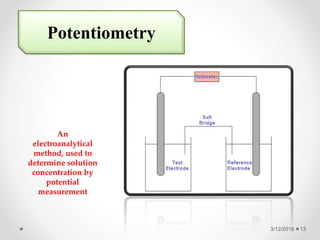
Potentiometry
An
electroanalytical
method, used to
determine solution
concentration by
potential
measurement
3/12/2019 14
Principle
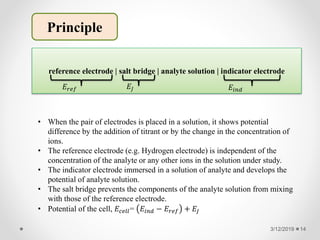
reference electrode | salt bridge | analyte solution | indicator electrode
𝐸𝑟𝑒𝑓 𝐸𝐽 𝐸𝑖𝑛𝑑
• When the pair of electrodes is placed in a solution, it shows potential
difference by the addition of titrant or by the change in the concentration of
ions.
• The reference electrode (e.g. Hydrogen electrode) is independent of the
concentration of the analyte or any other ions in the solution under study.
• The indicator electrode immersed in a solution of analyte and develops the
potential of analyte solution.
• The salt bridge prevents the components of the analyte solution from mixing
with those of the reference electrode.
• Potential of the cell, 𝐸𝑐𝑒𝑙𝑙= 𝐸𝑖𝑛𝑑 − 𝐸𝑟𝑒𝑓 + 𝐸𝐽
3/12/2019 15
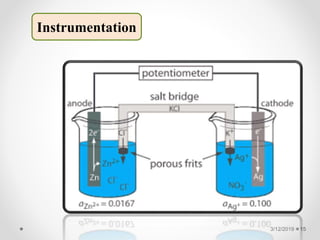
Instrumentation
3/12/2019 16
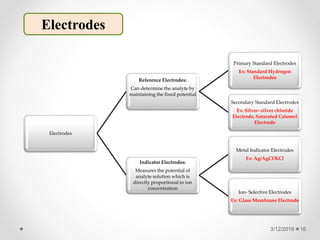
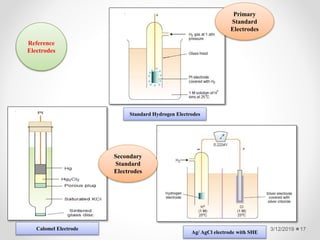
Electrodes
Electrodes
Reference Electrodes:
Can determine the analyte by
maintaining the fixed potential
Primary Standard Electrodes
Ex: Standard Hydrogen
Electrodes
Secondary Standard Electrodes
Ex: Silver- silver chloride
Electrode, Saturated Calomel
Electrode
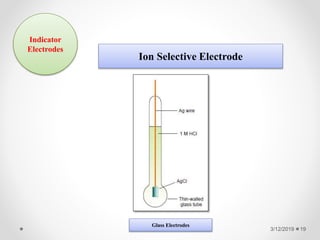
Indicator Electrodes:
Measures the potential of
analyte solution which is
directly proportional to ion
concentration
Metal Indicator Electrodes
Ex: Ag/AgCl/KCl
Ion- Selective Electrodes
Ex: Glass Membrane Electrode
3/12/2019 17
Reference
Electrodes
Standard Hydrogen Electrodes
Ag/ AgCl electrode with SHE
Calomel Electrode
Primary
Standard
Electrodes
Secondary
Standard
Electrodes
3/12/2019 18
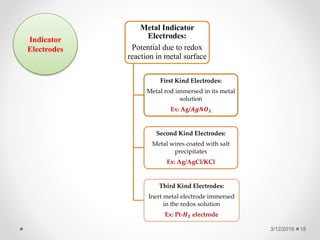
Indicator
Electrodes
Metal Indicator
Electrodes:
Potential due to redox
reaction in metal surface
First Kind Electrodes:
Metal rod immersed in its metal
solution
Ex: Ag/𝑨𝒈𝑵𝑶 𝟑
Second Kind Electrodes:
Metal wires coated with salt
precipitates
Ex: Ag/AgCl/KCl
Third Kind Electrodes:
Inert metal electrode immersed
in the redox solution
Ex: Pt-𝑯 𝟐 electrode
3/12/2019 19
Indicator
Electrodes
Ion Selective Electrode
Glass Electrodes
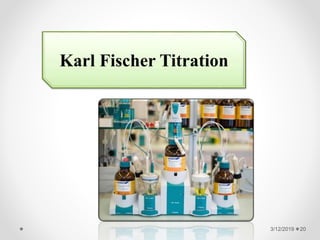
Karl Fischer Titration
3/12/2019 20
Introduction
• It is a classical titration method in analytical chemistry to
determine trace amounts of water in liquid and solid materials.
• It was invented in 1953 by the German chemist Karl Fischer.
• Now a days titration is done with an automated Karl Fischer
titrator.
3/12/2019 21
Principle
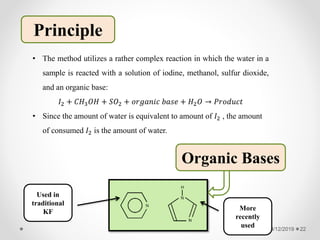
• The method utilizes a rather complex reaction in which the water in a
sample is reacted with a solution of iodine, methanol, sulfur dioxide,
and an organic base:
𝐼2 + 𝐶𝐻3 𝑂𝐻 + 𝑆𝑂2 + 𝑜𝑟𝑔𝑎𝑛𝑖𝑐 𝑏𝑎𝑠𝑒 + 𝐻2 𝑂 → 𝑃𝑟𝑜𝑑𝑢𝑐𝑡
• Since the amount of water is equivalent to amount of 𝐼2 , the amount
of consumed 𝐼2 is the amount of water.
Organic Bases
3/12/2019 22
Used in
traditional
KF More
recently
used
 Toxic
 Disagreeable odor
 Doesn’t give optimum pH for the measurement
3/12/2019 23
Disadvantage of Using Pyridine
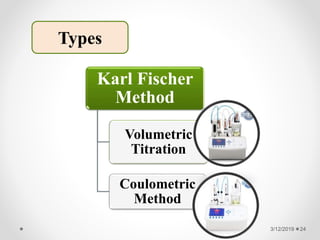
Types
Karl Fischer
Method
Volumetric
Titration
Coulometric
Method
3/12/2019 24
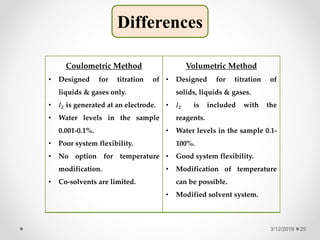
Differences
Coulometric Method
• Designed for titration of
liquids & gases only.
• 𝐼2 is generated at an electrode.
• Water levels in the sample
0.001-0.1%.
• Poor system flexibility.
• No option for temperature
modification.
• Co-solvents are limited.
Volumetric Method
• Designed for titration of
solids, liquids & gases.
• 𝐼2 is included with the
reagents.
• Water levels in the sample 0.1-
100%.
• Good system flexibility.
• Modification of temperature
can be possible.
• Modified solvent system.
3/12/2019 25
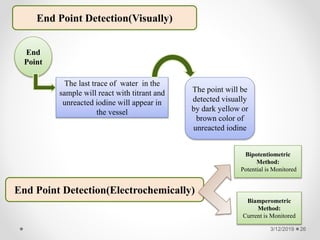
End Point Detection(Visually)
End
Point
The last trace of water in the
sample will react with titrant and
unreacted iodine will appear in
the vessel
The point will be
detected visually
by dark yellow or
brown color of
unreacted iodine
End Point Detection(Electrochemically)
Bipotentiometric
Method:
Potential is Monitored
Biamperometric
Method:
Current is Monitored
3/12/2019 26
The electrochemical
scheme utilizes two
platinum wire electrodes
and no reference
electrode.Figure: Dual Platinum Electrode Probe
3/12/2019 27
 Moisture from surrounding: Process cell is sealed from laboratory air and
Water absorbing material is used
 Solvent Moisture: Solvent moisture is titrated with iodine and then sample is
injected
3/12/2019 28
Elimination of Extraneous Water
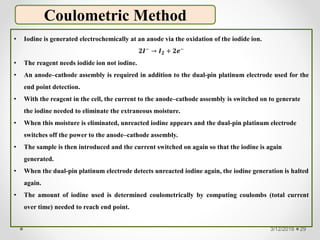
Coulometric Method
• Iodine is generated electrochemically at an anode via the oxidation of the iodide ion.
𝟐𝑰−
→ 𝑰 𝟐 + 𝟐𝒆−
• The reagent needs iodide ion not iodine.
• An anode–cathode assembly is required in addition to the dual-pin platinum electrode used for the
end point detection.
• With the reagent in the cell, the current to the anode–cathode assembly is switched on to generate
the iodine needed to eliminate the extraneous moisture.
• When this moisture is eliminated, unreacted iodine appears and the dual-pin platinum electrode
switches off the power to the anode–cathode assembly.
• The sample is then introduced and the current switched on again so that the iodine is again
generated.
• When the dual-pin platinum electrode detects unreacted iodine again, the iodine generation is halted
again.
• The amount of iodine used is determined coulometrically by computing coulombs (total current
over time) needed to reach end point.
3/12/2019 29
3/12/2019 30
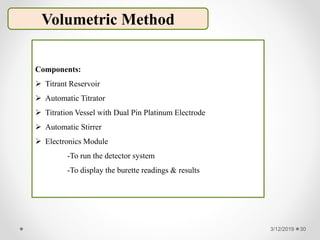
Volumetric Method
Components:
 Titrant Reservoir
 Automatic Titrator
 Titration Vessel with Dual Pin Platinum Electrode
 Automatic Stirrer
 Electronics Module
-To run the detector system
-To display the burette readings & results
3/12/2019 31
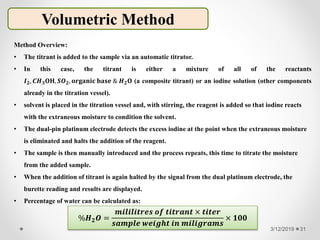
Method Overview:
• The titrant is added to the sample via an automatic titrator.
• In this case, the titrant is either a mixture of all of the reactants
𝑰 𝟐, 𝑪𝑯 𝟑 𝐎𝐇, 𝑺𝑶 𝟐, 𝐨𝐫𝐠𝐚𝐧𝐢𝐜 𝐛𝐚𝐬𝐞 & 𝑯 𝟐 𝐎 (a composite titrant) or an iodine solution (other components
already in the titration vessel).
• solvent is placed in the titration vessel and, with stirring, the reagent is added so that iodine reacts
with the extraneous moisture to condition the solvent.
• The dual-pin platinum electrode detects the excess iodine at the point when the extraneous moisture
is eliminated and halts the addition of the reagent.
• The sample is then manually introduced and the process repeats, this time to titrate the moisture
from the added sample.
• When the addition of titrant is again halted by the signal from the dual platinum electrode, the
burette reading and results are displayed.
• Percentage of water can be calculated as:
Volumetric Method
%𝑯 𝟐 𝑶 =
𝒎𝒊𝒍𝒊𝒍𝒊𝒕𝒓𝒆𝒔 𝒐𝒇 𝒕𝒊𝒕𝒓𝒂𝒏𝒕 × 𝒕𝒊𝒕𝒆𝒓
𝒔𝒂𝒎𝒑𝒍𝒆 𝒘𝒆𝒊𝒈𝒉𝒕 𝒊𝒏 𝒎𝒊𝒍𝒊𝒈𝒓𝒂𝒎𝒔
× 𝟏𝟎𝟎
Applications
Increased
product stability,
e.g.
pharmaceutical
products or food
products
Stopping growth
of
microorganisms
by determining
water level
Analytical
technique for
quantitative
analysis of total
water content
3/12/2019 32
• High accuracy & precision
• Selectivity for water
• Short analysis duration
• Easy sample preparation
• Small sample quantities
required
• Suitability for analyzing
solids, liquids & gases
• High cost of apparatus
• Inference of compound
reaction with iodine
• Highly acidic or basic
compounds can not be
determined
• Large amount of sample is
needed
Limitations
Advantages
3/12/2019 33
3/12/2019 34
Potentiometric Titration
3/12/2019 35
Definition
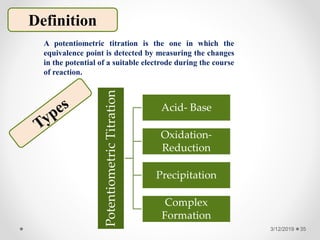
A potentiometric titration is the one in which the
equivalence point is detected by measuring the changes
in the potential of a suitable electrode during the course
of reaction.
PotentiometricTitration Acid- Base
Oxidation-
Reduction
Precipitation
Complex
Formation
3/12/2019 36
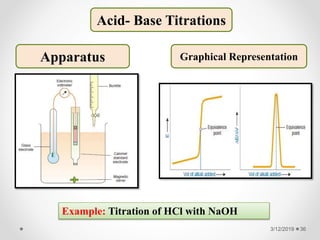
Acid- Base Titrations
Apparatus Graphical Representation
Example: Titration of HCl with NaOH
3/12/2019 37
Oxidation- Reduction Titrations
Apparatus Graphical Representation
Example: Titration of 𝑭𝒆 𝟐+and 𝑪𝒆 𝟒+ ions
3/12/2019 38
Precipitation Titrations
Apparatus Graphical Representation
Example: Titration of 𝑵𝒂𝑪𝒍 and 𝑨𝒈𝑵𝑶 𝟑 solutions
3/12/2019 39
Applications of Potentiometry
 Clinical Chemistry
 Environmental Chemistry
 Potentiometric Titration
 Agriculture
 Detergent Manufacturing
 Food Processing
3/12/2019 40
Voltammetry
A type of electroanalytical methods
which is used to measure the
produced current by the
application of a specific voltage on
a working electrode
3/12/2019 41
Invention
 Polarography is a particular type of voltammetry which differs
from other types of voltammetry in that is working electrode is
unique dropping mercury electrode.
 After declining polarography, voltammetry have grown at an
astonishing pace using same working electrode.
Polarography
 Earliest voltammetry technique is polarography developed by
Jaroslav Heyrovsky in 1920 (Nobel Prize in Chemistry in 1959)
3/12/2019 42
Introduction
 Measures the current that flows as the applied potential is
varied.
 From this current measurement, information about analyte is
obtained.
 Analytical data comes in the form of voltammogram (current
produced by analyte versus potential of working electrode).
3/12/2019 43
Instrumentations
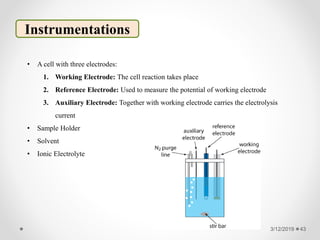
• A cell with three electrodes:
1. Working Electrode: The cell reaction takes place
2. Reference Electrode: Used to measure the potential of working electrode
3. Auxiliary Electrode: Together with working electrode carries the electrolysis
current
• Sample Holder
• Solvent
• Ionic Electrolyte
3/12/2019 44
Working Electrode
Materials
Mercury, platinum, gold, silver and carbon
Why Mercury??!!
• High overvoltage for the reduction of hydronium ion to
hydrogen
• Fresh metallic surface
• Many metal ions are reversibly reduced to amalgams at
the surface of mercury electrode
Reference Electrode
 Calomel Electrode
 Ag/ AgCl electrode
3/12/2019 45
Auxiliary Electrode
 Working electrode maintain charge transfer to and from the analyte.
 Reference electrode balance the charge added or removed by the working electrode.
 After the viable set up, there are some shortcomings.
 It is extremely difficult for an electrode to maintain a constant potential while
passing current to counter redox event at the working electrode.
 To solve this problem, the roles of supplying electrons and providing a reference
potential are divided into two separate electrodes.
 Now, the reference electrode only acts as reference in measuring and controlling the
working electrode’s potential and doesn’t pass any current.
 The auxiliary electrode passes all the current needed to balance the current observed
at the working electrode.
 Acts as cathode when the working electrode is anode and vice versa.
 Are fabricated from electrochemically inert materials such as gold, platinum etc.
3/12/2019 46
Types
 Linear Sweep Voltammetry
 Polarography Voltammetry
 Striping Voltammetry
 Hydrodynamic Voltammetry
 Pulse Voltammetry
 Square Wave Voltammetry
 Differential Pulse Voltammetry
 Cyclic Voltammetry
3/12/2019 47
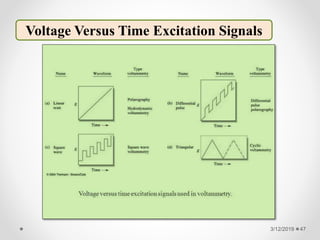
Voltage Versus Time Excitation Signals
3/12/2019 48
Applications
• Voltammetric Sensors: A number of voltammetric systems are produced
commercially for the determination of specific species that are of interest in
industry and research.
• The Oxygen Electrode: The determination of dissolved oxygen in a variety
of aqueous environments, such as sea water, blood, effluents from chemical
plants and soils is of tremendous importance to industry, biomedical and
environmental research and clinical medicine.
3/12/2019 49
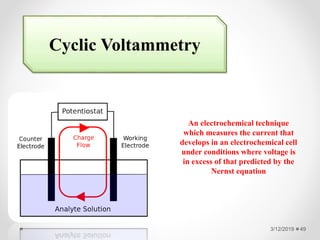
Cyclic Voltammetry
An electrochemical technique
which measures the current that
develops in an electrochemical cell
under conditions where voltage is
in excess of that predicted by the
Nernst equation
3/12/2019 50
Why CV!!??
 A wide range of current over potentials
 Fast technique
 Low signal to noise ratio
 The product of the electron transfer
reaction that occurred in the forward scan
can be probed again in reverse scan.
3/12/2019 51
Principle
 Potential is changed continuously as
a linear function of time (Figure-1).
 When applied potential approaches
characteristic E° for redox reaction,
cathodic current begins to increase
until a peak is reached and then
decrease.
 When the potential is reversed,
Anodic peak results (Figure-2).
0
0.2
0.4
0.6
0.8
1
1.2
0 0.5 1 1.5 2
t / s
Figure-1
Figure-2
3/12/2019 52
Cyclic Voltammetry – a potentiodinamic transient voltammetry
Cyclic voltammetry (CV) is the most
frequently used technique. Almost any
electrochemical study starts with
application of CV. From the features of the
cyclic voltammogram, one can deduce
thermodynamic, kinetic and
mechanistic characteristics of the
electrode reaction!
R ⇄ O + e-
0
0.2
0.4
0.6
0.8
1
1.2
0 0.5 1 1.5 2
t / s
-0.04
-0.03
-0.02
-0.01
0
0.01
0.02
0.03
0.04
0.05
-0.4 -0.3 -0.2 -0.1 0 0.1 0.2 0.3 0.4
R  O + e
O + e  R
Current/A
Potential / V
Variation of the electrode potential in the course of the
experiment. The rate of potential variation in time is
called scan rate (v (V/s)), which represents the critical
time of the experiment.
The outcome of the experiment is presented as an I-E
curve, called cyclic voltammogram. By convention, the
positive current reflects oxidation, whereas the negative
current represents reduction reaction.
forward scan
reverse scan
3/12/2019 53
Typical features of a cyclic voltammogram
-0.04
-0.03
-0.02
-0.01
0
0.01
0.02
0.03
0.04
0.05
-0.4 -0.3 -0.2 -0.1 0 0.1 0.2 0.3 0.4
Current/A
Potential / V
Ip,a (anod.
peak current)
Ep,a (anod.
peak potential)
Ip,c (cathod.
peak current)
Ep,c (cathod.
peak
potential)
•Anodic peak current
•Cathodic peak current
•Anodic peak potential
•Cathodic peak potential
The peak-like shape of the voltammetric
curves of both forward and reverse scan
are consequence of the exhaustion of
the diffusion layer adjacent to the
electrode with the electro active
material. With time, the thickness of the
diffusion layer increases, thus the flux
(i.e., the current) decreases with time.
That is why the current commences
decreasing after reaching the peak of the
current. The expansion of the diffusion
layer with time is shown on a next slide.
3/12/2019 54
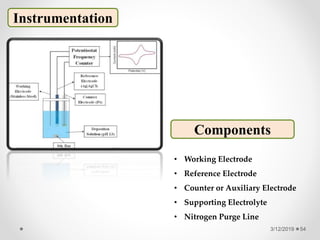
Instrumentation
Components
• Working Electrode
• Reference Electrode
• Counter or Auxiliary Electrode
• Supporting Electrolyte
• Nitrogen Purge Line
3/12/2019 55
Applications
CV is rarely used for quantitative determinations but it is widely used
for:
• The study of redox process
• Understanding reaction intermediates
• Obtaining stability of reaction
• Study of reaction mechanism
3/12/2019 56
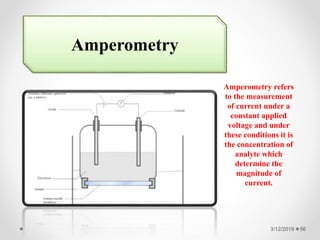
Amperometry
Amperometry refers
to the measurement
of current under a
constant applied
voltage and under
these conditions it is
the concentration of
analyte which
determine the
magnitude of
current.
3/12/2019 57
Introduction
 Voltage across the indicator and reference electrode is kept constant
 Diffusion current passing through the cell is measured and plotted
against the volume of reagent added
 Current is proportional to the concentration of electro active material
in the solution
 Independent of capillary and supporting electrolyte
3/12/2019 58
Amperometric Titration
• In Amperometric titration the potential applied between the indicator
electrode (dropping mercury electrode) and the appropriate depolarizing
reference electrode (saturated calomel electrode) is kept constant and
current through the electrolytic cell is then measured on the addition of
each increment of titrating solution.
• In these titrations the current passing through the cell between the
indicator electrode and reference electrode at a suitable constant voltage
is measured as a function of the volume of the titrating reagent.
3/12/2019 59
Principle
• According to Ilkovic equation the diffusion current (= limiting current – residual current) is
directly proportional to the concentration of the electro active material in the solution.
• If some of the electro-active material is removed by interaction with reagent, the diffusion
current will decrease. This is the fundamental principle of amperometric titrations.
• The observed diffusion current at a suitable applied voltage is measured as a function of
the volume of the titrating solution: the end point is the point of intersection of two lines
giving the change of current before and after the equivalence point.
• Example: Fe(ii) solution titrated with Ce(iv) solution
Reaction: 𝐹𝑒 𝑖𝑖 + 𝐶𝑒 𝑖𝑣 ↔ 𝐹𝑒 𝑖𝑖𝑖 + 𝐶𝑒(𝑖𝑖)
3/12/2019 60
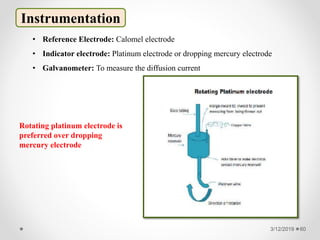
Instrumentation
• Reference Electrode: Calomel electrode
• Indicator electrode: Platinum electrode or dropping mercury electrode
• Galvanometer: To measure the diffusion current
Rotating platinum electrode is
preferred over dropping
mercury electrode
3/12/2019 61
Rotating Platinum Electrode
• Glass tube of length 12-20cm
• Platinum wire extends 50-10mm from the wall of glass tubing
• Electrode is mounted on shaft of the motor and rotated at constant speed
600RPM
• Electrical connection is made to the electrode by copper wire passing
through tubing to the mercury covering the platinum wire seal
Advantage of RPE over DME
• Diffusion current is 20times larger then DME which allows measuring
the small concentration ion
• RPE can be used at positive potential which increase the workable range
to positive voltage side
• Electrode is simple to construct
• Steady diffusion rate is reached quickly
3/12/2019 62
Operation
• Only reducible ions (For example: 𝑃𝑏2+ ) give diffusion
current.
• Non- reducible ions like 𝑆𝑂4
2−
do not give diffusion
current.
• Concentration of the reducible 𝑃𝑏2+ ions is steadily
decreased as the 𝑆𝑂4
2−
ions remove some of the electro
active 𝑃𝑏2+
ions.
3/12/2019 63
Titration Curves
3/12/2019 64
Titration Curves
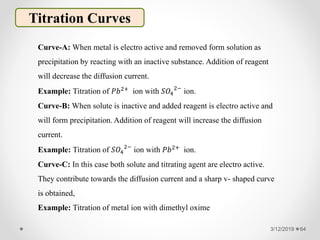
Curve-A: When metal is electro active and removed form solution as
precipitation by reacting with an inactive substance. Addition of reagent
will decrease the diffusion current.
Example: Titration of 𝑃𝑏2+
ion with 𝑆𝑂4
2−
ion.
Curve-B: When solute is inactive and added reagent is electro active and
will form precipitation. Addition of reagent will increase the diffusion
current.
Example: Titration of 𝑆𝑂4
2−
ion with 𝑃𝑏2+ ion.
Curve-C: In this case both solute and titrating agent are electro active.
They contribute towards the diffusion current and a sharp v- shaped curve
is obtained,
Example: Titration of metal ion with dimethyl oxime
3/12/2019 65
Biamperometric Titration
• Involves titration in uniformly stirred solutions.
• Two small and similar platinum electrodes are
used where small emf is applied.
• Reversible oxidation- reduction system should be
present either before or after end point.
3/12/2019 66
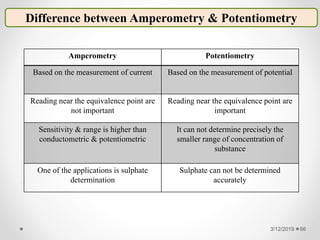
Difference between Amperometry & Potentiometry
Amperometry Potentiometry
Based on the measurement of current Based on the measurement of potential
Reading near the equivalence point are
not important
Reading near the equivalence point are
important
Sensitivity & range is higher than
conductometric & potentiometric
It can not determine precisely the
smaller range of concentration of
substance
One of the applications is sulphate
determination
Sulphate can not be determined
accurately
3/12/2019 67
Applications
1. Widely applicable than Potentiometry and Polarography. This method is widely used for
the determination of sulphate which could not be determined accurately by Potentiometric
method due to lack of suitable indicator.
2. Successive determination of chloride, bromine, Iodide by using rotating microelectrode.
3. They are used as micro detectors in liquid chromatography.
4. In bioamperometric titration this technique is widely used in Karl-fisher moisture titration.
5. Other applications are:
a) Phosphate with uranyl acetate
b) Lead with dichromate ions
c) Sulphate with lead nitrate
d) Cu, CO, Pt with
e) Iodine with mercuric nitrate
3/12/2019 68
Advantages
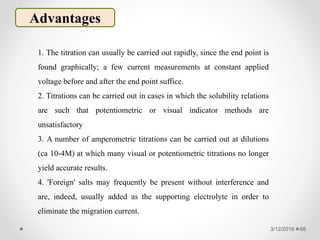
1. The titration can usually be carried out rapidly, since the end point is
found graphically; a few current measurements at constant applied
voltage before and after the end point suffice.
2. Titrations can be carried out in cases in which the solubility relations
are such that potentiometric or visual indicator methods are
unsatisfactory
3. A number of amperometric titrations can be carried out at dilutions
(ca 10-4M) at which many visual or potentiometric titrations no longer
yield accurate results.
4. 'Foreign' salts may frequently be present without interference and
are, indeed, usually added as the supporting electrolyte in order to
eliminate the migration current.
3/12/2019 69
Anodic Stripping
Voltammetry
A voltammetric method for
quantitative determination of
specific ion species.
3/12/2019 70
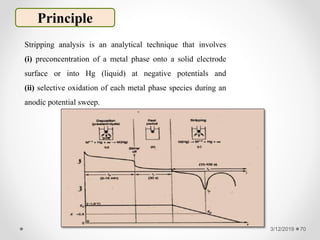
Principle
Stripping analysis is an analytical technique that involves
(i) preconcentration of a metal phase onto a solid electrode
surface or into Hg (liquid) at negative potentials and
(ii) selective oxidation of each metal phase species during an
anodic potential sweep.
3/12/2019 71
Instrumentation
• Working Electrode: Mercury or Bismuth film over
glass carbon electrode
• Reference Electrode
• Auxiliary Electrode
• Electrolyte
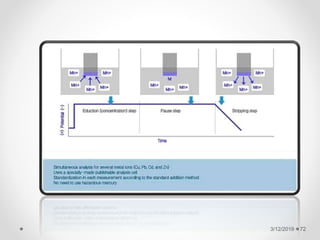
Mechanism
Step-1: Cleaning Step; potential is more oxidizing than the analyte for a period of time
in order to fully remove it from electrolyte.
Step-2: Deposition; Potential is held at lower to reduce the analyte and deposit it to the
electrolyte.
Step-3: Distribution; stirring is stopped, potential is kept lowered, deposited analyte is
distributed more evenly in the mercury.
Step-4: Stripping; working electrode potential is raised and oxidation of analyte occurs.
3/12/2019 72
3/12/2019 73
Usefulness
• High sensitivity
• For trace analysis
• Mainly for metal
analysis
Applications
• Testing drinking water
quality and swage or
waste water
3/12/2019 74
Thanks
to
All

Electroanalytical Methods of analysis

  • 1.
    3/12/2019 1 Prepared By ShantaMajumder M.Sc. 1st Semester Session: 2016-217 Department of Chemistry Comilla University
  • 2.
    3/12/2019 2 Presentation On Electroanalytical Methods of Analysis
  • 3.
    3/12/2019 3 Definition Why touse??? A class of analytical technique that studies an analyte by measuring potentials or currents in an electrochemical cell containing the analyte i) Specific for a particular oxidation state of an element. Example: Determination of Ce (iii) & Ce (iv) separately from a mixture. ii) Instruments are relatively inexpensive. iii) Provides information about activities of a species rather than its concentration.
  • 4.
    3/12/2019 4 Introduction  Extensionof classical oxidation- reduction reaction.  Redox process occurs on the surface of or within the two electrodes. Reduction -gain of electron -Loss of oxygen -occurs in the cathode Oxidation - loss of electron - Gain of oxygen -occurs in the anode Redox Reactions
  • 5.
    3/12/2019 5 Anode orCathode Current or Potential Cell Galvanic Cell • Current flows spontaneously • Potentiometric methods Electrolytic Cell • Current flow is not spontaneous • Voltammetric and amperometric methods
  • 6.
    3/12/2019 6 Figure: GeneralBasis of Electro analytical Methods Figure: Galvanic Cell
  • 7.
  • 8.
    𝐸° 𝑐𝑒𝑙𝑙 = 𝐸° 𝑐𝑎𝑡ℎ𝑜𝑑𝑒− 𝐸° 𝑎𝑛𝑜𝑑𝑒 Example: Calculation of cell potential for following reaction: Solution: 3/12/2019 8 Calculation of Cell Potential
  • 9.
    • An equationhas been derived to calculate the cell potential when conditions other than standard conditions are present. This equation is called the Nernst equation. • It is used to calculate the true E (cell potential) from the 𝐸° , temperature, pressure, and ion concentrations. • Let us consider a general reaction: aA+ bB↔cC+ dD Nernst equation will be: 3/12/2019 9 The Nernst Equation
  • 10.
    What is theE for the 𝐹𝑒3+/𝐹𝑒2+ half cell if [𝐹𝑒3+] = 10−4M and [𝐹𝑒2+] = 10−1M at 25℃? Solution: 3/12/2019 10 Calculation of Cell Potential By Nernst Equation
  • 11.
    3/12/2019 11 Applications ofStandard Electrode Potential (1) Calculating thermodynamic cell potentials (2) Calculating equilibrium constants for redox reactions (3) Constructing redox titration curves
  • 12.
    3/12/2019 12 Calculating thermodynamiccell potentials Ecell = Eright – Eleft Calculating equilibrium constants for redox reactions
  • 13.
    3/12/2019 13 Potentiometry An electroanalytical method, usedto determine solution concentration by potential measurement
  • 14.
    3/12/2019 14 Principle reference electrode| salt bridge | analyte solution | indicator electrode 𝐸𝑟𝑒𝑓 𝐸𝐽 𝐸𝑖𝑛𝑑 • When the pair of electrodes is placed in a solution, it shows potential difference by the addition of titrant or by the change in the concentration of ions. • The reference electrode (e.g. Hydrogen electrode) is independent of the concentration of the analyte or any other ions in the solution under study. • The indicator electrode immersed in a solution of analyte and develops the potential of analyte solution. • The salt bridge prevents the components of the analyte solution from mixing with those of the reference electrode. • Potential of the cell, 𝐸𝑐𝑒𝑙𝑙= 𝐸𝑖𝑛𝑑 − 𝐸𝑟𝑒𝑓 + 𝐸𝐽
  • 15.
  • 16.
    3/12/2019 16 Electrodes Electrodes Reference Electrodes: Candetermine the analyte by maintaining the fixed potential Primary Standard Electrodes Ex: Standard Hydrogen Electrodes Secondary Standard Electrodes Ex: Silver- silver chloride Electrode, Saturated Calomel Electrode Indicator Electrodes: Measures the potential of analyte solution which is directly proportional to ion concentration Metal Indicator Electrodes Ex: Ag/AgCl/KCl Ion- Selective Electrodes Ex: Glass Membrane Electrode
  • 17.
    3/12/2019 17 Reference Electrodes Standard HydrogenElectrodes Ag/ AgCl electrode with SHE Calomel Electrode Primary Standard Electrodes Secondary Standard Electrodes
  • 18.
    3/12/2019 18 Indicator Electrodes Metal Indicator Electrodes: Potentialdue to redox reaction in metal surface First Kind Electrodes: Metal rod immersed in its metal solution Ex: Ag/𝑨𝒈𝑵𝑶 𝟑 Second Kind Electrodes: Metal wires coated with salt precipitates Ex: Ag/AgCl/KCl Third Kind Electrodes: Inert metal electrode immersed in the redox solution Ex: Pt-𝑯 𝟐 electrode
  • 19.
  • 20.
  • 21.
    Introduction • It isa classical titration method in analytical chemistry to determine trace amounts of water in liquid and solid materials. • It was invented in 1953 by the German chemist Karl Fischer. • Now a days titration is done with an automated Karl Fischer titrator. 3/12/2019 21
  • 22.
    Principle • The methodutilizes a rather complex reaction in which the water in a sample is reacted with a solution of iodine, methanol, sulfur dioxide, and an organic base: 𝐼2 + 𝐶𝐻3 𝑂𝐻 + 𝑆𝑂2 + 𝑜𝑟𝑔𝑎𝑛𝑖𝑐 𝑏𝑎𝑠𝑒 + 𝐻2 𝑂 → 𝑃𝑟𝑜𝑑𝑢𝑐𝑡 • Since the amount of water is equivalent to amount of 𝐼2 , the amount of consumed 𝐼2 is the amount of water. Organic Bases 3/12/2019 22 Used in traditional KF More recently used
  • 23.
     Toxic  Disagreeableodor  Doesn’t give optimum pH for the measurement 3/12/2019 23 Disadvantage of Using Pyridine
  • 24.
  • 25.
    Differences Coulometric Method • Designedfor titration of liquids & gases only. • 𝐼2 is generated at an electrode. • Water levels in the sample 0.001-0.1%. • Poor system flexibility. • No option for temperature modification. • Co-solvents are limited. Volumetric Method • Designed for titration of solids, liquids & gases. • 𝐼2 is included with the reagents. • Water levels in the sample 0.1- 100%. • Good system flexibility. • Modification of temperature can be possible. • Modified solvent system. 3/12/2019 25
  • 26.
    End Point Detection(Visually) End Point Thelast trace of water in the sample will react with titrant and unreacted iodine will appear in the vessel The point will be detected visually by dark yellow or brown color of unreacted iodine End Point Detection(Electrochemically) Bipotentiometric Method: Potential is Monitored Biamperometric Method: Current is Monitored 3/12/2019 26
  • 27.
    The electrochemical scheme utilizestwo platinum wire electrodes and no reference electrode.Figure: Dual Platinum Electrode Probe 3/12/2019 27
  • 28.
     Moisture fromsurrounding: Process cell is sealed from laboratory air and Water absorbing material is used  Solvent Moisture: Solvent moisture is titrated with iodine and then sample is injected 3/12/2019 28 Elimination of Extraneous Water
  • 29.
    Coulometric Method • Iodineis generated electrochemically at an anode via the oxidation of the iodide ion. 𝟐𝑰− → 𝑰 𝟐 + 𝟐𝒆− • The reagent needs iodide ion not iodine. • An anode–cathode assembly is required in addition to the dual-pin platinum electrode used for the end point detection. • With the reagent in the cell, the current to the anode–cathode assembly is switched on to generate the iodine needed to eliminate the extraneous moisture. • When this moisture is eliminated, unreacted iodine appears and the dual-pin platinum electrode switches off the power to the anode–cathode assembly. • The sample is then introduced and the current switched on again so that the iodine is again generated. • When the dual-pin platinum electrode detects unreacted iodine again, the iodine generation is halted again. • The amount of iodine used is determined coulometrically by computing coulombs (total current over time) needed to reach end point. 3/12/2019 29
  • 30.
    3/12/2019 30 Volumetric Method Components: Titrant Reservoir  Automatic Titrator  Titration Vessel with Dual Pin Platinum Electrode  Automatic Stirrer  Electronics Module -To run the detector system -To display the burette readings & results
  • 31.
    3/12/2019 31 Method Overview: •The titrant is added to the sample via an automatic titrator. • In this case, the titrant is either a mixture of all of the reactants 𝑰 𝟐, 𝑪𝑯 𝟑 𝐎𝐇, 𝑺𝑶 𝟐, 𝐨𝐫𝐠𝐚𝐧𝐢𝐜 𝐛𝐚𝐬𝐞 & 𝑯 𝟐 𝐎 (a composite titrant) or an iodine solution (other components already in the titration vessel). • solvent is placed in the titration vessel and, with stirring, the reagent is added so that iodine reacts with the extraneous moisture to condition the solvent. • The dual-pin platinum electrode detects the excess iodine at the point when the extraneous moisture is eliminated and halts the addition of the reagent. • The sample is then manually introduced and the process repeats, this time to titrate the moisture from the added sample. • When the addition of titrant is again halted by the signal from the dual platinum electrode, the burette reading and results are displayed. • Percentage of water can be calculated as: Volumetric Method %𝑯 𝟐 𝑶 = 𝒎𝒊𝒍𝒊𝒍𝒊𝒕𝒓𝒆𝒔 𝒐𝒇 𝒕𝒊𝒕𝒓𝒂𝒏𝒕 × 𝒕𝒊𝒕𝒆𝒓 𝒔𝒂𝒎𝒑𝒍𝒆 𝒘𝒆𝒊𝒈𝒉𝒕 𝒊𝒏 𝒎𝒊𝒍𝒊𝒈𝒓𝒂𝒎𝒔 × 𝟏𝟎𝟎
  • 32.
    Applications Increased product stability, e.g. pharmaceutical products orfood products Stopping growth of microorganisms by determining water level Analytical technique for quantitative analysis of total water content 3/12/2019 32
  • 33.
    • High accuracy& precision • Selectivity for water • Short analysis duration • Easy sample preparation • Small sample quantities required • Suitability for analyzing solids, liquids & gases • High cost of apparatus • Inference of compound reaction with iodine • Highly acidic or basic compounds can not be determined • Large amount of sample is needed Limitations Advantages 3/12/2019 33
  • 34.
  • 35.
    3/12/2019 35 Definition A potentiometrictitration is the one in which the equivalence point is detected by measuring the changes in the potential of a suitable electrode during the course of reaction. PotentiometricTitration Acid- Base Oxidation- Reduction Precipitation Complex Formation
  • 36.
    3/12/2019 36 Acid- BaseTitrations Apparatus Graphical Representation Example: Titration of HCl with NaOH
  • 37.
    3/12/2019 37 Oxidation- ReductionTitrations Apparatus Graphical Representation Example: Titration of 𝑭𝒆 𝟐+and 𝑪𝒆 𝟒+ ions
  • 38.
    3/12/2019 38 Precipitation Titrations ApparatusGraphical Representation Example: Titration of 𝑵𝒂𝑪𝒍 and 𝑨𝒈𝑵𝑶 𝟑 solutions
  • 39.
    3/12/2019 39 Applications ofPotentiometry  Clinical Chemistry  Environmental Chemistry  Potentiometric Titration  Agriculture  Detergent Manufacturing  Food Processing
  • 40.
    3/12/2019 40 Voltammetry A typeof electroanalytical methods which is used to measure the produced current by the application of a specific voltage on a working electrode
  • 41.
    3/12/2019 41 Invention  Polarographyis a particular type of voltammetry which differs from other types of voltammetry in that is working electrode is unique dropping mercury electrode.  After declining polarography, voltammetry have grown at an astonishing pace using same working electrode. Polarography  Earliest voltammetry technique is polarography developed by Jaroslav Heyrovsky in 1920 (Nobel Prize in Chemistry in 1959)
  • 42.
    3/12/2019 42 Introduction  Measuresthe current that flows as the applied potential is varied.  From this current measurement, information about analyte is obtained.  Analytical data comes in the form of voltammogram (current produced by analyte versus potential of working electrode).
  • 43.
    3/12/2019 43 Instrumentations • Acell with three electrodes: 1. Working Electrode: The cell reaction takes place 2. Reference Electrode: Used to measure the potential of working electrode 3. Auxiliary Electrode: Together with working electrode carries the electrolysis current • Sample Holder • Solvent • Ionic Electrolyte
  • 44.
    3/12/2019 44 Working Electrode Materials Mercury,platinum, gold, silver and carbon Why Mercury??!! • High overvoltage for the reduction of hydronium ion to hydrogen • Fresh metallic surface • Many metal ions are reversibly reduced to amalgams at the surface of mercury electrode Reference Electrode  Calomel Electrode  Ag/ AgCl electrode
  • 45.
    3/12/2019 45 Auxiliary Electrode Working electrode maintain charge transfer to and from the analyte.  Reference electrode balance the charge added or removed by the working electrode.  After the viable set up, there are some shortcomings.  It is extremely difficult for an electrode to maintain a constant potential while passing current to counter redox event at the working electrode.  To solve this problem, the roles of supplying electrons and providing a reference potential are divided into two separate electrodes.  Now, the reference electrode only acts as reference in measuring and controlling the working electrode’s potential and doesn’t pass any current.  The auxiliary electrode passes all the current needed to balance the current observed at the working electrode.  Acts as cathode when the working electrode is anode and vice versa.  Are fabricated from electrochemically inert materials such as gold, platinum etc.
  • 46.
    3/12/2019 46 Types  LinearSweep Voltammetry  Polarography Voltammetry  Striping Voltammetry  Hydrodynamic Voltammetry  Pulse Voltammetry  Square Wave Voltammetry  Differential Pulse Voltammetry  Cyclic Voltammetry
  • 47.
    3/12/2019 47 Voltage VersusTime Excitation Signals
  • 48.
    3/12/2019 48 Applications • VoltammetricSensors: A number of voltammetric systems are produced commercially for the determination of specific species that are of interest in industry and research. • The Oxygen Electrode: The determination of dissolved oxygen in a variety of aqueous environments, such as sea water, blood, effluents from chemical plants and soils is of tremendous importance to industry, biomedical and environmental research and clinical medicine.
  • 49.
    3/12/2019 49 Cyclic Voltammetry Anelectrochemical technique which measures the current that develops in an electrochemical cell under conditions where voltage is in excess of that predicted by the Nernst equation
  • 50.
    3/12/2019 50 Why CV!!?? A wide range of current over potentials  Fast technique  Low signal to noise ratio  The product of the electron transfer reaction that occurred in the forward scan can be probed again in reverse scan.
  • 51.
    3/12/2019 51 Principle  Potentialis changed continuously as a linear function of time (Figure-1).  When applied potential approaches characteristic E° for redox reaction, cathodic current begins to increase until a peak is reached and then decrease.  When the potential is reversed, Anodic peak results (Figure-2). 0 0.2 0.4 0.6 0.8 1 1.2 0 0.5 1 1.5 2 t / s Figure-1 Figure-2
  • 52.
    3/12/2019 52 Cyclic Voltammetry– a potentiodinamic transient voltammetry Cyclic voltammetry (CV) is the most frequently used technique. Almost any electrochemical study starts with application of CV. From the features of the cyclic voltammogram, one can deduce thermodynamic, kinetic and mechanistic characteristics of the electrode reaction! R ⇄ O + e- 0 0.2 0.4 0.6 0.8 1 1.2 0 0.5 1 1.5 2 t / s -0.04 -0.03 -0.02 -0.01 0 0.01 0.02 0.03 0.04 0.05 -0.4 -0.3 -0.2 -0.1 0 0.1 0.2 0.3 0.4 R  O + e O + e  R Current/A Potential / V Variation of the electrode potential in the course of the experiment. The rate of potential variation in time is called scan rate (v (V/s)), which represents the critical time of the experiment. The outcome of the experiment is presented as an I-E curve, called cyclic voltammogram. By convention, the positive current reflects oxidation, whereas the negative current represents reduction reaction. forward scan reverse scan
  • 53.
    3/12/2019 53 Typical featuresof a cyclic voltammogram -0.04 -0.03 -0.02 -0.01 0 0.01 0.02 0.03 0.04 0.05 -0.4 -0.3 -0.2 -0.1 0 0.1 0.2 0.3 0.4 Current/A Potential / V Ip,a (anod. peak current) Ep,a (anod. peak potential) Ip,c (cathod. peak current) Ep,c (cathod. peak potential) •Anodic peak current •Cathodic peak current •Anodic peak potential •Cathodic peak potential The peak-like shape of the voltammetric curves of both forward and reverse scan are consequence of the exhaustion of the diffusion layer adjacent to the electrode with the electro active material. With time, the thickness of the diffusion layer increases, thus the flux (i.e., the current) decreases with time. That is why the current commences decreasing after reaching the peak of the current. The expansion of the diffusion layer with time is shown on a next slide.
  • 54.
    3/12/2019 54 Instrumentation Components • WorkingElectrode • Reference Electrode • Counter or Auxiliary Electrode • Supporting Electrolyte • Nitrogen Purge Line
  • 55.
    3/12/2019 55 Applications CV israrely used for quantitative determinations but it is widely used for: • The study of redox process • Understanding reaction intermediates • Obtaining stability of reaction • Study of reaction mechanism
  • 56.
    3/12/2019 56 Amperometry Amperometry refers tothe measurement of current under a constant applied voltage and under these conditions it is the concentration of analyte which determine the magnitude of current.
  • 57.
    3/12/2019 57 Introduction  Voltageacross the indicator and reference electrode is kept constant  Diffusion current passing through the cell is measured and plotted against the volume of reagent added  Current is proportional to the concentration of electro active material in the solution  Independent of capillary and supporting electrolyte
  • 58.
    3/12/2019 58 Amperometric Titration •In Amperometric titration the potential applied between the indicator electrode (dropping mercury electrode) and the appropriate depolarizing reference electrode (saturated calomel electrode) is kept constant and current through the electrolytic cell is then measured on the addition of each increment of titrating solution. • In these titrations the current passing through the cell between the indicator electrode and reference electrode at a suitable constant voltage is measured as a function of the volume of the titrating reagent.
  • 59.
    3/12/2019 59 Principle • Accordingto Ilkovic equation the diffusion current (= limiting current – residual current) is directly proportional to the concentration of the electro active material in the solution. • If some of the electro-active material is removed by interaction with reagent, the diffusion current will decrease. This is the fundamental principle of amperometric titrations. • The observed diffusion current at a suitable applied voltage is measured as a function of the volume of the titrating solution: the end point is the point of intersection of two lines giving the change of current before and after the equivalence point. • Example: Fe(ii) solution titrated with Ce(iv) solution Reaction: 𝐹𝑒 𝑖𝑖 + 𝐶𝑒 𝑖𝑣 ↔ 𝐹𝑒 𝑖𝑖𝑖 + 𝐶𝑒(𝑖𝑖)
  • 60.
    3/12/2019 60 Instrumentation • ReferenceElectrode: Calomel electrode • Indicator electrode: Platinum electrode or dropping mercury electrode • Galvanometer: To measure the diffusion current Rotating platinum electrode is preferred over dropping mercury electrode
  • 61.
    3/12/2019 61 Rotating PlatinumElectrode • Glass tube of length 12-20cm • Platinum wire extends 50-10mm from the wall of glass tubing • Electrode is mounted on shaft of the motor and rotated at constant speed 600RPM • Electrical connection is made to the electrode by copper wire passing through tubing to the mercury covering the platinum wire seal Advantage of RPE over DME • Diffusion current is 20times larger then DME which allows measuring the small concentration ion • RPE can be used at positive potential which increase the workable range to positive voltage side • Electrode is simple to construct • Steady diffusion rate is reached quickly
  • 62.
    3/12/2019 62 Operation • Onlyreducible ions (For example: 𝑃𝑏2+ ) give diffusion current. • Non- reducible ions like 𝑆𝑂4 2− do not give diffusion current. • Concentration of the reducible 𝑃𝑏2+ ions is steadily decreased as the 𝑆𝑂4 2− ions remove some of the electro active 𝑃𝑏2+ ions.
  • 63.
  • 64.
    3/12/2019 64 Titration Curves Curve-A:When metal is electro active and removed form solution as precipitation by reacting with an inactive substance. Addition of reagent will decrease the diffusion current. Example: Titration of 𝑃𝑏2+ ion with 𝑆𝑂4 2− ion. Curve-B: When solute is inactive and added reagent is electro active and will form precipitation. Addition of reagent will increase the diffusion current. Example: Titration of 𝑆𝑂4 2− ion with 𝑃𝑏2+ ion. Curve-C: In this case both solute and titrating agent are electro active. They contribute towards the diffusion current and a sharp v- shaped curve is obtained, Example: Titration of metal ion with dimethyl oxime
  • 65.
    3/12/2019 65 Biamperometric Titration •Involves titration in uniformly stirred solutions. • Two small and similar platinum electrodes are used where small emf is applied. • Reversible oxidation- reduction system should be present either before or after end point.
  • 66.
    3/12/2019 66 Difference betweenAmperometry & Potentiometry Amperometry Potentiometry Based on the measurement of current Based on the measurement of potential Reading near the equivalence point are not important Reading near the equivalence point are important Sensitivity & range is higher than conductometric & potentiometric It can not determine precisely the smaller range of concentration of substance One of the applications is sulphate determination Sulphate can not be determined accurately
  • 67.
    3/12/2019 67 Applications 1. Widelyapplicable than Potentiometry and Polarography. This method is widely used for the determination of sulphate which could not be determined accurately by Potentiometric method due to lack of suitable indicator. 2. Successive determination of chloride, bromine, Iodide by using rotating microelectrode. 3. They are used as micro detectors in liquid chromatography. 4. In bioamperometric titration this technique is widely used in Karl-fisher moisture titration. 5. Other applications are: a) Phosphate with uranyl acetate b) Lead with dichromate ions c) Sulphate with lead nitrate d) Cu, CO, Pt with e) Iodine with mercuric nitrate
  • 68.
    3/12/2019 68 Advantages 1. Thetitration can usually be carried out rapidly, since the end point is found graphically; a few current measurements at constant applied voltage before and after the end point suffice. 2. Titrations can be carried out in cases in which the solubility relations are such that potentiometric or visual indicator methods are unsatisfactory 3. A number of amperometric titrations can be carried out at dilutions (ca 10-4M) at which many visual or potentiometric titrations no longer yield accurate results. 4. 'Foreign' salts may frequently be present without interference and are, indeed, usually added as the supporting electrolyte in order to eliminate the migration current.
  • 69.
    3/12/2019 69 Anodic Stripping Voltammetry Avoltammetric method for quantitative determination of specific ion species.
  • 70.
    3/12/2019 70 Principle Stripping analysisis an analytical technique that involves (i) preconcentration of a metal phase onto a solid electrode surface or into Hg (liquid) at negative potentials and (ii) selective oxidation of each metal phase species during an anodic potential sweep.
  • 71.
    3/12/2019 71 Instrumentation • WorkingElectrode: Mercury or Bismuth film over glass carbon electrode • Reference Electrode • Auxiliary Electrode • Electrolyte Mechanism Step-1: Cleaning Step; potential is more oxidizing than the analyte for a period of time in order to fully remove it from electrolyte. Step-2: Deposition; Potential is held at lower to reduce the analyte and deposit it to the electrolyte. Step-3: Distribution; stirring is stopped, potential is kept lowered, deposited analyte is distributed more evenly in the mercury. Step-4: Stripping; working electrode potential is raised and oxidation of analyte occurs.
  • 72.
  • 73.
    3/12/2019 73 Usefulness • Highsensitivity • For trace analysis • Mainly for metal analysis Applications • Testing drinking water quality and swage or waste water
  • 74.