Activity and Activity Coefficients
Experimental Observation:
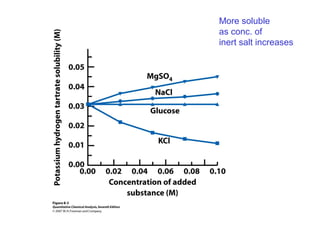
A precipitate is more soluble in a solution containing an
inert salt than it is in water
Ex. BaSO4
2-fold increase in solubility when KNO3 concentration
is increased from 0 to 0.02M
Activity and Activity Coefficients
Experimental Observation:
Degree of dissociation increases with the addition of an
inert salt
Ex. Acetic Acid
At 0.00 M NaCl, Ka
’
= 1.75 x 10⁻⁵
At 0.02 M NaCl, Ka
’
= 2.29 x 10⁻⁵
At 1.01 M NaCl, Ka
’
= 3.16 x 10⁻⁵
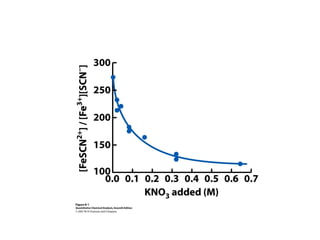
More soluble
as conc. of
inert salt increases
Activity and Activity Coefficients
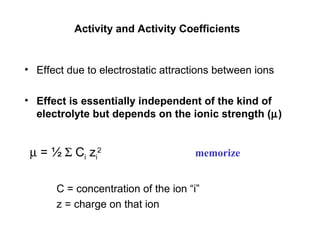
• Effect due to electrostatic attractions between ions
• Effect is essentially independent of the kind of
electrolyte but depends on the ionic strength (µ)
memorizeµ = ½ Σ Ci zi
2
C = concentration of the ion “i”
z = charge on that ion
Activity and Activity Coefficients
aA + bB = cC + dD
K = [C]c
[D]d
/ [A]a
[B]b
Does not predict any effect on the ionic strength
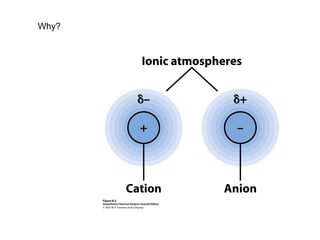
Why?
Activity and Activity Coefficients
activity Activity coefficient
Ac = [C] γC
K = AC
c
AD
d
/ AB
b
AA
a
K = γC
c
[C]c
γD
d
[D]d
/ γB
b
[B]b
γA
a
[A]a
Activity and Activity Coefficients
Examples:
Sparingly soluble salt
BaSO4(s) = Ba2+
+ SO4
2-
Ksp = ABaASO4 = [Ba][SO4] γBaγSO4
pH
pH = - log AH+ = -log [H+
] γH+
Activity and Activity Coefficients
Weak Acid
HA + H2O = A- + H30+
Ka = ([A-][H3O+] / [HA]) (γA-γH3O / γHA)
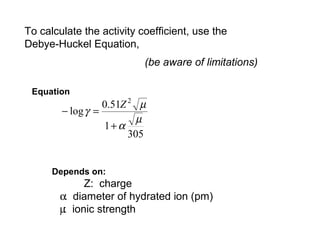
To calculate the activity coefficient, use the
Debye-Huckel Equation,
(be aware of limitations)
Equation
305
1
51.0
log
2
µ
α
µ
γ
+
=−
Z
Depends on:
Z: charge
α: diameter of hydrated ion (pm)
µ: ionic strength
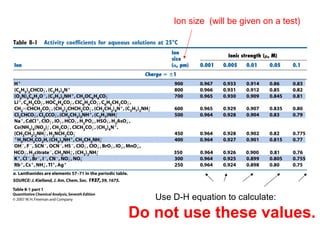
Ion size (will be given on a test)
Use D-H equation to calculate:
Do not use these values.
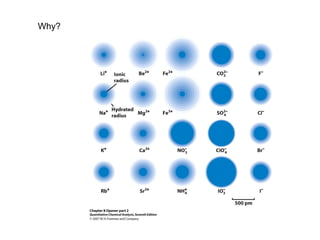
Why?
Activity and Activity Coefficients
Properties of Activity Coefficients:
• Measure of the “effectiveness” with which that
species influences an equilibrium
µ  0, γx  1, ax  [X], K’
 K
• Dilute solutions, γx is independent of the nature of
electrolyte and dependent on µ
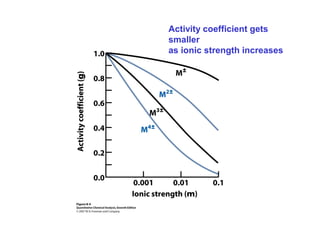
• For a given µ, γx departs farther from unity as
the charge increases
Activity coefficient gets
smaller
as ionic strength increases
Chapter 7 activity
Chapter 7 activity
Chapter 7 activity
Chapter 7 activity
Chapter 7 activity

Chapter 7 activity

  • 1.
    Activity and ActivityCoefficients Experimental Observation: A precipitate is more soluble in a solution containing an inert salt than it is in water Ex. BaSO4 2-fold increase in solubility when KNO3 concentration is increased from 0 to 0.02M
  • 2.
    Activity and ActivityCoefficients Experimental Observation: Degree of dissociation increases with the addition of an inert salt Ex. Acetic Acid At 0.00 M NaCl, Ka ’ = 1.75 x 10⁻⁵ At 0.02 M NaCl, Ka ’ = 2.29 x 10⁻⁵ At 1.01 M NaCl, Ka ’ = 3.16 x 10⁻⁵
  • 4.
    More soluble as conc.of inert salt increases
  • 5.
    Activity and ActivityCoefficients • Effect due to electrostatic attractions between ions • Effect is essentially independent of the kind of electrolyte but depends on the ionic strength (µ) memorizeµ = ½ Σ Ci zi 2 C = concentration of the ion “i” z = charge on that ion
  • 6.
    Activity and ActivityCoefficients aA + bB = cC + dD K = [C]c [D]d / [A]a [B]b Does not predict any effect on the ionic strength
  • 7.
  • 8.
    Activity and ActivityCoefficients activity Activity coefficient Ac = [C] γC K = AC c AD d / AB b AA a K = γC c [C]c γD d [D]d / γB b [B]b γA a [A]a
  • 9.
    Activity and ActivityCoefficients Examples: Sparingly soluble salt BaSO4(s) = Ba2+ + SO4 2- Ksp = ABaASO4 = [Ba][SO4] γBaγSO4 pH pH = - log AH+ = -log [H+ ] γH+
  • 10.
    Activity and ActivityCoefficients Weak Acid HA + H2O = A- + H30+ Ka = ([A-][H3O+] / [HA]) (γA-γH3O / γHA)
  • 11.
    To calculate theactivity coefficient, use the Debye-Huckel Equation, (be aware of limitations) Equation 305 1 51.0 log 2 µ α µ γ + =− Z Depends on: Z: charge α: diameter of hydrated ion (pm) µ: ionic strength
  • 12.
    Ion size (willbe given on a test) Use D-H equation to calculate: Do not use these values.
  • 13.
  • 14.
    Activity and ActivityCoefficients Properties of Activity Coefficients: • Measure of the “effectiveness” with which that species influences an equilibrium µ  0, γx  1, ax  [X], K’  K • Dilute solutions, γx is independent of the nature of electrolyte and dependent on µ • For a given µ, γx departs farther from unity as the charge increases
  • 15.
    Activity coefficient gets smaller asionic strength increases