








BY
Dr. Gurumeet.C.Wadhawa
DEPARTMENT OF CHEMISTRY
K. B. P. College,Vashi,Navimumbai
ELECTRODES IN ELECTROANALYTICAL
CHEMISTRY
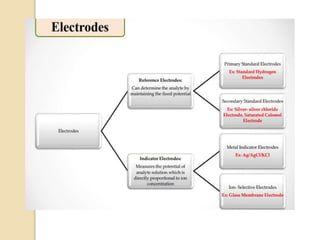
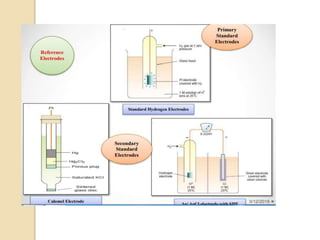
Types and Examples of Electrodes
Here we will look at some examples of electrodes.
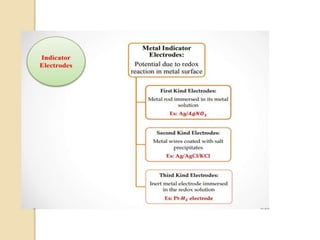
There are mainly two types of electrodes namely reactive and inert
electrodes.
An inert type does not participate in any reaction while reactive types
participate actively in reactions.
Some commonly used inert electrodes include platinum, gold,
graphite(carbon), and rhodium.
Some reactive electrodes include zinc, copper, lead, and silver.
Whereas when the current enters during oxidation reaction it is known
as the anode. As such, electrodes are vital components
in electrochemical cells as they transport produced electrons from one
half-cell to another, which results in the production of an electrical
charge.
What is Electrode?
As per the definition of the electrode, it is any substance that is a good
conductor of electricity and these substances usually connect non-metallic
parts of a circuit for example semiconductors, an electrolyte, plasmas,
vacuum or even air. The term was first coined by William Whewell
and derived from Greek words Elektron, which means “amber” and
hodos which translates to “a way.”
An early version of an electrode was the electrophore which was used to
study static electricity. It was invented by Johan Wilcke. To help you
understand the concept in simple terms, an electrode is a point where the
current enters and leaves the electrolyte. Notably, an electrode does not
necessarily have to metals.
When studying electrodes, there are a few things that we come across.
The two common terms we hear is cathode and anode. The cathode is
the current that leaves the electrodes or cathode is a result of reduction
reaction taking place in an electrolyte mixture. Here electrons are
released from the electrode and the surrounding solution is reduced.
Uses of Electrodes
The main use of electrodes is to generate electrical current and pass it
through non-metal objects to basically alter them in several ways.
Electrodes are also used to measure conductivity. Some other uses
include:
Electrodes are used in different battery types, electroplating and
electrolysis, welding, cathodic protection, membrane electrode
assembly, for chemical analysis, and Taser electroshock weapon. In the
medical field, electrodes are also used in ECG, ECT, EEG, and
defibrillator. Electrodes are further used for electrophysiology techniques
in biomedical research.
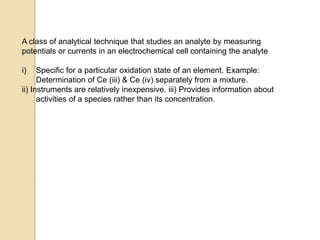
A class of analytical technique that studies an analyte by measuring
potentials or currents in an electrochemical cell containing the analyte
i) Specific for a particular oxidation state of an element. Example:
Determination of Ce (iii) & Ce (iv) separately from a mixture.
ii) Instruments are relatively inexpensive. iii) Provides information about
activities of a species rather than its concentration.
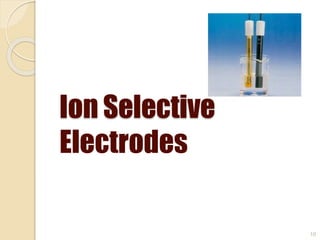
Ion Selective
10
Electrodes
INDEX:
11
• The principle of the I.S.E.
• Advantages and limitations.
• Types of I.S.E.
• Application.
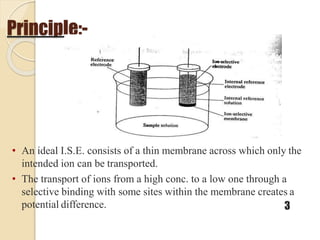
Principle:-
• An ideal I.S.E. consists of a thin membrane across which only the
intended ion can be transported.
• The transport of ions from a high conc. to a low one through a
selective binding with some sites within the membrane creates a
potential difference. 3
•
4
ADVANTAGE:-
5
When compared to many other analytical techniques, Ion-
Selective Electrodes are relatively inexpensive and simple
to use and have an extremely wide range of applications
and wide concentration range.
The most recent plastic-bodied, all-solid-state or gel-
filled models are very robust and durable and ideal for
use in either field or laboratory environments.
Under the most favourable conditions, when measuring
ions in relatively dilute aqueous solutions and where
interfering ions are not a problem, they can be used very
rapidly and easily (e.g. simply dipping in lakes or
rivers, dangling from a bridge or dragging behind a boat).
They are particularly useful in applications where only an
order of magnitude concentration is required.
 They are particularly useful in biological/medical
applications because they measure the activity of the ion
directly, rather than the concentration.
They are unaffected by sample colour or turbidity.
 ISEs can be used in aqueous solutions over a wide
temperature range. Crystal membranes can operate in the
range 0°C to 80°C and plastic membranes from 0°C to
50°C.
ISEs are one of the few techniques which can measure
both positive and negative ions.
 Non-destructive: no consumption of analyte.
 Non-contaminating.
 Short response time: in sec. or min. useful in industrial
6
LIMITATION:-
7
• Precision is rarely better than 1%.
• Electrodes can be fouled by proteins or other organic
solutes.
• Interference by other ions.
• Electrodes are fragile and have limited shelf life.
• Electrodes respond to the activity of uncomplexed ion.
So ligands must be absent.
Types of I.S.E :-
 Glass electrodes
 Liquid ion exchanger membrane electrodes
Solid state membrane electrodes
 Neutral carrier membrane electrodes
 Coated wire electrodes
 Field effect transistor electrodes
 Gas sensing electrodes
Air gap electrodes
Biomembrane electrode
8
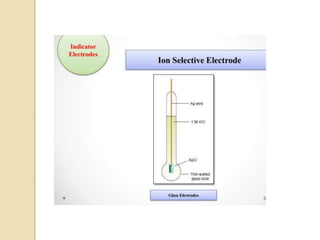
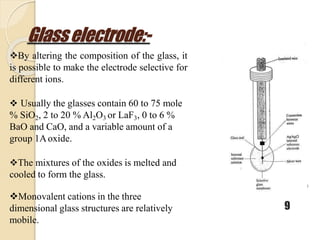
Glasselectrode:-
9
By altering the composition of the glass, it
is possible to make the electrode selective for
different ions.
 Usually the glasses contain 60 to 75 mole
% SiO2, 2 to 20 % Al2O3 or LaF3, 0 to 6 %
BaO and CaO, and a variable amount of a
group 1Aoxide.
The mixtures of the oxides is melted and
cooled to form the glass.
Monovalent cations in the three
dimensional glass structures are relatively
mobile.
Consequently, monovalent cations from a solution into
which the glass is dipped can penetrate into the surface of
the glass and be cation exchanged net negatively charged
sites in the glass.
Because the concentration of the analyzed ion in the
sample solution differs from that in the internal reference
solution, a potential difference develops across the
membrane.
Glass membranes are selective for monovalent cations
because polyvalent ions cannot easily penetrate the
surface of the membrane.
19
Evidently the selectivity of glass electrodes is related both
to the ability of the various Monovalent cations to
penetrate into the glass membrane and to the degree of
attraction of the cations to the negative sites within the
glass.
Glass electrodes which are selective for H+ (pH
electrode),Li+, Na+, K+, Cs+ ,Ag+, Ti+ and NH4
+ are
commercially available
20
Liquidionexchangermembrane
electrodes:-
12
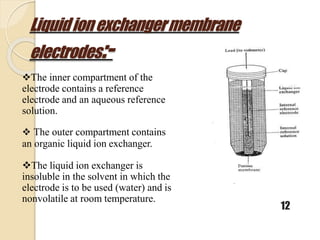
The inner compartment of the
electrode contains a reference
electrode and an aqueous reference
solution.
 The outer compartment contains
an organic liquid ion exchanger.
The liquid ion exchanger is
insoluble in the solvent in which the
electrode is to be used (water) and is
nonvolatile at room temperature.
The ion exchanger is dissolved in a relatively high
molecular weight solvent such as dioctylphenyl
phosphonate.
Liquid ion exchanger consists of polar ionic sites
attached to a relatively large non polar organic molecule.
The ionic sites are negative in a cation exchanger and
positive in an anion exchanger.
Typical liquid ion exchangers are (RO)2PO2- (for Ca2+
and Mg2+) and RSCH2COO- (for Cu2+ and Pb2+). R in the
ion exchangers can be any of several organic groups, for
example p-(1,1,3,3-tetramethylbutyl)phenyl, p-(n-
octyl)phenyl, and decyl. The S and O- in ion exchanger of
the RSCH2COO- type selectively form chelate rings with
a certain ions, e.g., Cu2+ orPb2+.
22
The ion exchangers and reference solutions are held in
place inside the electrodes by a porous membrane.
Although the membrane can be made from polyvinyl
chloride (PVC), it is usually constructed from some form
of cellulose, e.g., from cellulose acetate.
The membrane is prepared to have a pore diameter of
about 100 nm.
23
Chemical treatment makes the membrane hydrophobic.
 The membrane is in physical contact with the liquid ion
exchanger and becomes permeated with it.
Because the membrane is hydrophobic, water from the
internal reference solution and from the sample solution
is prevented from mixing with the liquid ion exchanger.
A second type of liquid ion exchanger membraneutilizes
a polymeric membrane to permanently hold the ion
exchanger solution in place within the membrane.
24
That type of membrane does not need to be in direct
contact with a solution of liquid ion exchanger.
In either case the shell of the electrode is made from an
inert material such as glass or an organic polymer.
Liquid ion exchanger membrane electrodes owe their
selectivity to their ability to selectively exchange ions.
Upon contacting the membrane, an ion from the aqueous
solution exchanges with an ion on a polar site in the ion
exchanger.
The newly created ion and ion exchanger combination
can freely diffuse throughout the membrane.
25
The ionic conductivity of the membrane results from the
mobility of the ion within the membrane.
The potential across the membrane is related to the ionic
conductivity within the membrane.
Liquid ion exchanger membrane electrode have been
used for the assay of :-
Ca2+, K+, Li+, Na+, Mg2+, Ni2+, Zn2+, Ti+,Ag+,
Hg2+, water hardness (Ca2+ + Mg2+), Cu2+,Pb2+, Cl-, BF4
-,
NO3
-, ClO4
-, Cr2O7
2-, benzoates, SCN- and other ions.
26
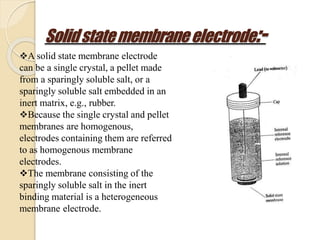
Solidstatemembraneelectrode:-
A solid state membrane electrode
can be a single crystal, a pellet made
from a sparingly soluble salt, or a
sparingly soluble salt embedded in an
inert matrix, e.g., rubber.
Because the single crystal and pellet
membranes are homogenous,
electrodes containing them are referred
to as homogenous membrane
electrodes.
The membrane consisting of the
sparingly soluble salt in the inert
binding material is a heterogeneous
membrane electrode.
 The lanthanum fluoride (LaF3) membrane is the only
single crystal membrane that is widely used in ion
selective electrodes.
In the process called as “doping”, the resistance of the
LaF3 crystal is decreased by replacing a relatively small
number of La3+ ions in the crystals with Eu2+ ions.
Fluoride ions migrate from vacancy to vacancy in the
defective LaF3 crystal.
As a fluoride ion abandons one position in the crystalline
structure, it leaves a hole into which another fluoride can
migrate.
 The result is a crystal which exhibits ionic conductivity.
28
The conductance to the membrane, as well as the
potential across the membrane, can be related to the
analyte concentration for many solid state membrane
electrodes.
Vacancies in the crystalline structure have exactly the
proper size, charge, and shape to hold a fluoride ion.
Because fluoride can selectively migrate to the crystal,
the lanthanum fluoride membrane is selective for
fluoride.
If no fluoride is present in the sample solution, the LaF3
membrane electrode can be used to assay for La3+.
29
A heterogeneous membrane consists of an activeingredient
dispersed throughout an inert binding material.
The inert binder provides the physical properties that are
required of the membrane, and the active ingredient provides
the membrane selectivity.
Wax, silicon rubber, polyvinyl chloride and several other
polymeric substances are used as inert binders in ion selective
electrode.
30
 Silicon rubber and PVC are most popular binders.
After mixing binder with active ingredient, the
membrane is formed into thin sheet of appropriate size
and attached to the end of the electrode body.
The active ingredient is often a sparingly soluble
substance similar to the substance in homogenous
membranes.
31
Neutral-carrier membrane
electrodes:-
 They have the same design as liquid-ion-exchanger
membrane electrodes.
The liquid-ion-exchanger is replaced in neutral-carrier
membranes with a neutral complexing agent (a neutral
carrier) such as crown ether, which is dissolved in a highly
water insoluble organic solvent.
The neutral carrier complexes with the analyte at
membrane-sample interface to form a charged complex
which is extracted from the aqueous solution into the
organic solvent in the membrane.
The selectivity of the membrane for a particular ion
depends upon the ability to extract the ion into the
membrane, which in turn depends upon the ability of the io2n3
to form a complex with the neutral carrier.
After complexation and extraction, the species in the
neutral-carrier membrane has the same charge as the
extracted ion.
The solvent in which the neutral carrier is dissolved is
usually a high boiling organic compound such as
nitrobenzene (used in Ba2+ selective electrodes),
dibutylsebacate (used in K+ selective electrode) and o-
nitrophenyl-n-octylether (used in a Ca2+ selective
electrode).
The physical support for the neutral carrier and solvent is
usually a cellulose membrane, more commonly, a PVC
membrane. In addition to K+, Ca2+, Ba2+, neutral-carrier
membrane electrodes are also selective for Li+, H+, Mg2+,
NH4
+ ,Sr2+.
24
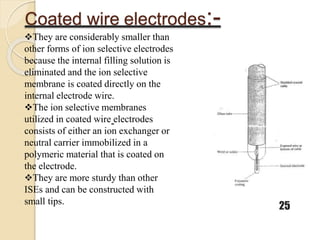
Coated wire electrodes:-
25
They are considerably smaller than
other forms of ion selective electrodes
because the internal filling solution is
eliminated and the ion selective
membrane is coated directly on the
internal electrode wire.
The ion selective membranes
utilized in coated wire electrodes
consists of either an ion exchanger or
neutral carrier immobilized in a
polymeric material that is coated on
the electrode.
They are more sturdy than other
ISEs and can be constructed with
small tips.
Method of preparation of the electrode:-
First the metal on the interior of the electrode is sealed
into a glass or some other suitable material so that several
mm or less of the wire is exposed.
The exposed wire is successively dipped into a solution
of the polymeric material and then into a solution of the
ion exchanger or neutral carrier.
35
After the electrode has air-dried, the dipping procedure is
repeated, if necessary, until the membrane coating on the
wire is the desired thickness.
Alternatively, the wire can be dipped into a single
solution containing both the membrane material and the
polymerizer.
The polymeric matrix can be any of materials including
PVC, polymethyl acrylate(PMM) or epoxy.
The internal electrode can be constructed from metals
like platinum, copper, silver wire and graphite rods.
36
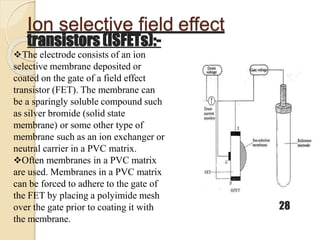
Ion selective field effect
28
transistors (ISFETs):-
The electrode consists of an ion
selective membrane deposited or
coated on the gate of a field effect
transistor (FET). The membrane can
be a sparingly soluble compound such
as silver bromide (solid state
membrane) or some other type of
membrane such as an ion exchanger or
neutral carrier in a PVC matrix.
Often membranes in a PVC matrix
are used. Membranes in a PVC matrix
can be forced to adhere to the gate of
the FET by placing a polyimide mesh
over the gate prior to coating it with
the membrane.
The potential at the membrane is partially determined by
the activity of the analyte in solution.
That potential determines the flow of current through the
drain of the FET.
The drain current consequently varies with the activity
of the analyte and is the monitored factor.
29
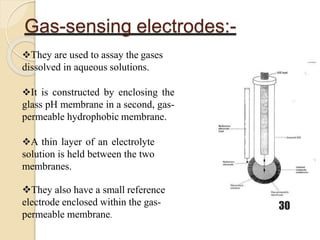
Gas-sensing electrodes:-
30
They are used to assay the gases
dissolved in aqueous solutions.
It is constructed by enclosing the
glass pH membrane in a second, gas-
permeable hydrophobic membrane.
A thin layer of an electrolyte
solution is held between the two
membranes.
They also have a small reference
electrode enclosed within the gas-
permeable membrane.
The potential between the internal ISE and the reference electrode
within the outer membrane is monitored.
 The gas permeable membrane holds a constant volume of
solution around the internal ISE into which the gaseous analyte
can diffuse.
 The hydrophobic gas-permeable membrane can be composed of
substance which allows passage of dissolved gas but prevents the
solution within the membrane from escaping.
The materials used are silicon rubber, Teflon polypropylene,
fluorinated ethylene propylene, polyvinylidene fluoride etc…
 Gas from the sample solution passes through the submerged gas-
permeable membrane and equilibrates in the electrolyte solution
between the two membranes.
31
 The gas reacts reversibly with the electrolyte solution to form anion
to which the ion selective electrode responds.
 Because the activity of the ion that is formed between the two
membranes is proportional to amount of gas dissolved in sample, the
electrode response is directly related to the activity of the gas in the
sample.
 The gases (primarily NH3, SO2 and CO2) which are detected by gas
sensing electrodes based on the pH electrode equilibrate with the
electrolyte solution to alter its pH:
• NH3 + H2O = NH4
+ + OH-
• SO2 + H2O = HSO3
- + H+
• CO2 + H2O = HCO3
- + H+
 H2S, HCN, HF and chloride can be assayed by using internal
homogenous membrane electrode containing the appropriatesilver
salt.
 Disadvantage possesses relatively long response time i.e; require1-7
minutes after insertion in to a sample solution to reach equilibrium.32
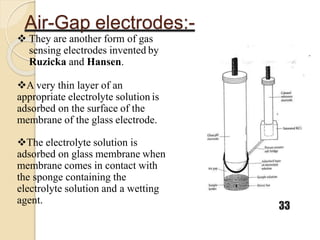
Air-Gap electrodes:-
33
 They are another form of gas
sensing electrodes invented by
Ruzicka and Hansen.
A very thin layer of an
appropriate electrolyte solution is
adsorbed on the surface of the
membrane of the glass electrode.
The electrolyte solution is
adsorbed on glass membrane when
membrane comes in contact with
the sponge containing the
electrolyte solution and a wetting
agent.
The reference electrode makes contact with the adsorbed
electrolyte layer through a small, porous, ceramic salt
bridge.
The air gap electrode is used to assay ionic species which
can be chemically converted to gases,
e.g. HCO3
-
 The HCO - solution is placed in the sample holder and an
3 2
3
acid is added to convert HCO -(aq) to CO (g).
The sample holder is placed in position under the electrode
and stirred with a magnetic stirrer and stirrer bar.
Carbon dioxide which is emitted during the chemical
reaction equilibrates with the electrolyte solution on the
glass membrane and alters the pH of the solution. 34
The glass electrode measures the pH of the resulting solution.
 The electrolyte solutions used with air gap electrode are the
same as those used with other gas-sensing electrodes.
The air-gap electrode has a faster response time due to the
thinner layer of electrolyte solution and a longer lifetime than
most of the other types of sensing electrodes.
 A typical response time for an air-gap electrode is less than a
minute.
 Air-gap electrode is primarily used for analysis of NH +,
4
HSO -. As an example they can be used for the determination
3
of urea in blood.
35
Biomembrane electrodes:-
 It is an ion selective electrode which is coated with an
 enzyme-containing acrylamide gel.
 The gel and enzyme are held in place on the surface of the ion selective
electrode by an inert physical support.
 The design is same as gas-sensing electrode.
 The support is a sheet of cellophane or a piece of gauze made
from dacron or nylon.
The physical support is wrapped around the electrode
membrane and tied in place.
36
 The acrylamide gel containing the enzyme is
coagulated on the support-electrode combination.
 Enzymes are highly selective biochemical catalysts.
The selectivity of Biomembrane electrode is due to
the selectivity of the enzymes that are used in
electrodes.
Here the enzyme-catalyzed reaction of the analyte
yields an ionic reaction product which is monitored
by the internal ion-selective electrode.
The operation of the urea-selective electrode will
serve to illustrate the operation of Biomembrane
electrodes.
46
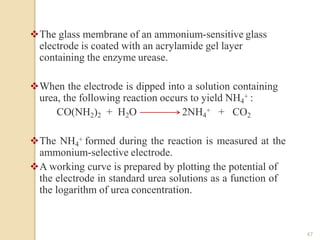
The glass membrane of an ammonium-sensitive glass
electrode is coated with an acrylamide gel layer
containing the enzyme urease.
When the electrode is dipped into a solution containing
urea, the following reaction occurs to yield NH4
+ :
CO(NH2)2 + H2O 2NH4
+ + CO2
The NH4
+ formed during the reaction is measured at the
ammonium-selective electrode.
A working curve is prepared by plotting the potential of
the electrode in standard urea solutions as a function of
the logarithm of urea concentration.
47
 The urea concentration in the sample is obtained from
the working curve.
Unfortunately the enzymes used in Biomembrane
electrodes gradually decay and the enzyme containing gel
must be periodically replaced.
The Biomembrane of urea electrode lasts about 2 weeks.
Biomembrane electrodes have long response time of 5 or
more minutes.
48
APPLICATION:-
• Ion-selective electrodes are used in a wide variety of
applications for determining the concentrations of various
ions in aqueous solutions. The following is a list of some
of the main areas in which ISEs have been used.
• Pollution Monitoring: CN, F, S, Cl, NO3 etc., in effluents,
and natural waters.
• Agriculture: NO3, Cl, NH4, K, Ca, I, CN in soils, plant
material, fertilisers and feedstuffs.
• Food Processing: NO3, NO2 in meat preservatives.
• Salt content of meat, fish, dairy products, fruit juices,
brewing solutions.
• F in drinking water and other drinks.
40
• K in fruit juices and wine making.
• Corrosive effect of NO3 in canned foods.
• Detergent Manufacture: Ca, Ba, F for studying effects on
water quality.
• Paper Manufacture: S and Cl in pulping and recovery-
cycle liquors.
• Explosives: F, Cl, NO3 in explosive materials and
combustion products.
• Biomedical Laboratories: Ca, K, Cl in body fluids (blood,
plasma, serum, sweat).
• F in skeletal and dental studies.
• Education and Research: Wide range of applications.
• Ca in dairy products and beer.
50
Index
• History
• Introduction
• Sensor
• Principle
• Components and working
• Enzymes biosensor
• Glucometer
• Types of biosensor
• Advantage and disadvantage
• Reference
History
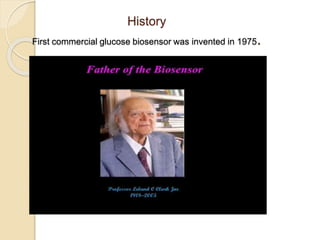
First commercial glucose biosensor was invented in 1975.
Introduction
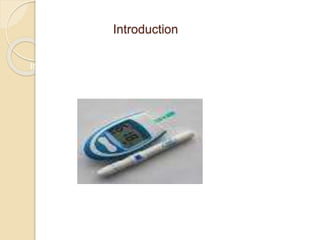
It is an analytical device, used for the detection of analyt, that
combine a biological component
with a physiochemical detector.
Sensor
- It is an analytical device which convert a biological response into an electric
signal.
-It detects, records and transmit information regarding a physiological change or
process.
Principle
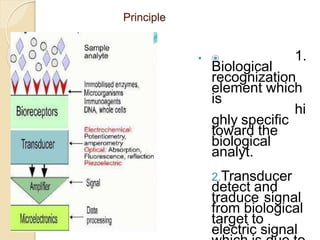
 ⦿ 1.
Biological
recognization
element which
is
hi
ghly specific
toward the
biological
analyt.
2.Transducer
detect and
traduce signal
from biological
target to
electric signal
Components and Working
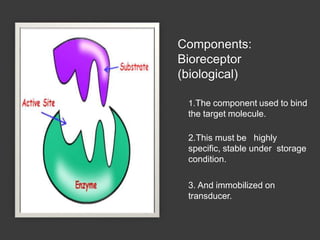
Bioreceptor (biological)+Transducer (physiological)
Components:
Bioreceptor
(biological)
1.The component used to bind
the target molecule.
2.This must be highly
specific, stable under storage
condition.
3. And immobilized on
transducer.
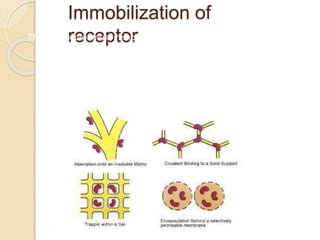
Immobilization of
receptor
The bioreceptor must immobilized on transducer by following
method.
- physical adsorption
- covalent binding
-entrapment etc.
Transducer
- It convert the bio recognization eventinto a measurable
signal.
-This is done by measuring the change that occur in the
bioreceptor reaction.
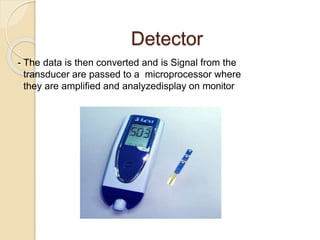
Detector
-.
- The data is then converted and is Signal from the
transducer are passed to a microprocessor where
they are amplified and analyzedisplay on monitor.
Ideal biosensor should be:
- highly specific for analyt.
- device should be tiny and biocompatible.
- device should be cheap and small.
- easy to use.
- should be durable.
- capable of repeated use.
- Should be sterilizable.
- Should require small sample volume.
Enzyme based
biosensor
- The biological material i.e. Enzyme is immobilized on transducer.
- The analyte i.e. substrate binds to the enzyme to form a bound analyte.
-The analyte is converted into a product which could be associated with the
release of heat, gas, or hydrogen ions.
- The transducer then convert the product linked change into electrical single
which is amplified and measure.
Example of enzyme biosensor
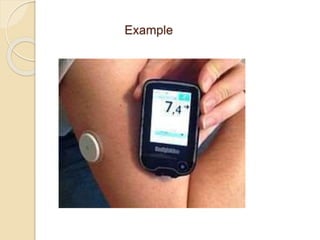
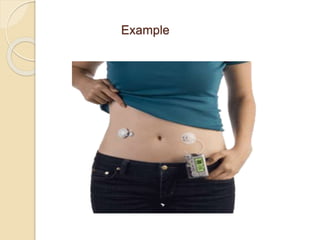
Glucometer
Procedure
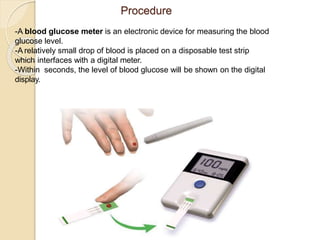
-A blood glucose meter is an electronic device for measuring the blood
glucose level.
-A relatively small drop of blood is placed on a disposable test strip
which interfaces with a digital meter.
-Within seconds, the level of blood glucose will be shown on the digital
display.
How does it works?
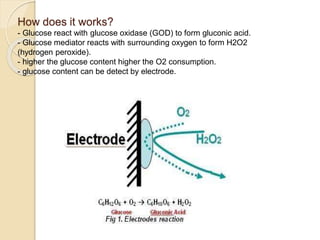
- Glucose react with glucose oxidase (GOD) to form gluconic acid.
- Glucose mediator reacts with surrounding oxygen to form H2O2
(hydrogen peroxide).
- higher the glucose content higher the O2 consumption.
- glucose content can be detect by electrode.
3 different type of transducer can be use:
- an oxygen sensor that measure 02 concentration.
- A pH sensor that measure the gluconic acid production.
- A peroxide sensor that measure H2O2 concentration.
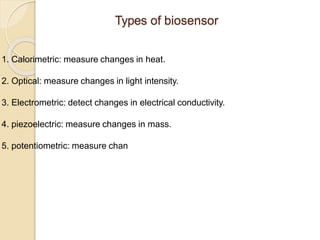
Types of biosensor
1. Calorimetric: measure changes in heat.
2. Optical: measure changes in light intensity.
3. Electrometric: detect changes in electrical conductivity.
4. piezoelectric: measure changes in mass.
5. potentiometric: measure changes in charge.
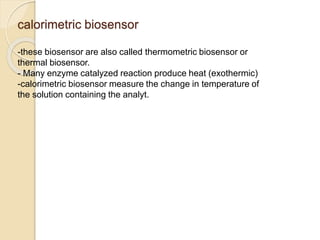
calorimetric biosensor
-these biosensor are also called thermometric biosensor or
thermal biosensor.
- Many enzyme catalyzed reaction produce heat (exothermic)
-calorimetric biosensor measure the change in temperature of
the solution containing the analyt.
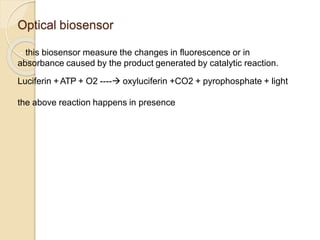
Optical biosensor
- this biosensor measure the changes in fluorescence or in
absorbance caused by the product generated by catalytic reaction.
Luciferin + ATP + O2 ---- oxyluciferin +CO2 + pyrophosphate + light
the above reaction happens in presence of enzyme Luciferase.
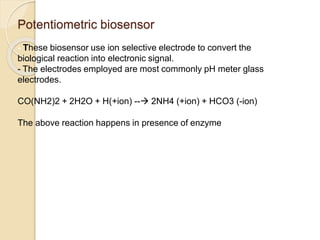
Potentiometric biosensor
- These biosensor use ion selective electrode to convert the
biological reaction into electronic signal.
- The electrodes employed are most commonly pH meter glass
electrodes.
CO(NH2)2 + 2H2O + H(+ion) -- 2NH4 (+ion) + HCO3 (-ion)
The above reaction happens in presence of enzyme urease.
Advantage
1. more specific than cell based sensor.
2. Faster responds due to shorter diffusion path (no cell walls).
Disadvantage
1. More expensive to produce due to additional problem of isolating the enzyme.
2. Enzyme are often unstable when isolated.
Example
Example
Example
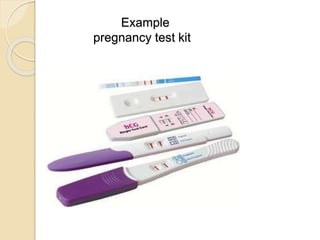
pregnancy test kit
Reference
• B.D. Singh, Biotechnology ,Expanding Horizon .
Second edition, Chapter 15 , Enzymes Technology ,
Biosensor , Page 666-672.
• http://www.slideshare.net/951384/biosensors-
33317356
• http://engineering.mit.edu/ask/how-do-glucometers-
work
• https://en.wikipedia.org/wiki/Blood_glucose_monitoring
#Blood_glucose_meters
• http://de.123rf.com/photo_9176220_diabetes-
patienten-lustig-finger-glucose-level-bluttest-von-
neuen-smart-glucometer-auf-weissem-hinte.html
THANK YOU
References:-
77
• http://www.cma-science.nl
• www2.vernier.com/booklets/ise.pdf
• http://www.sfu.ca/chemistry/groups/Li/chem215/selective
.PDF
78

Electroanalytical chemistry

  • 1.
    BY Dr. Gurumeet.C.Wadhawa DEPARTMENT OFCHEMISTRY K. B. P. College,Vashi,Navimumbai ELECTRODES IN ELECTROANALYTICAL CHEMISTRY
  • 2.
    Types and Examplesof Electrodes Here we will look at some examples of electrodes. There are mainly two types of electrodes namely reactive and inert electrodes. An inert type does not participate in any reaction while reactive types participate actively in reactions. Some commonly used inert electrodes include platinum, gold, graphite(carbon), and rhodium. Some reactive electrodes include zinc, copper, lead, and silver. Whereas when the current enters during oxidation reaction it is known as the anode. As such, electrodes are vital components in electrochemical cells as they transport produced electrons from one half-cell to another, which results in the production of an electrical charge.
  • 3.
    What is Electrode? Asper the definition of the electrode, it is any substance that is a good conductor of electricity and these substances usually connect non-metallic parts of a circuit for example semiconductors, an electrolyte, plasmas, vacuum or even air. The term was first coined by William Whewell and derived from Greek words Elektron, which means “amber” and hodos which translates to “a way.” An early version of an electrode was the electrophore which was used to study static electricity. It was invented by Johan Wilcke. To help you understand the concept in simple terms, an electrode is a point where the current enters and leaves the electrolyte. Notably, an electrode does not necessarily have to metals. When studying electrodes, there are a few things that we come across. The two common terms we hear is cathode and anode. The cathode is the current that leaves the electrodes or cathode is a result of reduction reaction taking place in an electrolyte mixture. Here electrons are released from the electrode and the surrounding solution is reduced.
  • 4.
    Uses of Electrodes Themain use of electrodes is to generate electrical current and pass it through non-metal objects to basically alter them in several ways. Electrodes are also used to measure conductivity. Some other uses include: Electrodes are used in different battery types, electroplating and electrolysis, welding, cathodic protection, membrane electrode assembly, for chemical analysis, and Taser electroshock weapon. In the medical field, electrodes are also used in ECG, ECT, EEG, and defibrillator. Electrodes are further used for electrophysiology techniques in biomedical research.
  • 5.
    A class ofanalytical technique that studies an analyte by measuring potentials or currents in an electrochemical cell containing the analyte i) Specific for a particular oxidation state of an element. Example: Determination of Ce (iii) & Ce (iv) separately from a mixture. ii) Instruments are relatively inexpensive. iii) Provides information about activities of a species rather than its concentration.
  • 10.
  • 11.
    INDEX: 11 • The principleof the I.S.E. • Advantages and limitations. • Types of I.S.E. • Application.
  • 12.
    Principle:- • An idealI.S.E. consists of a thin membrane across which only the intended ion can be transported. • The transport of ions from a high conc. to a low one through a selective binding with some sites within the membrane creates a potential difference. 3
  • 13.
  • 14.
    ADVANTAGE:- 5 When compared tomany other analytical techniques, Ion- Selective Electrodes are relatively inexpensive and simple to use and have an extremely wide range of applications and wide concentration range. The most recent plastic-bodied, all-solid-state or gel- filled models are very robust and durable and ideal for use in either field or laboratory environments. Under the most favourable conditions, when measuring ions in relatively dilute aqueous solutions and where interfering ions are not a problem, they can be used very rapidly and easily (e.g. simply dipping in lakes or rivers, dangling from a bridge or dragging behind a boat). They are particularly useful in applications where only an order of magnitude concentration is required.
  • 15.
     They areparticularly useful in biological/medical applications because they measure the activity of the ion directly, rather than the concentration. They are unaffected by sample colour or turbidity.  ISEs can be used in aqueous solutions over a wide temperature range. Crystal membranes can operate in the range 0°C to 80°C and plastic membranes from 0°C to 50°C. ISEs are one of the few techniques which can measure both positive and negative ions.  Non-destructive: no consumption of analyte.  Non-contaminating.  Short response time: in sec. or min. useful in industrial 6
  • 16.
    LIMITATION:- 7 • Precision israrely better than 1%. • Electrodes can be fouled by proteins or other organic solutes. • Interference by other ions. • Electrodes are fragile and have limited shelf life. • Electrodes respond to the activity of uncomplexed ion. So ligands must be absent.
  • 17.
    Types of I.S.E:-  Glass electrodes  Liquid ion exchanger membrane electrodes Solid state membrane electrodes  Neutral carrier membrane electrodes  Coated wire electrodes  Field effect transistor electrodes  Gas sensing electrodes Air gap electrodes Biomembrane electrode 8
  • 18.
    Glasselectrode:- 9 By altering thecomposition of the glass, it is possible to make the electrode selective for different ions.  Usually the glasses contain 60 to 75 mole % SiO2, 2 to 20 % Al2O3 or LaF3, 0 to 6 % BaO and CaO, and a variable amount of a group 1Aoxide. The mixtures of the oxides is melted and cooled to form the glass. Monovalent cations in the three dimensional glass structures are relatively mobile.
  • 19.
    Consequently, monovalent cationsfrom a solution into which the glass is dipped can penetrate into the surface of the glass and be cation exchanged net negatively charged sites in the glass. Because the concentration of the analyzed ion in the sample solution differs from that in the internal reference solution, a potential difference develops across the membrane. Glass membranes are selective for monovalent cations because polyvalent ions cannot easily penetrate the surface of the membrane. 19
  • 20.
    Evidently the selectivityof glass electrodes is related both to the ability of the various Monovalent cations to penetrate into the glass membrane and to the degree of attraction of the cations to the negative sites within the glass. Glass electrodes which are selective for H+ (pH electrode),Li+, Na+, K+, Cs+ ,Ag+, Ti+ and NH4 + are commercially available 20
  • 21.
    Liquidionexchangermembrane electrodes:- 12 The inner compartmentof the electrode contains a reference electrode and an aqueous reference solution.  The outer compartment contains an organic liquid ion exchanger. The liquid ion exchanger is insoluble in the solvent in which the electrode is to be used (water) and is nonvolatile at room temperature.
  • 22.
    The ion exchangeris dissolved in a relatively high molecular weight solvent such as dioctylphenyl phosphonate. Liquid ion exchanger consists of polar ionic sites attached to a relatively large non polar organic molecule. The ionic sites are negative in a cation exchanger and positive in an anion exchanger. Typical liquid ion exchangers are (RO)2PO2- (for Ca2+ and Mg2+) and RSCH2COO- (for Cu2+ and Pb2+). R in the ion exchangers can be any of several organic groups, for example p-(1,1,3,3-tetramethylbutyl)phenyl, p-(n- octyl)phenyl, and decyl. The S and O- in ion exchanger of the RSCH2COO- type selectively form chelate rings with a certain ions, e.g., Cu2+ orPb2+. 22
  • 23.
    The ion exchangersand reference solutions are held in place inside the electrodes by a porous membrane. Although the membrane can be made from polyvinyl chloride (PVC), it is usually constructed from some form of cellulose, e.g., from cellulose acetate. The membrane is prepared to have a pore diameter of about 100 nm. 23
  • 24.
    Chemical treatment makesthe membrane hydrophobic.  The membrane is in physical contact with the liquid ion exchanger and becomes permeated with it. Because the membrane is hydrophobic, water from the internal reference solution and from the sample solution is prevented from mixing with the liquid ion exchanger. A second type of liquid ion exchanger membraneutilizes a polymeric membrane to permanently hold the ion exchanger solution in place within the membrane. 24
  • 25.
    That type ofmembrane does not need to be in direct contact with a solution of liquid ion exchanger. In either case the shell of the electrode is made from an inert material such as glass or an organic polymer. Liquid ion exchanger membrane electrodes owe their selectivity to their ability to selectively exchange ions. Upon contacting the membrane, an ion from the aqueous solution exchanges with an ion on a polar site in the ion exchanger. The newly created ion and ion exchanger combination can freely diffuse throughout the membrane. 25
  • 26.
    The ionic conductivityof the membrane results from the mobility of the ion within the membrane. The potential across the membrane is related to the ionic conductivity within the membrane. Liquid ion exchanger membrane electrode have been used for the assay of :- Ca2+, K+, Li+, Na+, Mg2+, Ni2+, Zn2+, Ti+,Ag+, Hg2+, water hardness (Ca2+ + Mg2+), Cu2+,Pb2+, Cl-, BF4 -, NO3 -, ClO4 -, Cr2O7 2-, benzoates, SCN- and other ions. 26
  • 27.
    Solidstatemembraneelectrode:- A solid statemembrane electrode can be a single crystal, a pellet made from a sparingly soluble salt, or a sparingly soluble salt embedded in an inert matrix, e.g., rubber. Because the single crystal and pellet membranes are homogenous, electrodes containing them are referred to as homogenous membrane electrodes. The membrane consisting of the sparingly soluble salt in the inert binding material is a heterogeneous membrane electrode.
  • 28.
     The lanthanumfluoride (LaF3) membrane is the only single crystal membrane that is widely used in ion selective electrodes. In the process called as “doping”, the resistance of the LaF3 crystal is decreased by replacing a relatively small number of La3+ ions in the crystals with Eu2+ ions. Fluoride ions migrate from vacancy to vacancy in the defective LaF3 crystal. As a fluoride ion abandons one position in the crystalline structure, it leaves a hole into which another fluoride can migrate.  The result is a crystal which exhibits ionic conductivity. 28
  • 29.
    The conductance tothe membrane, as well as the potential across the membrane, can be related to the analyte concentration for many solid state membrane electrodes. Vacancies in the crystalline structure have exactly the proper size, charge, and shape to hold a fluoride ion. Because fluoride can selectively migrate to the crystal, the lanthanum fluoride membrane is selective for fluoride. If no fluoride is present in the sample solution, the LaF3 membrane electrode can be used to assay for La3+. 29
  • 30.
    A heterogeneous membraneconsists of an activeingredient dispersed throughout an inert binding material. The inert binder provides the physical properties that are required of the membrane, and the active ingredient provides the membrane selectivity. Wax, silicon rubber, polyvinyl chloride and several other polymeric substances are used as inert binders in ion selective electrode. 30
  • 31.
     Silicon rubberand PVC are most popular binders. After mixing binder with active ingredient, the membrane is formed into thin sheet of appropriate size and attached to the end of the electrode body. The active ingredient is often a sparingly soluble substance similar to the substance in homogenous membranes. 31
  • 32.
    Neutral-carrier membrane electrodes:-  Theyhave the same design as liquid-ion-exchanger membrane electrodes. The liquid-ion-exchanger is replaced in neutral-carrier membranes with a neutral complexing agent (a neutral carrier) such as crown ether, which is dissolved in a highly water insoluble organic solvent. The neutral carrier complexes with the analyte at membrane-sample interface to form a charged complex which is extracted from the aqueous solution into the organic solvent in the membrane. The selectivity of the membrane for a particular ion depends upon the ability to extract the ion into the membrane, which in turn depends upon the ability of the io2n3 to form a complex with the neutral carrier.
  • 33.
    After complexation andextraction, the species in the neutral-carrier membrane has the same charge as the extracted ion. The solvent in which the neutral carrier is dissolved is usually a high boiling organic compound such as nitrobenzene (used in Ba2+ selective electrodes), dibutylsebacate (used in K+ selective electrode) and o- nitrophenyl-n-octylether (used in a Ca2+ selective electrode). The physical support for the neutral carrier and solvent is usually a cellulose membrane, more commonly, a PVC membrane. In addition to K+, Ca2+, Ba2+, neutral-carrier membrane electrodes are also selective for Li+, H+, Mg2+, NH4 + ,Sr2+. 24
  • 34.
    Coated wire electrodes:- 25 Theyare considerably smaller than other forms of ion selective electrodes because the internal filling solution is eliminated and the ion selective membrane is coated directly on the internal electrode wire. The ion selective membranes utilized in coated wire electrodes consists of either an ion exchanger or neutral carrier immobilized in a polymeric material that is coated on the electrode. They are more sturdy than other ISEs and can be constructed with small tips.
  • 35.
    Method of preparationof the electrode:- First the metal on the interior of the electrode is sealed into a glass or some other suitable material so that several mm or less of the wire is exposed. The exposed wire is successively dipped into a solution of the polymeric material and then into a solution of the ion exchanger or neutral carrier. 35
  • 36.
    After the electrodehas air-dried, the dipping procedure is repeated, if necessary, until the membrane coating on the wire is the desired thickness. Alternatively, the wire can be dipped into a single solution containing both the membrane material and the polymerizer. The polymeric matrix can be any of materials including PVC, polymethyl acrylate(PMM) or epoxy. The internal electrode can be constructed from metals like platinum, copper, silver wire and graphite rods. 36
  • 37.
    Ion selective fieldeffect 28 transistors (ISFETs):- The electrode consists of an ion selective membrane deposited or coated on the gate of a field effect transistor (FET). The membrane can be a sparingly soluble compound such as silver bromide (solid state membrane) or some other type of membrane such as an ion exchanger or neutral carrier in a PVC matrix. Often membranes in a PVC matrix are used. Membranes in a PVC matrix can be forced to adhere to the gate of the FET by placing a polyimide mesh over the gate prior to coating it with the membrane.
  • 38.
    The potential atthe membrane is partially determined by the activity of the analyte in solution. That potential determines the flow of current through the drain of the FET. The drain current consequently varies with the activity of the analyte and is the monitored factor. 29
  • 39.
    Gas-sensing electrodes:- 30 They areused to assay the gases dissolved in aqueous solutions. It is constructed by enclosing the glass pH membrane in a second, gas- permeable hydrophobic membrane. A thin layer of an electrolyte solution is held between the two membranes. They also have a small reference electrode enclosed within the gas- permeable membrane.
  • 40.
    The potential betweenthe internal ISE and the reference electrode within the outer membrane is monitored.  The gas permeable membrane holds a constant volume of solution around the internal ISE into which the gaseous analyte can diffuse.  The hydrophobic gas-permeable membrane can be composed of substance which allows passage of dissolved gas but prevents the solution within the membrane from escaping. The materials used are silicon rubber, Teflon polypropylene, fluorinated ethylene propylene, polyvinylidene fluoride etc…  Gas from the sample solution passes through the submerged gas- permeable membrane and equilibrates in the electrolyte solution between the two membranes. 31
  • 41.
     The gasreacts reversibly with the electrolyte solution to form anion to which the ion selective electrode responds.  Because the activity of the ion that is formed between the two membranes is proportional to amount of gas dissolved in sample, the electrode response is directly related to the activity of the gas in the sample.  The gases (primarily NH3, SO2 and CO2) which are detected by gas sensing electrodes based on the pH electrode equilibrate with the electrolyte solution to alter its pH: • NH3 + H2O = NH4 + + OH- • SO2 + H2O = HSO3 - + H+ • CO2 + H2O = HCO3 - + H+  H2S, HCN, HF and chloride can be assayed by using internal homogenous membrane electrode containing the appropriatesilver salt.  Disadvantage possesses relatively long response time i.e; require1-7 minutes after insertion in to a sample solution to reach equilibrium.32
  • 42.
    Air-Gap electrodes:- 33  Theyare another form of gas sensing electrodes invented by Ruzicka and Hansen. A very thin layer of an appropriate electrolyte solution is adsorbed on the surface of the membrane of the glass electrode. The electrolyte solution is adsorbed on glass membrane when membrane comes in contact with the sponge containing the electrolyte solution and a wetting agent.
  • 43.
    The reference electrodemakes contact with the adsorbed electrolyte layer through a small, porous, ceramic salt bridge. The air gap electrode is used to assay ionic species which can be chemically converted to gases, e.g. HCO3 -  The HCO - solution is placed in the sample holder and an 3 2 3 acid is added to convert HCO -(aq) to CO (g). The sample holder is placed in position under the electrode and stirred with a magnetic stirrer and stirrer bar. Carbon dioxide which is emitted during the chemical reaction equilibrates with the electrolyte solution on the glass membrane and alters the pH of the solution. 34
  • 44.
    The glass electrodemeasures the pH of the resulting solution.  The electrolyte solutions used with air gap electrode are the same as those used with other gas-sensing electrodes. The air-gap electrode has a faster response time due to the thinner layer of electrolyte solution and a longer lifetime than most of the other types of sensing electrodes.  A typical response time for an air-gap electrode is less than a minute.  Air-gap electrode is primarily used for analysis of NH +, 4 HSO -. As an example they can be used for the determination 3 of urea in blood. 35
  • 45.
    Biomembrane electrodes:-  Itis an ion selective electrode which is coated with an  enzyme-containing acrylamide gel.  The gel and enzyme are held in place on the surface of the ion selective electrode by an inert physical support.  The design is same as gas-sensing electrode.  The support is a sheet of cellophane or a piece of gauze made from dacron or nylon. The physical support is wrapped around the electrode membrane and tied in place. 36
  • 46.
     The acrylamidegel containing the enzyme is coagulated on the support-electrode combination.  Enzymes are highly selective biochemical catalysts. The selectivity of Biomembrane electrode is due to the selectivity of the enzymes that are used in electrodes. Here the enzyme-catalyzed reaction of the analyte yields an ionic reaction product which is monitored by the internal ion-selective electrode. The operation of the urea-selective electrode will serve to illustrate the operation of Biomembrane electrodes. 46
  • 47.
    The glass membraneof an ammonium-sensitive glass electrode is coated with an acrylamide gel layer containing the enzyme urease. When the electrode is dipped into a solution containing urea, the following reaction occurs to yield NH4 + : CO(NH2)2 + H2O 2NH4 + + CO2 The NH4 + formed during the reaction is measured at the ammonium-selective electrode. A working curve is prepared by plotting the potential of the electrode in standard urea solutions as a function of the logarithm of urea concentration. 47
  • 48.
     The ureaconcentration in the sample is obtained from the working curve. Unfortunately the enzymes used in Biomembrane electrodes gradually decay and the enzyme containing gel must be periodically replaced. The Biomembrane of urea electrode lasts about 2 weeks. Biomembrane electrodes have long response time of 5 or more minutes. 48
  • 49.
    APPLICATION:- • Ion-selective electrodesare used in a wide variety of applications for determining the concentrations of various ions in aqueous solutions. The following is a list of some of the main areas in which ISEs have been used. • Pollution Monitoring: CN, F, S, Cl, NO3 etc., in effluents, and natural waters. • Agriculture: NO3, Cl, NH4, K, Ca, I, CN in soils, plant material, fertilisers and feedstuffs. • Food Processing: NO3, NO2 in meat preservatives. • Salt content of meat, fish, dairy products, fruit juices, brewing solutions. • F in drinking water and other drinks. 40
  • 50.
    • K infruit juices and wine making. • Corrosive effect of NO3 in canned foods. • Detergent Manufacture: Ca, Ba, F for studying effects on water quality. • Paper Manufacture: S and Cl in pulping and recovery- cycle liquors. • Explosives: F, Cl, NO3 in explosive materials and combustion products. • Biomedical Laboratories: Ca, K, Cl in body fluids (blood, plasma, serum, sweat). • F in skeletal and dental studies. • Education and Research: Wide range of applications. • Ca in dairy products and beer. 50
  • 51.
    Index • History • Introduction •Sensor • Principle • Components and working • Enzymes biosensor • Glucometer • Types of biosensor • Advantage and disadvantage • Reference
  • 52.
    History First commercial glucosebiosensor was invented in 1975.
  • 53.
    Introduction It is ananalytical device, used for the detection of analyt, that combine a biological component with a physiochemical detector.
  • 54.
    Sensor - It isan analytical device which convert a biological response into an electric signal. -It detects, records and transmit information regarding a physiological change or process.
  • 55.
    Principle  ⦿ 1. Biological recognization elementwhich is hi ghly specific toward the biological analyt. 2.Transducer detect and traduce signal from biological target to electric signal
  • 56.
    Components and Working Bioreceptor(biological)+Transducer (physiological)
  • 57.
    Components: Bioreceptor (biological) 1.The component usedto bind the target molecule. 2.This must be highly specific, stable under storage condition. 3. And immobilized on transducer.
  • 58.
    Immobilization of receptor The bioreceptormust immobilized on transducer by following method. - physical adsorption - covalent binding -entrapment etc.
  • 59.
    Transducer - It convertthe bio recognization eventinto a measurable signal. -This is done by measuring the change that occur in the bioreceptor reaction.
  • 60.
    Detector -. - The datais then converted and is Signal from the transducer are passed to a microprocessor where they are amplified and analyzedisplay on monitor.
  • 61.
    Ideal biosensor shouldbe: - highly specific for analyt. - device should be tiny and biocompatible. - device should be cheap and small. - easy to use. - should be durable. - capable of repeated use. - Should be sterilizable. - Should require small sample volume.
  • 62.
    Enzyme based biosensor - Thebiological material i.e. Enzyme is immobilized on transducer. - The analyte i.e. substrate binds to the enzyme to form a bound analyte. -The analyte is converted into a product which could be associated with the release of heat, gas, or hydrogen ions. - The transducer then convert the product linked change into electrical single which is amplified and measure.
  • 63.
    Example of enzymebiosensor Glucometer
  • 64.
    Procedure -A blood glucosemeter is an electronic device for measuring the blood glucose level. -A relatively small drop of blood is placed on a disposable test strip which interfaces with a digital meter. -Within seconds, the level of blood glucose will be shown on the digital display.
  • 65.
    How does itworks? - Glucose react with glucose oxidase (GOD) to form gluconic acid. - Glucose mediator reacts with surrounding oxygen to form H2O2 (hydrogen peroxide). - higher the glucose content higher the O2 consumption. - glucose content can be detect by electrode.
  • 66.
    3 different typeof transducer can be use: - an oxygen sensor that measure 02 concentration. - A pH sensor that measure the gluconic acid production. - A peroxide sensor that measure H2O2 concentration.
  • 67.
    Types of biosensor 1.Calorimetric: measure changes in heat. 2. Optical: measure changes in light intensity. 3. Electrometric: detect changes in electrical conductivity. 4. piezoelectric: measure changes in mass. 5. potentiometric: measure changes in charge.
  • 68.
    calorimetric biosensor -these biosensorare also called thermometric biosensor or thermal biosensor. - Many enzyme catalyzed reaction produce heat (exothermic) -calorimetric biosensor measure the change in temperature of the solution containing the analyt.
  • 69.
    Optical biosensor - thisbiosensor measure the changes in fluorescence or in absorbance caused by the product generated by catalytic reaction. Luciferin + ATP + O2 ---- oxyluciferin +CO2 + pyrophosphate + light the above reaction happens in presence of enzyme Luciferase.
  • 70.
    Potentiometric biosensor - Thesebiosensor use ion selective electrode to convert the biological reaction into electronic signal. - The electrodes employed are most commonly pH meter glass electrodes. CO(NH2)2 + 2H2O + H(+ion) -- 2NH4 (+ion) + HCO3 (-ion) The above reaction happens in presence of enzyme urease.
  • 71.
    Advantage 1. more specificthan cell based sensor. 2. Faster responds due to shorter diffusion path (no cell walls). Disadvantage 1. More expensive to produce due to additional problem of isolating the enzyme. 2. Enzyme are often unstable when isolated.
  • 72.
  • 73.
  • 74.
  • 75.
    Reference • B.D. Singh,Biotechnology ,Expanding Horizon . Second edition, Chapter 15 , Enzymes Technology , Biosensor , Page 666-672. • http://www.slideshare.net/951384/biosensors- 33317356 • http://engineering.mit.edu/ask/how-do-glucometers- work • https://en.wikipedia.org/wiki/Blood_glucose_monitoring #Blood_glucose_meters • http://de.123rf.com/photo_9176220_diabetes- patienten-lustig-finger-glucose-level-bluttest-von- neuen-smart-glucometer-auf-weissem-hinte.html
  • 76.
  • 77.
    References:- 77 • http://www.cma-science.nl • www2.vernier.com/booklets/ise.pdf •http://www.sfu.ca/chemistry/groups/Li/chem215/selective .PDF
  • 78.