POLAROGRAPHY
Madhuri Shelar (M pharm)
Assistant Professor
Alard College of Pharmacy
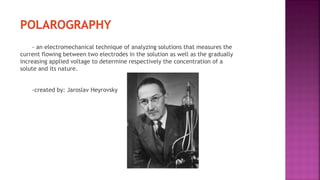
- an electromechanical technique of analyzing solutions that measures the
current flowing between two electrodes in the solution as well as the gradually
increasing applied voltage to determine respectively the concentration of a
solute and its nature.
-created by: Jaroslav Heyrovsky
“Polarographic Analysis”
Is a method of analysis based on the measurement of current electrolysis of
an electroactive species at a given electrode potential under controlled
conditions.
It is the branch of voltammetry where the working electrode is a dropping
mercury electrode (DME) or a static mercury drop electrode (SMDE), which
are useful for their wide cathodic ranges and renewable surfaces.
required.
Reference electrode- acts to maintain a constant potential throughout the
measurement.
Indicator electrode- assumes the potential impressed upon it from an
external source.
Reference electrode
Indicator electrode
3
1
.
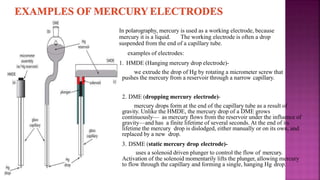
In polarography, mercury is used as a working electrode, because
mercury it is a liquid. The working electrode is often a drop
suspended from the end of a capillary tube.
examples of electrodes:
1. HMDE (Hanging mercury drop electrode)-
we extrude the drop of Hg by rotating a micrometer screw that
pushes the mercury from a reservoir through a narrow capillary.
2. DME (dropping mercury electrode)-
mercury drops form at the end of the capillary tube as a result of
gravity. Unlike the HMDE, the mercury drop of a DME grows
continuously— as mercury flows from the reservoir under the influence of
gravity—and has a finite lifetime of several seconds. At the end of its
lifetime the mercury drop is dislodged, either manually or on its own, and
replaced by a new drop.
3. DSME (static mercury drop electrode)-
uses a solenoid driven plunger to control the flow of mercury.
Activation of the solenoid momentarily lifts the plunger, allowing mercury
to flow through the capillary and forming a single, hanging Hg drop.
 The theory involved in polarography is when the working electrode is dipped in the
analyte solution containing electro-active species, the following reduction takes
place:
 A(OX) + ne− A(RED)
 Example: Cu+2 + 2e− Cu
 The reduced potential is created on the working electrode. The movement of the ions
from the solution to the electrode is by three mechanisms. They are as follows:
 Convection: This is also known as discharge process. This is carried out by the
stirring of the sample solution at a constant temperature.
 Migration: Here movement of particles due to attraction of force of the electric field
is created by the electrode.
 Diffusion: Here spontaneous movement of the sample ions occurs based on the
concentration gradient.
 The movement of the sample ions is controlled by the placement of the supporting
electrolyte solution.
 This supporting electrolyte solution surrounds the electrode with ions. The
supporting electrolyte should posses the following ideal requirements:
 It should be chemically inert.
 It should have different discharge potentials.
 It should have ionic conductivity.
 The total current flowing is given by the following equation:
 I = Id + Im
 where I is the total current; Id is the diffusion current; Im is the migration
current.
 The diffusion rate of the ion on the electrode surface is stated by Fick's
second law:
 δc/δt = Dδ2c/δx2
 where D is the diffusion coefficient; C is the concentration; t is the time; x
is the distance from the electrode surface.
8
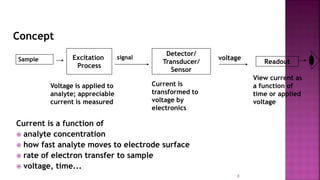
Current is a function of
 analyte concentration
 how fast analyte moves to electrode surface
 rate of electron transfer to sample
 voltage, time...
Readout
voltage
Detector/
Transducer/
Sensor
signalExcitation
Process
Sample
Voltage is applied to
analyte; appreciable
current is measured
View current as
a function of
time or applied
voltage
Current is
transformed to
voltage by
electronics
Concept
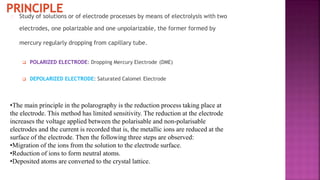
Study of solutions or of electrode processes by means of electrolysis with two
electrodes, one polarizable and one unpolarizable, the former formed by
mercury regularly dropping from capillary tube.
 POLARIZED ELECTRODE: Dropping Mercury Electrode (DME)
 DEPOLARIZED ELECTRODE: Saturated Calomel Electrode
•The main principle in the polarography is the reduction process taking place at
the electrode. This method has limited sensitivity. The reduction at the electrode
increases the voltage applied between the polarisable and non-polarisable
electrodes and the current is recorded that is, the metallic ions are reduced at the
surface of the electrode. Then the following three steps are observed:
•Migration of the ions from the solution to the electrode surface.
•Reduction of ions to form neutral atoms.
•Deposited atoms are converted to the crystal lattice.
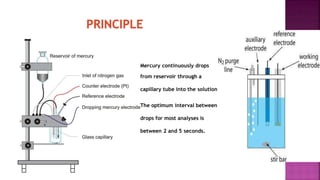
 Mercury continuously drops
from reservoir through a
capillary tube into the solution.
 The optimum interval between
drops for most analyses is
between 2 and 5 seconds.
11
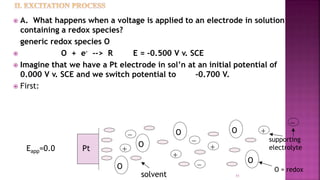
 A. What happens when a voltage is applied to an electrode in solution
containing a redox species?
generic redox species O
 O + e- --> R E = -0.500 V v. SCE
 Imagine that we have a Pt electrode in sol’n at an initial potential of
0.000 V v. SCE and we switch potential to -0.700 V.
 First:
solvent
O = redox
supporting
electrolytePt

O O
O




Eapp=0.0

O
O
12
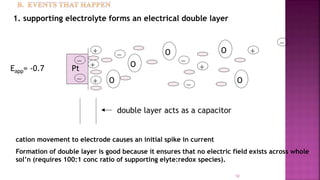
1. supporting electrolyte forms an electrical double layer
cation movement to electrode causes an initial spike in current
Formation of double layer is good because it ensures that no electric field exists across whole
sol’n (requires 100:1 conc ratio of supporting elyte:redox species).
Pt

O O
O



 Eapp= -0.7




O
O
double layer acts as a capacitor
13
How does more O get to electrode surface?
mass transport mechanisms
O is converted to R at electrode surface.
Pt

O O
O



 Eapp= -0.7




O
O
O
R
R
A depletion region of O develops - a region in which conc of
O is zero.
{
14
1. Migration - movement in response to electric field. We add
supporting electrolyte to make analyte’s migration nearly zero.
(fraction of current carried by analyte  zero)
2. Convection
 stirring
3. Diffusion
In experiments relying upon diffusion
15
1. Solutions: redox couple + solvent + supporting electrolyte
 supporting elyte: salt that migrates and carries current, and doesn’t do
redox in your potential window of interest
 a wide potential window is desirable
 water - good for oxidations, not reductions except on Hg supporting elytes: lots
of salts
 nonaqueous solvents: acetonitrile, dimethylformamide, etc.
 supporting electrolytes: tetraalkylammonium BF4, PF6, ClO4
 Oxygen is fairly easily reduced - we remove it by deoxygenating with an inert gas
(N2, Ar).
Mercury as working electrode is useful because:
 It displays a wide negative potential range
 Its surface is readily regenerated by producing a new drop or film
 Many metal ions can be reversibly reduced into it.
17
 Polaragrams are recorded in the presence of a relatively high
concentration of a base electrolyte such as KCI.
 The base electrolyte will decrease the resistance for the movement of
the metal ions to be determined thus, the IR drop throughout the cell
will be negligible.
 It helps also the movement of ions towards the electrode surface by
diffusion only.
 The discharge potential of the base electrolyte takes place at a very
low negative potential therefore, most ions will be reduced before the
base electrolyte species.
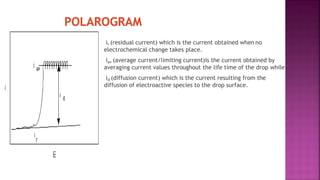
Obtained from an automatic recording instrument is called a polarogram, and
the trace is called a polarographic wave.
POLAROGRAM
• is a graph of current versus potential in a polarographic analysis.
3 categories:
A. collectively referred to as residual current (impurities and supporting electrolyte)
B. referred to as diffusion current resulting from the reduction of the sample
C. called the limiting current
 The diffusion current of a known concentration of reference standard are first determined
followed by the determination of the diffusion current of the unknown concentration.
ir (residual current) which is the current obtained when no
electrochemical change takes place.
iav (average current/limiting current)is the current obtained by
averaging current values throughout the life time of the drop while
id (diffusion current) which is the current resulting from the
diffusion of electroactive species to the drop surface.
Residual current
It is the sum of the relativity larger condenser current (charging current) and
a very small faradic current.
 MIGRATION CURRENT
 It is due to migration of cations from the bulk of the solution towards
cathode due to diffusive force . Irrespective of concentration gradient
 Kinetic current
 It is proportional to rate constant and volume of interface, hence
direct function of size of mercury drop but independent of
velocity of flow of mercury from capillary
 Diffusion current is due to the actual diffusion of electroreducible ion
from the bulk of the sample to the surface of the mercury droplets due to
concentration gradient
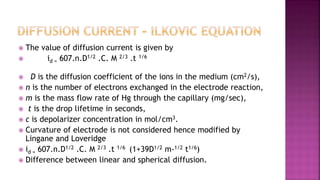
 The value of diffusion current is given by
 id = 607.n.D1/2 .C. M 2/3 .t 1/6
 D is the diffusion coefficient of the ions in the medium (cm2/s),
 n is the number of electrons exchanged in the electrode reaction,
 m is the mass flow rate of Hg through the capillary (mg/sec),
 t is the drop lifetime in seconds,
 c is depolarizer concentration in mol/cm3.
 Curvature of electrode is not considered hence modified by
Lingane and Loveridge
 id = 607.n.D1/2 .C. M 2/3 .t 1/6 (1+39D1/2 m-1/2 t1/6)
 Difference between linear and spherical diffusion.
 CONCENTRATION : Diffusion current is directly proportional to
concentration of the electroreducible ions . This forms the basis
quantitative analysis. i.e, if concentration is less , then diffusion current
is less . If concentration is more then diffusion current also more
 Diffusion of ions is being affected by temperature hence diffusion
current also varies with respect is temperature (directly proportional)
 Viscosity of the medium- inversely proportional
 Dimensions of capillary
 Molecular or ionic state of elecro-active species
 Pressure on the dropping mercury elecrode
 Temperature
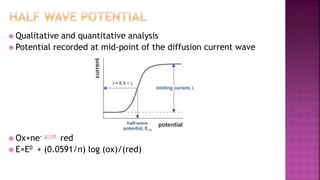
 Qualitative and quantitative analysis
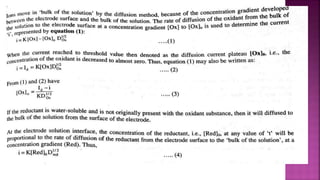
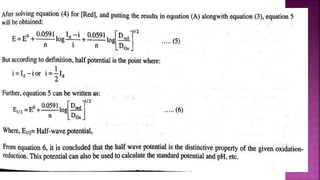
 Potential recorded at mid-point of the diffusion current wave
 Ox+ne- red
 E=E0 + (0.0591/n) log (ox)/(red)
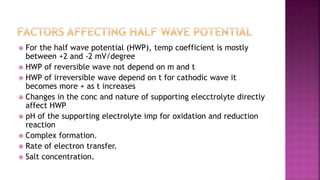
 For the half wave potential (HWP), temp coefficient is mostly
between +2 and -2 mV/degree
 HWP of reversible wave not depend on m and t
 HWP of irreversible wave depend on t for cathodic wave it
becomes more + as t increases
 Changes in the conc and nature of supporting elecctrolyte directly
affect HWP
 pH of the supporting electrolyte imp for oxidation and reduction
reaction
 Complex formation.
 Rate of electron transfer.
 Salt concentration.
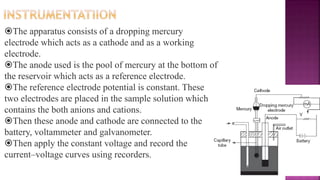
The apparatus consists of a dropping mercury
electrode which acts as a cathode and as a working
electrode.
The anode used is the pool of mercury at the bottom of
the reservoir which acts as a reference electrode.
The reference electrode potential is constant. These
two electrodes are placed in the sample solution which
contains the both anions and cations.
Then these anode and cathode are connected to the
battery, voltammeter and galvanometer.
Then apply the constant voltage and record the
current–voltage curves using recorders.
 The sample cell is made of glass with tapering edge to place the mercury. The
cathode capillary is dipped into the sample solution by setting the drop time of
about 2–7 s.
 To control the movement of the ions to the surface on the electrode, the
supporting electrolytes such as saturated potassium chloride solution are used.
 The oxygen present in the sample solution is removed by the alkaline pyrogallol
solution.
 The determined diffusion current is directly proportional to the concentration of
the sample solution.
 The current–voltage curves have the following advantages:
 Surface area is calculated by the weight of the drops.
 Reproducible values.
 Reduction potential is less.
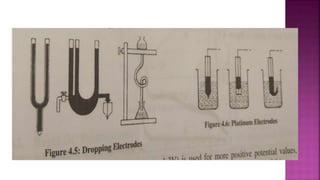
 Electrodes: The polarography is mainly composed of the three types of the electrodes. They are as
follows:
 Working electrodes: The working electrode is mainly used for the determination of the analyte
response to the potential.
Example: Dropping mercury electrode
 Dropping mercury electrode: This electrode was first introduced by the Barker. The basic principle
involved in this electrode is to control mercury flow through the capillary tube which is closed by the
needle valve.
 Advantages:
 this electrode is applicable to +0.4 to −1.8 V.
 Surface area is reproducible
 Constant renewal of electrode surface, poisoning effect can be removed
 Reduction of alkali metal ions can be obsevered due to large hydrogen overvoltage on Hg
 Surface area can be calculated by weght of drop
 Steady value is obtained by diffusion current
 Disadvantage: It can be oxidised easily hence avoided to used as anode
 capillary blocking
 Auxiliary electrode: It completes the circuit between the
potentiostat and the working electrode. Examples: Platinum
electrode, Glass carbon electrode
 Reference electrode:
 internal and external –
 External – kept separated from solution through salt bridge or
porous membrane
 Internal: directly in contact with solution, preferred when high
negative potential is required or salt bridge material affect adversly
 It is made by coiling of around 15-20 cm of gauze silver wire into
helix, coiling around DME
 This electrode provides the reference potential for the working
electrode and for the auxiliary electrode. Examples: Silver–silver
chloride electrode, Calomel electrode
 Silver electrode is not effective in solution containing cyanide,
thiosulphate, ammmonia and hi concentration of halids, solutions
containing only acetates, percholate and nitrate.
 Oxygen dissolved in electrolyte solution easily reduced at
dropping mercury electrode
 Results in producing two waves of approximate equal height
and extending over a voltage range
 Linear scan polaropghraphy
 Rapid DC polaroghraphy
 Sampled (or test) DC polaroghraphy
 Pulse P
 Normal pulse
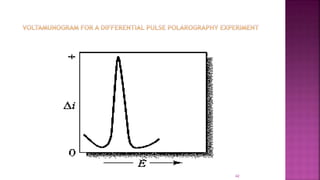
 Differential pulse
 Square wave polaroghraphy
 Rapid scan Voltammetry is the simplest technique.
 At the working electrode is applied a rapid potential scanning
that varies linearly (20 – 100 mV/s).
 The scanning starts before the discharging potential and
stops afterwards
 Capacitive current increases when the velocity of scanning is
increased and cannot be electronically compensated. Thus
the performance of this technique are strongly restricted.
Detection limits range at mg/l levels.
 Rapid DC Polarography
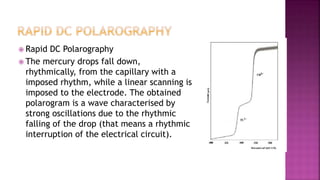
 The mercury drops fall down,
rhythmically, from the capillary with a
imposed rhythm, while a linear scanning is
imposed to the electrode. The obtained
polarogram is a wave characterised by
strong oscillations due to the rhythmic
falling of the drop (that means a rhythmic
interruption of the electrical circuit).
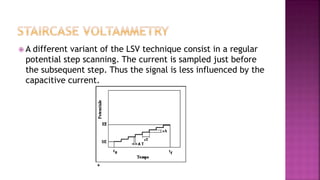
 A different variant of the LSV technique consist in a regular
potential step scanning. The current is sampled just before
the subsequent step. Thus the signal is less influenced by the
capacitive current.
37
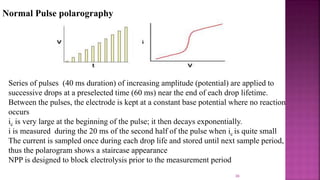
1. Normal Pulse polarog. : gradual increase in the amplitude in the
voltage pulse
2. Differential pulse polarog.: Voltage pulse of constant amplitude
superimposed on a slowly increasing voltage
3. squarewave voltammetry : which can be considered a special type of
differential pulse voltammetry in which equal time is spent at the
potential of the ramped baseline and potential of the superimposed
pulse.
38
Series of pulses (40 ms duration) of increasing amplitude (potential) are applied to
successive drops at a preselected time (60 ms) near the end of each drop lifetime.
Between the pulses, the electrode is kept at a constant base potential where no reaction
occurs
ic is very large at the beginning of the pulse; it then decays exponentially.
i is measured during the 20 ms of the second half of the pulse when ic is quite small
The current is sampled once during each drop life and stored until next sample period,
thus the polarogram shows a staircase appearance
NPP is designed to block electrolysis prior to the measurement period
Normal Pulse polarography
39
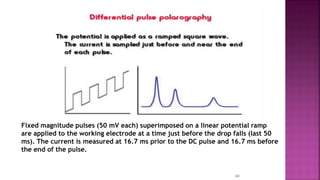
 A pulse (of constant amplitude of 5-100 mV) of 40-60 ms is
applied during the last quarter of the drop life
 The pulse is superimposed on a slowly increasing linear
voltage ramp.
 The current is measured twice: one immediately preceding
the pulse and the other near the end of the pulse.
 Overall response plotted is the difference between the two
currents sampled
40
Fixed magnitude pulses (50 mV each) superimposed on a linear potential ramp
are applied to the working electrode at a time just before the drop falls (last 50
ms). The current is measured at 16.7 ms prior to the DC pulse and 16.7 ms before
the end of the pulse.
41
42
1. Simple sample handling
2. Speed of analysis
3. High sensitivity
4. Comparable or better accuracy
5. Cheaper instrumentation and lower cost of chemicals used
6. Limited used of environmentally unfriendly organic solvents
 Less accurate.
 Skilled person is required.
 APPLICATIONS
 Used in the determination of the composition of the alloys.
 Used in the qualitative determination of the elements.
 Used in the estimation of the trace metals like Zn, Fe, Mn and Cu.
 Used in the determination of the free sulfur in petroleum
fractions.
 Used in the determination of the vitamin C in the food beverages.
 Used in the functional group analysis.
 Used in the determination of the complex compositions.
 Used in the determination of the dissolved oxygen in the gases.
 Used in the determination of the local anesthetics (dyclonine).
Polarography

Polarography

  • 1.
    POLAROGRAPHY Madhuri Shelar (Mpharm) Assistant Professor Alard College of Pharmacy
  • 2.
    - an electromechanicaltechnique of analyzing solutions that measures the current flowing between two electrodes in the solution as well as the gradually increasing applied voltage to determine respectively the concentration of a solute and its nature. -created by: Jaroslav Heyrovsky
  • 3.
    “Polarographic Analysis” Is amethod of analysis based on the measurement of current electrolysis of an electroactive species at a given electrode potential under controlled conditions. It is the branch of voltammetry where the working electrode is a dropping mercury electrode (DME) or a static mercury drop electrode (SMDE), which are useful for their wide cathodic ranges and renewable surfaces.
  • 4.
    required. Reference electrode- actsto maintain a constant potential throughout the measurement. Indicator electrode- assumes the potential impressed upon it from an external source. Reference electrode Indicator electrode
  • 5.
    3 1 . In polarography, mercuryis used as a working electrode, because mercury it is a liquid. The working electrode is often a drop suspended from the end of a capillary tube. examples of electrodes: 1. HMDE (Hanging mercury drop electrode)- we extrude the drop of Hg by rotating a micrometer screw that pushes the mercury from a reservoir through a narrow capillary. 2. DME (dropping mercury electrode)- mercury drops form at the end of the capillary tube as a result of gravity. Unlike the HMDE, the mercury drop of a DME grows continuously— as mercury flows from the reservoir under the influence of gravity—and has a finite lifetime of several seconds. At the end of its lifetime the mercury drop is dislodged, either manually or on its own, and replaced by a new drop. 3. DSME (static mercury drop electrode)- uses a solenoid driven plunger to control the flow of mercury. Activation of the solenoid momentarily lifts the plunger, allowing mercury to flow through the capillary and forming a single, hanging Hg drop.
  • 6.
     The theoryinvolved in polarography is when the working electrode is dipped in the analyte solution containing electro-active species, the following reduction takes place:  A(OX) + ne− A(RED)  Example: Cu+2 + 2e− Cu  The reduced potential is created on the working electrode. The movement of the ions from the solution to the electrode is by three mechanisms. They are as follows:  Convection: This is also known as discharge process. This is carried out by the stirring of the sample solution at a constant temperature.  Migration: Here movement of particles due to attraction of force of the electric field is created by the electrode.  Diffusion: Here spontaneous movement of the sample ions occurs based on the concentration gradient.  The movement of the sample ions is controlled by the placement of the supporting electrolyte solution.
  • 7.
     This supportingelectrolyte solution surrounds the electrode with ions. The supporting electrolyte should posses the following ideal requirements:  It should be chemically inert.  It should have different discharge potentials.  It should have ionic conductivity.  The total current flowing is given by the following equation:  I = Id + Im  where I is the total current; Id is the diffusion current; Im is the migration current.  The diffusion rate of the ion on the electrode surface is stated by Fick's second law:  δc/δt = Dδ2c/δx2  where D is the diffusion coefficient; C is the concentration; t is the time; x is the distance from the electrode surface.
  • 8.
    8 Current is afunction of  analyte concentration  how fast analyte moves to electrode surface  rate of electron transfer to sample  voltage, time... Readout voltage Detector/ Transducer/ Sensor signalExcitation Process Sample Voltage is applied to analyte; appreciable current is measured View current as a function of time or applied voltage Current is transformed to voltage by electronics Concept
  • 9.
    Study of solutionsor of electrode processes by means of electrolysis with two electrodes, one polarizable and one unpolarizable, the former formed by mercury regularly dropping from capillary tube.  POLARIZED ELECTRODE: Dropping Mercury Electrode (DME)  DEPOLARIZED ELECTRODE: Saturated Calomel Electrode •The main principle in the polarography is the reduction process taking place at the electrode. This method has limited sensitivity. The reduction at the electrode increases the voltage applied between the polarisable and non-polarisable electrodes and the current is recorded that is, the metallic ions are reduced at the surface of the electrode. Then the following three steps are observed: •Migration of the ions from the solution to the electrode surface. •Reduction of ions to form neutral atoms. •Deposited atoms are converted to the crystal lattice.
  • 10.
     Mercury continuouslydrops from reservoir through a capillary tube into the solution.  The optimum interval between drops for most analyses is between 2 and 5 seconds.
  • 11.
    11  A. Whathappens when a voltage is applied to an electrode in solution containing a redox species? generic redox species O  O + e- --> R E = -0.500 V v. SCE  Imagine that we have a Pt electrode in sol’n at an initial potential of 0.000 V v. SCE and we switch potential to -0.700 V.  First: solvent O = redox supporting electrolytePt  O O O     Eapp=0.0  O O
  • 12.
    12 1. supporting electrolyteforms an electrical double layer cation movement to electrode causes an initial spike in current Formation of double layer is good because it ensures that no electric field exists across whole sol’n (requires 100:1 conc ratio of supporting elyte:redox species). Pt  O O O     Eapp= -0.7     O O double layer acts as a capacitor
  • 13.
    13 How does moreO get to electrode surface? mass transport mechanisms O is converted to R at electrode surface. Pt  O O O     Eapp= -0.7     O O O R R A depletion region of O develops - a region in which conc of O is zero. {
  • 14.
    14 1. Migration -movement in response to electric field. We add supporting electrolyte to make analyte’s migration nearly zero. (fraction of current carried by analyte  zero) 2. Convection  stirring 3. Diffusion In experiments relying upon diffusion
  • 15.
    15 1. Solutions: redoxcouple + solvent + supporting electrolyte  supporting elyte: salt that migrates and carries current, and doesn’t do redox in your potential window of interest  a wide potential window is desirable  water - good for oxidations, not reductions except on Hg supporting elytes: lots of salts  nonaqueous solvents: acetonitrile, dimethylformamide, etc.  supporting electrolytes: tetraalkylammonium BF4, PF6, ClO4  Oxygen is fairly easily reduced - we remove it by deoxygenating with an inert gas (N2, Ar).
  • 16.
    Mercury as workingelectrode is useful because:  It displays a wide negative potential range  Its surface is readily regenerated by producing a new drop or film  Many metal ions can be reversibly reduced into it.
  • 17.
    17  Polaragrams arerecorded in the presence of a relatively high concentration of a base electrolyte such as KCI.  The base electrolyte will decrease the resistance for the movement of the metal ions to be determined thus, the IR drop throughout the cell will be negligible.  It helps also the movement of ions towards the electrode surface by diffusion only.  The discharge potential of the base electrolyte takes place at a very low negative potential therefore, most ions will be reduced before the base electrolyte species.
  • 18.
    Obtained from anautomatic recording instrument is called a polarogram, and the trace is called a polarographic wave. POLAROGRAM • is a graph of current versus potential in a polarographic analysis. 3 categories: A. collectively referred to as residual current (impurities and supporting electrolyte) B. referred to as diffusion current resulting from the reduction of the sample C. called the limiting current  The diffusion current of a known concentration of reference standard are first determined followed by the determination of the diffusion current of the unknown concentration.
  • 19.
    ir (residual current)which is the current obtained when no electrochemical change takes place. iav (average current/limiting current)is the current obtained by averaging current values throughout the life time of the drop while id (diffusion current) which is the current resulting from the diffusion of electroactive species to the drop surface.
  • 20.
    Residual current It isthe sum of the relativity larger condenser current (charging current) and a very small faradic current.  MIGRATION CURRENT  It is due to migration of cations from the bulk of the solution towards cathode due to diffusive force . Irrespective of concentration gradient  Kinetic current  It is proportional to rate constant and volume of interface, hence direct function of size of mercury drop but independent of velocity of flow of mercury from capillary  Diffusion current is due to the actual diffusion of electroreducible ion from the bulk of the sample to the surface of the mercury droplets due to concentration gradient
  • 21.
     The valueof diffusion current is given by  id = 607.n.D1/2 .C. M 2/3 .t 1/6  D is the diffusion coefficient of the ions in the medium (cm2/s),  n is the number of electrons exchanged in the electrode reaction,  m is the mass flow rate of Hg through the capillary (mg/sec),  t is the drop lifetime in seconds,  c is depolarizer concentration in mol/cm3.  Curvature of electrode is not considered hence modified by Lingane and Loveridge  id = 607.n.D1/2 .C. M 2/3 .t 1/6 (1+39D1/2 m-1/2 t1/6)  Difference between linear and spherical diffusion.
  • 22.
     CONCENTRATION :Diffusion current is directly proportional to concentration of the electroreducible ions . This forms the basis quantitative analysis. i.e, if concentration is less , then diffusion current is less . If concentration is more then diffusion current also more  Diffusion of ions is being affected by temperature hence diffusion current also varies with respect is temperature (directly proportional)  Viscosity of the medium- inversely proportional  Dimensions of capillary  Molecular or ionic state of elecro-active species  Pressure on the dropping mercury elecrode  Temperature
  • 23.
     Qualitative andquantitative analysis  Potential recorded at mid-point of the diffusion current wave  Ox+ne- red  E=E0 + (0.0591/n) log (ox)/(red)
  • 26.
     For thehalf wave potential (HWP), temp coefficient is mostly between +2 and -2 mV/degree  HWP of reversible wave not depend on m and t  HWP of irreversible wave depend on t for cathodic wave it becomes more + as t increases  Changes in the conc and nature of supporting elecctrolyte directly affect HWP  pH of the supporting electrolyte imp for oxidation and reduction reaction  Complex formation.  Rate of electron transfer.  Salt concentration.
  • 27.
    The apparatus consistsof a dropping mercury electrode which acts as a cathode and as a working electrode. The anode used is the pool of mercury at the bottom of the reservoir which acts as a reference electrode. The reference electrode potential is constant. These two electrodes are placed in the sample solution which contains the both anions and cations. Then these anode and cathode are connected to the battery, voltammeter and galvanometer. Then apply the constant voltage and record the current–voltage curves using recorders.
  • 28.
     The samplecell is made of glass with tapering edge to place the mercury. The cathode capillary is dipped into the sample solution by setting the drop time of about 2–7 s.  To control the movement of the ions to the surface on the electrode, the supporting electrolytes such as saturated potassium chloride solution are used.  The oxygen present in the sample solution is removed by the alkaline pyrogallol solution.  The determined diffusion current is directly proportional to the concentration of the sample solution.  The current–voltage curves have the following advantages:  Surface area is calculated by the weight of the drops.  Reproducible values.  Reduction potential is less.
  • 29.
     Electrodes: Thepolarography is mainly composed of the three types of the electrodes. They are as follows:  Working electrodes: The working electrode is mainly used for the determination of the analyte response to the potential. Example: Dropping mercury electrode  Dropping mercury electrode: This electrode was first introduced by the Barker. The basic principle involved in this electrode is to control mercury flow through the capillary tube which is closed by the needle valve.  Advantages:  this electrode is applicable to +0.4 to −1.8 V.  Surface area is reproducible  Constant renewal of electrode surface, poisoning effect can be removed  Reduction of alkali metal ions can be obsevered due to large hydrogen overvoltage on Hg  Surface area can be calculated by weght of drop  Steady value is obtained by diffusion current  Disadvantage: It can be oxidised easily hence avoided to used as anode  capillary blocking
  • 31.
     Auxiliary electrode:It completes the circuit between the potentiostat and the working electrode. Examples: Platinum electrode, Glass carbon electrode  Reference electrode:  internal and external –  External – kept separated from solution through salt bridge or porous membrane  Internal: directly in contact with solution, preferred when high negative potential is required or salt bridge material affect adversly  It is made by coiling of around 15-20 cm of gauze silver wire into helix, coiling around DME  This electrode provides the reference potential for the working electrode and for the auxiliary electrode. Examples: Silver–silver chloride electrode, Calomel electrode  Silver electrode is not effective in solution containing cyanide, thiosulphate, ammmonia and hi concentration of halids, solutions containing only acetates, percholate and nitrate.
  • 32.
     Oxygen dissolvedin electrolyte solution easily reduced at dropping mercury electrode  Results in producing two waves of approximate equal height and extending over a voltage range
  • 33.
     Linear scanpolaropghraphy  Rapid DC polaroghraphy  Sampled (or test) DC polaroghraphy  Pulse P  Normal pulse  Differential pulse  Square wave polaroghraphy
  • 34.
     Rapid scanVoltammetry is the simplest technique.  At the working electrode is applied a rapid potential scanning that varies linearly (20 – 100 mV/s).  The scanning starts before the discharging potential and stops afterwards  Capacitive current increases when the velocity of scanning is increased and cannot be electronically compensated. Thus the performance of this technique are strongly restricted. Detection limits range at mg/l levels.
  • 35.
     Rapid DCPolarography  The mercury drops fall down, rhythmically, from the capillary with a imposed rhythm, while a linear scanning is imposed to the electrode. The obtained polarogram is a wave characterised by strong oscillations due to the rhythmic falling of the drop (that means a rhythmic interruption of the electrical circuit).
  • 36.
     A differentvariant of the LSV technique consist in a regular potential step scanning. The current is sampled just before the subsequent step. Thus the signal is less influenced by the capacitive current.
  • 37.
    37 1. Normal Pulsepolarog. : gradual increase in the amplitude in the voltage pulse 2. Differential pulse polarog.: Voltage pulse of constant amplitude superimposed on a slowly increasing voltage 3. squarewave voltammetry : which can be considered a special type of differential pulse voltammetry in which equal time is spent at the potential of the ramped baseline and potential of the superimposed pulse.
  • 38.
    38 Series of pulses(40 ms duration) of increasing amplitude (potential) are applied to successive drops at a preselected time (60 ms) near the end of each drop lifetime. Between the pulses, the electrode is kept at a constant base potential where no reaction occurs ic is very large at the beginning of the pulse; it then decays exponentially. i is measured during the 20 ms of the second half of the pulse when ic is quite small The current is sampled once during each drop life and stored until next sample period, thus the polarogram shows a staircase appearance NPP is designed to block electrolysis prior to the measurement period Normal Pulse polarography
  • 39.
    39  A pulse(of constant amplitude of 5-100 mV) of 40-60 ms is applied during the last quarter of the drop life  The pulse is superimposed on a slowly increasing linear voltage ramp.  The current is measured twice: one immediately preceding the pulse and the other near the end of the pulse.  Overall response plotted is the difference between the two currents sampled
  • 40.
    40 Fixed magnitude pulses(50 mV each) superimposed on a linear potential ramp are applied to the working electrode at a time just before the drop falls (last 50 ms). The current is measured at 16.7 ms prior to the DC pulse and 16.7 ms before the end of the pulse.
  • 41.
  • 42.
  • 43.
    1. Simple samplehandling 2. Speed of analysis 3. High sensitivity 4. Comparable or better accuracy 5. Cheaper instrumentation and lower cost of chemicals used 6. Limited used of environmentally unfriendly organic solvents
  • 44.
     Less accurate. Skilled person is required.
  • 45.
     APPLICATIONS  Usedin the determination of the composition of the alloys.  Used in the qualitative determination of the elements.  Used in the estimation of the trace metals like Zn, Fe, Mn and Cu.  Used in the determination of the free sulfur in petroleum fractions.  Used in the determination of the vitamin C in the food beverages.  Used in the functional group analysis.  Used in the determination of the complex compositions.  Used in the determination of the dissolved oxygen in the gases.  Used in the determination of the local anesthetics (dyclonine).