Ch. 15: Redox Titrations
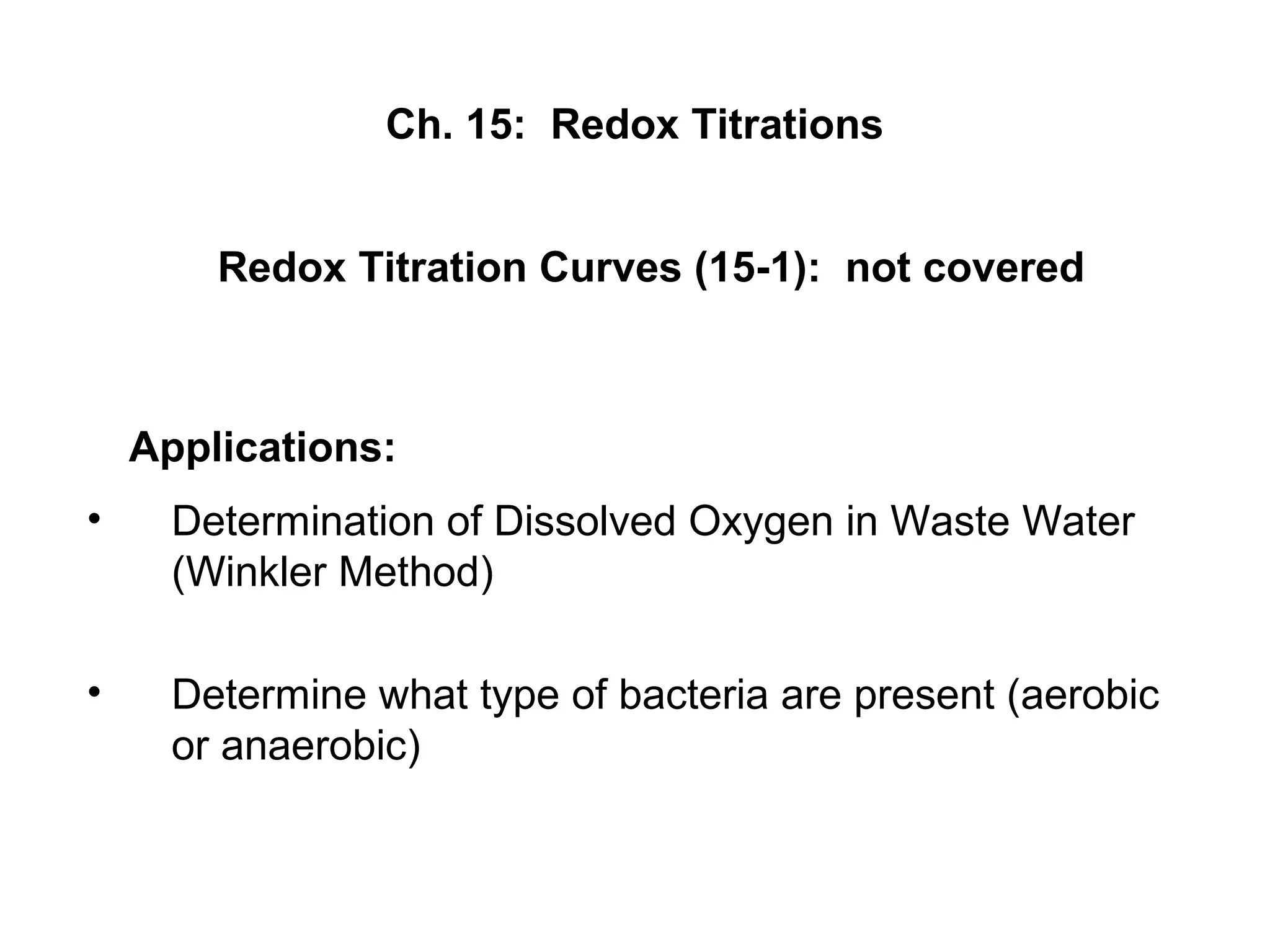
• Determination of Dissolved Oxygen in Waste Water
(Winkler Method)
• Determine what type of bacteria are present (aerobic
or anaerobic)
Applications:
Redox Titration Curves (15-1): not covered
Ch. 15: Redox Titrations
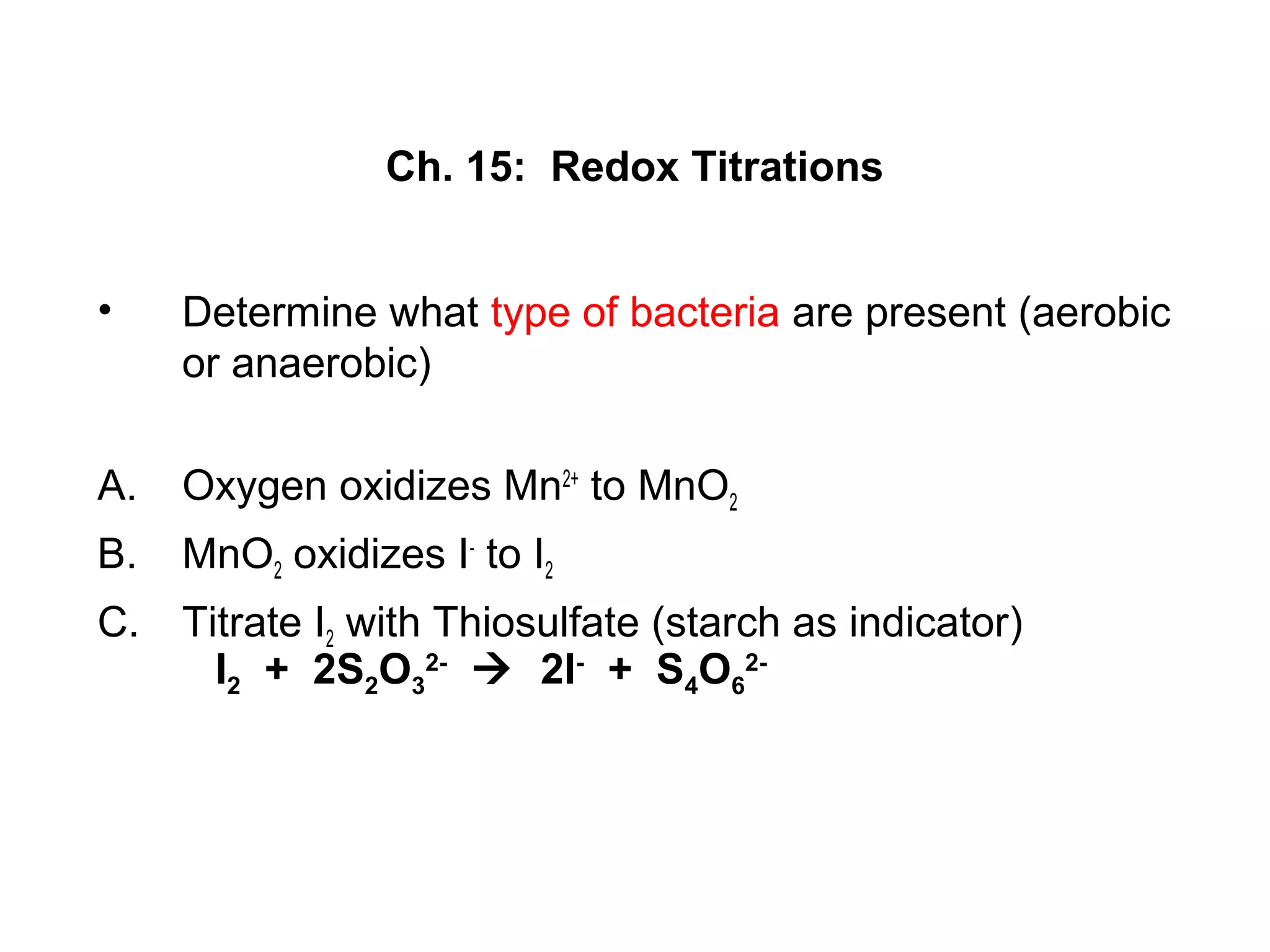
• Determine what type of bacteria are present (aerobic
or anaerobic)
A. Oxygen oxidizes Mn2+
to MnO2
B. MnO2 oxidizes I-
to I2
C. Titrate I2 with Thiosulfate (starch as indicator)
I2 + 2S2O3
2-
 2I-
+ S4O6
2-
Ch. 15: Redox Titrations
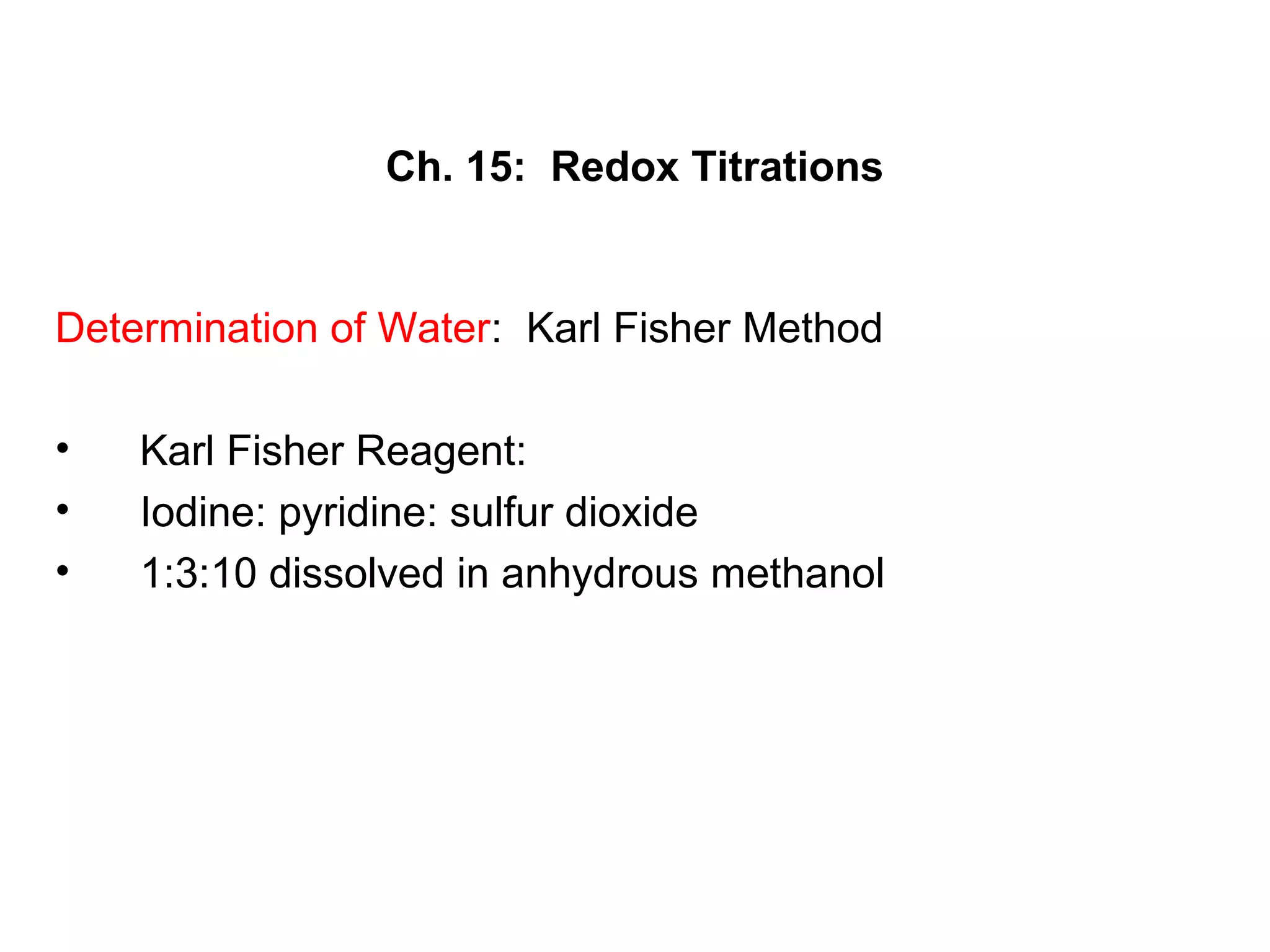
Determination of Water: Karl Fisher Method
• Karl Fisher Reagent:
• Iodine: pyridine: sulfur dioxide
• 1:3:10 dissolved in anhydrous methanol
Ch. 15: Redox Titrations
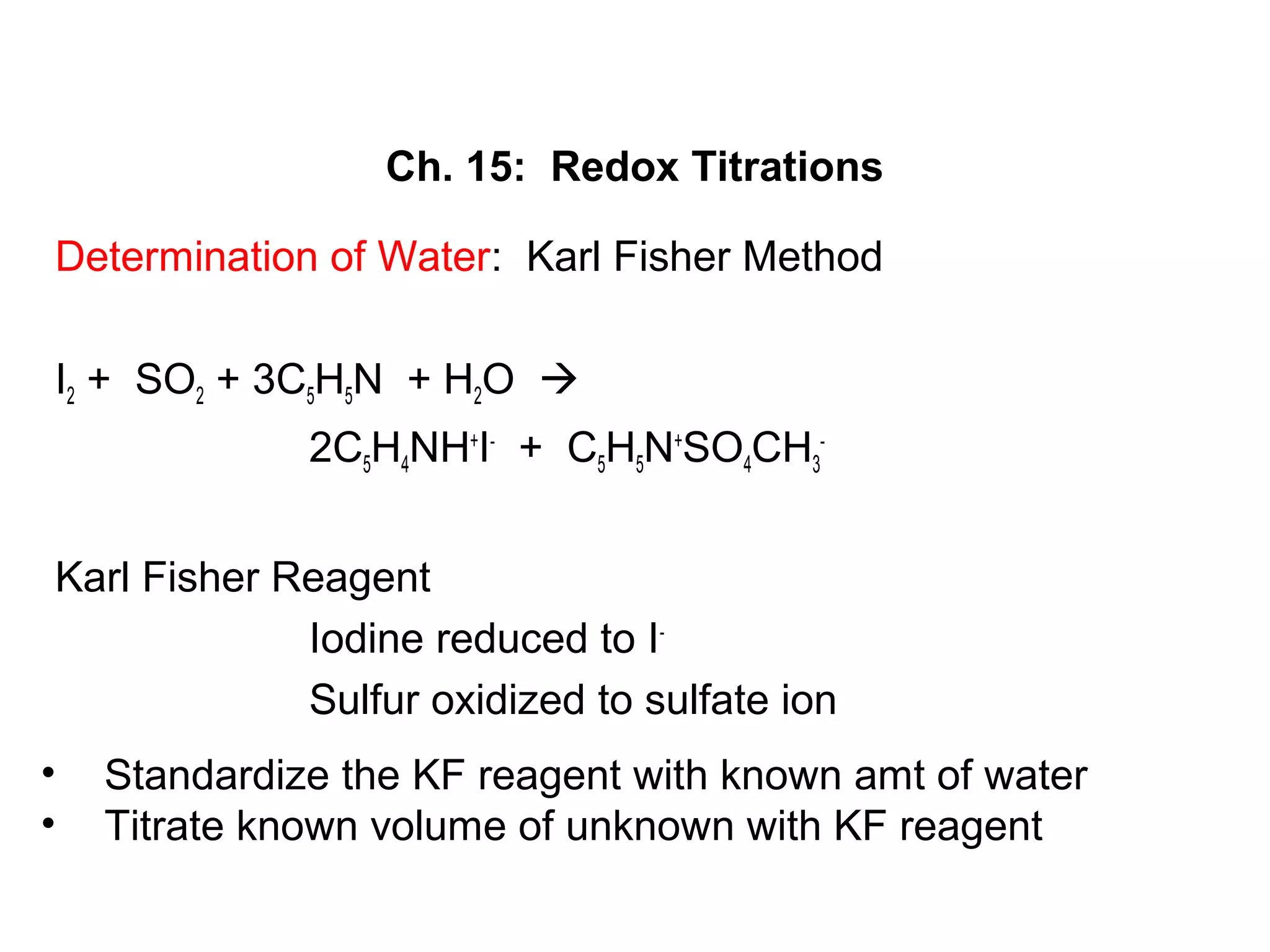
Determination of Water: Karl Fisher Method
I2 + SO2 + 3C5H5N + H2O 
2C5H4NH+
I-
+ C5H5N+
SO4CH3
-
Karl Fisher Reagent
Iodine reduced to I-
Sulfur oxidized to sulfate ion
• Standardize the KF reagent with known amt of water
• Titrate known volume of unknown with KF reagent
Ch. 15: Redox Titrations
• Sample Preparation(15-3)
– Analyte may reside in more than one oxidation state
– Convert to a single oxidation state
Treat with reductant or oxidant
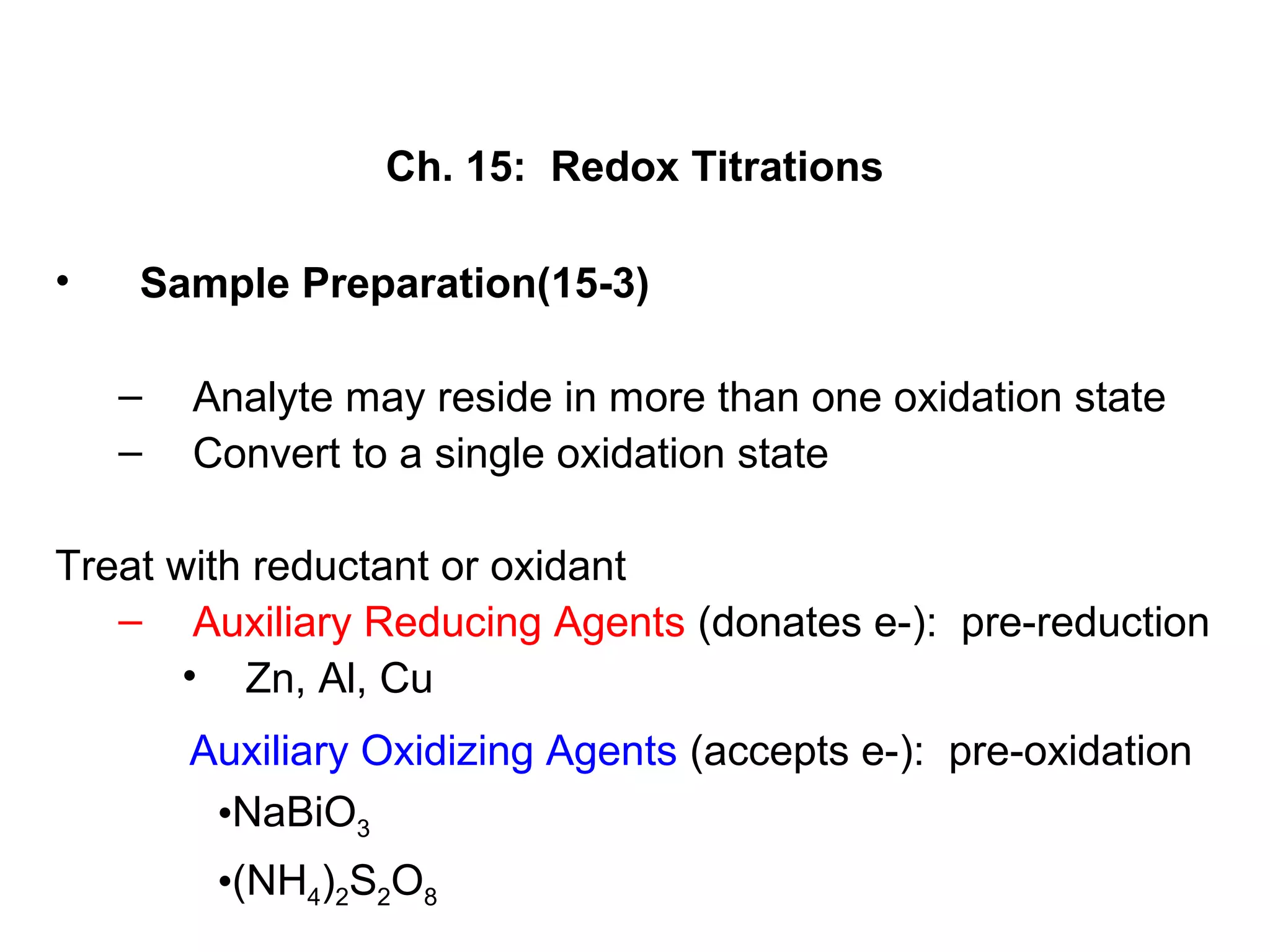
– Auxiliary Reducing Agents (donates e-): pre-reduction
• Zn, Al, Cu
Auxiliary Oxidizing Agents (accepts e-): pre-oxidation
•NaBiO3
•(NH4)2S2O8
Ch. 15: Redox Titrations
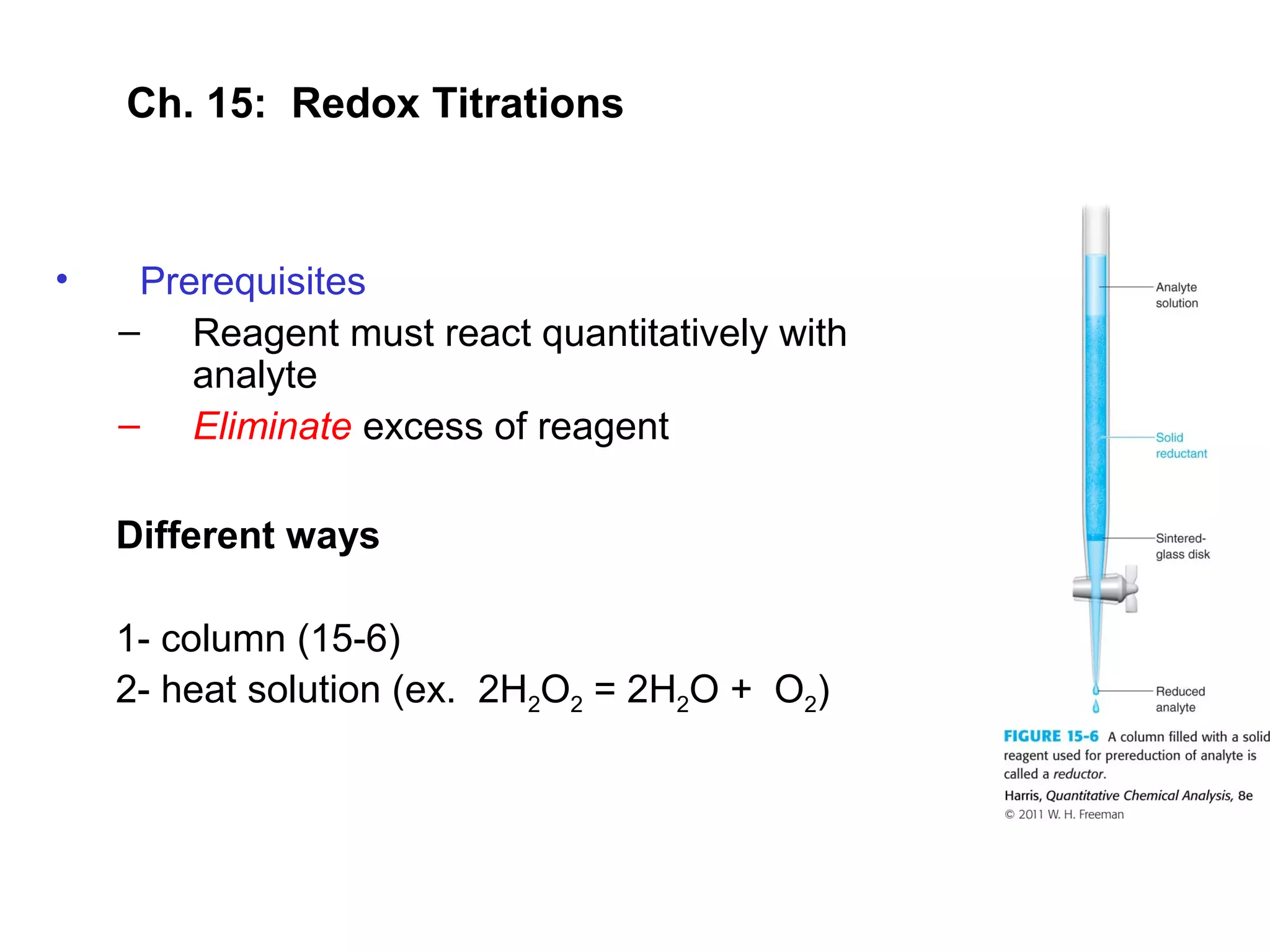
• Prerequisites
– Reagent must react quantitatively with
analyte
– Eliminate excess of reagent
Different ways
1- column (15-6)
2- heat solution (ex. 2H2O2 = 2H2O + O2)
Ch. 15: Redox Titrations
Standard Oxidants
– Potassium permanganate
– Potassium bromate
– Cerium (IV)
– Potassium dichromate
– Iodine
Ch. 15 Redox Titrations
• Choice:
– Strength of analyte as a reducing agent
– Rate of rxn
– Stability
– Cost
– Availability of indicator
Ch. 15: Redox Titrations
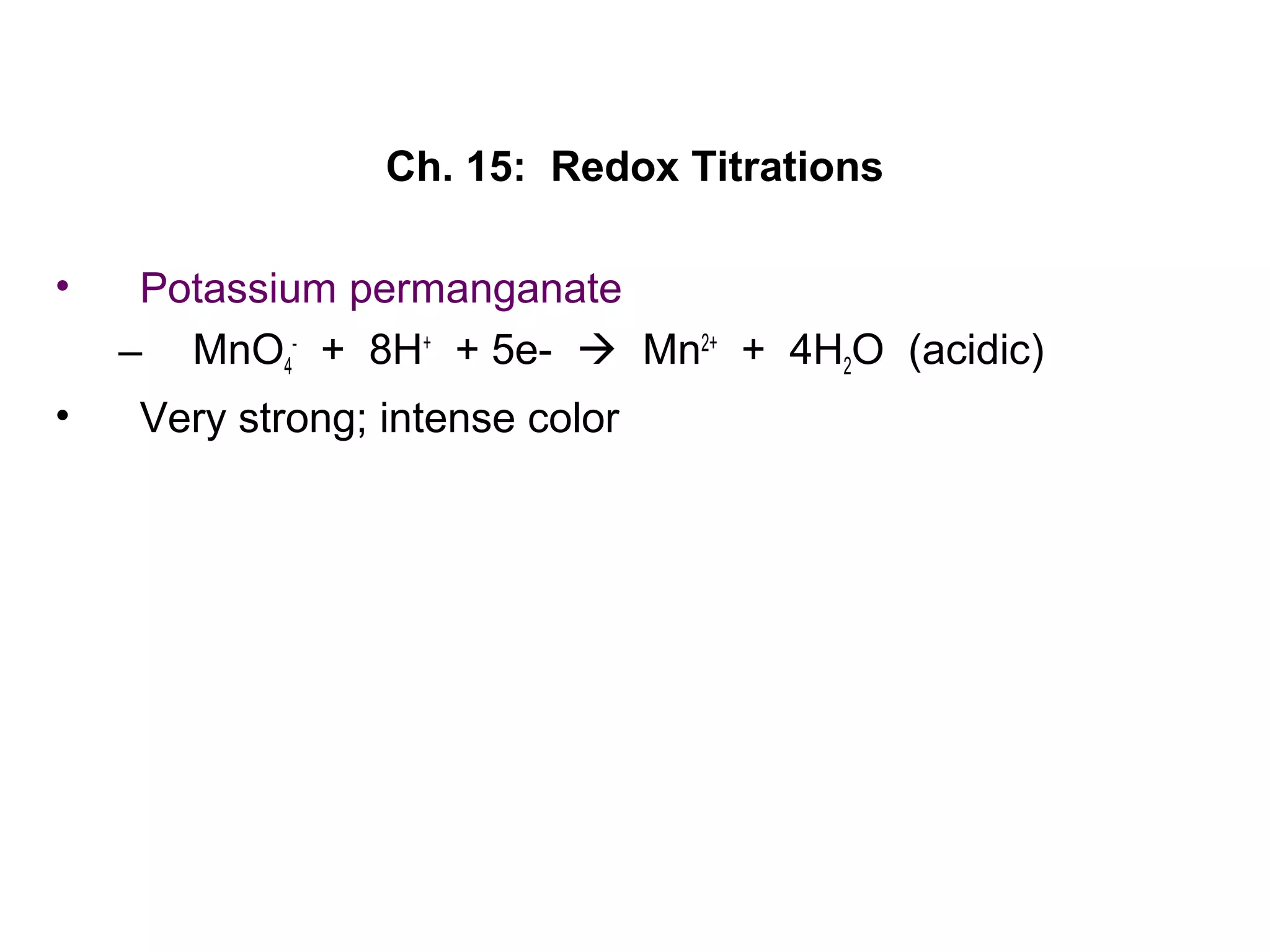
• Potassium permanganate
– MnO4
-
+ 8H+
+ 5e-  Mn2+
+ 4H2O (acidic)
• Very strong; intense color
Ch. 15: Applications of Redox Titrations
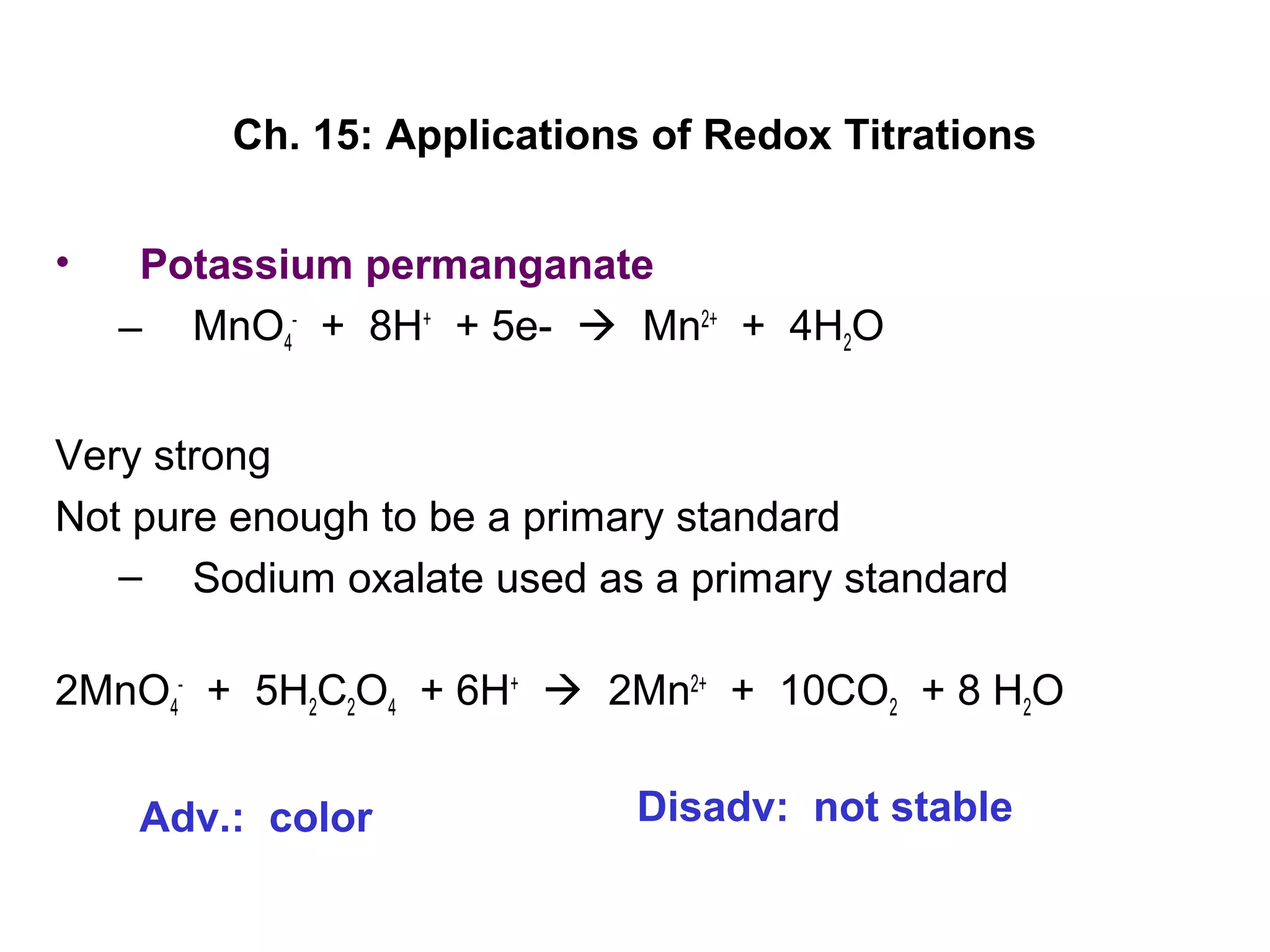
• Potassium permanganate
– MnO4
-
+ 8H+
+ 5e-  Mn2+
+ 4H2O
Very strong
Not pure enough to be a primary standard
– Sodium oxalate used as a primary standard
2MnO4
-
+ 5H2C2O4 + 6H+
 2Mn2+
+ 10CO2 + 8 H2O
Adv.: color Disadv: not stable
Ch. 15: Applications of Redox Titrations
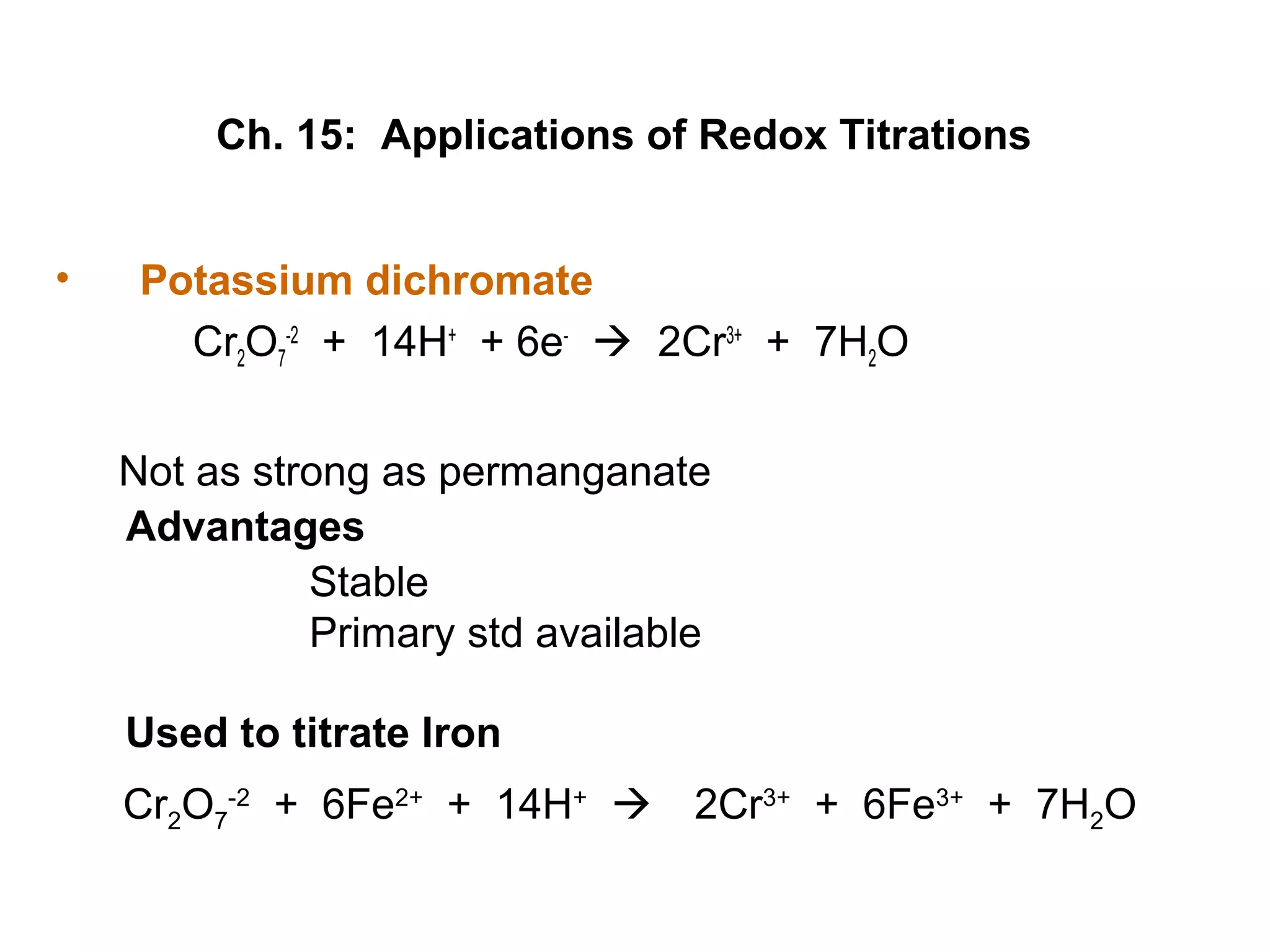
• Potassium dichromate
Cr2O7
-2
+ 14H+
+ 6e-
 2Cr3+
+ 7H2O
Not as strong as permanganate
Advantages
Stable
Primary std available
Used to titrate Iron
Cr2O7
-2
+ 6Fe2+
+ 14H+
 2Cr3+
+ 6Fe3+
+ 7H2O
Ch. 15: Applications of Redox Titrations
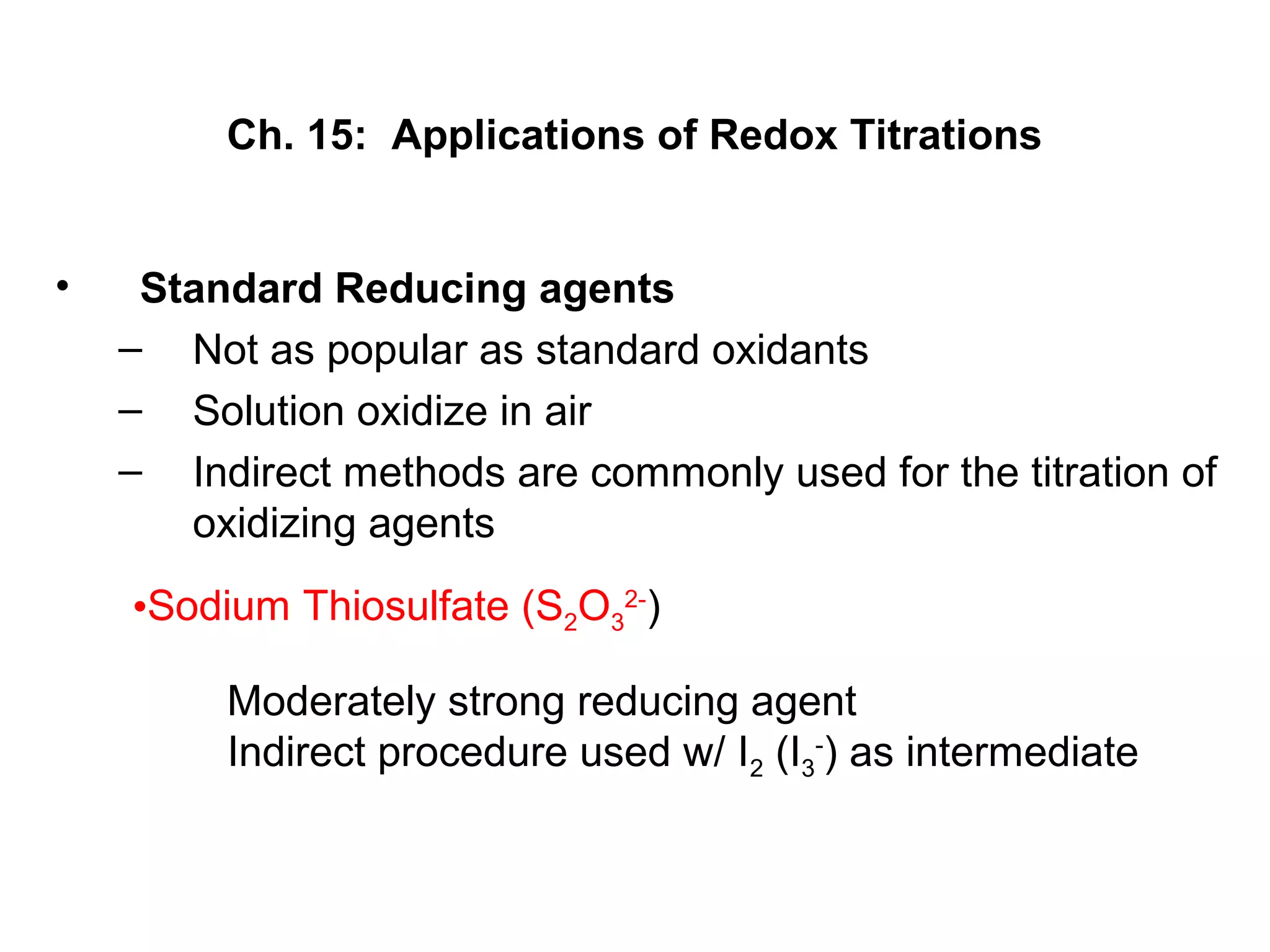
• Standard Reducing agents
– Not as popular as standard oxidants
– Solution oxidize in air
– Indirect methods are commonly used for the titration of
oxidizing agents
•Sodium Thiosulfate (S2O3
2-
)
Moderately strong reducing agent
Indirect procedure used w/ I2 (I3
-
) as intermediate
Ch. 15: Applications of Redox Titrations
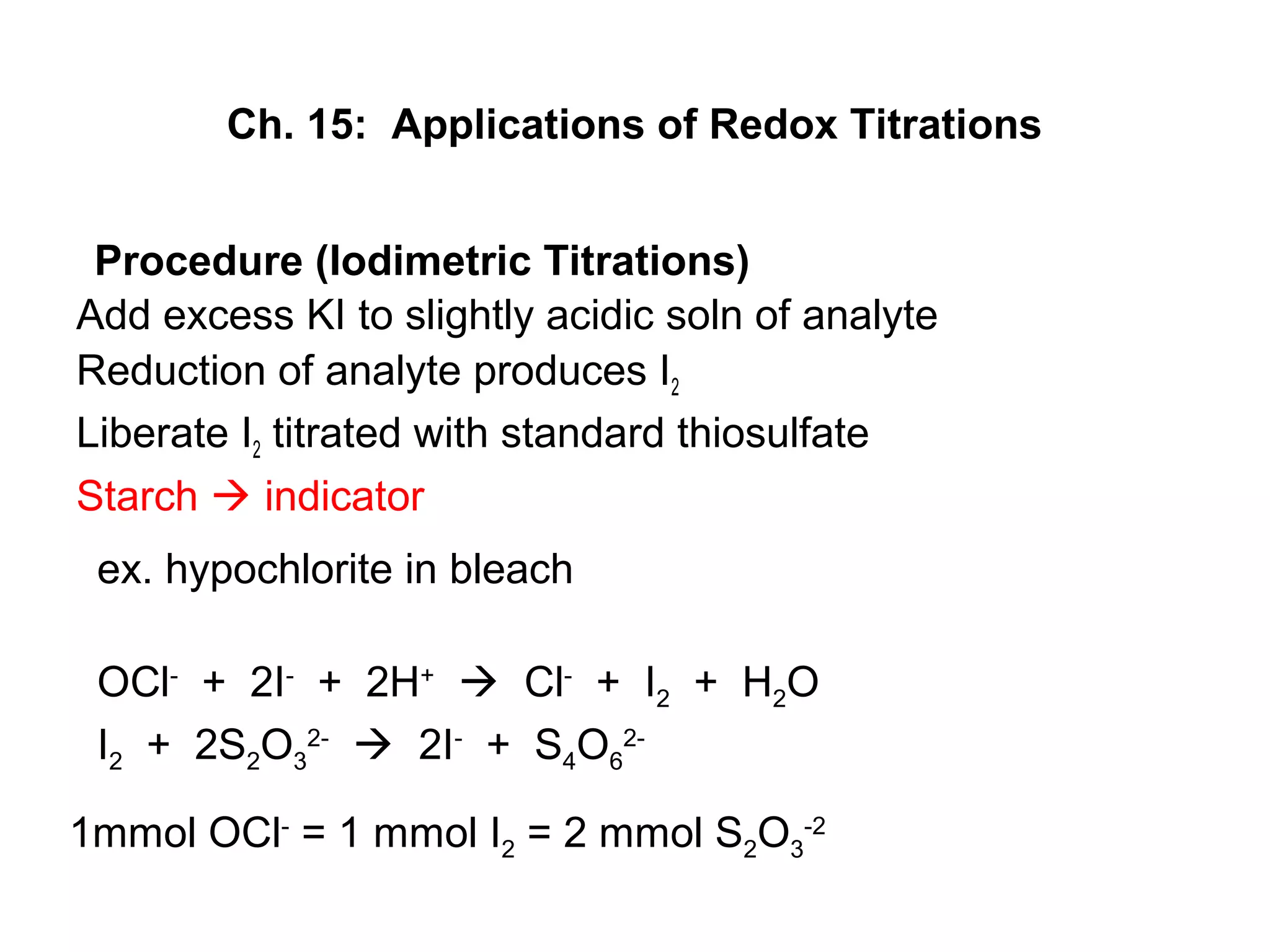
Add excess KI to slightly acidic soln of analyte
Reduction of analyte produces I2
Liberate I2 titrated with standard thiosulfate
Starch  indicator
ex. hypochlorite in bleach
OCl-
+ 2I-
+ 2H+
 Cl-
+ I2 + H2O
I2 + 2S2O3
2-
 2I-
+ S4O6
2-
1mmol OCl-
= 1 mmol I2 = 2 mmol S2O3
-2
Procedure (Iodimetric Titrations)
Ch. 15: Applications of Redox Titrations
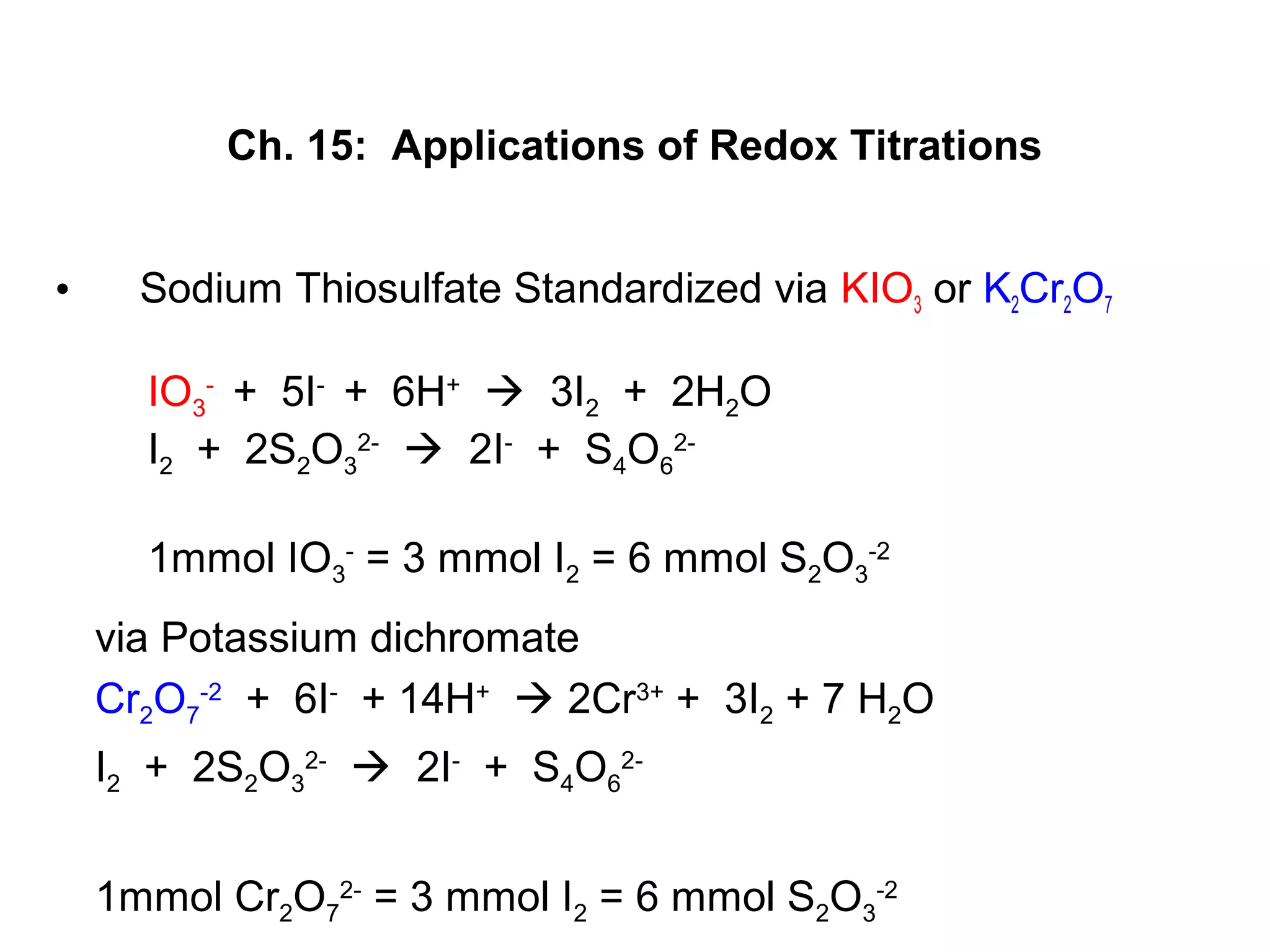
• Sodium Thiosulfate Standardized via KIO3 or K2Cr2O7
IO3
-
+ 5I-
+ 6H+
 3I2 + 2H2O
I2 + 2S2O3
2-
 2I-
+ S4O6
2-
1mmol IO3
-
= 3 mmol I2 = 6 mmol S2O3
-2
via Potassium dichromate
Cr2O7
-2
+ 6I-
+ 14H+
 2Cr3+
+ 3I2 + 7 H2O
I2 + 2S2O3
2-
 2I-
+ S4O6
2-
1mmol Cr2O7
2-
= 3 mmol I2 = 6 mmol S2O3
-2
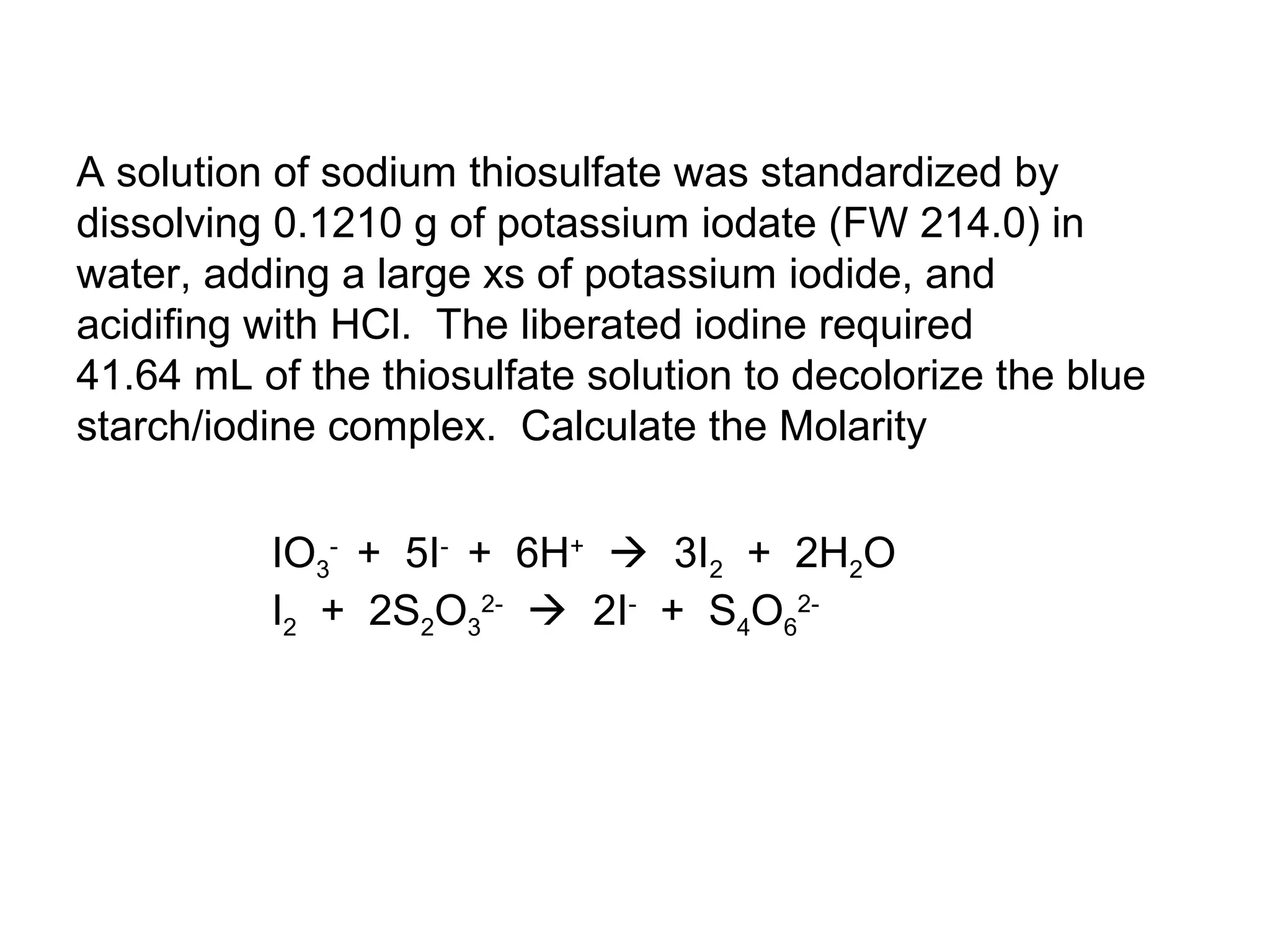
A solution of sodium thiosulfate was standardized by
dissolving 0.1210 g of potassium iodate (FW 214.0) in
water, adding a large xs of potassium iodide, and
acidifing with HCl. The liberated iodine required
41.64 mL of the thiosulfate solution to decolorize the blue
starch/iodine complex. Calculate the Molarity
IO3
-
+ 5I-
+ 6H+
 3I2 + 2H2O
I2 + 2S2O3
2-
 2I-
+ S4O6
2-

Oxidation reduction titrations

  • 1.
    Ch. 15: RedoxTitrations • Determination of Dissolved Oxygen in Waste Water (Winkler Method) • Determine what type of bacteria are present (aerobic or anaerobic) Applications: Redox Titration Curves (15-1): not covered
  • 2.
    Ch. 15: RedoxTitrations • Determine what type of bacteria are present (aerobic or anaerobic) A. Oxygen oxidizes Mn2+ to MnO2 B. MnO2 oxidizes I- to I2 C. Titrate I2 with Thiosulfate (starch as indicator) I2 + 2S2O3 2-  2I- + S4O6 2-
  • 3.
    Ch. 15: RedoxTitrations Determination of Water: Karl Fisher Method • Karl Fisher Reagent: • Iodine: pyridine: sulfur dioxide • 1:3:10 dissolved in anhydrous methanol
  • 4.
    Ch. 15: RedoxTitrations Determination of Water: Karl Fisher Method I2 + SO2 + 3C5H5N + H2O  2C5H4NH+ I- + C5H5N+ SO4CH3 - Karl Fisher Reagent Iodine reduced to I- Sulfur oxidized to sulfate ion • Standardize the KF reagent with known amt of water • Titrate known volume of unknown with KF reagent
  • 5.
    Ch. 15: RedoxTitrations • Sample Preparation(15-3) – Analyte may reside in more than one oxidation state – Convert to a single oxidation state Treat with reductant or oxidant – Auxiliary Reducing Agents (donates e-): pre-reduction • Zn, Al, Cu Auxiliary Oxidizing Agents (accepts e-): pre-oxidation •NaBiO3 •(NH4)2S2O8
  • 6.
    Ch. 15: RedoxTitrations • Prerequisites – Reagent must react quantitatively with analyte – Eliminate excess of reagent Different ways 1- column (15-6) 2- heat solution (ex. 2H2O2 = 2H2O + O2)
  • 7.
    Ch. 15: RedoxTitrations
  • 8.
    Ch. 15: RedoxTitrations Standard Oxidants – Potassium permanganate – Potassium bromate – Cerium (IV) – Potassium dichromate – Iodine
  • 9.
    Ch. 15 RedoxTitrations • Choice: – Strength of analyte as a reducing agent – Rate of rxn – Stability – Cost – Availability of indicator
  • 10.
    Ch. 15: RedoxTitrations • Potassium permanganate – MnO4 - + 8H+ + 5e-  Mn2+ + 4H2O (acidic) • Very strong; intense color
  • 11.
    Ch. 15: Applicationsof Redox Titrations • Potassium permanganate – MnO4 - + 8H+ + 5e-  Mn2+ + 4H2O Very strong Not pure enough to be a primary standard – Sodium oxalate used as a primary standard 2MnO4 - + 5H2C2O4 + 6H+  2Mn2+ + 10CO2 + 8 H2O Adv.: color Disadv: not stable
  • 13.
    Ch. 15: Applicationsof Redox Titrations • Potassium dichromate Cr2O7 -2 + 14H+ + 6e-  2Cr3+ + 7H2O Not as strong as permanganate Advantages Stable Primary std available Used to titrate Iron Cr2O7 -2 + 6Fe2+ + 14H+  2Cr3+ + 6Fe3+ + 7H2O
  • 14.
    Ch. 15: Applicationsof Redox Titrations • Standard Reducing agents – Not as popular as standard oxidants – Solution oxidize in air – Indirect methods are commonly used for the titration of oxidizing agents •Sodium Thiosulfate (S2O3 2- ) Moderately strong reducing agent Indirect procedure used w/ I2 (I3 - ) as intermediate
  • 15.
    Ch. 15: Applicationsof Redox Titrations Add excess KI to slightly acidic soln of analyte Reduction of analyte produces I2 Liberate I2 titrated with standard thiosulfate Starch  indicator ex. hypochlorite in bleach OCl- + 2I- + 2H+  Cl- + I2 + H2O I2 + 2S2O3 2-  2I- + S4O6 2- 1mmol OCl- = 1 mmol I2 = 2 mmol S2O3 -2 Procedure (Iodimetric Titrations)
  • 16.
    Ch. 15: Applicationsof Redox Titrations • Sodium Thiosulfate Standardized via KIO3 or K2Cr2O7 IO3 - + 5I- + 6H+  3I2 + 2H2O I2 + 2S2O3 2-  2I- + S4O6 2- 1mmol IO3 - = 3 mmol I2 = 6 mmol S2O3 -2 via Potassium dichromate Cr2O7 -2 + 6I- + 14H+  2Cr3+ + 3I2 + 7 H2O I2 + 2S2O3 2-  2I- + S4O6 2- 1mmol Cr2O7 2- = 3 mmol I2 = 6 mmol S2O3 -2
  • 17.
    A solution ofsodium thiosulfate was standardized by dissolving 0.1210 g of potassium iodate (FW 214.0) in water, adding a large xs of potassium iodide, and acidifing with HCl. The liberated iodine required 41.64 mL of the thiosulfate solution to decolorize the blue starch/iodine complex. Calculate the Molarity IO3 - + 5I- + 6H+  3I2 + 2H2O I2 + 2S2O3 2-  2I- + S4O6 2-