Ion selective electrodes and their
applications
By Amare Ayalew (Ph.D)
Under the Guidance of Professor Bhavana. A. Shah
Chemistry department
Veer Narmad South Gujarat University
Outline
Definition and classification of Ion selective
electrodes (ISE)
Properties of ion selective membranes
Potential of the cell
Chemical composition and working principle
of each ion selective electrode
Applications
Definition- Ion selective electrodes (ISE) are
indicator Electrodes
They are two types
Membrane indicator electrodes
Metallic indicator electrodes
Membrane indicator electrodes
 Responds Selectively to one ion
- Contains a thin membrane capable of selecting the
desired ion
 Does not involve a redox process
 It is a boundary potential that develops across a membrane
that separates the analyte solution from the reference
solution
Membrane electrode classified as
Glass membrane (i.e.H+
electrode)
Solid-state electrode (e.g. F-
electrode uses a Eu2+
-
doped LaF3 crystal
Liquid-based electrode (e.g. Ca2+
electrode uses a
liquid chelator)
Molecular/compound electrode (e.g. CO2 gas
sensing electrode)
Properties of ion selective membranes
 Minimal solubility-solubility in analyte solutions(usually
aqueous) approaches zero
 Electrical conductivity-the form of migration of singly charged
ions within the membrane
 Selective reactivity with the analyte-the capability of the
membrane selectively binding the analyte ion from the matrix
using:
ion-exchange
Crystalization
 complexation binding technique
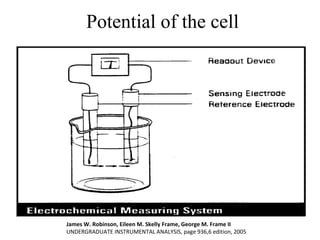
Potential of the cell
James W. Robinson, Eileen M. Skelly Frame, George M. Frame II
UNDERGRADUATE INSTRUMENTAL ANALYSIS, page 936,6 edition, 2005
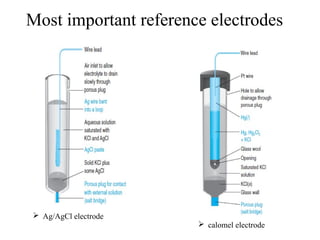
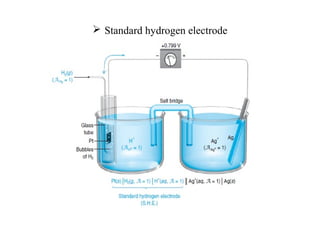
Most important reference electrodes
 calomel electrode
 Ag/AgCl electrode
 Standard hydrogen electrode
Chemical composition and working principle of
each ion selective electrode
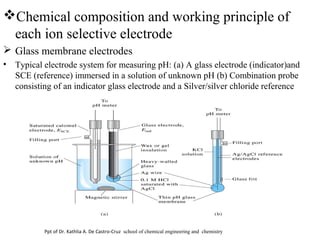
 Glass membrane electrodes
• Typical electrode system for measuring pH: (a) A glass electrode (indicator)and
SCE (reference) immersed in a solution of unknown pH (b) Combination probe
consisting of an indicator glass electrode and a Silver/silver chloride reference
Ppt of Dr. Kathlia A. De Castro-Cruz school of chemical engineering and chemistry
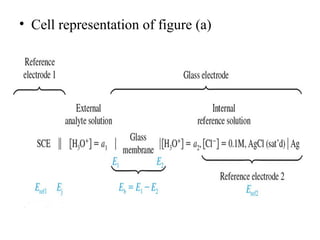
• Cell representation of figure (a)
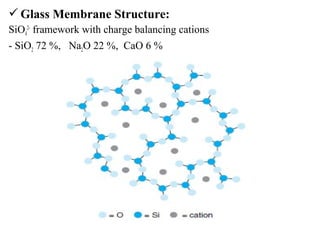
Glass Membrane Structure:
SiO4
2-
framework with charge balancing cations
- SiO2 72 %, Na2O 22 %, CaO 6 %
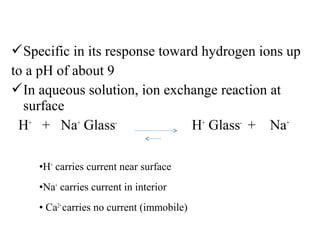
Specific in its response toward hydrogen ions up
to a pH of about 9
In aqueous solution, ion exchange reaction at
surface
H+
+ Na+
Glass-
H+
Glass-
+ Na+
•H+
carries current near surface
•Na+
carries current in interior
• Ca2+
carries no current (immobile)
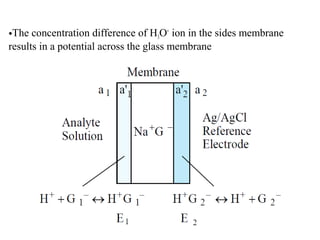
•The concentration difference of H3O+
ion in the sides membrane
results in a potential across the glass membrane
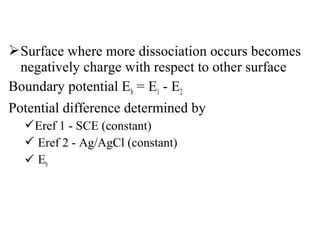
Surface where more dissociation occurs becomes
negatively charge with respect to other surface
Boundary potential Eb = E1 - E2
Potential difference determined by
Eref 1 - SCE (constant)
 Eref 2 - Ag/AgCl (constant)
 Eb
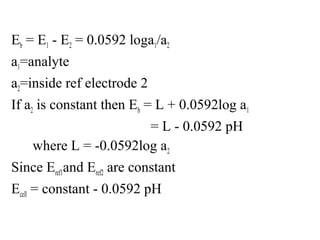
Eb = E1 - E2 = 0.0592 loga1/a2
a1=analyte
a2=inside ref electrode 2
If a2 is constant then Eb = L + 0.0592log a1
= L - 0.0592 pH
where L = -0.0592log a2
Since Eref1and Eref2 are constant
Ecell = constant - 0.0592 pH
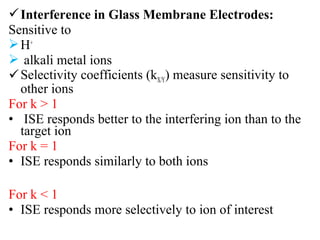
Interference in Glass Membrane Electrodes:
Sensitive to
H+
 alkali metal ions
Selectivity coefficients (kX/Y) measure sensitivity to
other ions
For k > 1
• ISE responds better to the interfering ion than to the
target ion
For k = 1
• ISE responds similarly to both ions
For k < 1
• ISE responds more selectively to ion of interest
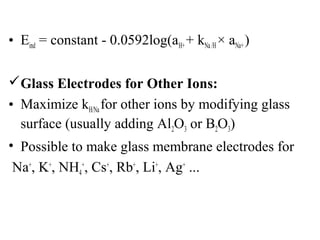
• Eind = constant - 0.0592log(aH++ kNa/H× aNa+)
Glass Electrodes for Other Ions:
• Maximize kH/Nafor other ions by modifying glass
surface (usually adding Al2O3 or B2O3)
• Possible to make glass membrane electrodes for
Na+
, K+
, NH4
+
, Cs+
, Rb+
, Li+
, Ag+
...
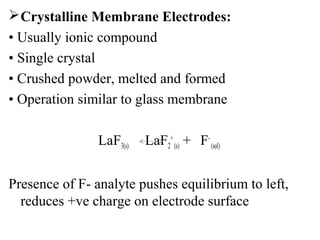
Crystalline Membrane Electrodes:
• Usually ionic compound
• Single crystal
• Crushed powder, melted and formed
• Operation similar to glass membrane
LaF3(s) LaF2
+
(s) + F-
(sol)
Presence of F- analyte pushes equilibrium to left,
reduces +ve charge on electrode surface
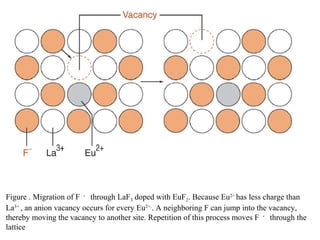
Figure . Migration of F -
through LaF3 doped with EuF2. Because Eu2+
has less charge than
La3+
, an anion vacancy occurs for every Eu2+.
. A neighboring F can jump into the vacancy,
thereby moving the vacancy to another site. Repetition of this process moves F -
through the
lattice
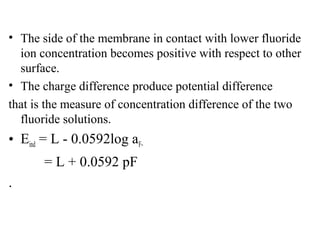
• The side of the membrane in contact with lower fluoride
ion concentration becomes positive with respect to other
surface.
• The charge difference produce potential difference
that is the measure of concentration difference of the two
fluoride solutions.
• Eind = L - 0.0592log aF-
= L + 0.0592 pF
.
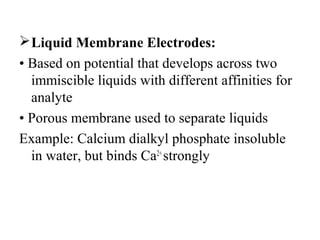
Liquid Membrane Electrodes:
• Based on potential that develops across two
immiscible liquids with different affinities for
analyte
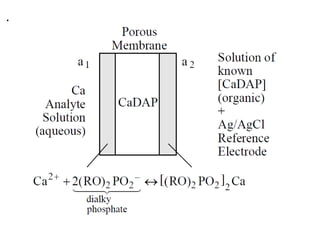
• Porous membrane used to separate liquids
Example: Calcium dialkyl phosphate insoluble
in water, but binds Ca2+
strongly
.
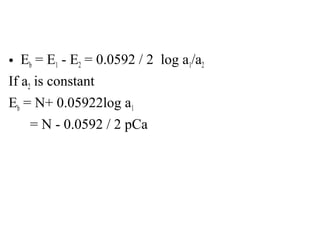
• Eb = E1 - E2 = 0.0592 / 2 log a1/a2
If a2 is constant
Eb = N+ 0.05922log a1
= N - 0.0592 / 2 pCa
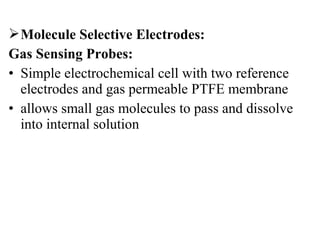
Molecule Selective Electrodes:
Gas Sensing Probes:
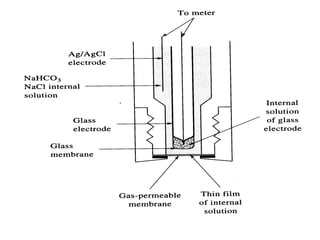
• Simple electrochemical cell with two reference
electrodes and gas permeable PTFE membrane
• allows small gas molecules to pass and dissolve
into internal solution
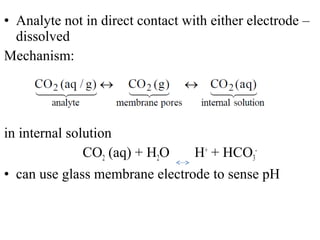
• Analyte not in direct contact with either electrode –
dissolved
Mechanism:
in internal solution
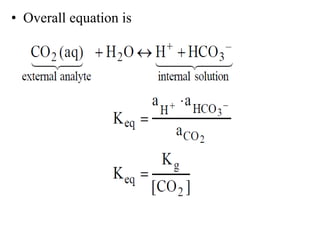
CO2 (aq) + H2O H+
+ HCO3
-
• can use glass membrane electrode to sense pH
• Overall equation is
• activity of neutral unaffected by other ions
aCO2=[CO2]
Applications
Potentiometric measurements are often used in routine
analyses because they are simple to achieve and the
detection limit of the electrodes are on the order of 10−5
–10−6
M. However, the observed detection limit is governed by
the presence of interfering ions or impurities. Some routine
applications of the method are:
 in agriculture, the analysis of nitrates in soil samples
 in foodstuffs, the analysis of ions such as NO−3,
F−,
Br−
,Ca2+
,
etc. in drinks, milk, meat, or fruit juices
 in industry, the analyses of chlorides in paper paste,
cyanides in electrolysis baths, chlorides and fluorides in
galvanic processes
 in clinical chemistry, the analysis of certain ions in serum
and other biological fluids.
References
1.Douglas A. Skoog, et al, Instrumental analysis,2007 by
Brooks/Cole,a part of Cengage Learning.
2.Francis Rouessac and Annick Rouessac,Chemical Analysis,
Modern Instrumentation Methods and Techniques, Second
Edition, 2007 by John Wiley & Sons Ltd,
3.Daniel C. Harris, Quantitative Chemical Analysis, Eighth
Edition, 2010 by W. H. Freeman and Company.
.

Dr. Amare ayalew abebe

  • 1.
    Ion selective electrodesand their applications By Amare Ayalew (Ph.D) Under the Guidance of Professor Bhavana. A. Shah Chemistry department Veer Narmad South Gujarat University
  • 2.
    Outline Definition and classificationof Ion selective electrodes (ISE) Properties of ion selective membranes Potential of the cell Chemical composition and working principle of each ion selective electrode Applications
  • 3.
    Definition- Ion selectiveelectrodes (ISE) are indicator Electrodes They are two types Membrane indicator electrodes Metallic indicator electrodes Membrane indicator electrodes  Responds Selectively to one ion - Contains a thin membrane capable of selecting the desired ion  Does not involve a redox process  It is a boundary potential that develops across a membrane that separates the analyte solution from the reference solution
  • 4.
    Membrane electrode classifiedas Glass membrane (i.e.H+ electrode) Solid-state electrode (e.g. F- electrode uses a Eu2+ - doped LaF3 crystal Liquid-based electrode (e.g. Ca2+ electrode uses a liquid chelator) Molecular/compound electrode (e.g. CO2 gas sensing electrode)
  • 5.
    Properties of ionselective membranes  Minimal solubility-solubility in analyte solutions(usually aqueous) approaches zero  Electrical conductivity-the form of migration of singly charged ions within the membrane  Selective reactivity with the analyte-the capability of the membrane selectively binding the analyte ion from the matrix using: ion-exchange Crystalization  complexation binding technique
  • 6.
    Potential of thecell James W. Robinson, Eileen M. Skelly Frame, George M. Frame II UNDERGRADUATE INSTRUMENTAL ANALYSIS, page 936,6 edition, 2005
  • 7.
    Most important referenceelectrodes  calomel electrode  Ag/AgCl electrode
  • 8.
  • 9.
    Chemical composition andworking principle of each ion selective electrode  Glass membrane electrodes • Typical electrode system for measuring pH: (a) A glass electrode (indicator)and SCE (reference) immersed in a solution of unknown pH (b) Combination probe consisting of an indicator glass electrode and a Silver/silver chloride reference Ppt of Dr. Kathlia A. De Castro-Cruz school of chemical engineering and chemistry
  • 10.
  • 11.
    Glass Membrane Structure: SiO4 2- frameworkwith charge balancing cations - SiO2 72 %, Na2O 22 %, CaO 6 %
  • 12.
    Specific in itsresponse toward hydrogen ions up to a pH of about 9 In aqueous solution, ion exchange reaction at surface H+ + Na+ Glass- H+ Glass- + Na+ •H+ carries current near surface •Na+ carries current in interior • Ca2+ carries no current (immobile)
  • 13.
    •The concentration differenceof H3O+ ion in the sides membrane results in a potential across the glass membrane
  • 14.
    Surface where moredissociation occurs becomes negatively charge with respect to other surface Boundary potential Eb = E1 - E2 Potential difference determined by Eref 1 - SCE (constant)  Eref 2 - Ag/AgCl (constant)  Eb
  • 15.
    Eb = E1- E2 = 0.0592 loga1/a2 a1=analyte a2=inside ref electrode 2 If a2 is constant then Eb = L + 0.0592log a1 = L - 0.0592 pH where L = -0.0592log a2 Since Eref1and Eref2 are constant Ecell = constant - 0.0592 pH
  • 16.
    Interference in GlassMembrane Electrodes: Sensitive to H+  alkali metal ions Selectivity coefficients (kX/Y) measure sensitivity to other ions For k > 1 • ISE responds better to the interfering ion than to the target ion For k = 1 • ISE responds similarly to both ions For k < 1 • ISE responds more selectively to ion of interest
  • 17.
    • Eind =constant - 0.0592log(aH++ kNa/H× aNa+) Glass Electrodes for Other Ions: • Maximize kH/Nafor other ions by modifying glass surface (usually adding Al2O3 or B2O3) • Possible to make glass membrane electrodes for Na+ , K+ , NH4 + , Cs+ , Rb+ , Li+ , Ag+ ...
  • 18.
    Crystalline Membrane Electrodes: •Usually ionic compound • Single crystal • Crushed powder, melted and formed • Operation similar to glass membrane LaF3(s) LaF2 + (s) + F- (sol) Presence of F- analyte pushes equilibrium to left, reduces +ve charge on electrode surface
  • 19.
    Figure . Migrationof F - through LaF3 doped with EuF2. Because Eu2+ has less charge than La3+ , an anion vacancy occurs for every Eu2+. . A neighboring F can jump into the vacancy, thereby moving the vacancy to another site. Repetition of this process moves F - through the lattice
  • 20.
    • The sideof the membrane in contact with lower fluoride ion concentration becomes positive with respect to other surface. • The charge difference produce potential difference that is the measure of concentration difference of the two fluoride solutions. • Eind = L - 0.0592log aF- = L + 0.0592 pF .
  • 21.
    Liquid Membrane Electrodes: •Based on potential that develops across two immiscible liquids with different affinities for analyte • Porous membrane used to separate liquids Example: Calcium dialkyl phosphate insoluble in water, but binds Ca2+ strongly
  • 22.
  • 23.
    • Eb =E1 - E2 = 0.0592 / 2 log a1/a2 If a2 is constant Eb = N+ 0.05922log a1 = N - 0.0592 / 2 pCa
  • 24.
    Molecule Selective Electrodes: GasSensing Probes: • Simple electrochemical cell with two reference electrodes and gas permeable PTFE membrane • allows small gas molecules to pass and dissolve into internal solution
  • 26.
    • Analyte notin direct contact with either electrode – dissolved Mechanism: in internal solution CO2 (aq) + H2O H+ + HCO3 - • can use glass membrane electrode to sense pH
  • 27.
  • 28.
    • activity ofneutral unaffected by other ions aCO2=[CO2]
  • 29.
    Applications Potentiometric measurements areoften used in routine analyses because they are simple to achieve and the detection limit of the electrodes are on the order of 10−5 –10−6 M. However, the observed detection limit is governed by the presence of interfering ions or impurities. Some routine applications of the method are:  in agriculture, the analysis of nitrates in soil samples  in foodstuffs, the analysis of ions such as NO−3, F−, Br− ,Ca2+ , etc. in drinks, milk, meat, or fruit juices  in industry, the analyses of chlorides in paper paste, cyanides in electrolysis baths, chlorides and fluorides in galvanic processes  in clinical chemistry, the analysis of certain ions in serum and other biological fluids.
  • 30.
    References 1.Douglas A. Skoog,et al, Instrumental analysis,2007 by Brooks/Cole,a part of Cengage Learning. 2.Francis Rouessac and Annick Rouessac,Chemical Analysis, Modern Instrumentation Methods and Techniques, Second Edition, 2007 by John Wiley & Sons Ltd, 3.Daniel C. Harris, Quantitative Chemical Analysis, Eighth Edition, 2010 by W. H. Freeman and Company.
  • 31.