Principles of Titration and errors

       By Dr. A. Amsavel
Introduction
Volumetric analysis
 Simple and easy
 Fast and can be done on site
 Less expensive
 Estimation of content or Assay
 Precise and accurate
     Depends on method and specificity
Requirements of a Titration Reaction

  Reaction must complete by 99.9 %
       so that < 0.1 % (or 1 ppt) remains unreacted
  Rxn must be rapid
      Titration needs to be performed in a
      reasonable time period
  The stoichiometry must be well defined, and
  known
  It can be predicted from equilibrium constants
  A method must be available to determine the
  equivalence point
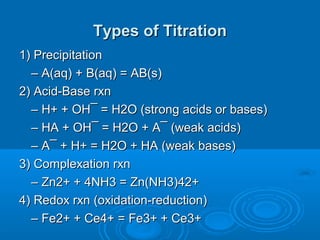
Types of Titration
1) Precipitation
  – A(aq) + B(aq) = AB(s)
2) Acid-Base rxn
  – H+ + OH¯ = H2O (strong acids or bases)
  – HA + OH¯ = H2O + A¯ (weak acids)
  – A¯ + H+ = H2O + HA (weak bases)
3) Complexation rxn
  – Zn2+ + 4NH3 = Zn(NH3)42+
4) Redox rxn (oxidation-reduction)
  – Fe2+ + Ce4+ = Fe3+ + Ce3+
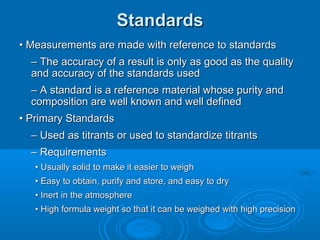
Standards
• Measurements are made with reference to standards
  – The accuracy of a result is only as good as the quality
  and accuracy of the standards used
  – A standard is a reference material whose purity and
  composition are well known and well defined
• Primary Standards
  – Used as titrants or used to standardize titrants
  – Requirements
   • Usually solid to make it easier to weigh
   • Easy to obtain, purify and store, and easy to dry
   • Inert in the atmosphere
   • High formula weight so that it can be weighed with high precision
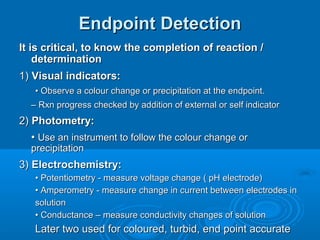
Endpoint Detection
It is critical, to know the completion of reaction /
    determination
1) Visual indicators:
   • Observe a colour change or precipitation at the endpoint.
  – Rxn progress checked by addition of external or self indicator
2) Photometry:
   • Use an instrument to follow the colour change or
  precipitation
3) Electrochemistry:
   • Potentiometry - measure voltage change ( pH electrode)
   • Amperometry - measure change in current between electrodes in
   solution
   • Conductance – measure conductivity changes of solution
   Later two used for coloured, turbid, end point accurate
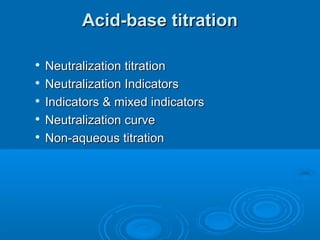
Acid-base titration

   Neutralization titration

    Neutralization Indicators
   Indicators & mixed indicators
   Neutralization curve
   Non-aqueous titration
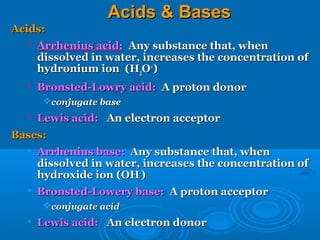
Acids & Bases
Acids:
     Arrhenius acid: Any substance that, when
      dissolved in water, increases the concentration of
      hydronium ion (H3O+)
  
      Bronsted-Lowry acid: A proton donor
       conjugate base
  
      Lewis acid: An electron acceptor
Bases:
  
      Arrhenius base: Any substance that, when
      dissolved in water, increases the concentration of
      hydroxide ion (OH-)
  
      Bronsted-Lowery base: A proton acceptor
       conjugate acid
  
      Lewis acid: An electron donor
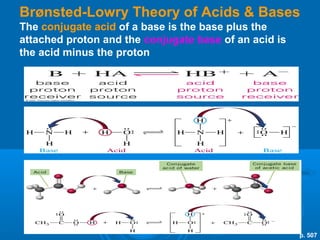
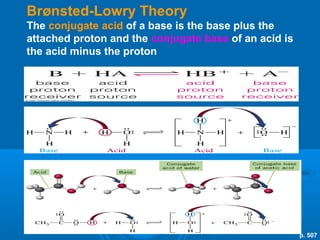
Brønsted-Lowry Theory of Acids & Bases
The conjugate acid of a base is the base plus the
attached proton and the conjugate base of an acid is
the acid minus the proton


                                                       p. 507
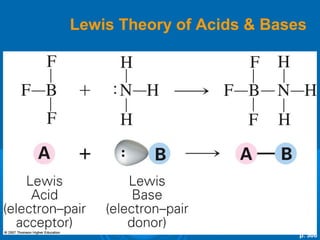
Lewis Theory of Acids & Bases


                            p. 506
pH calculation
Q1: Calculate the pH of a solution if [H+] = 2.7 x 10⁻⁴ M
  pH = -log[H+]      pH = -log(2.7 x 10⁻⁴) = 3.57


Q2: Find the hydrogen ion concentration of a solution if its
  pH is 11.62.
  [H+] = 10-pH       [H+] = 10-11.62 = 2.4 x 10⁻¹²M


Q3: Find the pOH and the pH of a solution if its hydroxide
  ion concentration is 7.9 x 10⁻⁵M
  pOH = -log[OH-]     pOH = -log(7.9 x 10⁻⁵) = 4.10
  pH + pOH = 14       pH = 14 - 4.10      pH = 9.9
A solution with a pH of 1 has [H+] of 0.1 mol/L or 10-1
A solution with a pH of 3 has [H+] of 0.001 mol/L or 10-3
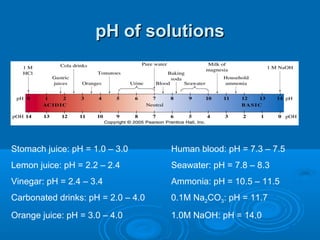
pH of solutions


Stomach juice: pH = 1.0 – 3.0       Human blood: pH = 7.3 – 7.5
Lemon juice: pH = 2.2 – 2.4         Seawater: pH = 7.8 – 8.3
Vinegar: pH = 2.4 – 3.4             Ammonia: pH = 10.5 – 11.5
Carbonated drinks: pH = 2.0 – 4.0   0.1M Na2CO3: pH = 11.7
Orange juice: pH = 3.0 – 4.0        1.0M NaOH: pH = 14.0
ENDPOINT = POINT OF NEUTRALIZATION =
          EQUIVALENCE POINT

  MOLES OF ACID = MOLES OF BASE
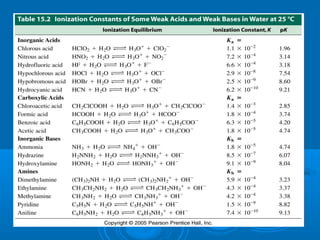
Ka and Kb
The equilibrium constant for a Brønsted acid is
represented by Ka, and base is represented by Kb.

CH3COOH(aq) + H2O(l)            H3O+(aq) + CH3COO–(aq)
                                   [H3O+][CH3COO–]
 Notice that H2O is not      Ka = –––––––––––––––––
  included in either                  [CH3COOH]
equilibrium expression.

      NH3(aq) + H2O(l)        NH4+(aq) + OH–(aq)
                                    [NH4+][OH–]
                              Kb = –––––––––––––
 pH of 1M AcoH =2.4                   [NH3]
NaOH
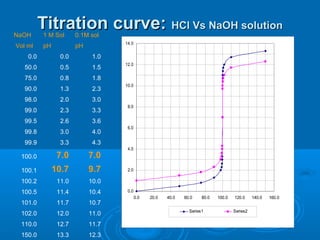
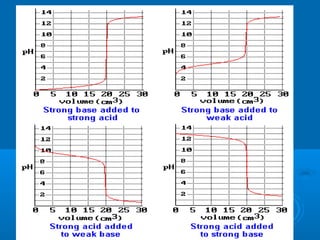
          Titration curve: HCl Vs NaOH solution
          1 M Sol      0.1M sol
                                   14.0
Vol ml    pH           pH
    0.0          0.0         1.0
                                   12.0
   50.0          0.5         1.5
   75.0          0.8         1.8
                                   10.0
   90.0          1.3         2.3
   98.0          2.0         3.0
                                    8.0
   99.0          2.3         3.3
   99.5          2.6         3.6
                                    6.0
   99.8          3.0         4.0
   99.9          3.3         4.3
                                    4.0
 100.0          7.0         7.0
 100.1         10.7         9.7     2.0

 100.2          11.0        10.0
 100.5          11.4        10.4    0.0
                                          0.0   20.0   40.0   60.0    80.0   100.0   120.0     140.0   160.0
 101.0          11.7        10.7
                                                                Series1              Series2
 102.0          12.0        11.0
 110.0          12.7        11.7
 150.0          13.3        12.3
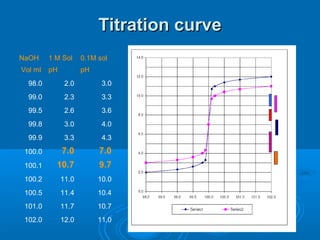
Titration curve
NaOH     1 M Sol     0.1M sol
Vol ml   pH          pH
  98.0         2.0         3.0
  99.0         2.3         3.3
  99.5         2.6         3.6
  99.8         3.0         4.0
  99.9         3.3         4.3
 100.0        7.0         7.0
 100.1     10.7           9.7
 100.2        11.0        10.0
 100.5        11.4        10.4
 101.0        11.7        10.7
 102.0        12.0        11.0
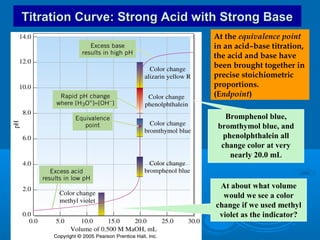
Titration Curve: Strong Acid with Strong Base
                               At the equivalence point
                               in an acid–base titration,
                               the acid and base have
                               been brought together in
                               precise stoichiometric
                               proportions.
                               (Endpoint)

                                  Bromphenol blue,
                                bromthymol blue, and
                                 phenolphthalein all
                                 change color at very
                                   nearly 20.0 mL


                                 At about what volume
                                  would we see a color
                                change if we used methyl
                                 violet as the indicator?
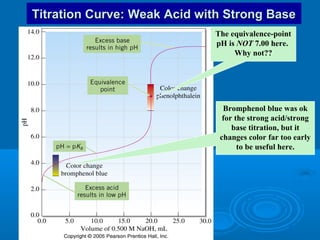
Titration Curve: Weak Acid with Strong Base
                             The equivalence-point
                             pH is NOT 7.00 here.
                                  Why not??


                               Bromphenol blue was ok
                               for the strong acid/strong
                                  base titration, but it
                              changes color far too early
                                    to be useful here.
Acid–Base Indicators
   An acid–base indicator is a weak acid or
    base.
   The acid form (HA) of the indicator has one
    color, the conjugate base (A–) has a different
    color. One of the “colors” may be colorless.
   In an acidic solution, [H3O+] is high. Because
    H3O+ is a common ion, it suppresses the
    ionization of the indicator acid, and we see
    the color of HA.
   In a basic solution, [OH–] is high, and it reacts
    with HA, forming the color of A–.
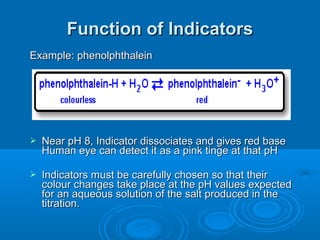
Function of Indicators
Example: phenolphthalein


   Near pH 8, Indicator dissociates and gives red base
    Human eye can detect it as a pink tinge at that pH

   Indicators must be carefully chosen so that their
    colour changes take place at the pH values expected
    for an aqueous solution of the salt produced in the
    titration.
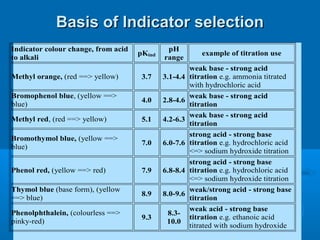
Basis of Indicator selection
Indicator colour change, from acid            pH
                                     pKind               example of titration use
to alkali                                    range
                                                     weak base - strong acid
Methyl orange, (red ==> yellow)       3.7    3.1-4.4 titration e.g. ammonia titrated
                                                     with hydrochloric acid
Bromophenol blue, (yellow ==>                        weak base - strong acid
                                      4.0    2.8-4.6
blue)                                                titration
                                                     weak base - strong acid
Methyl red, (red ==> yellow)          5.1    4.2-6.3
                                                     titration
                                                     strong acid - strong base
Bromothymol blue, (yellow ==>
                                      7.0    6.0-7.6 titration e.g. hydrochloric acid
blue)
                                                     <=> sodium hydroxide titration
                                                     strong acid - strong base
Phenol red, (yellow ==> red)          7.9    6.8-8.4 titration e.g. hydrochloric acid
                                                     <=> sodium hydroxide titration
Thymol blue (base form), (yellow                     weak/strong acid - strong base
                                      8.9    8.0-9.6
==> blue)                                            titration
                                                     weak acid - strong base
Phenolphthalein, (colourless ==>               8.3-
                                      9.3            titration e.g. ethanoic acid
pinky-red)                                    10.0
                                                     titrated with sodium hydroxide
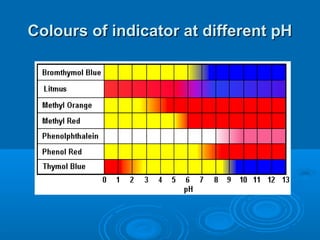
Colours of indicator at different pH
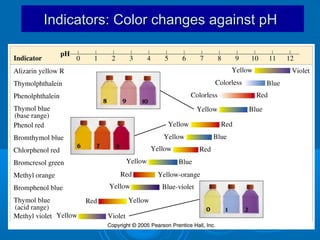
Indicators: Color changes against pH
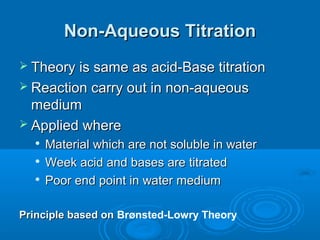
Non-Aqueous Titration
 Theory is same as acid-Base titration
 Reaction carry out in non-aqueous
  medium
 Applied where
  
      Material which are not soluble in water
     Week acid and bases are titrated
     Poor end point in water medium

Principle based on Brønsted-Lowry Theory
Brønsted-Lowry Theory
The conjugate acid of a base is the base plus the
attached proton and the conjugate base of an acid is
the acid minus the proton


                                                       p. 507
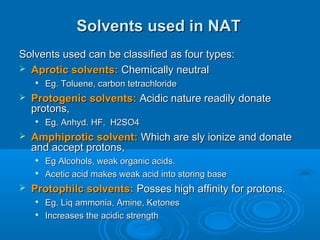
Solvents used in NAT
Solvents used can be classified as four types:
 Aprotic solvents: Chemically neutral
    
        Eg. Toluene, carbon tetrachloride
   Protogenic solvents: Acidic nature readily donate
    protons,
       Eg. Anhyd. HF, H2SO4
   Amphiprotic solvent: Which are sly ionize and donate
    and accept protons,
       Eg Alcohols, weak organic acids.
    
        Acetic acid makes weak acid into storing base
   Protophilc solvents: Posses high affinity for protons.
    
        Eg. Liq ammonia, Amine, Ketones
    
        Increases the acidic strength
Selection of Solvents for NAT
Acetic acid used for titration of weak bases,
  Nitrogen containing compounds
Acetonitrile / with ACOH: Metal ethanoates
Alcohols (IPA, nBA) : Soaps and salts of
  organic acids,
DMF: Benzoic acid, amides etc
Titrants for NAT
 Perchloric acid in acetic acid
     Amines, amine salts, amino acids, salts of
      acids


 Potassium     Methoxide in Toluene-
  Methanol
 Quan ammonium hydroxide in Acetonitrile-
  pyridine
     Acids, enols, imides & sulphonamides
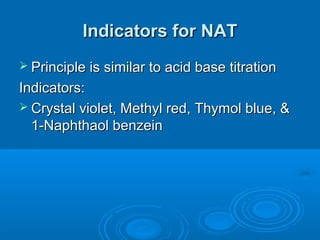
Indicators for NAT
 Principle is similar to acid base titration

Indicators:
 Crystal violet, Methyl red, Thymol blue, &
  1-Naphthaol benzein
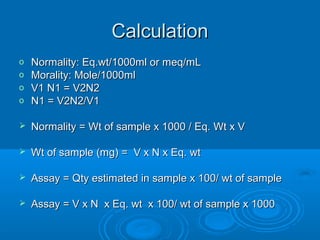
Calculation
o   Normality: Eq.wt/1000ml or meq/mL
o   Morality: Mole/1000ml
o   V1 N1 = V2N2
o   N1 = V2N2/V1

   Normality = Wt of sample x 1000 / Eq. Wt x V

   Wt of sample (mg) = V x N x Eq. wt

   Assay = Qty estimated in sample x 100/ wt of sample

   Assay = V x N x Eq. wt x 100/ wt of sample x 1000
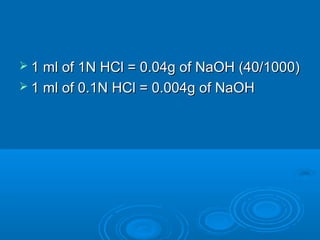
 1 ml of 1N HCl = 0.04g of NaOH (40/1000)
 1 ml of 0.1N HCl = 0.004g of NaOH
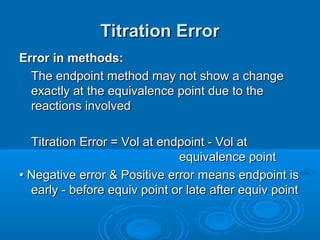
Titration Error
Error in methods:
  The endpoint method may not show a change
  exactly at the equivalence point due to the
  reactions involved

  Titration Error = Vol at endpoint - Vol at
                              equivalence point
• Negative error & Positive error means endpoint is
  early - before equiv point or late after equiv point
Errors in Volume and weight:
 10 ml titre volume = 100 %
     If difference is 0.1ml error is 1%; 0.2ml = 2%
 5ml titre volume = 100 %
  
      0.1ml = 2% error
 Optimum    level is about 25ml
 25 ml titre volume = 100 %
  
      0.1ml = 0.4% error
Volumetric apparatus
USP:
 Burette selection:
       NLT 30% nominal volume (15ml in 50ml burette)
       Micro burette for < 10ml
   Limit of error:
     Volumetric flask: 25ml, 50ml, 100ml is 0.03, 0.05&
      0.08ml
     Pipets:5, 10, 25 ml is 0.01, 0.02 &0.03ml

     Burets:10, 25, 50ml is 0.02, 0.1&0.1ml


    Tips: out flow NMT 500uL per second
Operational & personal error
List several of the variables involved in correctly using a
   10mL volumetric pipette.
 drain time;
 possible beads on the inner surface
 temperature;
 bringing meniscus to the proper level;
 angle of drain;
 touching off last drop;
 rinsing of the pipet with the solution used;
 Pipet calibration; etc.
Error in weighing can occur.

• Misreading of the balance,
• Balance not level,
• Not cleaning the surface of the balance first,
• Touching the weighed object with moist hands,
• Leaving the balance doors open during weighing,
• Using a miscalibrated balance,
• Not cooling the sample down to near room temperature,
• Not removing a static charge from the sample,
• Excess vibration or air currents from people or nearby
   equipment, and
• Prolonged time sample left on pan adds/loses moisture.
Possible contamination

An analyst could
   contaminate a sample during weighing by placing a
    contaminated spatula
   placing the sample on or into a contaminated holder
    during weighing,
   dropping some lint/hair/skin or sneeze into the sample
    while weighing,
   opening up a bottle of chemicals near the sample being
    weighed.
   When performing trace analysis, it is possible for just a
    microgram even massive fingerprint!
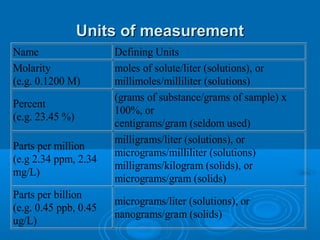
Units of measurement
Name                   Defining Units
Molarity               moles of solute/liter (solutions), or
(e.g. 0.1200 M)        millimoles/milliliter (solutions)
                       (grams of substance/grams of sample) x
Percent
                       100%, or
(e.g. 23.45 %)
                       centigrams/gram (seldom used)
                       milligrams/liter (solutions), or
Parts per million
                       micrograms/milliliter (solutions)
(e.g 2.34 ppm, 2.34
                       milligrams/kilogram (solids), or
mg/L)
                       micrograms/gram (solids)
Parts per billion
                       micrograms/liter (solutions), or
(e.g. 0.45 ppb, 0.45
                       nanograms/gram (solids)
ug/L)
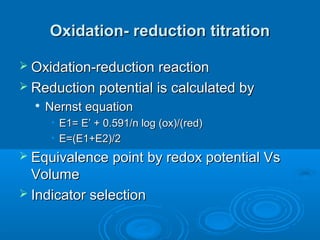
Oxidation- reduction titration

 Oxidation-reduction reaction
 Reduction potential is calculated by
     Nernst equation
       • E1= E’ + 0.591/n log (ox)/(red)
       • E=(E1+E2)/2
 Equivalence point by redox potential Vs
  Volume
 Indicator selection
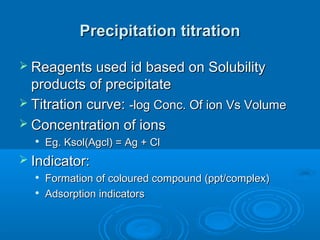
Precipitation titration

 Reagents used id based on Solubility
  products of precipitate
 Titration curve: -log Conc. Of ion Vs Volume
 Concentration of ions
  
      Eg. Ksol(Agcl) = Ag + Cl
 Indicator:
     Formation of coloured compound (ppt/complex)
     Adsorption indicators
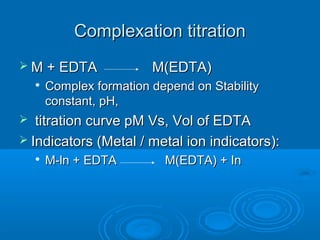
Complexation titration
 M + EDTA                M(EDTA)
       Complex formation depend on Stability
        constant, pH,
  titration curve pM Vs, Vol of EDTA
 Indicators (Metal / metal ion indicators):
       M-ln + EDTA         M(EDTA) + In
Types of Complexation titration
 Back titration
 Masking
 Selective de-masking
 Separation by ppt   and solvent extraction

 Application, almost metals,
An Equation for Buffer
                Solutions
   In certain applications, there is a need to repeat the
    calculations of the pH of buffer solutions many times.
    This can be done with a single, simple equation, but
    there are some limitations.
   The Henderson–Hasselbalch equation:
                                  [conjugate base]
                pH = pKa + log ––––––––––––––
                                    [weak acid]

• To use this equation, the ratio [conjugate base]/[weak acid]
  must have a value between 0.10–10 and both concentrations
  must exceed Ka by a factor of 100 or more.
The Common Ion Effect
   Consider a solution of acetic acid.
   If we add acetate ion as a second solute (i.e., sodium
    acetate), the pH of the solution increases:


     LeChâtelier’s principle: What
      happens to [H3O+] when the
     equilibrium shifts to the left?

Titration ppt

  • 1.
    Principles of Titrationand errors By Dr. A. Amsavel
  • 2.
    Introduction Volumetric analysis  Simpleand easy  Fast and can be done on site  Less expensive  Estimation of content or Assay  Precise and accurate  Depends on method and specificity
  • 3.
    Requirements of aTitration Reaction Reaction must complete by 99.9 % so that < 0.1 % (or 1 ppt) remains unreacted Rxn must be rapid Titration needs to be performed in a reasonable time period The stoichiometry must be well defined, and known It can be predicted from equilibrium constants A method must be available to determine the equivalence point
  • 4.
    Types of Titration 1)Precipitation – A(aq) + B(aq) = AB(s) 2) Acid-Base rxn – H+ + OH¯ = H2O (strong acids or bases) – HA + OH¯ = H2O + A¯ (weak acids) – A¯ + H+ = H2O + HA (weak bases) 3) Complexation rxn – Zn2+ + 4NH3 = Zn(NH3)42+ 4) Redox rxn (oxidation-reduction) – Fe2+ + Ce4+ = Fe3+ + Ce3+
  • 5.
    Standards • Measurements aremade with reference to standards – The accuracy of a result is only as good as the quality and accuracy of the standards used – A standard is a reference material whose purity and composition are well known and well defined • Primary Standards – Used as titrants or used to standardize titrants – Requirements • Usually solid to make it easier to weigh • Easy to obtain, purify and store, and easy to dry • Inert in the atmosphere • High formula weight so that it can be weighed with high precision
  • 6.
    Endpoint Detection It iscritical, to know the completion of reaction / determination 1) Visual indicators: • Observe a colour change or precipitation at the endpoint. – Rxn progress checked by addition of external or self indicator 2) Photometry: • Use an instrument to follow the colour change or precipitation 3) Electrochemistry: • Potentiometry - measure voltage change ( pH electrode) • Amperometry - measure change in current between electrodes in solution • Conductance – measure conductivity changes of solution Later two used for coloured, turbid, end point accurate
  • 7.
    Acid-base titration  Neutralization titration  Neutralization Indicators  Indicators & mixed indicators  Neutralization curve  Non-aqueous titration
  • 8.
    Acids & Bases Acids:  Arrhenius acid: Any substance that, when dissolved in water, increases the concentration of hydronium ion (H3O+)  Bronsted-Lowry acid: A proton donor conjugate base  Lewis acid: An electron acceptor Bases:  Arrhenius base: Any substance that, when dissolved in water, increases the concentration of hydroxide ion (OH-)  Bronsted-Lowery base: A proton acceptor conjugate acid  Lewis acid: An electron donor
  • 9.
    Brønsted-Lowry Theory ofAcids & Bases The conjugate acid of a base is the base plus the attached proton and the conjugate base of an acid is the acid minus the proton p. 507
  • 10.
    Lewis Theory ofAcids & Bases p. 506
  • 11.
    pH calculation Q1: Calculatethe pH of a solution if [H+] = 2.7 x 10⁻⁴ M pH = -log[H+] pH = -log(2.7 x 10⁻⁴) = 3.57 Q2: Find the hydrogen ion concentration of a solution if its pH is 11.62. [H+] = 10-pH [H+] = 10-11.62 = 2.4 x 10⁻¹²M Q3: Find the pOH and the pH of a solution if its hydroxide ion concentration is 7.9 x 10⁻⁵M pOH = -log[OH-] pOH = -log(7.9 x 10⁻⁵) = 4.10 pH + pOH = 14 pH = 14 - 4.10 pH = 9.9
  • 12.
    A solution witha pH of 1 has [H+] of 0.1 mol/L or 10-1 A solution with a pH of 3 has [H+] of 0.001 mol/L or 10-3
  • 13.
    pH of solutions Stomachjuice: pH = 1.0 – 3.0 Human blood: pH = 7.3 – 7.5 Lemon juice: pH = 2.2 – 2.4 Seawater: pH = 7.8 – 8.3 Vinegar: pH = 2.4 – 3.4 Ammonia: pH = 10.5 – 11.5 Carbonated drinks: pH = 2.0 – 4.0 0.1M Na2CO3: pH = 11.7 Orange juice: pH = 3.0 – 4.0 1.0M NaOH: pH = 14.0
  • 14.
    ENDPOINT = POINTOF NEUTRALIZATION = EQUIVALENCE POINT MOLES OF ACID = MOLES OF BASE
  • 15.
    Ka and Kb Theequilibrium constant for a Brønsted acid is represented by Ka, and base is represented by Kb. CH3COOH(aq) + H2O(l) H3O+(aq) + CH3COO–(aq) [H3O+][CH3COO–] Notice that H2O is not Ka = ––––––––––––––––– included in either [CH3COOH] equilibrium expression. NH3(aq) + H2O(l) NH4+(aq) + OH–(aq) [NH4+][OH–] Kb = ––––––––––––– pH of 1M AcoH =2.4 [NH3]
  • 17.
    NaOH Titration curve: HCl Vs NaOH solution 1 M Sol 0.1M sol 14.0 Vol ml pH pH 0.0 0.0 1.0 12.0 50.0 0.5 1.5 75.0 0.8 1.8 10.0 90.0 1.3 2.3 98.0 2.0 3.0 8.0 99.0 2.3 3.3 99.5 2.6 3.6 6.0 99.8 3.0 4.0 99.9 3.3 4.3 4.0 100.0 7.0 7.0 100.1 10.7 9.7 2.0 100.2 11.0 10.0 100.5 11.4 10.4 0.0 0.0 20.0 40.0 60.0 80.0 100.0 120.0 140.0 160.0 101.0 11.7 10.7 Series1 Series2 102.0 12.0 11.0 110.0 12.7 11.7 150.0 13.3 12.3
  • 18.
    Titration curve NaOH 1 M Sol 0.1M sol Vol ml pH pH 98.0 2.0 3.0 99.0 2.3 3.3 99.5 2.6 3.6 99.8 3.0 4.0 99.9 3.3 4.3 100.0 7.0 7.0 100.1 10.7 9.7 100.2 11.0 10.0 100.5 11.4 10.4 101.0 11.7 10.7 102.0 12.0 11.0
  • 19.
    Titration Curve: StrongAcid with Strong Base At the equivalence point in an acid–base titration, the acid and base have been brought together in precise stoichiometric proportions. (Endpoint) Bromphenol blue, bromthymol blue, and phenolphthalein all change color at very nearly 20.0 mL At about what volume would we see a color change if we used methyl violet as the indicator?
  • 20.
    Titration Curve: WeakAcid with Strong Base The equivalence-point pH is NOT 7.00 here. Why not?? Bromphenol blue was ok for the strong acid/strong base titration, but it changes color far too early to be useful here.
  • 22.
    Acid–Base Indicators  An acid–base indicator is a weak acid or base.  The acid form (HA) of the indicator has one color, the conjugate base (A–) has a different color. One of the “colors” may be colorless.  In an acidic solution, [H3O+] is high. Because H3O+ is a common ion, it suppresses the ionization of the indicator acid, and we see the color of HA.  In a basic solution, [OH–] is high, and it reacts with HA, forming the color of A–.
  • 23.
    Function of Indicators Example:phenolphthalein  Near pH 8, Indicator dissociates and gives red base Human eye can detect it as a pink tinge at that pH  Indicators must be carefully chosen so that their colour changes take place at the pH values expected for an aqueous solution of the salt produced in the titration.
  • 24.
    Basis of Indicatorselection Indicator colour change, from acid pH pKind example of titration use to alkali range weak base - strong acid Methyl orange, (red ==> yellow) 3.7 3.1-4.4 titration e.g. ammonia titrated with hydrochloric acid Bromophenol blue, (yellow ==> weak base - strong acid 4.0 2.8-4.6 blue) titration weak base - strong acid Methyl red, (red ==> yellow) 5.1 4.2-6.3 titration strong acid - strong base Bromothymol blue, (yellow ==> 7.0 6.0-7.6 titration e.g. hydrochloric acid blue) <=> sodium hydroxide titration strong acid - strong base Phenol red, (yellow ==> red) 7.9 6.8-8.4 titration e.g. hydrochloric acid <=> sodium hydroxide titration Thymol blue (base form), (yellow weak/strong acid - strong base 8.9 8.0-9.6 ==> blue) titration weak acid - strong base Phenolphthalein, (colourless ==> 8.3- 9.3 titration e.g. ethanoic acid pinky-red) 10.0 titrated with sodium hydroxide
  • 25.
    Colours of indicatorat different pH
  • 26.
  • 27.
    Non-Aqueous Titration  Theoryis same as acid-Base titration  Reaction carry out in non-aqueous medium  Applied where  Material which are not soluble in water  Week acid and bases are titrated  Poor end point in water medium Principle based on Brønsted-Lowry Theory
  • 28.
    Brønsted-Lowry Theory The conjugateacid of a base is the base plus the attached proton and the conjugate base of an acid is the acid minus the proton p. 507
  • 29.
    Solvents used inNAT Solvents used can be classified as four types:  Aprotic solvents: Chemically neutral  Eg. Toluene, carbon tetrachloride  Protogenic solvents: Acidic nature readily donate protons,  Eg. Anhyd. HF, H2SO4  Amphiprotic solvent: Which are sly ionize and donate and accept protons,  Eg Alcohols, weak organic acids.  Acetic acid makes weak acid into storing base  Protophilc solvents: Posses high affinity for protons.  Eg. Liq ammonia, Amine, Ketones  Increases the acidic strength
  • 30.
    Selection of Solventsfor NAT Acetic acid used for titration of weak bases, Nitrogen containing compounds Acetonitrile / with ACOH: Metal ethanoates Alcohols (IPA, nBA) : Soaps and salts of organic acids, DMF: Benzoic acid, amides etc
  • 31.
    Titrants for NAT Perchloric acid in acetic acid  Amines, amine salts, amino acids, salts of acids  Potassium Methoxide in Toluene- Methanol  Quan ammonium hydroxide in Acetonitrile- pyridine  Acids, enols, imides & sulphonamides
  • 32.
    Indicators for NAT Principle is similar to acid base titration Indicators:  Crystal violet, Methyl red, Thymol blue, & 1-Naphthaol benzein
  • 33.
    Calculation o Normality: Eq.wt/1000ml or meq/mL o Morality: Mole/1000ml o V1 N1 = V2N2 o N1 = V2N2/V1  Normality = Wt of sample x 1000 / Eq. Wt x V  Wt of sample (mg) = V x N x Eq. wt  Assay = Qty estimated in sample x 100/ wt of sample  Assay = V x N x Eq. wt x 100/ wt of sample x 1000
  • 34.
     1 mlof 1N HCl = 0.04g of NaOH (40/1000)  1 ml of 0.1N HCl = 0.004g of NaOH
  • 35.
    Titration Error Error inmethods: The endpoint method may not show a change exactly at the equivalence point due to the reactions involved Titration Error = Vol at endpoint - Vol at equivalence point • Negative error & Positive error means endpoint is early - before equiv point or late after equiv point
  • 36.
    Errors in Volumeand weight:  10 ml titre volume = 100 %  If difference is 0.1ml error is 1%; 0.2ml = 2%  5ml titre volume = 100 %  0.1ml = 2% error  Optimum level is about 25ml  25 ml titre volume = 100 %  0.1ml = 0.4% error
  • 37.
    Volumetric apparatus USP:  Buretteselection:  NLT 30% nominal volume (15ml in 50ml burette)  Micro burette for < 10ml  Limit of error:  Volumetric flask: 25ml, 50ml, 100ml is 0.03, 0.05& 0.08ml  Pipets:5, 10, 25 ml is 0.01, 0.02 &0.03ml  Burets:10, 25, 50ml is 0.02, 0.1&0.1ml Tips: out flow NMT 500uL per second
  • 38.
    Operational & personalerror List several of the variables involved in correctly using a 10mL volumetric pipette.  drain time;  possible beads on the inner surface  temperature;  bringing meniscus to the proper level;  angle of drain;  touching off last drop;  rinsing of the pipet with the solution used;  Pipet calibration; etc.
  • 39.
    Error in weighingcan occur. • Misreading of the balance, • Balance not level, • Not cleaning the surface of the balance first, • Touching the weighed object with moist hands, • Leaving the balance doors open during weighing, • Using a miscalibrated balance, • Not cooling the sample down to near room temperature, • Not removing a static charge from the sample, • Excess vibration or air currents from people or nearby equipment, and • Prolonged time sample left on pan adds/loses moisture.
  • 40.
    Possible contamination An analystcould  contaminate a sample during weighing by placing a contaminated spatula  placing the sample on or into a contaminated holder during weighing,  dropping some lint/hair/skin or sneeze into the sample while weighing,  opening up a bottle of chemicals near the sample being weighed.  When performing trace analysis, it is possible for just a microgram even massive fingerprint!
  • 41.
    Units of measurement Name Defining Units Molarity moles of solute/liter (solutions), or (e.g. 0.1200 M) millimoles/milliliter (solutions) (grams of substance/grams of sample) x Percent 100%, or (e.g. 23.45 %) centigrams/gram (seldom used) milligrams/liter (solutions), or Parts per million micrograms/milliliter (solutions) (e.g 2.34 ppm, 2.34 milligrams/kilogram (solids), or mg/L) micrograms/gram (solids) Parts per billion micrograms/liter (solutions), or (e.g. 0.45 ppb, 0.45 nanograms/gram (solids) ug/L)
  • 42.
    Oxidation- reduction titration Oxidation-reduction reaction  Reduction potential is calculated by  Nernst equation • E1= E’ + 0.591/n log (ox)/(red) • E=(E1+E2)/2  Equivalence point by redox potential Vs Volume  Indicator selection
  • 43.
    Precipitation titration  Reagentsused id based on Solubility products of precipitate  Titration curve: -log Conc. Of ion Vs Volume  Concentration of ions  Eg. Ksol(Agcl) = Ag + Cl  Indicator:  Formation of coloured compound (ppt/complex)  Adsorption indicators
  • 44.
    Complexation titration  M+ EDTA M(EDTA)  Complex formation depend on Stability constant, pH,  titration curve pM Vs, Vol of EDTA  Indicators (Metal / metal ion indicators):  M-ln + EDTA M(EDTA) + In
  • 45.
    Types of Complexationtitration  Back titration  Masking  Selective de-masking  Separation by ppt and solvent extraction  Application, almost metals,
  • 46.
    An Equation forBuffer Solutions  In certain applications, there is a need to repeat the calculations of the pH of buffer solutions many times. This can be done with a single, simple equation, but there are some limitations.  The Henderson–Hasselbalch equation: [conjugate base] pH = pKa + log –––––––––––––– [weak acid] • To use this equation, the ratio [conjugate base]/[weak acid] must have a value between 0.10–10 and both concentrations must exceed Ka by a factor of 100 or more.
  • 47.
    The Common IonEffect  Consider a solution of acetic acid.  If we add acetate ion as a second solute (i.e., sodium acetate), the pH of the solution increases: LeChâtelier’s principle: What happens to [H3O+] when the equilibrium shifts to the left?