Voltammetry
伏安分析法
Basic principle of voltammetry
Voltammetry:
A group of electrochemical methods based on
measuring current (i)- applied potential curve during
electrolysis
- only a small amount of sample (analyte) is used
Polarography:
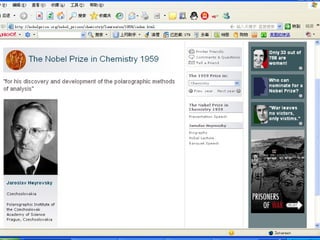
Invented by J. Heyrovsky (Nobel Prize 1959). Differs
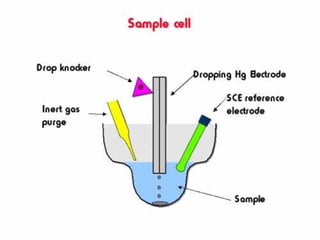
from voltammetry in that it employs a dropping mercury
electrode (DME) as Working electrode to continuously
renew the electrode surface.
Read: pp. 716 –753 Problems: 25-1,2,3,6,13
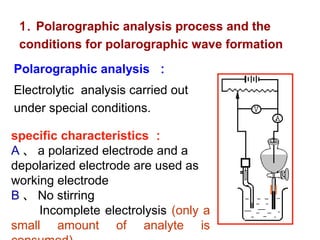
Polarographic analysis :
Electrolytic analysis carried out
under special conditions.
1. Polarographic analysis process and the
conditions for polarographic wave formation
specific characteristics :
A 、 a polarized electrode and a
depolarized electrode are used as
working electrode
B 、 No stirring
Incomplete electrolysis (only a
small amount of analyte is
If the electrode potential has great changes
when infinite small current flow through the
electrode, such electrode is referred to as
polarized electrode. eg. DME ;
If the electrode potential does not change with
current , such electrode is called ideal
depolarized electrode. eg. SCE
Polarized electrode and depolarized electrode
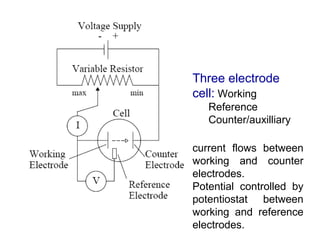
Three electrode
cell: Working
Reference
Counter/auxilliary
current flows between
working and counter
electrodes.
Potential controlled by
potentiostat between
working and reference
electrodes.
Two special electrodes
Supporting electrolyte : Usually relatively higher
concentration of strong electrolytes (alkali metal salts)
serves as supporting electrolyte
Dissolved oxygen is usually removed by bubbling
nitrogen through the solution
Voltage scanning Under unstirred state, recording
voltage - current curve
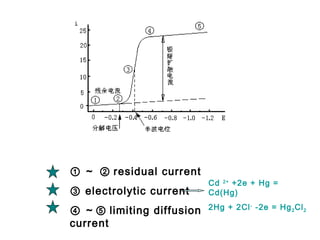
① ~ ② residual current
③ electrolytic current
④ ~⑤ limiting diffusion
current
Cd 2+
+2e + Hg =
Cd(Hg)
2Hg + 2Cl-
-2e = Hg2Cl2
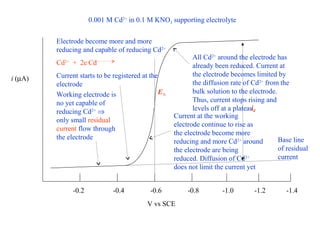
-0.2 -0.4 -0.6 -0.8 -1.0 -1.2 -1.4
i (µA)
0.001 M Cd2+
in 0.1 M KNO3 supporting electrolyte
V vs SCE
Working electrode is
no yet capable of
reducing Cd2+
⇒
only small residual
current flow through
the electrode
Electrode become more and more
reducing and capable of reducing Cd2+
Cd2+
+ 2e-
Cd
Current starts to be registered at the
electrode
Current at the working
electrode continue to rise as
the electrode become more
reducing and more Cd2+
around
the electrode are being
reduced. Diffusion of Cd2+
does not limit the current yet
All Cd2+
around the electrode has
already been reduced. Current at
the electrode becomes limited by
the diffusion rate of Cd2+
from the
bulk solution to the electrode.
Thus, current stops rising and
levels off at a plateauid
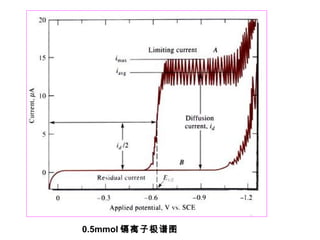
E½
Base line
of residual
current
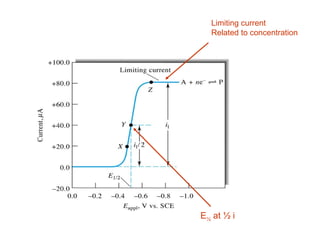
E½ at ½ i
Limiting current
Related to concentration
0.5mmol 镉离子极谱图
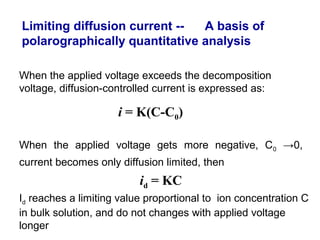
Limiting diffusion current -- A basis of
polarographically quantitative analysis
When the applied voltage exceeds the decomposition
voltage, diffusion-controlled current is expressed as:
i = K(C-C0)
When the applied voltage gets more negative, C0 →0,
current becomes only diffusion limited, then
id = KC
Id reaches a limiting value proportional to ion concentration C
in bulk solution, and do not changes with applied voltage
longer
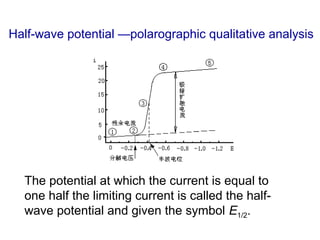
The potential at which the current is equal to
one half the limiting current is called the half-
wave potential and given the symbol E1/2.
Half-wave potential —polarographic qualitative analysis
How it works?
▲ The applied voltage is gradually increased,
typically by going to a more positive( more negative
decomposing potential)
▲ A small residual current is observed.
▲ When the voltage becomes great enough,
reduction occurs at the analytical electrode causing a
current.
▲ The electrode is rapidly saturated so current
production is limited – based on diffusion of the
analyte to the small electrode.
How it works ?
The reduced species alters the surface of the
mercury electrode.
To prevent problems, the mercury surface is
renewed by “ knocking off ” a drop –providing a
fresh surface.
This results in an oscillation of the data as it is
collected.
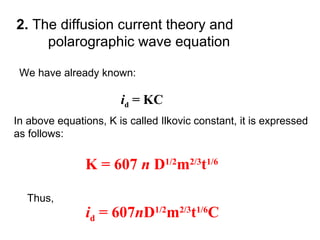
2. The diffusion current theory and
polarographic wave equation
In above equations, K is called Ilkovic constant, it is expressed
as follows:
id = KC
We have already known:
K = 607 n D1/2
m2/3
t1/6
Thus,
id = 607nD1/2
m2/3
t1/6
C
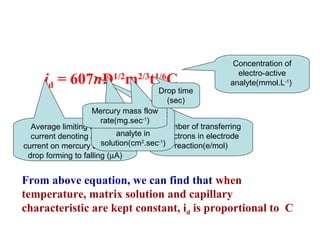
id = 607nD1/2
m2/3
t1/6
C
Average limiting diffusion
current denoting average
current on mercury drop from
drop forming to falling (µA)
Number of transferring
electrons in electrode
reaction(e/mol)
Diffusion coefficient
of electroactive
analyte in
solution(cm2
.sec-1
)
Mercury mass flow
rate(mg.sec-1
)
Drop time
(sec)
Concentration of
electro-active
analyte(mmol.L-1
)
From above equation, we can find that when
temperature, matrix solution and capillary
characteristic are kept constant, id is proportional to C
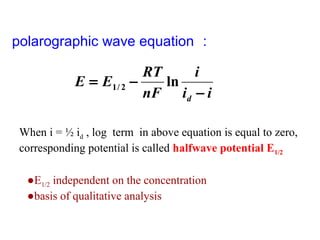
polarographic wave equation :
ii
i
nF
RT
EE
d −
−= ln2/1
When i = ½ id , log term in above equation is equal to zero,
corresponding potential is called halfwave potential E1/2
●E1/2 independent on the concentration
●basis of qualitative analysis
● Residual current
(1) redox reactions of impurities in solution
(2) charging of Hg drop
(non-faradaic current / non-redox current)
● Migration current
The current produced by static attraction of the
electrode to sought-for ions
3. Interference current
in classical DC polarography
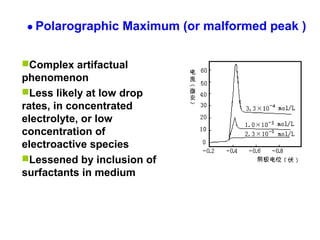
Complex artifactual
phenomenon
Less likely at low drop
rates, in concentrated
electrolyte, or low
concentration of
electroactive species
Lessened by inclusion of
surfactants in medium
● Polarographic Maximum (or malformed peak )
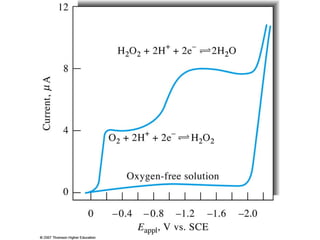
● Oxygen wave
Dissolved oxygen is easily reduced at many working
electrodes. Thus an aqueous solution saturated with air
exhibits two distinct oxygen waves.
The first results from the reduction of oxygen to
hydrogen peroxide:
O2 + 2H+
+ 2e-
 H2O2
The second wave corresponds to the further reduction of
hydrogen peroxide:
H2O2 + 2H+
+ 2e-
 2H2O
Sparge solutions with high purity N2 or Ar for 5-20 min
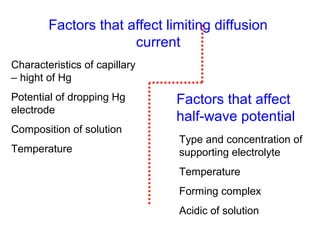
Factors that affect limiting diffusion
current
Characteristics of capillary
– hight of Hg
Potential of dropping Hg
electrode
Composition of solution
Temperature
Factors that affect
half-wave potential
Type and concentration of
supporting electrolyte
Temperature
Forming complex
Acidic of solution
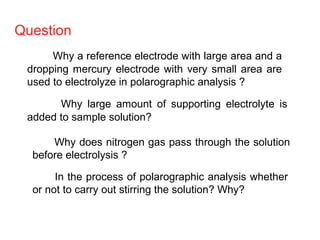
Question
Why a reference electrode with large area and a
dropping mercury electrode with very small area are
used to electrolyze in polarographic analysis ?
Why large amount of supporting electrolyte is
added to sample solution?
Why does nitrogen gas pass through the solution
before electrolysis ?
In the process of polarographic analysis whether
or not to carry out stirring the solution? Why?
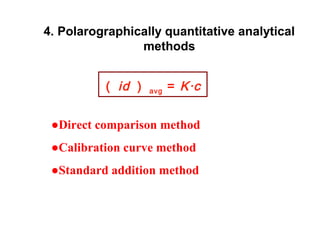
( id ) avg = K·c
●Direct comparison method
●Calibration curve method
●Standard addition method
4. Polarographically quantitative analytical
methods
Fundamental studies
Inorganic applications
Organic applications
Applications in pharmaceutical and biochem fields
5. Applications

Voltammetry

  • 1.
  • 2.
    Basic principle ofvoltammetry Voltammetry: A group of electrochemical methods based on measuring current (i)- applied potential curve during electrolysis - only a small amount of sample (analyte) is used Polarography: Invented by J. Heyrovsky (Nobel Prize 1959). Differs from voltammetry in that it employs a dropping mercury electrode (DME) as Working electrode to continuously renew the electrode surface. Read: pp. 716 –753 Problems: 25-1,2,3,6,13
  • 6.
    Polarographic analysis : Electrolyticanalysis carried out under special conditions. 1. Polarographic analysis process and the conditions for polarographic wave formation specific characteristics : A 、 a polarized electrode and a depolarized electrode are used as working electrode B 、 No stirring Incomplete electrolysis (only a small amount of analyte is
  • 7.
    If the electrodepotential has great changes when infinite small current flow through the electrode, such electrode is referred to as polarized electrode. eg. DME ; If the electrode potential does not change with current , such electrode is called ideal depolarized electrode. eg. SCE Polarized electrode and depolarized electrode
  • 9.
    Three electrode cell: Working Reference Counter/auxilliary currentflows between working and counter electrodes. Potential controlled by potentiostat between working and reference electrodes.
  • 10.
    Two special electrodes Supportingelectrolyte : Usually relatively higher concentration of strong electrolytes (alkali metal salts) serves as supporting electrolyte Dissolved oxygen is usually removed by bubbling nitrogen through the solution Voltage scanning Under unstirred state, recording voltage - current curve
  • 11.
    ① ~ ②residual current ③ electrolytic current ④ ~⑤ limiting diffusion current Cd 2+ +2e + Hg = Cd(Hg) 2Hg + 2Cl- -2e = Hg2Cl2
  • 12.
    -0.2 -0.4 -0.6-0.8 -1.0 -1.2 -1.4 i (µA) 0.001 M Cd2+ in 0.1 M KNO3 supporting electrolyte V vs SCE Working electrode is no yet capable of reducing Cd2+ ⇒ only small residual current flow through the electrode Electrode become more and more reducing and capable of reducing Cd2+ Cd2+ + 2e- Cd Current starts to be registered at the electrode Current at the working electrode continue to rise as the electrode become more reducing and more Cd2+ around the electrode are being reduced. Diffusion of Cd2+ does not limit the current yet All Cd2+ around the electrode has already been reduced. Current at the electrode becomes limited by the diffusion rate of Cd2+ from the bulk solution to the electrode. Thus, current stops rising and levels off at a plateauid E½ Base line of residual current
  • 13.
    E½ at ½i Limiting current Related to concentration
  • 14.
  • 15.
    Limiting diffusion current-- A basis of polarographically quantitative analysis When the applied voltage exceeds the decomposition voltage, diffusion-controlled current is expressed as: i = K(C-C0) When the applied voltage gets more negative, C0 →0, current becomes only diffusion limited, then id = KC Id reaches a limiting value proportional to ion concentration C in bulk solution, and do not changes with applied voltage longer
  • 16.
    The potential atwhich the current is equal to one half the limiting current is called the half- wave potential and given the symbol E1/2. Half-wave potential —polarographic qualitative analysis
  • 17.
    How it works? ▲The applied voltage is gradually increased, typically by going to a more positive( more negative decomposing potential) ▲ A small residual current is observed. ▲ When the voltage becomes great enough, reduction occurs at the analytical electrode causing a current. ▲ The electrode is rapidly saturated so current production is limited – based on diffusion of the analyte to the small electrode.
  • 18.
    How it works? The reduced species alters the surface of the mercury electrode. To prevent problems, the mercury surface is renewed by “ knocking off ” a drop –providing a fresh surface. This results in an oscillation of the data as it is collected.
  • 19.
    2. The diffusioncurrent theory and polarographic wave equation In above equations, K is called Ilkovic constant, it is expressed as follows: id = KC We have already known: K = 607 n D1/2 m2/3 t1/6 Thus, id = 607nD1/2 m2/3 t1/6 C
  • 20.
    id = 607nD1/2 m2/3 t1/6 C Averagelimiting diffusion current denoting average current on mercury drop from drop forming to falling (µA) Number of transferring electrons in electrode reaction(e/mol) Diffusion coefficient of electroactive analyte in solution(cm2 .sec-1 ) Mercury mass flow rate(mg.sec-1 ) Drop time (sec) Concentration of electro-active analyte(mmol.L-1 ) From above equation, we can find that when temperature, matrix solution and capillary characteristic are kept constant, id is proportional to C
  • 21.
    polarographic wave equation: ii i nF RT EE d − −= ln2/1 When i = ½ id , log term in above equation is equal to zero, corresponding potential is called halfwave potential E1/2 ●E1/2 independent on the concentration ●basis of qualitative analysis
  • 22.
    ● Residual current (1)redox reactions of impurities in solution (2) charging of Hg drop (non-faradaic current / non-redox current) ● Migration current The current produced by static attraction of the electrode to sought-for ions 3. Interference current in classical DC polarography
  • 23.
    Complex artifactual phenomenon Less likelyat low drop rates, in concentrated electrolyte, or low concentration of electroactive species Lessened by inclusion of surfactants in medium ● Polarographic Maximum (or malformed peak )
  • 24.
    ● Oxygen wave Dissolvedoxygen is easily reduced at many working electrodes. Thus an aqueous solution saturated with air exhibits two distinct oxygen waves. The first results from the reduction of oxygen to hydrogen peroxide: O2 + 2H+ + 2e-  H2O2 The second wave corresponds to the further reduction of hydrogen peroxide: H2O2 + 2H+ + 2e-  2H2O Sparge solutions with high purity N2 or Ar for 5-20 min
  • 26.
    Factors that affectlimiting diffusion current Characteristics of capillary – hight of Hg Potential of dropping Hg electrode Composition of solution Temperature Factors that affect half-wave potential Type and concentration of supporting electrolyte Temperature Forming complex Acidic of solution
  • 27.
    Question Why a referenceelectrode with large area and a dropping mercury electrode with very small area are used to electrolyze in polarographic analysis ? Why large amount of supporting electrolyte is added to sample solution? Why does nitrogen gas pass through the solution before electrolysis ? In the process of polarographic analysis whether or not to carry out stirring the solution? Why?
  • 28.
    ( id )avg = K·c ●Direct comparison method ●Calibration curve method ●Standard addition method 4. Polarographically quantitative analytical methods
  • 29.
    Fundamental studies Inorganic applications Organicapplications Applications in pharmaceutical and biochem fields 5. Applications