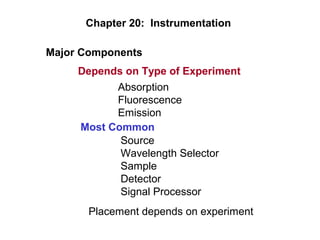
Chapter 20: Instrumentation
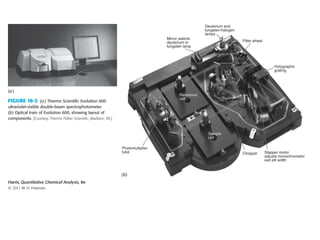
Major Components
Depends on Type of Experiment
Absorption
Fluorescence
Emission
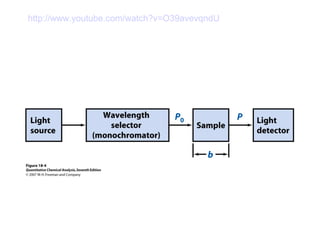
Source
Wavelength Selector
Sample
Detector
Signal Processor
Most Common
Placement depends on experiment
http://www.youtube.com/watch?v=O39avevqndU
Instrument Components
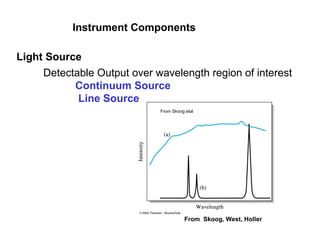
Light Source
Detectable Output over wavelength region of interest
Continuum Source
Line Source
From Skoog etal
From Skoog, West, Holler
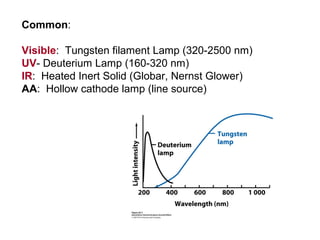
Common:
Visible: Tungsten filament Lamp (320-2500 nm)
UV- Deuterium Lamp (160-320 nm)
IR: Heated Inert Solid (Globar, Nernst Glower)
AA: Hollow cathode lamp (line source)
Instrument Components
2. Wavelength Selector
Restrict radiation to a narrow band
Two Types
Filter – removes “wide” bands
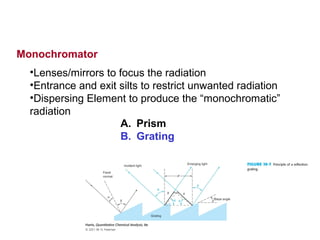
Monochromator
Monochromator
A. Prism
B. Grating
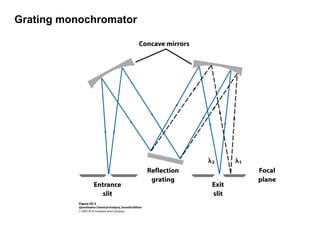
•Lenses/mirrors to focus the radiation
•Entrance and exit silts to restrict unwanted radiation
•Dispersing Element to produce the “monochromatic”
radiation
Grating monochromator
Instrument Components
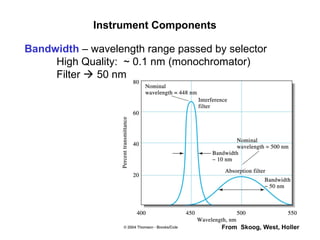
Bandwidth – wavelength range passed by selector
High Quality: ~ 0.1 nm (monochromator)
Filter  50 nm
From Skoog, West, Holler
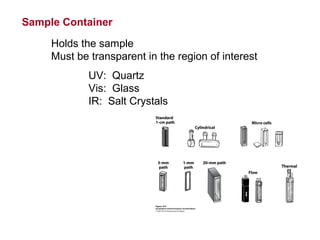
Sample Container
Holds the sample
Must be transparent in the region of interest
UV: Quartz
Vis: Glass
IR: Salt Crystals
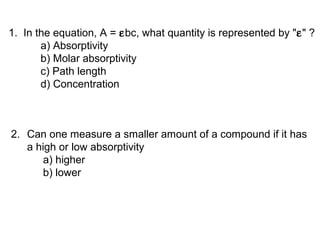
1. In the equation, A = εbc, what quantity is represented by "ε" ?
a) Absorptivity
b) Molar absorptivity
c) Path length
d) Concentration
2. Can one measure a smaller amount of a compound if it has
a high or low absorptivity
a) higher
b) lower
Instrument Components
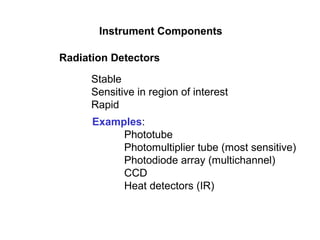
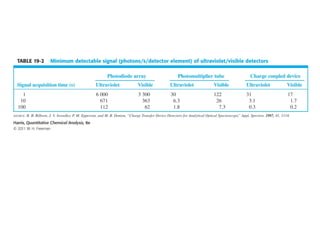
Radiation Detectors
Stable
Sensitive in region of interest
Rapid
Examples:
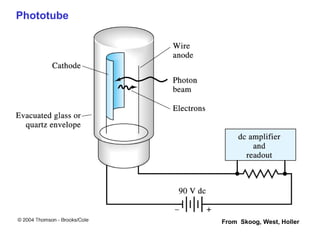
Phototube
Photomultiplier tube (most sensitive)
Photodiode array (multichannel)
CCD
Heat detectors (IR)
Phototube
From Skoog, West, Holler
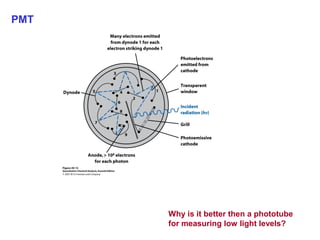
PMT
Why is it better then a phototube
for measuring low light levels?
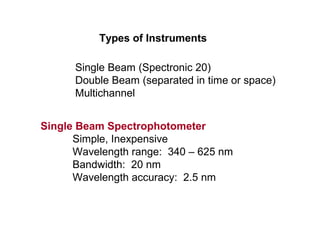
Types of Instruments
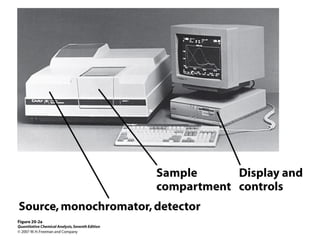
Single Beam (Spectronic 20)
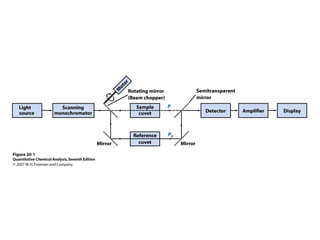
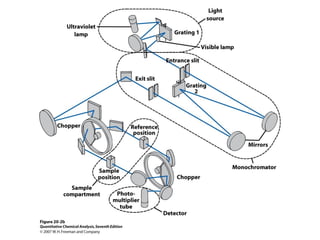
Double Beam (separated in time or space)
Multichannel
Single Beam Spectrophotometer
Simple, Inexpensive
Wavelength range: 340 – 625 nm
Bandwidth: 20 nm
Wavelength accuracy: 2.5 nm
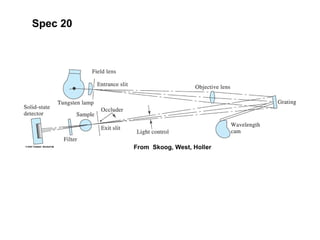
Spec 20
From Skoog, West, Holler
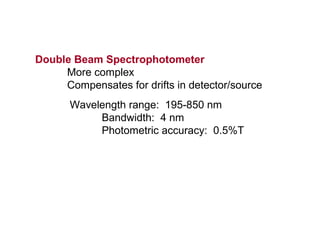
Double Beam Spectrophotometer
More complex
Compensates for drifts in detector/source
Wavelength range: 195-850 nm
Bandwidth: 4 nm
Photometric accuracy: 0.5%T
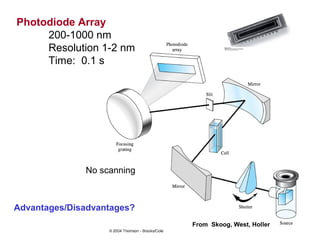
Photodiode Array
200-1000 nm
Resolution 1-2 nm
Time: 0.1 s
No scanning
From Skoog, West, Holler
Advantages/Disadvantages?
An 8.64 ppm solution of [FeSCN]Cl (149 g/mol) has a T of 0.295
at 580 nm when measured in a 1.00-cm cell. Calculate
the molar absorptivity coefficient for the complex
at this wavelength.
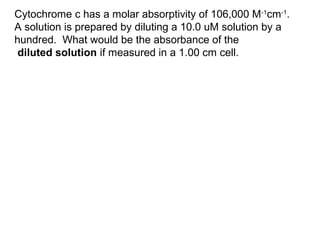
Cytochrome c has a molar absorptivity of 106,000 M-1
cm-1
.
A solution is prepared by diluting a 10.0 uM solution by a
hundred. What would be the absorbance of the
diluted solution if measured in a 1.00 cm cell.

Chapter 19 instrument components