Potentiometry,
Voltamemtry and
Conductometry
Basic Concept
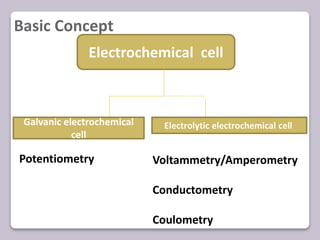
Electrochemical cell
Galvanic electrochemical
cell
Electrolytic electrochemical cell
Voltammetry/Amperometry
Conductometry
Coulometry
Potentiometry
Galvanic Cells (Voltaic Cells )
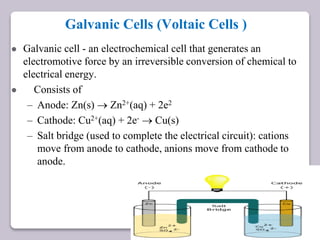
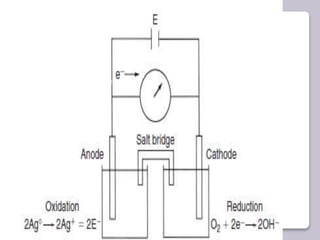
 Galvanic cell - an electrochemical cell that generates an
electromotive force by an irreversible conversion of chemical to
electrical energy.
 Consists of
– Anode: Zn(s)  Zn2+(aq) + 2e2
– Cathode: Cu2+(aq) + 2e-  Cu(s)
– Salt bridge (used to complete the electrical circuit): cations
move from anode to cathode, anions move from cathode to
anode.
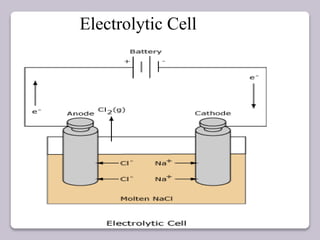
Electrolytic Cell
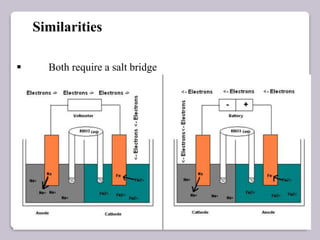
 Both require a salt bridge
 Both have a cathode and anode side
 Both have a consistent flow of electrons from the anode to
the cathode
Similarities
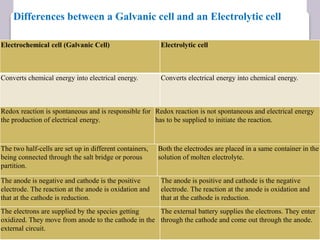
Differences between a Galvanic cell and an Electrolytic cell
Electrochemical cell (Galvanic Cell) Electrolytic cell
Converts chemical energy into electrical energy. Converts electrical energy into chemical energy.
Redox reaction is spontaneous and is responsible for
the production of electrical energy.
Redox reaction is not spontaneous and electrical energy
has to be supplied to initiate the reaction.
The two half-cells are set up in different containers,
being connected through the salt bridge or porous
partition.
Both the electrodes are placed in a same container in the
solution of molten electrolyte.
The anode is negative and cathode is the positive
electrode. The reaction at the anode is oxidation and
that at the cathode is reduction.
The anode is positive and cathode is the negative
electrode. The reaction at the anode is oxidation and
that at the cathode is reduction.
The electrons are supplied by the species getting
oxidized. They move from anode to the cathode in the
external circuit.
The external battery supplies the electrons. They enter
through the cathode and come out through the anode.
Analytical Methods of Electrochemistry used in
Clinical Laboratory
1. Potentiometry
2. Voltammetry and Amperometry
3. Conductometry
4. Coulometry
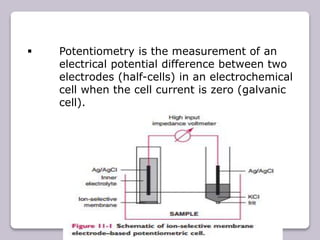
 Potentiometry is the measurement of an
electrical potential difference between two
electrodes (half-cells) in an electrochemical
cell when the cell current is zero (galvanic
cell).
Potentiometry
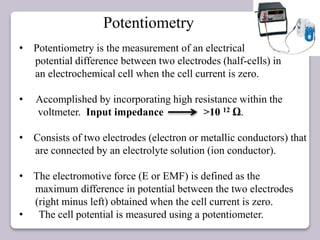
• Potentiometry is the measurement of an electrical
potential difference between two electrodes (half-cells) in
an electrochemical cell when the cell current is zero.
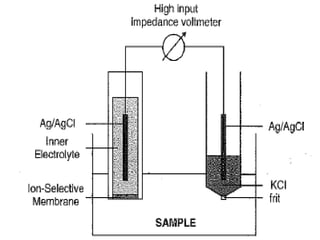
• Accomplished by incorporating high resistance within the
voltmeter. Input impedance >10 12 Ω.
• Consists of two electrodes (electron or metallic conductors) that
are connected by an electrolyte solution (ion conductor).
• The electromotive force (E or EMF) is defined as the
maximum difference in potential between the two electrodes
(right minus left) obtained when the cell current is zero.
• The cell potential is measured using a potentiometer.
Types of Electrodes
• Redox
• Ion-selective membrane (Glass and Polymer)
• PCO2 electrodes.
Redox Electrodes
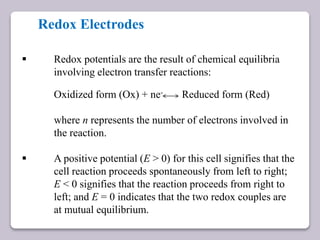
 Redox potentials are the result of chemical equilibria
involving electron transfer reactions:
Oxidized form (Ox) + ne- Reduced form (Red)
where n represents the number of electrons involved in
the reaction.
 A positive potential (E > 0) for this cell signifies that the
cell reaction proceeds spontaneously from left to right;
E < 0 signifies that the reaction proceeds from right to
left; and E = 0 indicates that the two redox couples are
at mutual equilibrium.
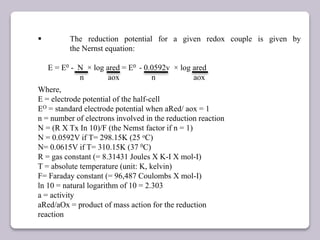
 The reduction potential for a given redox couple is given by
the Nernst equation:
E = E0 - N × log ared = E0 - 0.0592v × log ared
n aox n aox
Where,
E = electrode potential of the half-cell
EO = standard electrode potential when aRed/ aox = 1
n = number of electrons involved in the reduction reaction
N = (R X Tx In 10)/F (the Nemst factor if n = 1)
N = 0.0592V if T= 298.15K (25 oC)
N= 0.0615V if T= 310.15K (37 0C)
R = gas constant (= 8.31431 Joules X K-I X mol-I)
T = absolute temperature (unit: K, kelvin)
F= Faraday constant (= 96,487 Coulombs X mol-I)
ln 10 = natural logarithm of 10 = 2.303
a = activity
aRed/aOx = product of mass action for the reduction
reaction
Redox electrodes currently in use include
(1) Inert metal electrodes immersed in solutions
containing redox couples. E.g:- Platinum and Gold.
(2) Metal electrodes whose metal functions as a member
of the redox couple. E.g:- Silver-Silver Chloride.
Ion Selective Electrodes
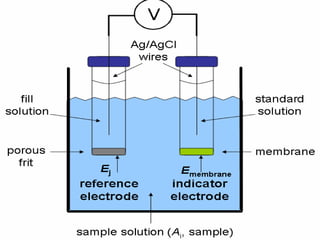
• Based on the principle of potentiometry.
• An ion selective electrode (ISE) measures the activity of
an ion in a solution by measuring the electric potential
formed across a membrane when the electrode is
submerged in the solution.
• The potential produced at the membrane-sample solution
interface is proportional to the logarithm of the ionic activity or
concentration of the ion in question.
3/23/2014
• The ion-selective membrane is the "heart" of an ISE
as it controls the selectivity of the electrode.
• Composed of glass, crystalline, or polymeric materials.
• In practice, other ions exhibit finite interaction with
membrane sites and will display some degree of
interference for, determination of an analyte ion.
The Nicolsky-Eisenman equation describes the selectivity
of an ISE for the ion of interest over interfering ions:
E= E0 + [ 2.303RT ] log ( ai + Ʃ ki/j aj zi/zj )
zi F
where
ai = activity of the ion of interest
aj = activity of the interfering ion
Ki/j = selectivity coefficient for the primary ion over the
interfering ion. Low values indicate good selectivity for
the analyte "i" over the interfering ion "t.
Zi = charge of primary ion
Zj = charge of interfering ion
• The selectivity coefficient is a measure of the strength
of response for an interfering ion compared to the
response for the selected ion.
• Glass membrane and Polymer membrane electrodes are
two types of ISEs commonly used in clinical chemistry
applications.
Why Use Ion Selective Electrodes ????
 The main reasons Ion selective electrodes are popular :-
---- The initial set up is inexpensive.
---- The measurements are unaffected by colour or turbidity
in the sample.
---- The sample pre-treatment is usually simple.
---- The measurements can be done in “real time”, and can
be easily automated.
---- Wide dynamic range-usually several decades.
pH Meter
 pH is a Unit of Measurement
pH = Power of Hydrogen (H+)
Defined as the Negative Logarithm of hydrogen
ion activity
pH = log (1/H+)
 Used for determining the acidity or alkalinity of an
aqueous solution.
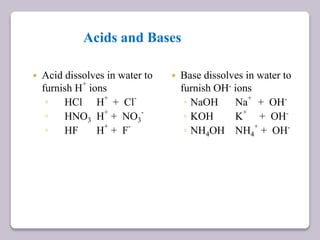
Acids and Bases
 Acid dissolves in water to
furnish H
+
ions
◦ HCl H
+
+ Cl
-
◦ HNO3 H
+
+ NO3
-
◦ HF H+
+ F-
 Base dissolves in water to
furnish OH- ions
◦ NaOH Na
+
+ OH-
◦ KOH K
+
+ OH-
◦ NH4OH NH4
+
+ OH-
pH is a Potentiometric Measurement
 The measuring system
consists of a pH measuring
electrode and reference
electrode.
 The potential difference
between the two electrodes
is a function of the pH
value of the measured
solution.
 The solution must be
conductive and is part of
the electrical circuit
pH Measuring Electrode Reference Electrode
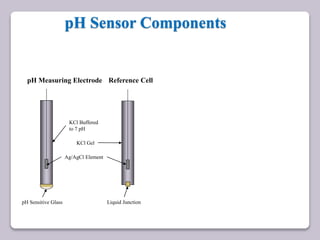
pH Sensor Components
Ag/AgCl Element
pH Measuring Electrode Reference Cell
pH Sensitive Glass Liquid Junction
KCl Gel
KCl Buffered
to 7 pH
pH Measuring Electrode
◦ Purpose is to develop a millivolt potential directly proportional to the
free hydrogen ion concentration in an aqueous solution.
Reference Cell
◦ Purpose is to maintain a constant reference potential regardless of pH
change or other ionic activity in the solution.
Reference Cell Liquid Junction
◦ Purpose is to maintain electrical contact between the reference
electrode and the measuring electrode by way of the solution
Process
Internal Fill Solution
How the pH Sensitive Glass Works?
H+H+H+H+ H+ H+
pH Glass
External Gel Layer
Internal Gel Layer
H+
H+ H+ H+ H+ H+
Li Li
Li
Li Li
Li
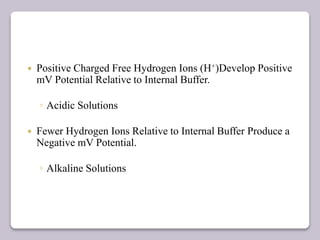
 Positive Charged Free Hydrogen Ions (H+)Develop Positive
mV Potential Relative to Internal Buffer.
◦ Acidic Solutions
 Fewer Hydrogen Ions Relative to Internal Buffer Produce a
Negative mV Potential.
◦ Alkaline Solutions
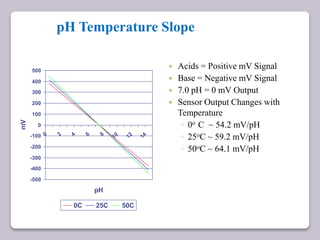
pH Temperature Slope
-500
-400
-300
-200
-100
0
100
200
300
400
500
0 2 4 6 8 10 12 14
pH
mV
0C 25C 50C
 Acids = Positive mV Signal
 Base = Negative mV Signal
 7.0 pH = 0 mV Output
 Sensor Output Changes with
Temperature
◦ 0o C ~ 54.2 mV/pH
◦ 25oC ~ 59.2 mV/pH
◦ 50oC ~ 64.1 mV/pH
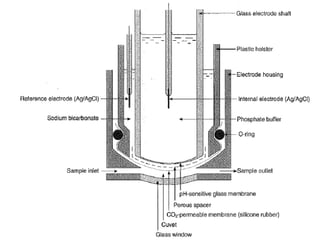
Electrodes for PCO2
• Stow and Severinghaus in 1950s.
• Glass pH electrode used as the internal element in a
potentiometric cell for measurement of the partial pressure
of CO2.
• Uses – pH, PCO2, PO2 measurement.
Limitations of Severinghaus Style PCO2 sensors
 Construction of such sensor is limited by size, shape, and
ability to fabricate the internal pH sensitive element.
 Hence, a slightly different potentiometric cell for PCO2
was introduced ( Two PVC type- pH sensitive electrodes
in a differential mode).
Voltammetry/Amperometry
 Most sensitive and widely applicable of all electroanalytical
methods.
 Based on electrolytic electrochemical cells, in which an external
voltage is applied to a polarizable working electrode (measured
versus a suitable reference electrode: Eappl = Ework - Eref.
 Current flows only if E is greater than a certain voltage
(decomposition Voltage) determined by the thermodynamics for
a given redox reaction of interest [ Ox+ ne- ↔ Red) .
 The charge transfer at the interface (Oxidation/Reduction
reaction at the surface of the working electrode (current flow)
that provides the analytical information.
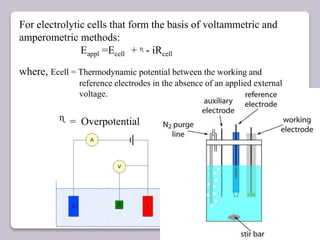
For electrolytic cells that form the basis of voltammetric and
amperometric methods:
Eappl =Ecell + ᶯ - iRcell
where, Ecell = Thermodynamic potential between the working and
reference electrodes in the absence of an applied external
voltage.
ᶯ = Overpotential
3/23/2014
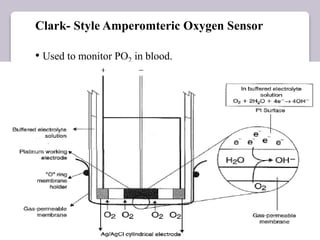
Clark- Style Amperomteric Oxygen Sensor
• Used to monitor PO2 in blood.
Conductometry
• Electrochemical technique used to determine the quality of
an analyte present in a mixture by measurement of its effects
on the electrical conductivity of the mixture.
• Measure of the ability of ions in solution to carry current
under the influence of a potential difference.
• Uses
Measurement of the volume fraction of
erythrocytes in whole blood.
Electronic counting of blood cells in
suspension.(Coulter Principle)
 Coulometry is the general name for methods that
measure the amount of electricity required to react
exactly with an analyte.
 It is generally is a redox reaction. The amount of charge
passing between the electrodes is directly
proportional to oxidation or reduction of an electroactive
substance at one of the electrodes.
Coulometry
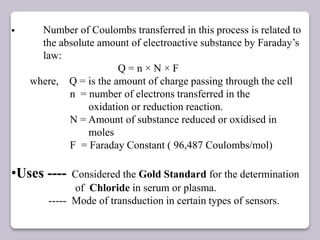
 Number of Coulombs transferred in this process is related to
the absolute amount of electroactive substance by Faraday’s
law:
Q = n × N × F
where, Q = is the amount of charge passing through the cell
n = number of electrons transferred in the
oxidation or reduction reaction.
N = Amount of substance reduced or oxidised in
moles
F = Faraday Constant ( 96,487 Coulombs/mol)
•Uses ---- Considered the Gold Standard for the determination
of Chloride in serum or plasma.
----- Mode of transduction in certain types of sensors.
NOVA-8 Analyzer
• Available test
 Sodium
 Potassium
 Ionised Calcium
 Ionised Magnesium
 pH
 Hematocrit
 Normalised Magnesium
 Normalised Calcium
3/23/2014
Potentiometry, voltamemtry and conductometry

Potentiometry, voltamemtry and conductometry

  • 1.
  • 2.
    Basic Concept Electrochemical cell Galvanicelectrochemical cell Electrolytic electrochemical cell Voltammetry/Amperometry Conductometry Coulometry Potentiometry
  • 3.
    Galvanic Cells (VoltaicCells )  Galvanic cell - an electrochemical cell that generates an electromotive force by an irreversible conversion of chemical to electrical energy.  Consists of – Anode: Zn(s)  Zn2+(aq) + 2e2 – Cathode: Cu2+(aq) + 2e-  Cu(s) – Salt bridge (used to complete the electrical circuit): cations move from anode to cathode, anions move from cathode to anode.
  • 5.
  • 6.
     Both requirea salt bridge  Both have a cathode and anode side  Both have a consistent flow of electrons from the anode to the cathode Similarities
  • 7.
    Differences between aGalvanic cell and an Electrolytic cell Electrochemical cell (Galvanic Cell) Electrolytic cell Converts chemical energy into electrical energy. Converts electrical energy into chemical energy. Redox reaction is spontaneous and is responsible for the production of electrical energy. Redox reaction is not spontaneous and electrical energy has to be supplied to initiate the reaction. The two half-cells are set up in different containers, being connected through the salt bridge or porous partition. Both the electrodes are placed in a same container in the solution of molten electrolyte. The anode is negative and cathode is the positive electrode. The reaction at the anode is oxidation and that at the cathode is reduction. The anode is positive and cathode is the negative electrode. The reaction at the anode is oxidation and that at the cathode is reduction. The electrons are supplied by the species getting oxidized. They move from anode to the cathode in the external circuit. The external battery supplies the electrons. They enter through the cathode and come out through the anode.
  • 8.
    Analytical Methods ofElectrochemistry used in Clinical Laboratory 1. Potentiometry 2. Voltammetry and Amperometry 3. Conductometry 4. Coulometry
  • 9.
     Potentiometry isthe measurement of an electrical potential difference between two electrodes (half-cells) in an electrochemical cell when the cell current is zero (galvanic cell).
  • 10.
    Potentiometry • Potentiometry isthe measurement of an electrical potential difference between two electrodes (half-cells) in an electrochemical cell when the cell current is zero. • Accomplished by incorporating high resistance within the voltmeter. Input impedance >10 12 Ω. • Consists of two electrodes (electron or metallic conductors) that are connected by an electrolyte solution (ion conductor). • The electromotive force (E or EMF) is defined as the maximum difference in potential between the two electrodes (right minus left) obtained when the cell current is zero. • The cell potential is measured using a potentiometer.
  • 11.
    Types of Electrodes •Redox • Ion-selective membrane (Glass and Polymer) • PCO2 electrodes.
  • 12.
    Redox Electrodes  Redoxpotentials are the result of chemical equilibria involving electron transfer reactions: Oxidized form (Ox) + ne- Reduced form (Red) where n represents the number of electrons involved in the reaction.  A positive potential (E > 0) for this cell signifies that the cell reaction proceeds spontaneously from left to right; E < 0 signifies that the reaction proceeds from right to left; and E = 0 indicates that the two redox couples are at mutual equilibrium.
  • 13.
     The reductionpotential for a given redox couple is given by the Nernst equation: E = E0 - N × log ared = E0 - 0.0592v × log ared n aox n aox Where, E = electrode potential of the half-cell EO = standard electrode potential when aRed/ aox = 1 n = number of electrons involved in the reduction reaction N = (R X Tx In 10)/F (the Nemst factor if n = 1) N = 0.0592V if T= 298.15K (25 oC) N= 0.0615V if T= 310.15K (37 0C) R = gas constant (= 8.31431 Joules X K-I X mol-I) T = absolute temperature (unit: K, kelvin) F= Faraday constant (= 96,487 Coulombs X mol-I) ln 10 = natural logarithm of 10 = 2.303 a = activity aRed/aOx = product of mass action for the reduction reaction
  • 14.
    Redox electrodes currentlyin use include (1) Inert metal electrodes immersed in solutions containing redox couples. E.g:- Platinum and Gold. (2) Metal electrodes whose metal functions as a member of the redox couple. E.g:- Silver-Silver Chloride.
  • 15.
    Ion Selective Electrodes •Based on the principle of potentiometry. • An ion selective electrode (ISE) measures the activity of an ion in a solution by measuring the electric potential formed across a membrane when the electrode is submerged in the solution. • The potential produced at the membrane-sample solution interface is proportional to the logarithm of the ionic activity or concentration of the ion in question.
  • 16.
  • 17.
    • The ion-selectivemembrane is the "heart" of an ISE as it controls the selectivity of the electrode. • Composed of glass, crystalline, or polymeric materials. • In practice, other ions exhibit finite interaction with membrane sites and will display some degree of interference for, determination of an analyte ion.
  • 19.
    The Nicolsky-Eisenman equationdescribes the selectivity of an ISE for the ion of interest over interfering ions: E= E0 + [ 2.303RT ] log ( ai + Ʃ ki/j aj zi/zj ) zi F where ai = activity of the ion of interest aj = activity of the interfering ion Ki/j = selectivity coefficient for the primary ion over the interfering ion. Low values indicate good selectivity for the analyte "i" over the interfering ion "t. Zi = charge of primary ion Zj = charge of interfering ion
  • 20.
    • The selectivitycoefficient is a measure of the strength of response for an interfering ion compared to the response for the selected ion. • Glass membrane and Polymer membrane electrodes are two types of ISEs commonly used in clinical chemistry applications.
  • 21.
    Why Use IonSelective Electrodes ????  The main reasons Ion selective electrodes are popular :- ---- The initial set up is inexpensive. ---- The measurements are unaffected by colour or turbidity in the sample. ---- The sample pre-treatment is usually simple. ---- The measurements can be done in “real time”, and can be easily automated. ---- Wide dynamic range-usually several decades.
  • 22.
    pH Meter  pHis a Unit of Measurement pH = Power of Hydrogen (H+) Defined as the Negative Logarithm of hydrogen ion activity pH = log (1/H+)  Used for determining the acidity or alkalinity of an aqueous solution.
  • 23.
    Acids and Bases Acid dissolves in water to furnish H + ions ◦ HCl H + + Cl - ◦ HNO3 H + + NO3 - ◦ HF H+ + F-  Base dissolves in water to furnish OH- ions ◦ NaOH Na + + OH- ◦ KOH K + + OH- ◦ NH4OH NH4 + + OH-
  • 24.
    pH is aPotentiometric Measurement  The measuring system consists of a pH measuring electrode and reference electrode.  The potential difference between the two electrodes is a function of the pH value of the measured solution.  The solution must be conductive and is part of the electrical circuit pH Measuring Electrode Reference Electrode
  • 25.
    pH Sensor Components Ag/AgClElement pH Measuring Electrode Reference Cell pH Sensitive Glass Liquid Junction KCl Gel KCl Buffered to 7 pH
  • 26.
    pH Measuring Electrode ◦Purpose is to develop a millivolt potential directly proportional to the free hydrogen ion concentration in an aqueous solution. Reference Cell ◦ Purpose is to maintain a constant reference potential regardless of pH change or other ionic activity in the solution. Reference Cell Liquid Junction ◦ Purpose is to maintain electrical contact between the reference electrode and the measuring electrode by way of the solution
  • 27.
    Process Internal Fill Solution Howthe pH Sensitive Glass Works? H+H+H+H+ H+ H+ pH Glass External Gel Layer Internal Gel Layer H+ H+ H+ H+ H+ H+ Li Li Li Li Li Li
  • 28.
     Positive ChargedFree Hydrogen Ions (H+)Develop Positive mV Potential Relative to Internal Buffer. ◦ Acidic Solutions  Fewer Hydrogen Ions Relative to Internal Buffer Produce a Negative mV Potential. ◦ Alkaline Solutions
  • 29.
    pH Temperature Slope -500 -400 -300 -200 -100 0 100 200 300 400 500 02 4 6 8 10 12 14 pH mV 0C 25C 50C  Acids = Positive mV Signal  Base = Negative mV Signal  7.0 pH = 0 mV Output  Sensor Output Changes with Temperature ◦ 0o C ~ 54.2 mV/pH ◦ 25oC ~ 59.2 mV/pH ◦ 50oC ~ 64.1 mV/pH
  • 30.
    Electrodes for PCO2 •Stow and Severinghaus in 1950s. • Glass pH electrode used as the internal element in a potentiometric cell for measurement of the partial pressure of CO2. • Uses – pH, PCO2, PO2 measurement.
  • 32.
    Limitations of SeveringhausStyle PCO2 sensors  Construction of such sensor is limited by size, shape, and ability to fabricate the internal pH sensitive element.  Hence, a slightly different potentiometric cell for PCO2 was introduced ( Two PVC type- pH sensitive electrodes in a differential mode).
  • 33.
    Voltammetry/Amperometry  Most sensitiveand widely applicable of all electroanalytical methods.  Based on electrolytic electrochemical cells, in which an external voltage is applied to a polarizable working electrode (measured versus a suitable reference electrode: Eappl = Ework - Eref.  Current flows only if E is greater than a certain voltage (decomposition Voltage) determined by the thermodynamics for a given redox reaction of interest [ Ox+ ne- ↔ Red) .  The charge transfer at the interface (Oxidation/Reduction reaction at the surface of the working electrode (current flow) that provides the analytical information.
  • 34.
    For electrolytic cellsthat form the basis of voltammetric and amperometric methods: Eappl =Ecell + ᶯ - iRcell where, Ecell = Thermodynamic potential between the working and reference electrodes in the absence of an applied external voltage. ᶯ = Overpotential 3/23/2014
  • 35.
    Clark- Style AmperomtericOxygen Sensor • Used to monitor PO2 in blood.
  • 36.
    Conductometry • Electrochemical techniqueused to determine the quality of an analyte present in a mixture by measurement of its effects on the electrical conductivity of the mixture. • Measure of the ability of ions in solution to carry current under the influence of a potential difference. • Uses Measurement of the volume fraction of erythrocytes in whole blood. Electronic counting of blood cells in suspension.(Coulter Principle)
  • 37.
     Coulometry isthe general name for methods that measure the amount of electricity required to react exactly with an analyte.  It is generally is a redox reaction. The amount of charge passing between the electrodes is directly proportional to oxidation or reduction of an electroactive substance at one of the electrodes. Coulometry
  • 38.
     Number ofCoulombs transferred in this process is related to the absolute amount of electroactive substance by Faraday’s law: Q = n × N × F where, Q = is the amount of charge passing through the cell n = number of electrons transferred in the oxidation or reduction reaction. N = Amount of substance reduced or oxidised in moles F = Faraday Constant ( 96,487 Coulombs/mol) •Uses ---- Considered the Gold Standard for the determination of Chloride in serum or plasma. ----- Mode of transduction in certain types of sensors.
  • 39.
    NOVA-8 Analyzer • Availabletest  Sodium  Potassium  Ionised Calcium  Ionised Magnesium  pH  Hematocrit  Normalised Magnesium  Normalised Calcium
  • 41.

Editor's Notes

  • #3 Electrochemical Cell- Cell capable of either deriving electrical energy from chemical reactions or facilitating chemical reactions. An electrochemical cell is a device capable of either generating electrical energy from chemical reactions or facilitating chemical reactions through the introduction of electrical energy. through the introduction of electrical energy.
  • #4  The electron flow from the anode to the cathode is what creates electricity. As oxidation occurs, Zn is converted to Zn2+ and 2e-. The electrons flow towards the anode where they are used in the reduction reaction.
  • #5 Electrochemical cell consists of two half-cells and a salt bridge, which can be a piece of filter paper saturated with electrolytes.
  • #6  An example of an electrolytic cell is shown below, in which molten NaCl is electrolyzed to form liquid sodium and chlorine gas. The sodium ions migrate toward the cathode, where they are reduced to sodium metal. Similarly, chloride ions migrate to the anode and are oxided to form chlorine gas. This type of cell is used to produce sodium and chlorine.The chlorine gas can be collected surrounding the cell.The sodium metal is less dense than the molten salt and is removed as it floats to the top of the reaction container.
  • #10 Such a cell consists of two electrodes (electron and metallic conductors) that are connected by an electrolyte solution (ion conductor).
  • #11 Such a cell consists of two electrodes (electron or metallic conductors) that are connected by an electrolyte solution (ion conductor). An electrode, or half-cell, consists of a single metallic conductor that is in contact with an electrolyte solution. The ion conductors can be composed of one or more phases that are either in direct contact with eachother or separated by membranes permeable only to specific cations or anions (see Figure 4-1). One of the electrolyte solutions is the unknown or test solution; this solution may be replaced by an appropriate reference solution for calibration purposes. By convention, the cell notation is shown so that the left electrode (Mr.) is the reference electrode; the right electrode (MR) is the indicator (measuring) electrode.
  • #18  In clinical practice, if the interference exceeds an acceptable level, a correction is required.
  • #22 typically one only needs a pH/mV meter or Ion meter, the electrodes, a stirring stand, and some basic chemicals)
  • #32  CO2 from sample ---- diffusion through membrane----dissolves in the internal electrolyte layer ---- carbonic acid formation ---- which dissociates----shifts the pH of bicarbonate solution in the internal layer as CO2 + H2O ---- H2CO3----H+ + HCO3- .
  • #34 Often, slow kinetics of electron transfer for the redox reaction on a given inert working electrode (Pt, carbon, gold, etc.) mandates use of a much more negative (for reductions) or positive (for oxidations) Eappl than predicted based merely on the EO for a given redox reaction. This is called an overpotential.